Home Blog Page 19

“Super Depressing”: Flare Founder Calls Out Ripple Dev Over XRP, FXRP Concerns

0

Flare Networks co-founder Hugo Philion has responded to concerns about FXRP after Ripple engineer Neil Hartner raised questions about the security of blockchain bridges.

Notably, the discussion followed a security incident involving Liquid Network’s Liquid BTC. The company said hackers withdrew about 4,000 BTC, worth roughly $320 million at the time, from the Liquid Federation wallet.

Hartner responded to the incident by saying, “Bridges are hard.” Meanwhile, Flare promoter Hussein Badakhchani replied that Flare had “fixed” the problems associated with bridges.

However, Hartner responded by saying, “I think of this often,” while referencing a 2024 warning that there are essentially two types of bridges: those that have already been hacked and those that will eventually be hacked.

Giving a subtle jab at Flare, founder Philion joined the conversation.

Philion Defends FXRP Security

Philion said it was “super depressing” to see comments from key Ripple figures that appear to ignore concerns important to XRP holders and the Flare ecosystem.

He said comments from well-known Ripple figures could make the XRP community think that Ripple is against Flare and FXRP. Philion stressed that this is not the case.

He then explained why he believes FXRP was built with security in mind. According to Philion, most of the XRP used in FXRP is protected through XRPL Escrow, the same system Ripple uses to hold its large XRP reserves.

He said XRPL Escrow has safely held large amounts of XRP for years, so the likelihood of a major, undiscovered security flaw is relatively low. Philion added that if XRPL Escrow itself had a serious security problem, it would affect much more than just FXRP.

FXRP Limits Potential Losses

Philion also explained what could happen if FXRP were hacked. He said that if an attack occurred, most of the XRP held in escrow would be moved to a custodian for protection. The remaining XRP, usually less than 20%, is backed by additional collateral in stablecoins and FLR.

The idea is to limit how much money an attacker could steal.

Philion said FXRP was designed to keep the amount of funds at risk as small as possible. This means that even if a security breach occurred, the losses would be much smaller than those seen in some major bridge hacks.

Ripple Engineer Clarifies His Comments

Meanwhile, Hartner later said Philion had misunderstood his earlier comments. He explained that his main concern was the long history of bridge hacks. Because of this, he believes users should be “hyper-vigilant” when using any bridge.

Hartner also said he was not suggesting that Flare is careless about security. Instead, he was warning that saying a bridge has “fixed” its security problems could make users overly confident.

Australia Acts on 45 Crypto and Remittance Registrations Over Past Year

0

Australia’s anti-money laundering watchdog has taken regulatory action against 45 registrations held by remittance and cryptocurrency businesses over the past 12 months, using measures ranging from cancellations and suspensions to refusals to renew registrations.

AUSTRAC attributed the actions to several compliance and operational issues. Some providers had ceased activity or become insolvent, while others were deemed unable to continue operating. Registration errors and failures to disclose important changes also led to action. In the most serious cases, the agency identified substantial exposure to illicit finance and terrorism financing risks.

Cancellation has a direct consequence for an affected provider: it loses the registration required to keep operating. Brendan Thomas, who heads AUSTRAC, said information concerning people linked to certain businesses had also been passed to domestic authorities or relevant agencies abroad.

GetCoins Among Businesses Targeted by AUSTRAC 

GetCoins was among the operators highlighted in AUSTRAC’s enforcement update. Its operator, BA Digital Ventures, lost its authorization as a virtual asset provider in June after customer complaints prompted regulatory action.

AUSTRAC said organized crypto investment scam operations allegedly used the GetCoins service. The agency worked on the matter alongside Australia’s National Anti-Scam Centre, with the intervention contributing to efforts to stop the alleged scam activity.

The announcement provided only a partial picture of the businesses affected. AUSTRAC withheld the identities of some operators covered by the 45 actions and did not give separate totals for remittance businesses and virtual asset firms. A separate public record maintained by the agency shows recent VASP registration decisions concerning GetCoins, Self Custody, Cryptolink, Coinsec Australia and Jam Xchange.

Scrutiny Extends to Western Union and Cryptolink

Those 45 registration decisions are not the only recent steps AUSTRAC has taken across the payments and virtual asset industries. Its wider regulatory activity includes an ongoing probe involving Western Union. In another case, AUSTRAC suspended Cryptolink’s VASP authorization in August, preventing the company’s network of cryptocurrency ATMs from operating.

Dormant Shiba Inu Whale Moves 407,999,431,439 SHIB After Three Years of Silence

0

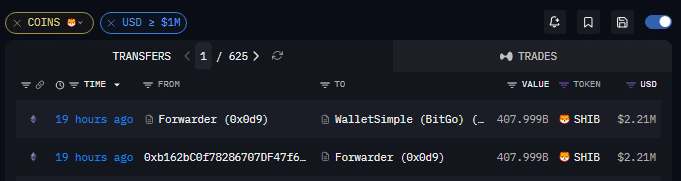
A Shiba Inu whale has ended more than three years of inactivity by transferring 407.99 billion SHIB to BitGo, potentially signaling an intention to sell.

The transaction occurred this week as Shiba Inu faced renewed volatility and struggled to hold above the psychologically important $0.0000055 level.

Whale Moves 407.99 Billion SHIB to BitGo

According to Arkham data, the whale recorded no outflow activity after receiving SHIB on July 16, 2023. At the time, another whale wallet sent 600 billion SHIB to the address.

That sending wallet had previously accumulated 10 trillion SHIB before distributing most of its holdings to multiple addresses in batches of 600 billion tokens.

After receiving its allocation, the dormant wallet remained inactive for more than three years. However, that streak ended on September 6, 2026, when the whale initiated its first-ever outflow.

First, the wallet transferred 836,221 SHIB to purchase ETH for gas fees. It then moved 407,999,431,439 (407.99 billion) SHIB tokens to a Forwarder address. The Forwarder subsequently routed the tokens to BitGo. At the time of the transaction, the transfer was worth $2.21 million. 

Shiba Inu Transfer
Shiba Inu Transfer

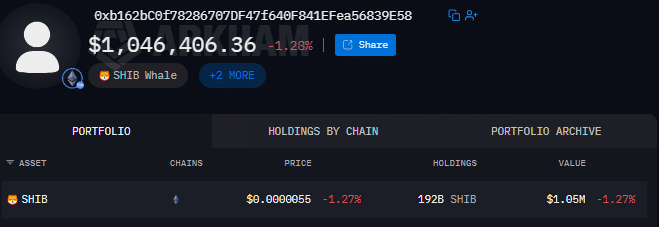
Following the move, the whale still held roughly 192 billion SHIB, currently valued at about $1.05 million. 

Shiba Inu Whale Balance

Similar Transaction

Interestingly, the latest transaction mirrors a similar movement recorded last week.

As previously reported by TheCryptoBasic, another major Shiba Inu whale transferred 600 billion SHIB to BitGo through the same routing mechanism. That whale first sent the tokens to a Forwarder address before the funds ultimately reached BitGo.

Exchange deposits often attract attention because investors can move tokens to trading platforms when preparing to sell. However, the transfer itself does not confirm that the whale has liquidated its holdings.

Therefore, it remains unclear whether the latest 407.99 billion SHIB movement signals an imminent sale, an internal fund transfer, or another purpose.

SHIB Exchange Outflows Continue to Outpace Inflows

The whale’s transaction also contrasts with broader SHIB exchange-flow data.

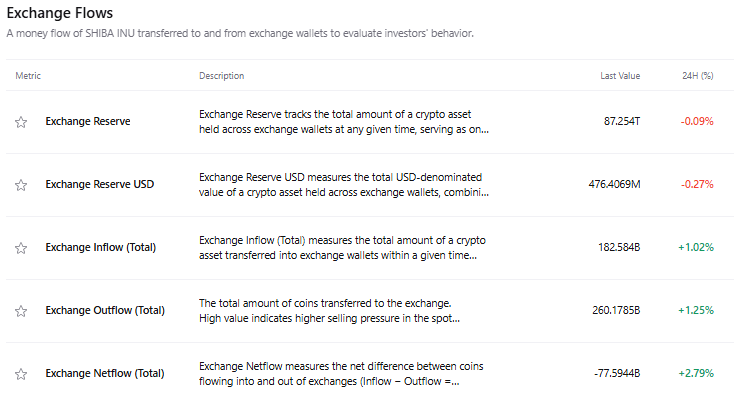
According to CryptoQuant, more SHIB left exchanges than entered them over the past 24 hours. Notably, 260.17 billion SHIB flowed out of exchanges, compared with roughly 182.58 billion SHIB in inflows. As a result, SHIB recorded a negative netflow of 77.59 billion tokens.

This broader trend suggests that, despite the whale’s large transfer to BitGo, the overall market has seen more SHIB withdrawn from exchanges than deposited. 

SHIB Exchange Flow
SHIB Exchange Flow Data

SHIB Struggles to Hold $0.0000055

At press time, SHIB traded around $0.000005469, down 1.73% over the past 24 hours.

Consequently, the decline pushed SHIB slightly below the $0.0000055 threshold, which has emerged as an important psychological level for the token.

Shiba Inu currently ranks as the 29th-largest cryptocurrency by market capitalization, with a market value of approximately $3.18 billion.

XRP Maintains Bullish BoS as Price Targets Rebound to $1.48

0

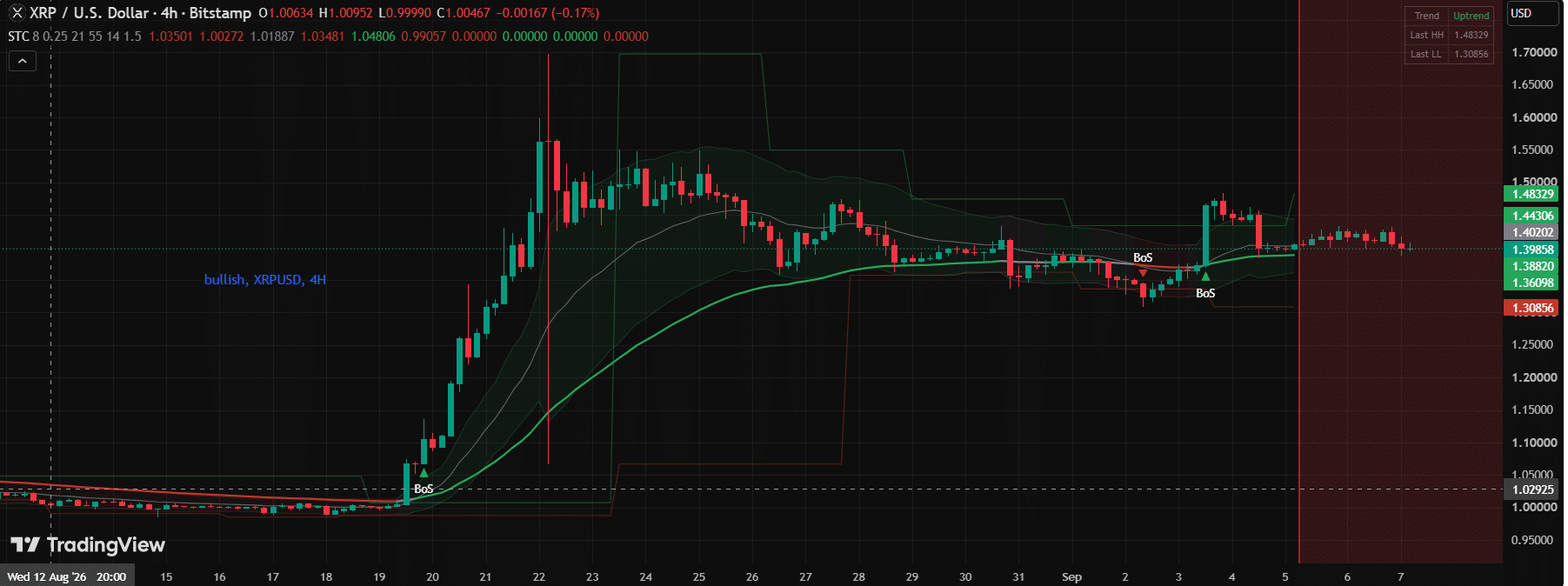
XRP has pulled back from the $1.69 high reached during its August rally, but its 4-hour chart still shows a bullish Break of Structure (BoS). 

Notably, XRP rose 71.8% from $0.988 to $1.698 in August before the current pullback began. The decline has already erased about 20% of the August high, as the price now trades just above the EMA21 at $1.4020. 

This level could help determine whether the pullback stays limited or turns into a steeper decline.

XRP Maintains Bullish BoS

The 4-hour chart shows that XRP formed a bullish BoS 23 bars ago after breaking above $1.4335. This move gave buyers control of the short-term trend, but the recent decline has brought the price back to the EMA21 at $1.4020. The EMA55 at $1.3884 now provides another support level below the EMA21. 

Meanwhile, XRP’s Bollinger Bands range from $1.3607 to $1.4433. XRP currently sits in the lower half of this range, but this alone does not point to a reversal. Instead, the price action could simply undergo a period of consolidation within the wider 4-hour uptrend.

XRP Maintains Bullish BoS

The chart leaves the $1.4835 swing high as the next major level to watch. XRP has not tested this level since forming the bullish BoS. As a result, a move toward it would give buyers a chance to complete the next major test in the current structure.

Important XRP Demand Zone

The area around the EMA21 at $1.4020 and the $1.4335 BoS level features an important support zone for the current structure. 

Below it, the $1.35$1.38 region could provide further support. Market analyst Ali Martinez previously identified this area as a major demand zone, with about 3.2 billion XRP changing hands there.

If XRP loses the EMA21, the price could first move toward the EMA55 at $1.3884. Further weakness could then bring the $1.35-$1.38 demand zone into focus. However, a move back above $1.4335 would strengthen the bullish setup and increase the chances of a retest of $1.4835.

XRP ETFs Keep Drawing Fresh Capital

XRP’s price has declined from its August high, but spot XRP ETFs have continued to attract capital. US spot XRP ETFs recorded $110.49 million in inflows during the week ending Aug. 28, marking their strongest weekly inflow of 2026. 

The funds extended their inflow streak to 11 straight trading sessions, bringing in roughly $170 million during that period. The continued inflows as XRP declined suggest that investors are still adding exposure as the market works through its recent correction.

Despite Goldman Sachs confirming about $87.4 million in XRP ETF exposure as of the second quarter, retail investors still account for nearly 84% of XRP ETF inflows, which leaves room for greater institutional participation.

XRP Needs to Reclaim $1.4335

Essentially, the bullish setup needs XRP to close a 4-hour candle above $1.4335. Such a move would show that buyers have reclaimed the BoS level and could clear the path toward the $1.4835 swing high.

If XRP breaks above $1.4835, the next major target would be the $1.6999 August high. However, the structure also has a clear level that would weaken the bullish case. 

A 4-hour close below the EMA55 at $1.3884 would put the current structure under pressure and could indicate that the bullish setup has failed.

XRP Price targets Based on Historic Cycle Gains

0

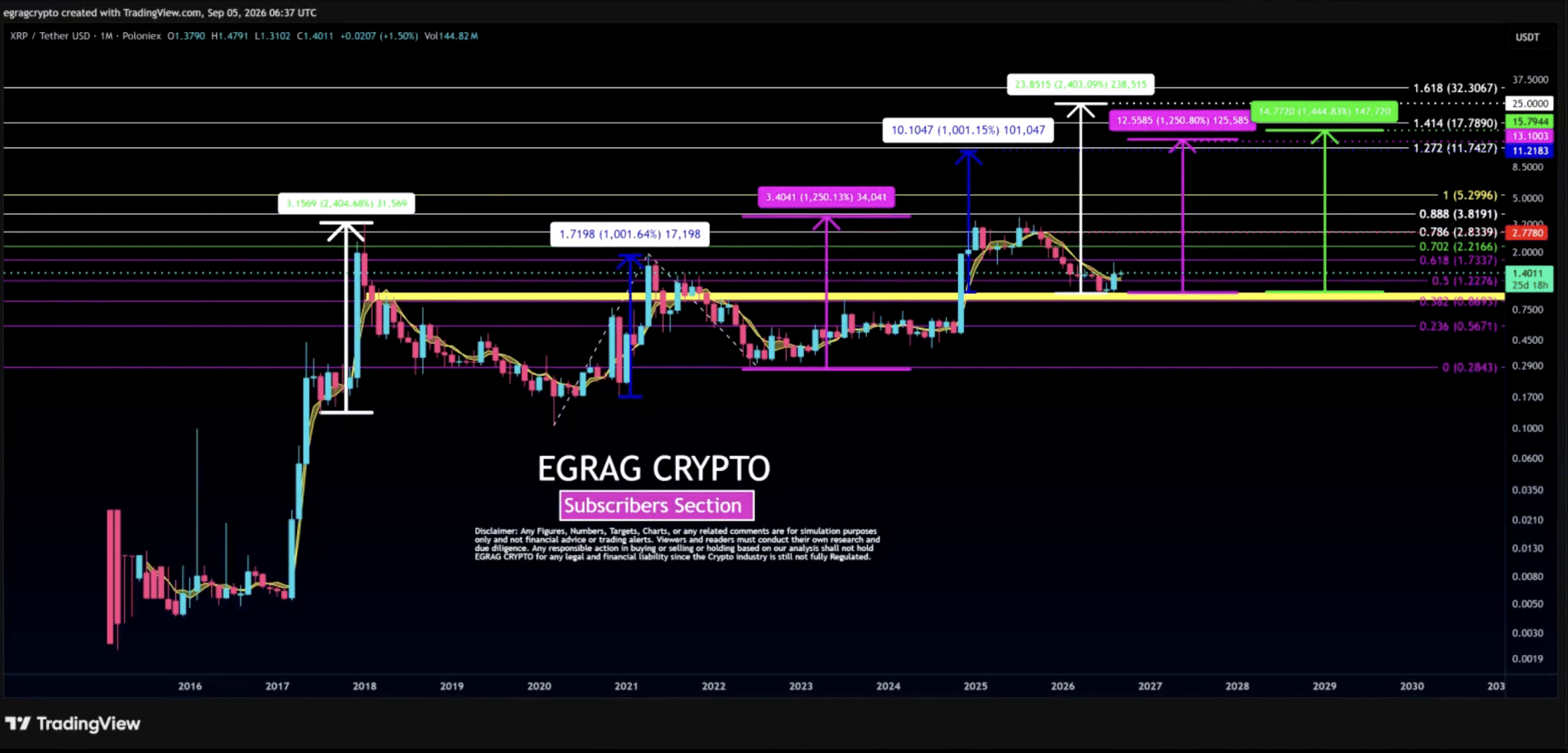
XRP shows the potential for another major price surge based on past market cycles that delivered gains of 2,405%, 1,002%, and 1,250%.

Based on these figures, the average gain was about 1,552%, while the geometric average came in at around 1,444%.

Analyst EGRAG says his analysis is based on XRP’s historical performance, not random price predictions.

With XRP currently trading around $1.40, a 1,444% increase would put the price near $21.62. However, another calculation referenced by analyst Moon Lambo places the target at around $14.77, depending on the starting price used.

XRP Past Gains Point to More Price Upside

Moon Lambo responded to EGRAG’s analysis, describing it as a reasonable way to assess XRP’s historical price gains. He focused on the 1,444% figure, which EGRAG calculated from XRP’s three previous major market cycles.

Moon Lambo also examined XRP’s 1,250% gain from a previous cycle. If XRP matches a similar gain from its current price, the token would reach approximately $12.55.

However, Moon Lambo emphasized that these figures are not guaranteed price targets. He said he does not know where XRP’s price will be in the future. His long-term view is that XRP has room to continue rising if its fundamentals keep improving.

XRP Price Chart By EGRAG

Can It Repeat Past Gains?

The key question for XRP investors is whether the token can replicate the enormous gains recorded during previous market cycles.

A 1,000% or larger price increase would represent a massive rally that pushes XRP market cap near $1 trillion. EGRAG’s analysis demonstrates that XRP has delivered gains of this magnitude during previous major market expansions.

Still, historical performance does not guarantee future results. XRP’s market capitalization, liquidity, investor demand, and the crypto market have all changed significantly over time.

XRP Bear Market Not Over

While EGRAG is projecting a 10X price surge for XRP, analyst RWA_Investor expects XRP to face more volatility before entering a major bullish phase. His Elliott Wave analysis projects a rally toward $1.87–$2.11, followed by a move to $2.64–$3.09.

The rally would then be followed by another sharp correction, potentially sending XRP toward $1.42 and eventually $0.7451—about 46% below current levels. According to the analyst, the larger bull market would begin once this corrective pattern is complete.

Alex Jones Warns US Government Could Seize XRP During Financial Crisis

0

American media personality Alex Jones has warned that proposed changes to the financial system could eventually give governments greater control over privately held assets, including XRP.

During a recent broadcast, Jones linked discussions surrounding centralized financial ledgers, bank bail-ins, and the mobilization of household savings to a broader concern about government intervention in private wealth. He suggested that regulators could eventually develop mechanisms to control citizens’ assets during a severe financial crisis.

Jones specifically raised the possibility that authorities could target digital assets such as XRP. He compared the potential scenario with the U.S. government’s restrictions on private gold ownership in 1933, arguing that digital assets could face similar intervention under extraordinary circumstances.

However, his comments have faced strong criticism from members of the XRP community, who argue that the claims lack supporting evidence.

XRP Community Challenges Jones’ Claims

XRP community figure Moon Lambo dismissed Jones’ warning as “conspiracy theory nonsense,” arguing that there is no established U.S. government plan to confiscate XRP.

According to Moon Lambo, forcibly taking XRP from American investors would undermine confidence in the digital-asset market and could trigger panic selling. He further argued that such a move could deprive the United States of a significant source of retail and institutional capital.

Moon Lambo also challenged Jones’ comparison with the 1933 gold restrictions. He pointed out that the U.S. operated under a gold-standard monetary system at the time, whereas the modern U.S. dollar is a fiat currency. Therefore, he argued, the government has no comparable monetary requirement to acquire XRP.

Aussie XRP likewise labeled Jones’ claim pure FUD, stressing that the government cannot simply confiscate XRP held in a self-custody wallet. Meanwhile, Jacob Metzger took a more evidence-focused position. He challenged Jones and others making similar claims to identify the specific law, policy, or government document that would authorize regulators to seize people’s XRP, homes, or bank accounts.

Self-Custody Remains a Key Point

Digital Ascension Group Chairman Jake Claver also questioned the timing of Jones’ comments, while an XRPL dUNL validator Vet emphasized that self-custodied XRP remains under the control of whoever possesses the corresponding private keys.

The validator also rejected the characterization of XRP as exclusively a “bank asset.” Instead, he noted that the XRP Ledger is open-source and available to anyone.

Furthermore, financial authorities such as the U.S. FDIC do not have an established legal framework that simply allows them to seize privately held digital assets. Similarly, claims about authorities intervening in Ripple’s locked XRP escrow holdings have faced legal scrutiny, with those escrows operating through predefined mechanisms rather than giving regulators direct control over privately held XRP.

Jones Clarifies His XRP Comments

Amid the backlash, Jones has since clarified that his concerns are focused more broadly on vulnerabilities within the financial system rather than on XRP itself.

Jones explained that viewers had initially asked whether governments could seize XRP during an extreme economic crisis. In response, he said his primary concern was the potential use of emergency government powers, including bank bail-ins, and whether authorities could target different forms of private wealth if the traditional financial system came under severe pressure.

As a result, his clarification shifts the focus from a specific prediction that the government will confiscate XRP to a broader warning about how emergency financial powers could affect private assets during a systemic crisis.

Despite the controversy, some XRP proponents believe Jones’ comments could ultimately benefit the asset by exposing it to a much larger audience. Jones has a massive following of roughly 4.4 million users on X, meaning his discussion of XRP reaches an audience far beyond the cryptocurrency community.

DBS, Citi Complete First Weekend Cross-Border Payment Using Tokenized Deposits on SWIFT

0

DBS and Citi moved tokenized bank deposits from Singapore to a U.S. destination on Saturday, completing what DBS described as the first transfer of its kind to be processed over a weekend through SWIFT’s digital-ledger infrastructure.

Settlement took only minutes, allowing the funds to move when conventional bank processing would normally be unavailable. Announcing the transfer on Monday, DBS contrasted that speed with standard international transfers, which can take up to two working days to settle.

The milestone highlights banks’ growing use of blockchain infrastructure to move money internationally while keeping deposits inside the conventional banking system.

SWIFT Ledger Draws Major Banks Into Tokenized Payments

The latest milestone builds on an August transaction between HSBC and Standard Chartered. That transfer marked the first time financial institutions used SWIFT’s ledger to move tokenized deposits across borders.

A month earlier, SWIFT had announced that the ledger was entering its initial operational stage. Seventeen large banks were preparing to trial tokenized deposits for international money movement, with Citi and DBS joining BNP Paribas, HSBC, ANZ, UBS and Standard Chartered among the participating institutions.

Citi Advances Another Digital-Deposit Project

Citi’s work extends beyond the Swift initiative. The lender is among a group of major U.S. banks developing another system for representing deposits digitally, with The Clearing House expected to run the infrastructure.

A launch is being targeted for the first six months of 2027, according to comments from the payments operator’s CEO, David Watson, reported by The Wall Street Journal in June.

DBS, JPMorgan Work to Link Deposit-Token Systems

DBS has another project underway with JPMorgan that aims to enable deposit-token platforms at different banks to communicate with one another.

The partnership was disclosed in late 2025. The companies said the proposed framework would use blockchain technology to enable on-chain transfers between their deposit-token systems. They plan to develop a common payments framework that could eventually be used across the banking industry.

Harmony Proposes Layer-1 Shutdown With ONE Migration to Ethereum

0

Harmony has proposed shutting down the layer-1 blockchain and converting ONE into an ERC-20 token on Ethereum, a move that would end the network’s seven-year run as an independent chain.

The plan remains non-binding, and Harmony has not set a date for the network’s last block or said whether validators will vote on the proposal through the network’s governance process.

A final block would establish the balances used for the migration. Harmony would then distribute ERC-20 ONE to the corresponding Ethereum addresses without requiring holders to file claims, while exchange listings would also move to the Ethereum-based token.

The distribution snapshot would include wallets, centralized exchanges (CEXs), staking delegations, validator rewards, and smart contracts. Multisig safes, on-chain applications, and liquidity pools, however, cannot be transferred under the plan, and Harmony has told users to leave all smart contracts before Sept. 10.

Validators Can Begin Node Shutdowns Sept. 10 as Governance Role Changes

Node operators could start shutting down on Sept. 10, with Harmony reserving $1.372 million for validators that cease operations on schedule, keep their stakes, and agree to remain as governors. Validators could alternatively continue in governance or join Harmony’s new AI-video initiative.

Under Harmony’s published governance framework, elected validators may submit proposals. Unelected validators may vote, with voting power determined by total stake.

Approval under those rules requires participation representing 51% of total stake weight and 66.7% support. The process includes a seven-day introduction period followed by 14 days of voting. Harmony has not specified whether those procedures will apply to the proposed network retirement.

Exploit Preceded Harmony’s Proposal to Leave Layer 1

The proposed shutdown follows an exploit less than four weeks earlier that resulted in forged ONE and led Harmony to plan a rollback affecting more than 109,000 transactions.

Harmony said on Aug. 12 that it was considering reversing the chain after reports that an attacker had created nearly 4 billion unauthorized ONE, representing about 26% of the supply. At the time, an outside account estimated that roughly 2.8 billion of the tokens had reached exchanges, a figure Harmony had not confirmed.

Five days later, Harmony said it intended to restore the blockchain to an Aug. 11 checkpoint. That action would remove 109,126 regular transactions and 315 staking transactions from the chain.

Harmony added that the investigation traced nearly all counterfeit tokens to identifiable wallets or service endpoints and that the team was coordinating with bridge operators, exchanges, and law enforcement agencies.

Two More Major Waves Remain Before XRP Bear Market Ends

0

XRP still has two major price waves to complete before the altcoin bear market ends, according to crypto market analyst RWA_Investor.

In a recent post on X, the analyst shared an Elliott Wave chart showing XRP rising again before facing another major correction and entering a larger bullish phase.

In other words, the analyst expects more volatility before XRP’s next major uptrend.

XRP Set to Push Toward $2.64–$3.09

The analysis sees XRP’s recent price movement as part of a larger correction in a W-X-Y pattern. From its current level, XRP will first rise toward $1.87–$2.11 before moving even higher.

The main upside target is between $2.64 and $3.09, suggesting that XRP is on track for a potential 2x price run. However, the chart shows that this will not mark the end of the correction. Another major drop will follow before the larger bullish move begins.

XRP chart: Source X
XRP chart: Source X

One of the most notable aspects of the setup is the projected decline after the rally. Following the move toward the $2.64–$3.09 zone, the chart shows XRP falling back toward approximately $1.42 before beginning another major leg lower.

The analyst’s projection ultimately places Wave (Z) around $0.7451, representing a substantial downside move of approximately 46% from current levels.

Under this structure, XRP will experience a strong rally followed by another major sell-off before the overall corrective pattern is complete. From then on, the market enters a full-fledged bullish phase, according to the analyst.

XRP Remains Up 35% Monthly

Despite the bearish long-term scenario outlined in the chart, XRP recent performance remains relatively strong. XRP is trading around $1.39, down 1.38% over the past 24 hours. However, the token remains up approximately 35% over the past month.

The current price also remains well above the chart’s earlier $1.0357 Fibonacci support area, which marks an important level in the analyst’s structure. For now, XRP needs to hold above the $1.40 area and build enough momentum to challenge the $1.87 and $2.11 resistance zones.

Other Analysts’ View on XRP Price

Analyst XForceGlobal XRP recently said he expects XRP to first reach $2 and potentially climb to $3–$4 if its bullish trend continues. 

For context, XRP recently dropped more than 22% from $1.70 but has recovered from $1.31 to around $1.40. XForceGlobal believes the current decline may be a final correction before another rally. 

Meanwhile, XRP’s falling reserves on Binance could also support the bullish outlook. Specifically, Binance’s XRP reserves have fallen by about 500 million XRP, from 3.1 billion in November 2025 to 2.6 billion currently. This suggests investors may be moving coins into private wallets for long-term holding.

Capital B Buys 376 BTC for $29.4M in Largest Bitcoin Purchase in a Year

0

Capital B bought 376 Bitcoin for €25.3 million ($29.4 million) after completing new capital raises, marking the French Bitcoin treasury firm’s largest BTC acquisition since September 2025.

The company said Monday that proceeds from recent fundraising funded the purchase. The fundraising included a €28.7 million ($33.3 million) private placement, with Adam Back contributing an additional €7.6 million ($8.8 million) through the transaction. His investment increased his ordinary ownership stake to 17.64%.

Capital B last made a larger Bitcoin purchase in September 2025, when it added 551 BTC. Its acquisition activity was considerably smaller last month, with just 6 BTC purchased.

Capital B’s Bitcoin Holdings Reach 3,521 BTC

Following the latest purchase, Capital B holds 3,521 BTC acquired for a combined €309.4 million ($359.3 million). That puts the average acquisition cost of its holdings at €87,878 ($102,058) per Bitcoin.

The company adopted the Capital B name in July 2025 after previously operating as The Blockchain Group, with the rebranding centered on its Bitcoin treasury strategy

As part of that broader Bitcoin focus, Capital B said in June that it was exploring a Bitcoin-backed credit product for Europe modeled on Strategy’s STRC and Strive’s SATA. 

Bitcoin Holds Near $79,500

Bitcoin traded around $79,500 on Monday and was little changed over the previous 24 hours, according to CoinGecko. The cryptocurrency had climbed to a local high of about $81,700 last Thursday before pulling back.