Home Blog Page 20

XRP Ledger Sees Major Revival as Daily Transactions Hold Above 2M in September

0

Daily XRP Ledger transactions have remained above the 2 million mark since the start of September 2026 despite the prevalent price uncertainty.

Notably, the XRP ecosystem has maintained this level for up to a week as network activity continues to recover. This is according to on-chain data provided by XRPScan, a leading XRP Ledger block explorer.

The recent strength represents a change from the period between mid-June and late July 2026, when the network averaged about 1.5 million daily transactions and failed to consistently cross 2 million. Activity had previously reached between 2.4 million and 2.6 million transactions in May before declining.

XRP Transactions See Recovery in August

The network began showing signs of recovery in early August. Specifically, daily XRP transactions moved above 2.3 million by Aug. 4, before climbing to 3 million on Aug. 5. Importantly, this figure marked a four-month peak for XRP Ledger activity.

Interestingly, the increase in network activity came while XRP’s price faced intense selling pressure. XRP witnessed consistent declines from $1.0864 on Aug. 3 to $0.99 by Aug. 11. 

After reaching the 3 million XRP transaction peak on Aug. 5, activity cooled and moved between roughly 1.6 million and 2.7 million for the rest of August. 

This coincided with XRP’s recent price rebound, as the asset rallied from $0.98 on Aug. 17 to $1.69 by Aug. 22 before facing resistance and pulling back. Despite this price rebound, transaction activity still failed to remain consistently high.

XRP Transactions See Consistent Trend in September 

The uneven pattern finally changed at the end of August. Notably, Daily XRP Ledger transactions crossed 2 million on Aug. 31, and the network has maintained that level throughout September so far.
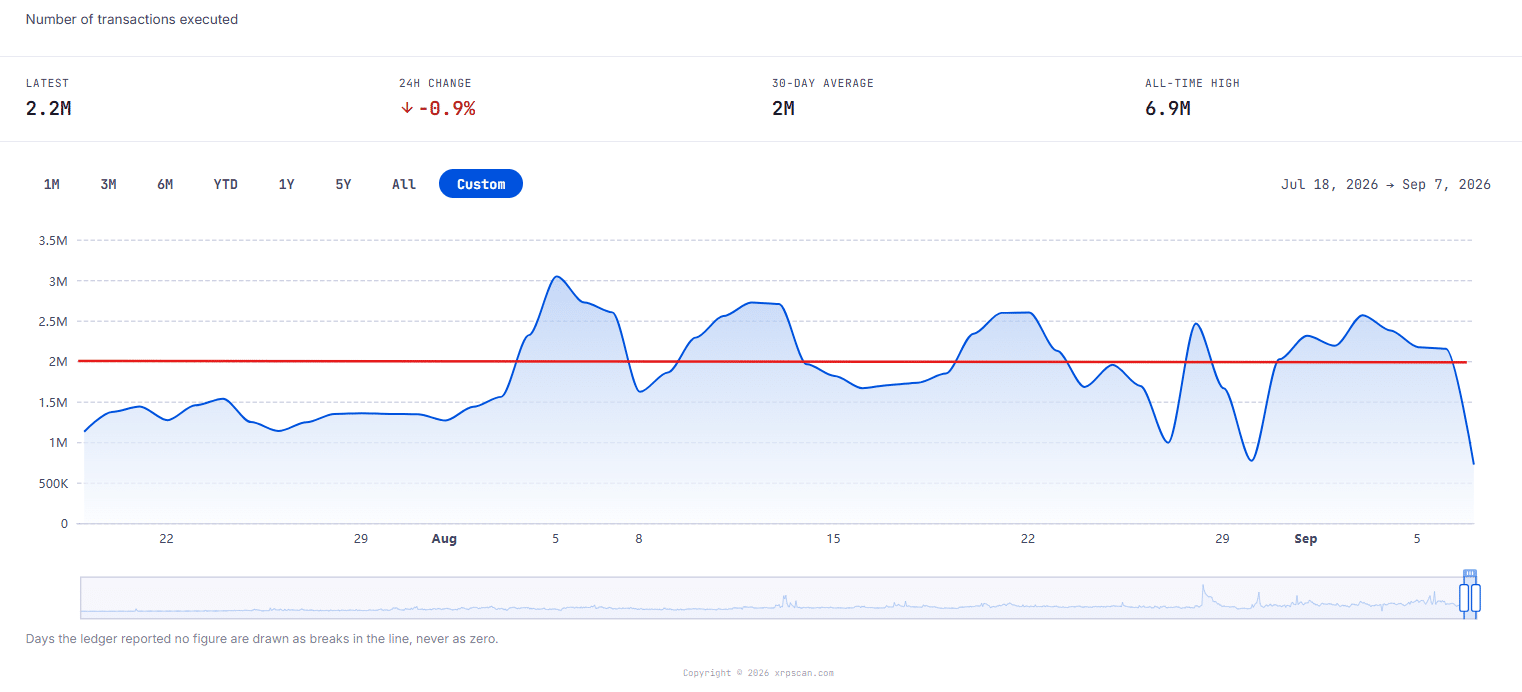
Daily XRP Transactions Source XRPScan
Daily XRP Transactions | Source: XRPScan

Specifically, transactions reached 2.3 million on Sept. 1, before slipping to 2.193 million the next day. Activity then recovered to 2.572 million by Sept. 3, which represents the highest daily figure recorded for the month so far. 

Although the transaction count declined after this peak, it has remained above 2 million throughout September. The network has recorded 722,000 transactions so far today, which leaves open the question of whether it can maintain the current pace as the day progresses.

XRP Active Accounts and Payments Also Recovering

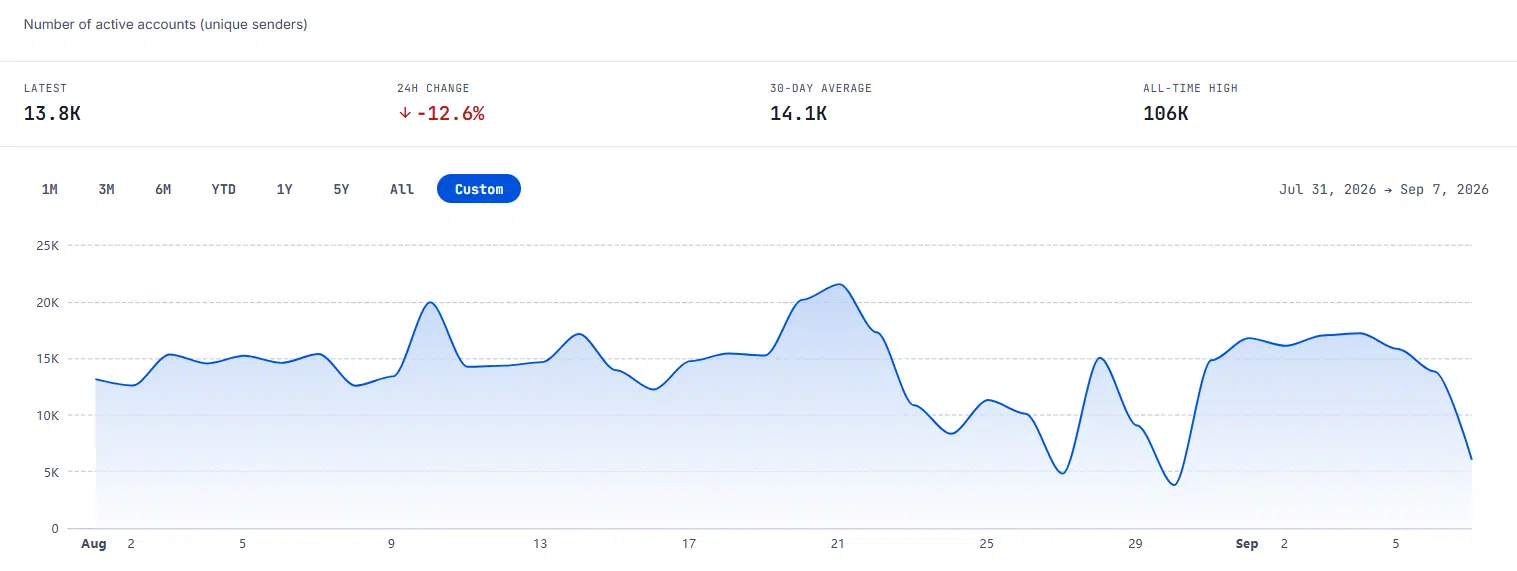
Meanwhile, transaction growth has not been the only sign of renewed activity on the XRP Ledger. The number of active XRP Ledger accounts also increased in September after falling to just 3,898 accounts on Aug. 30.
Daily XRP Active Accounts Source XRPScan
Daily XRP Active Accounts | Source: XRPScan

The network reached 14,841 active accounts on Aug. 31. Interestingly, growth continued into September, with active accounts reaching a monthly high of 17,222 on Sept. 4. Although the figure declined on Sept. 5 and 6, daily active accounts have remained above 13,000 this month.

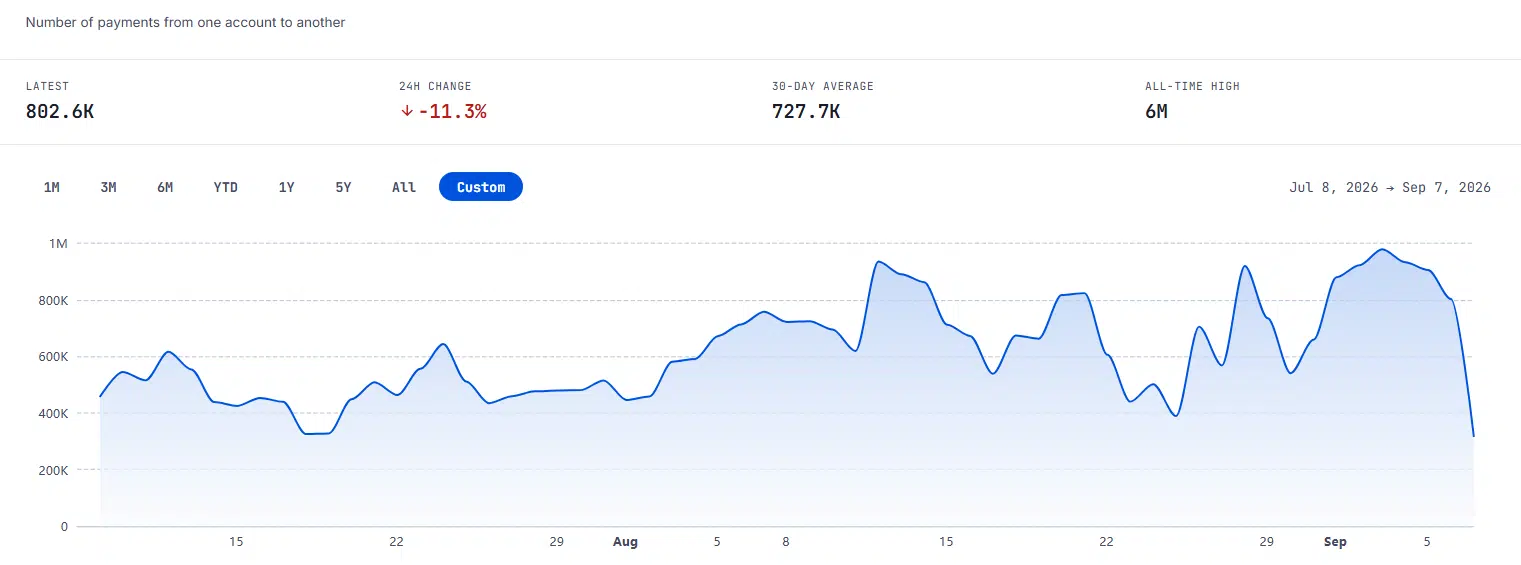
Moreover, daily XRP payments have also followed the broader recovery in network activity. Payments fell to 540,695 on Aug. 30, but the metric rebounded to 879,868 payments by Sept. 1.

Since then, daily payments have remained above 800,000, reaching a monthly high of 978,555 payments on Sept. 3. Notably, this payment peak came on the same day XRP Ledger transactions reached their September high of 2.572 million.
Daily XRP Payments XRPScan
Daily XRP Payments | Source: XRPScan

Overall, the rise in XRP transaction counts, active accounts, and payments confirms that the XRP Ledger is witnessing renewed network activity in September following the August price rally. It remains to be seen if the network can sustain these high levels as the month progresses.


Solana-Based Fomo Tops Pump.fun in Daily Revenue With $1.76M

0

Fomo generated $1.76 million in revenue on Friday, putting the social crypto trading platform ahead of memecoin launchpad Pump. fun, which recorded $1.1 million for the day, according to DefiLlama data.

The daily result follows Fomo’s expansion into additional trading products this year. The platform combines cryptocurrency trading with a social feed that lets users see other users’ transactions. On June 11, Fomo added Hyperliquid-powered perpetual futures for users outside the U.S.

Fomo Expands Platform as User Activity Grows

Fomo secured $75 million in a Series B financing led by Index Ventures in June, which valued the social trading app at $550 million.

The company has also reported uptake among first-time crypto buyers. More than 68,000 users made their initial cryptocurrency purchase on Fomo through Apple Pay, representing about $25 million in transaction volume, according to the company.

Separately, Fomo said on June 2 that payments to users through its referral program had exceeded $2 million.

Pump.fun Still Leads Fomo Over 30 Days

Despite Fomo moving ahead on Friday, Pump.fun remains well ahead over the longer term. The memecoin launchpad generated more than $57 million over the past 30 days, versus $17.6 million for Fomo.

Cardano Founder Highlights Key Solution to Growing AI Threats After Liquid Network’s $320M Bitcoin Breach

0

Cardano founder Charles Hoskinson has reacted to the reported theft of 4,000 Bitcoin from the Liquid Network’s federation wallet.

Liquid confirmed the incident in an X post yesterday, stating that hackers siphoned approximately 4,000 Bitcoin worth $320 million from its federation wallet. According to the network, the attackers moved the funds through the SideSwap Peg-out Authorization Key (PAK) service.

However, Liquid and SideSwap both indicated that the PAK itself was not compromised. Instead, SideSwap said the L-BTC involved in the transaction originated from a vulnerability in Elements, the Bitcoin-derived software that powers the Liquid sidechain.

Following the incident, Liquid disabled its bridge nodes and paused network activity while federation members investigated the breach. Meanwhile, exchanges received notifications and began pausing, or preparing to pause, L-BTC deposits and withdrawals.

The transaction also contained an OP_RETURN message, in which the attackers, who claimed to be white hats, requested on-chain contact.

Hoskinson Warns of AI-Driven Cybersecurity Risks

Reacting to the incident, Hoskinson used the breach to highlight what he sees as a growing cybersecurity threat from artificial intelligence.

He argued that formal methods may provide one of the strongest defenses against increasingly capable AI-driven attacks. As AI systems become better at analyzing source code, identifying vulnerabilities and automating sophisticated attacks, blockchain developers face an increasingly narrow window between the discovery of a software weakness and its exploitation.

AI has already begun changing the cryptocurrency security landscape by helping attackers identify potential targets, analyze complex code, and automate phishing and social-engineering campaigns. The reported Coldcard hack, which involved the theft of $130 million worth of Bitcoin, has further fueled concerns about how advanced AI tools could make difficult vulnerabilities easier to identify and exploit.

Against this backdrop, Hoskinson argues that conventional testing alone may no longer provide sufficient protection. Instead, he points to formal methods, which use mathematical specifications and proofs to establish whether software behaves according to its intended design.

Cardano’s Emphasis on Formal Verification

Hoskinson’s warning also aligns with Cardano’s long-standing emphasis on mathematically rigorous blockchain development.

Cardano’s development philosophy incorporates academic research, peer review, and formal verification as important components of its security approach. Its Ouroboros consensus protocol, for example, emerged from formal academic research, while the broader ecosystem has emphasized proving critical properties of protocols and software rather than relying exclusively on experimental testing.

This approach supports Hoskinson’s argument because formal verification seeks to mathematically demonstrate that specified properties hold. As a result, developers can potentially identify entire classes of vulnerabilities before deploying code to production.

Cardano also relies on functional programming technologies such as Haskell and Plutus. Their strong type systems and mathematical foundations can help developers detect certain categories of programming errors earlier in the development process.

Notably, Cardano’s approach aims to prevent vulnerabilities before they reach production rather than relying solely on testing and conventional security practices. 

Coldcard Wave 3 Exploiter Has Moved 45% of Stolen Bitcoin, Galaxy Says

0

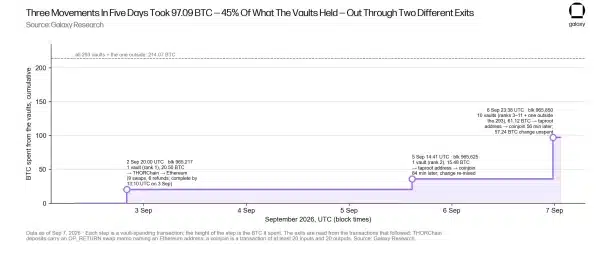
The attacker behind the third wave of Coldcard Bitcoin wallet thefts has moved 45% of the funds stolen in that phase, with 97.09 BTC worth $7.8 million at Monday’s prices spent so far, Galaxy Research said in its analysis.

In posts on social media platform X, Galaxy said the latest activity involved CoinJoin transactions on Sunday, following an earlier move on Sept. 2 in which the exploiter swapped stolen Bitcoin into Ethereum through THORChain. The research firm said the operator continues to move the stolen coins.

Coldcard Wave 3 Exploiter Moves 45% of Stolen Bitcoin

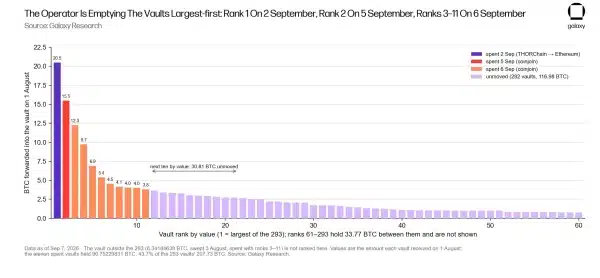
Exploiter Moves Largest Coldcard Theft Vaults First

Galaxy’s tracking shows the attacker has been moving the stolen holdings from the largest vaults to the smallest. Vaults ranked 1 through 11 have already been moved, while the next 10 untouched vaults contain a combined 30.81 BTC. Another 33.77 BTC is spread across the smaller vaults ranked 61 through 293.

Coldcard Wave 3 Exploiter Moves Largest Bitcoin Vaults First

In its Monday post, Galaxy also linked the operator to a previously unidentified vault comprising 58 addresses that the research firm said are likely associated with Coldcard victims. If those addresses are included, the amount stolen across the Coldcard attacks would rise to 1,806 BTC, equivalent to $143.9 million at current prices.

Across the overall exploit, 82% of the stolen funds remain in the original addresses controlled by the attackers. Galaxy said the remainder has been moved for laundering purposes.

Firmware Flaw Allowed Coldcard Seeds to Be Brute-Forced

The thefts began on July 30 and originated from a firmware bug that Coinkite shipped in 2021. The flaw reduced the randomness used when Coldcard devices generated wallet seeds, enabling attackers to brute-force private seed phrases and drain single-signature addresses without accessing the devices themselves.

By mid-August, Galaxy had identified roughly 1,779 BTC taken from 190 victims and more than 8,600 addresses. The research firm has also raised the possibility of a fourth wave of thefts, although it has not confirmed one.

XRP Ledger Value Explodes 43X From $99M to $4.26B in Just Six Quarters

0

The value of stablecoins and tokenized assets on the XRP Ledger (XRPL) has grown about 43 times in just six quarters.

According to Evernorth, the average value of these assets rose from $99 million in Q1 2025 to $4.26 billion in Q2 2026. The value increased every quarter, with no declines.

The Q2 2026 figure was the highest recorded, suggesting that the XRP Ledger is managing and settling large financial assets.

Tokenized Assets Fuel XRPL Growth

Tokenized assets were the main reason for XRPL’s rapid growth. According to the report, tokenized assets on XRPL averaged $3.72 billion in Q2 2026, up more than 3,000% from the previous year.

RLUSD, Ripple’s dollar-backed stablecoin, also grew quickly. Its average balance reached $539 million in Q2 2026, compared with $73 million a year earlier — a 642% increase.

RLUSD’s balance increased every quarter over the six-quarter period. Its share of the stablecoin supply on XRPL also rose from 20% to 34%. The amount of money moved through RLUSD also jumped 925% compared with a year earlier, according to Evernorth.

Fewer Accounts, But More Value Per Account

Meanwhile, XRPL has fewer active users, but the users who remain are moving more value. The average number of accounts making transactions each day fell to 16,587 in Q2, down from a previous high of 33,145. New wallets also dropped, from 6,617 per day to 2,783.

However, the amount of XRP traded by each account is much higher than it was in 2025. XRP traded per account rose 81% in Q4 2025 and another 85% in Q1 2026. Although it fell 15% in Q2, it was still 2.7 times higher than where it started.

In simple terms, fewer accounts are active, but the accounts that are active are moving much more money.

DEX Activity Points to Bigger Traders

The same trend is also visible on XRPL’s decentralized exchange (DEX).

Order-book trading averaged 3.57 million XRP per day in Q2, up 79% from a year earlier. However, the number of accounts executing trades dipped from 1,864 to 1,111 each day.

This means each active account traded about 3,217 XRP per day, compared with 1,072 a year earlier. Order-book transactions also accounted for 81% of DEX activity, unlike 54% last year.

Evernorth noted that higher trading volumes with fewer active accounts could mean professional traders are becoming a bigger part of the market. This trend also comes as XRP Ledger adds more tools aimed at institutions, including permissioned trading platforms.

XRPL Infrastructure Keeps Growing

On May 20, the XRPL EVM sidechain launched version 9.0.0. The update replaced older Evmos software with newer Cosmos EVM technology and added support for newer Ethereum standards.

On May 27, the fixCleanup3_1_3 update went live. It enhanced MPTs and permissioned domains while supporting new lending and vault features.

On June 4, RLUSD expanded to more networks through Wormhole. It gained native connections to Optimism, Ink, Base, Unichain and the XRP Ledger EVM sidechain, in addition to XRPL and Ethereum.

XRP Funding Pushes Below Zero: Possible Implications for Price

0

XRP funding rates on Binance have moved below zero to negative territory as leverage unwinds in the derivatives market.

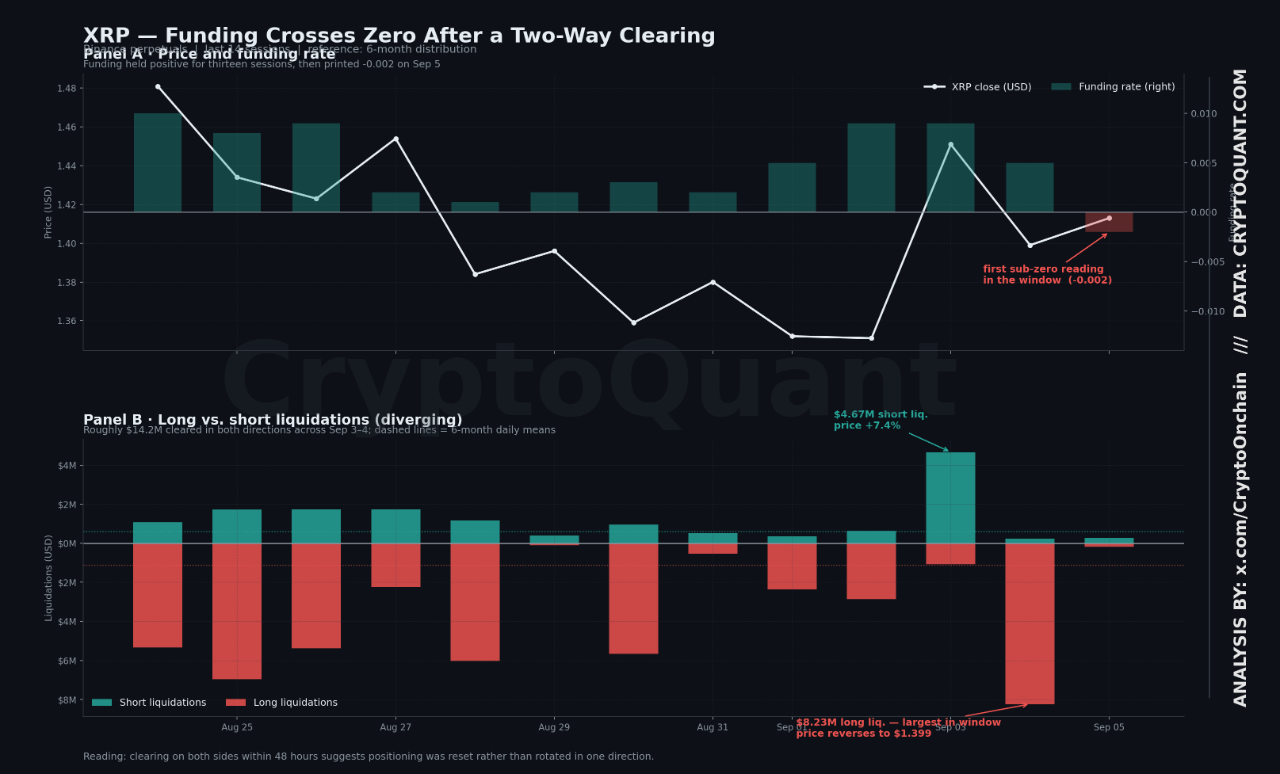
XRP’s derivatives market recently saw an important change when the Binance XRP funding rate fell to -0.002. This marked the first negative reading in 14 trading sessions.

Why the XRP Funding Change is Critical

Before then, funding had stayed positive for two weeks, moving between +0.001 and +0.010 as traders remained largely bullish after XRP’s strong August recovery.

XRP Funding Pushes Below Zero | Source: CryptoQuant

For context, XRP had risen from below $1 earlier in the month to a 3-month high of about $1.69 before facing resistance and pulling back to the current price of $1.41. While the move to -0.002 may look small, it’s worth watching due to the timing.

For the uninitiated, funding rates help keep perpetual futures prices close to the spot market. When funding stays positive, long traders pay short traders, which usually suggests stronger demand for long positions. 

When funding turns negative, short traders pay long traders, showing that bearish positioning has gained ground. Nonetheless, negative funding does not always lead to a price decline. 

In April 2025, XRP funding became deeply negative before XRP climbed from $1.60 to $3.65, an 82% gain, as short positions began to unwind. When too many traders bet on falling prices, even a small increase in buying can force them to close their positions and push the price higher.

XRP Market Clears Leverage

The change in XRP funding came after a round of liquidations across XRP’s derivatives market. During the 48 hours before the recent funding reading, both long and short traders faced heavy losses. 

On Sept. 3, XRP rose 7.4%, forcing the market to close $4.67 million in short positions. The next session brought a reversal, which led to $8.23 million in long liquidations. Overall, the two sessions cleared around $14.2 million from the derivatives market.

XRP Leverage Unwind | Source: CryptoQuant

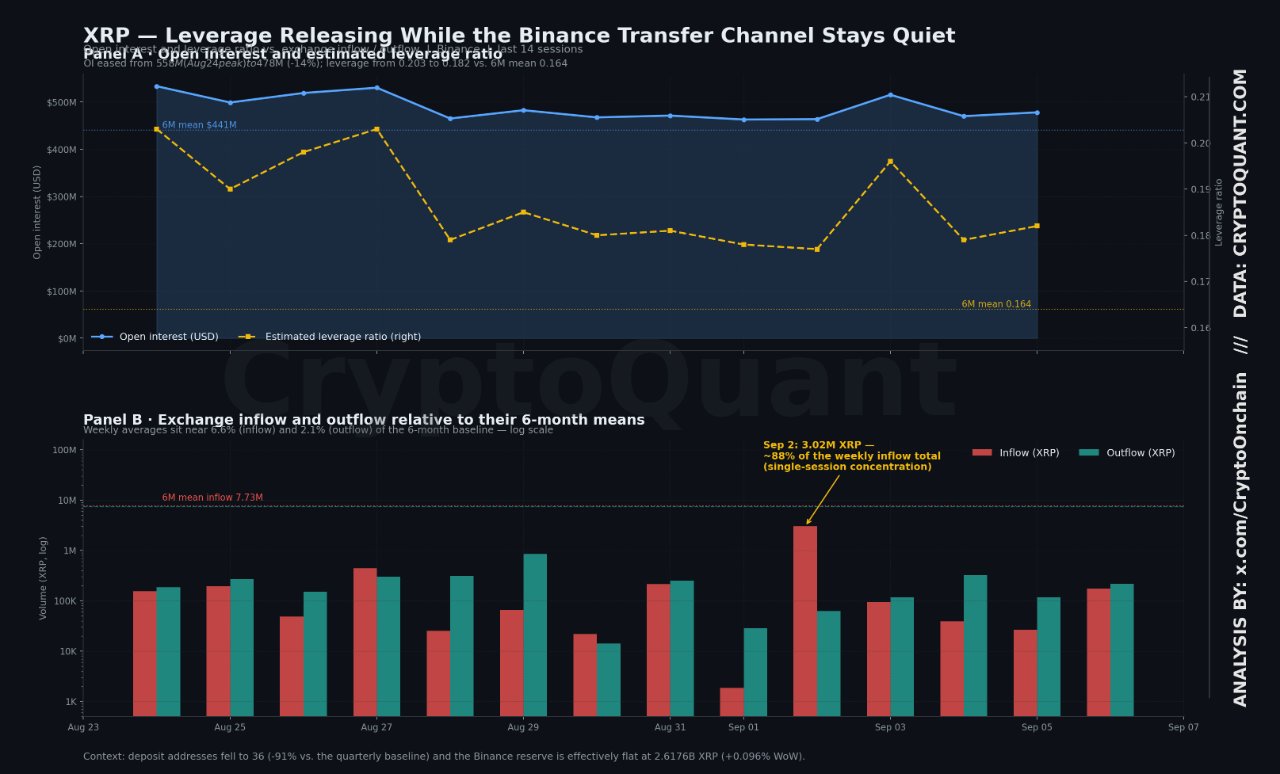
The liquidations also caused a drop in open interest. Notably, the XRP open interest fell from $558 million to $478 million, a 14% decline, as traders reduced their positions. The estimated leverage ratio also fell from 0.203 to 0.182. However, it remains above the six-month average of 0.164, suggesting that some leverage remains in the market. 

During the peak of the August rally, the leverage ratio reached 0.213, its highest level in seven months, and open interest rose to $3.45 billion during a 44% price increase. The recent decline shows that traders have reduced risk, although the market has not completely cleared its excess leverage.

Spot Channels Now Quiet

Binance’s spot-market data also shows limited activity around XRP. Specifically, inflows reached only 510,229 XRP, equal to 6.6% of the six-month average. Outflows were even lower at 160,247 XRP, or just 2.1% of the average.

Meanwhile, the number of deposit addresses fell to 36, representing a 91% decline from the quarterly baseline. These figures suggest that far fewer traders are moving XRP onto Binance, including those who may be preparing to sell.

Binance’s XRP reserve ended the period almost unchanged at 2.6 billion XRP. However, 88% of the week’s total inflow came during the Sept. 2 session. This happened on the same day Ripple carried out its regular monthly release of 1 billion XRP from escrow. 

The release contributed to some profit-taking and short-term selling pressure. Once the one-off event is removed, the broader inflow picture looks very quiet. 

CryptoQuant data also shows that Binance’s 30-day average XRP balance fell from about 3.17 billion XRP in November 2025 to 2.61 billion XRP on Sept. 1, 2026. This represents a decline of roughly 551 million XRP, or 17.4%, in less than a year. 

The launch of spot XRP ETFs in November and December 2025 may have played a role, as institutional demand moved XRP away from exchanges and into ETF custody.

Two Paths from Here

Currently, XRP trades at around $1.41, already up 2% in September. The latest derivatives indicators now show that traders have reduced their exposure.

These metrics leave XRP with two possible paths. First, the market could begin forming a base if funding returns to normal levels and XRP continues to hold support. 

However, lower liquidity could also make the market more vulnerable to another decline if Binance reserves start rising alongside renewed deposits. 

XRP is approaching an important test, especially with the September 15 CLARITY Act vote just eight days away. The outcome of the vote could determine whether the current market reset supports a recovery or leads to another pullback.

Hanwha Builds Tokenized Securities Platform on Avalanche as South Korea Prepares New Rules

0

South Korea’s Hanwha Investment & Securities has reportedly developed a multi-network tokenized securities platform supporting Avalanche (AVAX) as the country prepares to regulate security tokens under its existing capital markets framework.

The brokerage worked with blockchain technology company FairSquare Lab on the system, with development starting in 2025, according to a Sunday report by Seoul Economic Daily. Rather than being limited to Avalanche, the platform was designed for multiple networks and also supports Hyperledger Besu.

The project comes ahead of regulatory changes scheduled for Feb. 4, 2027, when amendments recognizing distributed ledgers as legally valid securities registers are due to take effect in South Korea.

Hanwha Deepens Tokenization Exposure

The platform adds to Hanwha Group’s existing investments across blockchain and tokenization businesses.

Three Hanwha affiliates have accumulated a combined 9.6% stake in Securitize (SECZ) over several years, making the group the company’s largest shareholder.

Hanwha Investment & Securities separately disclosed in July a 30 billion Korean won ($22.3 million) investment in Digital Asset, the operator of Canton Network.

FSC Plans Phased Expansion of Tokenized Securities

Against that backdrop, South Korea’s Financial Services Commission (FSC) has laid out a three-stage roadmap for implementing the incoming securities token amendments.

Beginning when the new laws take effect in February, tokenization will be permitted for privately placed money market funds and bonds, fractional investment securities, and unlisted stocks structured through a trust wrapper.

If the initial rollout proves successful, the regulator plans to expand the framework to all publicly offered securities. Its longer-term plan is to establish onchain payment rails that would enable investors to settle tokenized securities using stablecoins.


Shiba Inu Insider Says SHIB Is on Track for a Dedicated Spot ETF

0

Shiba Eternity Advisor Mazrael says Shiba Inu has made significant progress toward gaining broader access to regulated exchange-traded products. 

Mazrael made the remarks while responding to a Shiba Inu community member seeking an update on the possibility of a U.S. SHIB ETF.

In response, Mazrael acknowledged that Shiba Inu still lacks a dedicated U.S. spot ETF. Nonetheless, he pointed to developments across the United States, Europe, Japan, and Canada as signs that SHIB is gradually moving closer to that milestone.

SHIB Gains Exposure Through T. Rowe Price’s ETF

Mazrael identified the T. Rowe Price Active Crypto ETF (TKNZ) as one of the most significant developments for SHIB.

T. Rowe Price launched TKNZ on NYSE Arca on July 16, 2026, as an actively managed, multi-token spot crypto exchange-traded product. Instead of tracking a single cryptocurrency, the fund selects assets from an eligible universe and can hold a basket of digital assets.

Notably, SHIB appeared among the eligible assets listed in the fund’s July prospectus. This gives institutional investors a regulated U.S. investment vehicle that can potentially provide exposure to SHIB. However, SHIB was not among the assets featured at the fund’s initial launch.

Europe and Japan Expand Regulated SHIB Access

Meanwhile, Mazrael highlighted Valour’s SHIB ETP in Europe, which trades under the ticker 1VBS on the Spotlight Stock Market.

He also pointed to SHIB’s regulated spot access in Japan through Nomura’s Laser Digital following registration with the Japanese Financial Services Agency. Although the Japanese product is not an ETF, Mazrael considers the listing another important step toward expanding regulated investment access to SHIB.

Furthermore, Mazrael noted the growing availability of SHIB derivatives in Canada. Regulatory filings confirmed the certification of Shiba Inu-related futures products in 2026, including a SHIB/USD futures product and a SHIB perpetual futures contract.

More recently, Coinbase’s regulated futures operation added SHIB to its crypto derivatives offerings for eligible Canadian clients.

While futures differ from spot ETFs, Mazrael believes their availability further demonstrates SHIB’s expanding presence within regulated financial markets.

SHIB Is Taking a Different Route From Dogecoin

Mazrael also compared SHIB’s progress with Dogecoin’s path to the ETF market.

According to him, Dogecoin reached the dedicated spot ETF market before Shiba Inu. However, SHIB has followed a different route by gradually building eligibility, ETP exposure, regulated spot access, and derivatives infrastructure across multiple jurisdictions.

Therefore, although Shiba Inu still lacks a dedicated U.S. spot ETF, Mazrael believes the groundwork for such a product is increasingly taking shape.

“No ETF yet. But well on track,” Mazrael remarked. 

U.S. Spot Bitcoin ETFs Draw $986.9 Million in Weekly Inflows as Institutional Demand Recovers

0

U.S. spot Bitcoin exchange-traded funds (ETFs) drew $986.9 million in net inflows last week, up from $924.5 million the previous week. This marked the third consecutive week of positive flows.

BlackRock’s IBIT accounted for $691.5 million of the inflows in the week ended Sept. 4, according to SoSoValue data. The continued allocations were accompanied by lower trading activity, with weekly volume across the Bitcoin funds falling to $14.5 billion from nearly $19 billion.

The latest figures extended momentum from August, when spot Bitcoin ETFs attracted $3.52 billion in net inflows, their strongest monthly showing since September 2025.

Dominick John, an analyst at Zeus Research, said the sustained inflows indicate institutional capital is gradually rebuilding Bitcoin exposure and generating genuine spot demand rather than demand based on leveraged speculation.

Presto Research associate Min Jung similarly attributed the flows to renewed institutional demand, saying crypto appeared to be undergoing a catch-up trade after trailing other risk assets.

Ethereum Funds Extend Their Own Three-Week Inflow Run

Spot Ethereum ETFs also recorded a third consecutive week of positive flows, attracting $218.4 million in net inflows last week. Trading volume fell to $4.1 billion from $6.3 billion the previous week.

The Ethereum funds brought in $1.85 billion during August, their highest monthly net inflow since August 2025.

Bitcoin Trades Near $80,000 as Macro Data Comes Into Focus

Bitcoin remained around $80,000 after reaching approximately $81,700 last Thursday, according to CoinGecko. It was little changed over the preceding 24 hours at $79,771 as of 2:10 a.m. ET on Monday.

John viewed Bitcoin’s ability to hold $80,000 as supportive of the market structure and expected the cryptocurrency to continue moving gradually toward the $82,000-to-$85,000 range. He said, however, that macroeconomic developments would probably drive the next move.

According to John, traders were watching jobless claims scheduled for Sept. 10 and the consumer price index (CPI) due Sept. 11 for indications about Federal Reserve policy, yields and liquidity.

Jung said a favorable macroeconomic environment could prolong the rally, while a stronger inflation reading represented the principal downside risk.

XRP Spot Volume Hits Six-Month High as Binance Records $7.3B in Trading

0

XRP trading activity increased massively in August, with spot trading volume on top crypto exchanges like Binance reaching its highest level in six months.

This shows that interest in XRP has picked up after a period of weaker activity. It also suggests that liquidity and participation in the XRP market have improved.

Binance Leads in XRP Trading Volume

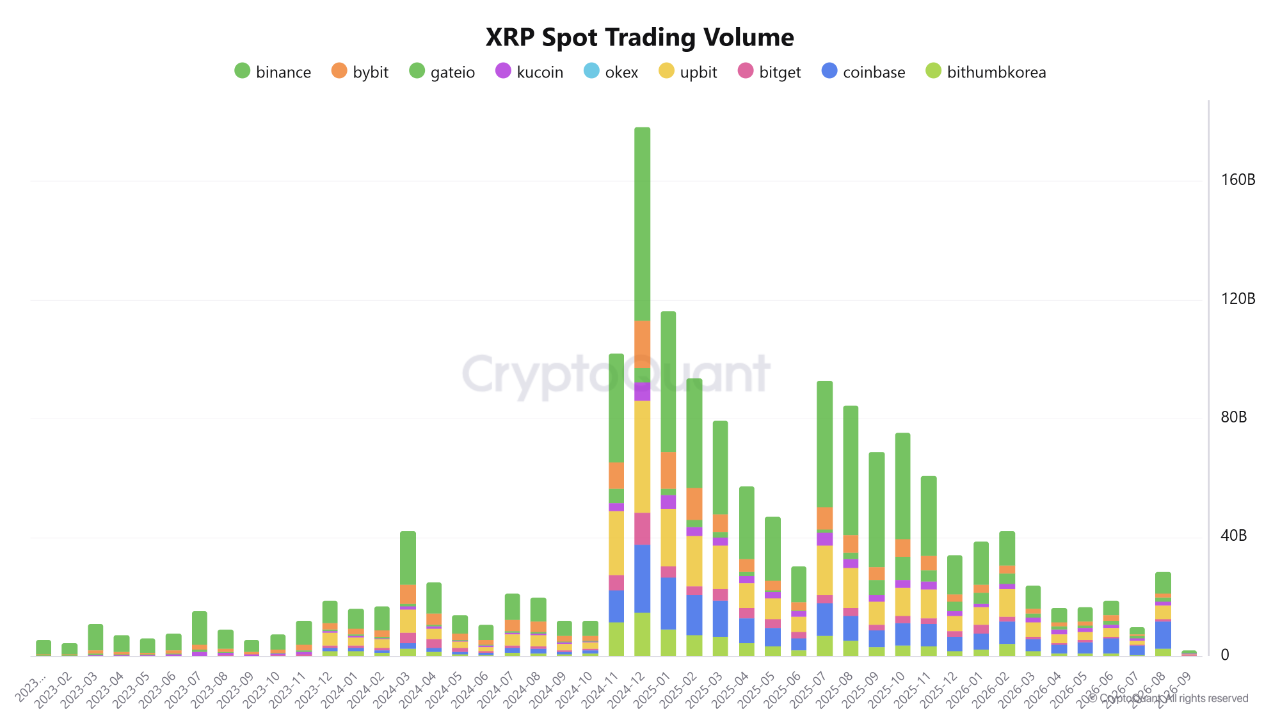
According to CryptoQuant author Arab Chain, Binance had the highest XRP trading volume in August, at about $7.28 billion. Upbit came next with $4.68 billion, followed by Bithumb with $2.59 billion.

Other exchanges also recorded strong volumes. Bybit had about $1.40 billion, Gate.io $1.33 billion, and KuCoin $1.23 billion. Bitget recorded around $918.5 million, while Coinbase had about $915.4 million.

The increase across several major exchanges suggests XRP’s renewed trading activity and liquidity were spread across multiple markets.

XRP trading volume on exchanges including Binance

Higher Volume Shows Renewed XRP Interest

Trading volume shows how much of an asset is being bought and sold over a certain period. A dramatic increase means more people are actively trading.

Arab Chain noted that the rise in XRP trading volume should not automatically be seen as bullish or bearish. Higher volume simply means more people are participating in the market. Price direction still depends on whether buyers or sellers are stronger.

Still, reaching a six-month high is an important sign.

Notably, the massive surge in spot volume in August coincided with a major price recovery for XRP in that month. The price surged 72% from $0.987 to $1.700 in the third week of August, helping elevate market interest in the coin. Meanwhile, the price action has cooled following a 21% dip.

XRP Could Target $3–$4 as Correction Nears End

Meanwhile, Elliott Wave analyst XForceGlobal believes XRP could resume its uptrend after its recent pullback, targeting $3–$4. While XRP has fallen more than 20% from its recent high, it has rebounded from $1.3098 to around $1.4835, gaining 13.26%.

XForceGlobal expects XRP to first target $2, with $3–$4 possible if the bullish trend continues—roughly 2–3x from current levels.

A fundamental catalyst is declining XRP reserves on Binance, which have dropped by about 500 million XRP, reflecting increased long-term holding and demand from spot XRP ETFs.

Ultimately, if strong trading activity continues in the coming months, XRP could benefit from a more active and liquid market.

The August numbers are a positive sign for XRP’s market health. Major exchanges such as Binance, Upbit, and Bithumb all recorded strong trading activity, helping XRP reach its highest spot volume in six months.