Home Blog Page 2044

Deaton Explains Why SEC Didn’t Include Former Ripple Founder Jed McCaleb in XRP Lawsuit

0

Attorney Deaton said McCaleb is Crypto’s, Teflon Don.

XRP community members have continued to question why American programmer Jed McCaleb was not included in the ongoing Ripple v. SEC lawsuit, despite being one of the company’s co-founders.

Recall that the Securities and Exchange Commission charged Ripple in December 2020 for allegedly offering unregistered securities in the form of XRP. The SEC also charged Ripple’s CEO, Brad Garlinghouse, and the company’s co-founder Chris Larsen for the same offense.

However, McCaleb, former Ripple Labs co-founder, and CTO was not listed as one of the defendants in the case.

Although XRP community members had previously asked why McCaleb was not on the list of defendants, Matt Hamilton, Ripple’s former director of developer relations, raised the question in a recent tweet.

“I’ve always found it strange how conspicuously absent Jed’s name is in the SEC v. Ripple case,” Hamilton quizzed. 

The tweet gave fresh breath to the controversial question that has lingered throughout SEC’s legal battle. As expected, XRP community members made different assertions in the comment section. For some XRP community members, McCaleb may have agreed to work as a whistleblower for the Securities and Exchange Commission.

Deaton Reacts

Interestingly, CryptoLaw founder attorney John Deaton explained why the SEC omitted McCaleb as one of the defendants in the lawsuit.

Attorney Deaton said McCaleb was exempted because he is one of the industry players on “Crypto’s Mount Rushmore” list. The CryptoLaw founder listed Bitcoin’s pseudonymous founder Satoshi Nakamoto, and Ethereum’s Vitalik Buterin, McCaleb, and David Chaum, as his unbiased choice for Crypto’s Mount Rushmore.

Attorney Deaton added that McCaleb is also the “Teflon Don” of crypto. For context, Teflon Don was the nickname given to former American gangster and leader of the Gambino crime family John Joseph Goti Jr.


McCaleb Empties His XRP Account

It is worth noting that McCaleb received a share of 20 billion XRP in 2012, shortly after Ripple (named OpenCoin at the time) was founded. However, he left the company in 2014 with his XRP share due to a fallout with Ripple executives.

Before leaving Ripple, McCaleb agreed to lock-up terms for his share of XRP to prevent a market crash that may happen if the former Ripple executive decides to offload his entire XRP holding at once.

According to the lock-up plan, McCaleb agreed not to sell more than $10,000 worth of XRP per week for the first year. The amount McCaleb could offload was later raised to $20,000 worth of XRP weekly for the three years following.

Between 2018 and 2019, the restriction applied to the number of XRP tokens, which was limited to an offloading amount of 1 billion XRP per year. In addition, the amount was increased to 2 billion per year in 2020 and beyond.

As reported last year on July 18, McCaleb finally emptied his XRP account after an eight-year selloff.

XRP Sees Highest Profit-Taking Ratio Since Aug 2021 Amid 44% Rally

0

XRP has established a firm position above the $0.50 price territory, aiming to conquer $0.55.

XRP traders are raking in profits from their investments amid a highly-anticipated uptrend that has seen the asset surge by over 44% in the past 8 days. Notably, the XRP network is witnessing the highest trader profit-taking ratio since August 2021.

According to data from market intelligence resource Santiment, XRP investors engage in profit-taking transactions twice as much as loss-incurring transactions. As a result, the “Ratio of Daily On-chain Transaction Volume in Profit to Loss” has increased to a value of 1.104. The last time the indicator saw this high level was 19 months ago.


The ratio of daily on-chain transaction volume in profit and loss is an indicator that compares the value of transactions resulting in a profit to the value of transactions resulting in a loss within a single day. A high ratio indicates that market participants are making more profits than losses.

XRP Targets $0.55

This bullish turn of events comes on the back of XRP’s massive uptrend at a time when most assets, including Bitcoin, are facing exhaustion in their rallies. XRP’s bullish run started on March 21 amid circulating speculations of an imminent judgment in Ripple’s favor in the ongoing SEC litigation. The asset saw a massive whale-induced accumulation campaign.

Since kicking off the rally eight days ago, XRP has gained by 44.8%, rising from a low of $0.374 on March 21 to its current value of $0.5416 as of press time. The last time XRP saw this price was in May 2022. The asset has established a firm position above the much-coveted $0.50 price level and seeks to conquer $0.55.

Moreover, XRP’s social dominance has recently shot up, soaring to its highest level in almost a year, as social engagements see an uptick. According to Santiment, this rapid increase in social activity is likely to trigger demand and mainstream interest, which will result in more volatility.


With a 16.92% gain in the past week, XRP is the highest-gaining asset among the top 80 cryptocurrencies. The asset’s short-term goal is to tower above the last significant resistance before $0.55. This resistance point sits at $0.5450. Once captured, XRP’s next major resistance level rests on the $0.5761 point.

Deaton Says XRP is the Altcoin With the Best Comeback Story

0

The altcoin has faced opposition from industry leaders and regulators.

XRP is, without a doubt, among the most criticized projects within the cryptocurrency space. In a tweet yesterday, Attorney John E. Deaton asserted that the ability of the cryptocurrency to stay relevant despite these had earned it the title of crypto’s “comeback coin.”

The attorney’s latest comments came in response to a tweet from the prominent crypto Youtube channel Altcoin Daily which asked the crypto community which altcoin project had the best comeback story.

The CryptoLaw founder chronicling the project’s hurdles pointed out that Ripple’s early marketing of XRP as a liquidity solution for banks did not sit well with the Bitcoin community as it appeared to be the opposite of what Bitcoin stood for. Recall that the Bitcoin white paper appeared shortly after the 2007-2008 financial crisis as an alternative to a centralized and corruptible financial system.

Then in 2020, Ethereum co-founder and one of crypto’s albeit unwitting cult leaders Vitalik Buterin declared XRP a “shitcoin.” Buterin’s statement came in response to Ripple’s Wells submission, which raised concerns about the concentration of crypto mining activity in China. Notably, at this time, Ripple and XRP were already in the United States Securities and Exchange Commission (SEC) crosshairs.

Finally, the SEC proceeded with its enforcement action against Ripple, labeling XRP an unregistered security. As highlighted by Deaton, this ought to have been the nail in the coffin. The price of XRP tanked, and about $15 billion was wiped from its market capitalization as U.S.-based crypto exchanges rushed to delist the token in fear of SEC litigation.

However, amidst all these, the token remains among the top 10 cryptocurrencies by market cap.

“In the end, XRP is the comeback coin,” the attorney asserted.

Meanwhile, XRP’s comeback story is arguably not complete yet. For many, the climax would come if XRP is declared a non-security in the extended SEC case against Ripple, allowing U.S. crypto exchanges to relist the asset.

As explained by Deaton, who represents thousands of XRP holders as a friend of the court in the case, Ripple does not need to win for this to happen. A  judicial opinion that secondary market sales do not constitute security offerings could be enough to clarify the asset’s classification.

SHIB Based PawZone Dispels Insider Trading Claims Following Launch on ShibaSwap and CMC

0

The token launched on ShibaSwap on March 26, attracting over 3,000 holders in less than a day.

PawZone, a project based on Shiba Inu’s Shibarium network, has officially launched its native token PawZone (PAW). However, following the launch, accusations of insider trading surfaced. JD, founder of PawZone and a Shiba Inu community member, recently dispelled these claims.

PawZone’s Token Launch

The PawZone team officially launched the token two days ago on ShibaSwap, Shiba Inu’s decentralized exchange. The launch came almost two weeks after the team behind the project announced plans for an impending “fair launch” on ShibaSwap.


Shortly after the launch, the token saw a massive trade activity and renown surge. Notably, leading crypto price-tracking resource CoinMarketCap (CMC) listed the asset less than a day after its launch. The asset is currently on the watchlists of 458 CMC users.


The PawZone token also saw a rapid increase in unique holders, as its total holders soared above the 3,000 thresholds in less than 24 hours. The token now boasts 3,392 holders. Moreover, trade volume increased to $40 million as of March 27. 

JD Addresses PawZone FUD

Amid the bullish turn of events, DeFi Kraken, a pseudonymous Shiba Inu community member, called attention to an alleged insider trading scheme carried out in tandem with the PawZone token launch.


He pointed out a transaction carried out by an unidentified wallet address involving a large volume of PawZone tokens. The address had procured 28.4 billion tokens minutes before the announcement. The disclosure triggered insider trade speculations, defeating the “fair launch” narrative.

Responding to the growing FUD, JD took to Twitter today to dispel the claims of insider trades. He said he had to mitigate the tokens and allocate them in smart contracts before the token launch to confuse trading bots. This underscores the magnitude of efforts he put in to reduce the chances of insider trading.

“There were no insider trades. I didn’t even tell my own admin that have stuck by my side through the years to be as fair as possible. I’ve been in this community longer than most and have been supporting it ever since. I didn’t work this hard on #PawZone to just make a quick profit off of a token,” he added.


JD further disclosed that he still holds his PawZone bag and even amassed more tokens following the launch. In addition, he highlighted that 100% of the token’s liquidity is locked, with an unlock rate of 20% for the next 6 months and 80% for the next 2 years.

After CFTC Lawsuit, Unknown Wallet Moves 2,000 Ethereum Dormant for 2.5 Years From Binance

0

An anonymous Ethereum whale withdraws 2,000 units of ETH dormant for 2.5 years.

Lookonchain, a leading cryptocurrency data analytics platform, reported that an anonymous Ethereum whale withdrew 2,000 ETH ($3.47 million) from an address dormant for two and a half years from Binance.

Per data shared by Lookonchain, the transaction occurred today at 01:35 UTC, with the owner paying a nominal fee of just $0.84. Lookonchain says the address has been dormant for two and a half years.

The last time the user did a transaction from the address was on September 2, 2020, withdrawing $1 million worth of USDC from the world’s largest cryptocurrency exchange by 24-hour trading volume.


The reason behind today’s transaction was unclear at the time of writing. However, crypto enthusiasts believe that reports of the Commodity Futures Trading Commission’s (CFTC) lawsuit against Binance and its CEO Changpeng Zhao (CZ), may have influenced the whale’s decision.

Recall that the CFTC filed charges against Binance and CZ, alleging that the duo offered unregistered cryptocurrency derivatives products in the United States. The commission further alleged that Binance directed U.S. customers to utilize VPN to gain access to the exchange’s products and services.

A Mere Coincidence?

There is a tendency that the withdrawal of 2K ETH by the Binance user might be a mere coincidence. Recently, cryptocurrency investors have moved vast amounts of crypto assets from dormant addresses, and TheCryptoBasic has covered some of these transactions.

In November, an Ethereum address holding 200 ETH was activated after being dormant for more than seven years. Similarly, another whale activated a 7.3 years dormant address containing 500 ETH.

Aside from ETH, cryptocurrency whales have also moved huge amounts of other crypto assets that have been dormant for over two years. A case in point is a transaction that took place earlier this month. As reported, the anonymous whale moved 2,400 Bitcoin (BTC) dormant for over five years.

Shiba Inu: Shibarium Beta Records Massive Growth, Boasts 121K Transactions With Over 65K Addresses

0

The testnet’s transaction count and total wallet addresses have seen a massive uptick since the relaunch four days ago.

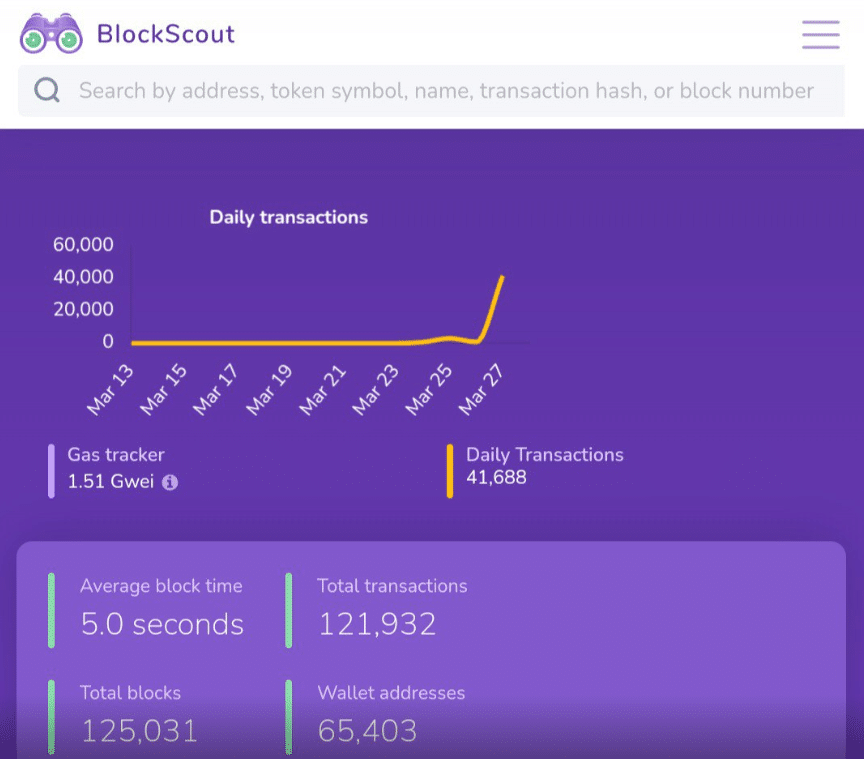
Puppynet, the beta testnet for Shiba Inu’s Shibarium network, is witnessing a remarkable surge in adoption rate following its redeployment. The testnet has now processed over 121,000 transactions since its relaunch, boasting an impressive wallet address count above the 65,000 mark.

Lucie, a prominent Shiba Inu community influencer, drew public attention to the noteworthy increase in the testnet’s metrics today. Specifically, at the time of her disclosure, the testnet had processed 109,655 transactions and hosted 57,781 wallet addresses, further emphasizing its impressive growth.

Just two hours after the disclosure, data from Puppyscan, the network’s dedicated chain explorer, reveals that the number of wallet addresses has increased by over 13% from 57,781 to the current figure of 65,403 as of press time.

Shibarium puppynet
Shibarium puppynet

Similarly, the transaction count has witnessed a rapid 11% surge, currently at 121,932. Moreover, daily transactions on the network remain at 41,688, while total blocks have surged to 125,031 at the time of reporting. The average block time remains at an impressive rate of 5 seconds.

Puppynet achieved these milestones four days after being relaunched with a reviewed Chain ID. The testnet was redeployed on March 24, after its Chain ID was changed from 917 to 719 to address the circulating FUD campaign targeted at Shibarium amid speculations that the network is a clone of the Rinia testnet.

Following the redeployment, the network’s statistics were reset. However, most of these stats have now surpassed previous highs. Despite Puppynet’s growing adoption rate, Shytoshi Kusama, Shiba Inu’s project lead, has continually advised investors against spending any real money on the network, which could lead to a loss of funds. The network is purely for testing purposes.

Polkadot (DOT) vs Chainlink (LINK), Which of These Will Accompany RenQ Finance (RENQ) To Change The Future of DeFi?

0

Decentralized finance (DeFi) has taken the world by storm, and it’s only just getting started. DeFi has the potential to revolutionize traditional finance by providing a trustless, transparent, and decentralized alternative. The DeFi space is continually evolving, with new projects and platforms emerging every day.

Two of the most promising projects in the space are Polkadot (DOT) and Chainlink (LINK), both of which are poised to have a significant impact on the future of DeFi.

In this article, we will examine the potential of these two projects and their role in the future of DeFi, along with RenQ Finance (RENQ), another promising DeFi platform.

Polkadot (DOT)

Polkadot (DOT) is a next-generation blockchain platform that allows for interoperability between different blockchains. Polkadot’s architecture allows for different blockchains to connect and communicate with each other, allowing for seamless interoperability between different ecosystems. The Polkadot network consists of a relay chain and multiple parachains, each of which can be customized to support specific use cases. One of the significant advantages of Polkadot is its scalability. The network’s sharding design allows it to handle a significant number of transactions per second, making it an ideal platform for DeFi applications. Polkadot is also known for its governance system, which allows holders of the DOT token to vote on network upgrades and proposals.

Chainlink (LINK)

Chainlink (LINK) is a decentralized oracle network that connects smart contracts to real-world data. Chainlink’s oracle network allows smart contracts to access off-chain data, such as market prices, weather data, and sports scores. This connection to real-world data is essential for DeFi applications, as it allows them to interact with the external world.

Chainlink has become a popular platform in the DeFi space due to its secure and reliable oracle network. Many DeFi applications rely on Chainlink’s oracle network to access real-world data, making it a critical component of the DeFi ecosystem. Additionally, Chainlink is known for its robust community and developer ecosystem, which has helped to fuel the project’s growth.

RenQ Finance (RENQ)

RenQ Finance (RENQ) is a decentralized finance platform that aims to solve the liquidity problem by connecting isolated blockchains. RenQ Finance offers a comprehensive suite of DeFi tools, including a decentralized exchange (DEX), yield farming, and liquidity pools.

It was created to address the challenges faced by traditional finance systems and has gained a lot of attention from investors due to its innovative features.

RenQ Finance’s architecture is designed to be modular and flexible, allowing it to be easily integrated into other DeFi platforms. This integration is critical for the DeFi ecosystem, as it allows different platforms to work together seamlessly.

Additionally, RenQ Finance’s SmartLock technology allows tokens to be locked up for teams, developers, and early stakeholders, helping to prevent token dumps and rug pulls.

The Future of DeFi

The DeFi space is still in its early stages, and it’s difficult to predict which projects will ultimately succeed. However, Polkadot, Chainlink, and RenQ Finance are all well-positioned to have a significant impact on the future of DeFi.

Polkadot’s interoperability and scalability make it an ideal platform for DeFi applications, while Chainlink’s oracle network is essential for connecting DeFi applications to real-world data. RenQ Finance’s modular architecture and SmartLock technology make it a valuable addition to the DeFi ecosystem.

Ultimately, the success of these projects will depend on their ability to solve the challenges facing the DeFi ecosystem

In conclusion, while Polkadot and Chainlink have promising technology and strong teams, they face different challenges in their quest to revolutionize DeFi. RenQ Finance (RENQ) is a promising project that has already gained significant attention from investors and has the potential to solve one of the biggest challenges facing the DeFi ecosystem.

As the DeFi space continues to evolve, it will be interesting to see how these projects develop and how they contribute to the future of decentralized finance.

Click Here to Buy RenQ Finance (RENQ) Tokens.

Visit the links below for more information about RenQ Finance (RENQ):

Website
Whitepaper

dcSpark Introduces Proposal To Bring Account Abstraction to Cardano

Smart contract wallets with greater flexibility could be coming to Cardano.

dcSpark – a crypto ecosystem builder focusing on Cardano, Algorand and Mina – is working to bring account abstraction to the Cardano ecosystem, per a tweet from the company on Monday.

“Exciting news for Cardano!” dcSpark’s tweet read.

“dcSpark is working on account abstraction, which aims to treat smart contracts the same as regular user wallets.”

To this end, the company has submitted a Cardano Improvement Proposal (CIP) dubbed CIP-0038. As explained by dcSpark’s Chief Technology Officer Sebastien Guillemot, account abstraction promises to simplify coding on the blockchain and allow for the creation of smart contract wallets.

The idea of account abstraction is popular because it addresses one of the pain points of crypto self-custody – wallet recovery. Traditionally, to recover a crypto wallet, users have to securely store a 12 or 24-word recovery phrase, as in the case of Cardano. However, this is easier said than done, as online storage can be prone to hacks, and physical storage can be lost or damaged. Consequently, this challenge has pushed many to hold crypto on central exchanges for easy account recovery.

With smart contract wallets, users would have more flexibility in managing their private keys and transactions. One of the possibilities includes creating multiple wallet recovery options aside from storing a seed phrase.

Meanwhile, the benefits of account abstraction do not end there. It can also allow users to place desired security restrictions on wallet spending, including requesting special verification before certain transactions can be processed.

Consequently, dcSpark’s proposal has received significant support.

It is worth noting that the concept has dominated discussions in the Ethereum community in recent weeks with the introduction of the ERC-4337 standard at ETHDenver. The standard first proposed by leading Ethereum researchers, including Vitalik Buterin, in September 2021 introduces the concept as a smart contract for Ethereum and all Ethereum Virtual Machine (EVM) compatible chains.

The Cardano network is at a significant stage of its development as it enters a new era of governance – the Age of Voltaire. It is the final stage in Input Output’s Cardano roadmap and promises to revolutionize decentralized governance.

Shiba Inu Lead Developer Says 500 Validators Interested in Shibarium 

0

Validators have shown interest in the upcoming Shiba Inu L2 network.

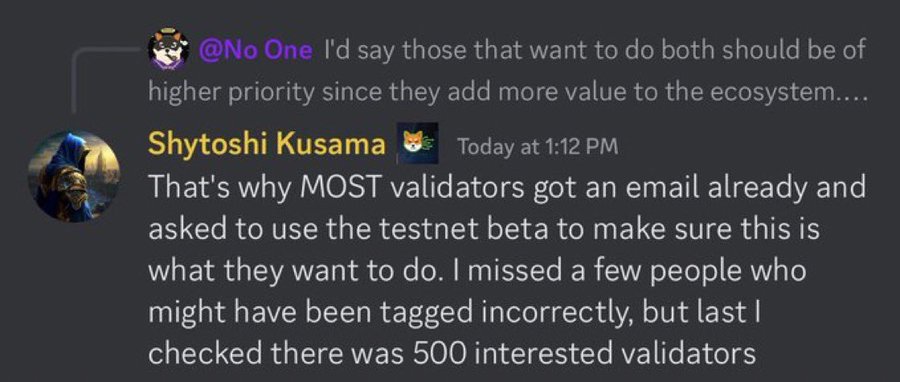
Shytoshi Kusama, the pseudonymous lead developer of Shiba Inu, has revealed a growing interest in Shibarium among validators. Per a screenshot shared by @sunshineSHIB, a Shiba Inu influencer, Kusama said 500 validators had shown interest in joining Shibarium.

The lead developer said most of these validators have already been invited to use the Shibarium Beta testnet. Giving most validators early access to the protocol will help them decide before the official network launches, Kusama said.

“[…] That’s why most validators have received an email asking them to use the testnet beta to help them decide if this is what they want to do,” he said. 

Kusama noted that the message was not sent to some applicants who have shown interest in becoming a Shibarium validator due to a tagging mistake.

“The last I checked, there were 500 interested validators,” Kusama added.

Image Source: https://twitter.com/sunshineSHIB/status/1640341605709234180?

For context, validators are blockchain nodes responsible for verifying and validating transactions on a network. These nodes are run by operators known as validator operators. Once Shibarium launches, the validator operators will be responsible for verifying the validity of transactions within the network. 

Notably, the number of Shibarium validators is limited to only 100 slots. Shiba Inu stated in January that it would select these validators based on their experience, knowledge, and trust. Since there is a limited slot, new validators can join the network when an active validator loses their slot.

Validators must stake at least 10K units of BONE tokens to become Shibarium validators.

Ripple CBDC Product Manager Contributes to New Digital Euro Association Paper

0

The DEA explores privacy concerns surrounding CBDCs.

The Digital Euro Association (DEA) has released a new whitepaper with contributions from Ripple Director of CBDC Product Management Anthony Ralphs.

The blockchain payments company disclosed this in a tweet today. The latest paper from the think tank explores privacy controls for central bank digital currencies (CBDCs), as explained in an accompanying blog post.

As highlighted in the article, privacy remains the primary concern of citizens when considering CBDCs, and these concerns must be tackled if governments are to ensure adoption. 

“It was a pleasure to collaborate with such an expert group of contributors on the CBDC and Privacy whitepaper,” Ralphs said in a written statement. 

“One thing the paper explores is that CBDCs—and the blockchain technology they are built upon—offer enhanced security and access management to help ensure privacy across the various use cases that are being implemented,” he added.

The DEA’s latest paper concludes that each central bank would have a different view on privacy. Consequently, it suggests the creation of minimum global standards. Some recommended measures include strong encryption, access restrictions, audits and deterrence against privacy violations.

A digital euro would “at least” offer the same level of privacy obtainable with today’s electronic payment methods, European Central Bank (ECB) president Christine Lagarde said in November. 

However, in a recent virtual Bank of International Settlements event, she also conceded that it would never provide the same level of anonymity as cash, as reported by Bloomberg. For this reason, cash would always be around, said Lagarde. Nonetheless, she hailed the “resilience” a CBDC could provide in times of conflict.

The ECB digital euro project remains in the “investigation phase.”

It bears mentioning that Ripple continues positioning itself as a solution provider in the CBDC race. As recently reported, Ripple Senior Vice President Brook Entwistle has disclosed that the firm is currently working with 20 countries on CBDC solutions. In addition, the company was also mentioned in the Bank of England’s digital pound consultation paper.