Home Blog Page 214

XRP Withdrawals From Binance Spike as ETFs Absorb $1.4B

On-chain data shows a notable shift in XRP supply dynamics, with large amounts of the asset moving off exchanges while inflows into ETFs continue to grow.

Recent data from CryptoQuant indicates that XRP withdrawal transactions from Binance have surged sharply in recent weeks. The surge coincided with strong capital inflows into spot XRP exchange-traded funds.

Key Points

  • XRP withdrawals from Binance surged, with 12,500–20,000 transactions recorded between Feb 21 and Mar 7.

  • The spike in withdrawals coincides with strong demand for XRP ETFs, which have attracted $1.4B in inflows since launch.

  • Analysts say rising exchange outflows may signal investors are shifting XRP into long-term storage.

  • Meanwhile, XRP Ledger activity is climbing, with daily transactions reaching about 2.7M.

XRP Withdrawal Transactions

Notably, the market saw between 12,500 and 20,000 withdrawal transactions between February 21 and March 7 on Binance. The trend suggests investors may be moving tokens away from trading platforms and into long-term storage.

Meanwhile, each spike in withdrawal transactions was followed by a sharp drop in the metric.

Image

Rising Withdrawals Hint at Supply Tightening

XRP commentator John Squire described the development as an “interesting signal” for the market. According to Squire, rising withdrawals from exchanges while ETFs accumulate billions in capital often indicate that investors are shifting coins into long-term holdings.

When assets leave exchanges, the amount of readily tradable supply decreases. Combined with continued inflows into ETFs, XRP supporters believe the dynamic could create a tightening supply environment that may impact XRP’s price.

XRP ETFs Continue to Attract Capital

Indeed, demand for regulated XRP exposure has remained strong even during a market pullback. Bloomberg analyst James Seyffart recently confirmed that XRP ETFs have collectively recorded about $1.4 billion in cumulative inflows since their launch in November 2025.

The steady inflows are particularly notable given that XRP’s price has declined over the same period. The asset has fallen 44% from around $2.5 at the time of the ETF launch to roughly $1.38. Despite this significant price drawdown, the funds have continued to attract new capital.

Seyffart noted that the data raises questions about the identity of many investors accumulating the funds.

Institutional Investors Reveal Early Positions

Among investors, Goldman Sachs emerged as the largest institutional holder of XRP ETF exposure. The firm reported roughly $153.8 million in XRP, equivalent to about 83.63 million XRP through various ETF products.

Other institutions have also taken positions, including:

  • Millennium Management with roughly $23 million in exposure
  • Citadel Advisors with about $4.52 million
  • Smaller allocations from firms such as Jane Street and DRW Trading Group

Several wealth managers and advisory firms also reported smaller positions, suggesting a broad mix of institutional interest.

Network Activity on the XRP Ledger Climbs

Meanwhile, activity on the XRP Ledger has been increasing. Daily transactions on the network have climbed to around 2.7 million. The surge reflects rising usage, partly driven by real-world asset tokenization initiatives building on the chain.

The total value of tokenized assets on the network has approached $461 million, highlighting expanding ecosystem activity.

Despite the improving on-chain metrics and ETF demand, XRP’s price has remained relatively stable in the short term. XRP has been consolidating between $1.30 and $1.44. Analysts believe a breakout may be delayed due to continued bearish sentiment across the broader crypto market.

Bitcoin Now at “Most Frustrating” Stage of the Cycle

0

For Bitcoin, three major market indicators currently point to a very frustrating period in the asset’s cycle, particularly for holders.

A combination of these three on-chain metrics explains the growing discontent among enthusiasts as Bitcoin enters a price range. With periods of hits and corresponding misses, here’s why this is the case and what could happen next.

Key Points

  • Bitcoin continues to fluctuate within a relatively narrow range, between $65,000 and $70,000.
  • Three major market indicators currently point to a very frustrating period in the asset’s cycle, particularly for holders.
  • The apparent demand metric shows unsustained demand.
  • The CryptoQuant Bull Market Cycle Indicator has identified volatile market conditions often associated with consolidation periods that appear during bearish phases. 
  • Meanwhile, the Long-Term Holder SOPR metric has recently fallen below the 1 threshold.

A Frustrating Time for Bitcoin Market Participants

Bitcoin is currently moving through a stage of the market cycle that verified CryptoQuant author Moreno considers one of the most difficult for participants to navigate. Instead of strong directional momentum, the premier asset is showing signs of indecision, with several on-chain indicators suggesting it is one of the most psychologically taxing periods in the current cycle.

For context, the current broader environment reflects uncertainty rather than clear conviction. Bitcoin continues to fluctuate within a relatively narrow range, between $65,000 and $73,000. Each rally sparks short-lived hopes of a foray to higher prices, only for a retracement to quickly kick in. This has not only wiped out late leveraged bets but also tested the patience of spot holders.

Three On-Chain Metrics Provide Context

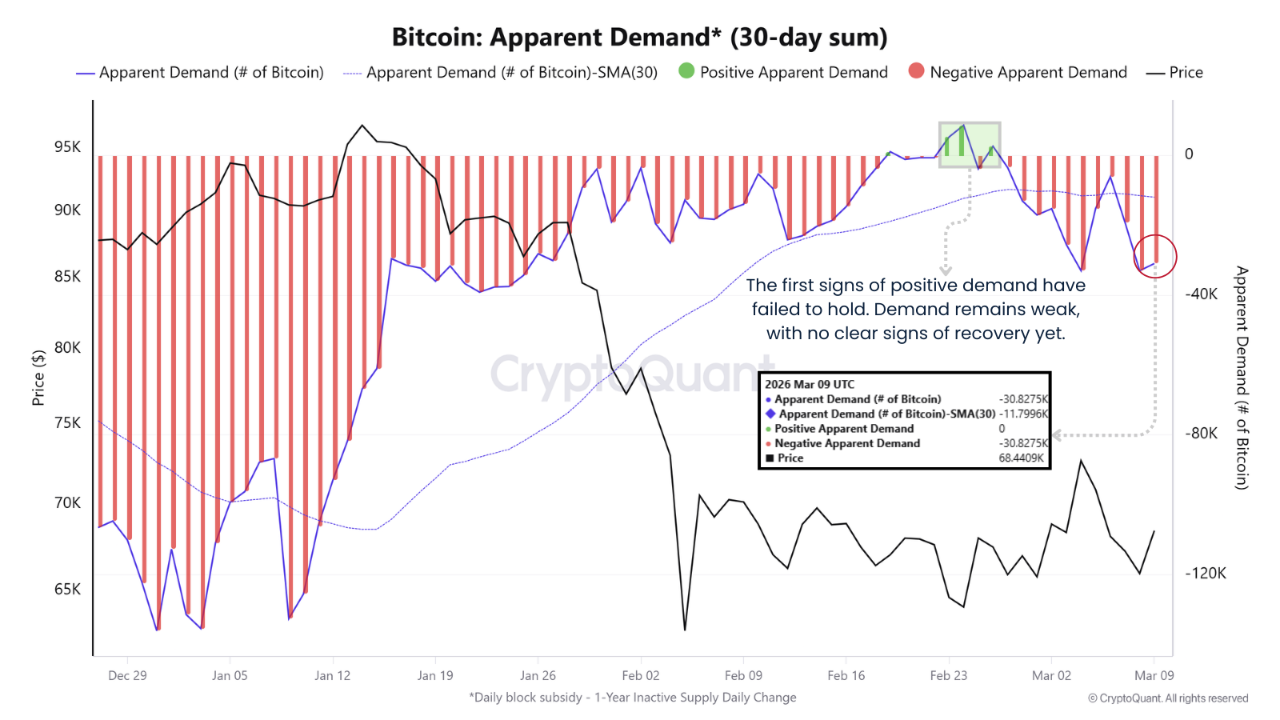
The analysis highlighted the “Apparent Demand” indicator as one of the clearest signals of the current market uncertainty. For the uninitiated, this metric attempts to measure the balance between new supply entering the market and coins being absorbed by buyers. 

After the recent market selloffs, the metric briefly hinted at a recovery as opportunistic buyers stepped in to buy the dip, resulting in a positive apparent demand. However, that improvement quickly faded.

Bitcoin Apparent Demand/CryptoQuant

Demand slipped back into negative territory, suggesting that buyers remain reluctant to accumulate aggressively at current levels. Rather than sustained buying pressure, a recent report from The Crypto Basic confirmed renewed distribution attempts by short-term holders, who took profits as the realized price moved above their entry price.

This event crippled recovery attempts, adding fresh selling pressure to Bitcoin. In earlier market cycles, this type of behavior appears when participants are uncertain whether a price rally might be a relief pump or the start of a longer recovery attempt.

Bitcoin Bull Market Indicator and LTH Behavior Shows Fatigue

The analysis also highlighted that the CryptoQuant Bull Bear Market Cycle Indicator presents a similar picture. Notably, the on-chain metric has identified conditions often associated with consolidation periods that appear during bearish phases.

Bitcoin Bull-Bear Market Cycle Indicator/CryptoQuant

During these stretches, price movements tend to become volatile while maintaining a broader sideways price trend. Those short-term pops and crashes tend to stir caution among Bitcoin investors.

Another important metric, Long-Term Holder SOPR, is beginning to show signs that even experienced market participants are under pressure. The indicator has fallen below the 1 threshold, indicating that some long-term holders are selling coins at a loss.

Bitcoin Long-Term Holder SOPR/CryptoQuant

Historically, this development tends to appear during the later stages of prolonged downturns. When uncertainty persists for extended periods, even investors who typically maintain strong conviction may begin to reduce their exposure. The liquidated positions enter the hands of new participants at lower cost bases.

In the meantime, Bitcoin trades at $70,350, near the upper boundary of its recent range. The next sustainable direction remains uncertain amid split analytical opinion. However, the next resistance lies at $74,000, and a break above it would elongate the short-term bullish trend.

Bitcoin Realized Cap UTXO Age Band Drops to Levels That Marked the Bottom in 2015, 2019, and 2022

0

A short-term Bitcoin realized cap UTXO age band has dropped to levels that historically aligned with price bottoms in past bear markets.

Notably, Bitcoin has staged a relief recovery above $70,000 amid the Israel-Iran conflict, as it eyes a second consecutive weekly gain for the first time in 2026. However, the broader picture remains weak, with the cryptocurrency still down 19.49% for the year and sitting 44% below its October 2025 all-time high of $126,000.

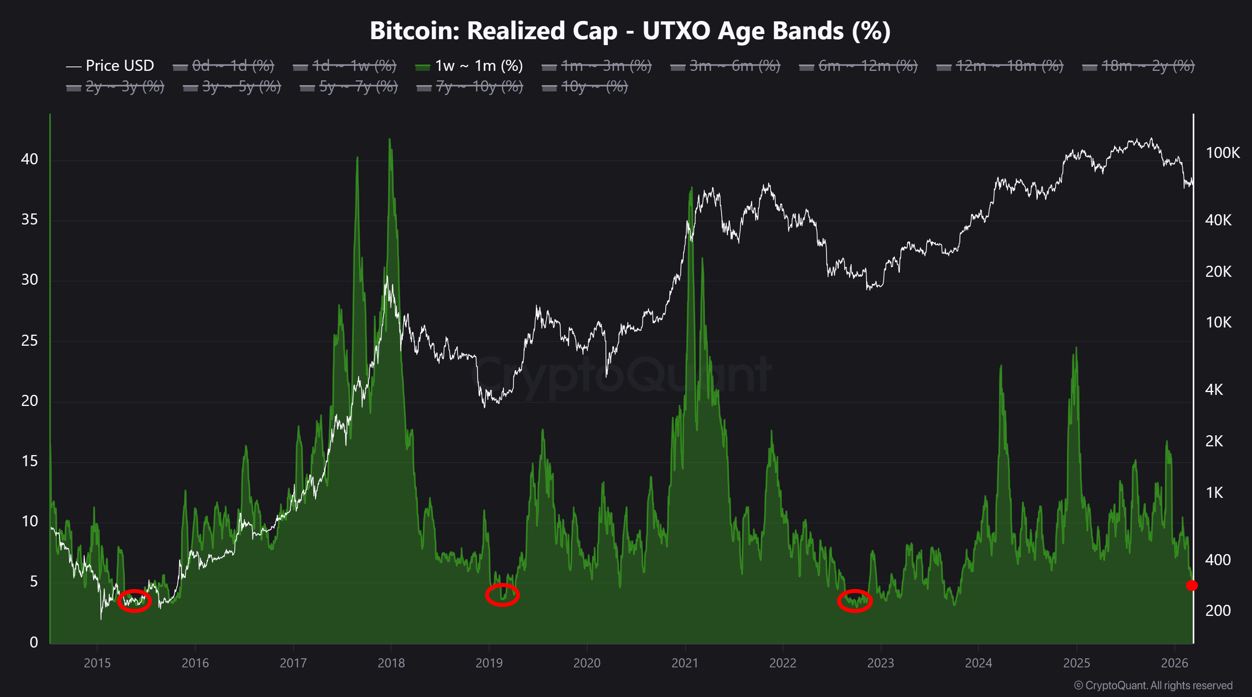
Amid the downturn, a major on-chain indicator now sends signals that have historically aligned with major market bottoms. The 1-week to 1-month UTXO age band’s share of Bitcoin’s total realized cap has dropped to 4.62%, a level that previously marked the bottom of bear markets in 2015, 2019, and 2022.

Key Points

  • Bitcoin currently trades at $70,400, down 19.49% in 2026 and 44% below its all-time high of $126,000 set in October 2025.
  • Notably, data shows the 1-week to 1-month UTXO age band now holds 4.62% of Bitcoin’s realized cap, reaching levels that have historically marked cycle bottoms.
  • This signal appeared at Bitcoin’s $198 low in August 2015, its $3,322 low in January 2019, and its $15,479 low in November 2022, each time preceding a major bull run.
  • While Bitcoin has entered a zone reasonably close to undervalued territory, the current level does not confirm a definitive bottom yet.

Bitcoin Indicator Hits Historic Lows

Notably, market analyst and CryptoQuant Korea Community Manager Dan flagged this important on-chain development in a recent commentary. Dan based his observation on the Bitcoin Realized Cap – UTXO Age Bands (%) indicator.

For the uninitiated, this indicator tracks how Bitcoin’s total realized value spreads across coins grouped by how long they have stayed unmoved. Realized cap is different from regular market cap because it values each coin at the price it last traded at instead of valuing it at today’s price. 

When it groups the coins by age, it then shows what share of the network’s capital sits with short-term holders versus long-term holders. At the moment, coins that last moved between one week and one month ago account for 4.62% of Bitcoin’s total realized cap.

Bitcoin Reasonably Close to Undervalued Territory 

Dan called the 1-week to 1-month holding ratio a tool that analysts often use to get a short-term read on Bitcoin’s liquidity. Notably, historical data reveals that the periods when this ratio dropped sharply often aligned with the lows from previous bear markets. 

However, he stressed that the current reading, while significantly lower, is not quite low enough to call a definitive bottom. Despite this, he said the historical context suggests that Bitcoin may have entered a zone that is reasonably close to undervalued territory.

Dan also acknowledged that the broader market mood remains shaky. Nonetheless, he pointed out that there comes a point where investors need to start engaging with the market rather than waiting on the sidelines indefinitely. 

Historical Data

Historical Data from the chart confirms Dan’s suggestion. Specifically, in August 2015, Bitcoin dropped to a low of $198, and at that point, the 1-week to 1-month age band’s share of realized cap fell below 5%, marking the cycle bottom. What followed was one of Bitcoin’s biggest bull runs, with the price eventually reaching $19,666 in December 2017.

Bitcoin Realized Cap UTXO Age Bands CryptoQuant
Bitcoin Realized Cap UTXO Age Bands | CryptoQuant

The same thing happened in January 2019, when Bitcoin hit a low of $3,322. The age band’s share once again fell to similar sub-5% levels, and that turned out to be the bottom of the bear market. Bitcoin then recovered, reaching $69,000 by November 2021. 

Then, in November 2022, with Bitcoin trading at $15,479, the indicator dropped below 5% once more, marking the final low before Bitcoin went on to hit its latest all-time high of $126,200 in October 2025.

Right now, the 1-week to 1-month age band share has once again dipped below 5%, with Bitcoin trading at $70,500. This marks the fourth time this signal has appeared near a major price floor, following similar readings in 2015, 2019, and 2022. 

No indicator can guarantee what comes next, but the fact that this pattern has held up across multiple cycles gives it real weight for anyone watching Bitcoin’s next move closely. However, as Dan said, it remains unclear if this confirms the definitive bottom.

Samson Mow: Bitcoin Unlikely Below $80K in Four Weeks, $100K More Likely

0

Samson Mow, the CEO of Jan3, has issued a bold short-term prediction about Bitcoin’s price trajectory.

Posting on X today, Mow reignited discussions about Bitcoin’s near-term price action, suggesting that the leading cryptocurrency could trade above $80,000 in the coming weeks. 

Key Points 

  • Samson Mow predicts Bitcoin is unlikely to trade below $80,000 over the next four weeks, implying a 13% rise from current levels.
  • He also expects Bitcoin to move closer to the $100,000 mark during this period.
  • Bullish voices such as Robert Kiyosaki support Bitcoin’s long-term outlook, while Arthur Hayes of BitMEX warns BTC could drop below $60,000.
  • Despite Mow’s optimism, investors must remain cautious, as some of his previous predictions have not come to fruition.

Bitcoin to Trade Above $80,000 in Early April 

Mow expressed strong optimism about Bitcoin’s near-term performance. He argued that the asset is unlikely to trade below $80,000 over the next four weeks, or early April 2026. Instead, he expects Bitcoin to move closer to the $100,000 mark during that period.

His comments reflect growing bullish sentiment among Bitcoin supporters who believe the asset may be entering a new upward phase after a recent downturn. Notably, Bitcoin last traded in the $80,000–$100,000 range in January 2026 before steadily declining to $60,000 on February 5. 

However, Mow believes the downtrend has ended and expects the cryptocurrency to reclaim $80,000 and potentially approach $100,000 again soon. 

BTC Reclaims $70,000 

Meanwhile, his forecast followed a recent rally in which Bitcoin briefly climbed to $71,500 yesterday. Although the price later slipped below $70,000 during a broader market pullback, it quickly recovered and currently trades around $70,625. From this level, the asset would need to rally about 13.3% to surpass $80,000.

In the meantime, sentiment has strengthened after the Bitcoin network minted its 20 millionth coin this week, highlighting the asset’s limited supply. Notably, Brian Armstrong of Coinbase emphasized Bitcoin’s scarcity as evidence of its decentralized and inflation-resistant design. Similarly, financial author Robert Kiyosaki urged investors to buy Bitcoin as a hedge against a potential market crash. 

Need for Caution 

However, not all analysts share the same short-term optimism. For example, Arthur Hayes, co-founder of BitMEX, warned that Bitcoin could drop below $60,000 if geopolitical tensions escalate between the U.S., Israel, and Iran. Despite this caution, Hayes still believes Bitcoin could eventually reach $250,000 later this year.

Notably, while Mow expects Bitcoin to trade within the $80,000–$100,000 range in the coming weeks, the outcome remains uncertain. Like many analysts, he has also made predictions that did not materialize.

For instance, he previously forecast that Bitcoin would reach $1 million before the end of last year, a milestone that never occurred, highlighting the need for caution when evaluating price projections. 

Bloomberg ETF Analyst Says XRP ETFs Have “Held Up Pretty Well,” Despite Sell off

XRP exchange-traded funds (ETFs) have continued to attract strong investor demand despite declines in the token’s price since their debut.

James Seyffart, a widely followed ETF analyst at Bloomberg, recently confirmed this in a post on X. He noted that XRP ETFs have performed relatively well even as the market cooled.

Key Points

  • James Seyffart says XRP ETFs have held up well, pulling $1.4B in inflows since launching in Nov. 2025.

  • Despite inflows, XRP fell from about $2.5 at launch to around $1.38, showing demand for regulated exposure.

  • Goldman Sachs leads disclosed holders with about $153.8M in XRP ETF exposure, equal to roughly 83.6M XRP.

  • Most demand may come from retail investors, as many ETF holders don’t appear in public filings like 13F reports.

$1.4B Inflow Since Launch

According to Seyffart’s data, the XRP ETFs have collectively attracted $1.4 billion in cumulative inflows since their launch in November 2025.

The inflows are notable given that XRP has experienced a significant pullback during the same period. The asset has declined from around $2.50 at the time of the ETF launch to roughly $1.11. Currently, XRP is trading at $1.38. Yet the investment products have continued to draw capital.

Image

Seyffart suggested that the steady inflows raise questions about who exactly is buying and holding the funds. He explained that only a fraction of ETF investors can be identified through regulatory filings such as 13Fs, meaning the majority of holders remain unknown.

Institutional Investors Reveal Early Positions

Among the disclosed investors, Goldman Sachs stands out as the largest known institutional holder of XRP ETF exposure. As of Dec. 31, 2025, the Wall Street giant held about $153.8 million worth of XRP exposure. This is equivalent to roughly 83.63 million XRP through various ETF products.

Other notable hedge funds and asset managers have also taken positions. These include Millennium Management, which reported about $23 million in holdings, and Citadel Advisors, which disclosed roughly $4.52 million in exposure.

Additional firms with smaller but still notable allocations include Jain Global and Logan Stone Capital, along with market-making and trading firms such as Jane Street and DRW.

Beyond these firms, numerous wealth managers and financial institutions reported smaller positions ranging from under $1 million to several hundred thousand dollars. This reflects a broad mix of institutional and advisory interest in XRP ETFs.

Image

Retail Demand Appears to Drive the Market

Seyffart noted that while institutional filings provide a partial snapshot of ownership, retail investors likely account for the majority of demand in XRP ETFs. Because most retail participants do not file 13F disclosures, their activity remains largely invisible in public data.

Still, the steady inflows indicate continued interest in regulated XRP exposure through traditional financial products.

XRP ETF Market Continues to Grow

The strong demand aligns with recent developments in the XRP ETF sector. Earlier this month, the Bitwise Asset Management XRP ETF became the largest XRP ETF in the United States, surpassing its main competitor from Canary Capital after attracting fresh inflows.

Specifically, Bitwise rose to the top position after bringing in $10 million in weekly inflows, pushing its assets to about $289 million. However, the latest figures show Canary Capital has reclaimed the top spot. It boasts a total XRP asset of $271.56 million while Bitwise’s product sits slightly below at $263.55 million.

Notably, the XRP ETF market also includes products from major issuers such as Franklin Templeton, 21Shares, and Grayscale Investments.

XRP ETF snapshot
XRP ETF snapshot

Ultimately, the sustained inflows suggest that both retail and institutional investors are continuing to build exposure to XRP through regulated investment vehicles.

Shiba Inu or Pepe: Which Could Make More Millionaires by 2030?

0

Following the recent relief rally, investors are debating which meme coin, Shiba Inu or Pepe, could deliver stronger returns by 2030. 

Both SHIB and PEPE have previously generated explosive gains and attracted retail investors seeking high-reward opportunities. However, differences in ecosystem development, tokenomics, and market positioning may shape their long-term wealth-creation potential.

Key Points

  • Although Shiba Inu and Pepe already delivered explosive gains in their early stages, investors are debating which could create more millionaires by 2030.
  • Telegaon projects that Shiba Inu could outperform Pepe, forecasting potential gains of up to 2,105% by 2030.
  • ChatGPT estimates that Pepe could deliver returns of up to 2,345%, compared to Shiba Inu’s projected 1,678%.
  • Both tokens remain under pressure this year, with Shiba Inu and Pepe down 18.5% and 18.7%, respectively, year-to-date. 

Pepe and Shiba Inu History 

For context, Shiba Inu launched in 2020 and quickly became one of the most prominent meme coins. Since then, the project has evolved into a broader ecosystem that includes decentralized finance tools, NFT initiatives, and the layer-2 network Shibarium. 

Meanwhile, Pepe debuted in 2023 and rapidly gained traction through strong community engagement and meme-driven marketing. Its growth has largely depended on social media hype and speculative trading rather than a broad ecosystem of products and services.

While both assets delivered massive early-stage returns, investors are now evaluating which token could create the most millionaires by the end of the decade.

Shiba Inu and Pepe’s Current Performance 

The crypto market has experienced significant downturns, with assets like Shiba Inu and Pepe incurring huge losses. As a result, both tokens have recorded notable year-to-date (YTD) losses, with SHIB down 18.5% and PEPE declining 18.7%. 

At press time, SHIB was trading at $0.000005623, while PEPE was changing hands at $0.000003271. Despite the bearish pressure, many market participants expect a recovery in the coming months, particularly if the Clarity Act is enacted and geopolitical tensions ease. 

Shiba Inu and Pepe Projections for 2030  

Looking ahead to 2030, prediction platform Telegaon estimates that SHIB could trade between $0.0000919 and $0.000124, representing potential gains of 1,534% to 2,105% from current levels. 

Telegaon 2030 Projection for Shiba Inu

Meanwhile, Telegaon projects that PEPE could reach $0.000056 under conservative conditions and $0.0000575 in a bullish scenario by 2030. From its current price, PEPE would need to rally 1,446% to hit the minimum target and 1,657% to reach the maximum forecast. 

Telegaon 2030 Projection for Pepe

Based on these projections, Telegaon suggests that SHIB could outperform PEPE and potentially create more millionaires by 2030. 

To put this into perspective, an investor holding 8.06 billion Shiba Inu, currently worth about $45,346, would become a millionaire if SHIB rises to $0.000124. By comparison, investing the same $45,346 in Pepe today would purchase 13.86 billion PEPE, which would be worth around $797,124 even if the token reaches its projected $0.0000575 target.

ChatGPT Forecast 

However, ChatGPT’s projections favor Pepe over Shiba Inu. Drawing on multiple forecasts, the model estimates that SHIB could trade within the range of $0.00003 – $0.00004 in bearish conditions, $0.00005 to $0.00007 in moderate scenarios, and $0.00008 to above $0.00010 in bullish conditions.

Notably, the upper $0.0001 target represents a potential 1,678% increase from the current price. 

ChatGPT 2030 Projection for Shiba Inu

For PEPE, ChatGPT projects a $0.000005–$0.00001 range in bearish scenarios, $0.00001–$0.00003 in moderate conditions, and $0.00003–$0.00008 in bullish environments.

The upper $0.00008 projection would represent a 2,345% increase from current levels, suggesting that PEPE could deliver larger percentage gains under strong market conditions than Shiba Inu. 

For context, investors holding 12.5 billion PEPE would see their portfolio grow to $1 million if the token climbs to the projected $0.00008 level. At the current price, those 12.5 billion PEPE are worth about $40,887.

However, investing a similar amount in SHIB today would buy around 7.27 billion SHIB, which would be valued at approximately $727,138 if SHIB reaches its projected $0.0001 target by 2030. 

ChatGPT 2030 Projection for Pepe

Notably, the contrasting forecasts from Telegaon and ChatGPT highlight the uncertainty surrounding long-term crypto predictions. Nonetheless, the performance of both tokens will likely depend on several factors, including market adoption, ecosystem development, token supply dynamics, and the overall growth of the cryptocurrency market. 

CZ Disputes Forbes Estimate Putting His Net Worth at $110B

0

Changpeng Zhao, widely known as CZ, has challenged a recent estimate of his personal fortune after Forbes ranked him among the world’s richest individuals.

The Binance founder said the reported figure does not accurately reflect his financial reality and described billionaire rankings as largely speculative. His comments came following a report that valued his wealth at roughly $110 billion, placing him 17th on the global rich list.

Key Points

  • Forbes estimated Binance founder CZ’s net worth at $110 billion, ranking him 17th globally.
  • Zhao disputes the ranking, calling billionaire lists speculative and unreliable when it comes to crypto-linked wealth.
  • The bulk of Zhao’s fortune comes from Binance, of which he controls approximately 90%, valued at around $100 billion.
  • Binance generated $16–17 billion in revenue and handled $30 trillion in annual trading volume, holding 38% of the global crypto exchange market.
  • His reported wealth now surpasses figures of traditional billionaires like Bill Gates ($108B) and Michael Bloomberg ($109B), highlighting crypto’s rising influence.

CZ Questions Billionaire Ranking

Zhao addressed the estimate in a post on X, arguing that wealth rankings often rely heavily on assumptions rather than verified financial disclosures.

He also noted that estimating the fortunes of cryptocurrency businesses can be particularly difficult due to market volatility. According to him, the crypto market has yet to return to its previous highs. Specifically, he highlighted that Bitcoin and many other digital assets remain roughly 50% below their all-time peaks.

Despite his skepticism, the ranking still places Zhao among the small group of individuals with fortunes exceeding $100 billion. This status places him firmly within the upper tier of global billionaires.

Binance Valuation Drives Wealth Surge

Much of the estimated increase in Zhao’s wealth is linked to the performance and valuation of Binance, the cryptocurrency exchange he founded in 2017.

As the company’s dominant shareholder, Zhao stands to benefit directly from any rise in its market value. According to market estimates cited by Forbes, Binance’s valuation is around $100 billion. Zhao is widely believed to control roughly 90% of the company, a stake that largely accounts for the magnitude of his estimated fortune.

Operational figures further highlight the exchange’s scale. Reports indicate Binance generated approximately $16–17 billion in revenue during 2024–2025. In addition, the platform processed more than $30 trillion in annual trading volume. This impressive activity allowed it to capture about 38% of the global crypto exchange market.

These metrics highlight why shifts in Binance’s valuation can significantly influence estimates of Zhao’s personal wealth.

Legal Case and Presidential Pardon

Zhao’s recent financial standing developed after a major legal episode involving Binance.

In November 2023, he admitted to a regulatory violation linked to shortcomings in the company’s anti-money laundering (AML) procedures. The settlement imposed a $50 million personal fine on Zhao and required Binance to pay $4.3 billion.

Moreover, Zhao stepped down as Binance’s CEO as part of the deal. Subsequently, he served four months in prison in the U.S.

The situation evolved further in October 2025, when President Donald Trump granted him a full presidential pardon.

Trump said at the time that he did not personally know Zhao. Nevertheless, the Binance founder later appeared at a Mar-a-Lago forum hosted by World Liberty.

Standing Among Global Billionaires

Regardless of debates over the accuracy of wealth estimates, Zhao remains the most prominent billionaire in the cryptocurrency industry.

His reported fortune places him ahead of several well-known financial figures on the Forbes list. These include Michael Bloomberg, co-founder of Bloomberg LP, whose wealth is estimated at $109 billion.

Other financiers ranked below Zhao include trading executive Jeff Yass, worth roughly $67.4 billion, and hedge fund leader Ken Griffin, with an estimated net worth of $49.8 billion.

Perhaps most notable is Zhao’s position relative to Bill Gates. The Microsoft co-founder’s wealth is estimated at around $108 billion, according to Forbes. Gates’ fortune has declined in recent years due to significant charitable donations and his 2021 divorce from Melinda French Gates.

Consequently, Gates now sits two places below Zhao on the global ranking, underscoring the rapid rise of crypto-linked fortunes in the broader billionaire landscape.

Dogecoin Price Analysis: Any DOGE Breakout Depends on Price Breaking Above This Resistance

0

Dogecoin remains capped by overhead resistance, with any breakout now depending on stronger momentum and follow-through.

Dogecoin (DOGE) currently trades for $0.09178, a notable 3.98% decline over the past 24 hours with a corresponding drop of $0.00381 in absolute terms. The daily chart illustrates a clear downward trajectory in the short term, with the price line dipping from a recent high near $0.1002 to the current level. 

This comes amid a broader crypto market cooldown, where altcoins have witnessed reduced hype and increased overhead supply resistance. The Dogecoin Open Interest sits at $1.11B, suggesting active positions that could amplify volatility.

Meanwhile, futures volume has reached $4.60B while spot volume is at $556.25M, indicating sustained interest from derivatives traders despite the price dip. For now, Dogecoin investors have continued to monitor key levels like $0.093 for breakout signals. 

Can Dogecoin Break Overhead Resistance?

Dogecoin’s daily chart suggests overhead resistance remains the main obstacle to any stronger recovery. Price is trading around $0.0918, while the Donchian Channel midline sits above it near $0.0965, and the upper band is much higher near $0.1061. 

Dogecoin Price Analysis

That setup shows DOGE remains trapped in the lower half of its recent trading range, which usually means bulls have not yet regained control. For now, any breakout case depends on DOGE first reclaiming the channel basis around $0.096.

The CRSI reading near 36.05 adds a cautious tone. Momentum has cooled and is sitting below neutral, which suggests the market is not yet oversold enough to force a reversal. However, it is not strong enough to confirm fresh upside traction. 

Dogecoin can still attempt a push higher, but the current indicators favor a grind against resistance rather than a clean breakout through it. Ultimately, a decisive move above the Donchian midline would improve the short-term outlook.

Dogecoin’s Social Media Commentary

On the social commentary end, Trader Tardigrade also pointed to a potentially bullish longer-term setup on Dogecoin’s 3-day chart. He says the meme coin is forming a pattern similar to one seen before its strong 2024 rally. 

Dogecoin Prediction
Dogecoin Prediction

According to the analyst, the structure now bears watching for three key signals: a breakout from the current range, a clear momentum shift, and sustained follow-through. 

That view adds an important contrast to the shorter-term resistance picture, because it suggests Dogecoin may still be building a larger bullish trend towards levels above $0.6. To reach $0.60, DOGE would need to surge by about 553.7% from the current $0.09178.

U.S. Financial and Investing Advice Firm Shares 4 Reasons to Buy XRP with $2,500 and Hold for 5 Years

0

The Motley Fool, a leading U.S.-based investing advice firm, has presented four reasons investors should buy XRP worth $2,500 and hold for five years.

XRP has dropped 25% this year amid a broader crypto market downturn, but many analysts see the decline as a buying opportunity rather than a reason to exit, insisting that a rebound could ensue before long.

The Motley Fool, a well-known U.S. financial and investing advice firm, recently joined this campaign with a surprise endorsement for XRP. Notably, the company presented four reasons why investors should commit $2,500 into XRP and hold it for five years.

Key Points

  • XRP has fallen 25% this year, but The Motley Fool recommends a gradual $2,500 investment held until early 2031.
  • The U.S.-based financial and investing advice company mentioned upcoming XRPL network upgrades and stablecoin and tokenization growth as reasons for its opinion.
  • For instance, tokenized commodities on the XRPL recently surpassed $1 billion, indicating that XRP has captured a large chunk of the $7 billion market.
  • Stablecoin supply on the XRPL has also reached $430 million, indicating rising network activity and stronger long-term demand for XRP.

The Motley Fool Makes Its Case for XRP

In a recent report, The Motley Fool highlighted XRP’s 158% price gain over the past five years as evidence that the crypto asset has already shown what it can do, rather than simply promising future results. 

The firm suggested that XRP was sitting at the start of what could be a very exciting stretch for holders, with a long list of planned network upgrades acting as the main reason for its positive outlook.

While the Motley Fool noted that investors could commit $2,500 into XRP, it suggested that they should spread the investment gradually over the next few months instead of committing everything at once. This points to a dollar-cost averaging (DCA) technique.

The report also clarified that the money should be funds investors can leave alone until around early 2031, roughly five years from now, and should not come from money needed for day-to-day expenses or emergencies.

Confidential Transfers Could Lead to Institutional Demand

The firm then presented four reasons they believe XRP could perform well within this period. First, a major part of The Motley Fool’s case is on a major feature the XRP Ledger plans to roll out in the first half of 2026, which involves giving users the ability to make confidential transfers. 

Notably, the report stressed that currently, most blockchains work like open books, where anyone can look up another user’s transaction history and account balances. Everyday crypto users tend to accept this, but for financial institutions and businesses that keep their payments and positions private, this much transparency is a serious problem.

According to the report, the XRPL plans to fix this by using advanced cryptography to hide transaction amounts while still allowing selective data sharing for audits and regulatory checks. This confidentiality feature will also cover tokenized real-world assets such as stocks and bonds held on the XRPL. 

XRPL Compliance Tools

The Motley Fool’s second reason involves the compliance tools the XRPL continues to build out. Notably, creating a token is not particularly difficult on a technical level, but enforcing the rules around who can hold, move, freeze, claw back, or delete those tokens is where things get complicated for regulated financial players. 

Meeting those requirements is often a legal condition for doing business, not an optional extra. The XRPL actively develops these compliance tools in the form of Permissioned DEX, Permissioned Domains, and Credentials, which make the network a more capable and reliable place to manage tokenized assets over time. 

As financial institutions look around for the right blockchain platform to handle their tokenized capital, a network that already meets regulatory standards will likely stand out. This growing reputation for compliance is something The Motley Fool sees as a steady driver of XRP’s value in the years ahead.

Tokenized Commodities and Stablecoins

For the third reason, The Motley Fool highlighted the rise of tokenized commodities. Per the report, during the 30-day period ending Feb. 20, the total market cap of tokenized commodities jumped 20% to hit $7 billion. At press time, the figure has increased further to $7.59 billion.

The XRPL already acts as the record-keeping layer for $1.1 billion worth of those commodities, a position it built through its compliance features and its automated market maker (AMM). As the network adds more features over the next five years to bring in additional tokenized commodity capital, The Motley Fool expects the growth to push demand for XRP higher.

The fourth reason involves stablecoins. The XRPL currently holds $430 million in stablecoins, most of which come from Ripple’s stablecoin, RLUSD. Per the report, this figure grew by more than 7% in just 30 days. 

The Motley Fool believes that as more users and developers see capital building up on the XRPL and looking for a return, they will feel more confident putting their own money to work on the network or building financial services on top of it. Since every transaction on the ledger requires XRP, a growing stablecoin supply points directly to stronger long-term demand for the coin.

Crypto Co-founder Says the Path XRP Follows Is Not a Mystery

A well-known crypto co-founder has insisted that XRP follows a clear path in its overall global mission despite the short-term price disruptions.

This commentary came from Vandell Aljarrah, a prominent XRP community figure and co-founder of the Black Swan Capitalist. According to him, the path XRP has chosen to take is not a mystery.

Key Points

  • Aljarrah recently suggested that XRP’s overall path is not a mystery, referencing content he had originally shared in January 2025.
  • The January 2025 post featured remarks from Rosie Rios, a former U.S. Treasurer who joined Ripple’s board of directors in May 2021.
  • Rios spoke at a past Global Business Summit where she called XRP a tool used by legitimate financial institutions to settle cross-border payments in seconds and at minimal cost.
  • Rios is believed to have left the board around January 2026, though neither she nor Ripple has released any official statement confirming the date or reason for her departure.
  • Despite this, Aljarrah insisted Rios’ exit was a positive development, arguing that she had fulfilled her responsibilities as part of a larger agenda.

XRP’s Path Not a Mystery

Notably, Aljarrah presented these opinions in a post on X amid the ongoing market struggles. For context, XRP has been going through a rough patch price-wise as the broader crypto market faces a difficult period. However, individuals like Vandell Aljarrah have maintained their focus on the larger goal. 

Some of these individuals believe XRP is gradually moving toward assuming an important role in the global financial system. The exact details of how and when this happens remain speculative, but most of these voices highlight XRP’s function as a bridge asset as their primary motivation.

Aljarrah’s latest comments about XRP’s path being clear for all to see come as these discussions have dominated the XRP community. While the market pundit failed to provide further details about what he meant, the post pointed back to something he had shared in January 2025.

Rios’ XRP Commendation

For context, the January 2025 post from Aljarrah included remarks from Rosie Rios, a former U.S. Treasurer who stepped onto Ripple’s board of directors in May 2021 after serving as the United States’ 43rd Treasurer from 2009 to 2016. 

The remarks came from a video of her speaking at a past Global Business Summit. In her appearance, Rios explained why she chose to join Ripple’s board, and her reason revolves around the practical value she saw in XRP. 

While speaking, she highlighted the attention the entire crypto industry had continued to receive and confirmed her connection to the space through her board role at Ripple.

Interestingly, Rios linked Ripple and XRP together. She said her decision to join the board came from the fact that XRP has a real and specific purpose, acting as a tool that makes cross-border payments faster and far less expensive. 

She pointed out a difference between XRP and what she described as arbitrary stores of value with no real backing, arguing that XRP represents something legitimate financial institutions actually use. 

Aljarrah’s Take on Rios Leaving the Ripple Board

Meanwhile, recent data suggests Rios is no longer part of Ripple’s board. At press time, Ripple’s official leadership page lists its board as Chris Larsen serving as Executive Chairman, Brad Garlinghouse as CEO, and Anja Manuel, Sandie O’Connor, David Schwartz, Warren Jenson, and Masashi Okuyama rounding out the rest. 

Ripple Board of Directors

Rios is absent from that list, and available information suggests she stepped down around January 2026. Ripple has not released any official statement confirming the exact date or reason for her departure.

When Aljarrah addressed the fact that Rios had left Ripple’s board, he argued that it was bullish. He suggested that she may have left because she had completed whatever tasks she had been brought on to handle as part of a bigger agenda. However, he failed to provide any further context on this.

It is important to note that neither Ripple nor Rios has publicly explained her exit. Some community discussions have suggested that her role had to do with helping Ripple maintain credibility during its legal dispute with the SEC, but all these speculations lack any confirmation from an official source.