Home Blog Page 213

Wells Fargo Files “WFUSD” Trademark, Hints at Stablecoin Ambitions

0

The $2.1 trillion financial services giant, Wells Fargo, has applied to trademark “WFUSD” for services related to digital assets and blockchain technology.

The application was submitted on March 10, according to records from the United States Patent and Trademark Office. The filing has already been accepted and placed in the agency’s processing system.

However, the process is still in its early stages. The application has not yet been assigned to an examining attorney. Based on typical USPTO timelines, the review queue can extend beyond 10 months before a detailed examination begins.

The filing suggests that the San Francisco bank may be exploring services related to cryptocurrency and stablecoins.

Key Points

  • Wells Fargo submitted the trademark application for “WFUSD” on March 10, 2026, to the USPTO.
  • The application is still under review and may take more than 10 months to process.
  • The filing covers three service classes: IC 009 (technology products), IC 036 (financial services), and IC 042 (software development).
  • Services described include crypto transaction software, trading platforms, exchange services, and digital payment systems.
  • Similar filings by firms like Western Union and JPMorgan indicate interest in blockchain experimentation.

Trademark Covers Crypto Software and Financial Services

The application outlines service categories related to financial technology and digital asset infrastructure. It specifies three trademark classes, IC 009, IC 036, and IC 042, which cover technology products, financial services, and software development.

In practical terms, the filing references software designed to facilitate financial transactions using digital assets. It also includes platforms for cryptocurrency trading, exchange services, and digital payment systems.

Additionally, the application mentions software tools for processing cryptocurrency, stablecoins, and other blockchain-based assets.

Taken together, these descriptions indicate that the trademark could support a range of blockchain-based financial tools. However, the filing itself does not confirm whether Wells Fargo intends to launch a stablecoin or any specific digital asset product.

Similar Trademark Moves by Other Financial Firms

Wells Fargo is not the only financial institution exploring trademark registrations in digital assets. For instance, Western Union previously filed an application for “WUUSD,” which included two identical service categories—IC 009 and IC 036—indicating a similar focus on potential crypto-related services.

The filing attracted attention after the company later revealed plans to develop a U.S. dollar-backed stablecoin under the ticker USDPT. The firm plans to launch the token on the Solana network in 2026.

In the cryptocurrency market, tickers containing “USD” often signal a stablecoin pegged to the U.S. dollar. However, past cases show that such naming conventions can sometimes lead to incorrect assumptions.

Past Filings Show Tickers Can Be Misleading

Trademark applications from major banks frequently trigger speculation in crypto markets.

One example came in June last year, when JPMorgan Chase filed a trademark application for “JPMD.” Some crypto users initially interpreted the filing as a potential stablecoin project.

However, the bank later clarified that JPMD refers to a tokenized deposit product, rather than a dollar-pegged stablecoin.

According to filing records, the trademark application remains under review. The episode highlights how trademark filings often signal experimentation with blockchain technology rather than confirming specific product launches.

Wells Fargo’s Broader Crypto Strategy

Wells Fargo’s interest in digital assets has been developing for several years. As early as 2020, the company opposed claims that cryptocurrency was merely a short-term trend, signaling openness to blockchain financial innovation.

The bank expanded its involvement in early 2024 by giving clients access to Bitcoin exchange-traded funds (ETFs).

More recently, reports indicated that Wells Fargo was included in discussions among several banks about launching a joint stablecoin initiative.

Ripple CEO Highlights XRP ETFs Impressive Milestone

0

Ripple CEO Brad Garlinghouse has highlighted the remarkable performance of spot-based XRP exchange-traded funds (ETFs).

In a simple post on X, Ripple CEO reignited public interest in XRP as spot ETFs showed resilience amid the ongoing price slump.

Key Points

  • Ripple CEO Brad Garlinghouse highlighted the resilience of XRP spot ETFs, which continued attracting capital despite XRP’s price decline.
  • Data from Bloomberg shows ETF inflows rising from $150 million on November 13, 2025, to about $1.44 billion by March 4, 2026.
  • XRP currently trades around $1.37, yet cumulative ETF inflows still exceed $1.2 billion.
  • Total net assets across XRP ETFs have fallen below $1 billion.

Ripple CEO Reacts to XRP ETFs’ Strong Performance

Garlinghouse reacted to commentary from James Seyffart of Bloomberg Intelligence, who noted that XRP ETFs continue to attract capital even as the underlying asset’s price declines. According to Seyffart, cumulative inflows into the products reached about $1.4 billion as of March 4, reflecting steady institutional demand.

Notably, data from Bloomberg shows inflows rising consistently from about $150 million on November 13, 2025, when Canary Capital launched the first XRP ETF, to roughly $1.44 billion by March 4, 2026.

Image

In response, Garlinghouse reacted with a simple ‘eyes’ emoji, which many XRP enthusiasts interpreted as an acknowledgment of the milestone.

XRP ETF Inflows Soar Despite Price Dip

Since the first ETF launched in mid-November, these funds have recorded mostly consistent inflows, with only a few days of outflows. By mid-December, cumulative net flows had already surpassed $1 billion despite a sharp decline in XRP’s price.

For context, XRP traded at around $2.50 when the first spot ETF began trading in the U.S. However, the token dipped below $2 in December.

Nonetheless, institutional investors continued allocating funds, pushing ETF inflows past the $1 billion mark. With XRP now trading around $1.37, the products hold more than $1.2 billion in cumulative inflows as of press time.

This trend contrasts with typical trading behavior, where capital often exits during price declines. Instead, steady ETF inflows suggest institutional investors have used market weakness to accumulate XRP exposure.

Net Assets Fall Below $1B

Although XRP ETF inflows stand at $1.21 billion, total net assets have fallen below $1 billion. At press time, combined assets across XRP ETFs stood at $985.73 million, largely due to four consecutive days of outflows between March 5 and 10.

Currently, the Canary XRP ETF (XRPC) leads the U.S. market with $273.02 million in net assets. It recently reclaimed the top spot from the Bitwise XRP ETF, which now ranks second with $264.88 million in assets.

Meanwhile, the Franklin XRP ETF, 21Shares XRP ETF, and Grayscale XRP ETF hold the third, fourth, and fifth positions, with net assets of $225.65 million, $156.11 million, and $66.07 million, respectively.

Ethereum Price Forecast for Mar 12: Can ETH Rebound While Trading Below Major SMAs?

0

Ethereum remained under pressure below major trend levels, while heavy trading activity still failed to confirm a rebound.

Ethereum (ETH) trades at $2,025.67, up just 0.12% on the day, after an intraday rally toward the $2,080 area faded into a retreat back near $2,020. This reversal matters more than the small daily gain because it suggests buyers could lift the price temporarily but could not defend higher levels. 

The more unusual angle is in the market structure behind the move: futures volume stands at $44.94 billion, while spot volume is just $2.94 billion. That gap suggests Ethereum is seeing far more speculative turnover than spot-led activity, which often points to short-term trading intensity.

Ultimately, Ethereum does not look ignored or inactive. Instead, it looks stuck in a high-participation and low-conviction phase. Here, heavy trading interest keeps returning but fails to produce durable upside.

Where’s Ethereum Headed?

Ethereum’s daily chart still looks structurally weak, and the moving averages make that clear. ETH trades below $2,030, which leaves it below the 50-day SMA at $2,187, the 100-day SMA at $2,637, and the 200-day SMA at $3,271. That stacked alignment shows trend damage across short-, medium-, and long-term timeframes, with each major average now acting as overhead resistance.

Ethereum 1D Chart
Ethereum 1D Chart

More importantly, the recent sideways movement near $2,000 does not yet reveal reclaiming strength. It shows ETH stabilizing well beneath its trend markers, which usually means the market is trying to build a floor, not launch a confirmed reversal.

The Aroon indicator adds to that cautious view. Aroon Up sits near 42.86%, while Aroon Down is much lower at 14.29%, suggesting bullish trend pressure remains weak even after the recent consolidation. In simple terms, Ethereum has stopped falling aggressively, but buyers still have not produced the kind of persistent highs needed to shift trend control. 

Ethereum Liquidation Data

Ethereum liquidation data also showed a mixed but slightly bearish short-term derivatives picture. Over the past hour, total liquidations reached $115,720, with shorts accounting for $64,380 and longs for $51,330.

ETH Liquidation Data

In the 4-hour window, total liquidations stood at $1.20 million, including $184.54K in short liquidations and $1.02 million in long liquidations. Over 12 hours, total liquidations hit $7.71 million, with longs making up $6.72 million versus $987.99K for shorts. 

The 24-hour figures showed the largest wipeout, with $43.23 million in total liquidations, including $19.27 million in longs and $23.97 million in shorts.

Elon Musk Officially Speaks About His Shiba Inu Holdings

0

Billionaire entrepreneur Elon Musk addressed a question about how many Shiba Inu tokens he holds in his crypto portfolio.

A widely followed crypto influencer resurfaced a comment regarding Musk’s likely SHIB holdings. The post attempted to suggest that Musk’s comment had negatively impacted the Shiba Inu price.

Key Points

  • Elon Musk in 2021 said he holds no Shiba Inu tokens.
  • He revealed that he owns only Bitcoin, Dogecoin, and Ethereum.
  • The billionaire has consistently snubbed Shiba Inu despite the ecosystem’s efforts to get his attention.
  • Despite maintaining his distance from Shiba Inu, he has remained closely associated with its rival, Dogecoin.

Elon Musk Confirms Not Owning Any Shiba Inu

On October 24, 2021, Musk responded to a popular community figure known as “SHIB Holder,” who asked how many Shiba Inu he owned. Musk replied that he did not own any Shiba Inu tokens, ending speculation that he might have accumulated SHIB behind the scenes.


Notably, the question emerged because Musk had already become a prominent supporter of Dogecoin. His frequent posts about the meme coin significantly influenced its popularity and price movements.

In addition, his company, SpaceX, enabled Dogecoin payments for select merchandise, further strengthening his association with the asset.

Given this close relationship with Dogecoin, many crypto enthusiasts wondered whether Musk had also invested in Shiba Inu, which was gaining traction at the time. However, his response made clear that he held no SHIB.

Shiba Inu Still Reached an ATH

Although Musk’s statement triggered a brief pullback in SHIB’s price, it did little to slow the token’s momentum. At the time of the exchange, SHIB traded between $0.000033 and $0.000044.

However, just four days later, on October 28, 2021, the token surged to an all-time high of $0.00008845. Since then, Shiba Inu has fallen sharply from its peak and currently trades about 93.55% below that record level, around $0.000005703.

Musk Ignores Shiba Inu Team

Since that interaction, Musk has largely avoided engaging with members of the Shiba Inu community. Nonetheless, the project’s developers and supporters have repeatedly attempted to attract his attention.

For instance, Shiba Inu lead developer Shytoshi Kusama proposed the Strategic Hub for Innovation in Blockchain (S.H.I.B.), suggesting it could contribute to initiatives linked to Donald Trump’s administration. The proposal followed Musk’s planned launch of the Department of Government Efficiency.

Additionally, the Shiba Inu team highlighted several ecosystem achievements in hopes of securing Musk’s recognition or endorsement. Supporters believe that if Musk backed SHIB the same way he supports Dogecoin, it could trigger significant market momentum.

So far, Musk has remained silent on those efforts and continues to distance himself from the Shiba Inu project. Nonetheless, he has confirmed that he holds a few cryptocurrencies in his personal portfolio, including Dogecoin, Ethereum, and Bitcoin.

XRP Still Not Moved Despite Ripple’s $750M Share Buyback and MasterCard Inclusion

0

XRP remains unmoved despite reports confirming Ripple’s $750 million share buyback and the firm’s inclusion in MasterCard’s latest program.

XRP has failed to respond to two major bullish developments surrounding the Ripple ecosystem that emerged within the last 24 hours, still recording considerable losses and trading at $1.37.

The two developments include Ripple’s $750 million share buyback program, which values the company at approximately $50 billion, and Ripple’s inclusion in Mastercard’s newly launched Crypto Partner Program alongside more than 85 global partners.

Key Points

  • Recent reports confirmed Ripple has launched a share buyback program worth up to $750 million, valuing the company at approximately $50 billion, up from $40 billion last year.
  • Also, Mastercard recently launched its Crypto Partner Program, including over 85 companies, with Ripple explicitly named as one of the partners.
  • Despite both developments, XRP has dropped 1.42% over the last 12 hours, down more than 51% since Q4 2025.
  • XRP’s inability to react to positive Ripple news shows how most top altcoins take their directional cues from the broader market.

Ripple Launches $750M Share Buyback

Notably, Bloomberg first reported the development surrounding Ripple’s share buyback, citing people familiar with the matter. According to the report, Ripple is launching a share repurchase program worth up to $750 million, covering shares held by both investors and employees through a tender offer. 

The program places Ripple’s valuation at approximately $50 billion, which marks a 25% jump from the company’s previous valuation of $40 billion. The earlier $40 billion valuation came from a $500 million funding round completed last November, backed by major institutions including Galaxy Digital, Citadel Securities, and Pantera Capital, among others. 

The new buyback program, expected to run through April 2026, gives early investors, secondary holders, and employees a way to cash out without requiring Ripple to go public through an IPO. Ripple itself has not confirmed any of the details, with every report relying on anonymous sources. 

Mastercard Debuts Its Crypto Partner Program with Ripple on Board

The second development involves Mastercard’s launch of its Crypto Partner Program. For context, the program involves 85 crypto-native companies, payments providers, financial institutions, and blockchain entities within one global framework. Ripple is one of the explicitly named partners, joining a list that also includes Binance, PayPal, Crypto.com, Bybit, Circle, Paxos, Gemini, and Paxos.

Mastercard built the program to connect blockchain tools with its payments infrastructure across more than 200 countries, focusing on practical use cases such as cross-border transfers, B2B payments, global payouts, and programmable payments. 

The program follows Mastercard’s earlier digital asset work, including its Crypto Card programs and Start Path initiatives, and indicates a move away from experimentation toward real-world application at scale. 

Recall that in November 2025, Mastercard and Ripple ran a pilot announced at Ripple’s Swell event, where Ripple’s RLUSD stablecoin, running on the XRP Ledger, was tested for settling Mastercard credit card transactions through partners like Gemini and WebBank. 

XRP Shows No Reaction

Interestingly, XRP has not shown any bullish reactions to the two developments. Instead, the token continues to follow the broader crypto market lower, dropping 1.42% over the last 12 hours and recording three consecutive losing 4-hour candlesticks in the process.

XRP Seeing Three Straight Red 4h Candles

XRP has now fallen more than 51% since Q4 2025 and sits roughly 62% below its all-time high of $3.60, which it reached in July 2025. The sustained decline has wiped out a large portion of earlier gains and left XRP with very little upward momentum to work with.

This situation shows how most top altcoins, including XRP, mostly take their directional cues from the broader market. With the wider market bearish, XRP may not have the macro support it needs to push higher on its own. However, most analysts still hold a constructive view on XRP’s longer-term prospects, expecting the token to outperform once the broader market turns.

Ripple Sells XRP to Fund Shares Buybacks, Institutional Investors buy Equity in Ripple, not XRP: Analyst

Crypto commentators are accusing Ripple of using proceeds from XRP sales to finance share buybacks.

They are raising questions about whether retail token holders truly benefit from the company’s expansion. Notably, the discussion emerged amid news that Ripple has launched a share buyback program valuing the company at roughly $50 billion.

Key Points

  • Ripple has launched a $750M share buyback that values the company at about $50B, up from its $40B valuation last year.

  • Critics claim Ripple sells XRP into the market and may use the proceeds to repurchase company shares.

  • The move comes after Ripple moved 200M XRP shortly before announcing the buyback program.

  • Ripple says its expansion, acquisitions, and RLUSD stablecoin aim to strengthen the XRP Ledger ecosystem.

Ripple’s $50 Billion Buyback Program

According to details from the tender offer, Ripple seeks to reacquire up to $750 million in shares from employees and investors. The program will close in April and represents a significant jump from the $40 billion valuation that Ripple achieved in a November funding round.

That fundraising round brought in $500 million from several major financial firms, including Pantera Capital, Fortress Investment Group, Galaxy Digital, Citadel Securities, Marshall Wace, and Brevan Howard.

The higher valuation is notable given that the crypto market has declined over the same period, with Bitcoin and XRP both experiencing sharp price corrections.

“Selling XRP to Fund Buybacks”

The news has stirred mixed reactions from market observers. Popular crypto commentator WhaleFUD argued that Ripple’s financial strategy primarily benefits institutional investors rather than XRP holders.

According to the commentator, the company sells XRP into the market and later uses the proceeds to repurchase its own equity, while venture capital firms and institutional investors accumulate shares in Ripple itself.

In that view, retail traders provide liquidity in the XRP market, while Wall Street firms capture the value through equity ownership in the company. “Retail is the liquidity, Wall Street is the winner,” the statement read.

Another long-time critic, known online as Fishy Catfish, echoed similar concerns. The commentator argued that XRP serves as a financial engine for corporate expansion. He suggests that Ripple sells the token to fund acquisitions and operations, while the benefits ultimately accrue to the company’s private shareholders.

Ripple Moves 200M XRP Just Before Buyback News

It is worth mentioning that just last week, The Crypto Basic reported that Ripple moved 200 million XRP, worth about $280.8 million, to another wallet. The transfer came shortly after Ripple’s March escrow routine, during which it unlocked 1 billion XRP on March 1 and re-locked 700 million XRP on March 3.

Now, this week, the company has announced a major buyback program. These XRP movements often fuel concerns about Ripple selling XRP, even though some transactions are internal.

Expansion Through Acquisitions

Ripple has been aggressively expanding its institutional infrastructure in recent years. The company bought prime brokerage platform Hidden Road for $1.25 billion and corporate treasury management firm GTreasury for $1 billion.

These acquisitions are part of Ripple’s plan to build stronger financial infrastructure around the XRP Ledger. According to the company, its payments network has already processed more than $100 billion in transactions, mainly focused on cross-border payments for banks and financial institutions.

Ripple has also launched a dollar-pegged stablecoin called RLUSD, which currently has a supply of about $1.5 billion. The company says the stablecoin is meant to improve liquidity and increase activity on the XRP Ledger.

Meanwhile, critics remain skeptical, arguing that Ripple’s rising corporate value does not always lead to higher XRP prices. As the company continues expanding its financial infrastructure and buying back shares, the question of whether XRP holders directly benefit from Ripple’s success remains open.

Over 15% of Global Tokenized Commodities On-chain Exist on XRP

0

The XRP Ledger accounts for more than 15% of the total tokenized commodities on-chain, putting it second on the global leaderboard.

While prices have struggled this year on the back of the spillover from 2025, the broader crypto market has continued to witness progress in terms of broader adoption and real-world usage, especially in the area of tokenization.

Specifically, the crypto ecosystem has welcomed over $3.5 billion worth of tokenized commodities on chain, and the XRP Ledger (XRPL) has benefited tremendously from this growth. Notably, $1.14 billion in tokenized commodities resides on the XRPL, accounting for over 15% of the global market.

Key Points

  • While prices have struggled this year, the crypto ecosystem has added $3.4 billion worth of tokenized commodities within the same period.
  • The XRP Ledger has benefited from this growth, with its tokenized commodities market growing from $111 million at the start of the year to $1.14 billion today.
  • At the current position, the XRPL accounts for more than 15% of the total tokenized commodities on-chain, putting it second on the global leaderboard.
  • Most of the value on the XRPL comes from Justoken’s JMWH energy product and the Diamonds products on Ctrl Alt.

Crypto Market Adds $3.4B in Commodities

The crypto market started the year on the wrong track, and the turbulence has persisted to this day. As a result of the downturn, the total crypto market cap has lost more than $589 billion year-to-date, dropping from $2.93 trillion to $2.35 trillion. Notably, XRP contributed $27.58 billion to this figure. 

However, while the crypto market has faced losses in terms of price action, the industry has continued to witness impressive growth in institutional adoption, especially in the area of tokenization. 

Specifically, data from RWA.xyz shows that the value of commodities tokenized on-chain has grown from $4.151 billion at the start of the year to the current figure of $7.542 billion. This marks an increase of nearly $3.4 billion in less than three months this year. For context, the whole of 2025 saw a rise of $3 billion worth of these products.

XRP Accounts for Much of This Growth

Interestingly, the XRP ecosystem accounts for much of the growth of tokenized commodities this year. Notably, the XRPL hosted $111 million worth of commodities at the start of the year. Today, this figure has increased to $1.14 billion, representing an increase of $1.029 billion in less than three months. This means XRP has accounted for a third of the global on-chain commodities growth this year.

Commodities on the XRP Ledger

With the current $1.14 billion, the XRPL now hosts more than 15% of the entire global tokenized commodity market. This figure places the network second on the list of largest blockchains by commodity worth, only behind Ethereum, which currently hosts $5.4 billion in tokenized commodities, mostly from Tether and Paxos Gold products.

Tokenized Commodities Leaderboard

As for the XRP Ledger, much of the value of its commodities comes from Justoken’s JMWH, which represents megawatts of electricity, and Ctrl Alt’s Diamond products. Specifically, JMWH boasts $861 million in tokenized MW of electricity on the XRPL, while Ctrl Alt’s Diamonds collections make up $279 million.

Mastercard Praises Ripple for Fueling the Future of Digital Payments

0

Mastercard has acknowledged Ripple’s growing role in global payments following the launch of its Crypto Partner Program. 

In its response, Mastercard highlighted Ripple’s long-standing work in cross-border payments and recognized the firm’s contribution to advancing the future of digital payments globally. 

Key Points 

  • Mastercard has launched its Crypto Partner Program, bringing together more than 85 crypto firms, fintech companies, and financial institutions to collaborate on next-generation payment solutions.
  • The initiative includes major participants such as Ripple, Solana, Aptos, PayPal, and OKX.
  • Mastercard acknowledged Ripple’s role in advancing the future of digital payments.
  • Ripple has built a strong reputation in cross-border payments, with its network processing over $100 billion in transaction volume across more than 60 markets. 

Mastercard Launches Crypto Partner Program 

The acknowledgment came shortly after Mastercard announced the launch of its Crypto Partner Program. Notably, the initiative brings together more than 85 crypto and financial companies to collaborate on the next generation of blockchain-enabled payment solutions. 

According to Mastercard, the program will create a forum for dialogue and product development, allowing participants to help shape new payment solutions that combine blockchain’s speed and programmability with Mastercard’s global card infrastructure.

Moreover, the initiative reflects Mastercard’s view that digital assets are entering a new phase of development. Technologies that once operated outside traditional finance are now supporting practical use cases such as cross-border remittances, institutional payouts, and business-to-business transfers.

More than 85 companies have joined the program, including major crypto and fintech firms such as Ripple, PayPal, Circle, and Solana. 

Mastercard Says Ripple Is Fueling Future of Digital Payments 

Reacting to the initiative, Ripple praised the effort and stated that digital assets are rapidly evolving from experimental technologies into tools capable of supporting real-world financial applications. 

The company added that collaboration across the ecosystem is essential to connect blockchain innovation with the trusted infrastructure that powers global payments.

In response, Mastercard emphasized Ripple’s expertise in cross-border transactions, noting that companies like Ripple are helping drive the future of digital payments. 

This recognition signals Mastercard’s acknowledgment of Ripple’s influence in the global payments landscape, particularly in blockchain-based cross-border settlement. It also reflects a broader shift in the financial sector, where major payment networks are increasingly collaborating with crypto-native firms instead of competing with them. 

It is worth noting that Ripple and Mastercard have collaborated on several initiatives. Last year, both were involved in a collaboration to improve fiat settlement using the Ripple USD (RLUSD) stablecoin built on the XRPL. 

Ripple’s Expertise in Cross-Border Settlement 

For context, Ripple has consistently demonstrated how blockchain technology and digital assets can enhance global money movement through several initiatives. The company aims to replace the slow and costly correspondent banking model with blockchain-backed rails that enable near-instant settlement in about 3.5 seconds at a lower cost.

Its flagship solution, Ripple Payments, uses digital assets like XRP as a bridge asset to facilitate instant cross-border settlement. Notably, the platform has since undergone major upgrades, including the integration of  RLUSD and the transformation of Ripple Payments into an all-in-one enterprise solution. Following the transformation, institutions can hold, collect, and send funds using both digital assets and fiat rails.

Notably, Ripple recently highlighted its growing relevance in global payments, revealing that Ripple Payments has processed over $100 billion in transaction volume across more than 60 markets.

XRP Withdrawals From Binance Spike as ETFs Absorb $1.4B

On-chain data shows a notable shift in XRP supply dynamics, with large amounts of the asset moving off exchanges while inflows into ETFs continue to grow.

Recent data from CryptoQuant indicates that XRP withdrawal transactions from Binance have surged sharply in recent weeks. The surge coincided with strong capital inflows into spot XRP exchange-traded funds.

Key Points

  • XRP withdrawals from Binance surged, with 12,500–20,000 transactions recorded between Feb 21 and Mar 7.

  • The spike in withdrawals coincides with strong demand for XRP ETFs, which have attracted $1.4B in inflows since launch.

  • Analysts say rising exchange outflows may signal investors are shifting XRP into long-term storage.

  • Meanwhile, XRP Ledger activity is climbing, with daily transactions reaching about 2.7M.

XRP Withdrawal Transactions

Notably, the market saw between 12,500 and 20,000 withdrawal transactions between February 21 and March 7 on Binance. The trend suggests investors may be moving tokens away from trading platforms and into long-term storage.

Meanwhile, each spike in withdrawal transactions was followed by a sharp drop in the metric.

Image

Rising Withdrawals Hint at Supply Tightening

XRP commentator John Squire described the development as an “interesting signal” for the market. According to Squire, rising withdrawals from exchanges while ETFs accumulate billions in capital often indicate that investors are shifting coins into long-term holdings.

When assets leave exchanges, the amount of readily tradable supply decreases. Combined with continued inflows into ETFs, XRP supporters believe the dynamic could create a tightening supply environment that may impact XRP’s price.

XRP ETFs Continue to Attract Capital

Indeed, demand for regulated XRP exposure has remained strong even during a market pullback. Bloomberg analyst James Seyffart recently confirmed that XRP ETFs have collectively recorded about $1.4 billion in cumulative inflows since their launch in November 2025.

The steady inflows are particularly notable given that XRP’s price has declined over the same period. The asset has fallen 44% from around $2.5 at the time of the ETF launch to roughly $1.38. Despite this significant price drawdown, the funds have continued to attract new capital.

Seyffart noted that the data raises questions about the identity of many investors accumulating the funds.

Institutional Investors Reveal Early Positions

Among investors, Goldman Sachs emerged as the largest institutional holder of XRP ETF exposure. The firm reported roughly $153.8 million in XRP, equivalent to about 83.63 million XRP through various ETF products.

Other institutions have also taken positions, including:

  • Millennium Management with roughly $23 million in exposure
  • Citadel Advisors with about $4.52 million
  • Smaller allocations from firms such as Jane Street and DRW Trading Group

Several wealth managers and advisory firms also reported smaller positions, suggesting a broad mix of institutional interest.

Network Activity on the XRP Ledger Climbs

Meanwhile, activity on the XRP Ledger has been increasing. Daily transactions on the network have climbed to around 2.7 million. The surge reflects rising usage, partly driven by real-world asset tokenization initiatives building on the chain.

The total value of tokenized assets on the network has approached $461 million, highlighting expanding ecosystem activity.

Despite the improving on-chain metrics and ETF demand, XRP’s price has remained relatively stable in the short term. XRP has been consolidating between $1.30 and $1.44. Analysts believe a breakout may be delayed due to continued bearish sentiment across the broader crypto market.

Bitcoin Now at “Most Frustrating” Stage of the Cycle

0

For Bitcoin, three major market indicators currently point to a very frustrating period in the asset’s cycle, particularly for holders.

A combination of these three on-chain metrics explains the growing discontent among enthusiasts as Bitcoin enters a price range. With periods of hits and corresponding misses, here’s why this is the case and what could happen next.

Key Points

  • Bitcoin continues to fluctuate within a relatively narrow range, between $65,000 and $70,000.
  • Three major market indicators currently point to a very frustrating period in the asset’s cycle, particularly for holders.
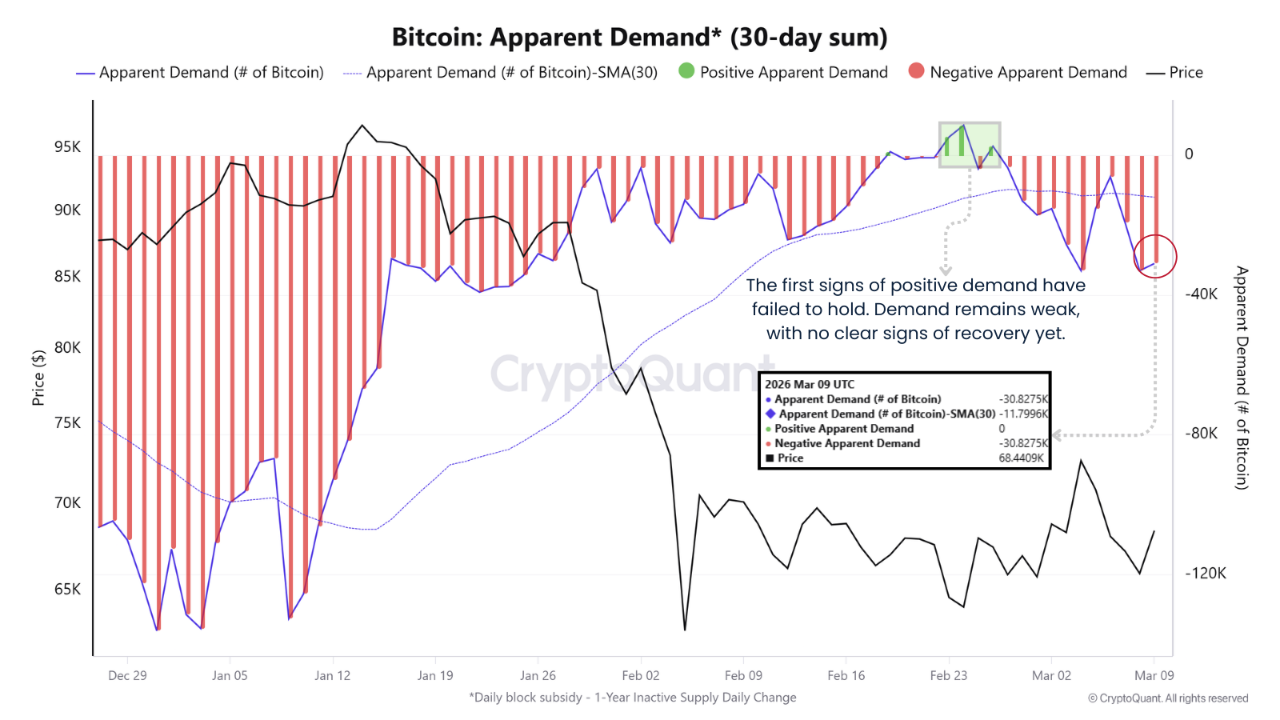
  • The apparent demand metric shows unsustained demand.
  • The CryptoQuant Bull Market Cycle Indicator has identified volatile market conditions often associated with consolidation periods that appear during bearish phases. 
  • Meanwhile, the Long-Term Holder SOPR metric has recently fallen below the 1 threshold.

A Frustrating Time for Bitcoin Market Participants

Bitcoin is currently moving through a stage of the market cycle that verified CryptoQuant author Moreno considers one of the most difficult for participants to navigate. Instead of strong directional momentum, the premier asset is showing signs of indecision, with several on-chain indicators suggesting it is one of the most psychologically taxing periods in the current cycle.

For context, the current broader environment reflects uncertainty rather than clear conviction. Bitcoin continues to fluctuate within a relatively narrow range, between $65,000 and $73,000. Each rally sparks short-lived hopes of a foray to higher prices, only for a retracement to quickly kick in. This has not only wiped out late leveraged bets but also tested the patience of spot holders.

Three On-Chain Metrics Provide Context

The analysis highlighted the “Apparent Demand” indicator as one of the clearest signals of the current market uncertainty. For the uninitiated, this metric attempts to measure the balance between new supply entering the market and coins being absorbed by buyers. 

After the recent market selloffs, the metric briefly hinted at a recovery as opportunistic buyers stepped in to buy the dip, resulting in a positive apparent demand. However, that improvement quickly faded.

Bitcoin Apparent Demand/CryptoQuant

Demand slipped back into negative territory, suggesting that buyers remain reluctant to accumulate aggressively at current levels. Rather than sustained buying pressure, a recent report from The Crypto Basic confirmed renewed distribution attempts by short-term holders, who took profits as the realized price moved above their entry price.

This event crippled recovery attempts, adding fresh selling pressure to Bitcoin. In earlier market cycles, this type of behavior appears when participants are uncertain whether a price rally might be a relief pump or the start of a longer recovery attempt.

Bitcoin Bull Market Indicator and LTH Behavior Shows Fatigue

The analysis also highlighted that the CryptoQuant Bull Bear Market Cycle Indicator presents a similar picture. Notably, the on-chain metric has identified conditions often associated with consolidation periods that appear during bearish phases.

Bitcoin Bull-Bear Market Cycle Indicator/CryptoQuant

During these stretches, price movements tend to become volatile while maintaining a broader sideways price trend. Those short-term pops and crashes tend to stir caution among Bitcoin investors.

Another important metric, Long-Term Holder SOPR, is beginning to show signs that even experienced market participants are under pressure. The indicator has fallen below the 1 threshold, indicating that some long-term holders are selling coins at a loss.

Bitcoin Long-Term Holder SOPR/CryptoQuant

Historically, this development tends to appear during the later stages of prolonged downturns. When uncertainty persists for extended periods, even investors who typically maintain strong conviction may begin to reduce their exposure. The liquidated positions enter the hands of new participants at lower cost bases.

In the meantime, Bitcoin trades at $70,350, near the upper boundary of its recent range. The next sustainable direction remains uncertain amid split analytical opinion. However, the next resistance lies at $74,000, and a break above it would elongate the short-term bullish trend.