Home Blog Page 218

Cardano Founder Says This Is the Worst Sentiment Period in Crypto History

0

Even market veterans like Cardano founder Charles Hoskinson have not seen periods of poor crypto sentiment like the current market.

Hoskinson noted in a recent YouTube podcast that in his 15 years of active participation in the crypto space, no period has seen as much fear, doubt, and uncertainty as now. This comes particularly as the crypto market struggled for months, and an internal crisis strengthened.

Key Points

  • Hoskinson noted that in his 15 years of active participation in the crypto space, no period has seen as much fear, doubt, and uncertainty as now.
  • The Cardano founder noted that hope is fading in the digital asset space, with crypto sentiments turning largely negative.
  • Hoskinson mentioned that the negative sentiment has persisted since the October 10 crash.
  • However, the Cardano founder suggests the sector can recover from this setback by being better and different.

Worst Crypto Sentiment Ever?

Charles Hoskinson noted that hope is fading in the digital asset space, with crypto sentiments turning largely negative. Bitcoin fell from $126,200 in October to $60,000 in February before reclaiming $71,000 at the time of writing. Altcoins, which didn’t even perform well by prior-cycle standards, recorded steeper declines, with over 38% of them currently near all-time lows.

This has caused investors to panic and exit the market. While this is not the first time such corrections have occurred, this time seemed different. Data shows that the Fear and Greed Index dropped to a new all-time low of 5 last month, signaling extreme fear.

What could have caused this worsened sentiment? Hoskinson mentioned the October 10 crash. Notably, the market capitulation of that day holds the record as the sector’s largest liquidation event, wiping out over $19 billion in 24 hours.

On the surface, it looked like Donald Trump’s 100% tariff hike on Chinese imports was the major cause of that bloodbath. But developments have seen industry leaders like OKX CEO Star Xu accuse Binance of causing the October 10 crash with its aggressive marketing of the Ethena USDe. Binance has since denied this, but this remains unconfirmed.

Meanwhile, the market has not recovered from that event, with assets trending even lower. The bloodbath saw investors lose large sums of money, creating skepticism and affecting sentiment towards the sector in general. Hoskinson noted it was the lowest he has seen crypto sentiment go in his 15 years following the sector.

How We Can Get Out: Cardano Founder

However, the Cardano founder suggests the sector can recover from this setback. In the podcast, he recommended doing something better and different.

“How we get out of it is by being better and being different and giving people a reason to have good sentiment,” Hoskinson stated.

For Cardano, Hoskinson stated that the ecosystem should work together, harnessing all its exceptional governance capabilities to build utility and enhance user experience. He added it is “theirs to lose,” as doing so would show the strength of their decentralized governance system over other centralized systems.

If the Cardano ecosystem heeds this clarion call, Hoskinson noted that it would be a flagbearer and “vanguard” of the new cryptocurrency space. The chain would also record its strongest year in history.

Dogecoin Price Analysis for Mar 10: What’s Next as DOGE Holds ‘Best Buy’ Zone and $1.2 Target in Focus

0

Dogecoin falls below a long-term Fibonacci extension as an analyst highlights a historic buy area.

Dogecoin (DOGE) trades near $0.09175, posting a modest 0.4% gain over the past 24 hours. DOGE is moving within a narrow band between $0.0897 and $0.0923, with price action repeatedly testing both ends of the range throughout the session. 

Earlier in the day, the asset dips toward the lower boundary near $0.089, but buyers gradually return, lifting the price back above the $0.091 level as short-term sentiment improves.

With the price hovering just below the $0.092 resistance area, the market now watches whether sustained buying pressure can push DOGE toward a stronger breakout. On the flip side, others are watching if it will keep it locked within its recent consolidation range.

What’s Next for Dogecoin?

Elsewhere, on the weekly chart, Dogecoin is attempting to stabilize after a prolonged downtrend that followed its previous rally. Price action remains below several key Fibonacci retracement levels derived from the earlier upward move, with the 0.786 retracement around $0.1678, the 0.618 level near $0.1975, and the 0.382 zone close to $0.2392 all acting as overhead resistance.

Dogecoin 1W Chart
Dogecoin 1W Chart

The market previously broke below the 1.0 Fibonacci extension level around $0.1300, which historically serves as an important structural support area. DOGE is now attempting to reclaim this $0.1300 level, which could determine whether the market begins forming a stronger recovery structure.

Further, the Average True Range on the weekly timeframe continues trending downward toward 0.027, signaling that volatility has been gradually decreasing. This contraction often reflects a period of reduced market activity before a larger directional move develops.

If Dogecoin successfully regains the $0.1300 Fibonacci extension, the next potential recovery targets could emerge toward the $0.167–$0.197 region. Failure to reclaim this level may leave the asset consolidating in the lower support zone.

Dogecoin’s Best Buy?

Elsewhere, crypto analyst Trader Tardigrade points to a notable development on Dogecoin’s long-term chart. He highlights that the asset is currently holding within a support channel on the monthly timeframe above the $0.085 level. 

Dogecoin Prediction
Dogecoin Prediction

According to the analyst, Dogecoin remains positioned near what he describes as a historically significant “best buy” level. The chart suggests that DOGE is once again testing this lower boundary of the long-term trend structure while maintaining support above the channel.

Notably, the analyst notes that this marks the third major “best buy” point in Dogecoin’s history, citing earlier periods in which similar pullbacks to the same trendline preceded large upward moves. 

By holding this support region, Dogecoin may be maintaining the broader bullish structure that has developed over multiple cycles and could push it toward $1.2. To reach $1.20, Dogecoin would need to surge by about 1,208% from the current price of $0.09175.

XRP Could Reach $25, But Price Must First Respect This Key EMA

0

XRP could target a Fibonacci extension range from $20 to $25, but the price must first respect a pivotal EMA support level.

XRP has been under serious selling pressure since Q4 2025, as turbulence across the broader crypto market pushed the asset through a painful decline. The price has dropped 51% during this period and now sits 62% below its all-time high of $3.6, which it set in July 2025.

While this performance has shaken most short-term traders, data shows XRP could be approaching a major support zone that previously marked its bottom and preceded an explosive bull phase.

Key Points

  • XRP has dropped 51% since Q4 2025 and trades 62% below its all-time high of $3.6, which it set in July 2025.
  • Market data shows that during major downturns like this, XRP often finds its bottom around the 100 EMA before a massive upsurge.
  • During the 2017 cycle, XRP broke out from $0.0056 in March 2017 and surged to $3.31 by January 2018 after bottoming near the 100 EMA.
  • In the 2021 cycle, XRP again bottomed between $0.21 and $0.32 around the 100 EMA before climbing to $1.96 by April 2021.
  • XRP currently trades around $1.38 and appears to be approaching the same macro support zone from the previous two cycles.
  • Data points to two Fibonacci expansion targets: a modest range of $6 to $9 based on the 1.618 extension, and a more bullish range of $20 to $25 based on the 2.414 to 2.618 extensions.

XRP Bottomed at 100 EMA in 2017

EGRAG Crypto, a well-known market analyst, highlighted this pattern in a recent analysis. Notably, the foundation of EGRAG’s analysis is the 100-period exponential moving average (EMA). 

He stressed that this indicator represents the zone where XRP has consistently found its footing at the bottom of past market cycles, before going on to post major gains. EGRAG sees this same structure setting up once more in the current cycle.

XRP Monthly Chart
XRP Monthly Chart | EGRAG Crypto

For instance, during Cycle 1 in 2017, XRP went through a rough period that ran from Q4 2016 into early 2017, with prices fluctuating between lows of around $0.005 and $0.007. Throughout this period, XRP traded around the 100 EMA and even dipped briefly below it. 

Afterwards, the trend flipped. By March 2017, XRP broke out from $0.0056 and went on to reach $3.31 by January 2018, representing a gain of 59,000%. The highest Fibonacci extension XRP touched during that run was the 2.618 level.

Another 100 EMA Bottom in 2021

Interestingly, XRP’s behavior leading into the 2021 rally also featured another 100 EMA bottom. Specifically, from August to October 2020, XRP traded between lows of roughly $0.21 and $0.32, and those lows aligned with where the 100 EMA sat at the time. 

Following the downturn, XRP climbed to $0.7889 by November 2020, pulled back, and then pushed even higher to hit $1.96 by April 2021. The highest Fibonacci extension it reached that cycle was the 1.618 level, marking a smaller move than 2017, but still a massive one from the accumulation zone.

The fact that the 100 EMA served as the bottom in two separate cycles has now given EGRAG confidence that history could repeat. Notably, XRP currently trades around $1.38, which the analyst says is approaching that same macro support area all over again.

Two XRP Fib Scenarios Point to $6-$9 or $20-$25

EGRAG presented two possible paths from here using Fibonacci projections. The first mirrors what happened in the 2021 cycle, targeting the 1.618 Fibonacci extension and placing XRP in a potential range of $6 to $9. 

However, the second follows the more explosive 2017 rally, targeting the 2.414 to 2.618 Fibonacci extensions, which puts XRP in a potential range of $20 to $25. EGRAG noted that hitting the higher target would depend on strong altcoin liquidity rotation and late-cycle momentum coming together at the right time.

Meanwhile, EGRAG also pointed out that XRP has been respecting a long-term ascending channel for years, where the price tends to bottom near the mid-to-lower band before rallying toward the upper channel during bull phases. Right now, XRP sits at that structural support area again.

Robert Kiyosaki Calls Bitcoin a Lifeboat Amid Looming Market Turbulence

0

Financial author and investor Robert Kiyosaki has again warned about the possibility of a major global market downturn.

In a recent message shared on X, he encouraged individuals to prepare by holding assets such as gold, silver, Bitcoin, Ethereum, and stakes in real oil wells. His latest remarks echo warnings he has repeated for years that the global financial system remains vulnerable to another large shock.

Key Points

  • Robert Kiyosaki predicts a potential global financial crash, possibly around 2026.
  • He links the risk to unresolved weaknesses from the 2008 Global Financial Crisis.
  • Kiyosaki highlights private credit markets, including firms like BlackRock, as potential triggers for the next financial shock.
  • Recommended protective assets include gold, silver, Bitcoin, Ethereum, and stakes in operational oil wells.
  • Silver is emphasized as an accessible option for new investors, with even small purchases considered a starting point.
  • He criticizes modern “woke” financial education, urging practical financial literacy and early investing.

Warning Linked to Earlier Predictions

Kiyosaki connected his latest outlook to ideas he outlined more than a decade ago. Specifically, in his 2013 book, Rich Dad’s Prophecy, he predicted what he described as the largest stock market crash in history.

According to Kiyosaki, that scenario may still materialize around 2026, although he hopes the forecast ultimately proves incorrect.

His concerns stem largely from unresolved issues dating back to the 2008 Global Financial Crisis. In his view, the structural weaknesses exposed during that period were never fully addressed, leaving the financial system susceptible to another, potentially more severe downturn.

To support his argument, Kiyosaki also referenced a past prediction he claims to have made shortly before the collapse of Lehman Brothers. He said the warning was delivered during an appearance on a CNN program hosted by Wolf Blitzer.

Concerns About the Private Credit Market

Beyond historical comparisons, Kiyosaki believes the next financial shock could originate from a different part of the financial system: the private credit market.

In his recent message, he pointed to potential risks tied to large investment firms, specifically mentioning BlackRock. According to Kiyosaki, stress in private credit markets could trigger a rapid and damaging financial event.

If such a collapse were to occur, Kiyosaki warned it could have widespread consequences. Retirement savings held by many baby boomers could face significant losses, while growing global debt levels may further increase systemic fragility.

Assets Kiyosaki Recommends for Protection

Given these risks, Kiyosaki urged investors to take precautionary steps before any potential crisis unfolds. His preferred strategy focuses on assets he believes tend to retain value during periods of economic instability.

Among the options he highlighted are physical precious metals and major cryptocurrencies, including gold, silver, Bitcoin, and Ethereum. He also suggested that partnerships in operational oil wells could serve as another form of tangible investment.

Of these choices, Kiyosaki described silver as one of the most accessible entry points for new investors. He noted that individuals can begin with small purchases from local precious-metal dealers, even suggesting that a $10 purchase of old silver coins, often referred to as “junk silver,” could be a starting point.

Criticism of Modern Financial Education

Alongside his investment recommendations, Kiyosaki criticized what he described as “woke” financial education. He argued that such approaches encourage people to see themselves as victims within the economic system rather than taking control of their financial futures.

Instead, he urged individuals to focus on practical financial education and take responsibility for their own investment decisions. In his view, proactive learning and early investing are essential steps toward long-term financial security.

Current Market Prices

At the time of writing, several major assets mentioned by Kiyosaki were showing upward momentum.

For instance, Bitcoin was trading at $70,316, up 4.5% over the previous 24 hours. Ethereum stood at $2,052, up 3.8% during the same period.

Meanwhile, gold was priced at $5,167 per ounce, while silver traded near $88.70 per ounce.

Cardano Has the Largest DAO In the Crypto Space: Charles Hoskinson

0

Charles Hoskinson, the founder of Cardano and IOG, has highlighted how exceptional the ADA ecosystem’s governance system is.

In September 2024, Cardano set the stage for a fully decentralized network protocol after the Chang hard fork ushered in the Voltaire era. This process was completed with the Plomin hard fork in January 2025. Currently, major stakeholders claim Cardano is the biggest in the crypto space in that parameter.

Key Points

  • Charles Hoskinson, the founder of Cardano, has highlighted how exceptional the ADA ecosystem’s governance system is.
  • The founder noted that Cardano has a huge treasury, with data showing the ecosystem’s bag holds 1.65 billion ADA, worth $429 million at the current market price.
  • Hoskinson also stated that Cardano has the largest decentralized autonomous organization (DAO) in the crypto space in terms of population and voting.
  • He noted that retailers cannot adopt Cardano because it has some intrinsic superiority over its competitors, but because of its experience and utility.
  • If Cardano builds utility, Hoskinson claimed it will surpass its competitors and grow tremendously.

The Sophisticated Cardano Governance System

Hoskinson highlighted the “capable” Cardano governance system in a recent podcast, calling it the most sophisticated in the industry. He did so while emphasizing why the ecosystem has no excuse to fail.

The founder noted that Cardano has a huge treasury. Notably, data confirms this, showing that the current treasury reserve stands at 1.65 billion ADA, worth $429 million at the current market price. For the uninitiated, the community uses these funds, derived from a portion of transaction fees and block rewards, to facilitate ecosystem development.

Further, Hoskinson stated that Cardano has the largest decentralized autonomous organization (DAO) in the crypto space in terms of population and voting. Part of the features of a DAO is inclusion and broader user participation, and he noted it is the only one in the top 10 cryptocurrencies with such huge capability

Spotlighting these perks, the Cardano founder noted that they become useless if the ecosystem cannot utilize them correctly. Particularly, he stated that it was being decisive in what they want to achieve with its fundamentally different governance system.

How Cardano Can Thrive

Further, he pointed out that retailers cannot adopt Cardano because it has some intrinsic superiority over its competitors. This suggests that being theoretically better than rivals like Ethereum and Solana does not directly translate into user traction.

However, what is more important for broader adoption is user experience and real utility. He noted that the crypto industry has shifted from the era of infrastructural differentiation to adoption based on use case. 

If Cardano does this, he claimed it will surpass its competitors and grow tremendously. Notably, this is part of the reason behind the formation of Pentad.

Hoskinson Is Committed to Cardano

The founder also highlighted that he has been committed to Cardano for a decade. He expects the community to join this course and fight as a team to accelerate its growth.

Interestingly, he noted that Cardano has the capacity to thrive. The infrastructure and the resources are at their disposal, and with limited time, the ecosystem needs to stand together and become a “shining beacon” for the space.

Additionally, Hoskinson emphasized that Cardano cannot afford to fall. If they do, it is not just ADA that failed, but the broader crypto sector’s freedom as well.

XRP OI Spikes $15M While Spot CVD Jumps $62M: Possible Short-Term Price Implication

0

Amid a spike in XRP Open Interest (OI) and rising bearish derivatives bets, spot CVD has increased $62 million as real buyers enter the market.

Notably, XRP has had a hard time finding stable ground. The price got a brief lift after the Israel-Iran conflict escalated on Feb. 28, climbing to a high of $1.47 by March 4. But that gain did not last, as XRP fell back to a weekend low of $1.32 before recovering slightly to $1.38, still down 24.92% so far this year.

Amid the uncertain price action, derivatives and spot data show leverage traders have started aggressively betting against a price recovery while actual buyers enter the market, a development that could potentially lead to a bullish reaction.

Key Points

  • XRP climbed to a high of $1.47 by March 4 following the Israel-Iran conflict escalation, before correcting to $1.32 and rebounding to $1.38.
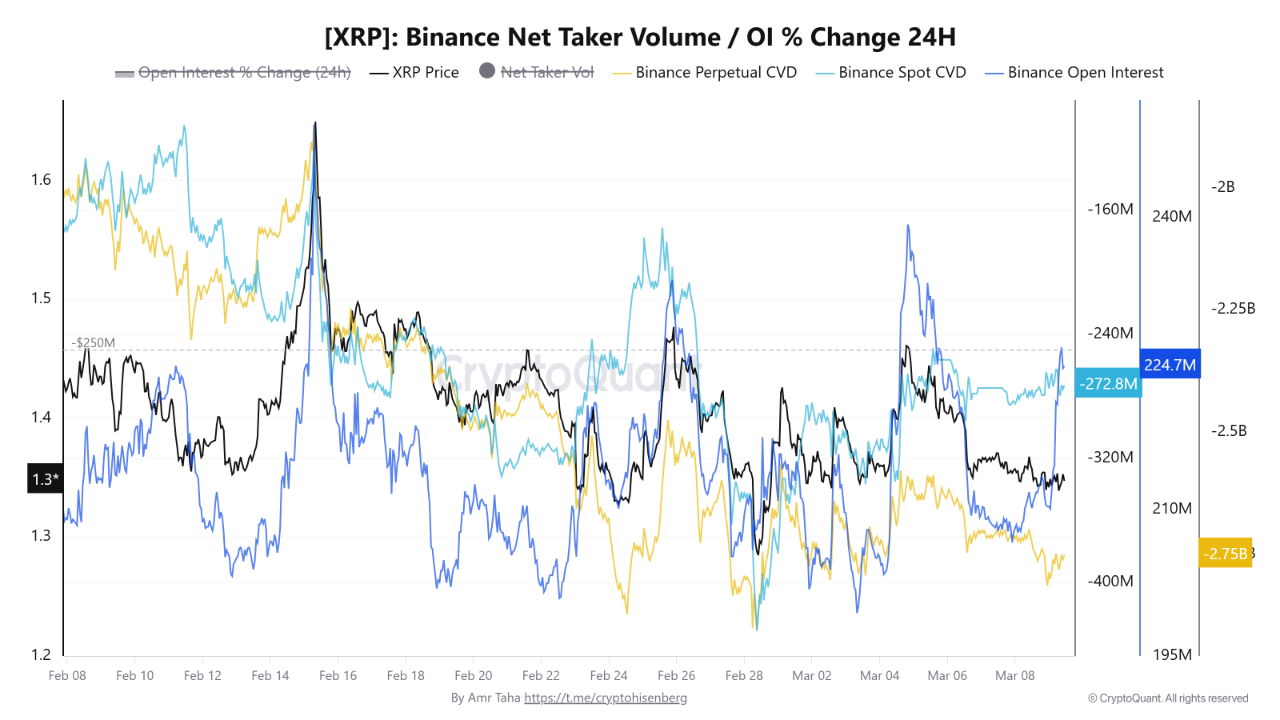
  • Data shows XRP’s Open Interest on Binance jumped by $15 million on March 9, indicating that leverage traders are actively opening new positions.
  • The Binance Perpetual CVD sits deeply negative at around -$2.75 billion, confirming that aggressive selling pressure continues to dominate the derivatives market.
  • Spot market data tells a different story, with the Binance Spot CVD growing by approximately $62 million between March 4 and the time of the report, reflecting real buying interest from spot traders.
  • The rising Open Interest and deeply negative Perpetual CVD historically point to an overcrowded short side, raising the chances of a short squeeze or temporary price bounce.

Leverage Traders Start Taking Big Positions in XRP

Amr Taha, a verified analyst at CryptoQuant, recently confirmed this trend in his latest market exposition. According to him, leverage traders have started aggressively building positions in XRP. 

Taha pointed out that even though the overall market mood remains mixed, data coming out of Binance shows a battle between real buyers and speculative traders looking to profit from price swings.

Taha based his analysis on three important indicators tracked on Binance. The first is the XRP Open Interest, which reflects the total value of all active derivatives contracts currently open in the market. 

Meanwhile, the second is the Perpetual Cumulative Volume Delta (CVD), which measures the running total of buying and selling pressure in perpetual futures contracts. He identified the third indicator as the Spot CVD, which tracks the same buying and selling pressure but within the spot market.

XRP OI Spikes $15M While Spot CVD Jumps $62M

Specifically, the market analyst revealed that on March 9, XRP’s Open Interest on Binance jumped by $15 million, moving from $210 million up to $225 million. 

Interestingly, at the same time, the Binance Perpetual CVD sits deeply in negative territory at around -$2.75 billion. Meanwhile, the Binance Spot CVD grew by about $62 million between March 4 and 9. These figures show how traders on both the derivatives and spot sides are setting themselves up around XRP right now. 

XRP Open Interest and CVDs CryptoQuant
XRP Open Interest and CVDs | CryptoQuant

Taha concluded that rising Open Interest and a deeply negative Perpetual CVD have historically pointed to a market where derivatives traders are heavily betting on further price drops. However, with Spot CVD seeing a notable increase, actual buyers in the spot market could be entering the scene.

Possible Short-Term Price Implication for XRP

Notably, when rising Open Interest occurs with a deeply negative Perpetual CVD during a market decline, it raises the chances of a short squeeze or a temporary price bounce, even when selling pressure remains strong. 

Rising Open Interest during a downturn means traders are opening fresh short positions. A highly negative Perpetual CVD adds to this trend by confirming that heavy selling, through market sell orders pushing down on bids, is driving the current price action.

When both of these conditions show up, it means the short side of the market is getting too crowded. If the price stops falling or ticks slightly higher, short sellers may begin unwinding their positions on their own or get forced out through liquidations, creating buy pressure that can drive the price up quickly. 

This kind of situation often catches late sellers who entered after the main move had already happened, and leaves the market open to a sharp counter-move or a liquidation-driven spike before the broader downtrend picks back up.

Bhutan Dumps $11.85M Bitcoin, YTD Outflows Top $42.5M

0

The Royal Government of Bhutan moved 175 Bitcoin on Monday, a transfer valued at about $11.85 million.

Blockchain tracking by Arkham Intelligence shows the transaction is part of a broader pattern of crypto movements this year. With this latest transfer, Bhutan’s total Bitcoin outflows in 2026 have reached roughly $42.5 million.

Key Points

  • Bhutan transferred 175 Bitcoin (~$11.85M) on Monday, bringing total Bitcoin outflows for 2026 to $42.5M.
  • As of this writing, Druk Holding & Investments, the sovereign wealth fund, manages around 5,400 Bitcoin (~$374M).
  • Bhutan largely sources its Bitcoin from domestic mining powered by hydroelectric energy.
  • Last July, Bhutan transferred over $60 million in Bitcoin. Its total reserves of more than 11,000 coins, worth $1.4 billion, represented over 40% of GDP at the time.

Sovereign Wealth Fund Oversees Digital Assets

Bhutan’s cryptocurrency reserves are managed by Druk Holding & Investments, the country’s sovereign wealth fund. Specifically, the institution oversees national investments and has played a central role in building Bhutan’s digital asset portfolio.

Current estimates indicate the fund holds around 5,400 Bitcoin. Based on recent market prices, those holdings are worth approximately $374 million.

Moreover, much of Bhutan’s Bitcoin supply comes from domestic mining operations. In fact, the country uses its hydroelectric power capacity to run these facilities, which officials describe as a sustainable approach to crypto mining.

Recent Transactions Follow a Consistent Pattern

Recent blockchain data suggests Bhutan has adopted a steady approach when moving its Bitcoin. According to Arkham Intelligence, most transactions are relatively small, typically ranging between $5 million and $10 million.

The latest transfer closely matches this pattern. In fact, it follows a similar transaction carried out roughly a month earlier.

During that earlier move, the government sold about $7 million worth of Bitcoin through the trading firm QCP Capital. However, Bhutanese authorities have not publicly explained how the proceeds from these transactions are used.

Earlier Activity Included Much Larger Transfers

While the latest transfers are modest, Bhutan has previously made significantly larger Bitcoin transfers.

Last July, the government moved more than $60 million worth of Bitcoin over four days. At that time, Bhutan’s reserves exceeded 11,000 coins. Those holdings were valued at approximately $1.4 billion. This amount represented more than 40% of Bhutan’s gross domestic product at the time.

Market Changes Affect the Value of Holdings

In addition, shifts in the broader crypto market have impacted the value of Bhutan’s reserves. Over the past year, Bitcoin’s price has declined by more than 40% from its earlier highs.

Consequently, the dollar value of Bhutan’s remaining Bitcoin holdings has decreased notably. At the latest market update, Bitcoin was trading close to $69,962. Although the price rose about 3.3% over the previous 24 hours, it remains roughly 20% lower since the beginning of the year.

Other Institutions Continue Building Bitcoin Reserves

While Bhutan has been transferring portions of its holdings, some large institutions are still increasing their exposure to Bitcoin. For instance, Strategy expanded its portfolio during the same period. Specifically, the company added 17,994 Bitcoin, bringing its total to 738,731 coins.

XRP: Investors Are Selling a $10 Coin for $1.34, First Ledger Says

A bold statement from the team behind First Ledger suggests the market may be undervaluing XRP.

In a post on X, First Ledger claimed traders are selling what it considers a “$10 coin” for about $1.34. This implies the asset is significantly undervalued at current prices.

The comment comes as XRP trades around $1.38 at press time, reflecting a 2.2% gain over the past 24 hours. Despite the short-term recovery, the token remains under pressure on a broader timeframe.

Over the past two months, XRP has fallen roughly 35%, and it sits more than 60% below its 2025 peak of $3.66.

Key Points

  1. First Ledger claims investors are selling what could be a $10 XRP for about $1.34, suggesting the asset may be undervalued.

  2. XRP trades near $1.38, up 2.2% in 24 hours, but remains over 60% below its 2025 peak of $3.66.

  3. The claim sparked debate, with some predicting $10+ for XRP while critics question its tokenomics and supply growth.

  4. Despite skepticism, some analysts believe XRP could be nearing the end of its bearish phase after a steep decline.

Community Divided Over XRP’s True Value

The claim drew mixed reactions from the crypto community. Some users agreed with the sentiment that XRP’s current valuation does not reflect its long-term potential.

Specifically, X user Justin Dudley suggested the asset could be worth far more than $10. In response, First Ledger said it was simply trying to remain modest with its estimate.

Others, however, pushed back against the optimistic outlook. A few critics argued that even if XRP were to reach the $10 level, the move could be followed by a swift correction based on the asset’s historical price behavior.

Some skeptics issue bearish projections suggesting the price could drop further. One X user specifically predicted a move toward the $0.50 range, citing similar declines in previous market cycles.

“XRP Has Been Trading for 12 Years”

Meanwhile, X user @bingo_smalls took the criticism even further. He pointed out that “XRP has been trading for over 12 years,” stressing that despite more than a decade of market presence, “it has never even reached $4,” the commenter lamented.

He argued that all the spot ETFs investing in XRP and the incoming Clarity Act cannot change what he considers “bad tokenomics.”

The X user went on to point out that XRP had a circulating supply of 43 billion tokens in 2019. But by 2026, the figure had increased to 61 billion. In his view, this “dilutes the price.”

It is worth mentioning that while XRP has indeed been trading for over a decade, the coin actually started with two zeros in its price. For instance, it had an all-time low of $0.0028, which, relative to its present price, represents a 49,188.24% gain.

However, many continue to criticize XRP’s price as it has remained below its $3.84 peak for more than eight years and counting.

Market Watches for a Rebound

Despite the divided opinions, many investors believe XRP could be approaching the end of its current bearish phase. After losing more than half its value from last year’s high, analysts are watching for signs of a rebound.

Ultimately, whether XRP can recover toward previous highs, or even approach the $10 level suggested by First Ledger, will depend on Bitcoin’s momentum and renewed demand for the asset in the months ahead.

Cardano: Here Are Midnight (NIGHT) Price Predictions for 2026, 2027, 2028, 2029, and 2030

0

Amid the rising adoption of Cardano sidechain Midnight, investors believe the growing demand could support the long-term price trajectory of its native token.

After launching only three months ago, NIGHT, the native token of Midnight, continues to gain traction. Notably, the Cardano analytics platform Cexplorer reported that NIGHT has become one of the most widely held tokens on the Cardano network, with the number of unique wallets approaching 55,000.

At press time, NIGHT’s unique wallet count stood at 54,682, marking an 89% increase from 28,892 recorded on January 20. Consequently, the rapid growth in holders has sparked bullish sentiment among investors, who see the expanding user base as a sign of strong community adoption and growing demand. Many believe this momentum could support NIGHT’s long-term price trajectory. 

Key Points 

  • The number of unique NIGHT wallets has surged 89% since January, rising from 28,892 to 54,682, sparking bullish sentiment among investors. 
  • Phemex predicts NIGHT could reach $0.15–$0.20 in 2026 and potentially $0.60 by 2030. 
  • Coincodex offers a more conservative outlook, projecting $0.15 by 2026 and $0.236 by 2030. 
  • ChatGPT forecasts gradual growth, with the price reaching $0.60 by 2030.

2026, 2027, 2028, 2029, and 2030 Midnight Predictions

Currently, NIGHT trades at $0.05568, down 6.34% over the past week. However, the token remains up 0.3% over the past day and 4.34% on the monthly timeframe. Although it has dropped more than 90% from its all-time high of $1.81, some analysts maintain a positive long-term outlook. 

Phemex 

For instance, analysts at crypto trading platform Phemex project that NIGHT could reach $0.15–$0.20 by 2026, driven by partnerships and improving market sentiment. They also suggest that Midnight’s validator expansion could push the token toward $0.25 by 2027, while broader ecosystem growth may lift it to $0.35 the following year. 

Looking further ahead, Phemex expects NIGHT to trade between $0.12 and $0.45 by 2029, then potentially revisit $0.18 in 2030 and later surge to $0.60. 

Phemex Prediction for Midnight

CoinCodex 

Meanwhile, crypto analytics platform CoinCodex offers a more conservative outlook. It predicts that NIGHT could climb to $0.15 by December 2026, but may decline to $0.08389 in 2027 and $0.06364 by the end of 2028.

However, CoinCodex expects a recovery to $0.08129 in 2029, followed by a rally to $0.2361 by September 2030, before retracing to $0.1664 by year-end. 

ChatGPT Forecast 

Furthermore, ChatGPT’s projections remain relatively cautious. The model estimates NIGHT could trade between $0.05 and $0.21 this year. It then projects steady growth to $0.23 in 2027, $0.35 in 2028, and $0.45 in 2029. For 2030, ChatGPT suggests a range between $0.07 and $0.60, depending on market conditions. 

ChatGPT Forecast for Midnight

Essentially, the overriding theme across these forecasts is that the NIGHT token may not reclaim its all-time high by the end of this decade.

According to the AI model, NIGHT’s long-term price trajectory will depend on the adoption of Midnight’s privacy technology, ecosystem development, regulatory conditions, and broader market growth.

Notably, the Midnight network is preparing for its mainnet launch later this month, a milestone analysts say could influence the token’s performance.

Nonetheless, the crypto market remains highly volatile. The Crypto Fear & Greed Index currently sits at 26, indicating strong market fear. Therefore, while forecasts offer insights, the actual price of NIGHT by 2030 remains uncertain. 

Pundit Shows Why Small Inflows to Coinbase Could Move XRP Price, But There’s a Catch

0

An XRP community figure recently suggested that Coinbase’s lower XRP reserves mean modest inflows could push prices higher.

XRP has dropped 25% this year to $1.37 amid a broader market downturn, and community commentators have been searching for recovery catalysts. One of those individuals, game designer Chad Steingraber, recently argued that small inflows into Coinbase could move XRP’s price due to the exchange’s limited XRP reserves.

Key Points 

  • Amid XRP’s ongoing downturn, Steingraber argued that Coinbase’s lower supply means modest inflows could help push prices higher.
  • Steingraber’s data suggested Coinbase held just over 3 million XRP in reserve, but Coinbase’s own proof-of-reserves disclosure puts the figure significantly higher at 39.5 million XRP tokens.
  • While thin order books can genuinely drive short-term price movement on an individual exchange, XRP trades across platforms holding over 16 billion tokens, and any single-exchange price move would be short-lived.
  • Exchange inflows typically signal selling pressure, not buying pressure, meaning Steingraber’s bullish interpretation of Coinbase inflows is against conventional market analysis.
  • Over the past week, Coinbase recorded $40.61 million in XRP outflows, joining Upbit’s $83.46 million and Binance’s $37.01 million in outflows.

Can Modest XRP Inflows on Coinbase Push Prices Higher?

Chad Steingraber shared his opinions during a recent commentary on X. He suggested that even modest inflows of XRP into Coinbase could be enough to push the token’s price higher. The pundit based his argument on what he claimed was a thin XRP supply on the platform.

He argued that because Coinbase does not hold a large volume of XRP, it would not take an enormous wave of buying pressure to produce a noticeable price shift. From his assessment, when just the right amount of capital starts flowing in, the XRP price could respond with a quick upthrust.

Steingraber presented this argument while citing data from Coinglass, a market analytics platform, which showed approximately $631,000 worth of XRP flowing into Coinbase across a four-hour window.

Also, further data from him suggested that Coinbase held just over 3 million XRP in reserve at the time. However, this contrasts with Coinbase’s own proof-of-reserves disclosure, which places the figure at a considerably larger 39.5 million XRP tokens.

Coinbase XRP Reserve

How Thin Order Books Can Influence Price Movements

While Steingraber’s theory is in the right direction, there are important caveats to note. Every exchange operates through an order book. When a market buy order comes in, it works through available sell orders from the lowest price upward. 

If sell orders near the current price are scarce, a single large buy can cut through the available supply, pushing the price up through several levels in a short period. 

For instance, if only 800,000 XRP worth of sell orders sit between $1.00 and $1.02, a market purchase of 600,000 XRP could sweep through most of the liquidity and send the price higher. This is the condition traders refer to as thin liquidity or low market depth.

In this sense, Steingraber’s reasoning is in the right direction. Specifically, if Coinbase’s XRP order books are as lean as he claimed, a comparatively modest inflow could determine XRP’s price action on that platform. 

Why Coinbase May Not Be Able to Influence XRP Price Globally 

However, XRP does not trade exclusively on one platform, as it also runs on dozens of major exchanges worldwide, including Binance, Upbit, Kraken, and Bitstamp, many of which hold far greater volumes of XRP than Coinbase. 

Across all centralized exchanges combined, total XRP holdings exceed 16 billion tokens. This makes it very difficult for a single exchange, however thinly stocked, to drive the global XRP price in any sustained way. 

The moment a price discrepancy opens up between Coinbase and a competing platform, arbitrage traders move almost immediately to buy where the price is lower and sell where it has risen, closing the gap within seconds.

Exchange Inflows Different from Order Book Activity

Moreover, exchange inflows and order book activity are different concepts in market structure, and treating them as equivalent can produce misleading conclusions. Steingraber highlighted deposits into the Coinbase exchange.

When a trader deposits XRP into an exchange, the most common motivation is to sell it or make it available for trading, which adds to the platform’s potential selling pressure rather than its buying pressure. 

As a result, market analysts often read large inflows as a bearish signal rather than a bullish one. Simply depositing tokens onto an exchange does nothing to shift the order book or generate buying pressure unless the depositor subsequently places an actual trade.

XRP Seeing Outflows Across Exchanges

Meanwhile, XRP has continued to see outflows across exchanges over the past week, a trend most analysts believe could be bullish for its price action.

Specifically, Upbit recorded $83.46 million in XRP outflows during this period, while Binance saw $37.01 million leave its platform, and Coinbase itself logged $40.61 million in XRP outflows. Only Bitstamp recorded $18.41 million in XRP inflows over the same window.

XRP 7D Netflows Across Major Exchanges
XRP 7D Netflows Across Major Exchanges | Coinglass

Market analysts generally interpret sustained exchange outflows as a bullish signal for price, since tokens moving off exchanges typically indicate that holders are transferring them into cold storage rather than positioning to sell.