Home Blog Page 2200

Ethereum Centralization Concerns Resurface As 51% Of Blocks Produced Are OFAC Compliant, Hoskinson Responds

Following The Merge, centralization concerns have run rampant, and now the Ethereum community has one more reason to be concerned as OFAC-compliant blocks reach a significant 51% level.

In a tweet on Friday, Gnosis co-founder Martin Köppelmann raised fresh Ethereum centralization concerns as he highlighted that data from mevwatch.info showed that 51% of Ethereum blocks were compliant with the Office Of Foreign Assets Control (OFAC), the sanctions enforcement arm of the US Treasury.

While Köppelmann asserts that should these validators decide not to attest to blocks carrying non-OFAC-compliant transactions, they could effectively censor the chain, it remains unclear if this will be the case. As pointed out by Danny Ryan, the data is for censoring blocks and not validators, which notably has technical fixes.

However, it is a different story if these validators choose to censor the chain and choose OFAC-compliant MEV relays as a result. In that case, as Jon Charbonneau of the New York Times pointed out, the issue ultimately comes down to what can be considered a slashable offense on the blockchain.

As pointed out by a speaker at Devcon 6: Bogota, an annual Ethereum conference, this policy is one that the community needs to come together to set, as per a video shared by prominent crypto investor Eric Wall sharing Köppelmann’s concern. Notably, Wall questions if the Flashbot system is the problem.

It is worth noting that in a bid to encourage people to run independent validators and stake with independent validators, Flashbots provide access to MEV boost relays to allow for fair competition with institutional platforms. Effectively allowing users to access a market of block builders to outsource block production. Notably, MEV boost allows users to choose between several MEV Relays, some of which are OFAC compliant.

As explained by Flashbot developer Bert Miller when CryptoMckenna anticipated the present situation, validators are not required to pick OFAC-compliant relays and have the option of picking from several non-compliant relays. Consequently, it increases the probability that these validators are choosing to censor the Ethereum chain and choosing these censorship relays.

Hoskinson Responds

Notably, Cardano founder Charles Hoskinson in response to the rising concerns shared a GIF showing a mocking acknowledgment.

It is worth noting that the Input Output Global (IOG) chief following the Ethereum Merge has not missed any opportunity to highlight perceived demerits of the Ethereum proof-of-stake (PoS) consensus application. Most recently, Hoskinson likened Ethereum to the Hotel California of crypto, as there is no clarity on when Ethereum stakers will be able to access their staked Ethereum.
Terra Rebels Respond To Criticism That The Latest Terra Luna Classic (LUNC) Tax Proposal Is Authoritarian

0

Fatman describes the latest LUNC tax proposal as worse than the burn tax parameter and authoritarian.


In a tweet on Friday, famous Terra whistleblower FatMan criticized the latest community proposal to reduce the tax burn parameter to 0.2% and allocate 10% of the tax to the community pool for development as authoritarian.

“Giving 10% of the tax to yourself is an even worse idea than the burn tax,” tweets FatMan. “Devs absolutely deserve to be paid – either through donations or via formal community pool spend proposals – but automatically redirecting 10% of every burn to “contributors” is authoritarian & wrong.”

FatMan believes that the Terra Classic chain should abandon the tax and mandatory donations and focus on providing utility and attracting decentralized applications (DApps).

The Terra Rebels Respond

Unsurprisingly, the comments by FatMan have attracted a lot of attention and responses from key members of the Terra Rebels.

For example, Edward Kim clarified that funds allocated to the community pool must still pass a governance vote to be distributed. Consequently, Terra Rebels do not have free access or a claim to the pool.

Meanwhile, Alex Forshaw described the comments by FatMan as unfair, as he asserted that a community-owned pool to fund developments is the only option left under the status quo. Notably, Forshaw challenged FatMan to propose an alternative.

Furthermore, StrathCole emphasizes Kim’s point highlighting that each spend has to go through a governance vote. In addition, he notes that even if the proposer explicitly stated that the 10% should be reserved for developers, it is not what the proposal achieves at the end of the day. 

Notably, none of the Terra Classic developers were involved in writing the proposal in question – proposal 5234.

It bears mentioning that proposal 5234 comes as the current 1.2% tax parameter has failed to meet expectations. It hopes to attract on-chain volume lost since the 1.2% tax implementation and provide a means for sustainable chain development.

Notably, the author of the proposal, Duncan Day, in response to FatMan’s concerns, while admitting errors in his writings, confirms that the outcome would be as stated by Kim and Strathmore.

Kim has recently revealed support for the proposal, as reported by The Crypto Basic.

TheCryptoBasic Mobile App Now Available on Android and iOS

0

TheCryptoBasic is proud to announce the launch of its mobile app for Android and iOS devices. Through the app, users will get real-time updates on happenings in the cryptocurrency industry, ranging from market analysis to regulations. 

Android users can download the application from here, while iOS mobile users can get the app via this link. TheCryptoBasic mobile app developers ensured that the app is user-friendly and convenient for everyone. Users can access and view content on the app with a few clicks. 

The app is perfectly customized and designed to fit all mobile screens, making it easy to read cryptocurrency-related content. In addition, commenting on articles has also been made easy via the app. To comment on articles, users can scroll to the bottom of each content to leave a reply. 

Aside from the attributes mentioned above, TheCryptoBasic mobile app is also equipped with other exciting features that will keep you entertained. The Android version of the app can be downloaded from here. You can also download the iOS version here. 

Do well to provide feedback and suggest possible improvements in the comment section of any of the mobile stores, to enable us to serve you better.

Polygon (MATIC) Daily Active Addresses Hit New All-Time High Soaring 300K in 5 days

0


The number of daily active addresses on Polygon has surged enormously in the past few days.


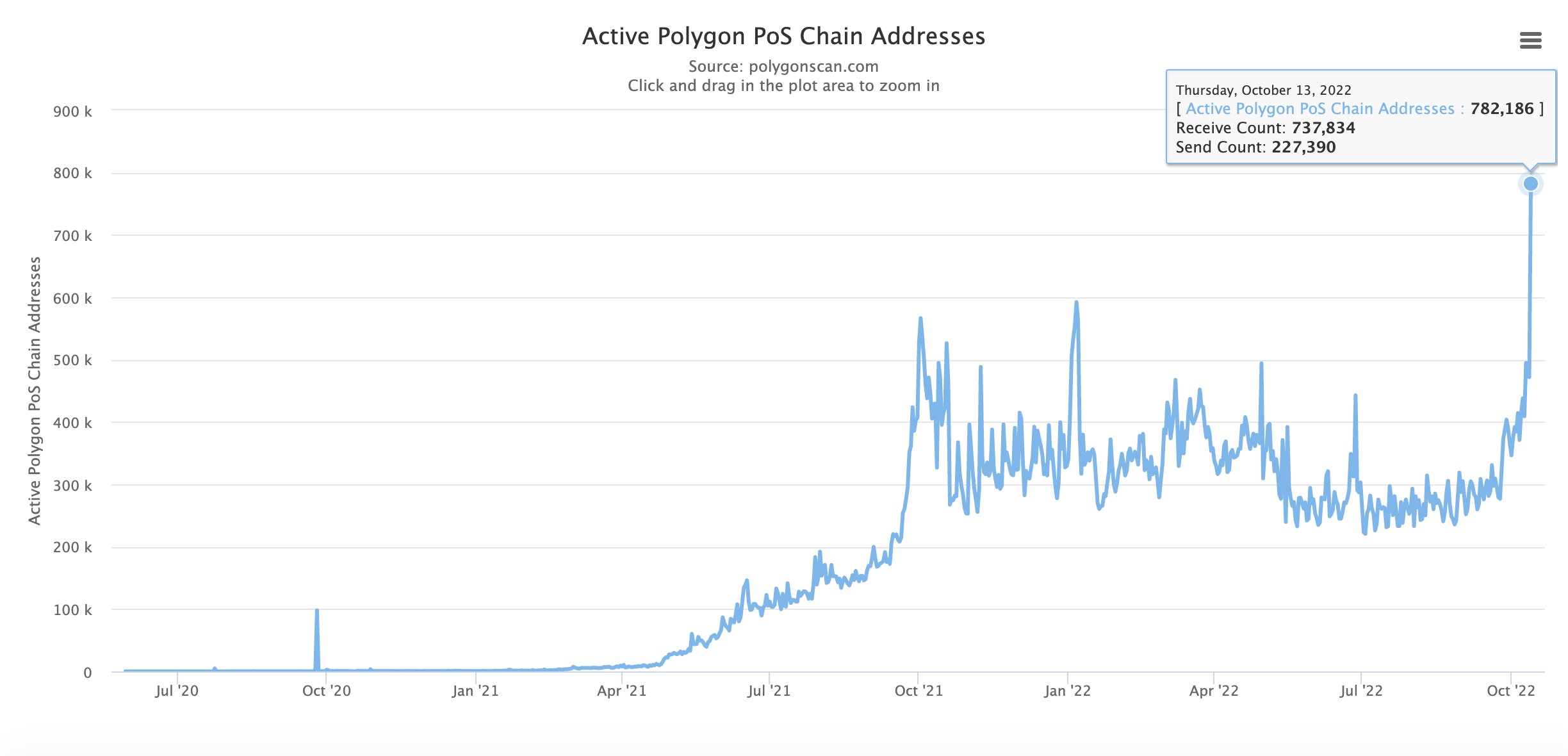
On Thursday, October 13, 2022, the number of active addresses on Polygon’s PoS chain reached a new all-time high of 782,186, according to data from Polygon Scan.

Polygon Daily Active Addresses Hit New All-Time High
image source: https://polygonscan.com/chart/active-address

The network’s daily active addresses have increased since Polygon launched the public testnet for the zkEVM. Recall that the zkEVM’s public testnet was launched on October 10, 2022, as part of an effort to improve the network’s scalability.

With developers from the community asked to test the solution and provide necessary feedback, the network’s daily active addresses rose immediately from 409,230 to 494,795. Since then, the number of daily active addresses on Polygon’s PoS chain has continued to soar, rising above 300K to a total of 782,186 in 5 days.

Meanwhile, data from the cryptocurrency analytics platform Nansen suggests that Polygon’s daily active addresses are approaching 1.2 million.

Top Brands Partner Polygon

Polygon’s consistent improvement has not gone unnoticed by top companies, who have continued to ink different partnership deals with the Ethereum scaling solution.

As reported by TheCryptoBasic, over the past 12 months, Polygon has been selected as a blockchain partner for top brands like Adobe, NFL, DraftKings, Disney, Starbucks, Mercedes, Meta, and Reddit.

MATIC, the native cryptocurrency of Polygon, is down 1.2% in the last 24 hours, with the token changing hands at $0.80 across major crypto exchanges.

Possible Reasons Why Terra Classic USD (USTC) Up Over 63% in 7 Days

0


TerraClassicUSD (USTC) has gained by over 63% in a week, making it one of the highest-gaining assets within the timeframe.


Social activity has historically proven to be a major contributing factor to a crypto asset’s price movements. Following the Terra collapse that led to the crash of the Terra ecosystem’s tokens, the assets were left for dead as investors looked to count their losses.

Nevertheless, a spike in social activity for Terra Classic (LUNC), including some bullish proposals to resurrect the asset, saw LUNC stage a massive rally last month. TerraClassicUSD (USTC) was carried along in the September rally before facing a fierce rejection. However, it appears that USTC is looking to make another comeback.

Per data from CoinMarketCap (CMC), USTC has gained by 63.39% in the past seven days, breaking above several resistance points to trade at $0.048 as of press time. USTC, trading sideways at the $0.029 zone last Friday, hit a peak of $0.061 on Wednesday before cooling off.

The last time the asset saw the $0.06 zone was a month ago, during the previous rally that took it to a 4-month high of $0.066 on September 10. The USTC/USD market is witnessing much volatility as of press time, indicating renewed interest in the asset.

As a result of the recent comeback, USTC’s market capitalization has gained by over 63% in 7 days, from a valuation of $290M last Friday to $473M at the time of reporting. The asset has sealed its position on the 72nd spot of top assets by market cap, well above Dash (DASH) and Lido DAO (LDO).

Possible Reasons Behind USTC’s Recent Rally

USTC’s price action appears to benefit from a renewed interest in the asset as social activity picks up.

Besides the recent Binance plans to include USTC on its borrowable assets on the Binance Crypto Loans platform, one of the major factors contributing to USTC’s rise in social activity is a recent debate on two proposals introduced by members of the Terra community aimed at re-pegging USTC.

Alex Forshaw and Tobia “Zarader” Andersen had proposed two varying initiatives that would help in the journey to re-peg USTC. Both initiatives sparked debates amongst the Terra community. Notwithstanding, Terra core developer Edward Kim recently revealed that both proposals could be equally executed and run concurrently.

The new re-peg proposals and the debates on the feasibility of the proposals have unarguably aided in USTC’s social activity spike. This has attracted renewed interest in the asset, contributing to its propitious price movements. USTC remains above the $0.48 level, as it trades at $0.4821 at the reporting time.

XRP Holders’ Attorney Reveals The “Fear” That Prompted Him to Sue SEC

0

Deaton reveals why he sued the SEC.


Attorney John Deaton, the founder of Crypto Law, has disclosed the major fear that prompted him to file a suit against the Securities and Exchange Commission (SEC). 

According to Deaton, in a scenario where the Judge in charge of the ongoing lawsuit between the SEC and Ripple rules on the Fair Notice Defense after declaring XRP security, XRP holders will become the victim. He added that he was forced to sue the SEC based on such a scenario.

“Most likely now, it won’t happen but there was a scenario where the SEC wins but Ripple doesn’t have to pay much. The judge could say XRP was and is a security but Ripple didn’t get fair notice so doesn’t have to pay. XRP Holders get screwed. That fear was one reason I sued the SEC,” Deaton said.

The Crypto Law founder added that the Fair Notice Defense would act as an insurance policy for Ripple in such a scenario. The move will come into play if the blockchain company loses “the security” litigation.

Deaton said if the court declares XRP security and rules that Ripple did not get Fair Notice, no United States-based exchange will re-list the cryptocurrency. He fears that if such an unfortunate event happens, U.S.-based XRP holders will use alternative means to sell the token.

“First, I’m not saying it is going to happen – I don’t believe it will – I predict it won’t. But in that scenario, you would have a token deemed a security with Ripple but gives you zero rights or interest in Ripple. No exchange would relist, have to be a dealer broker to sell, etc,” he added. 

Deaton Fighting to Protect XRP Holders’ Interest

It is worth mentioning that Deaton has engaged the SEC in a legal battle to protect the interest of XRP holders in the Ripple litigation.

In a tweet made in August, Deaton claimed XRP holders lost $15 billion because the SEC decided to brand all XRP, including secondary market sales, as securities instead of limiting the charges to Ripple. This resulted in many U.S.-based cryptocurrency exchanges, including Coinbase and Kraken, delisting XRP, putting pressure on the token’s price.

“Hydra Is Coming To Cardano One DApp At A Time” As SundaeSwap Reveals Successful Demo

0

SundaeSwap creates buzz with a successful Hydra demo.


In a tweet today, Cardano founder Charles Hoskinson asserted that “Hydra is coming to Cardano one DApp at a time” in response to SundaeSwap’s Hydra demo.

Notably, as highlighted above, the popular decentralized exchange (DEX) SundaeSwap on Friday revealed a successful demo of the Cardano scaling solution. While the DEX admits that a proper launch is still far off, it asserts that it is a huge leap for SundaeSwap’s and Cardano’s scaling journey.

Unsurprisingly, the demo has caused a lot of excitement within the Cardano community as it indicates that the Hydra launch is around the corner. Lead Hydra developer Sebastian Nagel lauded the effort from the SundaeSwap team, stating his interest in improving the protocol with their help.

It is worth noting that the development comes over a week after Hoskinson revealed in a series of tweets in response to a Twitter troll that decentralized apps (DApps) were already integrating the protocol. Notably, the troll had called out Input Output Global (IOG) for lack of transparency on the Hydra launch.

It bears mentioning that there is no fixed launch date which is not strange in the Cardano ecosystem, as IOG tends to emphasize releasing a product only when they are satisfied with testing without a launch date constraint. Meanwhile, as per recent statements from Hoskinson, Hydra, which will bring parallel processing, is only one part of the Cardano scaling plan.

Developers launched the Hydra Heads protocol on the public testnet in March. Some users have expressed the belief that these features will make Cardano, often touted as an “Ethereum Killer,” the king of DeFi soon.

TapJets Files Amicus Brief In Ripple Favor, Says XRP Use As An Alternative To Fiat Must Be Preserved

0


TapJets files an amicus brief in support of Ripple’s summary judgment motion.


Days after Judge Analisa Torres approved its request, TapJets, a private jet charter company, officially filed its amicus curiae brief supporting Ripple’s summary judgment motion against the SEC. 

Call to Preserve XRP Use As a Fiat Alternative

TapJets noted in the brief that its interest in the case is to preserve the use of XRP as an alternative to fiat, especially when the traditional banking system fails to function effectively or goes out of service during weekends.

The company said it started accepting XRP payments to navigate the complex process of booking private jet travel. Under the current system, TapJets users can instantly book private jet travel via innovative solutions – cryptocurrencies. 

TapJets describes the delay it takes the traditional banking system to process wire transfers during weekends and late hours on weekdays as “the Friday Night Problem.” 

“TapJets calls this the ‘Friday Night Problem’ because the limitations in fiat currency and the banking system become most problematic when a traveler wishes to book weekend travel, such as on Friday night,” the company stated. 

According to TapJets, XRP and other cryptocurrencies proffered solutions to the so-called Friday Night Problem. 

“XRP offered travelers the ability to pay for the air travel instantly, solving the Friday Night Problem,” TapJets said.

XRP Is A Trusted Form of Payment, TapJets Says

TapJets describes XRP as a time-proven and trusted payment method that many of its customers prefer; as shown in a 2018 Twitter poll, 43% of the respondents favored XRP over others.

“TapJets’ Twitter Poll received a total of 57,054 votes while the poll was live, with an overwhelming majority, 43.9% of the votes, or 25,046 unique, recorded votes, in favor of XRP,” the company added.  

The company said XRP is fast, safe, and secure, adding that it trusts the cryptocurrency’s stability to be used as a form of payment for high-dollar transactions.

SEC Lawsuit Against Ripple Effect on TapJets Business

It is noteworthy that TapJets was also forced to suspend its acceptance of XRP payments on March 31, 2021, due to the SEC’s litigation against Ripple. 

TapJets added that if U.S.-based cryptocurrency exchanges and other companies are not allowed to reinstate XRP after the lawsuit, it will suffer significant losses. This is because it has invested heavily in technologies that enabled its acceptance of XRP payments.

Based on its projections, TapJets believes XRP payments will allow more customers to book flight travels with cryptocurrency, thus boosting revenue. 

However, the SEC lawsuit against Ripple has affected its revenue. The company declared that it only accepted XRP payments as an alternative to fiat and not as an investment vehicle.

Accordingly, TapJets does not expect profit via its acceptance of XRP, as asserted by the Securities and Exchange Commission.

Meanwhile, I-Remit has also filed its amicus curiae brief supporting Ripple.

Author Of Terra Classic (LUNC) 1.2% Tax Burn Proposal Votes Yes To Reduce The Tax, Here’s Why

0

Edward Kim admits he does not know what will happen if the tax remains the same or if it is changed.


In a new medium post shared on Twitter on Friday by Terra Classic core developer Edward Kim, he reveals that he voted yes to proposal 5234, which will reduce the tax to 0.2% while allocating 10% to the community pool, which the community could use to incentivize chain development.

As per the blog post, Kim broke down the latest community proposal into 2 to make his decision. Firstly, Kim engages the idea of routing 10% of the tax to the community pool. The developer explained that it effectively meant burning 100% of the tax collected at the end of the epoch (7 days for the LUNC chain) and minting 10% of it at the start of the new epoch for the community pool. After highlighting the importance of funding the community pool, Kim declares his support for this part of the proposal.

“A community pool can be used for emergency funds, attracting dApps and projects back to the chain, and paying developers to improve the chain,” wrote Kim. “I vote yes for the 0.9 parameter change.”

Secondly, the core developer interrogates whether a leap from a 1.2% tax to 0.2% is justified, unjustified, or too soon. Here Kim makes several concessions. For example, he admits there is no guarantee that on-chain volume will return if the burn tax parameter is reduced. He also admits that current data using regression analysis does not indicate that on-chain volume will have an uptick anytime soon with the current parameter.

“I am admitting that I do not know, and thus I believe exploration at this stage is more important than exploitation,” Kim writes.

However,  what ultimately informs his decision are machine learning optimization principles used when the outcome of a particular choice is unknown. And both principles inform him that it is neither too early to change the tax nor is it too big of a leap, as he asserts that big leaps should be encouraged in a time of exploration.

“After weighing all the data, reflecting on what I know and recognizing what I don’t know, I voted yes to proposition 5234,” wrote the developer. Notably, he encourages others to do their research before making their decision.

It bears mentioning that Kim was the author of the most recent 1.2% burn tax parameter that created much excitement in the community.

However, after nearly 24 days of implementation, it has failed to deliver as expected, largely due to reduced on-chain volumes. Consequently, calls for the tax to be reduced have received new strength, ultimately leading to proposal 5234 by Akujiro and Duncan Day.

Six billion LUNC have been burnt by the tax so far.

SEC Chairman Asks Congress to Boost CFTC Authority Over Stablecoins

0

Gensler asked Congress to give the CFTC more powers to regulate stablecoins.


Gary Gensler, the Securities and Exchange Commission Chairman, has called on the United States Congress to give the Commodity Futures and Trading Commission (CFTC) more powers to regulate stablecoins.

Speaking at a conference in Washington, as reported by Reuters today, Gensler said granting the SEC more powers to oversee stablecoins would help mitigate the risks the asset class poses to the United States financial system.

According to Gensler, stablecoins have become increasingly popular and have continued to grow. Stablecoins currently has a total market capitalization of $150 billion and are primarily used to facilitate the trading of other digital currencies like Bitcoin (BTC), Ethereum (ETH), Ripple (XRP), etc.

Gensler noted a need for adequate regulation of stablecoins because digital currencies are similar to money market funds. Currently, the CFTC already has anti-manipulation and anti-fraud authorities over stablecoin issuers. However, Gensler said the agency still does not have the powers to establish rules to govern the exchange and transfer of stablecoins.

“I think the CFTC could have greater authority. They currently do not have direct regulatory authorities over the underlying non-security tokens,” Gensler said.

Calls for Adequate Crypto Regulations

Following the collapse of Terra ecosystem tokens in May, several federal agencies have stressed the need for adequate regulation of the emerging market.

Earlier this month, the Financial Stability Oversight Council urged Congress to formulate legislation addressing the risks of crypto assets to the U.S. financial system.

Meanwhile, this is not the first time Gensler has thrown his weight behind CFTC to control a specific segment of the crypto market. Last month, TheCryptoBasic reported that Gensler said the U.S. Congress should give CFTC more power to regulate Bitcoin and other non-security tokens.

SEC Claims Control Over Crypto Regulations

For years, there has been a debate over which federal agency would be the appropriate regulator for cryptocurrency. Members of the crypto community favor the CFTC over SEC. However, the SEC considers itself the appropriate regulator for the industry and has continued its clampdown on various crypto projects that breach U.S. Security rules.

Gensler considers most crypto assets, including algorithmic stablecoins, as securities. However, he said only a “handful” of cryptocurrencies are not securities. 

The SEC has already declared Bitcoin and stablecoin to be out of its regulatory purview, as it focuses on other cryptocurrencies like Ripple (XRP).