Home Blog Page 2257

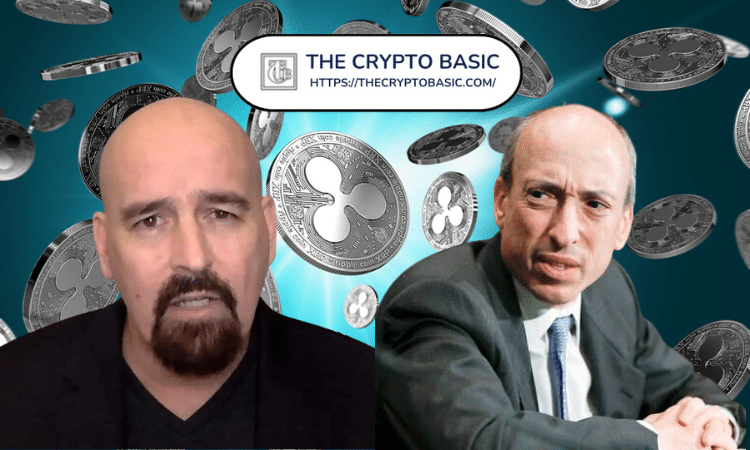
SEC Chairman To Testify In Front Of U.S. Senate Banking Committee, Deaton Says Now Gensler Cannot Hide Behind Twitter

0

Attorney Deaton Slams Gary Gensler’s Leadership at the SEC As SEC Chairman is Set To Testify In Front Of U.S. Senate Banking.


Ripple (XRP) Holders Attorney Slams SEC Chairman Leadership As Gensler Is To Testify In Front Of U.S. Senate Banking

Eleanor Terrett, a Fox Business journalist, recently revealed that SEC’s chair Gary Gensler is to testify in front of the U.S. Senate Banking, Housing, & Urban Affairs Committee Majority. According to Terrett, Gensler will reportedly testify in front of the committee on September 15, 2022.

Member of Financial Services Committee, Bill Huizenga says:


Congressman for Minnesota’s 6th District Emmer says:


It is unclear what questions will be thrown at Gensler during the testimony. However, some people believe his SEC leadership will be questioned. 

Crypto Law, a media outlet founded by attorney Deaton which focuses on regulatory news for crypto assets, joined others to react to Terrett’s tweet. In a recent tweet, Crypto Law said Gensler has realized that “hiding behind cringe Twitter videos” can no longer defend him from widespread criticism. 

“Looks like Gary Gensler realizes hiding behind cringey Twitter videos isn’t working and needs to defend himself against the escalating opposition to his leadership of the SEC.”

Attorney Deaton is currently representing Ripple (XRP) holders in a class action filed against the SEC for causing investors losses to the tune of $15 billion. 

CFTC Chair Scheduled to Testify Next Month

In the same vein, Terrett also disclosed that Rostin Behnam, chairman of the Commodity Futures Trading Commission (CFTC), would, on September 14, 2022, testify in front of the U.S. Senate Committee on Agriculture, Nutrition, & Forestry. 

The committee is still deliberating its newly introduced bill, which sought to give the CFTC more power to regulate the digital currency industry. 

Key industry players, as well as the CFTC, are expected to testify on the bill before voting commences. Terrett noted that her sources told her that the bill is “unlikely to pass this year.” 

Eleanor Terrett writes: “The Senate Ag hearing is on their recently-introduced crypto bill which would give the CFTC authority to regulate all digital commodities. The CFTC and key industry players will testify on the bill before it goes to markup, vote. Unlikely to pass this year I’m told.”

Crypto Investors Blast Gensler and SEC 

Gensler has been heavily criticized for his regulatory approach to the cryptocurrency industry. The SEC has been slammed for the lack of regulatory clarity for the cryptocurrency industry, which has continued to hamper the growth of the emerging market in the United States. 

Furthermore, Gensler and the SEC have been accused of preferring regulation by enforcement instead of making provisions for clear rules. 

While industry stakeholders have demanded regulatory clarity on crypto, the agency, which seeks to control the entire industry, has reiterated that its rules are clear for every entity. 

However, all efforts made by stakeholders to put a rest to the issue of unclear cryptocurrency regulations have not yielded positive results. Thus, prompting the SEC and Gensler to come under heavy criticism. 

Gensler tried to defend the SEC from the widespread scrutiny, as he recently asserted in a video that the agency is committed to protecting investors and market participants and “not willing to risk 90 years of securities law.” 
Binance Launches Football Fan Token Index Perpetual Contracts Ahead Of Fifa World Cup

0

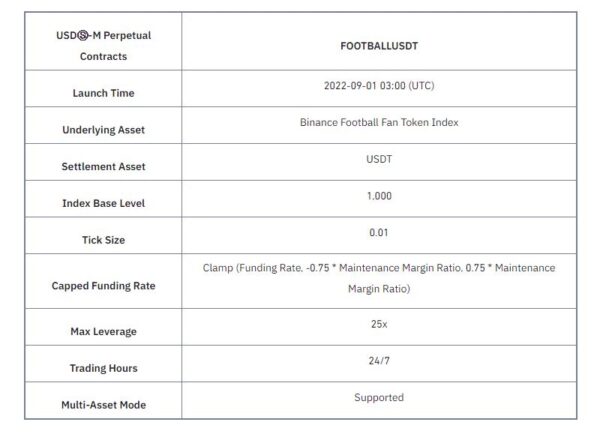
Binance futures is launching USD-M Binance Football Fan Token Index.


The newly launched Football Fan Token Index Perpetual Contracts has leverage up to 25X.

Binance Writes:

“Binance Futures will launch USDⓈ-M Binance Football Fan Token Index perpetual contracts (“FOOTBALLUSDT Perpetual Contracts”) with up to 25x leverage on 2022-09-01 at 03:00 (UTC). Binance Football Fan Token Index is a new cryptocurrency price index that tracks the ​​top Football Club Fan Tokens listed on Binance Spot by market capitalization.”
The Index will launch on 1st September, with Settlement assets as USDT and 24/7 trading hours.
binance football index
Binance further writes that the exchange may adjust the specifications of the contracts like “the tick size, maximum leverage, initial margin, and/or maintenance margin requirements.” FIFA world cup 2022 is scheduled from 20 November to 18 December 2022 In Qatar.

CNBC Mad Money Host Urges Investors To Stay Away From Shiba Inu and Dogecoin, As Fed Is “Getting Serious”

0


CNBC’s Jim Cramer Urges Crypto Investors to Stay Away From Shiba Inu (SHIB) and Dogecoin (DOGE).


The CNBC Mad Money host has issued a new warning to crypto investors amid Fed’s tightening cycle.

Jim Cramer, CNBC’s Mad Money host, has urged investors to “stay away from speculative assets like cryptocurrencies” as the Federal Reserve (Fed) continues its effort to mitigate rising inflation in the U.S. 

Cramer said the perfect explanation for Fed chief Jerome Powell’s speech last week was that Americans should stop investing in riskier assets. 

“Look, Fed chief Jay Powell told us that we need to stop doing stupid things with our money. That was the thrust of his speech on Friday,… He is going to bring the pain until it puts an end to the gambling,” Cramer said in a video published by CNBC. 

His emphasis was on memecoins like Shiba Inu (SHIB), Dogecoin (DOGE), as well as other top cryptos, including Polkadot (DOT). 

“Bottom line, and this is important; I need you to stay away from unprofitable junk […] Dogecoin, Polkadot, Avalanche, DAI, Polygon, Shiba Inu, Avalanche, Uniswap, Cosmos, Optimism, and a couple of other weird stuff,” he added.

Cramer also noted that he no longer believes in the argument that Bitcoin can be used as a store of value because the asset class has largely plummeted following the Fed’s recent tightening cycle. 

“This is what it looks like when the Fed gets serious,” Cramer added.  “What matters is that we just have to get through it intact. Don’t get memed. Don’t get SPAC’d. Don’t get crypto’d.”

Aside from cryptocurrencies, the Fed’s quest to mitigate rising inflation has also affected other financial instruments like stocks. 

Cramer: More Pains to Come

At the moment, it does not seem likely that the Fed will stop anytime soon, with Cramer stating that Fed chairman Powell would continue to inflict more pain on investors until inflation is reduced drastically. 

“We won’t see the end of this decline until we get a giant washout of all things that are speculative,” Cramer said. 

He also suggested that investors should avoid getting into money-losing firms that went public via special purpose acquisition companies (SPAC) and meme stocks.

Cramer’s recent statement about crypto is contradictory, given that he has previously encouraged investors to own a small percentage of the nascent asset. 

Crypto Investors May Not Heed the Warning

Interestingly, there is a possibility that investors may not heed Cramer’s warning following a Coinbase issue that occurred earlier this month. He hinted that crypto prices might plummet as Coinbase was under investigation for facilitating the trading of unregistered securities. In contrast to his assertion, crypto prices soared the following week, prompting investors to slam him for the comment.

Ethereum’s Vitalik Buterin Set To Release A Book 10 Years In The Making

0

Buterin is set to release a unique book featuring a compilation of his essays a month from now.


Ethereum founder Vitalik Buterin in a tweet today, revealed that he is set to release a book titled “Proof of Stake,” which compiles essays he has written in the last ten years in a month from now, noting that buyers can purchase a signed digital copy and NFT version of the book, with his share of the proceeds going to fund public goods on Gitcoin.

“‘Proof of Stake’, the (physical and digital) book compiling various writings I’ve made over the last ~10 years, will be out in a month!

You can get a signed digital copy and NFT here: proofofstake.gitcoin.co

My share of the proceeds all goes to @gitcoin grants public goods!” Buterin writes in the tweet.


As highlighted by software developer and Gitcoin founder Kevin Owocki, it is the first time an ebook is signed by an author’s public Ethereum keys and issued as an NFT. Notably, exploring the website reveals that pre-orders of the paperback currently cost $18.95. In contrast, users who want a signed digital copy will be required to donate 0.1337 ETH (approximately $215 at the current exchange rate).

The book launch is even more significant as the Ethereum network, Buterin’s brainchild, is now less than 16 days away from the famed Merge. The Merge will see the network migrate from the proof-of-work (PoW) consensus model to proof-of-stake (PoS) after nearly a decade of planning and anticipation. Notably, the move will significantly cut down the network’s carbon footprint.

The upgrade is slated to happen in two phases. First, on September 6, Ethereum’s PoS Beacon chain will undergo the Bellatrix upgrade. Then the Paris upgrade between September 10 to 20 will trigger the Merge once a Terminal Total Difficulty (TTD) 58750000000000000000000 is reached.

Buterin has urged node operators to upgrade their clients in preparation for the Bellatrix upgrade.

Aada Finance Launches The First Lending and Borrowing App on Cardano Mainnet

0

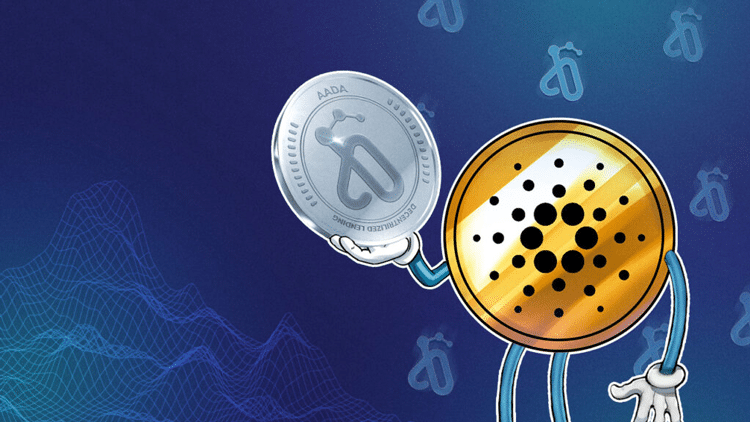
Aada Finance, a crypto assets lending platform, announces the imminent launch of the Aada Finance V1 lending and borrowing protocol on Cardano mainnet. The release is scheduled for the 13th of September, making Aada V1 the first lending and borrowing protocol to launch on Cardano mainnet.


Aada V1 leverages the first-mover advantage

After months of public testnet, Aada Finance is finally ready to deploy its eagerly-anticipated app. The release brings lending and borrowing to Cardano, introducing the DeFi primitives to the network for the first time. The event marks a significant milestone in the blockchain’s development, which will surely benefit the entire ecosystem.

Aada Finance plans to launch in anticipation of the Vasil hardfork, which will update the Cardano network. The team aims to leverage the first-mover advantage thanks to its V1 protocol’s peer-to-peer approach. While it provides a straightforward and efficient solution, the smart contract concept will mitigate future risks associated with hardfork migration.

A successful external audit to ensure high-level protocol security

A crucial aspect of the protocol’s security was the external audit. It was carried out by Vacuumlabs, a crypto and fintech company and a subset of Wingriders with extensive audit experience. Some of their accomplishments include finding security flaws in two top-10 cryptocurrencies and developing security guidelines for a renowned hardware wallet.

The Vaccumlabs’ thorough code review was a necessary step to ensure robust and risk-free smart contract implementation before mainnet launch. It also aligned with Aada Finance’s product-first approach, which will allow users to lend and borrow safely and seamlessly without putting their funds at risk.


Aada Finance is a fully-decentralized lending and borrowing protocol built on the Cardano blockchain. Its smart contracts allow users to lend and borrow assets in a peer-to-peer manner using the unique NFT bond strategy. Other unique features introduced by the platform are multi-asset lending and borrowing and the Aada 3-Node Liquidation Oracle. The latter plays an essential role in enabling lenders to liquidate their loans in the event of rapid loan Health Factor downfall.

The upcoming Aada Finance release culminates several months of work and development. The team acknowledges and is thankful for the community’s patience and support during the project’s early stages. To this end, they pledge to continue to follow its core principles of community-centric commitment and a build-first approach to Cardano DeFi.

Colombia Government Halts Project Using Ripple XRPL For Land Registry

0

A change in government has prompted Colombia to suspend registering land titles on the Ripple network.


Following Colombia’s change in government, the country’s initiative to register land titles on Ripple’s XRP Ledger (XRPL) has stalled. The project is now stopped as there is a change in country land titles policy due to changes in top country management. A blockchain expert even believes that the project is dead politically. 

Earlier, Colombia’s immediate administration’s Ministry of Information Technology and Communications partnered with software development firm Peersyst Technology to record land titles on Ripple’s XRPL. 

As reported by TheCryptoBasic, the first version of the country’s land registry record was deployed on the Ripple network late last month, with many expecting more versions to follow suit. However, it does not seem like the project will continue following a change in government. 

Forbes reported that the interim director of Colombia National Land Agency, Juan Manuel Noruega Martínez, disclosed that the transition of land records to XRPL is not a priority for the agency this year. 

“This isn’t one of the projects defined in the PETI [Strategic Plan for Information Technologies],” Martinez said. 


Commenting on the development, Mauricio Tovar, co-founder of Blockchain Colombia, stated that there is a tendency that the project is now politically dead following a change in government. 

“It’s very possible that the project is now politically dead,” 

Colombia Land Registry Issues

It is noteworthy that Colombia was plagued with civil war, which lasted for 52 years. The crisis saw over 7 million people displaced, thus making property rights a political priority. Over the past 52 years, land records have been poorly kept, suggesting the need to leverage blockchain solutions to verify property rights. 

Cardano Founder Charles Hoskinson Pushes Network Optimization Solution As Vasil Hard Fork Approaches

0


Cardano developers are not resting on their oars as they enter the final stages of developing a network optimization solution.


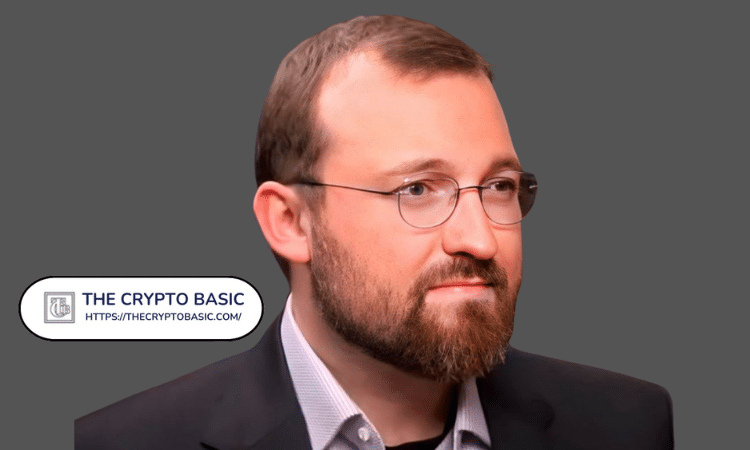
In a tweet on Tuesday, Cardano chief Charles Hoskinson urged stake pool operators (SPOs) to get involved in testing Mithril, a Cardano network optimization solution, as it enters the final stages of development.

“SPOs, get involved with Mithril,” the Input Output Global (IOG) founder tweeted.


Mithril is a solution developed by Cardano developers to optimize the data-sharing process between applications and nodes on the network. Notably, node synchronization is time-consuming as each node contains a full copy of the blockchain, requiring new nodes to download and verify each block. These require specialized equipment and extra time to synchronize the chain state. Mithril solves these by providing certified snapshots of the blockchain state in a staked-based signature scheme.

Notably, the team first introduced Mithril at the Cardano Summit in 2021. The IOG blog post reveals that the participation of all SPOs will make the Mithril network fully secure. Furthermore, CardanoLand stake pool notes in a tweet that it takes only 40 mins to launch the Mithril node on the testnet.


It bears mentioning that the Cardano network is on the brink of a significant upgrade at this time. On a live stream on Friday, Hoskinson noted that he expects the long-awaited Vasil hard fork to launch on the main network (mainnet) in September, barring any serious slowdown in development.

Notably, the Vasil hard fork upgrade promises to improve the network’s throughput, reduce transaction costs, and improve smart contract and decentralized app (dApp) development with improvements to the smart contract scripting language Plutus. Consequently, the upgrade is set to usher in a wave of dApps that promise to boost the total value locked (TVL) on the Cardano network.

As reported by The Crypto Basic on Monday, one of the three requirements for launching the hard fork on the mainnet has been met, as 75% of block-producing nodes were running version 1.35.3, the final node for the basil upgrade. Pooltool currently puts the figure at 82% today.

The remaining metrics include integration by at least 25 central exchanges and the top 10 dApps by TVL. The data shows that four exchanges have upgraded while several are in the process, while four of the top 10 dApps have already finished testing node 1.35.3.

Solana Based Defi Platform Accidentally Froze $661,000 USDC

0

OptiFi: $661,000 in USDC Permantly Frozen.


Derivatives-focused decentralized finance (DeFi) platform OptiFi closed its mainnet platform by accident, trapping $661,000 in USDC.

On August 29th at 06:00 UTC, OptiFi attempted to update its program code but instead used the “Solana program close” command by mistake, resulting in the permanent shutdown of the platform on the mainnet.


The team has acknowledged that they made a mistake in their official blog. The $661,000 lost in the accident belonged to the OptiFi team and investors. However, the team has vowed to refund all affected users in full.

In a blog post detailing the accident, OptiFi issued a public apology and outlined how the events unfolded. The platform is currently working on a solution to prevent similar accidents from occurring in the future.

Despite this setback, OptiFi remains committed to providing a safe and user-friendly platform for users to trade digital assets. The team is currently working on a plan to relaunch the mainnet soon.

For now, all user funds and open positions on OptiFi are locked in place and are not accessible. However, the team has said they will return all funds to affected users by September 2nd at 08:00 AM UTC. The team is also working on a solution to settle all user deposits and positions manually.

“We will return all users’ deposits and settle all user positions manually according to PythNetwork oracle at 8 AM UTC on Sep 2nd.”

OptiFi has also made changes to how they deploy updates in the future to prevent similar accidents from happening. Firstly, they will implement a peer-surveillance strategy, which necessitates the participation of at least three peers in the deployment process. Additionally, they would ensure every action conforms with the deposit contract’s state transitions.

Users who have questions or need assistance can contact the OptiFi team on their Discord channel.

The incident serves as a reminder of the importance of safety and security protocols in the DeFi space. It also highlights the need for platform providers to thoroughly test their code before making any changes to live platforms.

Leading Fintech Company Adopts Cardano Stablecoin (Djed) As a Payment Option

0

Jara Network Partners COTI Network to Use Cardano Stablecoin (Djed) As a Payment Option


Another leading fintech company adopts Cardano stablecoin as a payment solution.

COTI Network, the official issuer of Cardano stablecoin, has today announced a new partnership with Jara Network as part of the growing adoption of Cardano’s algorithmic stablecoin Djed. 


Under the partnership, COTI will integrate Djed as a payment option on Jara Network, an Open Finance Portal that allows access to financial services for emerging markets. 

Integrating Djed as a payment option will enable the project to bridge the gap between centralized finance (CeFi) and decentralized finance (DeFi). 

Commenting on the development, Abiola Shogbeni, Jara Network project lead, said: 

“We resonate with Djed’s stable coin infrastructure and its approach toward frictionless international payments as it’s a critical need for Jara Network customers. We are excited to partner with Djed towards a common goal.” 

Following the announcement, Jara Network now joins the list of projects willing to utilize Cardano’s algorithmic stablecoin as a payment method in exchange for their services. 

“This partnership will ensure the proper utilization of Djed across the entire Cardano ecosystem and create an increased use-case for it across multiple platforms. Stay tuned for more updates,” COTI said in a statement. 


Attorney Deaton Says Ripple Investors Lost $15 Billion Due to SEC Mistake 

0

Cryptocurrency enthusiasts continue to lambast the SEC for its crypto regulatory approach.


The cryptocurrency community has continued to slam Gary Gensler and the Securities and Exchange Commission (SEC) for their regulatory approach toward crypto. 

Crypto investors believe the SEC’s regulatory tactic in the crypto space is unfriendly compared to other financial markets. 

Deaton and Messari Founder Blast SEC

Ryan Selkis, the founder of Messari, blasted Gensler for focusing mainly on the “SEC’s power grab” over the entire crypto sector instead of prioritizing investors’ protection. 

According to Selkis, Gensler’s nonchalant attitude toward investor protection has resulted in losses worth $7 billion in “SEC’s fraud [for its failure] to approve a spot ETF at the expense of Grayscale investors.” 

Selkis’ tweet prompted a reaction from attorney John Deaton. He also slammed the SEC for causing XRP investors losses to the tune of $15 billion when the agency charged Ripple for allegedly offering unregistered securities in the U.S.  

Attorney Deaton, who is currently representing over 72,000 XRP holders in a class action suit against the SEC, said the agency intentionally decided not to limit its allegations against the Silicon Valley company to specific sales. 

However, the Securities and Exchange Commission labeled all XRP sales, including those conducted on secondary markets, as unregistered securities. 

The development prompted all U.S.-based cryptocurrency exchanges, including Coinbase, to de-list XRP from their trading platforms. Thus, causing XRP investors to suffer losses worth $15 billion. 

SEC and Gensler Come Under Heavy Fire

In recent times, the SEC and Gensler have come under heavy attack for threatening the existence of the U.S. cryptocurrency market. 

As the SEC seeks to gain total control of all crypto assets except Bitcoin, crypto stakeholders have urged the agency to provide regulatory clarity for the emerging market. 

However, the agency has ignored all calls with many people, including Forbes journalist Roslyn Layton, accusing the SEC of preferring regulation by enforcement instead of regulation by rules. 

Over 200 charges have been filed against crypto firms since 2017 to date by the agency, including the Ripple vs. SEC lawsuit. 

Currently, there is no guarantee that the SEC will collaborate with industry stakeholders to develop clearer regulatory guidelines for cryptos anytime soon.