Home Blog Page 2258

Qatar Introduces Digital Payment Services Ahead of FIFA World Cup

0

Qatar Introduces Digital Payment Services Ahead of FIFA World Cup.


On Tuesday, Qatar’s central bank announced that it had issued its first license for digital payments services to iPay by Vodafone Qatar and Ooredoo Money. As FIFA 2022 Qatar inches closer, the country is preparing itself for a significant influx of tourists and visitors by working to ensure that its infrastructure is up to par.


The FIFA World Cup is estimated to bring in 1.5 million visitors to Qatar, and the country is therefore aiming to have a payment system that will accommodate the needs of both local and international visitors.

This development comes after the central bank announced that Qatar’s banks were ready to launch payment services using GooglePay, ApplePay, and Samsung Pay. The Central Bank also announced that all global card issuers’ electronic wallet services would be accepted in Qatar.

Qatar’s central bank will supervise all digital payment services to develop a “safe and efficient” payments ecosystem in the country.


Ooredoo and Vodafone

The licensees, Ooredoo and Vodafone, are required to comply with the requirements and standards set by the central bank.

Ooredoo’s Money Wallet allows users to manage their financial transactions, send money, and make payments quickly and easily from anywhere using their mobile phones. Vodafone’s iPay service will offer a similar experience to users.

This is a big step forward for financial inclusion in Qatar. Mobile money apps are a convenient way to make payments and send money, especially for those who do not have a bank account.

Qatar’s central bank has also urged local and international financial institutions to work together to provide “the best possible” digital payment experience for visitors during the FIFA World Cup.

Post Ethereum 2.0 Merge ETH Could Qualify as a Security Or Not?

0

It’s been nearly seven years since Vitalik Buterin’s Ethereum (ETH) network began creating blocks now, as the Ethereum 2.0 merge draws ever closer in mid-September, the argument of whether or not the digital asset should qualify as a security rages on.

According to a new report, ETH has always been a work-in-progress. Before its launch in July of 2015, the native token ETH was sold via an initial coin offering (ICO) in exchange for the most popular digital asset, Bitcoin (BTC). During that ICO, around 50 million ETH were sold, which netted the ETH Foundation, which was a non-profit entity at the time, close to $19 million.

Even in ETH’s early days, those heavily involved in the still emerging crypto space felt as though the digital asset would pass the SEC’s Howey test, which would automatically constitute it as a security. According to the Howey test, an investment must pass the following criteria to be considered security: if it’s an investment of real money; if it’s a “common enterprise;” if it comes with the expectation of profit directly and explicitly from the interest and cash investment of others.

Financial experts say, from its inception, ETH was sold directly to the masses. In this regard, it clearly met the requirement of a cash investment. Also, when it comes to the ETH network, for which ETH is its currency, it required more than 100 developers for its launch, and this qualified it as a common enterprise.

Lastly, the ETH ICO, which occurred in August of 2014, almost a full year before its network launch, fully depended on its developer’s efforts. All this boils down to that under legal parameters, ETH should have been determined to be a security according to the Howey Test.

But despite these facts, ambiguity over the digital asset’s status as a security plagued its formative years, and since then, the bureaucracy-bound SEC has made its opinion on the matter public.

Back in 2018, William Hinman, the SEC’s former Director of Corporate Finance said that if you discount the fundraising aspect that accompanied ETH’s initial launch, based on his general understanding of the ETH network, taken along with its decentralized structure (which is what Ethereum is all about), then current investment in the digital asset does not constitute a securities transaction.

Therefore, based on Hinman’s opinion, which carried great weight in Washington, the SEC was very unlikely to classify ETH as an investment security. He also argued that in 2018, the ETH network was so decentralized that it could never be considered a traditional security under the laws stipulated by the U.S. government which regulates centralized securities.

But now, with the ETH 2.0 merge to “Proof-of-Stake” just weeks away, the security argument is once more in play. The merge is expected to “significantly change the underlying structure of the Ethereum network.” Proof-of-Stake will replace Proof-of-Work whereby miners compete to solve complex mathematical equations to mine blocks of ETH.

While other blockchain assets still use Proof-of-Stake for their operations, post-merge, ETH’s new validation system will profoundly affect Hinman’s 2018 evaluation and prove a challenge for the SEC’s current chair, Gary Gensler. Thus far, Gensler has shown a distinct distrust of decentralized digital assets.

So, the major billion-dollar question remains. Will the post-Ethereum 2.0 merge finally qualify ETH as a security? To answer this question, experts say that it’s necessary to understand how the merge will affect the overall network.

Currently, ETH uses Proof-of-Work validation mechanisms, allowing independent miners to come up with new blocks of the digital asset, much like they do for Bitcoin. The ETH mainnet will be docked with the beacon chain post merge, making it a Proof-of-Stake. In other words, no more miners.

Under the parameters of Proof-of-Stake, any investor who owns 32 Ethereum will be able to establish one full validator node on the ETH network. They can also team up with other validators to validate more blocks.

Once each block becomes validated, the validators will be given a reward along with “priority fees” for each approved transaction.But the Proof-of Stake argument is getting pushback from some financial experts, who argue that those running validators on ETH’s Proof-of Stake chain will not always be “pooling their funds.”

This contradicts the notion that the post Ethereum 2.0 merge can be considered a “common enterprise.” This alone will weaken the argument that ETH will be considered a security under the current SEC guidelines.


Bybit Introduced New Spot Trading Pair for Shiba Inu As Top 100 ETH Whales Now Hold $151M Worth Of SHIB

0

Singapore-based cryptocurrency exchange, Bybit has introduced SHIB/USDC on its platform.


Bybit, the most reliable crypto trading platform, recently announced via tweet that it had added four new USDC spot pairs, including SHIB/USDC, on its platform. The other pairs include GMT/USDC, LINK/USDC, and CHZ/USDC.

Bybit added support for SHIB last year on December 6, 2021.

Founded in 2018, Bybit is recognized as one of the world’s fastest-growing cryptocurrency exchanges, with over 5 million registered users. The cryptocurrency is based in Singapore and offers its users a smart trading system to trade over 100 digital assets. Besides this, the leading cryptocurrency exchange enables users to buy, sell or trade NFTs on the Ethereum ERC-721 standard through their Bybit Spot accounts.

Bybit is ranked 41 among the biggest exchanges on CoinMarketCap (CMC) based on the daily trading volume. In the past 24 hours, the users have exchanged hands with $254,485,898 ($254.48M) worth of digital assets on Bybit, according to CoinMarketCap.

Shiba Inu (SHIB) Price:

The most popular canine-themed cryptocurrency, SHIB is trading at the price of $0.00001251, up 3.18% over the last day, with a 24-hour trading volume of $388,060,711 ($388.06M).

Top 100 ETH Whale Holdings:

WhaleStats recently reported that Shiba Inu is the biggest holding position in terms of dollar value among the top 100 ETH Whales. They now hold a whopping total of $151,728,733 ($151.72M) worth of SHIB in their wallets.

Shiba Inu’s Bone ShibaSwap (BONE) Becomes Most Traded Token Among Top 100 Ethereum Whales 

0

BONE records another feat moments after surpassing the $2 threshold. 


Bone ShibaSwap (BONE), the governance token of the Shiba Inu decentralized exchange, has become the most traded token among the top 100 Ethereum whale addresses. 

According to data shared by WhaleStats, a crypto analytics platform that tracks the activities of top addresses on Ethereum, Binance Smart Chain (BSC), etc, BONE hit the milestone after overtaking Aave Interest Bearing WETH (aWETH). 

“JUST IN: $BONE @shibtoken flipped $aWETH for MOST TRADED token among top 100 #ETH whales,” WhaleStats reported. 

BONE Rallies Following Massive Whale Interest 

The massive interest in BONE among the top 100 Ethereum addresses has contributed immensely to the growth of the token’s price. 

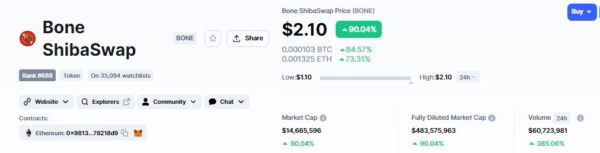
In the last 24 hours, BONE has seen its price surge by more than 90%, which helped the cryptocurrency surpass the $2 threshold. 

This comes following an announcement that the Shiba Inu ecosystem token has been listed on BlueBit.io. 

Meanwhile, there is a possibility that BONE could soon be listed on Gate.io exchange, as the trading platform is rumored to have bought a huge chunk of the crypto asset. 


Shiba Inu’s BONE Up 90% in 24 Hours, Crosses The $2 Threshold

0

Shiba Inu Ecosystem token Shibaswap Bone (BONE) is not stopping at all; up 90% in 24 Hours, Crosses the $2 mark.


Bone Up 90%, Crosses $2

Bone ShibaSwap (BONE), a Shiba Inu ecosystem token, appears to have shown immunity against the prevalent bear market, as it soars above $2. The value of $2 marks a 13-month high for the token, as it has remained below the level since November 2021.

At the time of reporting, BONE has gained by 90% in the past 24 hours, with trading volume up 385%, making it one of the highest-gaining assets in the markets, per data from CoinMarketCap. The asset has demonstrated impressive resilience against the bears, as the market downturns have had little effect on its price actions since August 20. 

The current value of $2.1 marks a 166% increase from the price of $0.75 the asset closed on August 20 with. Since its drop to $0.75, BONE has experienced a hurdle-free rally despite the cold hands of the Winter.

This auspicious movement comes barely 24 hours after Saint Vincent and the Grenadines-based digital asset exchange Bluebit.io listed the asset. As previously reported by The Crypto Basic on Monday, this development sent BONE above the $1.5 level—an incredible increase from the $1.06 the asset was consolidating at.

Furthermore, a few days back, Singapore-based exchange MEXC Global amassed about 11.63 million BONE tokens, sealing its position as the third largest holder of the asset. These promising moves have undoubtedly contributed to the asset’s recent rally. 

With a surge of over 87% in less than two days, BONE has demonstrated its resistance to unfavorable macro. Trading at $2.1 at the time of writing, the asset is showing no signs of slowing down.

VeChain Enters New Partnership With Canadian Product Verification Software Company

0


VeChain will help in verifying the authenticity of products in the legal cannabis industry.


VeChain, on its official Twitter account on Monday, disclosed that it has partnered with Canadian software firm TruTrace to improve blockchain adoption in product provenance and authentication.

“We’re excited to announce a strategic Integration Partnership with TruTrace Technologies, a Canadian SaaS platform that will soon offer VeChain ToolChain to clients. Together, we’re accelerating blockchain adoption for provenance & authentication,” VeChain wrote in its tweet.


TruTrace is a Software as a Service (SaaS) company that provides blockchain-integrated software for the legal cannabis, food, apparel, and pharmaceutical industries. Notably, TruTrace’s software can be used to demystify the supply chain process in all of these industries. 

TruTrace believes that integrating VeChain’s enterprise blockchain technology will improve the system’s transparency, protecting users from adulterated products. TruTrace believes this is true and very much needed in the legal cannabis sector, which it considers its primary focus.

“Although our confidence in the power of blockchain to support this mission never wavered, there were difficulties using this technology without onerous gas fees or being limited to permission-based systems. Fortunately, this all changed with the adoption of VeChainThor, which is a true enterprise-grade blockchain that understands how to bring value to clients at a reasonable cost with the ability to scale at a global level,” TruTrace CEO Robert Galarza said in the press release.

It is worth noting that VeChain is continuing to see increased adoption, especially in the supply chain industry. Most recently, the firm entered a partnership with US-based logistics firm OrionOne to allow logistics firms to employ blockchain technology without the stress of investing in infrastructure or digital currencies. Before that, Cambodia’s leading luxury alcoholic beverage distributor integrated VeChain technology to combat counterfeit products. 

VeChain is an enterprise blockchain that users can integrate for various applications, including supply chain, carbon footprint recording, Decentralized Finance (DeFi), and more. Notably, VeChain CEO Sunny Lu believes that VeChain and blockchain technology will change the world.

In July, VeChain was ranked amongst the top 10 crypto projects by engagement growth on CoinMarketCap. VeChain is a stark reminder of the disruptive power of blockchain technology, even in fields other than finance.

Whopping 742 Million Ripple (XRP) Worth $246M Shuffled In 24 Hours

0

Whale Alert reported massive XRP transactions.


In the past 24 hours, Whale Alert, a leading large cryptocurrency transaction tracker, has observed the shuffling of Ripple (XRP), transferred between top cryptocurrency exchanges and unknown wallets. 

The recent huge XRP transactions saw the movement of 742,471,122 (742 million) XRP coins over the last 24 hours; shortly after 500 million XRP were withdrawn from Kraken to an unknown wallet, the funds were worth $247.46 million at the current exchange rate. 

Details of the Transaction

As reported by Whale Alert, the first transaction occurred roughly 16 hours ago, involving an address on the Crypto.com exchange and an unknown wallet. According to Whale Alert, a total of 50 million XRP, worth $16.47 million at the time of the transaction, were sent from Crypto.com to an unknown wallet. 

Two hours later, Whale Alert observed the movement of another large XRP transfer from FTX to an anonymous address. This time, 160 million XRP coins valued at around $52.9 million were sent from an FTX address to an unknown address. 

At the same time, 48 million XRP were sent from an anonymous wallet to an address on the Bitstamp exchange. The funds were worth $15.74 million when the transaction was made. 

Roughly 10 hours ago, an unusual massive transaction involving XRP was spotted by Whale Alert. Per the cryptocurrency whale tracker, 176.5 million XRP worth $58.6 million were transferred from an unknown wallet to another unknown wallet. 

Furthermore, 40 million XRP ($13.44 million) were also sent to the Bitso exchange from an unknown wallet, suggesting a possible sale of the coins on the trading platform.  

In addition, another 60 million XRP coins ($19.99 million) were sent to the Bitso exchange from an unknown wallet. 

Another similar transaction occurred almost simultaneously, with 55 million XRP ($18.49 million) sent to Bitstamp from an unknown wallet. 

Moments later, 52,971,122 (52.97 million) XRP, worth $17.65 million, were sent from Bitstamp to an unknown wallet. 

Finally, a lump sum of 100 million XRP ($33.25 million) was sent to an unknown wallet from Bitso.  

In total, 742,471,122 (742 million) XRP coins moved in one day.

Dexilon Review – A DeFi Platform Created By Traders For Traders

What is Dexilon, and how is it different from competitors?

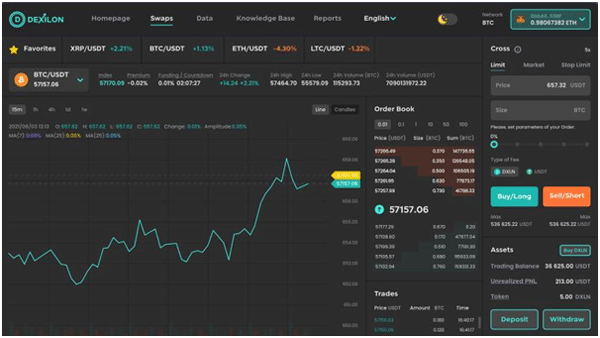
DEXILON is a next-generation decentralized derivative exchange and ecosystem which can be utilized to launch derivative contracts for non-crypto assets such as metals, energy, soft commodities, and foreign exchange (FX).

Transparent trading logic and instant execution combined with small fees is what actually makes Dexilon crypto derivatives exchange unique, unlike most DEXs out there on the market today.

Supported Wallets

To get started at Dexilon crypto decentralized exchange you need to connect a compatible wallet, such as MetaMask or a hardware wallet through MetaMask. As of today, September 2022 MetaMask is the only supported wallet with Binance wallet support coming up shortly.

How to Connect Your MetaMask Wallet to Dexilon crypto decentralized exchange

Connecting your wallet is quick and secure, simply follow these steps:

  1. If you do not have the Metamask extension installed yet, open Chrome extensions web store and add it to Chrome.
  2. After installation, you need to connect your wallet through the SignIn or SignUp process accordingly.
  3. Upon installation, you will be able to log in into the Dexilon website.
  4. Dexilon will ask you to set Polygon Mumbai as a preferred network for the Dexilon website. Agree on the step. For the deposit of tokens making process you may visit our more detailed guide here.

Now you are all set!

What coins you can trade on Dexilon

Since Dexilon, a new decentralized exchange, was launched, there is a limited amount of assets you can actually trade, yet this number is to be increased upon full scale launch later in 2022.

Currently, you can swap the following assets:

  • Bitcoin BTC / USDC
  • Ethereum ETH / USDC
  • Solana SOL / USDC
  • Cardano ADA / USDC
  • ATOM / USDC
  • ADA / USDC
  • DOGE / USDC
  • DOT / USDC
  • MATIC / USDC

Key features of Dexilon or how to use dexilon to earn more rewards

Dexilon isn’t the first cryptocurrency derivatives trading platform out there, yet it is the first new dex crypto exchange that offers a fully decentralized limit off-chain order book on a native blockchain with high TPS. Dexilon reviews traditional ways of trading crypto by emphasizing on security, trust and legit transparency to set the new standard of a crypto exchange platform to our investors.

Dexilon’s most prominent features are:

  • Self custody with personal cryptocurrency wallets
  • Redistribution of fees between takers, makers, insurance funds and data providers
  • A Rebate for every limit order book
  • No gas cost for each request (nodes are paid from the taker fee)
  • No KYC is required for futures, cryptocurrency or derivatives trading processes.
  • No regulations or restrictions on user actions

Is Dexilon Safe?

Dexilon is safe indeed as it’s fully decentralized, thus your funds are locked within the smart contract in contrast to being held by an exchange. Such an approach eliminates any possibility of an external threat to your funds being stolen by a 3rd party, thus making your trading experience at Dexilon safe and secure.

What are Dexilon Fees Like?

For every maker, there is a flat 0.01% rebate, therefore while trading using limit orders, you are getting compensated every single time. For takers, the fee starts from 0.05% and can get as low as 0,015% as it’s directly linked to the trading volume and the number of DXLN tokens in possession.

CryptoCom Mistakenly Sends $10.5M To Customer Instead of $100, Demands Refund

0

CryptoCom made a big blunder by transferring million into a customer account, and an even bigger mistake by not knowing what they had done for seven months.


Crypto.com, a prominent Singapore-based cryptocurrency exchange, is looking to recover excess payout to the tune of millions which the firm inadvertently sent to a customer. Recent reports suggest that the digital asset exchange accidentally transferred $10.5M to a woman instead of a planned settlement of $100.

Crypto.com discovered the mistake seven months later

Australian news media outlet Ticker News uncovered the story on Tuesday. According to the report, in May of 2021, a Melbourne-based Crypto_com customer requested a refund of $100 from the exchange. Nonetheless, instead of refunding $100, the exchange transferred $10.5M to the woman.

Apparently, the team in charge of the payout accidentally entered an account number in the space provided for the amount. The firm’s auditing team did not discover the mistake until December of 2021. This gave the woman seven months to cash out the erroneous transfer and spend it on a mansion in Craigieburn—a suburb in Melbourne.

After discovering the error in an audit exercise in December of last year, Crypto.com requested a refund. The firm charged the woman to court to demand the reimbursement of the funds. Discovering that the woman had spent the cash on a mansion, the court asked her to sell off the property. The proceedings from the sale would go into repaying the money.

Crypto.com has been expanding despite the Crypto Winter 

Besides this obvious blunder, CryptoCom has been making massive growth moves in the industry of late. Despite the steadfast Crypto Winter that has crippled several firms, the exchange has recently expanded enormously.

In March, the exchange revealed plans to seal its presence in Dubai by opening a physical office in the Emirate and carrying out a recruitment exercise afterward. Additionally, in June, Crypto.com procured an In-Principle License from Singapore’s central bank, the Monetary Authority of Singapore.

Barely a month after that, the exchange expanded to Italy, as it received regulatory clearance from the country. The approval allowed Crypto.com to offer digital asset services to Italians. Furthermore, just recently, on August 8, Crypto.com announced acquisitions of two local South Korean companies; with these acquisitions, the exchange entered South Korean digital asset markets.

Forbes Takes Down Its Article Criticizing SEC’s Crypto Regulatory Approach, Community Reacts

0


People have wondered what could have prompted Forbes to take down its journalist’s opinion piece about the SEC’s crypto regulatory tactics.


Shortly after Forbes journalist Roslyn Layton slammed the Securities and Exchange Commission’s cryptocurrency regulation style in an opinion piece on Forbes, the article has since been taken down. 

The unexpected decision to take down the article, which received massive applause from crypto investors, has raised eyebrows about what could have been the reason behind the move. 

Reaction to the Development

As expected, various crypto enthusiasts took to Twitter to comment on the development. Charles

Gasparino FOX Business Network Senior Correspondent asks, “Is That True?”

Some people asserted that the article was deleted by Forbes on purpose, as the media outlet wants to avoid getting in the bad books of the SEC.

Dogo_crypto says: “Dr. Rosalyn wrote a great piece on Gary Gensler’s overreach titled: Gary Gensler: Resign. The next day Forbes took down the piece. Understandably it’s a contentious title; however, inside the article were all facts.”


On the other hand, some noted that Layton took down the post herself without providing any proof backing the claim. Eleanor Terrett, a FOX Business Journalist, says Layton was solely responsible for the decision to delete the post. 

“I spoke with @RoslynLayton about (the development) today. She told me Forbes did not pull the article; rather, she and her editor decided to re-write the piece themselves,” Terrett said. 

Layton Slams SEC

As reported by TheCryptoBasic, Layton joined the list of journalists who are against the SEC’s regulatory tactic on the cryptocurrency industry. 

She stated that the Securities and Exchange Commission prefers to regulate the crypto sector via “regulation by enforcement” instead of “regulation by rules.” 

Layton also took out time to comment on SEC Chair Gary Gensler’s WSJ Op-Ed article titled “The SEC Treats Crypto Like the Rest of the Capital Markets.” 

According to Layton, Gensler’s WSJ Op-Ed article is misleading, as the SEC has slammed more lawsuits against crypto firms than any other financial market since 2017, with 90% of these cases settled out of court. 

While the SEC has been seeking total control of the cryptocurrency industry, the commission has failed to provide more precise regulatory guidelines for the emerging market on its website. 

“Indeed, some 90 percent of SEC cases are settled rather than concluded in court. Such a high degree of enforcement and settlement suggests that SEC rules are not clear and possibly non-existent,” she added.