
Home Blog Page 232

Ripple Top Executive Says “Seems Important,” as Hidden Road Goes Live on DTCC’s Clearing Corporation

0

The Ripple CTO Emeritus David Schwartz recently called attention to Hidden Road’s inclusion in the DTCC’s NSCC directory.

For context, Hidden Road (now Ripple Prime), a subsidiary of the blockchain technology firm Ripple, officially went live on the DTCC’s National Securities Clearing Corporation (NSCC) directory on March 2, allowing it to clear trades through the NSCC’s system and settle them on the XRP Ledger.

Key Points

  • Hidden Road went live on the NSCC MPID Directory with a First Trade Date of March 02, 2026.
  • Approval covers only OTC products, with no authorization for corporates, municipals, or unit investment trusts.
  • The NSCC, a subsidiary of DTCC, handles trade netting, risk management, and settlement for U.S. securities markets, processing volumes reaching quadrillions annually.
  • Speaking on the development, Ripple’s CTO Emeritus Schwartz emphasized that the inclusion “seems important.”
  • Ripple acquired Hidden Road in April 2025 for $1.25 billion, and the firm previously cleared about $3 trillion annually for more than 300 institutional clients.

Hidden Road Goes Live on NSCC

The DTCC shared the update in an Important Notice released through its clearing arm, the NSCC. Notably, XRP community figure Bank was one of the first to spotlight the development.

For context, the notice covered several routine operational updates, including firms leaving services, new firms joining, account number changes, clearing broker updates, and participation adjustments across DTCC services. In the document, the NSCC confirmed that it added “Hidden Road Partners CIV US LLC” to its MPID Directory.

Ripple Subsidiary Hidden Road on NSCC

According to the notice, Hidden Road began participation with a First Trade Date of March 02, 2026. The listing shows the firm under Clearing Broker PERS with Numeric Code 0443 and names HRFI as the Executing Broker, with the approved product category appearing strictly as OTC.

Importantly, the check mark appears only next to OTC on the list of possible options. The document shows no check marks for Corporates, Municipals, or UITs, which means the firm’s approval applies only to OTC products under this specific change.

“Seems Important”

With the inclusion of Hidden Road Partners CIV US LLC under broker code PERS (0443) and the recognition of HRFI as its executing broker, the NSCC now formally adds the firm to its clearing system for OTC trades. This allows the company to process approved OTC transactions through the NSCC’s centralized setup.

David Schwartz, former Ripple CTO, reacted to the development while responding to Bank’s disclosure. “Seems important,” Schwartz stressed on X, aligning with the typically understated tone that crypto projects often adopt when addressing major breakthroughs.

What is the NSCC?

For the uninitiated, the NSCC operates as a subsidiary of the DTCC, which acts as the backbone of U.S. securities clearing.

The NSCC handles trade netting, risk management, and settlement for equities, corporate bonds, municipal securities, OTC products, and Unit Investment Trusts. The DTCC and NSCC process extremely large volumes across financial markets, reaching quadrillions each year. 

As a major part of Wall Street’s post-trade system, the NSCC lets firms submit trades for clearing, reduce counterparty risk through centralized netting, and settle trades efficiently, usually on T+1 or T+2 timelines in many markets. With the recent listing, Hidden Road now connects to that established U.S. clearing framework.

What This Means for Hidden Road

Going live on the NSCC directory will increase Hidden Road’s clearing access. Specifically, the firm can now send eligible OTC trades through the NSCC’s centralized system and settle them on the XRPL. This will specifically bolster its post-trade capabilities and give it a stronger position in regulated U.S. markets.

The MPID Directory listing also helps with smoother trade comparison, netting, and settlement inside the DTCC network. However, the scope is quite narrow for now. Notably, the approval covers only OTC products and does not include corporates, municipals, or UITs.

Meanwhile, this recent move follows earlier regulatory milestones. Last April, Hidden Road secured FINRA broker-dealer approval and gained FICC membership for fixed income and repo clearing. The firm also picked up other entity licenses, building its regulatory base before this latest NSCC update.

Ripple’s $1.25 Billion Bet on Prime Brokerage

Ripple announced its acquisition of Hidden Road in April 2025 in a deal valued at $1.25 billion, one of the largest transactions in the digital assets space. The deal closed later in 2025, after which Hidden Road began operating under the Ripple Prime branding.

The acquisition made Ripple the first crypto company to own and run a global, multi-asset prime broker. Before Ripple completed the acquisition, reports showed that Hidden Road cleared about $3 trillion each year for more than 300 institutional clients. 

EasyA Founder Says XRP Was Ahead of Its Time, Shares Thesis on What Happens Now

Phil Kwok, co-founder of EasyA, says the XRP Ledger was built for a world that is only now beginning to understand its purpose.

In a recent post, Kwok argued that the XRP Ledger was “ahead of its time”. He stressed that the world increasingly needs a neutral bridge currency, and that XRP was designed to fill exactly that role.

Key Points

  • EasyA co-founder Phil Kwok says the XRP Ledger was built for today’s fragmented world.
  • He argues XRP’s neutral bridge design grows stronger as geopolitical tensions reshape finance.
  • Kwok says stablecoins can’t solve neutrality, despite growth of USDC and Ripple’s RLUSD push.
  • In his view, XRP was built for this moment as a liquidity layer above sovereign divides.

Neutral Bridge Currency in a Fractured World

Kwok’s core thesis centers on the idea of neutrality. As geopolitical tensions rise in the Middel East and global alliances shift, he believes the financial system will demand infrastructure that is not tied to any single government or ideology.

According to him, XRP’s original design as a bridge asset becomes more relevant in such an environment.

In the early days of crypto, before stablecoins became dominant, projects like Bitcoin, Ethereum, and XRP were created to enable value transfer without traditional banking rails. 

For the XRP Ledger, one of its defining features was auto-bridging. This feature allows users to move between two currencies efficiently by routing through XRP when direct liquidity was limited.

Instead of requiring trading pairs between every global currency combination, XRP could sit in the middle, reducing the need for countless illiquid pairs and improving efficiency. Kwok described this as one of the most powerful features baked directly into the ledger from its inception.

Stablecoins Didn’t Remove the Need for XRP

Over the past few years, the rapid rise of stablecoins like USDC has led some critics to argue that bridge assets such as XRP are no longer necessary. If users can transact in dollar-backed tokens, the argument goes, why rely on a separate bridge currency?

Kwok disagrees.

He acknowledged that stablecoins have grown exponentially and serve real demand. He also pointed to Ripple’s decision to launch RLUSD as a strategic move that taps into global appetite for dollar exposure.

However, he argued that dollar-denominated stablecoins cannot fully solve the neutrality problem. In a world where some nations seek alternatives to U.S. dollar dominance, relying solely on dollar-backed tokens may not be politically or strategically appealing.

While many countries are comfortable transacting in U.S. dollars, others are exploring alternatives, including settlements in the Chinese renminbi. To Kwok, the implication is that countries may not want to rely entirely on any single national currency. In his view, that is where a neutral bridge asset becomes critical.

Built for This Moment

Kwok emphasized that XRP was specifically designed to sit between currencies without being directly affiliated with a sovereign issuer. He described it as a liquidity layer, a neutral connector, rather than a replacement for fiat currencies.

In times of market turmoil and global uncertainty, he believes this design becomes even more compelling.

He compared the current moment to past accelerative events, such as the COVID era, which disrupted markets in the short term but rapidly advanced industries already well-positioned for digital transformation. 

In the same way that video conferencing tools like Zoom became essential almost overnight, Kwok believes geopolitical strain could accelerate the adoption of new financial rails.

Short-term volatility, he said, does not weaken the thesis. Instead, it may strengthen it.

“The Fundamentals Have Never Been Stronger”

Kwok concluded that rising global tensions reinforce, rather than undermine, the original vision behind the XRP Ledger. In his view, the spark for adoption may already be forming as countries reconsider how they move value across borders.

For him, XRP’s long-standing concept of a neutral bridge currency is no longer theoretical. It is a practical solution to a world that is becoming more fragmented.

Bitcoin Short-Term Holders Unfazed by Iran-Israel Conflict: What This Means for Price

0

Despite the ongoing Israel-Iran war, short-term Bitcoin holders have yet to show the usual risk-off reaction associated with geopolitical tensions.

Notably, rising tensions between the U.S., Israel, and Iran have rattled financial markets, pushing oil prices to fresh multi-month highs and putting pressure on risk assets. Bitcoin has not escaped the volatility.

Since Feb. 26, the crypto firstborn has fallen 3.6%, bringing its price to $65,548. When the war officially started, Bitcoin slipped below $65,000, dropping to $63,037 on Feb. 28, before climbing back above the $65,000 mark.

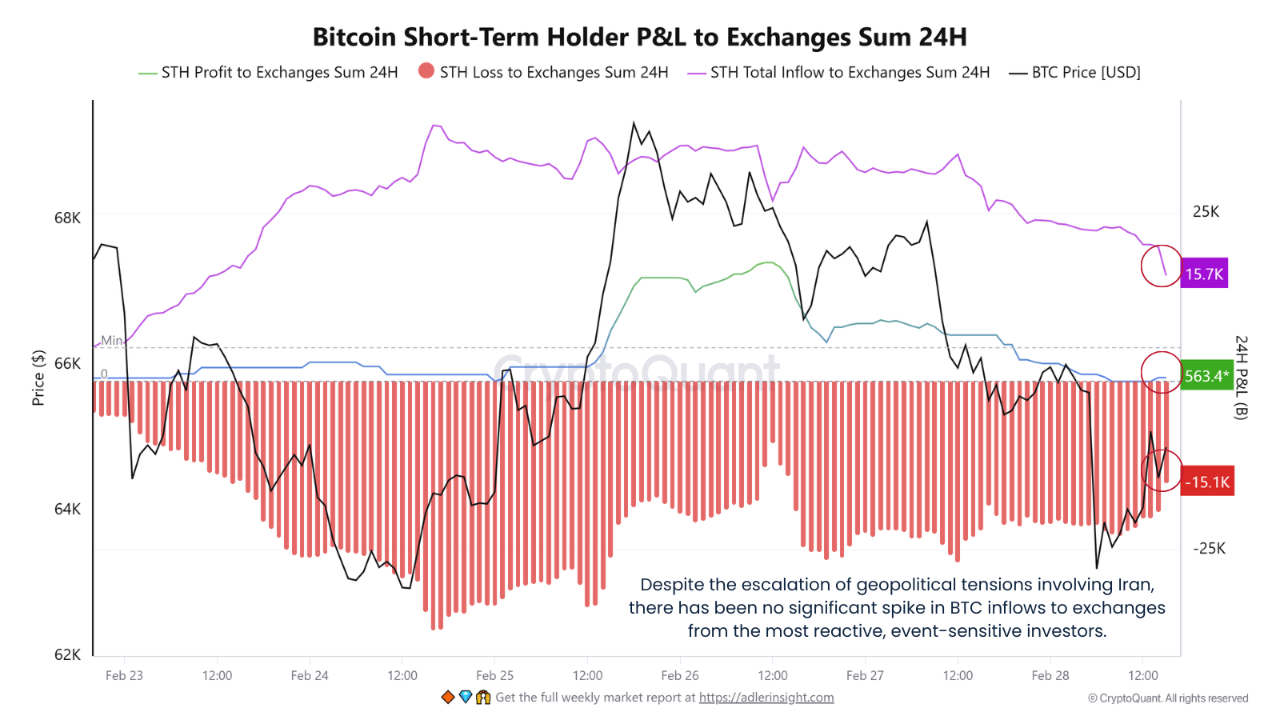
However, despite the sharp headlines and sudden price swings, on-chain data shows that one important group of investors has stayed calm. Specifically, short-term Bitcoin holders have not reacted the way they typically do during major global crises.

Key Points

  • Joint strikes from the U.S. and Israel against Iran have triggered another conflict in the Middle East, impacting asset prices.
  • Bitcoin has dropped 3.6% since Feb. 26 to $65,548, briefly hitting $63,037 on Feb. 28 before recovering above $65,000.
  • However, short-term holders appear to be showing more resilience, avoiding their typical panic-selling campaign during global tensions.
  • These holders sent 89,000 BTC to exchanges at a loss during the Feb. 5 capitulation, but loss-driven inflows have since declined.
  • Analysts see upside toward $80,000–$91,000 if $70,800 breaks, while a drop below $62,000 could trigger a move toward deeper support.

On-Chain Data Shows Fading Panic Among Bitcoin STHs

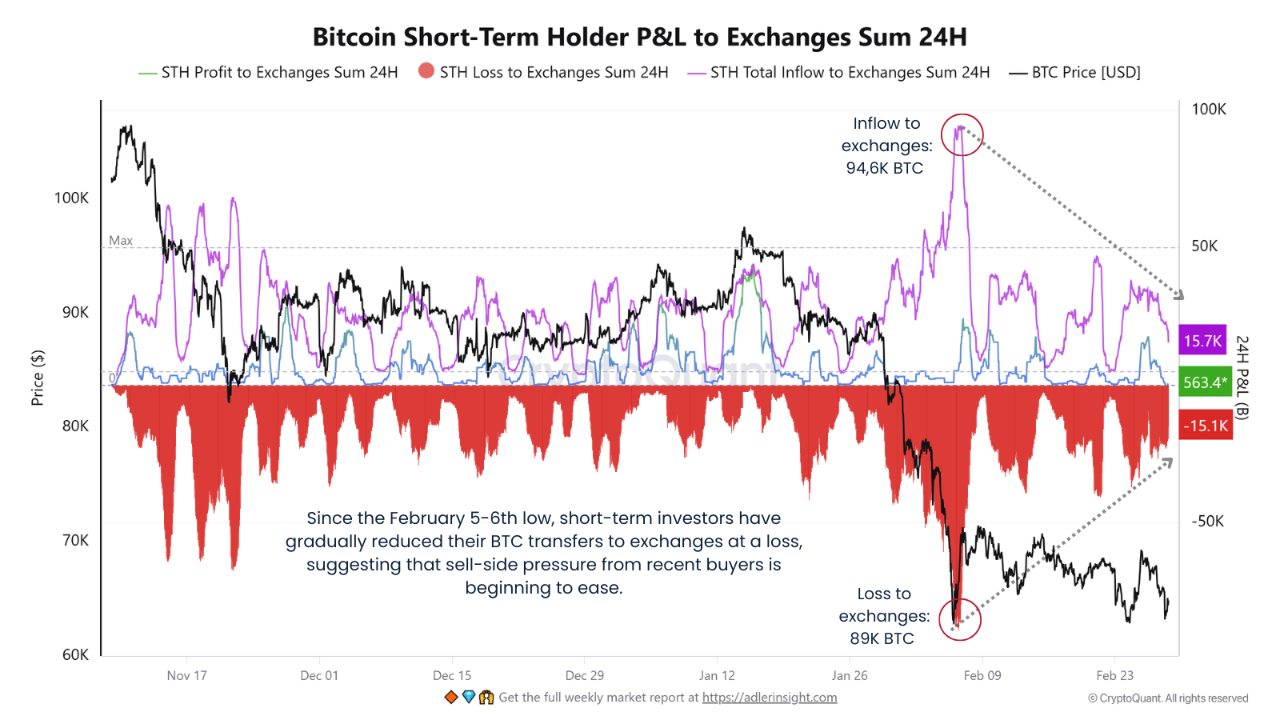
Verified CryptoQuant analyst Moreno recently highlighted the resilience demonstrated by Bitcoin short-term holders (STHs). Specifically, his analysis focused on the Short-Term Holder Profit and Loss to Exchanges metric, which tracks how recent buyers move their coins. 

Notably, these investors usually drive quick price swings because they tend to react fast when markets turn negative. Earlier in the month, on Feb. 5 and 6, short-term holders sent a massive 89,000 BTC to exchanges at a loss within just 24 hours. This marked a wave of panic selling.

Bitcoin STH Profit and Loss CryptoQuant
Bitcoin STH Profit and Loss to Exchanges | CryptoQuant

However, since then, things have changed. Specifically, loss-driven transfers to exchanges have steadily dropped. Even after the latest escalation involving Iran, short-term holders did not rush to sell. 

When Bitcoin dipped into the $63,000 to $64,000 range on Feb. 28, exchange inflows from this group stayed low. There was no major spike in profit-taking and no fresh wave of panic-driven selling, despite the kind of geopolitical shock that often triggers it.

Bitcoin STH Profit and Loss to Exchanges CryptoQuant
Bitcoin STH Profit and Loss to Exchanges | CryptoQuant

Why This Matters

Moreno believes this matters because markets often find stability after weaker hands finish selling. The steady decline in loss-driven transfers suggests that much of the recent selling pressure may already be behind us. 

Going forward, he says traders should watch whether exchange inflows from short-term holders remain quiet. If they stay low, it could point to seller exhaustion and possibly a recovery. If inflows suddenly jump, especially at a loss, it would signal that capitulation is not over.

If this calm continues, Bitcoin could stabilize and possibly follow the rebound patterns seen after the February 2022 and June 2025 conflicts. However, if short-term holders start sending large amounts to exchanges again, especially at a loss, the price could revisit $62,000 or even the $57,772 support level.

Historical Data from Past Wartime Moves

Speaking on the situation in the Middle East, market analyst Ted Pillows compared the current situation to earlier conflicts. In February 2022, when Russia invaded Ukraine, Bitcoin first dropped and then rallied 40%. In June 2025, when Israel attacked Iran, Bitcoin again fell before climbing 25%. 

Historical Data on Bitcoin Reactions During Conflicts

Now, after the U.S. attacked Iran in February 2026, Bitcoin has dropped once more. Pillows has begun questioning whether history could repeat itself with another strong rebound.

Possible Bitcoin Paths from Here

Meanwhile, another market commentator, Mak Investment, pointed out that after Iran’s operation, gold and oil prices jumped, Asian stock markets dropped, and liquidations increased. Still, Bitcoin held up better than many stocks, showing relative strength during a risk-off mood.

Mak also stressed that Bitcoin remains in a 47-48% mid-cycle correction from its $126,000 peak in October 2025. The analyst compared this pullback to similar corrections during the 2017 and 2021 bull runs. Mak identified $70,800 at the 0.5 Fib. retracement level as strong resistance and $57,772 at the 0.618 level as key support. 

He presented two possible paths. If tensions stay contained and Bitcoin breaks above $70,800, the price could quickly move toward the $80,000-$91,000 range. However, if the conflict spreads and Bitcoin falls below $62,000, it could drop sharply into a lower green demand zone. 

War Escalates Across the Middle East

At press time, the Iran-Israel conflict has grown into a full-scale regional war now in its third day. On Feb. 28, joint U.S.-Israeli strikes hit Iranian leadership, military bases, nuclear facilities, missile systems, and command centers. The strikes killed Iran’s Supreme Leader Ayatollah Ali Khamenei along with other senior military figures.

Iran responded quickly with waves of missiles and drones targeting Israel, U.S. bases, and several Gulf states. U.S.-Israeli forces have struck more than 2,000 targets across 131 Iranian cities and provinces, claiming air superiority over Tehran. 

Iran’s retaliation has reached locations including Beit Shemesh, Bahrain, Iraq, Saudi Arabia, Qatar, the United Arab Emirates, Cyprus, and a UK base. Hezbollah in Lebanon has also fired rockets into Israel, leading to Israeli strikes on Beirut suburbs and southern Lebanon.

Bitcoin, Ethereum, XRP See Major $1B Inflow as Crypto Funds Reverse 5-Week Outflow Streak

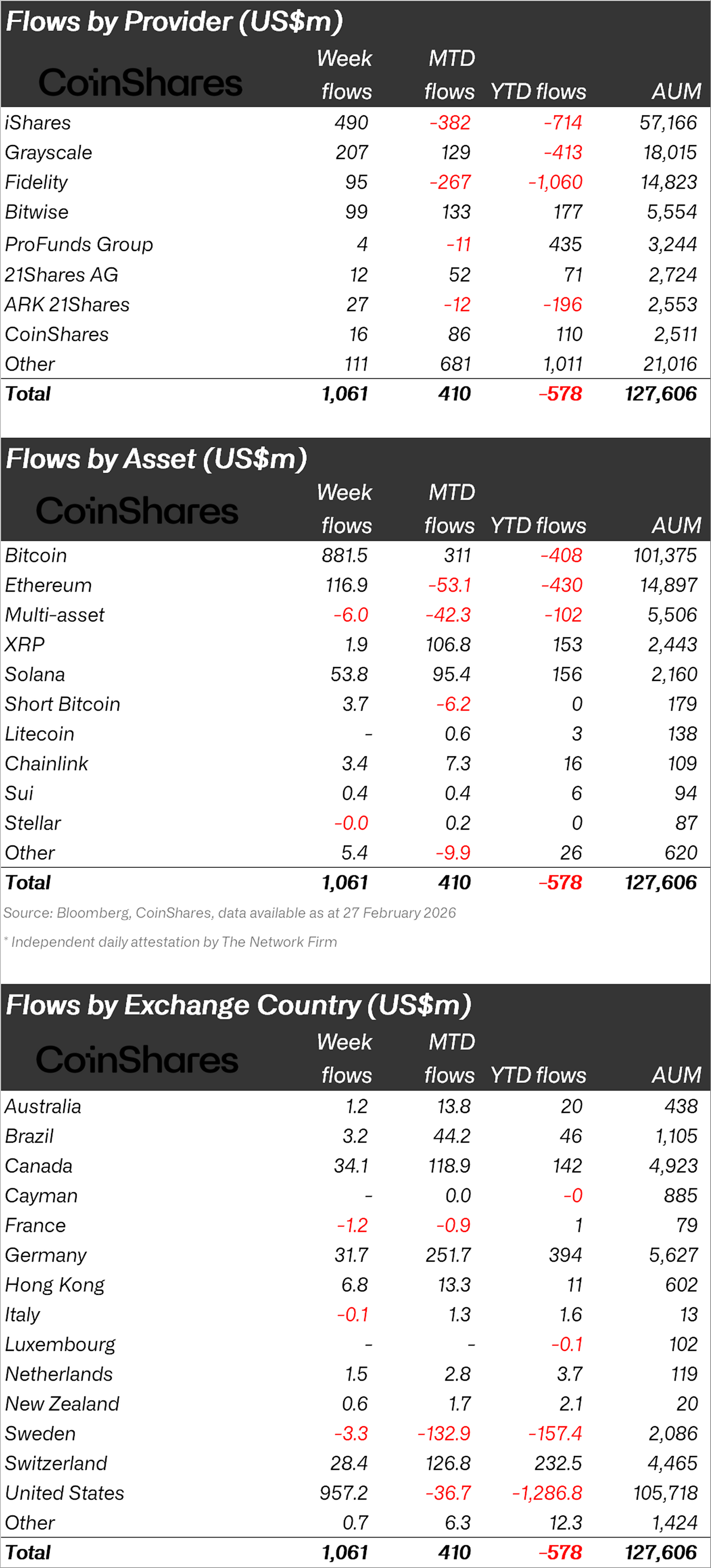
Bitcoin, Ethereum, and XRP investment products recorded $1.0 billion in inflows last week, bringing an end to a five-week run of outflows that had totaled $4.0 billion.

New weekly data from CoinShares confirmed this impressive turnaround. The shift marks a notable change in sentiment after weeks of sustained selling pressure. 

While it is difficult to pinpoint a single catalyst, the rebound appears to have been supported by prior price weakness, a break below key technical levels that encouraged re-entry, and fresh accumulation by large Bitcoin holders. 

US Leads Regional Inflows

Regionally, flows were largely aligned. The United States accounted for the lion’s share, attracting $957 million in inflows. Canada followed with $34.1 million, while Germany and Switzerland recorded $31.7 million and $28.4 million, respectively.

Despite the strong weekly performance, year-to-date (YTD) flows remain negative globally, with total YTD outflows at $578 million.

Bitcoin Dominates as Sentiment Improves

Bitcoin was the primary beneficiary of the renewed appetite, drawing $881.5 million in inflows last week. However, the presence of $3.7 million in inflows into short Bitcoin products suggests that market opinion remains divided, with some investors positioning for downside protection.

On a YTD basis, Bitcoin still shows net outflows of $408 million, indicating that the recovery is still in its early stages.

Ethereum Sees Strongest Weekly Inflows Since January

Ethereum recorded $116.9 million in inflows, marking its largest weekly intake since mid-January. Even so, Ethereum remains in a net outflow position YTD at $430 million.

The rebound suggests renewed institutional interest, though conviction remains low compared to Bitcoin’s dominant share in last week’s allocations.

XRP and Solana Maintain Positive YTD Momentum

XRP saw modest weekly inflows of $1.9 million but maintains a strong YTD inflow position of $153 million.

Solana posted $53.8 million in inflows last week and has now accumulated $156 million in inflows year-to-date, positioning it among the stronger-performing altcoins in terms of institutional demand.

Meanwhile, Chainlink recorded minor inflows of $3.4 million, with no significant outflows observed across other major assets.

Although last week’s $1 billion inflow signals a turning point after weeks of sustained redemptions, YTD figures show that both Bitcoin and Ethereum remain in negative territory overall.

The data suggests that while investors are beginning to re-enter the market, conviction remains selective, with capital concentrating primarily in Bitcoin and a handful of large-cap altcoins.

Most Bitcoin Buyers In Loss That Bought BTC Within the Past 2 Years

0

The persistent Bitcoin pullback is putting pressure on a group of long-term holders who rarely find themselves underwater.

Specifically, those who have bought Bitcoin within the last two years are now unprofitable, spurred by the asset’s ongoing price weakness. For context, BTC closed February down 14.6%, marking its fifth consecutive monthly downtrend and its fourth-worst Q1 performance since 2013.

Key Points

  • Those who bought Bitcoin within the last two years are now unprofitable, as the asset’s ongoing price weakness has eroded their holdings.
  • Data from the Bitcoin Realized Price: UTXO Age Bands highlighted this, specifically for coins aged roughly 18 months to two years.
  • Earlier cycles show that these moments frequently mark late-stage corrections.
  • Market environments where large numbers of holders are nursing losses have often aligned with stronger setups for a rebound.

Bitcoin Two-Year Cost Basis Below Price

Fresh on-chain data from CryptoQuant, highlighted by verified author “Crypto Dan,” shows how tight the situation has become for BTC holders who bought two years ago. The analysis harnessed data from the Bitcoin Realized Price: UTXO Age Bands.

It points out that the realized price for coins aged roughly 18 months to two years has climbed above the current market rate. On the chart, that band sits near the mid-$60,000 region, and a sustained hold below it pushes a large share of market participants into the red.

Bitcoin Realized Price: UTXO Age Bands/CryptoQuant

Historically, that shift in profitability has had a notable impact on market proceedings. Bitcoin often weakens when most holders are comfortably in profit, as selling pressure builds. Conversely, major recoveries and rallies have tended to start when losses dominate and weaker hands have already exited.

Why Does This Matter for Bitcoin?

The accompanying image highlights the two-year average purchase price steadily rising over time as newer buyers replace older ones. Notably, this cost basis now serves as a psychological and structural floor, substantially influencing market sentiment.

Earlier cycles show that these moments frequently mark late-stage corrections. In past downturns, dips below similar long-term cost levels preceded periods of accumulation and eventual recoveries.

History supports this, too. The chart shows that Bitcoin last broke below this cost basis in August 2022, around $24,000. Bitcoin price consolidated for two more months before reaching its low of $15,000 in November 2022, then rallied sharply from there to unprecedented highs.

Good Time to Approach Aggressively

The analyst highlighted that if Bitcoin decisively breaks below $60,000, most investors would be underwater, except for Bitcoin OGs. Interestingly, that environment has often aligned with stronger setups for a rebound.

This dynamic explains why sharp rallies sometimes emerge when sentiment is at its worst. When most participants are already nursing losses, there are fewer eager sellers left. As such, even modest demand can then move an asset’s price more easily.

In this case, Crypto Dan recommends a more aggressive approach in accumulation. With these conditions often closely aligned around the bottom, the current levels often provide a good buying opportunity.

Financial Author Robert Kiyosaki Says Bitcoin Set to Blast Off After Gold’s $128 Surge

0

Following a sharp surge in gold prices, renowned financial author Robert Kiyosaki has predicted that Bitcoin is on the verge of a major breakout. 

Over the weekend, crypto assets extended losses following renewed geopolitical tensions in the Middle East, leaving investors cautious. However, Kiyosaki moved to restore confidence, suggesting that Bitcoin could soon stage a strong recovery and deliver significant upside. 

Key Points 

  • Robert Kiyosaki suggests Bitcoin is on the verge of a major breakout.
  • After gold surged $128, he projected that Bitcoin and silver could be next to rally sharply.
  • He urged investors to remain patient as the bullish outlook unfolds.
  • While gold has gained amid West Asia’s geopolitical tensions, Bitcoin has instead recorded losses.

Bitcoin to Blast Off, Says Kiyosaki  

Earlier today, Kiyosaki highlighted gold’s reaction to escalating geopolitical tensions in the Middle East. According to him, gold surged by $128 in a single day, reaching $5,414, as investors rushed into traditional safe-haven assets. 

Building on this momentum, Kiyosaki argued that even stronger gains lie ahead for Bitcoin and silver, both of which he expects to “blast off.” 

He urged investors to “hang on,” signaling that markets may be approaching a critical turning point, with Bitcoin well positioned to benefit from rising inflation fears and weakening fiat currencies. 

Bitcoin as a Hedge Against Economic and Geopolitical Uncertainties 

His commentary reinforces the growing narrative of Bitcoin increasingly viewed as a hedge against economic and geopolitical uncertainty. His forecast comes as investors rotate capital into safe havens following renewed instability in the Middle East. 

This renewed tension was sparked by the latest airstrikes by Israel and the U.S., which led to the death of Iran’s Supreme Leader, Ayatollah Ali Khamenei. Since the incident, Iran has launched retaliatory attacks on U.S. military bases across neighboring countries, including the UAE, Saudi Arabia, and Bahrain. 

As tensions persist, concerns are mounting that the conflict could escalate into a prolonged crisis rather than a short-lived event. Hence, investors increasingly seek refuge in assets such as gold, leading to a short-term rally. Meanwhile, Kiyosaki expects Bitcoin and silver to follow suit soon. 

BTC Price Reacts Negatively 

Notably, Bitcoin has yet to reflect this anticipated shift. Instead, the leading cryptocurrency slid to $63,400 on Saturday. It attempted a rebound on Sunday, climbing toward $68,000. However, the recovery quickly faded after Donald Trump announced fresh military strikes during a broadcast yesterday, further dampening market sentiment. At press time, Bitcoin now trades at $65,537, down 2.27% over the past 24 hours. 

Meanwhile, other crypto advocates have echoed similar sentiments. For example, Arthur Hayes, CIO of Maelstrom, argued that Bitcoin could surge if the Iran war drags on. He indicated that the U.S. Federal Reserve may respond by printing more money, which would weaken the dollar and push investors toward safe-haven assets like Bitcoin. 

However, despite these bold forecasts, uncertainty remains over how long the conflict will last and how Bitcoin will perform throughout the crisis. 

Analyst Reveals Best Move for XRP Investors Today

0

Amid ongoing bearish pressure across the crypto market, community figure Adam has delivered a strategic message to XRP investors.

The wider market remains under intense selling pressure, with prices sliding back to late-2024 levels. Over the weekend, XRP followed the broader market downturn, dipping below $1.30 and reigniting concerns among traders.

As uncertainty spreads, Adam urged investors to take advantage of the pullback to position themselves for a potential rally in the next few years.

Key Points

  • Amid the broader market downturn, Adam advises investors to capitalize on lower prices by accumulating XRP.
  • He suggests moving holdings to a cold wallet and ignoring the asset for two years.
  • If XRP mounts a strong recovery by 2028, the strategy could yield substantial gains.
  • Community reactions remain divided, with some pointing to the challenge of ignoring a high-potential asset like XRP.

Best Move for XRP Investors?

Notably, Adam outlined what he considers “the best move for XRP holders right now”. In a brief message, he advised investors to buy the dip, transfer their holdings to a cold wallet, and ignore them for the next two years.

His commentary calls for a disciplined, long-term investment mindset. Rather than reacting emotionally to short-term volatility, he advocates strategic accumulation and secure storage.

This approach reduces panic selling and positions investors to benefit if XRP stages a strong recovery within the projected two-year timeframe, specifically by 2028. In his view, the current market turbulence could fade by 2028, a period many analysts anticipate could mark a strong rebound.

Potential XRP Valuation by 2028

Supporting this outlook, the Telegaon prediction platform estimates that XRP could reach a peak price of $12.84 by 2028. At that level, a $1,000 investment made today at $1.34 could grow to approximately $9,582.

Telegaon 2028 Prediction for XRP

However, Changelly offers a more conservative projection, suggesting that XRP could revisit $3 by 2028. Even under this scenario, a $1,000 investment would still triple in value, reaching about $3,000.

Community Divided Over Two-Year Holding Strategy

Meanwhile, Adam’s recommendation has sparked mixed reactions, particularly regarding the proposed two-year holding period. Some users consider the advice timely and practical, arguing that constantly tracking prices during volatile cycles increases stress, whereas stepping away could help investors return later with stronger gains and peace of mind.

On the other hand, critics acknowledge the strategy’s logic but contend that ignoring an asset with significant upside potential would be challenging. In their view, the prospect of major returns makes frequent price checks almost unavoidable.

Notably, factors such as the anticipated passage of the Clarity Act, rising institutional demand for XRP, and a potential easing of Middle East geopolitical tensions support a bullish outlook. Yet, it remains uncertain whether these catalysts will materialize or translate into sustained price gains.

XRP Price as XRP Now Setting up for 600% Surge Against Bitcoin

0

Chart data indicates that XRP may currently be setting up to record a 600% increase against Bitcoin, which could massively impact its price in dollar terms.

The broader crypto market recently recorded a fifth consecutive monthly loss amid a 13.41% decline in February 2026. This marked the largest monthly drop since October 2025, impacting Bitcoin (BTC) and altcoins such as XRP.

While XRP saw mildly steeper declines than Bitcoin in February, dropping by a modest 1.58% compared to the crypto firstborn, chart data indicates that the altcoin may be looking to engineer a 600% spike against Bitcoin, potentially pushing its price above $10.

Key Points

  • With the broader crypto market dropping 13.41% in February, XRP saw mildly steeper declines than Bitcoin, falling 1.58% against the crypto leader.
  • This adds to a sustained downtrend for the XRP/BTC pair that has lingered since December 2025, as Bitcoin shows more resilience than XRP.
  • Chart data indicates that the ongoing trend, which has been bearish for XRP, could be setting up for a bullish push against Bitcoin.
  • Analysts project a possible 600% increase for the XRP/BTC pair, a development that could push XRP’s price above $10.

XRP Struggles Against Bitcoin

Notably, market analyst Javon Marks has been at the forefront of this projection, insisting that XRP could soon flip the trend against Bitcoin for good. For context, XRP has continued to lose ground against Bitcoin since dropping from its all-time high of $3.66 in July 2025.

Specifically, at the $3.66 peak, the XRP/BTC pair stood at 0.00003070. It has since dropped to the current figure of 0.00002040, representing a massive 33.5% decline. This indicates that while Bitcoin and XRP have witnessed price declines on the back of the broader market downturn, XRP has recorded steeper drops.

XRPBTC 2W Chart Javon Marks
XRPBTC 2W Chart | Javon Marks

Descending Trendline Breakout and Retest

Interestingly, amid XRP’s price weakness compared to Bitcoin, data from Marks’ chart indicates that XRP currently trades above a multi-year descending trendline against Bitcoin on the 2-week chart.

This trendline started forming after the XRP/BTC pair dropped from the all-time high of 0.0002454 in May 2017. Since then, the trendline has held through, presenting a roadblock for any attempt from XRP to break out against Bitcoin. These failed attempts emerged in January 2018, November 2020, and July 2023.

However, when XRP made another attempt in November 2024, a successful breakout occurred, as the XRP price spiked from 0.00000725 BTC to a high of 0.00003419 BTC by January 2025, aligning with the $3.4 value. XRP dropped from this level to 0.00001928 BTC before recovering to 0.00003070 BTC in July 2025 and then dropping to the current price.

These struggles represent part of the effort to retest the descending trendline breakout. Interestingly, XRP crashed to 0.00000720 BTC on Binance during the 10/10 market collapse, effectively retesting the trendline, and then immediately recovered. If this marked a successful retest, Marks believes an upward push may be imminent.

Potential XRP Surge Against Bitcoin

It is against this backdrop that the analyst has now predicted a possible 600% rally for the XRP/BTC pair. His chart suggests the pair could soar to an eight-year peak of 0.0001579. At Bitcoin’s current price of $66,227, this would translate to a $10.4 value for XRP. 

Top Analyst Flags 75% Downside for Shiba Inu Amid Bearish Signals

0

Shiba Inu (SHIB) may be entering a decisive phase, according to crypto analyst Ali Martinez, who warned that the memecoin could fall as much as 75% if bearish momentum persists.

His caution comes at a time when SHIB is already grappling with sustained price weakness and fragile investor sentiment.

Key Points

  • Ali Martinez warns SHIB could drop up to 75% if a critical support level breaks.
  • The token is testing long-standing support near $0.00000510, held for 56 months.
  • A breakdown could send SHIB toward $0.00000138, with interim support at $0.00000304.
  • SHIB is already down 22% over the past month, reflecting sustained bearish momentum.
  • Shibarium suffered a $2.5 million hack in September 2025, denting investor confidence.

Technical Outlook Points to Potential Breakdown

Martinez based his assessment on a weekly chart pattern that signals continued downside risk. Specifically, he emphasized a long-standing support level near $0.00000510, a threshold that has reportedly held for 56 months.

A decisive break below that level, he suggested, could open the door to further losses. In that case, the next support sits around $0.00000304, while a broader breakdown could drag SHIB as low as $0.00000138. Altogether, such a move would represent a decline of roughly 75% from current prices.

Image

At present, SHIB trades at $0.00000554, down 8.5% over the past week and 22% over the last month. Meanwhile, the token’s market capitalization stands at approximately $3.26 billion, ranking it 27th among global cryptocurrencies. If selling pressure continues, continued weakness could push it outside the top 30, potentially compounding negative sentiment.

Ecosystem Challenges Add Pressure

Beyond price action, the broader Shiba Inu ecosystem has faced setbacks that may be weighing on confidence.

In September 2025, Shibarium, the project’s Layer-2 blockchain, suffered a significant hack, with approximately $4 million worth of tokens siphoned from the network. Consequently, the breach intensified scrutiny around security and undermined investor trust.

Since then, Kaal Dhairya and the core development team have rolled out technical improvements to restore confidence. Even so, progress has been gradual, and some community members have voiced frustration over the pace of recovery.

At the same time, attention has turned to Shytoshi Kusama. Reports indicate that the Shiba Inu ambassador is pursuing an independent AI-focused initiative.

Kusama addressed the matter on X, reaffirming his long-term focus on SHIB. He characterized his AI initiative as complementary to the project’s broader vision rather than a departure from it.

Exchange Flows Reveal Mixed Signals

Alongside technical and leadership concerns, on-chain data presents a more nuanced picture of market sentiment.

According to CryptoQuant, SHIB reserves on exchanges increased from 80.93 trillion tokens on February 27 to 81.06 trillion on February 28 — a shift that typically signals rising sell-side pressure.

However, the trend quickly reversed. Large holders, or whales, withdrew substantial amounts of SHIB shortly thereafter. Consequently, exchange reserves fell to 80.90 trillion and later declined further to 80.87 trillion at press time.

This back-and-forth movement underscores the market’s internal tension. Initial inflows suggested potential selling, but subsequent withdrawals point to dip buying by major investors.

Taken together, these developments place Shiba Inu at a crossroads. Technical indicators warn of significant downside risk, while whale accumulation hints at underlying support.

In the weeks ahead, traders will be watching closely to see whether key support levels hold, and whether SHIB can stabilize, or if a deeper correction ultimately unfolds.

Every Yield You Earn for Your XRP Comes With Risk: XRPL Validator Issues Warning

Vet, a validator on the XRP Ledger, is reminding holders that earning yield on XRP is never free of risk.

In a recent tweet, he cautioned that for every ounce of yield users get from their XRP, they “are paying for with some amount of risk”. He stressed that many investors do not fully examine where the yield originates before committing their tokens.

According to Vet, yield is a core part of decentralized finance, but due diligence remains essential. He warned users not to overlook the mechanics behind returns, especially as XRP-based DeFi products continue to expand.

Key Point

  • Vet, an XRP Ledger validator, warns that every XRP yield comes with hidden risk.
    He says many investors chase returns without understanding custody and counterparty exposure.
  • Debate grew around Xaman Wallet and Upshift over who controls deposited XRP.
  • As Flare Network expands FXRP and staking, users are urged to balance yield with risk.

Questions Around Custody and Trust

Joining the conversation, X user James Dula asked about who users are actually trusting when depositing XRP into yield platforms. He referenced a message sent to Xaman Wallet founder Wietse Wind, questioning whether users are trusting Xaman itself or Upshift, since XRP is transferred into Upshift’s custody.

Vet responded that the parties involved are transparent, but emphasized that users must read and understand the documentation. He compared the situation to blindly signing transactions without reviewing the details. 

For users with specific concerns, he recommended using in-wallet xApp support to seek clarification directly.

Another community member noted that regulatory clarity and institutional-grade custody solutions would provide greater confidence, adding that spreading funds across multiple platforms may help reduce exposure.

Echoes of Earlier Warnings on High Yields

The caution mirrors concerns raised in September 2025 by Digital Asset Investor. He said he would not participate in any 8–10% XRP yield products, choosing instead to prioritize asset protection. He argued that sacrificing a portion of potential returns would be worthwhile if proper insurance coverage were available.

His stance was shaped by historical collapses involving high-yield promises, from traditional financial frauds to failed crypto lending platforms like Celsius. The message is that attractive annual percentage yields can sometimes mask counterparty risks.

XRP Yield Products Gain Momentum

Despite the warnings, XRP yield opportunities are expanding. 

The Flare Network has integrated XRP into DeFi through its FAssets system, allowing users to mint FXRP, a one-to-one representation of XRP, and deploy it into lending and liquidity strategies. Its upcoming Firelight protocol aims to introduce stXRP, targeting around 7% annual returns.

At Ripple’s Seoul 2025 event, mXRP was unveiled with projected yields of around 10% APY via liquid staking structures.

Recent data shared by Flare CEO Hugo Philion showed that XRP bridged to Flare surged by over 10% in a single day, even as the broader market declined. More than 3 million XRP were deposited within 24 hours, pushing total FXRP supply above 114 million tokens.

The increase signals that many holders are actively putting their XRP to work, even during periods of price weakness.

Balancing Opportunity and Risk

While DeFi innovations are transforming XRP from a payments-focused asset into a yield-generating instrument, the core concern remains custody and counterparty exposure. Converting XRP into wrapped or staked representations often involves smart contracts, bridging mechanisms, and third-party management structures.

Vet’s warning does not dismiss yield opportunities outright. Instead, it reinforces a simple principle: higher returns typically come with trade-offs.

For XRP holders, the key question may not just be how much yield is offered, but how clearly they understand the risks attached to earning it.