
Home Blog Page 24

Cardano Eyes Second Rebound as Analyst Maps Path to $0.95

0

Cardano could be setting up for a second major rebound after breaking out of a prolonged bearish structure, according to crypto analyst Lana Valentis.

Valentis argues that Cardano has completed its first bounce from a multi-month descending channel that had pressured the token since mid-2025.

Following the breakout, ADA entered a consolidation phase above the $0.19 support zone on the daily chart. According to Valentis, holding this level remains crucial because it could provide the foundation for another upward move.

Therefore, a sustained hold above $0.19 would strengthen the bullish setup, while a break below the support could weaken expectations for a broader reversal.

$0.24 Break Could Confirm Bullish Structure

Valentis expects ADA to stage a second bounce from the current support area before testing the $0.24 resistance level.

Moreover, she believes a decisive break above $0.24 could mark a significant shift in ADA’s market structure. Such a move would potentially confirm that the token has moved beyond its prolonged bearish trend and entered a new bullish phase.

From there, Valentis identified progressively higher targets at $0.29, $0.39, $0.50, $0.70, and ultimately $0.95. With ADA currently trading at $0.1968, reaching $0.95 would require a gain of 382%. ADA last reached this level in September 2025, before coming under sustained selling pressure.

Previous Failed Bounces Highlight Risks

However, the bullish setup still faces significant risks. The chart shows two previous bounce attempts that failed to reverse ADA’s broader downtrend, with rejections occurring in October 2025 and February 2026.

These failed attempts suggest that another rejection could emerge if buyers fail to build sustained momentum above key resistance levels. Consequently, the $0.19 support and $0.24 resistance remain critical levels to watch as ADA develops its next move.

September Adds Another Headwind

Meanwhile, ADA has started September in the red, continuing a historically weak pattern for the token during the month.

ADA has already declined 1.82% in the first two days of September. Since its launch, Cardano has finished September in positive territory only once. In 2024, ADA gained 7.87% during the month.

By contrast, ADA ended September lower in 2018, 2019, 2020, 2021, 2022, 2023, and 2025, recording losses of 16.2%, 13.5%, 17.7%, 24%, 2.87%, 0.95%, and 0.53%, respectively.

Overall, ADA has posted an average September return of -7.74%, while its median September return stands at 2.87%. This historical weakness could add another challenge to ADA’s attempt to sustain a breakout and advance toward Valentis’ higher targets.

Cardano Monthly Returns

XRP Futures Trading Activity Slumps to $2.86B

0

XRP futures trading activity has witnessed a sudden crash as the cryptocurrency pulls back from the $1.70 high it reached two weeks ago. 

Recent market data shows that traders have started cutting their exposure to leveraged positions, causing futures volume to drop significantly while XRP’s price has held up relatively well.

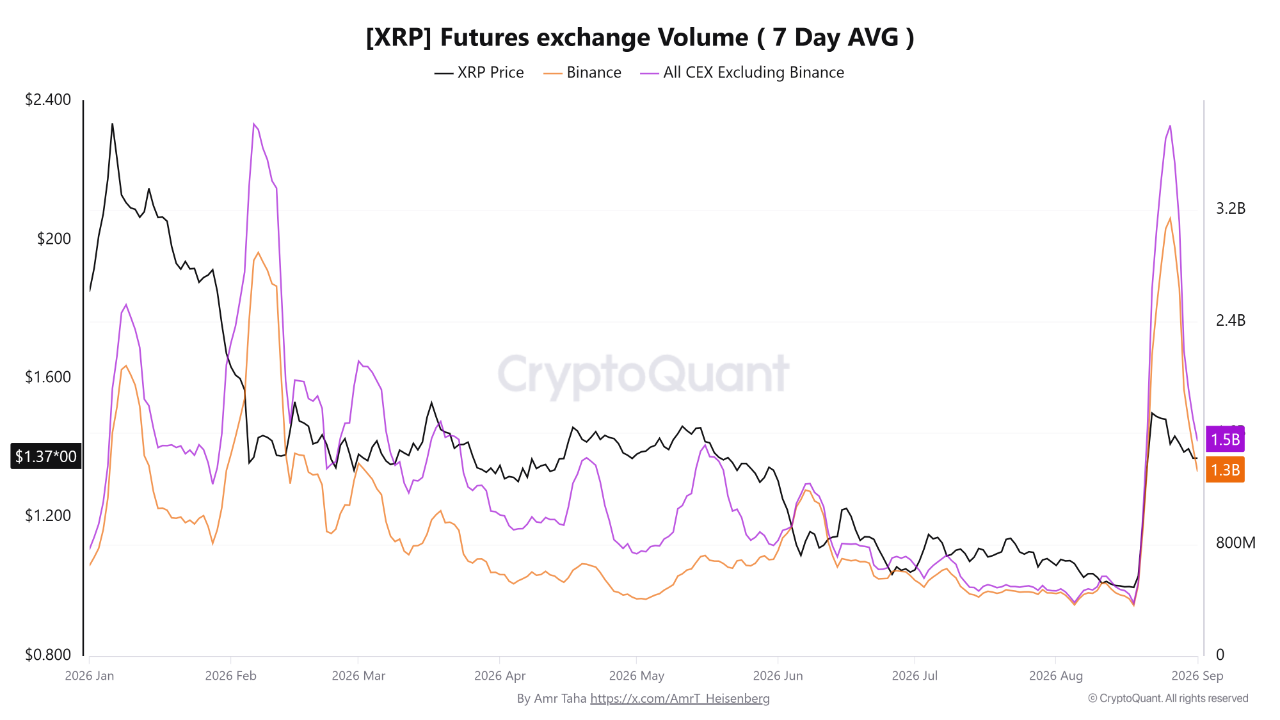
On Aug. 26, 2026, the 7-day average futures volume across Binance and other centralized exchanges reached $6.94 billion. Binance accounted for $3.14 billion, while exchanges outside Binance recorded $3.80 billion.

The combined figure stood about 4.2% above the previous 2026 peak of $6.66 billion recorded on Feb. 6. Binance’s activity was especially strong, with its volume coming in 10.6% above its February high. 

At the same time, futures volume outside Binance came close to its earlier peak. This showed that XRP futures trading reached its highest level of the year following the price spike that began two weeks ago.

Nearly $4.1 Billion in XRP Futures Trading Volume Disappears

However, the market changed over the next six days. By Sept. 1, 2026, Binance’s 7-day average futures volume had fallen to $1.32 billion, while exchanges outside Binance recorded $1.54 billion. Combined, futures activity across both groups stood at just $2.86 billion.

This figure represents a 58.8% decline from the $6.94 billion peak recorded on Aug. 26. Binance’s volume fell by 58.0%, while activity across other centralized exchanges dropped by 59.5%.

The similar size of the declines across both groups suggests that the slowdown has affected the broader XRP futures trading market instead of a single exchange. 

XRP Futures Trading Activity | Source: CryptoQuant

In less than a week, nearly $4.1 billion in 7-day average futures volume disappeared. Despite that major drop in futures activity, XRP’s price declined by only about 5% over the same period.

XRP Holds Above Important Support

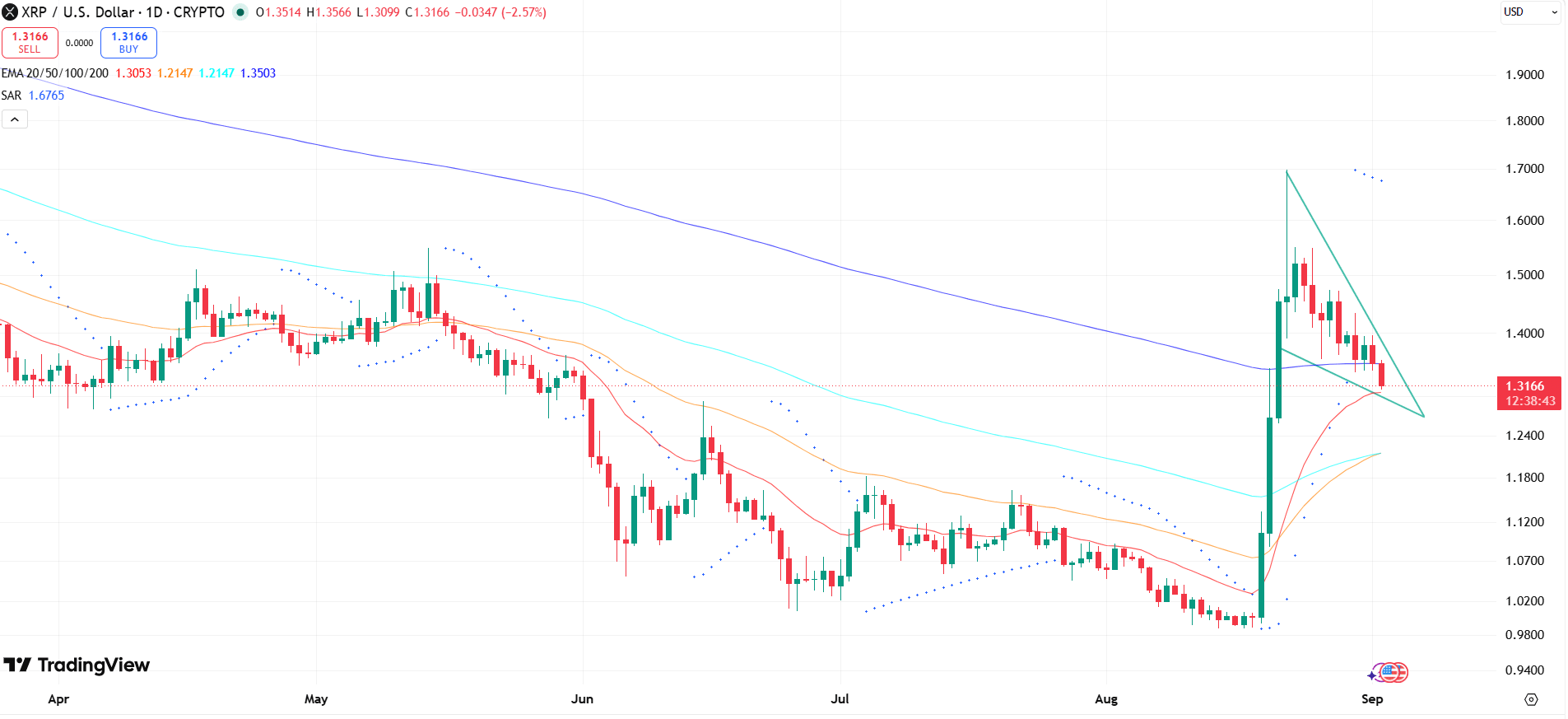
Currently, XRP trades at $1.3173, down 2.52% for the day. After its August rally from around $1.00 to $1.70, XRP has formed a descending triangle. The pattern comes on the back of a sudden correction after the strong upsurge.

XRP 1D Chart
XRP 1D Chart

The $1.35-$1.38 range remains the key demand area, with about 3.2 billion XRP previously traded around this zone. A close below $1.35 could increase the chances of a move toward $1.20.

For the bulls, XRP needs to first reclaim $1.55 to put $1.68 back in focus. A break above $1.68 could then bring $1.86 into play. If XRP confirms a move above $1.86, the next targets would be $2.00 and $2.19.

XRP still trades above its 20-day EMA at $1.3053 and 50-day EMA at $1.2147. However, the Parabolic SAR remains at $1.6765, above the current market price. This indicator suggests that sellers still have the upper hand in the short term.

At the same time, demand from US spot XRP ETFs remains a positive factor. These products recorded $110.49 million in weekly inflows through Aug. 28, confirming continued institutional interest in XRP despite the recent price decline.

The Federal Reserve’s September meeting could also become an important catalyst for XRP and the wider crypto market. For now, the sharp fall in futures volume does not appear to have caused a similar breakdown in price.

Top Japanese Firm Dumps 1.19M XRP to Go All-In on Bitcoin

0

Japanese company Remixpoint has sold all of its altcoins, including more than 1.19 million XRP, as it shifts to a Bitcoin-only strategy.

In a new release, the company said on September 2 that it sold its altcoins on September 1. Specifically, it sold 901.45 ETH, 13,920 SOL, 1.19 million XRP, and 2.80 million DOGE for a total of ¥878.8 million. The sales made a profit of ¥117.8 million.

The move leaves Bitcoin as Remixpoint’s only remaining crypto asset, with the company holding approximately 1,506 BTC.

Remixpoint Makes Profit on XRP Sale

Notably, Remixpoint sold about 1.19 million XRP for ¥260.43 million. Since the XRP had cost the company ¥248.90 million, it made a profit of ¥11.52 million.

Meanwhile, Ethereum brought in the biggest profit at ¥60.20 million, followed by Solana at ¥49.30 million. DOGE was the only cryptocurrency sold at a loss, costing the company ¥3.26 million.

Overall, Remixpoint made a total profit of ¥117.77 million from selling its altcoins. The company said it made the decision based on market conditions, risk, and its financial strategy. It now wants to focus its crypto holdings on Bitcoin to make its investment strategy simpler and use its capital more efficiently.

Bitcoin Becomes Remixpoint’s Sole Crypto Asset

After the transactions, Remixpoint’s cryptocurrency portfolio now consists exclusively of Bitcoin, with approximately 1,506 BTC, worth over $117 million today. This is a big change from its previous strategy, which included Bitcoin, XRP, Solana, and other cryptocurrencies.

The company had also earned extra income from its crypto holdings. Between February 24 and August 31, Remixpoint earned 14.92 BTC from lending its Bitcoin, worth about ¥164.2 million.

It also earned nearly ¥29.9 million in staking rewards from ETH and SOL between July 2025 and August 2026, before selling those assets.

Sale Could Fund Energy Investments

Remixpoint said it may use the money from the altcoin sales to invest in growth areas, including large-scale battery storage. The company also plans to strengthen its finances and take steps to increase value for the company and its shareholders.

This suggests the sale was part of a larger financial strategy, not just a decision to exit the crypto market. Remixpoint is choosing to focus on Bitcoin instead of holding a mix of cryptocurrencies.

For XRP, the sale means one major corporate holder has now left the market. Remixpoint sold its XRP for more than it had originally paid, making a ¥11.52 million profit.

XRP AVWAP Goes Flat; How Could This Affect Price in the Future?

0

The XRP AVWAP indicator has recently gone flat after a recent surge, which could have significant implications for XRP’s next price direction.

XRP had one of its strongest monthly performances in years in August 2026. The token rose 28.5% during the month, making it XRP’s best August since 2021. However, most of the gains came in the final two weeks, when XRP jumped from $1.00 to $1.70 in just three trading sessions.

The rally lost steam after the sudden move. XRP spent the next six sessions trading within a narrow range before falling further.

Currently, XRP trades near $1.33, about 20% below its late-August high. Amid this decline, one important technical indicator has stopped rising, and this could provide hints about XRP’s next move.

What a Flat XRP AVWAP Is Telling the Market

The Anchored Volume-Weighted Average Price (AVWAP) tracks the average price traders paid for an asset from a specific starting point, while also taking trading volume into account. 

In XRP’s case, analysts anchored the indicator to the Aug. 19-22 breakout that started the recent rally. This makes the AVWAP a useful measure of the average entry price for traders who bought during that move.

The AVWAP climbed during the first week after the breakout. This showed that the average buyer still had a price cushion, which reduced the pressure to sell. 

XRP AVWAP Goes Flat
XRP AVWAP Goes Flat

However, the swing AVWAP has now flattened at $1.392. XRP has also fallen below this level, meaning the average buyer from the August breakout now holds an unrealized loss. This could weaken the support that previously helped keep selling pressure under control.

The Range Is Compressing into a Decision

XRP’s six-session consolidation after the $1.70 surge has created a tightening range. The upper levels moved down from the $1.556 value area high to $1.51 and then to the $1.477 Point of Control (POC). Meanwhile, the lower levels moved up from $1.335 to $1.36 and then to the $1.392 AVWAP.

This shows that both sides of the range have moved closer to the same cost basis. The $1.477 POC is important because it marks the price where XRP recorded the highest trading volume during the August expansion. 

XRP tested this level and faced rejection on Aug. 25, Aug. 26, and again before the latest decline. These repeated rejections show that buyers have not yet had enough strength to push XRP above this key area. 

With XRP now below the AVWAP, the $1.477 POC has turned into overhead resistance, while the $1.335 value area low remains the main support below.

XRP Faces Two Paths Forward

XRP’s next major move could depend on whether it can recover the $1.392 AVWAP. For the bullish setup to strengthen, XRP would need to reclaim that level and then record two 4-hour closes above the $1.477 POC. 

If that happens, the $1.556 value area high would become the next major target. Above that level, the volume profile becomes much thinner toward the previous $1.70 high, which could allow XRP to move quickly if buying pressure returns.

The downside case currently appears more important in the short term. Ali Martinez identified the $1.35-$1.38 area as a major demand zone, with roughly 3.2 billion XRP previously traded within that range. 

A close below this zone could bring the $1.335 value area low into focus. If XRP also loses $1.335, the thin volume below could leave the price exposed to around $1.30.

Thailand Sets New Crypto Travel Rule, Requires Self-Custodial Wallet Checks

0

Thailand’s Securities and Exchange Commission (SEC) has issued Travel Rule requirements for digital asset businesses, extending compliance checks to transfers involving self-hosted wallets as the country brings its crypto oversight closer to international anti-money laundering (AML) standards.

The SEC announced the regulations on Wednesday. They will take effect on Feb. 27, 2027, giving digital asset operators nearly six months to develop systems for transmitting, receiving, and monitoring information tied to crypto transfers.

Self-Hosted Wallet Transfers Face Ownership Checks

Under the framework, digital asset operators must collect information on customers and their counterparties in connection with digital asset transfers. Operators must also verify ownership of, or control over, self-hosted wallets when customers transfer digital assets to or receive them from such wallets.

Self-custodial wallets differ from wallets operated by centralized exchanges (CEXs) or other custodians because users directly control the private keys required to access and transfer their crypto assets.

Operators must retain information accompanying every digital asset transaction for at least five years in a form that allows supervisory authorities to promptly retrieve or examine it.

For transfers between regulated operators, the originating operator must send information identifying the originator and beneficiary with the transfer order. If a digital asset transfer involves an intermediary operator, the originating operator must confirm that the intermediary is appropriately qualified.

The SEC said the measures are intended to improve operators’ ability to manage money-laundering risks and prevent digital asset services from being used for technology-related crime. SEC Secretary-General Pornanong Budsaratragoon said the framework would also reduce the risk of operators being used for money laundering and terrorist financing.

Thailand’s changes come as more jurisdictions implement the Financial Action Task Force’s standards for virtual assets. FATF said in July that 83% of the jurisdictions covered by the relevant portion of its 2026 survey, or 91 of 109, had passed Travel Rule legislation, up from 73% in 2025. 

Final Rules Follow Two Public Consultations

The SEC first sought public feedback on proposed Travel Rule principles in March before opening another consultation on draft regulations in June. Most stakeholders participating in the initial consultation supported the proposed principles, according to the regulator.

The Travel Rule forms part of a broader period of crypto rulemaking in Thailand, while the SEC is separately considering measures that would expand investor access to regulated digital asset products.

On Monday, the SEC proposed allowing intermediaries to provide retail investors with access to certain crypto derivatives traded on regulated overseas exchanges

Days earlier, the regulator advanced proposed rules covering spot Bitcoin and Ethereum exchange-traded funds and sought feedback on requirements governing foreign digital asset custodians used by funds investing in cryptocurrencies.

Strategy CEO Defends Bitcoin Sales Near $60K as Firm Resumes Buying Above $80K

0

Strategy CEO Phong Le said the company was justified in unloading Bitcoin in the $60,000 range before later re-entering the market at higher levels, arguing that its cryptocurrency transactions depend on financing economics rather than Bitcoin’s spot price.

Le told Bloomberg TV on Tuesday that selling Bitcoin to cover some dividends on Strategy’s preferred stock was the appropriate transaction at the time. He said the company now sees favorable economics in issuing MSTR shares at a premium and using the proceeds to acquire Bitcoin.

Balance-Sheet Overhaul Preceded Renewed Bitcoin Buying

Strategy suspended Bitcoin purchases for about 10 weeks as it strengthened its finances. According to Le, the company brought net debt down to zero from roughly $7 billion and accumulated about $7 billion in cash reserves during that period.

The company sold roughly 7,000 BTC while purchases were paused, with Bitcoin changing hands around $60,000 to $65,000. Le said those disposals amounted to less than 1% of Strategy’s Bitcoin position, while its holdings have grown by about 30% this year.

Strategy returned to the market last week, spending about $369.7 million on 4,603 BTC at an average price of $80,318. The acquisition increased its total holdings to 845,050 BTC, valued at roughly $65 billion at current prices.

Le described Strategy as a net accumulator of Bitcoin but said the company’s approach allows transactions in both directions when financial conditions warrant. He said even substantially higher Bitcoin prices would not necessarily stop Strategy from buying, citing $90,000, $100,000 and $130,000 as levels at which purchases could still make financial sense depending on the economics of raising capital.

Bernstein Keeps Outperform Rating, Lowers Strategy Target

Strategy’s renewed Bitcoin accumulation comes as analysts reassess the outlook for the company’s shares. Bernstein analysts maintained an “Outperform” rating on Strategy last week while reducing their price target to $350 from $450. The analysts also forecast Bitcoin reaching $150,000 by mid-2027.

Bitcoin was trading near $77,000 early Wednesday, down about 1.1% over the past 24 hours, according to CoinGecko. Strategy shares finished Tuesday at $124.88, a decline of 6.1% for the session.

UK Crime Agency Freezes $13.5M in Premier League Funds Linked to Sorare

0

Britain’s National Crime Agency (NCA) has frozen £10 million ($13.5 million) held in a Premier League bank account while investigating potential links between the funds and alleged third-party criminality. The money was reportedly paid by blockchain fantasy sports company Sorare under its former licensing agreement with the league.

The account-freezing order was obtained from Westminster Magistrates’ Court in January 2025, according to The Sun, which first reported the action. The measure prevents the money from being moved while the NCA investigates its potential links to alleged criminal activity involving third parties.

There is no allegation of wrongdoing by the Premier League.

Sorare Faces Separate UK Gambling Case

Sorare operates a fantasy sports platform where users collect and trade blockchain-based digital player cards and use them in competitions tied to athletes’ real-world performances.

The UK Gambling Commission charged Sorare in 2024 with providing gambling facilities to consumers in Britain without an operating licence. Sorare has denied that its product constitutes gambling under UK law. The case is scheduled for trial in June 2027.

The Premier League announced a four-year licensing agreement with Sorare in January 2023 covering digital player cards featuring players from all 20 clubs. The deal was reported to be worth about £120 million ($162 million) and ended after the 2025-26 season.

The Gambling Commission prosecution is separate from the NCA action. Publicly available information does not establish that the account-freezing order is based on the gambling case against Sorare.

UK Regulators Scrutinize Football Sponsorships

The freezing order comes amid broader scrutiny of financial and crypto companies associated with British football, although the Financial Conduct Authority’s actions are separate from the NCA investigation.

In June, the FCA said it had written to football clubs, mainly in the Premier League, about sponsorship relationships with financial firms that are not authorised to operate in the UK. The regulator said clubs should conduct due diligence before entering such agreements and continue monitoring sponsors afterward.

Crypto companies nevertheless maintain a significant presence in Premier League sponsorships. Circle, the issuer of the USDC stablecoin, became Chelsea’s front-of-shirt sponsor in August, while crypto exchange OKX has a sponsorship agreement with Manchester City.

XRP Drops Below $1.36 Again: Here Are the Levels Bulls Must Reclaim

0

XRP is at a critical point after falling below a key support level during the ongoing price retracement.

As the dip worsens, analyst ChartNerd says XRP needs to reclaim key resistance levels to regain bullish momentum.

In a recent YouTube analysis, ChartNerd explained that XRP has been trading within a range since its sharp rise from around $0.98. The $1.36 level served as key support, while $1.47 remains a major resistance zone. XRP has now fallen below $1.36 for the second time, putting pressure on the bullish structure.

XRP Price Struggles Below $1.47 Resistance

ChartNerd says XRP price must break above the $1.40–$1.43 range before challenging the $1.47 resistance level. Failure to reclaim $1.40–$1.43 leaves XRP in a pattern of lower highs and lower lows.

The chart has also weakened after XRP formed another lower high below the Supertrend resistance near $1.39. With XRP testing $1.36 again, traders are closely watching the next move for signs of either a recovery or further selling pressure.

$1.27 Becomes Important if XRP Falls Below $1.36

Meanwhile, a break below $1.36 puts $1.27 in focus. This level is important because it matches the weekly 20 EMA.

ChartNerd explained that when a coin moves below the weekly 20 EMA, it often spends several weeks trading between the 20 EMA and 50 EMA before establishing its next major direction.

XRP TradingView
XRP TradingView

For XRP price, holding $1.27 would support a higher-low setup and give bulls another chance to push the price higher. A drop below $1.27 would put XRP under greater downside pressure.

ChartNerd also noted that XRP’s rise from around $0.98 was significant, making a 20%–30% pullback part of a normal correction rather than an immediate end to the broader bullish trend.

$0.98 Remains a Key Level

Notably, the biggest challenge for XRP remains the weekly 50 EMA, which is a major resistance level. XRP recently climbed close to $1.70, but ChartNerd says the move did not confirm a reversal of the long-term downtrend.

Despite XRP’s strong rally, ChartNerd says the coin has not definitively established its cycle bottom.

Continued rejection at the weekly 50 EMA keeps $0.98 in focus. A breakdown of the bullish structure would put the $0.90–$0.70 range on the table.

However, a deeper correction would not automatically invalidate the bullish breakout. The key factor is where XRP establishes support and whether buyers return with enough strength to resume the larger trend.

For now, the key levels are $1.36 on the downside and $1.40–$1.47 on the upside. A break below $1.36 puts $1.27 in focus, while a sustained move above $1.47 shifts attention toward the $1.50–$1.80 range.

500 Million XRP Leave Binance as Exchange Reserves Fall to 2024 Levels

0

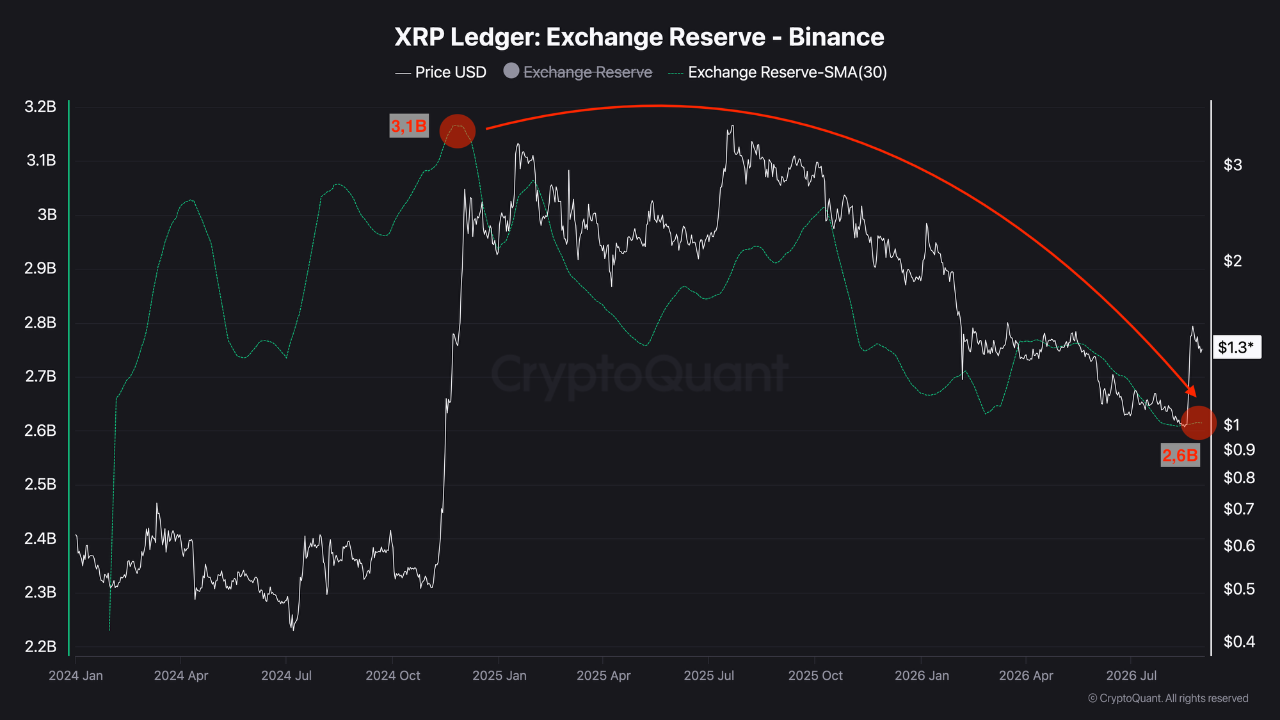
Binance XRP reserves have fallen to their lowest monthly average since February 2024, with roughly 500 million XRP leaving the exchange over the past year.

The decline comes despite XRP posting a nearly 30% gain over the latest month. This highlights a divergence between the coin’s price performance and the amount of XRP held on the world’s largest crypto exchange.

Binance XRP Reserves Drop to 2.6 Billion

CryptoQuant author Darkfost said Binance’s monthly average XRP reserves have declined from approximately 3.1 billion XRP in November 2025 to around 2.6 billion XRP currently.

That represents a reduction of about 500 million XRP in less than a year. The decline is notable because XRP has also experienced a substantial correction during the period. It fell from its $3.66 peak to $1.35, a drawdown of about 63%.

The data suggests that XRP holders continued withdrawing tokens from Binance even as the market moved through a prolonged correction.

Darkfost also observed that Binance’s XRP reserves have historically tended to rise during rebounds and decline again during subsequent retracements. Yet, the monthly-average nature of the metric creates a lag between price movements and changes in exchange balances.

XRP reserve decline on Binance

Investors May Be Moving XRP Into Long-Term Storage

One potential explanation for declining reserves is accumulation by investors moving XRP away from centralized exchanges and into private wallets.

A steady reduction in exchange balances suggests holders are less willing to keep their assets readily available for trading. Darkfost said the current reserve levels leave little doubt that at least some investors are accumulating XRP.

However, falling exchange balances do not always mean people are accumulating XRP for the long term. They may be moving XRP between exchanges, institutions, or custodians for other reasons.

XRP ETFs Also Driving Demand

Another factor identified by Darkfost is the launch of spot XRP exchange-traded funds in November and December 2025. ETF issuers need to acquire XRP to support the underlying exposure of their products.

This institutional demand may have led to more XRP being bought from the market and moved off exchanges.

The timing is interesting because Binance’s XRP reserves started falling around November 2025, when the spot XRP ETFs were launched.

In other words, this suggests that ETF demand, along with investors accumulating XRP, may have helped reduce the amount of XRP held on exchanges.

Binance’s Own Transfers

Meanwhile, Darkfost also noted that changes in Binance’s XRP reserves may be partly due to the exchange moving XRP between its own wallets.

Binance may move XRP around or adjust its reserves based on customer demand. Since the analysis looks at monthly averages rather than individual wallet transfers, these movements are unlikely to explain the entire long-term decline.

G20 Finance Leaders Back Clearer Regulatory Path for Digital Assets

0

G20 finance ministers and central bank governors committed to developing regulatory and supervisory frameworks for digital assets that support innovation and economic growth while safeguarding financial stability, according to a Chair’s Statement following a two-day meeting in Asheville, North Carolina.

The officials said digital financial innovation, including digital assets, could contribute to broad-based economic growth, with the private sector playing a central role in developing the technology. 

G20 Awaits FSB Findings on Global Stablecoins

The G20 said its approach would seek to accommodate responsible digital finance and digital-asset innovation while accounting for potential issues and opportunities that extend across borders.

As part of that work, officials are awaiting Financial Stability Board (FSB) findings on global stablecoin arrangements, including their cross-border implications and issues involving the availability and sources of stablecoin data.

Cross-Border Payments Work Remains a Priority

The focus on cross-border issues also extends to the G20’s broader payments agenda. Finance ministers and central bank governors reaffirmed their commitment to the G20 Roadmap for Enhancing Cross-border Payments and called on countries to pursue longer operating hours for large-value payment systems.

Several G20 jurisdictions, including the United States, the European Union, and Japan, have already introduced frameworks covering digital assets or stablecoins as policymakers examine their potential to improve the efficiency and accessibility of financial and payment systems.