Home Blog Page 25

500 Million XRP Leave Binance as Exchange Reserves Fall to 2024 Levels

0

Binance XRP reserves have fallen to their lowest monthly average since February 2024, with roughly 500 million XRP leaving the exchange over the past year.

The decline comes despite XRP posting a nearly 30% gain over the latest month. This highlights a divergence between the coin’s price performance and the amount of XRP held on the world’s largest crypto exchange.

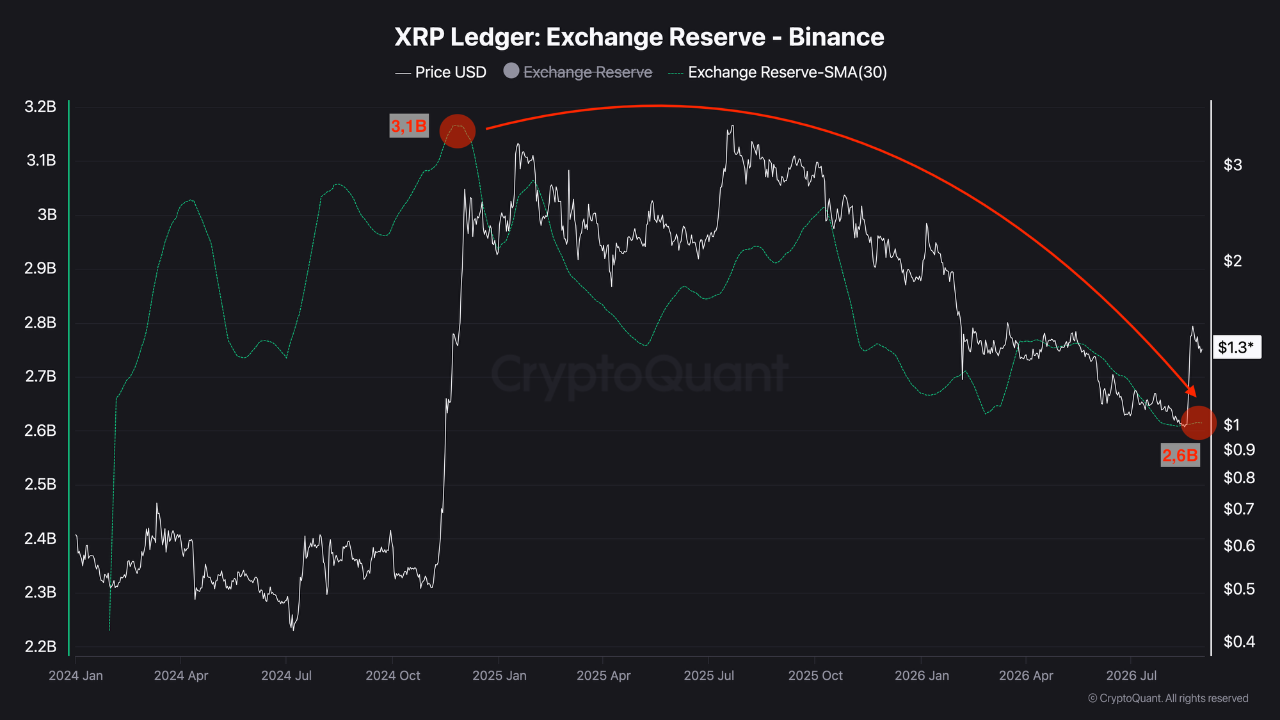
Binance XRP Reserves Drop to 2.6 Billion

CryptoQuant author Darkfost said Binance’s monthly average XRP reserves have declined from approximately 3.1 billion XRP in November 2025 to around 2.6 billion XRP currently.

That represents a reduction of about 500 million XRP in less than a year. The decline is notable because XRP has also experienced a substantial correction during the period. It fell from its $3.66 peak to $1.35, a drawdown of about 63%.

The data suggests that XRP holders continued withdrawing tokens from Binance even as the market moved through a prolonged correction.

Darkfost also observed that Binance’s XRP reserves have historically tended to rise during rebounds and decline again during subsequent retracements. Yet, the monthly-average nature of the metric creates a lag between price movements and changes in exchange balances.

XRP reserve decline on Binance

Investors May Be Moving XRP Into Long-Term Storage

One potential explanation for declining reserves is accumulation by investors moving XRP away from centralized exchanges and into private wallets.

A steady reduction in exchange balances suggests holders are less willing to keep their assets readily available for trading. Darkfost said the current reserve levels leave little doubt that at least some investors are accumulating XRP.

However, falling exchange balances do not always mean people are accumulating XRP for the long term. They may be moving XRP between exchanges, institutions, or custodians for other reasons.

XRP ETFs Also Driving Demand

Another factor identified by Darkfost is the launch of spot XRP exchange-traded funds in November and December 2025. ETF issuers need to acquire XRP to support the underlying exposure of their products.

This institutional demand may have led to more XRP being bought from the market and moved off exchanges.

The timing is interesting because Binance’s XRP reserves started falling around November 2025, when the spot XRP ETFs were launched.

In other words, this suggests that ETF demand, along with investors accumulating XRP, may have helped reduce the amount of XRP held on exchanges.

Binance’s Own Transfers

Meanwhile, Darkfost also noted that changes in Binance’s XRP reserves may be partly due to the exchange moving XRP between its own wallets.

Binance may move XRP around or adjust its reserves based on customer demand. Since the analysis looks at monthly averages rather than individual wallet transfers, these movements are unlikely to explain the entire long-term decline.

G20 Finance Leaders Back Clearer Regulatory Path for Digital Assets

0

G20 finance ministers and central bank governors committed to developing regulatory and supervisory frameworks for digital assets that support innovation and economic growth while safeguarding financial stability, according to a Chair’s Statement following a two-day meeting in Asheville, North Carolina.

The officials said digital financial innovation, including digital assets, could contribute to broad-based economic growth, with the private sector playing a central role in developing the technology. 

G20 Awaits FSB Findings on Global Stablecoins

The G20 said its approach would seek to accommodate responsible digital finance and digital-asset innovation while accounting for potential issues and opportunities that extend across borders.

As part of that work, officials are awaiting Financial Stability Board (FSB) findings on global stablecoin arrangements, including their cross-border implications and issues involving the availability and sources of stablecoin data.

Cross-Border Payments Work Remains a Priority

The focus on cross-border issues also extends to the G20’s broader payments agenda. Finance ministers and central bank governors reaffirmed their commitment to the G20 Roadmap for Enhancing Cross-border Payments and called on countries to pursue longer operating hours for large-value payment systems.

Several G20 jurisdictions, including the United States, the European Union, and Japan, have already introduced frameworks covering digital assets or stablecoins as policymakers examine their potential to improve the efficiency and accessibility of financial and payment systems.

Hyperliquid Strategies Raises Equity Facility to $2.5B, Holds 29.4M HYPE

0

Hyperliquid Strategies (PURR) has amended its financing arrangement with Chardan Capital Markets, lifting the maximum commitment for purchases of newly issued common shares to $2.5 billion from $1 billion, according to a Form 8-K filed with the U.S. Securities and Exchange Commission (SEC).

The change modifies the ChEF Purchase Agreement that the two companies entered into on Oct. 22, 2025. Hyperliquid Strategies can continue issuing shares to Chardan under the terms, conditions, and limits set by the agreement.

Lower-Priced Share Sales Face 19.99% Issuance Limit

A restriction takes effect once cumulative common-stock sales through the arrangement pass $1 billion. From that stage, transactions below $12.02 a share are generally limited to 42,641,847 shares, equal to 19.99% of the company’s outstanding common stock immediately before the amendment. 

Sales beyond that ceiling may proceed if shareholders authorize the additional issuance under applicable Nasdaq requirements, or when those rules do not require such approval.

Hyperliquid Strategies gave no explanation in the filing for enlarging the commitment. Earlier company disclosures showed that roughly $647 million of stock had been sold by June 30.

The expanded financing capacity comes as Hyperliquid Strategies continues to maintain a sizable HYPE treasury.

HYPE Treasury Stood at 29.4 Million Tokens

The company’s digital-asset treasury is centered on HYPE, the native token associated with Hyperliquid. Its latest Form 10-K reported holdings of about 29.4 million HYPE as of Aug. 23. 

As of this writing, HYPE trades at $82.06, down 1% over 24 hours. Nasdaq-listed PURR finished Tuesday’s session at $11.36 after falling 7.31%, while the shares remained up 73% over the preceding month and 230% year to date.

Kalshi, Polymarket August Volume Drops 14.5% in First Monthly Decline in a Year

0

Combined trading volume across prediction markets Kalshi, Polymarket and Polymarket US fell 14.5% in August from the previous month to $45.33 billion, ending a run of monthly increases that had lasted since August 2025.

Kalshi generated $37.17 billion in August volume, down 7.3% from $40.1 billion in July. Polymarket and its U.S. platform recorded a combined $8.16 billion, a 36.7% decline from $12.89 billion a month earlier, according to The Block’s data dashboard.

Prediction-Market Activity Retreats After World Cup Boost

The August pullback followed elevated summer trading, as the World Cup, held from June 11 through July 19, helped drive activity across prediction markets.

Still, trading remained well above pre-tournament levels. August’s combined volume of $45.33 billion was 76.7% higher than the $25.66 billion recorded in May.

Monthly Trading Volume Across Kalshi and Polymarket Platforms

The decline also comes as prediction-market operators face regulatory disputes in the United States over sports event contracts. More than a dozen states have pursued enforcement actions or litigation involving Kalshi and Polymarket.

Connecticut, for example, sued Kalshi last week seeking to stop the company from offering sports contracts, extending a legal dispute between the state and the prediction-market operator that has been running for months.

Kalshi Expands Sports Business Amid Regulatory Disputes

Despite the state-level challenges, Kalshi has continued expanding its presence in sports. The company recently reached a multi-year agreement with the U.S. Tennis Association to become the US Open’s exclusive prediction-market partner, with the partnership beginning with the 2026 tournament’s singles main draw on Aug. 30.

The agreement gives Kalshi a presence across US Open digital platforms and on-court signage while also establishing an integrity framework covering its tennis markets.

Kalshi has separately stepped up enforcement of its trading rules. Earlier this week, the company permanently barred former U.S. Representative George Santos from its platform, marking the first lifetime trading ban in Kalshi’s history.

The action stemmed from Santos’ trading in a contract tied to whether he would attend the State of the Union. Kalshi imposed a penalty of more than $71,000 and permanently prohibited him from trading on the platform.

Core DAO Moves to Emergency Hard Fork Over Excess Validator Rewards

0

Core DAO plans an emergency hard fork after a small group of validators received more CORE rewards than the protocol was designed to issue, as multiple crypto exchanges restricted CORE transfers around the time of the incident.

In an update, Core said the excess reward activity has been contained and that validators it called “malicious” can no longer obtain additional rewards through the issue. The project had earlier described the problem as limited to reward issuance and said user assets were not at risk.

The planned upgrade will apply prospectively, leaving the blockchain and all previously confirmed transactions unchanged.

Exchanges Restrict CORE Deposits and Withdrawals

Exchange operators took different measures in response to the incident. Coinbase temporarily disabled transfers to and from the Core network around the time the reward problem surfaced. South Korean trading platforms Coinone and Bithumb also suspended CORE deposits and withdrawals, citing security-related concerns in their notices.

Other trading platforms imposed restrictions for different stated reasons. Bitget attributed its suspension of CORE deposits and withdrawals to wallet maintenance, while LBank said it halted deposits at the project’s request.

Scale and Cause of Reward Issue Remain Unclear

Although Core says the incident has been contained, key details about its scope remain undisclosed. The project has yet to quantify the additional CORE issued or disclose how long the abnormal reward activity persisted. It also has not said whether tokens generated through the incident subsequently entered circulation.

Core has not provided technical details explaining the vulnerability that allowed validators to collect the additional rewards. The project said it plans to release a postmortem addressing the incident.

Meanwhile, CORE’s price stood at $0.0205 as of this writing, down 4.1% over the past 24 hours and 19.5% over seven days.

XRP Perpetual CVD Crashes to -$882M: Is a Recovery Guaranteed?

0

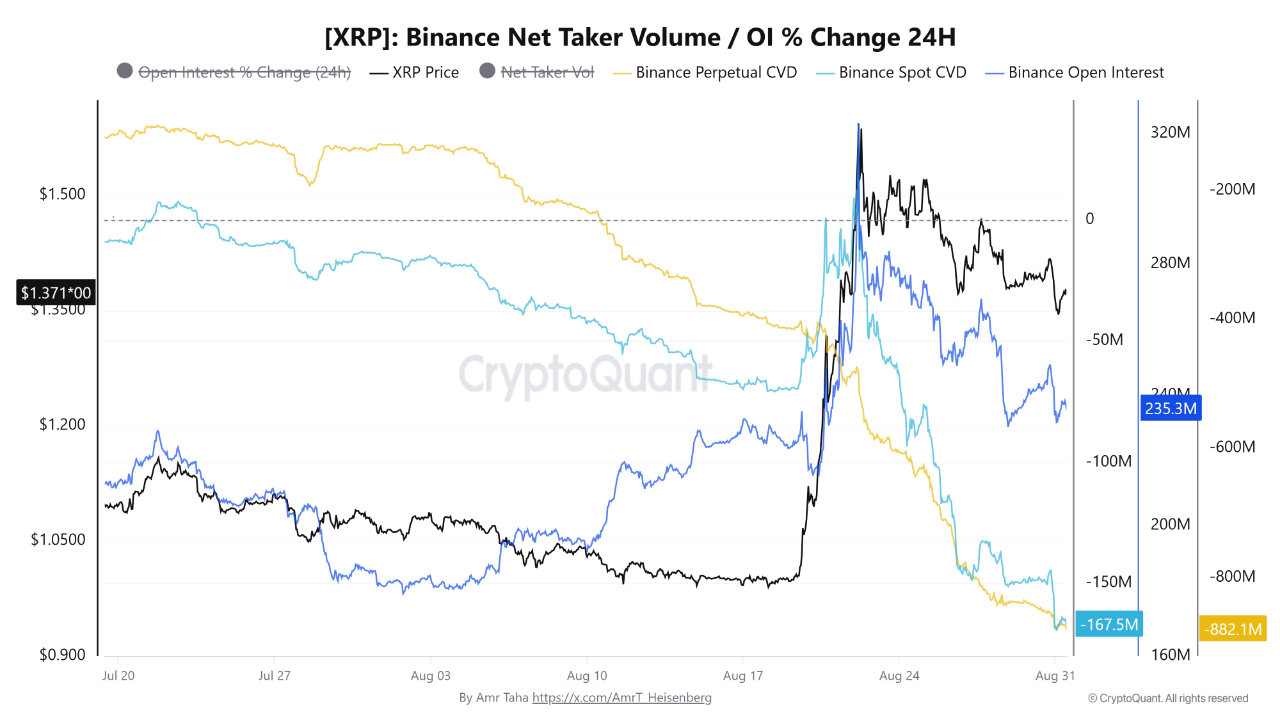
Amid the ongoing price correction, the XRP perpetual CVD has collapsed to -$882 million alongside declining Open Interest in the derivatives market.

After rising to $1.69 during the rally two weeks ago, XRP hit resistance along with the broader crypto market and started to pull back. The price has since fallen to $1.37, marking a near 19% drop, leading to a drop in derivatives interest.

XRP Open Interest Collapses

For instance, during the same period, XRP’s open interest on Binance dropped from $323 million to $235.3 million, falling by about 27.2%.

Open interest fell much faster than the price, which showed that traders have cut a large amount of their leveraged exposure during the decline. 

The move has also wiped out almost all of the leverage that built up earlier in August. This leaves XRP with much lower leveraged positioning than it had during the Aug. 22 rally.

For context, Binance XRP open interest rose from about $232.7 million on Aug. 17 to $323 million by Aug. 22, adding roughly $90 million in five days. Since then, it has fallen to $235.3 million, meaning about 97% of that buildup has now been unwound. 

This confirms how quickly traders reduced their positions as XRP pulled back. Much of the leverage that entered the market during the rally has now left. 

However, open interest alone cannot show which side of the market traders closed, so the decline does not by itself confirm that longs accounted for all the positions that disappeared.

XRP Perpetual CVD Drops to -$882.1 Million

The decline also appeared in Binance’s derivatives order flow. Specifically, Binance Perpetual CVD fell from about -$480 million on August 22 to -$882.1 million on August 31, making the negative imbalance roughly 84% larger. The latest reading also marks the most negative level recorded since July 2026 in the observed data.

XRP Perpetual CVD and Derivatives Data | Source: CryptoQuant

The fall in Perpetual CVD indicates continued aggressive selling in XRP perpetual futures. Alongside the falling price and lower open interest, the data suggests that traders have been reducing leveraged positions while selling pressure remains strong. 

However, a negative CVD does not automatically mean that XRP must continue falling, nor does the decline in leverage guarantee that a recovery will follow.

In addition, Binance Spot CVD fell from around +$39 million to -$167.5 million, creating a negative swing of approximately $206.5 million. The latest reading also represents the most negative Binance Spot CVD level since July 2026.

Does Lower Leverage Mean XRP Could Recover Soon?

A falling XRP price, lower Binance open interest, and increasingly negative Binance Perpetual CVD show that traders are closing positions and reducing leveraged exposure instead of adding more leverage. The drop in open interest has also reduced XRP’s dependence on the high leverage that built up earlier in August.

However, open interest cannot tell us which side of every position traders closed. While data indicates that aggressive selling remains present, it does not prove that traders closed only long positions.

The decline in leverage could eventually give XRP a healthier market structure by reducing the risks that come with crowded positions. Nonetheless, the -$882.1 million Perpetual CVD, -$167.5 million Spot CVD, and continued decline in XRP’s price show that sellers remain active.

For now, the data does not guarantee a recovery. XRP may have less leverage-related risk than it did on Aug. 22, but a sustained recovery would likely require selling pressure to ease and spot and derivatives order flow to improve.

XRP Now at a Crossroads: Here are Factors That Could Determine Its Next Direction

0

XRP now sits at a major crossroads after its latest rally, and multiple factors could determine its next direction from here.

After rising to nearly $1.70 two weeks ago, XRP met resistance at that level and has continued to pull back. The cryptocurrency now trades around $1.37, leaving its next move uncertain.

Amid the correction, chart data now indicates that several technical and fundamental factors could determine XRP’s next direction. Notably, XRP has seen a volatile 24 hours, with trading volume reaching about $2.02 billion.

The recent decline follows the asset’s recovery from the $1.00 psychological level to a peak near $1.70. So far, the pullback looks more like profit-taking after a strong recovery than a clear change in the broader trend.

XRP Faces $1.36 Support and $1.51 Resistance

The $1.40-$1.36 range is now an important support zone for XRP. Holding this area would help the cryptocurrency maintain its recent recovery structure and keep buyers in control. However, a break below this zone could put more pressure on the price and weaken the current setup.

XRP also faces strong resistance between $1.45 and $1.51, where large sell orders and whale distribution could make further gains more difficult. A daily close above $1.51 would give buyers a stronger signal and could send XRP toward $1.60 and beyond.

XRP at a Crossroads
XRP at a Crossroads

Moving averages currently point to a buy signal, while the 14-day Relative Strength Index (RSI) has cooled to around 43. This puts XRP in neutral territory, meaning the asset is neither overbought nor oversold. As a result, there remains room for a strong move once buyers or sellers take control.

Technical Factors That Could Dictate the Next XRP Move

In this position, derivatives activity is one factor to watch. Notably, recent selling pressure across the derivatives market has pushed weaker long positions out of the market, increasing the risk of a leverage squeeze. 

For instance, in the last 12 hours, long liquidations have totaled $1.70 million, accounting for nearly 77% of the total $2.21 million figure. Over the past 24 hours, liquidated longs have reached $2.13 million, a 64% share. This could add to XRP’s volatility as traders react to movements around the key support and resistance levels.

XRP Liquidation Data
XRP Liquidation Data | Source: Coinglass

Institutional activity, however, continues to provide a more positive backdrop. Spot XRP ETFs have recently recorded about $1.66 billion in cumulative inflows, and reports suggest that traditional brokers are looking to expand their custody options. 

Greater access through established financial firms could support XRP demand if broader market conditions remain favorable.

Fundamental Factors

Meanwhile, regulation could have an important impact on XRP’s next direction. The proposed CLARITY Act would confirm XRP alongside other assets as a digital commodity under the oversight of the Commodity Futures Trading Commission (CFTC). 

If passed, the legislation could bolster XRP’s regulatory position following its court victory and reduce some of the uncertainty that may still concern more cautious investors.

The Senate’s Sept. 15 cloture vote will also remain on the market’s radar. Polymarket currently places the odds of the bill advancing this year at 15%, suggesting that traders have already priced in a high chance of a delay.

XRP Could Target $2 or Fall Back Toward $1

A successful vote could create strong institutional demand and trigger a supply squeeze, helping XRP break through nearby resistance. 

If buyers clear $1.51, XRP could then move toward $1.60 and potentially reach the $2.00 level by late September. However, XRP would first need to overcome the $1.45-$1.51 resistance area and establish a clear break above $1.51.

On the other hand, a failed vote or a delay beyond the midterm period could hurt market confidence. Without additional legislative support, XRP would continue to rely on existing judicial precedents and could face renewed selling pressure toward the $1.00 support level.

Regulatory clarity could also have a wider impact on XRP’s long-term use. A clear legal framework could give traditional banks more confidence to hold XRP and use it for settlement.

XRP Delivers 13% Average Gains in September: Will History Repeat?

0

As the new month begins, XRP historical performance suggests that September could offer a favorable outlook for the coin, with potential double-digit price gains.

In particular, XRP has posted an average return of +12.7% during the month since 2018.

XRP Price Has Delivered More Green Septembers

Data from CryptoRank shows XRP recorded five positive Septembers and three negative ones between 2018 and 2025. The average September return over that period stands at +12.7%, giving the month a historically bullish bias.

The strongest September performance came in 2013, when XRP surged +94.4%. XRP also gained 73.2% in 2018 and 46.9% in September 2016.

Despite the positive average, September has not been consistently bullish. XRP declined 20.1% in September 2021 and 0.92% in September 2025. Notably, September 2015 saw a more damaging 30% dip.

XRP in September
XRP in September

September Starts With a Bullish Historical Bias

The historical data suggests the odds have generally leaned in XRP’s favor heading into September. However, past performance does not guarantee another positive month.

XRP ended August with a strong rally, gaining 30%, making September an important test of whether the momentum can continue. Some market analysts have also highlighted the possibility of a pullback after August’s gains.

Essentially, XRP’s September history gives bulls a statistical edge, with the month’s +12.7% average return suggesting a potential price near $1.74, although this is not guaranteed. XRP neared this price in August but dipped more than 20% shortly afterward.

Supportive Factors

Meanwhile, a supporting factor for XRP’s outlook in September is investor demand through ETFs. U.S. spot XRP ETFs are nearing $1.8 billion in cumulative net inflows. Weekly inflows recently jumped 177%, while August inflows reached about $159 million, up sharply from July.

The continued ETF demand suggests that institutional and investor interest in XRP remains strong despite recent price volatility.

Bloomberg ETF analyst James Seyffart confirmed this on X yesterday, saying that the funds’ performance has been “surprisingly resilient.”

Meanwhile, Ripple’s RLUSD stablecoin has reached a $2 billion market cap, with more than $1 billion issued on the XRP Ledger. Its growing use in payments, lending, and tokenized assets could increase activity and liquidity on the network, potentially supporting demand for XRP.

Why an XRP Price Dip in September Is Possible

In sum, whether XRP price will continue its August momentum into September remains uncertain. In fact, August and September have jointly delivered gains for XRP only once in history, in 2016. Other instances have shown an inverse pattern. Therefore, following August 2026’s 30% gains, a dip could follow in September.

Moreover, XRP’s recovery will depend partly on Bitcoin’s ability to remain stable above $79,000 and move toward $80,000, which has recently emerged as a significant resistance level.

CME Becomes Largest XRP Futures Venue as OI Spikes to 400M XRP

0

CME Group recently became the largest venue for XRP futures trading, as Open Interest on the regulated platform surged.

The XRP futures market has seen a major change in recent weeks, as professional traders increase their activity on regulated platforms. CME Group has now overtaken Binance as the largest venue for XRP futures open interest by notional value amid XRP’s recent recovery.

CME’s open interest rose from 284 million XRP on August 17 to 387 million XRP on Aug. 31, representing an increase of about 36% in two weeks. Over the same period, XRP climbed from around $0.99 to $1.38, giving the token a gain of nearly 40%.

CME Takes the Lead in XRP Futures

CME moved ahead of Binance on Sept. 1 in terms of XRP futures open interest by notional value. 

Data from CoinGlass showed that CME held about 410,000 XRP contracts worth approximately $530 million. Binance, meanwhile, had around 375,000 contracts valued at about $510 million.

CME now accounts for roughly 17% of total XRP futures open interest, compared with about 10% in mid-August. That means its share increased by 7 percentage points in about two weeks. 

The change is also important because it happened alongside a nearly 40% rise in XRP’s price, which indicates stronger activity from professional market participants.

Overall XRP Futures OI Moves Lower

The wider futures market shows a different trend. Total XRP futures open interest across all exchanges dropped from about 2.77 billion XRP to 2.34 billion XRP between Aug. 17 and 31. This represents a decline of roughly 16%.

Platforms outside CME accounted for most of that drop. Their combined futures positions fell by approximately 533 million XRP, representing a 21% decline over the same period. CME, however, continued to add positions while the rest of the market reduced exposure.

This created an unusual setup. XRP gained nearly 40% while total futures open interest fell by 16%. Strong price rallies often come with rising open interest as traders add leveraged positions. In this case, however, the market reduced leveraged exposure while CME’s share continued to grow.

This suggests that the recent rally may not have depended heavily on speculative leverage from offshore exchanges. Instead, stronger spot demand and increased activity from professional traders may have played a larger role.

ETF Inflows Add to Institutional Interest

Recent XRP ETF flows also support the growing institutional interest in the asset. U.S. spot XRP ETFs recorded $110.49 million in net inflows during the week ending Aug. 28. This marked their strongest weekly inflow of 2026 and pushed cumulative net inflows to approximately $1.66 billion.

Goldman Sachs also returned to the XRP ETF market during the second quarter. Its Q2 13F filings showed approximately $87.4 million in exposure across five spot XRP ETFs, making Goldman the largest disclosed holder among the institutions mentioned. Jane Street and Millennium Management followed.

Goldman had completely exited its XRP ETF positions in the previous quarter before rebuilding exposure across five funds in Q2. Its return, combined with the rise in CME futures activity, confirms that regulated investment products are becoming an increasingly important part of XRP’s market.

Hedge Funds Short While Dealers Add Longs

Meanwhile, CFTC data through Aug. 25 shows that not every professional group has taken a bullish position. Leveraged funds held 892 long contracts and 3,206 short contracts, leaving them with a net short position equivalent to approximately 116 million XRP.

This represented an increase from the roughly 57 million XRP net short position recorded the previous week. However, the figure does not necessarily mean that hedge funds are simply betting against XRP.

Dealers and asset managers moved in the opposite direction. Specifically, dealers increased their net-long exposure by nearly 60 million XRP, while asset managers added about 28 million XRP in long exposure.

Ethena Brings USDe Payments to Avalanche With Up to 6% Yield, 10% Cashback

0

Ethena Labs is moving into consumer payments with Ethena Pay, a self-custodial app that combines USDe balances with bank transfers, crypto transfers, and card spending, founder Guy Young told The Block.

The beta is being rolled out in stages across 48 countries on iOS and Android. Brazil, South Africa, Mexico, Kenya, Singapore, the Philippines, Japan, Australia, and the United Arab Emirates (UAE) are among the markets included in the initial rollout.

The U.S. and the EU are excluded from the initial release. Ethena expects to add those markets, as well as Canada, South Korea, and Taiwan, during the beta, subject to local regulatory requirements. The company also plans to introduce additional countries, currencies, and features each week during the testing period.

Young said Ethena Pay differs from neobanking products built around third-party stablecoins such as USDC and USDT because the app directly incorporates Ethena’s own USDe. He described the product as an effort to bring fiat and crypto services into a single experience for everyday financial use.

Users can receive fiat using International Bank Account Number (IBAN) details or send crypto to their wallets, with both routes resulting in a USDe balance. Funds can also be withdrawn to an external bank account and settled in the recipient’s local currency, according to Ethena.

The app supports fee-free transfers between users through usernames or tags. Ethena said bank transfers in U.S. dollars, euros, and British pounds carry no fee, while transfers in other currencies are charged between 0.05% and 0.1%. 

Iron, the stablecoin infrastructure company that MoonPay acquired in 2025, provides the app’s backend infrastructure.

ENA Holdings and Referrals Determine Reward Limits

Ethena Pay divides its rewards program into Standard, Pro, and VIP tiers, with higher levels available either by locking ENA tokens or meeting referral thresholds.

Standard membership is free and provides a 5% annual percentage yield (APY) on balances of up to $5,000. Pro status requires $2,000 worth of locked ENA or 10 referrals and raises the yield to 6% on balances capped at $15,000. Users qualify for VIP by locking $10,000 in ENA or referring 50 people, with the 6% rate applying to balances of up to $50,000.

According to Young, returns from USDe fund the savings yield. The company has not disclosed the funding source for the app’s other rewards.

Card spending carries a separate rewards structure. The Ethena Pay Card pays cashback in Avalanche’s AVAX token at rates of 4% for Standard members, 4.5% for Pro, and 5% for VIP users. At selected brands such as Spotify, Uber, and Claude, the maximum cashback rises to 5% for Pro and 10% for VIP, Ethena said.

Avalanche Deployment Comes as Ethena Navigates Regulatory Limits

Ethena Pay runs exclusively on Avalanche. Young said Ethena chose Avalanche because both companies are focused on developing financial products for businesses and infrastructure designed to operate largely behind the scenes for end users. He also cited Avalanche’s earlier work with Rain cards.

The launch also raises questions about the service’s regulatory status. When The Block asked what licenses or approvals Ethena Pay currently holds and where they are valid, Young did not provide specifics, saying the information would appear in public documentation this week. 

Ethena has previously faced regulatory scrutiny in Europe. Germany’s BaFin ordered Ethena GmbH to wind up its USDe business in June 2025 after the company withdrew its application for authorization under the European Union’s crypto rules. 

The expansion into payments also comes as USDe has about $4 billion in circulating supply, compared with a peak of approximately $15 billion in September 2025. Rather than using the fiat-reserve structure associated with stablecoins such as USDT and USDC, USDe relies on backing assets and derivatives positions intended to hedge price movements in the backing assets and maintain its dollar peg.