Home Blog Page 279

White House Frames Clarity Act as Crown Jewel of Crypto Policy

0

White House Crypto Adviser Patrick Witt described the Clarity Act as the most critical remaining piece of U.S. cryptocurrency legislation. 

Speaking at the Ondo Finance Summit yesterday, he emphasized the Clarity Act’s significance and how closely industry stakeholders tie the bill to their business models. 

Key Points 

  • White House adviser Patrick Witt says the Clarity Act is the final piece needed to complete the U.S. crypto policy framework.
  • He describes the bill as the “crown jewel” of the current agenda, with some industry leaders viewing it as more critical than the GENIUS Act.
  • Witt argues the act offers substantial industry benefits and urges stakeholders to refine it rather than derail its passage.
  • While the Senate Agriculture Committee has advanced its portion, the Banking Committee’s markup remains delayed.

Clarity Act is the Crown Jewel of the Current Legislative Agenda 

According to Witt, the Clarity Act is the “crown jewel” of the current legislative agenda, positioning it as the final measure needed to complete the emerging crypto policy framework. 

Moreover, he noted that the bill has attracted broad industry support, with some sectors viewing it as even more essential than the GENIUS Act. This is largely because the GENIUS Act centers on stablecoins, whereas the Clarity Act addresses the broader crypto industry. 

As discussions continue, Witt observed growing alignment among stakeholders, signaling a shared commitment to advancing the legislation. Ultimately, he argued that the bill offers meaningful benefits to both crypto firms and banks and should therefore be refined rather than derailed. 

Current Status of Clarity Act 

The Clarity Act, passed by the House in mid-2025, aims to deliver long-sought regulatory certainty in the crypto sector by clarifying the status of digital assets and their appropriate regulator–between the CFTC and SEC. 

However, the bill has stalled in the U.S. Senate as banking and crypto executives remain divided over key provisions, particularly stablecoin yields.

While the banking sector supports an outright ban on stablecoin yields, as highlighted in the Senate Banking Committee’s latest draft, many crypto leaders, including Coinbase CEO Brian Armstrong, are pushing to restore yield provisions. 

As a result, the Banking Committee suspended its planned markup, even as the Agriculture Committee narrowly advanced its portion of the bill in late January. 

No Agreement Reached in White House Meeting 

To bridge the divide, the White House, represented by Witt, convened a meeting this week to address disagreements between both sectors. Although no final consensus has emerged, reports indicate that the administration has set an end-of-February deadline to reach agreement on stablecoin yields. 

Despite the impasse, Witt expressed confidence that the issues will be resolved, arguing recently that there is no reason to “throw the baby out with the bathwater” given the Clarity Act’s broad benefits. 
What’s Next for Bitcoin as it Sweeps the April 2025 Lows

0

The next possible price action of Bitcoin is now in focus after weak momentum ensured it retested lows last seen in April 2025.

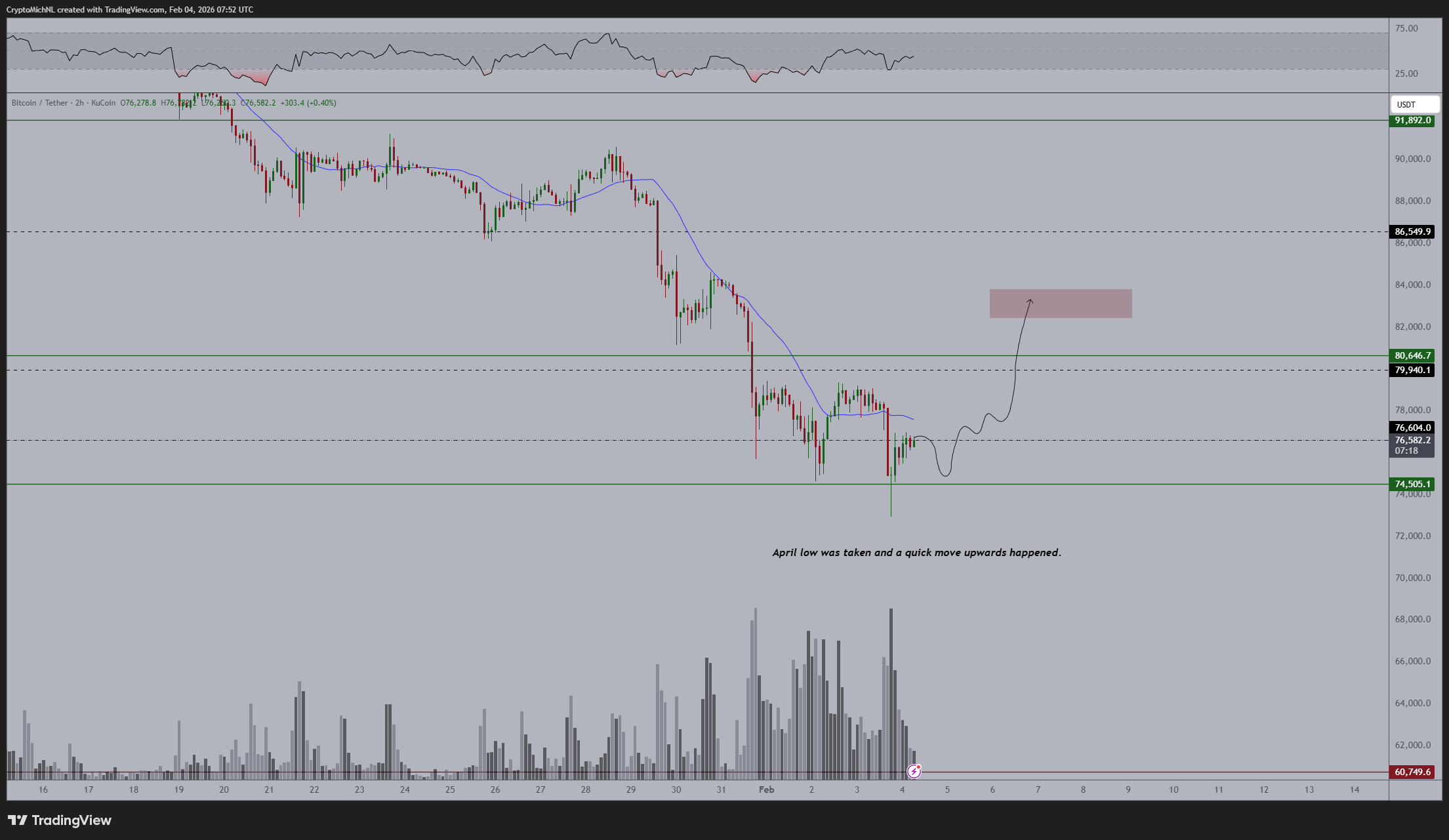
Bitcoin visited this low yesterday, contributing to a broader market bloodbath. Specifically, the premier crypto asset dropped to $72,911, a steeper price than the April 7 low of $74,441. However, BTC recovered slightly to close at $75,715.

Key Points

  • Bitcoin visited the April low yesterday, dropping to $72,911 before recovering slightly to close at $75,715.
  • There was a spike in the Bitcoin trading volume during the correction to the April low, suggesting growing market activity.
  • The retest also coincided with the end of the US government shutdown.
  • Bitcoin’s current sideways trend could continue for a little while before forming a higher low.
  • Subsequently, Bitcoin could rally to the $82,000 to $84,000 range, representing 9% to 11% growth from the current market price of $75,160.

What Played Out as Bitcoin Dropped Below $73K

Michael van de Poppe, the founder of MN Fund, recently discussed this as he drew attention to some interesting developments as Bitcoin revisited this multi-month low. First, he highlighted a spike in trading volume during the correction to the April low.

Notably, an increase in volume suggests renewed market participation. Such a spike in spot trading highlights that whales are either buying or selling aggressively during the dip. The quick price rebound suggests bull buying activity to defend the support level. This is speculative and unconfirmed at this point.

Van de Poppe also noted that the retest coincided with the end of the US government shutdown. The partial shutdown commenced on Saturday and lasted for four days before the US House passed a spending bill. President Donald Trump signed this $1.2 trillion budget, which funds government agencies.

What’s Next for Bitcoin

As the market continues to consolidate, the subsequent possible price action remains a boiling question among investors. Van de Poppe addressed this, predicting what to expect next from the pioneering cryptocurrency.

His February 4 tweet suggested that this sideways trend could continue for a little while. BTC is already showing a glimpse of weakness, having retraced nearly 1% since the start of today, supporting this narrative.

However, the analyst noted that Bitcoin would hold the $74,500 support level and form a higher low at some point. Notably, this is a bullish continuation pattern and precedes a price rebound.

After this, he sees Bitcoin rallying to the $82,000 to $84,000 range, representing 9% to 11% growth from the current market price of $75,160. Meanwhile, his chart shows that sustained momentum could push BTC towards the $91,892 resistance level.

Next Bitcoin Target/Michael Van de Poppe

Nonetheless, this move remains speculative, and there is no guarantee it would happen. Moreover, Bitcoin trades near the $74,500 support level and could break below it to new lows if bearish momentum persists.

$7 Trillion UBS Weighs Launch of Crypto Access for Retail Investors

0

UBS Group AG, the Zurich-based lender managing over $7 trillion in client assets, is exploring ways to provide cryptocurrency access to individual investors.

During a recent earnings call, CEO Sergio Ermotti emphasized that the bank will prioritize measured adoption over rushing to become an early market leader.

Key Points

  • UBS is considering offering cryptocurrency access to individual investors for the first time. 
  • CEO Sergio Ermotti confirmed the bank will prioritize measured adoption over being an early market leader. 
  • The bank is developing infrastructure for tokenized products, including crypto and tokenized deposits for corporates. 
  • UBS is taking a “fast follower” approach, planning a gradual rollout of digital offerings over 3–5 years. 
  • Initial crypto initiatives are aimed at affluent clients, signaling cautious market entry.
  • Regulatory frameworks, including Basel III, are shaping the bank’s deliberate pace in adopting crypto services.

Building the Foundation for Tokenized Offerings

Ermotti outlined UBS’s focus on developing the infrastructure needed to support tokenized products. For instance, potential initiatives include cryptocurrency access for individual clients and tokenized deposit solutions for corporate customers.

“These offerings are intended to complement our existing services, not replace them,” Ermotti said, highlighting the bank’s goal of integrating new technologies in a balanced and responsible manner.

Adopting a “Fast Follower” Strategy

UBS is deliberately taking a “fast follower” approach instead of striving to lead the market in tokenized assets.

Ermotti anticipates that the bank’s expansion into digital offerings will unfold gradually over the next three to five years. By moving cautiously, UBS aims to introduce crypto products while simultaneously managing risk and ensuring regulatory compliance.

Targeting Affluent Clients

The development follows a January report from The Crypto Basic that UBS is actively selecting partners for a cryptocurrency product tailored for wealthy clients. This marks a notable shift for a bank that has historically been cautious about virtual currencies.

The initiative reflects UBS’s strategy of carefully testing the waters of digital assets before expanding offerings more broadly.

Regulatory Context and Industry Trends

UBS’s cautious stance mirrors broader trends in global banking, where many large lenders are focusing on blockchain infrastructure for tokenized funds and payments rather than direct crypto trading.

Regulatory frameworks, including Basel III, have also constrained rapid adoption by imposing strict capital requirements. Ermotti emphasized that these factors play a central role in the bank’s deliberate pace toward introducing crypto services.

Ripple Exec Says Using XRP or Stablecoins Offers Another Viable Path

0

Ripple is signaling fresh momentum around XRP and stablecoins as it expands payment and treasury capabilities for enterprise clients.

During an interview, Ripple Treasury Chief Product Officer Mark Johnson said the company is exploring new funding currencies, payout options, and cross-border payment solutions, with XRP and stablecoins playing a central role.

Key Points

  • Ripple explores XRP and stablecoins to boost enterprise payment and treasury solutions.
  • Ripple Treasury lets clients convert funds without holding crypto directly.
  • XRP or RLUSD can act as a bridge for faster cross-border payments.
  • Ripple Treasury platform combines blockchain payments with traditional cash management.

XRP and Stablecoins Central to Ripple Treasury’s Strategy

Johnson confirmed that XRP and Ripple’s RLUSD stablecoin are key assets as Ripple Treasury continues to develop. He explained that the focus isn’t just on holding digital assets, but on how they can be used to facilitate smooth currency conversion during payments.

For example, clients could hold XRP or a stablecoin at the start of a transaction, with conversion occurring later based on the recipient’s needs and local regulations.

Conversion Without Holding Digital Assets

Johnson also noted that Ripple can handle conversions on behalf of clients. This means businesses don’t have to hold XRP or stablecoins themselves.

In a U.S.-to-international payment, a company could send funds in fiat, while Ripple’s system manages the conversion behind the scenes, enabling payments to arrive faster and more efficiently.

The executive said these features can improve traditional cash and fiat payouts, especially for cross-border transactions where speed and liquidity are common challenges.

By using XRP or stablecoins as a bridge, Ripple Treasury aims to accelerate settlement while giving recipients the option to receive funds in digital assets or local fiat.

“Another Path” for XRP and Stablecoin Adoption

Johnson wrapped up by emphasizing flexibility as a key theme. Clients can start with XRP, use a stablecoin like RLUSD, or rely on Ripple’s conversion tools without holding crypto at all. Each option serves as a practical entry point.

As he put it, the ability to begin with XRP or a stablecoin is simply another path forward. For Ripple, that path is becoming central to its long-term vision for commercial payments.

Ripple Launches Corporate Treasury Platform

In January, Ripple launched Ripple Treasury, a corporate treasury platform for large institutions that blends blockchain payments with traditional cash management.

This marks Ripple’s first major product rollout since acquiring GTreasury for $1 billion in October 2025. It allows businesses to connect digital asset platforms to their systems, much like traditional banks.

One of the platform’s key features is near-instant cross-border settlement. International payments can settle in three to five seconds using Ripple’s RLUSD stablecoin, compared to days with legacy systems.

Ripple Treasury also enhances access to short-term liquidity, supported by Hidden Road, the prime brokerage Ripple acquired last year for $1.25 billion.

Also in January, Ripple’s GTreasury acquired financial automation firm Solvexia to strengthen automated reconciliation and regulatory reporting.

The integration replaces manual, spreadsheet-based workflows with end-to-end automation across treasury, finance, and compliance. Notably, this helps enterprises reduce risk, improve audits, and better manage both fiat and digital assets.

A ‘Jump Across the Creek’ Could Push XRP to $4.9 After Wyckoff Spring Low: Analyst

0

Market data suggests that XRP could trigger a “jump across the creek” toward new highs after the Wyckoff Spring low.

XRP trades at $1.59 as the broader crypto market remains weak, but the recent pullback follows a Wyckoff Accumulation pattern that may be leading to higher prices once the existing structure plays out as expected. 

Notably, the daily chart shows XRP’s price moving through the final stages of consolidation after a strong upsurge, with the current action suggesting the market is preparing to “jump across the creek” to a price around $4.9 after recently hitting the Spring low.

Key Points

  • XRP currently faces bearish pressure, but market data indicates the downtrend is part of a larger Wyckoff Accumulation pattern.
  • Phase A of the pattern began in November 2025 when XRP’s price surged from $0.5 to the $3.4 peak two months later.
  • From there, an automatic pullback and follow-up test emerged, creating an accumulation range, with support around $1.50 to $1.60 and resistance between $3 and $3.6.
  • As XRP consolidated, a sloping resistance line formed the creek, which represented the major barrier prices must break to show strength.
  • In Phase C, a Spring emerged as the price dipped under $1.50 and quickly reclaimed the range.
  • A move above the creek would signal a sign of strength and Phase D, opening the way for a rally toward $4.9.

XRP’s November 2025 Rally Marks the Start of Accumulation

Chart Nerd, a market watcher, discussed this during a recent analysis. Data from his chart shows that the Wyckoff structure began in November 2025, when XRP broke out from a long base around $0.5. 

After the U.S. elections, buyers entered the market, pushing prices above the $1 and $2 resistance levels. Amid this move, stronger participants absorbed supply at higher levels. As the momentum persisted, XRP hit the buying climax (BC) at the $3.4 peak in January 2025.

This $3.4 area later became the upper boundary of the accumulation range. Once demand cooled, XRP pulled back, forming an automatic reaction (AR) that set the lower boundary of the range at around $1.6. A rebound attempt followed but failed to break higher, creating a secondary test (ST) that confirmed resistance and completed Phase A of the Wyckoff structure.

Phase B Consolidation Builds the Creek

After Phase A, XRP entered a prolonged Phase B, featuring sideways movement and repeated swings between support and resistance. The price spent months trading between $1.60 to $1.90 on the downside and $3.30 to $3.6 on the upside. During this phase, large participants continued to absorb supply without forcing a sustained breakout.

The chart also highlights an upthrust during Phase B, where XRP briefly moved above the resistance before quickly reversing back into the range. 

XRP Wyckoff Accumulation Pattern

This failed breakout trapped late buyers and confirmed that accumulation was dominant, not distribution. Over time, a descending internal resistance line formed across lower highs. Notably, this sloping barrier represents the creek, a level the price must clear to confirm renewed strength.

XRP Sees Spring Below Support in Phase C

As the range matured, XRP showed signs of weakness through lower highs. This led to Phase C, which brought up the most important event in the structure: the Spring. XRP now trades within this phase. Specifically, the price dropped below support, briefly dipping into the $1.50 support on Jan. 31.

In Wyckoff theory, the Spring acts as a shakeout. Notably, it forces weak holders out, triggers stop losses, and draws in short sellers, while stronger hands absorb the remaining supply. XRP quickly reclaimed the $1.60 area and followed up with a successful test that held above the Spring low. This showed that selling pressure had largely run its course.

Jump Across the Creek Could Push XRP to $4.9

With the Spring and test complete, the structure now heads toward Phase D. Chart Nerd called attention to the potential for a Jump Across the Creek, which would see XRP break above the descending creek trendline. This move would confirm that buyers have regained control.

After the jump, Wyckoff principles call for a last point of support, where price pulls back briefly but holds above former resistance. A strong follow-through, known as a sign of strength (SOS), would then carry XRP toward the top of the range above $3. 

Meanwhile, the projected roadmap moves beyond this zone, suggesting that a confirmed breakout could trigger Phase E, the markup phase, with XRP advancing toward the $4.9 level.

Dogecoin Prediction for Feb 4: Stiff Support at $0.095 While Analyst Eyes Next Resistance at $0.135

0

Dogecoin is holding critical support, with key resistance levels at higher price zones, while analysts watch for a potential recovery.

The Dogecoin (DOGE) market continues to display mixed performance, with the coin struggling to find strong momentum despite the slight recovery observed in the last 24 hours. The memecoin’s price rose by 0.04%, now trading at $0.10825. Dogecoin’s price has fluctuated within a narrow range of $0.107 to $0.109, showing cautious market sentiment. 

Meanwhile, trading volume on the spot market sits at $501.67 million, with futures trading at a much higher volume of $3.38 billion, indicating the active participation of leveraged traders in this period of consolidation.

Further, Dogecoin has been under pressure on the performance side, down about 27.55% in the past 30 days and 7.78% year-to-date. However, there is still significant bullish sentiment in the market, as reflected in the long/short ratios.

The long-to-short ratio on Binance stands at 2.62, indicating more long positions in Dogecoin as traders maintain optimism about its future price movement. The key resistance zone around $0.11 continues to cap price advances, but with continued long interest, Dogecoin may find the strength to challenge this barrier. What’s next for DOGE?

Where’s DOGE Headed?

The chart for Dogecoin indicates a current price with support at the $0.095 zone. The price has recently been trading near the lower daily range, suggesting consolidation in a downward trend. The recent trend has been confirmed by the Parabolic SAR indicator, which sits above the price, reinforcing the bearish sentiment.

Dogecoin 1-Day Analysis

On the upside, resistance exists at the $0.115 level, marked by the dotted lines of the Parabolic SAR, which suggests that price would need to break through this level to initiate an uptrend. The next strong resistance could be near the $0.12 mark, aligning with the previous price rejection points in early January.

Meanwhile, the Mass Index indicator is currently at 10.51, signaling widening volatility. This indicates that market fluctuations are increasing, and while the current trend remains weak, a potential reversal could be on the horizon. If Dogecoin holds above the support level at $0.095, there could be room for a short-term rebound. However, any break below this level would suggest further downside risk.

Dogecoin Already Holding Critical Support

Elsewhere, on X, analyst BitGuru shared his insights on Dogecoin’s current market action, emphasizing that Dogecoin is holding a critical support zone between $0.105 and $0.110. This area became significant following a liquidity sweep, and BitGuru stressed the importance of maintaining this base to attempt a recovery. If this support holds, Dogecoin could be poised for a move upward.

DOGE Prediction
DOGE Prediction

Key resistance levels exist near $0.135 and $0.150, marking potential upside targets if the price successfully breaks through the immediate resistance and begins a stronger recovery trend.

Cardano Analysis for Feb 4: Cardano Must Break This Bollinger Band Resistance But Where Next?

0

Cardano faces resistance at the middle Bollinger Band, with support holding firm while futures flows show mixed sentiment.

Cardano (ADA) is showing a slight recovery, increasing by 1.4% over the last 24 hours, with its price just below $0.30. The altcoin has fluctuated between $0.28 and $0.30 in recent hours, indicating some volatility within this narrow range. Also, the market cap sits at $11 billion, with a 24-hour trading volume of over $728 million, indicating healthy market participation.

However, ADA’s performance over the past 30 days has still been under pressure, with a 25% decline. Despite this, the coin continues to hold a significant presence, trading near levels of support while struggling to surpass resistance around the $0.30 mark. As market trends develop, eyes will remain on the resistance levels to determine if ADA can break through and shift into a bullish territory.

Cardano Price Prediction

Cardano is currently trading near the $0.2991 level, with the immediate support zone located at $0.28, having bounced off the lower Bollinger Band. This level is critical, as it aligns with recent price actions and serves as a lower bound in the current range. 

Cardano Price Prediction

The price has recently dropped to near this support, but with the Stochastic oscillator moving away from the oversold region, there could be a potential for a short-term bounce if this support holds. A break below $0.28 would open further downside risk, targeting the next key support around $0.26, where the price has previously consolidated.

On the upside, the immediate resistance lies at the middle Bollinger Band at $0.3431, which also aligns with the 20-day moving average. Further resistance can be expected at the upper band around $0.41, where the price has faced selling pressure previously.

The Stochastic Oscillator is currently at 28.95 but improving, signaling that ADA has cleared the oversold region, suggesting potential for higher prices. Overall, a move above the 20-day SMA at $0.3431 would be needed to confirm a trend reversal.

Cardano Futures Flows

Over the past 24 hours, Cardano has experienced solid market participation, with a $360.49M net inflow in futures. This reflects a positive $1.41M in net change, which is an impressive 187.80% increase from previous figures.

Cardano Futures Flows

The 8-hour flow data, however, tells a different story, showing a -88.69% decline despite a $616.14K net inflow. Nevertheless, both the 1-hour and 4-hour periods indicate modest but steady demand, with net inflows of $329.52K and $2.31M, respectively.

XRP Price Isn’t Reflecting the DeFi Boom About to Hit the XRP Ledger: Analyst

0

XRP YouTuber Zach Rector says the crypto market is still overlooking what could become one of the XRP Ledger’s biggest growth drivers: DeFi. 

According to Rector, the infrastructure now coming together on XRPL suggests a surge in decentralized finance activity that is not yet reflected in XRP’s market valuation.

Key Points

  • XRPL DeFi Growth Overlooked by the Market: Crypto influencer Zach Rector highlights that the infrastructure for decentralized finance on XRPL is improving rapidly but is not yet fully reflected in XRP’s market valuation.
  • Strong Foundations for XRPL DeFi Development: While known for fast, low-cost payments, XRPL’s native decentralized exchange and DeFi capabilities are expanding and have been operational since 2012, offering advantages over other platforms.
  • 2026 as a Pivotal Year for XRPL DEX: Top validator Vet suggests 2026 could be a significant turning point for XRPL’s decentralized exchange, driven by foundational design choices increasingly relevant due to rising demand for secure DeFi infrastructure.
  • XRPL’s DeFi Features and Security Advantages: XRPL’s built-in features like tokenization and on-ledger trading lack the smart contract risks seen elsewhere, making it attractive to institutional investors focused on security and compliance.
  • Institutional and Cross-Chain DeFi Expansion on XRPL: XRPL is advancing institutional DeFi through tokenized assets, native lending proposals, and cross-chain interoperability with wrapped XRP tokens, positioning it for significant growth and market impact.

Why Analysts Say XRPL DeFi Is Still Underestimated

Rector’s comment echoes a popular view across the XRP community that years of quiet groundwork on the XRP Ledger are finally aligning. While XRPL has long been known for fast, low-cost payments, its DeFi capabilities are now expanding in ways many believe the market has not fully absorbed.

Validators and developers have repeatedly argued that XRPL’s built-in decentralized exchange remains one of the most overlooked features in crypto. 

Unlike most DeFi platforms that rely on external smart contracts, the XRPL DEX is native to the base layer and has been live since 2012, offering speed, reliability, and minimal attack surfaces.

“2026 Is the Year of the XRPL DEX”

In January, top XRPL validator Vet stated that 2026 could be a turning point for the ledger’s decentralized exchange. The comment suggested that foundational design choices made years ago are now becoming relevant as demand for efficient, low-risk DeFi infrastructure grows.

Some builders, including Pano Mekras, describe the XRP Ledger as the original DeFi chain. Core features like tokenization, on-ledger trading, deflation, and payments have been part of XRPL from the start.

Because these functions are built into the ledger, XRPL avoids many smart contract risks seen on other chains. Analysts say this makes it more appealing to institutions, as security, compliance, and reliability matter more than experimentation.

Native Lending and Cross-Chain XRP Use

Meanwhile, XRPL’s DeFi growth goes beyond trading. The XLS-66 proposal for native fixed-term lending aims to allow predictable, protocol-level lending without overcollateralization or smart contracts.

XRP is also expanding across chains. Wrapped versions like wXRP and FXRP enable holders to use XRP across other DeFi ecosystems. Flare Networks reports over 94 million XRP bridged. As more yield strategies emerge, analysts see XRP shifting from an idle asset to a productive one.

Institutional DeFi Growth

Institutional DeFi on XRPL is advancing through the use of tokenized real-world assets. Last year, Ondo Finance launched a tokenized U.S. Treasury fund on XRPL, backed by BlackRock’s BUIDL. Along with earlier treasury tokenization projects, this shows XRPL emerging as a hub for compliant, yield-bearing on-chain finance.

According to observers like Zach Rector, the market isn’t fully valuing what’s coming. With a mature DEX, native lending on the horizon, growing cross-chain liquidity, and rising institutional interest, many in the XRP community see XRPL DeFi entering a breakout phase.

Should momentum continue through 2026, XRPL’s DeFi growth could become a key driver in how the market values XRP.

“Something Went Wrong”: Mike Novogratz Reacts to Bitcoin Sudden Drop

0

The recent Bitcoin drop below $73,000 has caught prominent investor Mike Novogratz off guard, arguing that the move runs counter to broader financial trends that would normally support BTC.

Speaking to Bloomberg, Novogratz said Bitcoin is currently behaving in a way few expected, particularly given the macroeconomic backdrop. “Bitcoin was not supposed to act like this. Something went wrong,” Novogratz remarked.

Key Points

  • Galaxy Digital founder Mike Novogratz says Bitcoin’s drop to the $70,000 range is unexpected.
  • Novogratz highlights strong traditional markets—gold, Nasdaq, and lower interest rates—which are normally favorable for Bitcoin.
  • In his view, profit-taking by long-term holders is a major factor contributing to the recent drop in Bitcoin.
  • Market sentiment is now pessimistic, but Novogratz expects near-term trading between $70,000 and $100,000.
  • Quantum computing fears influence some investors, though Novogratz considers them overstated and manageable.

Unexpected Bitcoin Decline Despite Supportive Markets

Novogratz contrasted Bitcoin’s weakness with strength across traditional markets. Gold has climbed to a fresh record high, U.S. equity indices such as the Nasdaq continue to advance, and interest rates have moved lower—conditions that typically ease financial stress and favor risk assets.

He also pointed to the Trump administration’s increasingly pro-crypto stance as another tailwind. Taken together, these factors would normally provide support for Bitcoin. Instead, prices have moved sharply lower. According to Novogratz, the divergence suggests short-term market forces are overwhelming otherwise favorable macro conditions.

Profit-Taking After a Historic Run

To explain the downturn, Novogratz focused on investor behavior following Bitcoin’s extraordinary long-term rally. He noted that the cryptocurrency has delivered dramatic gains since its early days, trading at single-digit prices roughly 16 years ago. Over time, investors entered at every stage—from double digits to well into five figures.

That long ascent ultimately carried Bitcoin above $100,000, culminating in an all-time high of $126,080 on October 6, 2025. Once that psychological milestone was breached, many long-term holders chose to lock in profits. As selling accelerated, prices began to retreat.

At the time of the interview, Bitcoin was trading near $76,467. Novogratz described this level as close to the lower end of the near-term trading range he expects.

“We’re Getting Close to the Bottom”

Novogratz said much of the excess leverage that amplified earlier price swings has now been flushed out of the system. He added that market sentiment has turned broadly pessimistic, a condition often associated with potential bottoms. “We’re getting close to the bottom,” Novogratz said.

Based on those factors, he expects Bitcoin to trade between $70,000 and $100,000 in the near term.

Still, he emphasized that price action is driven as much by psychology as by mechanics. Prolonged declines take an emotional toll on investors, and once selling begins, it can reinforce itself. Early believers who once refused to sell are now more willing to reduce exposure, making the environment increasingly difficult for holders.

Quantum Computing Fears in Focus

Alongside profit-taking, fears around quantum computing have also weighed on sentiment. Novogratz pushed back on those concerns, arguing they are being overstated. While he acknowledged the technology is real, he told Bloomberg it remains far from practical deployment.

He said Bitcoin’s underlying code can evolve as technology advances. In his view, the network will adapt well before quantum systems pose a real threat. Still, the issue has influenced decisions elsewhere in the market.

Last month, Jefferies’ global head of equity strategy, Christopher Wood, removed a 10% Bitcoin allocation from his model portfolio, citing quantum risks.

Similarly, Coinbase has warned that quantum computing could become a long-term challenge for cryptocurrencies.

More recently, the Ethereum Foundation elevated post-quantum security to a strategic priority by creating a dedicated team.

Shifting Investor Psychology

Taken together, Novogratz sees the current downturn as a reflection of changing investor psychology rather than a sign of structural weakness. He said the long-standing culture of holding Bitcoin indefinitely has softened. As early adopters take profits, selling pressure builds and feeds on itself.

Rather than signaling a fundamental breakdown, Novogratz views the move as a test of conviction during a period of transition—one shaped less by macro forces and more by shifting sentiment among long-time holders.

Short-Term XRP Holders Amass 1,800,000,000 XRP in 2 Days

0

Short-term XRP holders have accumulated about 1.8 billion tokens within just two days despite the prevalent bearish pressure.

For context, XRP has not fared well since it collapsed from the $3.6 peak in July 2025. Since dropping below this high, XRP has continued to face selling pressure, witnessing lower lows and slipping below the major psychological support levels at $3 and $2. Now, the asset changes hands at around $1.6, down 55% from the July 2025 high.

However, despite these declines, on-chain data indicates that short-term XRP holders who have held for 1 week to 1 month recently accumulated about 1.8 billion XRP, currently worth $2.88 billion, pushing their cumulative balance to 5.272% of the total XRP supply, which translates to 5.266 billion XRP tokens.

Key Points

  • XRP has not fared well since July 2025, when it collapsed from the $3.66 peak.
  • The price has been on a downward spiral in what appears to be a bearish phase that picked up in Q4 2025, with XRP now down 55% from the July peak.
  • Despite the downtrend, short-term XRP holders who have held their balances for 1 week to 1 month recently amassed 1.8 billion XRP within two weeks.
  • The recent accumulation event pushed the cumulative balance of this tier of addresses to 5.272% of the total XRP supply, translating to 5.266 billion tokens.

XRP Grapples with Market Struggles

Market commentator Steph (@Steph_iscrypto) highlighted the recent development, citing data from Glassnode’s XRP HODL Waves indicator. Notably, the indicator confirms that short-term XRP holders may be renewing interest in the market despite the ongoing bearish spell.

For context, after the turbulent Q4 2025, which led to a 35% collapse in XRP’s price, XRP embarked on a recovery run at the start of this year, recovering the previous losses and jumping to $2.41 on Jan. 6. However, since then, things have taken a turn for the worse, with XRP already down 13% this year alone, adding to its earlier woes.

Short-Term XRP Holders Renew Interest

While the downtrend has intensified in February, short-term XRP holders appear to have begun showing interest in the market. Specifically, wallets that have held XRP for 1 week to 1 month acquired 1.8 billion XRP worth $2.88 billion on Jan. 31 and Feb. 1. Interestingly, within this period, XRP collapsed by more than 8% to the $1.6 level.

As a result of the latest accumulation event, this cohort of addresses now hold 5.272% of XRP’s total supply, which translates to about 5.266 billion XRP worth $8.4 billion. Notably, before the recent development, data from Glassnode’s XRP HODL Waves indicator confirms that their balance stood below 2.52% of XRP’s total supply. 

Short=Term XRP Holders Glassnode
Short=Term XRP Holders | Glassnode

Historical data shows these short-term holders’ reaction to the ongoing downtrend has been erratic. Specifically, after the October 2025 decline, these investors increased their holdings from 3.5% of XRP’s supply in early November 2025 to nearly 7% two weeks later. From here, they gradually emptied their balance until it dropped below 2.52% of XRP’s supply in January 2026. Now, they have begun re-accumulating.

What Could This Mean?

Speaking on the development, Steph asked if these investors know something that public investors have not realized. Notably, this kind of buying often shows that these investors see value at lower levels and expect a rebound. Also, it can help form a temporary price floor should the downturn persist.

However, this group tends to move fast in and out of positions, which makes the signal less reliable for XRP’s long-term direction. While the surge in accumulation points to short-term confidence and a possible bounce, it does not guarantee a lasting recovery.