
Home Blog Page 347

Here’s Why Shiba Inu Is Losing Appeal as a Long-Term Investment

0

Shiba Inu currently faces major challenges that hinder its position as a long-term investment option. 

Despite rebounding from last week’s low below $0.000007 to the $0.0000075 range, Shiba Inu suffered a fresh setback over the weekend. As a result, the meme token slipped from 24th to 26th in the global crypto rankings.

Specifically, Canton (CC) and Uniswap (UNI) overtook SHIB, with market caps of $4.83 billion and $4.59 billion, respectively. Meanwhile, Shiba Inu is trading at $0.000007502, up 2.3% in the past 24 hours and 2.6% over the last week. 

However, a broader view reveals persistent weakness. SHIB remains down 12.4% over the past 30 days and 64.5% since the start of the year.

Despite this prolonged underperformance, some influencers continue to urge investors to overlook short-term price movements and focus on SHIB’s long-term potential. They argue that the ongoing dip presents an opportunity to accumulate tokens at cheaper rates ahead of a future surge. 

Shiba Inu Gradually Losing Its Standing as a Viable Long-Term Investment Option 

Contrary to this narrative, current market trends point to a more troubling reality, as SHIB continues to struggle to justify its appeal as a long-term investment.

Low-Impact Burns Fail to Reduce Supply

Notably, Shiba Inu launched in 2020 with an enormous supply of 1 quadrillion tokens. Since then, developers and the community have implemented token burns to cut supply. Nevertheless, SHIB still carries a massive circulating supply of about 589.24 trillion tokens, and the burn campaign — once seen as a key catalyst for long-term price appreciation—has lost momentum.

Previously, the community burn tracker Shibburn reported billions of tokens burned daily. Today, however, burn activity has dropped sharply, with only small amounts sent to dead wallets.

In fact, data from Shibburn shows the burn rate has plunged by 89.96% over the past 24 hours, with just 1.09 million tokens burned in that timeframe. Consequently, the likelihood of meaningfully reducing supply to support a sustained upside remains low.

Shiba Inu burnss
Shiba Inu burns

Shibarium Network Activity Slows

Similarly, when the team launched Shibarium in August 2023 as Shiba Inu’s Layer-2 network, it positioned the platform as a hub for developers building utility-driven projects. In theory, this expansion was expected to boost visibility for SHIB and other ecosystem tokens, thereby accelerating adoption.

In practice, however, outcomes have fallen short. Although a handful of projects have launched on Shibarium, they have yet to achieve meaningful adoption or attract broader market attention. As a result, SHIB and its sister tokens—BONE, LEASH, and TREAT—have seen little benefit from the network’s rollout.

Too Many Unfulfilled Promises

Moreover, as part of its effort to evolve from a meme coin into a utility-driven ecosystem, the Shiba Inu team announced multiple initiatives, including games, a metaverse, and blockchain infrastructure.

While it has successfully launched Shibarium and its decentralized exchange, ShibaSwap, several flagship projects remain incomplete.

Notably, the promise to deliver SHIB: The Metaverse and the SHIB Marketplace by 2024 remains unfulfilled to date. In addition, there has been no meaningful update on the proposed Layer-3 privacy blockchain, which was expected to debut last year.

These repeated delays have weakened investor confidence and made it harder for SHIB to be viewed as a serious long-term project.

Promotion of Non-Ecosystem Tokens

Compounding these issues, some key opinion leaders within the Shiba Inu community have promoted tokens outside the ecosystem. In one widely criticized instance, the @shibtoken X account, often regarded as the project’s official handle with over 3.9 million followers, promoted a Solana-based meme coin called Hachi.

Community members pushed back, arguing that such actions could divert attention and capital from SHIB to unrelated tokens.

Lack of New Utility

Furthermore, despite announcing multiple initiatives, Shiba Inu has yet to deliver utilities with a tangible, measurable impact. As a result, many investors continue to classify SHIB primarily as a meme coin. Even the adoption of existing ecosystem projects remains limited.

Although lead developer Shytoshi Kusama has teased an AI-related initiative, detailed information has yet to emerge. For many observers, the absence of clear, value-generating utility underscores the need for new products that could reposition SHIB as a credible long-term investment.

Team Inefficiencies and Transparency Concerns

Finally, ongoing concerns about the team’s transparency further undermine SHIB’s long-term outlook. Since launch, the core developers have operated under pseudonyms, and even public appearances by Kusama have occurred with his identity concealed. While some community members initially accepted this approach, skepticism has steadily grown.

More recently, communication between the team and the community has deteriorated. Several prominent figures have reduced engagement on X, with some accounts set to private or largely inactive.

Critics have seized on this silence, especially after K9 Finance revealed that the Shiba Inu team stopped responding to requests related to recovering funds lost in the Shibarium exploit. 

These unresolved issues significantly weaken confidence in Shiba Inu’s long-term prospects. Unless the team addresses these challenges, SHIB is likely to remain under pressure as investors reassess its long-term viability. 
Analyst Says Cardano “Back in Business” After Bullish Diamond Bottom Retest

0

Cardano could be on the verge of a rebound after retesting the support level of a multi-year, higher-timeframe bullish pattern.

Cardano (ADA) could bounce from here, analyst “The ChartWhisperer” suggested in an updated TradingView analysis on Sunday. This comes as the cryptocurrency pulls back to revisit a diamond bottom support on the 1-week chart.

Remarkably, ADA is already showing a glimpse of recovery. After three green daily candles from Friday to Sunday, the momentum has carried into this week, with Cardano rallying over 3% in the early hours of Monday.

Cardano Diamond Structure Support

For context, the analyst noted on September 2, 2024, that Cardano’s all-time chart formed a diamond bottom pattern. The weekly chart analysis shows that the coin has been trending within this diamond-shaped structure since April 2018.

Meanwhile, ADA broke out from the pattern in October 2023, moving from around $0.24 to March 2024’s high of $0.81. However, the coin entered a correctional phase after this peak price, retesting the diamond breakout area around $0.27 in August 2024.

A successful retest sparked another round of bullish momentum for Cardano, contributing to its strong price growth to its price high in December 2024. ADA soared from the lows of $0.27 to a high of $1.32, representing a 389% rise.

Back in Business

History seems to be repeating itself, as TheChartWhisperer highlighted a similar occurrence in Cardano’s price action. After the December 2024 high, it recorded another pullback, retracing 71% to the current levels.

The chart shows a flash crash to $0.27 on October 10, which retested the diamond bottom support, followed by a rebound to $0.70. Afterwards, the cryptocurrency has slowly chopped down to its low of $0.34 last week.

The analyst sees a repeat of previous price development from the support, stating that Cardano is “back in business.” From the current levels, he predicts a price surge to unprecedented heights.

Specifically, his ADA forecast of $48 remains firm. The commentator projected this move in his September 2024 Cardano price prediction. While it did not materialize then, the current retest of the major support has put the target back in play.

Cardano Diamond Formation

Notably, a $48 price represents a 12,531% increase from the current market price. With a circulating supply of 35.93 billion, this gives it a market cap of $1.72 trillion, closely aligning with Bitcoin’s current valuation. This shows how ambitious the analyst’s projection is. As a result, investors should not regard it as investment advice.

Russia’s Biggest Bank Pilots First Bitcoin-Backed Loan

0

Russia’s largest lender, Sberbank, has taken a landmark step into digital finance by issuing the country’s first loan secured by cryptocurrency.

The transaction, confirmed by the bank as a pilot project, reflects growing institutional engagement with Russia’s rapidly expanding Bitcoin mining sector.

It also positions Sberbank at the forefront of efforts to bridge traditional banking with crypto-based finance. These initiatives are unfolding within a regulatory framework that is still in development.

Pilot Deal With a Leading Bitcoin Miner

According to an official Sberbank statement, the loan was issued to Intelion Data, one of Russia’s largest Bitcoin mining firms.

Specifically, the bank confirmed that cryptocurrency was used as collateral, although it declined to disclose the loan’s size or valuation. Additionally, it withheld details regarding the loan’s duration and the specific digital asset involved.

Sberbank said the collateral consisted of digital assets mined directly by Intelion Data. Furthermore, the bank emphasized that the structure is not designed exclusively for mining firms. Instead, it indicated that the framework could, in due course, be extended to other companies holding cryptocurrencies on their balance sheets.

To manage risk, Sberbank employed its proprietary digital asset custody solution, Rutoken. The bank stated that Rutoken is specifically engineered to secure crypto assets throughout the loan period.

By characterizing the transaction as a pilot, the bank signaled that the initiative remains experimental rather than a fully commercial offering.

Regulatory Testing Through Controlled Experimentation

Sberbank executives framed the loan as part of a broader effort to test both regulatory and technical mechanisms. In particular, Deputy Chair Anatoly Popov stated that Russia’s digital currency regulations are still in their early stages.

He also added that Sberbank is prepared to work closely with the Central Bank of Russia to help develop the rules and infrastructure needed for similar services. In this context, the pilot provides an opportunity to evaluate custody and asset security models that could later underpin formal regulation.

At the same time, Timofey Semenov, CEO of Intelion Data, described the loan as a significant milestone for the industry.

Specifically, Semenov stated that the transaction indicates Russia’s crypto market is entering a more mature phase. He added that, if the model proves effective, similar financing structures could be adopted more widely across the mining sector.

Banks Take Gradual Steps Toward Crypto Services

The loan aligns with Sberbank’s broader exploration of digital finance. For instance, earlier this month, the bank announced that it was testing several decentralized finance (DeFi) tools. Simultaneously, it signaled support for the gradual integration of cryptocurrencies into Russia’s legal and financial frameworks.

Meanwhile, other major lenders appear willing to move faster. As previously reported, state-owned bank VTB has indicated interest in allowing customers to buy and sell cryptocurrencies directly.

Intelion Data’s Scale and Energy Expansion

Intelion Data’s participation in the pilot reflects its growing industrial footprint. According to RBC, the company generated $79 million in revenue in 2024. During the same period, its data centers consumed nearly 300 megawatts of electricity.

In addition, the firm is developing a mining facility near the Kalinin Nuclear Power Plant in Russia’s Tver region. It is also building a gas-powered energy station and offering turnkey mining data center solutions for industrial companies with excess power capacity.

Central Bank Signals Cautious Retail Access

Alongside these developments, the Central Bank of Russia has signaled limited openness to retail cryptocurrency activity. According to media reports, the regulator is prepared to allow individuals to trade digital assets within an annual cap of just over $3,800.

Taken together, these moves suggest Russia’s financial system is cautiously testing how cryptocurrencies may be integrated into mainstream banking while still maintaining regulatory control.

Here is How High XRP Could Go Even in Worst-Case Scenario by 2035

0

Although XRP may fall short of the optimistic projections suggested by some analysts, what could its worst-case price scenario be by 2035?

XRP has continued to face bearish pressure alongside the rest of the crypto market. After hitting the $3.66 peak in July 2025, bullish sentiments dominated the scene, with multiple analysts projecting higher targets. 

Not All Bullish Targets Play Out 

For instance, four months ago, when XRP traded at $3.15, market commentator Mario Nawfal projected that XRP could reach $10 by December 2025, assuming Bitcoin (BTC) hit $225,000. At the same time, Carl Moon took a more bullish view, suggesting XRP could grow tenfold, reaching $30.

However, December has arrived, and XRP has underperformed along with the broader market. Since the $3.66 high, the token has dropped to $2.03, a 44% decline. This shows that while some analysts remain bullish, reaching their projected targets is not a guarantee.

Looking ahead, there is the potential for XRP to grow beyond its current $2.03 price over the next decade, but it may also experience limited expansion in worst-case scenarios. The specific parameters of such scenarios are difficult to predict, so we asked Google Gemini.

XRP Worst Case Scenario Targets for 2035

Responding, Gemini suggested that by 2035, XRP could reach around $8 in a worst-case scenario. This represents roughly 4x the current price, which may seem disappointing for investors hoping for multi-digit figures. 

XRP Price Prediction Google Gemini
XRP Price Prediction | Google Gemini

Gemini noted that several factors could hold back growth, including competition from central bank digital currencies (CBDCs) and the SWIFT network, concerns about decentralization, a lack of expanded real-world use, and broader macroeconomic pressures.

Despite these challenges, Gemini expects XRP to grow above $2.03 because of two main drivers. The first is regulatory clarity following the end of the SEC lawsuit. Second, RippleNet could continue gaining adoption in smaller or developing markets.

Gemini suggested that in the $8 scenario, XRP would function effectively as a utility token in certain parts of the financial system but would not become a global monetary asset capable of reaching the multi-trillion-dollar market needed for two- or three-digit prices.

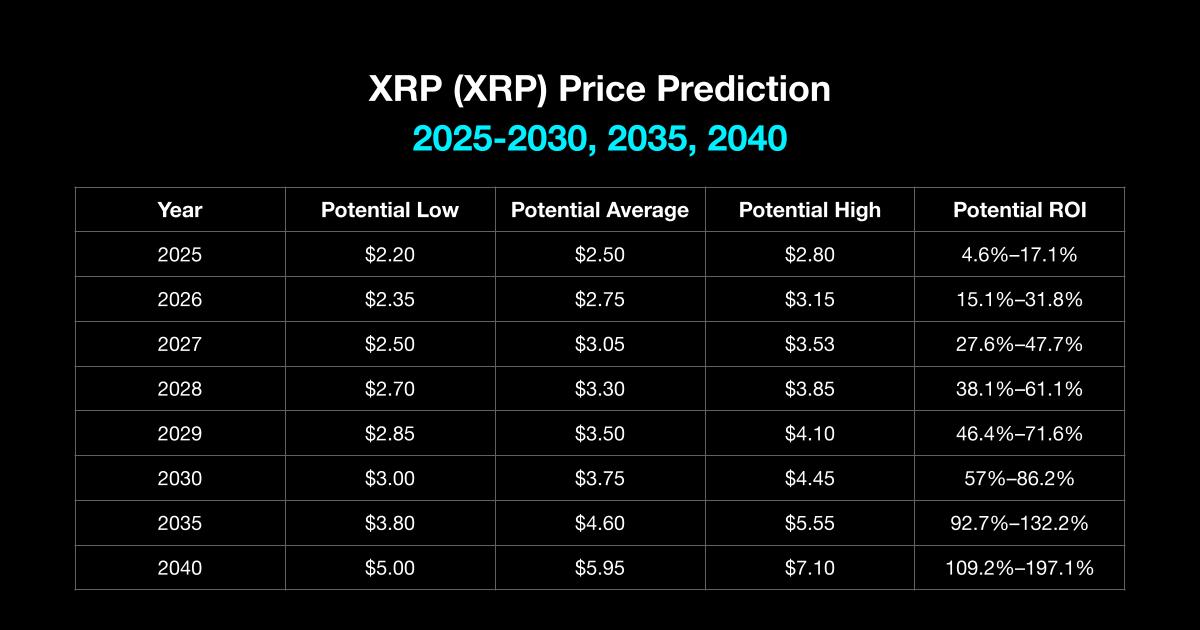
However, analysts at crypto exchange Bitget hold a much less optimistic view. Specifically, they estimated that XRP’s lowest potential price by 2035 could be $3.8, with a maximum potential of $5.55. Interestingly, even their top estimate falls short of Gemini’s $8 worst-case scenario.

XRP Price Predictions Bitget
XRP Price Predictions | Bitget

On the other hand, Telegaon analysts projected a much stronger outcome. Notably, they expect XRP to hit a maximum of $40.29 by 2035, while also considering a potential minimum price of $35.47 should bearish forces limit its growth.

XRP Price Predictions Telegaon
XRP Price Predictions | Telegaon

XRP High Price if It Hits Silver’s Market Cap, As Silver Crosses $4.48T Valuation:

0

Where could the XRP price reach if XRP matches silver’s market cap, as the precious metal crosses the $4.48 trillion valuation?

Amid an impressive year, silver (XAG) has been one of the best-performing assets globally in 2025, even outpacing gold (XAU), the largest asset by market cap. However, while silver has been on an impressive run, XRP has underperformed since October 2025 amid a broader crypto market downturn.

For perspective, silver, which began the year at $28.95, has increased 174% to $79 at press time, representing a new all-time high for the precious metal. This performance has brought silver’s market cap to a new peak of $4.485 trillion, considering the existing 1.751 million metric tonnes of silver.

XRP Gains the “Digital Silver” Tag

In contrast, XRP, which started the year with a price of $2.07, has collapsed 11.19% to $1.84 at the time of reporting. This comes despite several XRP community figures ascribing XRP with the “digital silver” tag, a description that has led to expectations of a rally similar to silver’s 2025 run.

Notably, Jake Molter from Molt Media recently pointed out that multiple investors dismissed silver for years, but appear to now be FOMOing into the market at peak prices. According to him, investors are currently dismissing XRP, and they could also FOMO into the market when XRP soars to record highs.

Meanwhile, market analyst Steph also called attention to a structure that gold and silver observed in 2022 before their eventual upsurge. Notably, this involved a long grind, a final flush wick, and then a quiet base. He suggested that XRP was following the same structure, which could lead to its own upsurge.

Silver Gold and XRP 3D Charts Steph is Crypto
Silver Gold and XRP 3D Charts | Steph is Crypto

XRP Price if It Claims a $4.485T Market Cap

Amid these discussions, we recently assessed how much the XRP price could rally for the crypto asset to match silver’s recent peak market cap of $4.485 trillion. Currently, XRP has a valuation of $111.99 billion at its current price of $1.84, having lost over $104.7 billion in value since the peak of $216.69 billion in July 2025.

XRP’s current market cap of $111.99 billion accounts for the crypto asset’s circulating supply of 60.57 billion tokens. If XRP claimed a market cap of $4.485 trillion like silver, its price would surge to $74, representing a 3,921% from the current price. 

Crypto Founder Says You Need To Hold at Least 1,000 XRP, If You are Serious About Your Finances

0

Edoardo Farina, founder of Alpha Lions Academy, believes holding at least 1,000 XRP could be a game-changer for your financial future.

In a post on X, Farina stated that anyone who is serious about their finances should consider holding no fewer than 1,000 XRP. He describes the threshold as “non-negotiable” for long-term positioning. 

His comment adds to a growing discussion within the XRP community about what level of exposure is needed to benefit meaningfully from future price expansion.

Why 1,000 XRP Is Seen as a Minimum Position

Farina’s argument centers on scale. At current prices below the $2 range, 1,000 XRP is worth roughly $2,000. While modest today, proponents argue that this amount provides meaningful upside if XRP appreciates over time.

According to this view, smaller holdings may struggle to generate life-changing outcomes even if prices rise dramatically. By contrast, 1,000 XRP offers flexibility, allowing investors to take partial profits while still maintaining exposure to further upside.

Farina has repeatedly stressed that holding fewer than 1,000 XRP limits financial optionality as prices increase.

Community Data Fuels the Scarcity Narrative

Supporters of the 1,000-XRP benchmark often reference wallet distribution data to strengthen their case.

Out of more than 7.44 million XRP wallets, only a small percentage hold more than 1,000. Specifically, wallets holding between 500 and 1,000 XRP total 256,435, while those holding 500 XRP or fewer exceed 6 million. 

Notably, as the price of XRP soars, the cost of accumulating these tokens also expands. For instance, in October 2024, one could buy 1,000 XRP for less than $500. But today, the price is close to $2,000.

For bullish commentators, as adoption grows, it could become increasingly difficult for new entrants to accumulate 1,000 XRP. This perceived scarcity has helped turn 1,000 XRP into a psychological milestone within the community.

Long-Term Price Expectations Drive the Thesis

The push to accumulate XRP rests on expectations of higher future prices. Some XRP advocates believe a move to $10 or $20 would be only the early stage of a much larger valuation cycle. 

Under such scenarios, 1,000 XRP could represent $10,000 to $20,000. Meanwhile, triple-digit prices would significantly alter the financial picture. In particular, $100 per coin, those holding 1,000 XRP will see valuations in hundreds of thousands of dollars.

More aggressive projections extend to even four-digit price targets. While highly speculative, these forecasts underpin Farina’s insistence that investors position early.

Not Everyone Shares the Optimism

Despite the confidence among XRP supporters, critics urge caution. Some analysts argue that triple-digit and above XRP prices require adoption levels that may not materialize in the near future. Others believe profit-taking at lower levels could be more realistic than hoping for triple digits.

Ultimately, Farina’s message reflects conviction rather than certainty. His stance assumes XRP will play a major role in future financial infrastructure and that patient holders will be rewarded. Accordingly, he sees holding 1,000 XRP as a strategic bet.

Expert Says to Ignore XRP Short-Term Noise as People Obsess Over Price, but XRP’s True Value Lies in Its Utility

0

Versan Aljarrah, founder of Black Swan Capitalist, has pushed back against the market’s fixation on XRP’s short-term price movements, arguing that the token’s real value lies in its utility.

His comments come amid growing concern over XRP’s recent price performance. Over the past month, XRP has fallen by 16.45%, while losses over the last three months have deepened to 34.2%. In December alone, the token dropped roughly 16%, with its price now hovering around $1.84.

As a result, many investors have taken to social media to voice frustration over XRP’s performance, even though the decline aligns with a broader market downturn. 

True Value Lies in XRP Utility, Not Short-Term Noise 

Nonetheless, Aljarrah has firmly pushed back against what he sees as an excessive focus on short-term price action. According to him, XRP derives its true strength from real-world utility rather than daily market fluctuations. At the same time, he acknowledged that price still matters, just not in a speculative context. 

Instead, Aljarrah explained that a higher XRP price enhances network functionality by improving liquidity, allowing larger values to move with fewer tokens. He argued that as liquidity improves, efficiency also increases. Consequently, this added efficiency makes XRP more attractive for real-world adoption. 

Meanwhile, he dismissed temporary market swings as mere short-term noise and urged the XRP community to remain patient, allowing “the technology and leadership to do the work.” 

Real Drivers of XRP Long-Term Value 

In this context, his commentary framed ongoing development, expanding partnerships, and clear strategic direction within the XRP ecosystem as the primary drivers of long-term value.

By design, XRP facilitates fast, low-cost cross-border payments, and several financial institutions have already adopted the token for this purpose. Notably, payment firm Tranglo and Japanese financial giant SBI use XRP to support international settlements.

Beyond payments, XRP’s utility continues to expand. Companies are now establishing reserves tied to the asset, signaling growing institutional confidence. For example, Ripple joined the Evernorth project, which aims to build the world’s largest XRP reserve, valued at no less than $1 billion.

Additionally, XRP is gaining traction in the decentralized finance space. Entities such as Flare and Axelar have introduced yield-bearing opportunities for XRP holders. As previously reported, Axelar has also announced plans to support XRP as a staking asset for validators within its ecosystem.

Additionally, XRP has secured a foothold in traditional markets through spot exchange-traded funds. So far, at least five XRP spot ETFs are trading in the U.S. Despite launching just last month, they have already attracted $1.24 billion in net assets. 

Against this backdrop, Aljarrah reiterated that XRP’s true value lies in its expanding utility and real-world adoption, not in short-term price movements. 

Inversion CEO Says He’s More Bullish on XRP Than ETH, Insists Ripple Is a Force Not to Be Reckoned With

0

The CEO and founder of Inversion recently admitted that he is more bullish on XRP than Ethereum, insisting that Ripple is a force to be reckoned with.

During a recent episode of the Empire podcast, host Jason Yanowitz spoke with Santiago Roel Santos, founder and CEO of Inversion, and Rob Hadick, General Partner at Dragonfly, about their expectations for the crypto market in 2026.

The discussion focused on Ripple, XRP, and Ethereum, with Santos presenting a notably strong endorsement of Ripple’s strategy.

Inversion CEO More Optimistic about Ripple than Ethereum

Santos explained that he entered the year believing crypto projects with large treasuries needed to use those resources deliberately to grow into their valuations. 

He said he publicly pushed this view early and emphasized that Ripple stood out as the only major project that acted on it. He noted that while he originally thought narratives would lose importance, Ripple proved that strong storytelling combined with decisive execution still matters.

Looking ahead to 2026, Santos said investors should reassess Ripple, especially given the long-standing criticism it has faced from crypto-native circles. He argued that Ripple delivered meaningful results through several acquisitions during the year. 

As a result, the industry leader said he now feels more confident in Ripple’s business development capabilities than those of any other crypto project, aside from his own company. “I’m actually more optimistic about Ripple and their BD muscle than any other project in the space,” Santo said.

Yanowitz asked Santos to confirm whether he truly ranked Ripple’s business development above all others. Santos responded without hesitation, stating his full confidence. “100%,” he affirmed.

XRP and Ripple Misjudged

When Hadick asked whether he personally owns XRP, Santos said he does not. He explained that underwriting XRP does not fit his current focus, adding that he lacks the time and does not operate as a trader.

Despite not holding XRP, Santos criticized crypto-native investors for repeatedly misjudging Ripple. He said they often resist momentum, narratives, and market psychology, only to fall behind year after year. 

To him, Ripple presents a rare case where a company may actually grow into its valuation due to its acquisition strategy. He described Ripple’s recent deals as impressive and highlighted that the company also raised a large funding round during the year.

Ripple a Force to Not be Reckoned with

The discussion then turned to Ripple’s acquisition activity. Hadick referenced multiple deals, including G-Treasury and Rail. Meanwhile, expanding his analysis, Santos said he began the year concerned about whether crypto projects could justify their valuations with real performance. 

He admitted he felt uneasy about valuations across both crypto and equity markets. In hindsight, he said Ripple executed better than any other major project. He contrasted this with Ethereum, arguing that high-profile figures do not translate into effective business development. 

He criticized Ethereum’s ecosystem for what he said was Fundstrat’s Tom Lee’s mixed public and private messaging. According to him, this behavior undermines credibility. However, Santos called Ripple a serious competitor that many had underestimated. “What I’m saying is that Ripple, I think, is a force not to be reckoned with,” he said.

XRP Holds a Greater Chance to Revisit ATHs

Hadick then asked whether XRP or Ripple’s equity would hold greater long-term value over a ten-year horizon. Santos responded by noting that Ripple controls roughly billions worth of XRP. He predicted that 2026 will likely prove difficult for both crypto and equity markets. 

Even so, he argued that XRP holds a stronger chance than most top-10 crypto networks to revisit all-time highs if markets decline. He said he remains highly skeptical that Ethereum can achieve the same recovery.

Reacting to the discussion, Digital Asset Investor (DAI), a prominent XRP community figure, said the conversation validated what XRP supporters have long believed. 

He argued that XRP holders correctly viewed the token as a tool for building infrastructure, not a shortcut for executive profits. DAI stated that XRP deployment is now approaching and concluded that neither Bitcoin nor Ethereum fits this role besides XRP.

Analyst Explains Ongoing XRP Price Manipulation, Breaks Down Liquidity Tactics

0

XRP market analyst Zach Rector has released a detailed breakdown explaining what he believes is ongoing price manipulation suppressing XRP’s value.

In a recent YouTube video, he explained that the current price isn’t due to weak fundamentals, but large investors using strategies that control liquidity and limit price movement.

XRP Price Suppression, Not Weak Demand

Notably, Rector says XRP is trading well below its true value because of deliberate price suppression. He believes the recent sideways movement below $2 and sudden drops aren’t caused by retail investors, but by institutions exploiting low liquidity.

According to him, these large players are quietly accumulating XRP while keeping the price from rising before a bigger move. He added that XRP doesn’t need heavy selling to fall. Instead, brief sell-offs during periods of low liquidity are enough to trigger liquidations and reset market leverage.

Furthermore, Rector said charts don’t tell the full story and that on-chain data is more important. He pointed to repeated cases where large amounts of XRP are sent to exchanges within short time periods, often right before major volatility events like options expirations.

He believes these transfers reflect institutional inventory management, not emotional retail selling. According to Rector, coins moved to exchanges are usually used to manage liquidity, recycle supply, or spark volatility — actions he says are typical of large institutions.

Macro Conditions Add Pressure

Moreover, Rector said XRP’s price pressure should be viewed in a larger economic context. He pointed to gold and silver hitting new all-time highs as signs of stress in the global financial system.

He also noted that the U.S. Federal Reserve is still supporting the system with liquidity through overnight repo operations, suggesting the system is not truly stable.

According to him, crypto has taken a temporary back seat while money has flowed into commodities and alternative markets like prediction platforms over the past year.

Why 2026 Is the Key Year

Despite short-term price swings, Rector believes XRP is set up for a big move higher once liquidity conditions improve. He expects the next major liquidity expansion, possibly around 2026, to make crypto one of the top-performing asset classes.

He says XRP’s pattern of sudden drops followed by quick rebounds shows a predatory market structure, not weakness. According to Rector, these conditions are also what allow XRP to surge sharply when liquidity returns.

Watching the Flows, Not the Fear

Rector concluded by advising traders to watch liquidity flows rather than short-term price moves. He believes XRP’s repeated sell-offs are part of a long-term accumulation phase.

Once that phase is over, he expects XRP to break out of suppression and reach new all-time highs. For now, he sees volatility as part of the setup, not a sign of failure, and says understanding how market makers operate is key to following XRP’s price action.

Top Investor Says XRP Is Designed to Price Out Retail

0

A long-time Bitcoin trader has argued that the evolution of XRP is deliberately structured to push retail investors out over time.

AltcoinFox, a veteran Bitcoin trader, took to X to warn that XRP’s future is not built around retail speculation. In his view, the design and direction of XRP point toward a system where everyday investors eventually lose access.

“The evolution of XRP is defined to ensure retail is priced out, AltcoinFox wrote, adding, “You will be priced out.”

His statement adds to a growing body of commentary suggesting that XRP’s endgame centers on institutional finance rather than mass retail ownership.

The XRP ‘Priced Out’ Narrative Has Been Years in the Making

AltcoinFox’s warning is not new. Similar views have surfaced repeatedly over the past two years, long before XRP climbed above the $2 level.

Back in July 2023, treasury management expert Shannon Thorp argued that XRP could not remain cheap indefinitely. She explained that retail investors make up only a tiny fraction of the XRP ecosystem and would have little influence once banks, corporations, and central institutions begin using the asset at scale.

In other words, when institutional money enters, retail becomes irrelevant.

Wallet Data Shows Retail Is Already Falling Behind

As of today, that theory is now showing up in the numbers. XRP commentators highlighted that most holders control very small balances.

Data from the XRP Rich List shows that more than 6 million XRP wallets hold 500 XRP or fewer. At the same time, acquiring 1,000 XRP is already out of reach for most participants, as it now costs about $2,000, compared to $500 just over a year ago.

XRP Rich List
XRP Rich List

Accordingly, Vandell Aljarrah, co-founder of Black Swan Capitalist, has emphasized that many people are being priced out without realizing it. With over half of Americans holding less than $5,000 in savings, even modest XRP accumulation is becoming difficult as prices rise.

He argued that by the time broader awareness arrives, meaningful exposure will already be financially impossible for most.

From Speculation to Infrastructure

Notably, supporters of the “priced out” thesis believe the shift is intentional. XRP supporters see it not as a speculative asset, but as part of financial infrastructure.

Ripple is building a large network for institutions, offering global payment systems, custody services, and XRP Ledger-based settlement tools. This suggests XRP is for big liquidity flows, not casual trading.

Analyst Pumpius even argued that XRP’s role in global settlements, tokenized real-world assets, and cross-border finance makes comparing its market cap to other coins pointless. In this view, XRP’s price depends on liquidity access, not hype.

Essentially, XRP proponents argue that rather than focusing on how high XRP’s price might go in the next bull run, the question is who will still be able to buy in once institutional demand takes over.

On the other hand, skeptics argue that these ideas are just theories, and that XRP’s price will still be driven largely by general market speculation.