
Home Blog Page 354

Expert Shares How to Never Sell Your XRP While Still Realizing Income from It

0

An XRP community expert has shared how investors could avoid selling their XRP tokens while still realizing income from it.

Notably, several market pundits have encouraged investors to hold their XRP rather than sell it. These experts argue that selling creates capital gains taxes and reduces long-term exposure to the token. Instead, they promote borrowing against XRP as a way to access funds while keeping ownership intact.

Brad Kimes from Digital Perspectives recently shared this view in his latest video commentary after reports surfaced that Ripple developers may be working on native XRP lending on the XRP Ledger. 

Ripple Developers Exploring Native Lending on XRPL 

Kimes credited community figure Diana with highlighting the update, noting that Ripple developer Edward Hennis brought the proposal to light. As previously reported by The Crypto Basic, Ripple developers are exploring a system that would allow institutions to borrow XRP directly on the ledger, treating it more like traditional money.

According to Kimes, native lending would allow XRP to be borrowed, locked, used, and repaid entirely on the XRP Ledger. This removes the need for third-party platforms and reduces risk. He noted that each loan would stand on its own, meaning one borrower’s failure would not affect others.

Kimes also explained that borrowed XRP would stay locked for set periods, similar to traditional loans. The pundit stressed that this temporarily reduces the amount of XRP available on the market, which could support prices as demand grows. He called the idea a major trust upgrade for banks and payment companies.

Throughout his commentary, Kimes mentioned his preference for borrowing directly on the ledger. He said he feels safer using a built-in system rather than relying on outside platforms when taking loans against crypto assets. Notably, the implosions of Voyager, Celsius, and BlockFi in 2022 exposed the risks of third-party lenders.

Kimes explained how the lending structure could work, noting that each borrower’s XRP would sit in a single-asset vault. A pool administrator or loan manager would oversee the process, while external platforms could build user interfaces. Importantly, this ensures that borrowers only face risks tied to their own positions.

How to “Never Sell Your XRP”

Kimes aligned the concept to what he called the “holy grail” in the XRP community: never selling XRP. While he clarified that he was not giving financial advice, he said many wealthy individuals follow this approach by borrowing against assets instead of selling them. This method helps delay taxes and maintain long-term ownership, as long as borrowers avoid taking on too much risk.

He also referenced comments from EasyA founder Dom Kwok, who expects market volatility to decrease over time as crypto markets mature and liquidity improves. Kimes said increased utility in areas such as payments, settlement, ETFs, and lending could make XRP prices more stable.

To explain the strategy further, Kimes presented a model he could follow. In his example, an investor could use a small portion of XRP holdings, such as 10%, as collateral for a loan. The borrowed funds go into income-producing assets like apartment buildings or laundromats.

Kimes explained that income from these assets can repay the loan, while remaining earnings become taxable income. Over time, the investor owns both the XRP and the businesses. Eventually, the investor can borrow against those businesses instead, leaving XRP untouched.

Here’s How High XRP Must Climb to Ease Liquidity Stress in Sovereign Settlements

0

A market commentator has assessed the price at which XRP must rise to facilitate sovereign-scale settlements with ease.

Today, XRP trades slightly above $1.9, but most analysts believe the crypto asset remains undervalued, especially when considering its potential role in global settlements. 

Notably, they believe large banks and sovereign institutions would need XRP priced much higher to move value smoothly and efficiently. Dr. Kamila Stevenson has supported this view, noting that banks would struggle to meet settlement needs at today’s price levels.

XRP Needs to Trade at $1,500-$3,000

Interestingly, Rob Cunningham of the KUWL Show shares this belief. In a recent post on X, Cunningham assessed the price range at which XRP could remove pre-funding, limit slippage, and ease liquidity pressure for sovereign-scale transactions.

Cunningham based his analysis on global settlement volumes, order book depth, central bank transaction sizes, and the need to reduce balance-sheet strain. From this, he concluded that XRP would need to trade between $1,500 and $3,000 to operate cleanly at a sovereign level.

To explain his reasoning, Cunningham presented a scenario where XRP trades around $2,000. At this price, he estimated the network value at about $200 trillion. 

Meanwhile, with a velocity assumption of 10x, he suggested the XRP Ledger could support up to $2 quadrillion in daily settlement capacity. He added that a single XRP would then represent a meaningful settlement unit. This would allow large sovereign transactions to clear without splitting liquidity across multiple pools.

At such price levels, Cunningham believes XRP’s role would change entirely. He argued that XRP would no longer behave like a speculative asset. Instead, it would function as financial infrastructure and act as a settlement rail and a reserve asset. 

Moreover, liquidity would become largely seamless, the cost of capital would move toward zero, and XRP would behave more like a system that powers finance rather than a typical form of money.

How Could Lower XRP Prices Work?

Notably, Cunningham also assessed how this would work at lower price levels. He said XRP around $500 could still be feasible, but only with inefficiencies. 

At that range, institutions would rely on workarounds that XRP was designed to avoid. To him, the $1,500 to $3,000 range marks the point where XRP fully delivers on its intended purpose. Beyond this level, the market would focus less on price and more on capacity.

He then explained that once markets recognize XRP as essential infrastructure, its price would no longer move like that of a normal asset. Specifically, instead of responding to earnings, stories, or cycles, XRP would reprice based on its role in the financial system. 

Cunningham believes institutions would treat XRP as a required tool, long-term holders would stop selling, and available supply would tighten.

A Three-Stage Valuation Process for XRP

The market pundit compared this to major historical changes, such as reserve currency transitions or the recognition of critical infrastructure. Notably, he called attention to a potential three-stage price process. 

The first stage would involve a rapid recognition period, due to clear regulation, sovereign or treasury-level adoption, or firm signals of real institutional use. During this time, he expects sharp price increases that could range from 5x to 20x in weeks.

The second stage would follow as markets focus on future demand rather than current pricing. Cunningham said this phase could push XRP from $100 to $500 and then toward $1,500 without heavy retail involvement. Specifically, institutional planning, market positioning ahead of scarcity, and capital shifts from bonds and foreign exchange markets would drive this move.

Meanwhile, in a subsequent post, Cunningham presented a third stage lasting one to three years. During this phase, XRP would enter what he described as infrastructure pricing. 

Notably, the markets would manage XRP through frameworks like liquidity corridors and collateral rules rather than speculation. Volatility would ease only after prices rise enough to remove liquidity stress, making four-digit prices normal instead of exceptional.

Cunningham concluded that most of XRP’s price adjustment would happen before broad agreement feels comfortable. According to him, XRP would rise not because belief spreads, but because institutions cannot afford to risk losing access to important settlement infrastructure.

Korean Scientist Shares Timeline for XRP Price to Reach $1,000

0

South Korean scientist YoungHoon Kim, who claims to have the world’s highest IQ, has outlined a long-term scenario in which XRP could reach $1,000.

Kim shared his view on X, stating that XRP could approach $1,000 over the next 10 years. He stressed that this is not financial advice and is based on a specific set of assumptions rather than a short-term price prediction. Notably, the outlook suggests that $1,000 XRP could occur by 2035.

YoungHoon Kim’s 10-Year XRP Scenario

According to Kim, such a valuation would require a large-scale migration of capital into crypto, a decline in the U.S. dollar’s value, and sustained high inflation. From his perspective, under these conditions, the numbers themselves do not rule out the possibility.

Notably, this post came just days after Kim predicted that XRP’s price could reach $100 within five years. He now envisions another tenfold expansion over the following five-year period.

At the time of his comment, XRP was trading around $1.87, with a circulating supply of 60.57 billion tokens. This makes the projection highly controversial, as it would require a market capitalization of roughly $60.57 trillion.

Market Cap Concerns

Given these implications, other market participants challenged Kim’s outlook. X user Utumax argued that XRP reaching $1,000 would imply a market capitalization larger than that of gold. Accordingly, he called the scenario unrealistic.

Kim responded by suggesting that only those with a high level of understanding would grasp his reasoning.

Meanwhile, YouTuber Zach Humphries asked Kim to explain the implied market capitalization of XRP at $1,000 and to outline the methodology behind the forecast. Humphries noted that while he remains bullish on XRP, he would be satisfied with a move toward $100 over the next decade. Interestingly, other commenters argue “market cap is irrelevant.”

Others, like X user Jamila, mocked the projection, saying that the supposed world’s smartest person issued a prediction while failing to factor in reality.

Another community member added that long-term value in crypto is driven by adoption, liquidity, and real-world use — not timelines or headline-grabbing price targets.

Top Voices Calling for $1,000 XRP

While Kim’s $1,000 XRP prediction faces criticism, the outlook is widespread within the XRP community. In February, Matthew Brienen, COO of CryptoCharged, said XRP reaching $100–$1,000 within 10 years is “highly possible.”

He revealed that XRP makes up 50% of his portfolio, which he has held and staked for over five years. Brienen plans to sell some XRP in the short term but hold a portion for 5–10 years. He cites XRP’s remittance utility, fast, low-cost global transfers, as the key driver for the outlook.

Separately, investor Armando Pantoja said he is willing to wait ten years for XRP’s price to reach $1,000, given the extraordinary upside that could follow. He argues that XRP is deeply undervalued after years of regulatory pressure from the SEC lawsuit, which he says suppressed its price.

Despite the popular optimism, critics continue to push back on the outlook. They consider a $60 trillion market cap unrealistic, noting that it raises questions about where Bitcoin, Ethereum, and gold would stand if XRP, which currently ranks below them, were to reach that level.

Q4 2025: Bitcoin Posts Worst Quarterly Loss Since 2018

0

The final quarter of 2025 has turned out to be the worst-performing quarter for Bitcoin in nearly a decade.

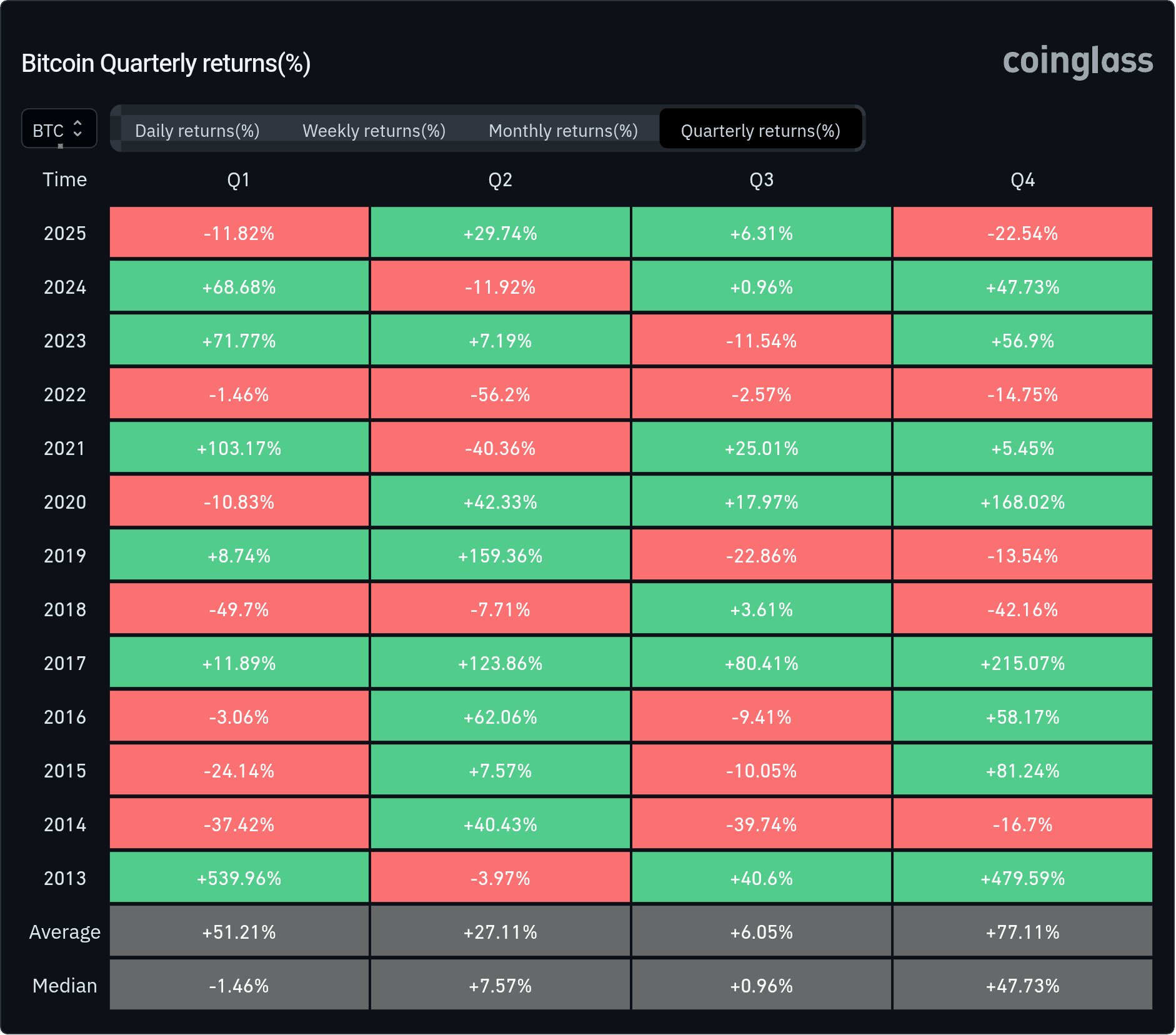
Data from Coinglass confirms that Bitcoin has registered a loss of 22.54% so far in the fourth quarter of 2025, with just a week remaining until the end of the year. The last time Bitcoin experienced such a massive negative performance in Q4 was in 2018, when it ended the year with a Q4 loss of 42.16%.

This is evident in the ongoing bearish performance the market has seen since Bitcoin hit a peak in October this year. Specifically, since October’s $126,198 peak, Bitcoin has declined 30.82% to $87,201.

Bitcoin’s price dip has wiped out over $1 trillion from the global crypto market valuation, falling from over $4.1 trillion a few months ago to $2.91 trillion today.

Bitcoin Worst Quarter Since 2018

Historically, the last quarter of the year is a bullish phase for Bitcoin, with an average gain of 77.11% and a median gain of 47.73%. Since 2013, Bitcoin has posted positive gains in Q4 eight times, with increases as high as 479.59% and as low as 5.45%. It has only registered losses five times, including Q4 2025.

Notably, after Bitcoin dipped 42% in Q4 2018, it saw a recovery in Q1 2019, posting gains of 8.74%. This set the stage for a more massive 159.36% gain by Q2 that year. However, Bitcoin registered a 22.86% loss in Q3 and a 13.54% loss in Q4 of 2019.

This marked another fourth-quarter loss for Bitcoin. The loss carried into 2020, with another 10.83% dip in Q1. From then on, a major recovery followed, with Bitcoin registering outstanding positive gains of 42.33%, 17.97%, and an even more massive 168.02% in Q2, Q3, and Q4, respectively.

Bitcoin historical chart from Coinglass

What Could Happen in Q1 2026?

As it stands, this historical account suggests two possible outcomes for Bitcoin:

It could see a relief in Q1 2026, consistent with recoveries after Q4 losses in 2018 and 2022. Notably, after Bitcoin dipped 14.75% in Q4 2022, it registered a massive 71.77% upside in Q1 2023.

Alternatively, Bitcoin could see another loss in Q1 2026, consistent with its performance after the Q4 2019 loss. However, that loss paved the way for explosive gains in Q2, Q3, and Q4. In other words, should Q1 2026 end bearish for Bitcoin, a rebound could follow for the rest of the year.

What Industry Experts Expect in 2026

According to Citibank, Bitcoin could reach as high as $189,000 in 2026 under an ultra-bullish scenario. It could also reach $143,000 under a moderate scenario, both of which would mark new all-time highs for BTC.

Notably, Bernstein analysts have similar expectations, suggesting BTC could reach $150,000 in 2026 and $200,000 in 2027.

Analysis Reveals One of the Factors Behind the Bitcoin Crash from $124K to $84K

0

A recent CryptoQuant analysis reveals one of the factors behind the recent Bitcoin price collapse, which appears to have stabilized.

Notably, after reaching a peak of $126,000 in early October 2025, Bitcoin briefly stabilized around $124,000 following an initial pullback. However, this stability did not last. 

From this level, Bitcoin dropped steadily and eventually bottomed at $84,000 in December, marking a decline of more than 32% over three months. Although BTC has since bounced modestly from the $84,000 low, it remains nearly 30% below the $124,000 region and currently trades near $87,000.

This prolonged downturn emerged during a broader bearish phase that has weighed heavily on the crypto market from early October through December. 

Whale Capitulation Contributed to Bitcoin Drop

Interestingly, new on-chain data has revealed one of the factors behind the decline. Market analytics platform CryptoQuant recently identified whale behavior as a major contributor to Bitcoin’s fall from $124,000 to $84,000.

According to CryptoQuant’s analysis, realized losses from newly active large holders played a decisive role in driving prices lower. 

As Bitcoin dropped from $124,000 to $84,000, losses booked by these newer whales intensified and placed sustained pressure on the market. Following the recent low at $84,000, those realized losses declined sharply and flattened out, showing a pause in aggressive selling from this cohort.

The chart data shared by CryptoQuant revealed that in early October, signs of whale capitulation began to appear but remained relatively muted. During this period, combined profits and losses fluctuated between $200 million and $100 million. 

Realized Profits by Bitcoin Whales CryptoQuant
Realized Profits by Bitcoin Whales | CryptoQuant

However, as Bitcoin prices weakened further later in October, selling activity accelerated significantly. New whales dominated these selloffs, and on certain days, realized profits surged as high as $400 million.

Whale Capitulation Goes Flat: Recovery Next?

The conditions changed again in November. As Bitcoin fell below the $100,000 mark, profits diminished even though sell pressure increased. Instead of booking gains, new whales began absorbing mounting losses. 

This change led to pronounced capitulation events, with realized losses reaching peaks of up to $600 million on some days throughout November. CryptoQuant linked these heavy losses directly to the sharp price collapse during that period.

By December, the data showed a notable reduction in these whale-driven selloffs. As capitulation eased, Bitcoin entered a phase of relative stability, with prices consolidating between roughly $87,000 and $90,000. 

With selling pressure from new whales now significantly reduced, the market may have room to stabilize further and potentially recover if large holders return as net buyers.

Analysts Remain Divided on Next Direction

However, despite this improvement, not all analysts expect an immediate reversal. Specifically, veteran trader Peter Brandt warned that Bitcoin may still face additional downside. 

Citing historical patterns, he noted that Bitcoin has experienced five major parabolic advances over its 15-year history, each followed by declines of at least 80% once those advances broke down. He believes the latest break suggests the current correction may not yet have fully played out.

Bitcoin 1W Chart Peter Brandt
Bitcoin 1W Chart | Peter Brandt

Meanwhile, analyst Michael van de Poppe observed that Bitcoin recently rejected a key resistance area near $90,000 and continues to move sideways. While this rejection disappointed some traders, he noted that shorter timeframes still show signs of a developing upward trend. 

He called attention to $86,000 as a major support level, suggesting that holding this area could bolster Bitcoin’s case for another attempt at breaking major resistance zones. 

Bitcoin 12h Chart Michael van de Poppe
Bitcoin 12h Chart | Michael van de Poppe

Van de Poppe also highlighted unusual market conditions, noting that while many traditional markets rally, crypto lags behind. Nonetheless, he believes this situation could change with time.

Bank of Russia Unveils Tiered Plan to Expand Crypto Access

0

The Bank of Russia has unveiled a new regulatory proposal to expand access to cryptocurrencies while cautiously maintaining strict supervisory control.

According to the central bank, the framework aims to address rising investor demand for digital assets without compromising financial stability or legal safeguards.

Rules for Retail and Professional Investors

A key aspect of the proposal is a clear distinction between retail and professional investors. Specifically, the Bank of Russia said access to cryptocurrencies would be determined by investor classification and the successful completion of eligibility requirements.

For instance, retail investors would continue to face significant restrictions. Namely, they would be permitted to purchase only the most liquid cryptocurrencies, with annual investments capped at 300,000 rubles. All transactions would be required to pass through a single approved intermediary, allowing regulators to maintain direct oversight of activity.

In contrast, professional investors would be subject to a more flexible regime. Notably, they would face no restrictions on transaction volumes. At the same time, the regulator’s proposal would prevent them from acquiring anonymous or privacy-focused cryptocurrencies.

Central Bank Reiterates Risk Warnings

Despite the proposed expansion, the Bank of Russia reiterated its long-standing concerns about cryptocurrencies. It continues to classify digital assets as high-risk, citing extreme price volatility, the lack of sovereign guarantees, and exposure to sanctions-related risks.

Consequently, the central bank emphasized that broader access would not equate to lighter regulation. While cryptocurrencies and stablecoins would be formally recognized as monetary assets and allowed to be bought and sold legally, their use for domestic payments within Russia would remain prohibited.

Regulated Infrastructure Remains Central

To maintain oversight, the Bank of Russia plans to confine crypto trading to existing licensed infrastructure. Therefore, transactions would continue to be conducted through regulated exchanges, brokers, and trustees.

Additionally, the regulator intends to introduce additional standards for specialized crypto depositories and exchange operators. These measures, in turn, aim to strengthen compliance requirements and prevent the emergence of unregulated markets.

Beyond cryptocurrencies, the proposal addresses digital financial assets and other forms of Russian digital rights, which could circulate on open networks.

According to the regulator, this approach is to improve transparency and attract foreign investment. It reflects a broader effort to integrate digital assets into Russia’s financial system under clear rules.

Notably, residents will also be able to purchase or transfer cryptocurrencies abroad through foreign accounts or Russian intermediaries. However, they must notify the tax authorities of such transactions.

Timeline for Legal Implementation

To advance the initiative, the Bank of Russia has submitted draft legislative amendments to the government, where they are currently under review.

Ultimately, the central bank aims to complete the full legal framework by July 1, 2026. Furthermore, liability for illegal activities by crypto intermediaries would be introduced one year later, taking effect on July 1, 2027.

Solana Analysis for Dec 23: Can SOL Close Above This Key Level?

Solana is testing a key support level, with liquidation data showing pressure on long positions.

Currently, Solana (SOL) is trading at $124.07, reflecting a 2.1% decline in the last 24 hours. The price has seen a bottom at $124.03 and hit its 24-hour top at $128.10, indicating some volatility within the day.

Over the past 7 days, Solana has seen a 1.1% decrease, indicating mild bearish sentiment in the short term. Over a 14-day period, the crypto has dropped by 6.6%, suggesting a broader downtrend in recent weeks.

However, the 1-year performance shows a 31.3% decline, highlighting a struggle to maintain upward momentum over the longer term. Traders will be closely watching whether Solana can regain strength or continue to face downward pressure.

Solana Price Prediction

Notably, a TradingView chart shows Solana testing key levels, with Fibonacci retracement indicating critical support and resistance areas. The 0.236 Fibonacci level at $124.02 is currently being tested, with a close below it possibly launching further downside.

Solana 1-Day Chart
Solana 1-Day Chart

The next support zone appears at the 0 level at $116.94. On the upside, immediate resistance is seen at the 0.382 retracement level around $128.40, and further resistance is located at the 0.5 level near $131.94. If the price manages to break above these resistance levels, Solana could be poised for a stronger recovery toward $148.

Looking at the RSI (Relative Strength Index) at 39.87, Solana is in neutral to slightly bearish territory, indicating that there is no immediate overbought or oversold pressure. The MACD histogram shows a bearish momentum, with the MACD line below the signal line, reinforcing the possibility of further downside. For a reversal to the upside, Solana would need to close above $124.02.

Solana Liquidation Data

The liquidation data for Solana across multiple timeframes reveals significant pressure on long positions. Over the 1-hour and 4-hour periods, $3.87 million and $4.15 million in liquidations occurred, respectively, with the majority coming from long positions, indicating strong selling pressure.

Solana Liquidation
Solana Liquidation

Meanwhile, the 12-hour data further confirms this trend, with $13.45 million in total liquidations, and $13.27 million from long positions. This indicates that long traders are being squeezed, and the market sentiment is leaning toward the downside in the short to medium term.

In the 24-hour period, the total liquidation figure rose significantly to $17.73 million, with $16.87 million coming from long positions and $856.28K from short positions. The continued dominance of long position liquidations suggests that Solana may continue to experience downward pressure.

Japanese Financial Expert Predicts When XRP Could Hit 1,000 Yen: Here’s the USD Equivalent

0

XRP has remained under pressure as the broader crypto market continues to struggle, but a Japanese financial commentator believes an upsurge may be imminent. 

Angorou, a well-known market analyst in Japan, recently shared a market commentary suggesting that XRP could climb to 1,000 yen, which equals roughly $6.41, based on current exchange rates.

At the time of his analysis, XRP traded at $1.99, or around 300 yen. Despite recent price weakness, Angorou contended that structural and regulatory developments would help XRP put up a stronger performance in 2026.

XRP’s Price Journey Since November 2024

In his commentary, Angorou highlighted XRP’s recent price history to explain how the market arrived at its current position. Specifically, on Nov. 3, 2024, XRP traded at 75 yen. Three days later, on November 6, 2024, Donald Trump won the U.S. presidential election. 

Angorou pointed out that Trump’s campaign promised to support cryptocurrency growth and remove SEC Chair Gary Gensler. According to the market pundit, this led many investors to expect an end to the legal battle between the SEC and Ripple.

XRP Price Journey Since November 2024
XRP Price Journey Since November 2024 | Angorou

Notably, this optimism triggered a sharp rally. XRP broke above 500 yen in January 2025 before sliding back into the 200-yen range following what Angorou described as a tax-driven shock. XRP later recovered and reached a new all-time high of 542 yen in July 2025.

After this peak, momentum faded. Specifically, XRP entered a steady decline and eventually fell to around 303 yen. From its July high, XRP has dropped 45%, placing it among the weaker performers within the top-ranked cryptocurrencies by market cap, though not the worst.

Whale Holdings Show Changing Market Sentiment

Angorou also called attention to on-chain data, focusing on whale addresses holding more than 1 million XRP, which equals over 300 million yen at current prices. On Nov. 6, 2024, the number of these large holders stood at 2,111.

XRP Whale Count Angorou
XRP Whale Count | Angorou

Following Trump’s election victory, whale accumulation accelerated quickly, moving in step with XRP’s price surge. XRP hit its 2025 peak in July, while the whale count continued rising and reached a record 2,758 addresses in October 2025.

As prices dropped sharply after that point, whale participation declined just as fast. Notably, the count fell back to 2,011, roughly matching levels seen during the U.S. election period. Angorou also noted growing signs that retail investors had begun exiting XRP, adding to the downward trend.

XRP ETF Inflows Persist Despite Price Declines

However, while price action and on-chain data suggested weakening sentiment, Angorou highlighted a major contradiction: institutional capital continued to flow into XRP. In November, Canary Capital launched the first pure XRP spot ETF in the United States, and the fund’s performance immediately stood out.

Four more products have since emerged. Interestingly, since their launch, the XRP ETFs have recorded no days of net outflows. From the Nov. 14 peak onward, the ETF logged 25 consecutive business days of inflows, reaching a cumulative total of about $1.07 billion, or roughly 169 billion yen at the time of Angorou’s analysis.

By comparison, in their best periods, Bitcoin ETFs recorded 19 straight inflow days, Ethereum ETFs reached 20 days, and Solana ETFs hit 21 days. XRP now holds the longest inflow streak in the crypto ETF market.

Clear Regulation Could Drive XRP’s 2026 Outlook

Meanwhile, Angorou believes regulatory clarity could become the defining catalyst for XRP in 2026. He highlighted the Clarity Act, which could clearly classify cryptocurrencies as either securities or commodities. 

Under this Act, the SEC oversees securities, while the CFTC regulates commodities with fewer restrictions. Regulators already recognize Bitcoin as a commodity, and growing evidence supports a similar classification for Ethereum. 

Angorou argued that formal recognition of XRP as a commodity by Congress would allow U.S. financial institutions to adopt Ripple’s remittance technology without legal risk. He also mentioned Ripple’s recent conditional approval to operate as a trust bank, suggesting the company could expand into regulated banking services.

XRP-to-Bitcoin Ratio Supports a 1,000 Yen Price

To estimate XRP’s upside, Angorou assessed its historical ratio relative to Bitcoin. During XRP’s strongest reputation phase, the ratio peaked at 0.48, with an average of 0.169. During the 4-year-and-8-month SEC lawsuit period, the ratio averaged 0.042 under the Biden administration and 0.069 after Trump’s election.

XRP to Bitcoin Ratio Angorou
XRP to Bitcoin Ratio | Angorou

Angorou believes regulatory clarity and institutional adoption could push the ratio back toward 0.169. If Bitcoin’s price remains stable and XRP closes that gap, XRP could reach around 780 yen. 

However, under two conditions, including the passage of the market structure law and Bitcoin rising above 20 million yen ($128,000) amid debate over a National Bitcoin Reserve Act, he expects XRP to exceed 1,000 yen in 2026, equivalent to approximately $6.41.

XRP Will Move Fast and Aggressively When It’s Time: Finance Coach

0

Amid the ongoing XRP downturn, a market pundit has suggested that the token would move “fast and aggressively” when bullish momentum returns.

XRP has continued to underperform, extending a difficult period for investors. At the time of writing, XRP trades around $1.88, down almost 34% over the past three months. 

With this decline, the token now seems likely to end 2025 in negative territory. However, despite this weakness, some market commentators believe XRP could rebound quickly once momentum returns.

XRP Could Move “Fast and Aggressively”

One of those individuals is finance coach and market analyst Coach JV. “XRP will move fast and aggressively when it happens,” the market pundit said in a recent commentary. He chose not to give price targets or timelines but stressed that his confidence comes from research and experience, not speculation.

Coach JV explained that he bases this view on facts, data, and logic rather than hype. Because of this belief, he holds XRP as his largest personal investment and a major asset in his company’s treasury.

Interestingly, XRP has already demonstrated its ability to move rapidly within a short period. For instance, after underperforming from 2015 to 2016, XRP spiked 801% from March to May 2017. In December 2017, the price also surged 746% within a month. Most recently, XRP rallied 283% in November 2024 after months of declines.

Coach JV believes a repeat could occur. However, he clarified that these views are his personal opinion, not financial advice. 

According to the pundit, he openly discusses his portfolio because he believes in standing behind his decisions, even if they lead to losses. He called attention to his investment results between 2020 and 2024 as proof of his disciplined approach.

Coach JV called XRP one of the most important assets investors may encounter in their lifetime. According to him, understanding financial systems matters more than chasing short-term price movements.

Banking System Lagging

Coach JV ascribed his outlook on XRP to his background in banking. He emphasized that traditional banks struggle with trapped liquidity, where money sits idle in accounts across borders. This system slows payments and ties up capital that could serve better uses.

He argued that today’s financial system no longer matches the speed of modern technology. Specifically, while artificial intelligence and digital platforms move quickly, money still travels through outdated systems. He believes this creates stress across the global economy.

Coach JV also pointed to rising debt levels, unstable bond markets, and changing interest rate policies. To him, these issues expose weaknesses in the current system and increase the need for faster and more efficient payment solutions.

Ripple and XRP Offer a Solution

According to Coach JV, Ripple has spent years working to fix these problems. He said the company built its technology to improve how money moves around the world, not to chase short-term trends.

He also called attention to Ripple’s growing involvement with regulators and the traditional banking system. For instance, the firm recently secured conditional approval to operate a banking charter.

Coach JV believes this progress supports a future where people gain more control over their finances, even if most users never realize they rely on blockchain technology. He said major changes in finance often happen quietly. By the time the public notices, institutions have already adopted the new systems.

Institutions are Paying Attention

Speaking further, the finance coach noted that many large financial firms have changed their views on crypto assets. He noted that institutions once critical of crypto now offer blockchain services, crypto-backed loans, and digital asset exposure. Vanguard is one such institution.

Coach JV added that many financial advisors understand XRP because it addresses a real-world problem. According to him, XRP’s focus on payments and settlement makes it easier for institutions to adopt.

TRON Founder Justin Sun Suffers $60M Loss Amid WLFI Blacklisting

0

TRON founder Justin Sun has remained locked out of World Liberty Financial for more than three months following his blacklisting.

The extended restriction has wiped out an estimated $60 million in the value of his frozen tokens. The scale of the losses was highlighted on Monday by blockchain analytics platform Bubblemaps. 

In a post on X, the firm stated that Sun remains blacklisted by World Liberty Financial (WLFI) and noted that the value of his locked tokens had declined significantly over the preceding three months.

The update has renewed attention on a dispute that has lingered largely out of public view since September.

How the Blacklist Began

World Liberty Financial blacklisted an address linked to Sun in September after he transferred roughly $9 million worth of WLFI tokens. The move triggered an immediate freeze, preventing any further transfers from the address.

More than three months later, Sun’s status remains unchanged, with the restriction still firmly in place.

The impact of the blacklist has been compounded by broader market weakness. According to CoinGecko data, WLFI has declined by more than 60% since trading began in September. Because Sun’s holdings remain frozen, he has been unable to respond to the downturn, amplifying the losses cited by Bubblemaps.

Heavy Backing Makes the Situation Notable

The ongoing freeze is notable given Sun’s prominent role as a backer of Trump-linked crypto ventures. He invested approximately $75 million in WLFI and committed about $100 million to the TRUMP memecoin. 

Altogether, Sun directed an estimated $175 million toward projects associated with President Donald Trump.

Sun’s involvement extended beyond capital. Having secured the position of top holder of the TRUMP memecoin, he was invited to a gala dinner with Trump and presented with a ‘Trump Golden Torbillon’ watch.

Even so, these public connections have not translated into a resolution of the blacklist.

Sun Pushes Back Against the Decision

Following the September action, Sun denied any wrongdoing. At the time, he said his transactions were consistent with long-term support for the project. He further described the freezing of his tokens as unreasonable, arguing that it contradicted his stated intention to strengthen the WLFI ecosystem.