
Home Blog Page 364

More On-Chain Activity as Over 131,000 Cardano Transactions Feature NIGHT Tokens

0

The launch of NIGHT, the native token of Midnight, has significantly impacted the number of transactions across the broader Cardano ecosystem.

Cardano founder Charles Hoskinson called Midnight a transformational project, suggesting it would shine a light on the network. It seems his projection is coming to fruition, as evidenced by recent on-chain activity.

Surge in NIGHT Transactions

According to data from Cardano-focused blockchain explorer Cexplorer.io, over 131,000 transactions on Cardano included the NIGHT token.

When the platform highlighted these impressive numbers on X on Wednesday, it was at 122,698 transactions. However, users have continued to move NIGHT on Cardano, with the figure standing at 131,325 at the time of writing.

Meanwhile, even at over 122,000 transactions, Cexplorer highlighted that it was an admirable user traction. It stated that the number of Cardano transactions involving NIGHT was surprisingly high, especially given that the token launched a week ago.

NIGHT debuted on December 10 and quickly gained the attention of exchanges. Several top-tier trading platforms like Binance, Bybit, and OKX promptly added support for the token, marking the first for any Cardano native token.

Since then, transaction volumes have continued to surge, with price performing relatively well compared to most high-caliber assets, including XRP and Cardano.

More On-Chain Activity for Cardano

Notably, the transaction data further adds to the bullish structure around NIGHT. In 8 days, users have carried out thousands of transactions involving the token.

For perspective, the SNEK meme coin, which was the token with the largest traction on Cardano before NIGHT, has a total of 3,029,007 transactions in two years and seven months after its first mint. If NIGHT sustains its current trajectory, it will reach SNEK’s total transaction in approximately 185 days.

Generally, NIGHT’s market debut has increased on-chain activity on Cardano. The strategy of allowing users of other chains to participate in its Glacier Drop also brought in new users, expanding the influx into the network.

Notably, the Midnight native token could be the game-changer for Cardano, which has struggled with user participation. Critics call Cardano a “ghostchain” because of its meager active users and transaction volume compared to other chains of its caliber, and NIGHT could help reverse this sentiment.

In the meantime, NIGHT trades at $0.064, up 3.82% in the past 24 hours. Interestingly, no other asset in the top 95 cryptocurrencies by market cap has this daily increase, signaling strength even during a broader market price dip.

Early Shiba Inu Top Investor Who Turned $13K Into $9B Moves 469B SHIB to OKX

0

An early Shiba Inu whale who accumulated 103 trillion SHIB in 2020 has resurfaced, transferring 469 billion SHIB to OKX.

Blockchain analyst EmberCN first drew public attention to the transaction, which occurred over the past day.


For context, the unidentified whale acquired 103 trillion SHIB, equivalent to 17.4% of the current total supply, back in 2020, when Shiba Inu was largely unknown. Notably, the entire purchase cost just 37.8 ETH or approximately $13,752 at the time. 

Whale Shifts 469 Billion SHIB to OKX 

Although the whale has remained active by moving other assets such as BNB, ETH, and UDS, they reignited market interest with this latest SHIB transaction. Citing Arkham data, EmberCN revealed that the whale transferred roughly 469 billion SHIB to the OKX exchange yesterday, a sum now worth about $3.64 million.

A closer look at the on-chain activity shows that the whale first routed the tokens through an unidentified intermediary wallet in two separate transactions. One contained 468.98 billion SHIB, and the other just 5 million SHIB.

Subsequently, the exact amounts were forwarded to an OKX-linked address, again split into two transactions: 468.98 billion and 5 million tokens.

Such transaction patterns are often used to obscure direct links between large holders and exchanges. Transfers to exchanges typically signal preparations to sell or swap assets into other tokens. However, it remains unclear whether the 469 billion SHIB has been sold.  

Strong Resilience in Shiba Inu 

Despite speculation that the whale may sell more SHIB, the investor is widely regarded as one of SHIB’s most bullish holders due to their long-term resilience. After purchasing 103 trillion SHIB in 2020, the whale watched their portfolio surge to an extraordinary $9.1 billion at the height of the 2021 bull market.

However, even at that peak valuation, they chose not to sell the vast majority of their tokens. Instead, they maintained their position through multiple market cycles. Notably, the recent transfer, although sizable, accounts for only a small portion of their total holdings.

While the whale has moved and sold a limited amount of SHIB over time, current data shows the address still controls approximately 96.684 trillion SHIB. This represents about 16.4% of the total supply and is valued at roughly $722.23 million at current market prices.

Early Shiba Inu whale portfolio

The development comes as Shiba Inu continues to struggle alongside the broader crypto market. SHIB has plunged by 64.9% year to date and 15.1% over the past 30 days. At the current price of $0.000007423, SHIB is down 4.88% over the past day. 

Brandt Says Love It or Not, You Need to Deal with XRP Bearish Structure

0

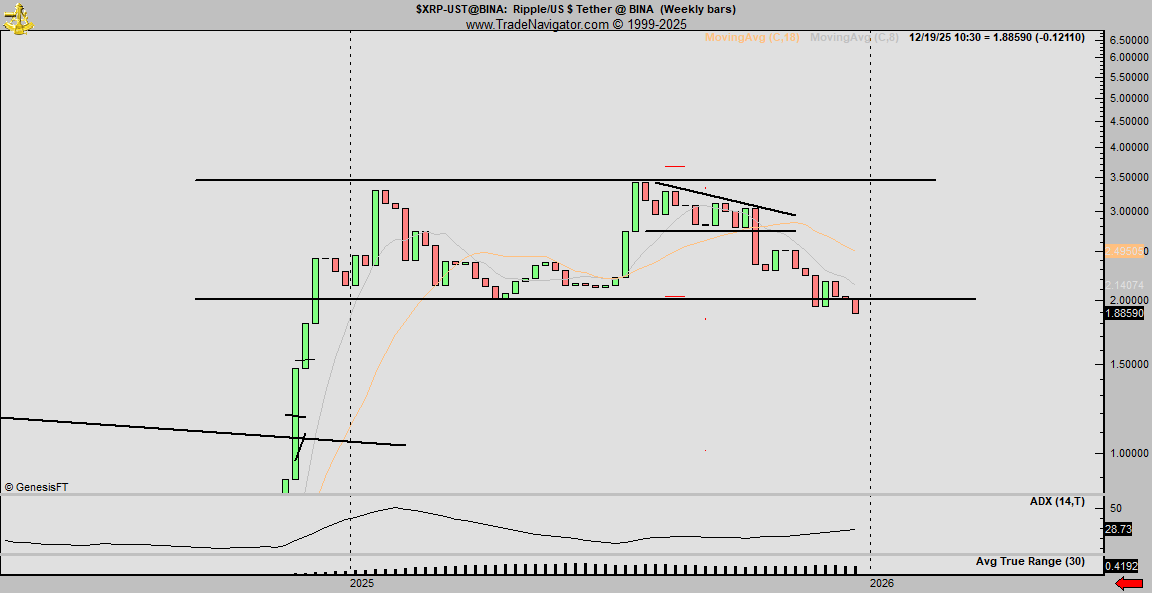
XRP has again taken center stage as veteran trader Peter Brandt has called attention to a potential bearish double top structure on the weekly chart.

As the global crypto market loses over $1.3 trillion over a three-month period, XRP has not been spared in the bloodbath. Currently trading for $1.83 at press time, XRP is now down 50% from its July peak of $3.65, pushing its annual loss to 11.73%, on track to close a year in the red for the first time since the 2022 bear market.

However, despite the massive losses, veteran trader Peter Brandt recently called attention to a potential structure that could lead to steeper declines for XRP. Specifically, Brandt revealed that XRP may be on the verge of forming a bearish double top pattern on the weekly timeframe.

Brandt: XRP Seeing Potential Double Top

For the uninitiated, a double top typically forms when an asset rises to a similar high twice within a specific period but fails to break the resistance at this high each time. The double top is confirmed when the asset corrects and closes below the neckline support, which represents the low between the two peaks.

Data from Brandt’s chart confirms that XRP formed the first top when it soared to a high of $3.4 in January 2025 on the back of the Trump-led market rally. After hitting this level, XRP failed to break the resistance, collapsing to a low of around $1.8 in March. 

Interestingly, XRP recovered from this bottom, staging a rally that eventually pushed its price to $3.65, aligning with the initial $3.4 peak, and forming the second top. However, the roadblock at the $3.65 high also formed formidable resistance, leading to an XRP drop, with the token down 50% since then.

XRP 1W Chart Peter Brandt
XRP 1W Chart | Peter Brandt

Now that XRP has collapsed to the $1.8 level around the neckline support, Brandt awaits a close below this region to confirm the formation of the double top. The market veteran admitted that the structure remains unconfirmed and may fail. 

He stressed that he will deal with it if it doesn’t play out, but warned that for now, there may be bearish implications. “Love it or not, you need to deal with it,” Brandt remarked. While he failed to highlight a potential bearish target if the pattern plays out, Brandt maintains that prices could tank.

XRP Weekly RSI Hits 33: Possible Recovery?

Meanwhile, Cryptollica, another market analyst, revealed that XRP may actually have entered a bullish positioning with respect to the weekly RSI (Relative Strength Index). Specifically, the RSI has dropped to 33, and each time it has slipped into the 30 region, prices have recovered sharply. This trend occurred in March 2020, June 2022, and July 2024, leading to recoveries.

Cryptollica pointed out to Brandt that a similar trend could play out now that the RSI has again corrected to the 30 mark. In response, the market veteran agreed, noting that if the double top structure fails, the recovery could be “exciting.” He stressed that he was not particularly championing a bearish case for XRP, just highlighting what the chart says.

Notably, Brandt has often expressed dissatisfaction with the response from XRP proponents when he highlights bearish technical setups for the asset. Earlier this month, he called XRP investors “the most madly obsessed permabulls” on earth.

Analyst Says You Won’t Be Able to Buy XRP Again if You Plan to Sell Now and Buy Back Later

0

A market commentator has suggested that investors planning to sell XRP and buy back later at lower prices may not be able to purchase the token again.

XRP has collapsed with the rest of the crypto market, leading to losses for investors who held past the $3.66 peak in July 2025. Today, XRP is down over 48% from that peak, as it currently trades for $1.90. At this price, XRP has dropped 37.5% in the past three months, on track to record a third consecutive monthly loss for the first time since late 2022.

With the bearish pressure dominating the scene and XRP losing the pivotal $2 support, market sentiments have slumped. In October, when the ongoing downtrend had just begun, market analytics resource Santiment found that XRP was already facing its highest level of bearish sentiment in six months.

You May Not Be Able to Buy XRP Back

Notably, such bearish sentiments often lead to retail selloffs, as investors without conviction take to selling off their bags out of panic. Moreover, some market participants may adopt the strategy of divesting their holdings amid the current market uncertainties and re-entering the market when the dust settles.

UnknownDLT, an anonymous XRP community commentator, has warned that such investors, especially those planning to buy back, may never get the opportunity again. According to his latest commentary, one reason why these individuals may find it difficult to repurchase their XRP tokens is an impending liquidity crisis.

Specifically, such a liquidity crisis could ensue in a situation where the available supply of XRP on public exchanges becomes too low for the competing investors looking to procure the token. While this could directly lead to large price swings, it may also make it difficult for investors to amass as much as they want except they bid for higher prices.

Due to their sufficient liquidity, no mainstream crypto asset has experienced such a situation at scale across multiple exchanges. However, UnknownDLT believes it may happen with XRP, citing the crypto asset’s touted role in the yen carry trade unwind in Japan.

The Yen Carry Trade Unwind

For context, with the Bank of Japan now raising interest rates after years of keeping them at zero and even negative, the yen carry trade, which involves institutions borrowing from Japan and leveraging that liquidity elsewhere, has begun to unwind. 

As some of these institutions scramble to unwind their positions, they may require an efficient bridge asset to convert from the source currency to the destination currency. Market commentators like Bri Teresi, an American model, believe XRP could emerge as the ideal option. As a result, Chartered Financial Analyst Michael Gayed believes XRP’s true adoption could begin in Japan.

UnknownDLT suggests that when these institutions begin leveraging XRP for their cross-border transactions, the increased adoption could lead to the lockup of most of XRP’s available supply, leaving only a few tokens to the public. In addition, some analysts have insisted that the XRP ETFs could also dry up the available supply.

“They have to know that the institutions will be illiquid, imagine the exchanges,” the market pundit said. However, all this remains highly speculative. Notably, there’s no confirmation that the institutions involved in the yen carry trade unwind would actually adopt XRP. 

Pundit Says People Laughing at XRP Will ‘End Up Crying for Life’

0

Widely followed XRP community commentator UnknowDLT has issued a stern warning to critics who continue to dismiss XRP’s long-term potential. 

In a recent post on X, he argued that XRP’s role in global finance was “planned more than a decade ago”. Accordingly, he claimed the token could eventually become “the most valuable asset in the world.” 

Based on this hope, the pundit argued that dismissing XRP today could prove costly in the future. 

“People keep laughing at XRP,” UnknowDLT wrote, “They will end up crying for life. The end will be tragic for them.”

Long-Term Thesis, Not Short-Term Price Action

While the outlook was extreme, the argument echoes a popular narrative within the XRP community. Supporters say markets focus on short-term price moves and overlook the structural and regulatory changes that could reshape XRP’s role in global finance.

They believe regulatory clarity, especially from the proposed U.S. CLARITY Act, could change how XRP’s long-term supply is valued. 

For example, X Finance Bull has suggested that Ripple’s escrowed XRP won’t flood the market but will serve large-scale financial uses, such as banking corridors and institutional liquidity hubs.

From this perspective, what critics call “overhead supply” is locked liquidity for future use, not speculative selling.

Regulatory Progress Fuels XRP Conviction

Meanwhile, UnknowDLT’s confidence also aligns with optimism about Ripple’s regulatory positioning in the United States. 

Ripple has received conditional clearance from the Office of the Comptroller of the Currency (OCC) to pursue a national trust bank charter. The firm is also pursuing a Federal Reserve master account.

Supporters argue these moves place Ripple, and by extension XRP, closer to the core of the U.S. financial system than most crypto firms. 

Community analysts such as Alex Cobb have argued that the market has yet to fully price in this regulatory progress as XRP continues to trade under $2 despite what they view as historic milestones.

Tokenization Narrative

UnknowDLT’s post also feeds into a longer-term narrative gaining traction among XRP supporters. Analysts like Chad Steingraber believe that large-scale tokenization of financial markets could accelerate between 2026 and 2027, with the XRP Ledger in position to handle regulated, high-throughput settlement.

Ripple itself has projected that the tokenization market could grow to $19 trillion by 2033. Some commentators extrapolate from this forecast to suggest dramatic upside for XRP, reaching $189, if even a fraction of that activity settles on XRPL.

Hype vs. Reality

Despite the growing chorus of bullish voices, more conservative forecasts remain far below the dramatic claims made by UnknowDLT. 

Firms such as Bitwise, Telgaon, and Changelly project XRP to trade below $30 by 2030, even in optimistic scenarios. Other models place a $100 XRP price well beyond the next decade. Ultimately, whether those who “laugh at XRP” will truly “cry for life” remains to be seen.

The Last Time This Happened, XRP Spiked 850%: Details

0

XRP has spent nearly 70 days below the pivotal 50-week SMA, with historical data triggering bullish expectations for the future.

The broader crypto market has continued to face bearish pressure since early October, with the global crypto market cap losing over $1.38 trillion worth of value within this period. Amid this downward pressure, XRP has fallen victim to the bears as well, having contributed $71.66 billion to the broader market loss.

After holding above the $2 support for most of the downtrend, XRP eventually gave up this level on Dec. 14, leading to steeper declines. However, market analyst Steph (@Steph_iscrypto) believes XRP may only be building strength for a breakout, as it observes a pattern that has historically led to massive price surges.

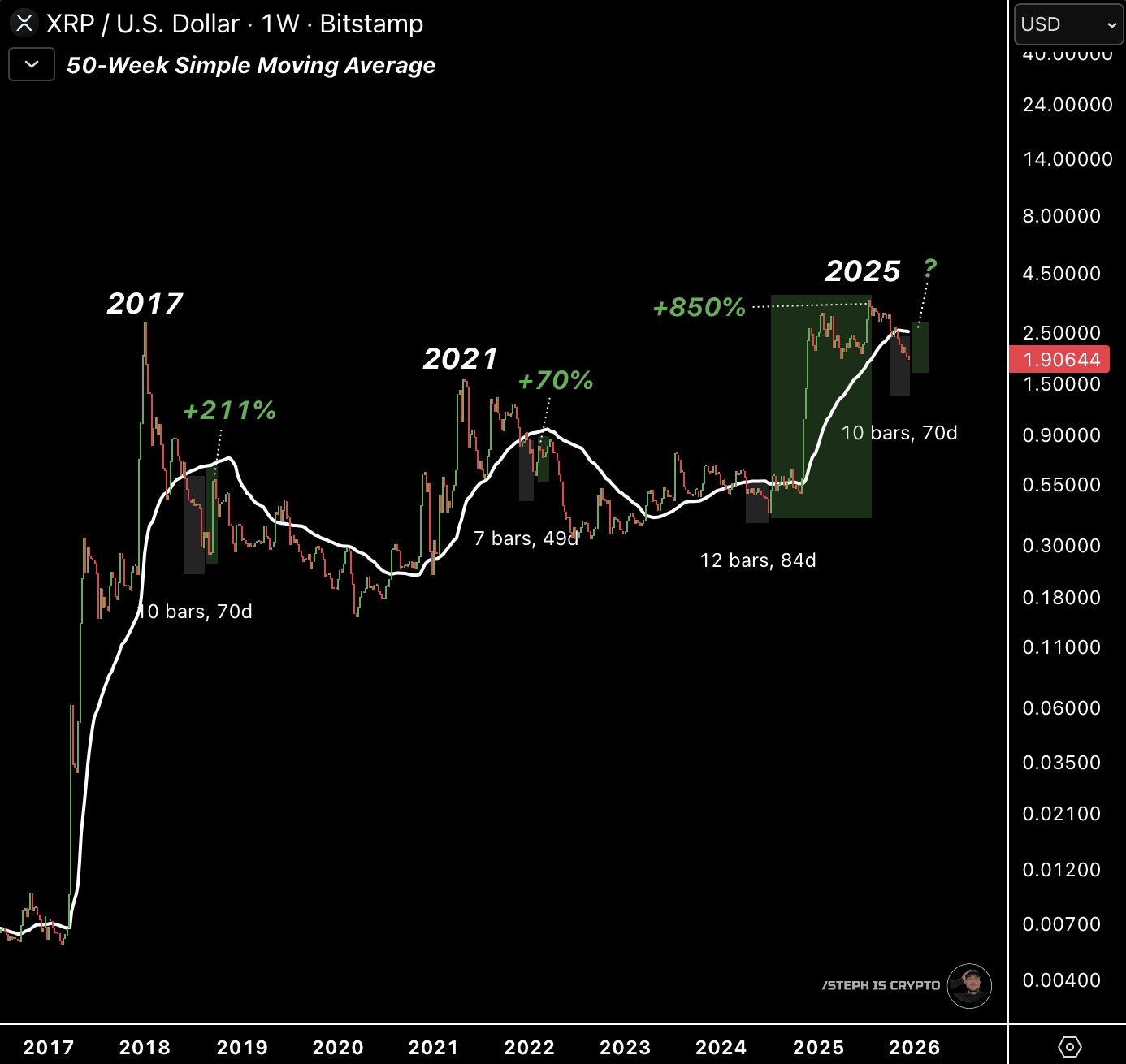
In his latest analysis, Steph confirmed that XRP has been trading below the crucial 50-week simple moving average (SMA) since this downward push began. While this indicates intense bearish pressure, XRP often stages impressive explosive rallies after spending an elongated period of time, specifically 50 to 84 days, below this moving average.

A Persistent Trend

Data from Steph’s weekly XRP chart confirms that this pattern has played out three times since 2018. Notably, after XRP collapsed from the $3.31 peak in January 2018, it entered a bearish phase.

As the downward push persisted, XRP eventually broke below the 50W SMA in early June 2018 and remained underneath it for 10 weekly bars or 70 days, with its lowest price being $0.2450 during this period. After this, it soared to $0.764 in September 2018, representing a 211.8% rise from the $0.2450 low.

XRP 1W Chart Steph
XRP 1W Chart | Steph

In 2021, a similar trend played out. Specifically, XRP slumped below the 50W SMA in December 2021 and traded underneath the moving average for 49 days. After it recovered, what followed was a spike to $0.9127 by February 2022, representing a 68% rise from the $0.5461 floor price during the downtrend.

The last time this pattern occurred was in 2024. Again, XRP dropped below the 50W SMA in April 2024 and stayed below the mark for 84 days. The recovery that ensued on the back of Donald Trump’s election victory pushed prices to the $3.66 peak in July 2025. This marked an 857% rise from the $0.3824 bottom within the downtrend.

XRP Repeating History?

After maintaining a price above the 50W SMA for most of this year, XRP slumped below it again in October 2025 and has now spent 10 weekly bars under it. This translates to 66 days, with four more days left before the close of this week. If XRP replicates the duration of the 2024 trend, it could continue to underperform until the end of December 2024, aligning with 84 days.

However, if the pattern repeats, another 857% explosion would push the XRP price to $17.3 from the $1.81 floor price during the ongoing downtrend. Even if XRP only managed to record half of the 2024/2025 run, amounting to a 428% increase, this would still lead to a $9.55 peak, representing a new all-time high. Nonetheless, there’s no guarantee history will repeat.

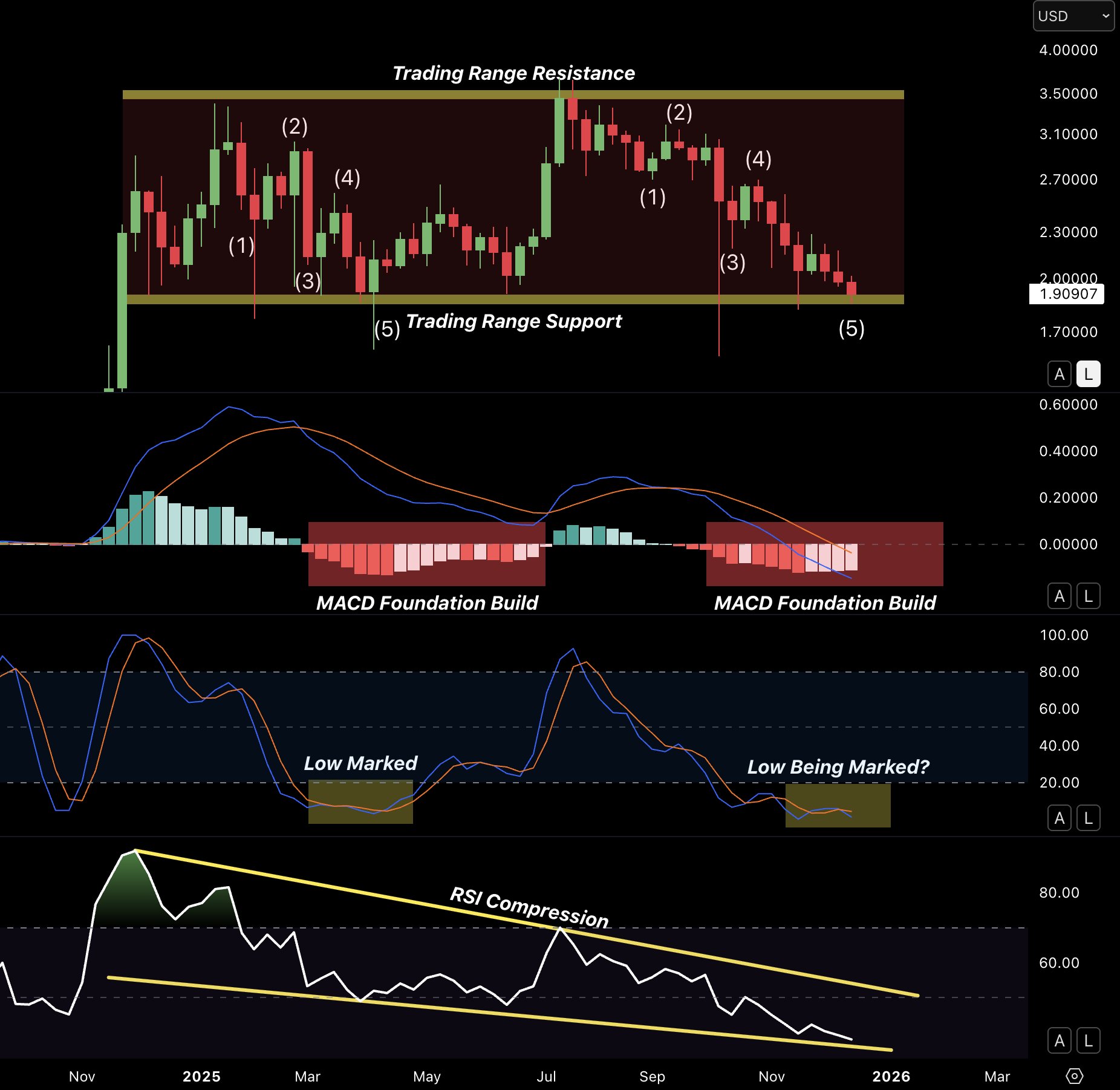
Meanwhile, analyst Chart Nerd pointed out that most XRP indicators now point to a potential bottom, indicating that a recovery could be imminent. Specifically, the RSI has moved to an oversold position, and the MACD has built a firm foundation. In addition, the RSI is compressing, with the 5-wave structure completed.

XRP Indicators Suggesting Bottom Chart Nerd
XRP Indicators Suggesting Bottom | Chart Nerd

Bitcoin Miner Hut 8 Secures $7B Google-Backed AI Data Center Lease

0

Bitcoin miner Hut 8 has landed one of the largest infrastructure deals ever signed by a Bitcoin company.

In particular, Hut 8 has secured a 15-year, $7 billion lease to deliver large-scale AI data center capacity at its River Bend campus in Louisiana. The deal shows how crypto miners are monetizing their power and infrastructure to meet the growing demand for AI computing.

Hut 8’s lease with AI infrastructure company Fluidstack covers 245 megawatts (MW) of IT capacity, with a 3% annual rent increase. 

Meanwhile, Google is backing the lease financially, stepping in if Fluidstack can’t make payments. This reduces risk and boosts confidence in Hut 8’s strategy.

The agreement also gives Fluidstack the option to lease up to 1,000 MW more as the campus grows.

Google Backstop and JPMorgan Financing Reduce Risk

Indeed, Google’s involvement as a financial guarantor throughout the base lease term is a defining feature of the transaction. In addition, Hut 8 and Fluidstack plan to enter into an operations services agreement for ongoing data center management, which a Google payment backstop will also support.

The project will be mostly financed through loans, with banks providing up to 85% of the cost. JPMorgan is the lead underwriter, with Goldman Sachs also involved, reducing the upfront money Hut 8 needs to invest.

Hut 8 expects the deal to generate around $6.9 billion in total net operating income over 15 years, or about $454 million per year.

Construction Timeline Extends to 2027

Work at the River Bend site has begun. The first data hall could be ready by the second quarter of 2027, with more halls coming online later that year. 

CEO Asher Genoot said the project reflects Hut 8’s “power-first, innovation-driven” approach, focusing on the right partners rather than speed.

Hut 8 Stock Reaction

Following the announcement, Hut 8 shares jumped about 20% in pre-market trading. This shows investor excitement over the company’s shift from Bitcoin mining to AI and high-performance computing.

Notably, the move builds on Hut 8’s earlier push into AI. In 2024, the company launched its Highrise AI subsidiary and deployed more than 1,000 Nvidia H100 GPUs to offer GPU-as-a-Service products.

Crypto Miners Moving into AI

Meanwhile, Hut 8’s deal is part of a trend of crypto companies shifting into AI to create new revenue. Core Scientific signed a $3.5 billion, 12-year deal with CoreWeave, expected to bring in about $290 million per year. 

Galaxy Digital expanded its Helios AI data center in Texas and signed a long-term lease with CoreWeave, projected to generate around $1 billion annually. Cipher Mining also made a high-performance computing deal with Fluidstack, backed by Google.

These deals show that power, land, and infrastructure built for Bitcoin mining are now being repurposed for large-scale AI, earning crypto firms billions over the next decade.

Bhutan to Allocate 10,000 Bitcoin for Development of Gelephu Mindfulness City

0

Bhutan has announced plans to allocate 10,000 Bitcoin from its national reserves to support the development of Gelephu Mindfulness City (GMC).

Located in southern Bhutan near the town of Gelephu, the project was conceived as a response to the steady outflow of young Bhutanese seeking employment abroad. By creating high-value jobs domestically, GMC aims to retain talent and build a more resilient local economy.

The special administrative region is structured to support a wide range of industries, including finance, technology, tourism, green energy, healthcare, and agriculture.

According to figures published on the project’s official website, the development will span approximately 2,600 square kilometers. This represents roughly 5% of Bhutan’s total land area, underscoring the project’s magnitude.

Consequently, it is set to become one of the most ambitious undertakings in the nation’s history.

Strategy Behind the Bitcoin Allocation

The government estimates the value of the 10,000 Bitcoin allocation at roughly $875 million. However, rather than liquidating the assets outright, authorities are considering a set of controlled financial approaches, including treasury management tools, low-risk yield strategies, and long-term holding plans.

Officials have emphasized that preserving the value of the Bitcoin reserve remains the top priority.

In an official statement, the government highlighted Bitcoin’s long-term growth potential and stressed that transparency, oversight, and prudent governance will guide all related decisions.

Bhutan’s Position Among Global Bitcoin Holders

Bhutan currently ranks fifth among nation-states in Bitcoin holdings, with most of its reserves derived from state-backed mining operations.

Specifically, data from the crypto analytics platform Bitbo estimates the country’s total holdings at approximately 11,286 Bitcoin. Based on current market prices, these holdings are valued at over $986 million.

This reserve forms the foundation of Bhutan’s broader digital asset strategy and underpins its ability to deploy Bitcoin as a strategic economic tool.

Part of a Broader National Bitcoin Strategy

The decision to use Bitcoin in support of GMC aligns with Bhutan’s broader Bitcoin Development Pledge. This national strategy seeks to strengthen long-term economic resilience by integrating digital assets into state planning and public finance.

Policymakers consistently describe Bitcoin as a strategic reserve rather than a short-term financial instrument.

King Jigme Khesar Namgyel Wangchuck has framed the project as a means of achieving shared prosperity. He has stated that the development should benefit Bhutan’s entire population of more than 796,000 people.

To support this vision, the King has outlined plans for a new land policy. The policy aims to protect landowners and prevent widening inequality. In this context, he has compared GMC to a company, with landowners acting as shareholders who share in its success.

Governance Structure and Project Progress

Key institutional foundations are already in place. For instance, authorities have released a master plan and legal framework, appointed a board of directors, and named a governor to oversee development.

Meanwhile, physical work has begun, with construction teams clearing and preparing site areas.

Additionally, crypto integration is already visible within the region. Merchants and tourism services in GMC accept crypto payments. Moreover, the city has also introduced TER, a sovereign digital token backed by physical gold.

Looking ahead, GMC is envisioned as an economic corridor linking South Asia with Southeast Asia. The city is expected to operate with executive autonomy and legal independence.

Development will take place in phases. The full build-out is planned over the next 20 years, aligning with Bhutan’s focus on stability, patience, and sustainable growth.

Rich Dad Poor Dad Author Says Buying Bitcoin Is One Way to Get Richer as Global Economy Crashes

0

Amid global economic uncertainties, “Rich Dad Poor Dad” author Robert Kiyosaki has identified Bitcoin as one way investors could get richer.

Despite the sustained pressure faced by the crypto market in recent times, as the global crypto market cap loses more than $1.92 trillion in total value over three months, Robert Kiyosaki continues to argue that Bitcoin presents an opportunity to build wealth during economic turmoil. 

In a recent post on X, the author of “Rich Dad Poor Dad” suggested that current global conditions expose flaws in the financial system and reward those who move into hard assets, especially Bitcoin and precious metals. He spotlighted them as ways to “get richer as the world economy crashes.”

Fed Rate Cuts Amid Economic Uncertainty

Kiyosaki’s latest comments follow a series of interest rate cuts by the U.S. Federal Reserve throughout 2025. On Dec. 10, the Fed lowered its benchmark rate by 25 basis points, bringing the federal funds target range to 3.50%–3.75%, its lowest level since late 2022. 

This move marked the third cut of the year after similar reductions in September and October. Policymakers did not agree unanimously, as the decision passed by a 9–3 vote, with dissenters split between calls for no cut and a deeper reduction. 

Moreover, on Dec. 1, the Fed ended its quantitative tightening program, which had reduced the balance sheet by more than $2 trillion since 2022, and resumed purchases of short-term Treasury bills at roughly $40 billion per month to maintain market liquidity. 

Kiyosaki pointed out that he sees these actions as an undeniable indication that central banks continue to rely on monetary expansion to manage economic stress.

He argued that such policies steadily weaken purchasing power and make everyday life more expensive for people who depend entirely on fiat currencies. As a result, Kiyosaki warned of an imminent hyperinflation. While official data does not support claims of extreme inflation, price pressures remain part of the broader economic discussion. 

The report for September 2025 showed that U.S. consumer inflation stood near 3.0% year over year, with core inflation and the Fed’s preferred PCE measure ranging between 2.8% and 2.9%. 

Bitcoin and Hard Assets as Ways to “Get Richer”

As a result, Kiyosaki suggested that Bitcoin and hard assets such as gold and silver are long-term protection against currency erosion rather than short-term inflation spikes. “My suggestion is the same…buy more real gold, silver, Bitcoin, and Ethereum,” he said.

According to him, following earlier rate cuts in 2025, he increased his exposure to silver. Silver prices have already surged, rising from a low of $21.9 per ounce in January 2024 to about $65 per ounce at press time, representing a gain of roughly 195%. 

Kiyosaki predicted silver could climb as high as $200 per ounce by 2026, a level well above most mainstream forecasts. Specifically, many long-term outlooks instead point to bullish but more measured targets between $70 and $100, assuming strong industrial demand and persistent supply constraints.

Alongside silver, Kiyosaki spotlighted Bitcoin as a major part of his strategy. Despite recent volatility, Bitcoin has delivered strong long-term gains. At press time, Bitcoin trades around $87,772, down from its October peak of around $126,272 during a broader market correction. 

Despite the recent pullback, Bitcoin remains up approximately 114% since 2024, although it sits slightly lower on a year-to-date basis in 2025 due to wider risk-off sentiment across global markets. 

Kiyosaki Continues to Shill Bitcoin

Throughout 2025, he has repeatedly championed Bitcoin as a sound investment. Two months ago, he described Bitcoin as the first truly scarce form of money, noting that nearly 20 million coins have already been mined and warning that growing demand could accelerate buying pressure. 

In August, he highlighted how Bitcoin’s structure simplifies long-term wealth creation. A month before that, he had confirmed adding to his holdings after Bitcoin crossed $120,000, encouraging newcomers to start small, even with a single satoshi.

Curved or Straight? Veteran Peter Brandt Responds as the Bitcoin Banana Slip Kicks In

0

Veteran trader Peter Brandt has sparked another round of debate in the crypto community with his Bitcoin Banana chart post.

Notably, the Banana chart has been Brandt’s long-standing Bitcoin outlook. With the prediction seemingly underway, he took to X to taunt “rookie chartists” who argued the correctness of his analysis when he first shared the chart.

Brandt Suggests Bitcoin Breakdown

For context, Brandt shared that Bitcoin has broken down a curved trendline. This happened in October, with BTC eventually ending the month down 3.6%. Since then, the cryptocurrency has been on a downtrend.

Brandt’s chart likens this to a banana peeling open. Typically, what follows this is a price correction, a trend that the veteran trader has persistently predicted.

Bitcoin Banana Slip
Bitcoin Banana Slip

However, not everyone agrees with this sentiment. According to Brandt, several inexperienced traders have labeled his curved trendline as false and replaced it with a straight line. Their view is that the November lows of $80,620 were merely a higher low formation at a support trendline.

Meanwhile, Brandt has remained unmoved. “What say you? Curved or straight?” he inquired amid the persisting price correction. The market veteran anticipated a backlash to his post. As a result, he added that it was time for rookies to show charts “with a line improperly connecting two low points.”

Trendlines are Garbage

Furthermore, Brandt highlighted in a follow-up tweet that trendlines are “garbage.” He reiterated his enduring belief that relying solely on trendlines to take trades is wrong, calling it the least reliable technical indicator.

Instead, he sees trends, levels, and signals (TLS) as better indicators. While he did not entirely consent to its use, he noted that he would honor that rather than using trendlines.

Could Bitcoin Consolidation Continue?

Notably, Brandt has continued to forecast lower Bitcoin prices. A few days back, he highlighted that BTC has broken down from a parabolic construct. Historically, each breakdown usually precedes a steep price correction.

But how low can Bitcoin go? According to Brandt, it could drop to $27,000. He made this prediction earlier in the year, highlighting that a similar pattern that steered the 2021 price crash has just repeated.

Notably, this target closely aligns with a projection from Bloomberg’s expert Mike McGlone, who predicted that the crypto leader could drop to $30,000 per coin.

However, some analysts argue that Bitcoin would not drop that steeply. Market technician EGRAG Crypto is predicting a wave 2 explosion similar to that seen in 2019. His target for this surge is a new all-time high of $173,000.