
Home Blog Page 37

Micron Adds Separate $10B Research Bet Beyond Its $250B U.S. Expansion

Micron Technology has unveiled Micron Research Labs, a long-term semiconductor research institution backed by a planned $10 billion investment over the next decade.

The Boise-headquartered organization will pursue breakthroughs in memory technology, computing architectures, advanced packaging and future semiconductor manufacturing. Micron expects to break ground on its flagship research facility in 2027, with the building designed to accommodate hundreds of researchers.

The investment is particularly significant because Micron described the $10 billion as separate from the more than $250 billion it previously committed to U.S. manufacturing and research and development.

However, the announcement did not immediately lift Micron stock. MU was indicated near $930.41 in premarket trading, down 0.71% from its previous close of $937.10, according to Google Finance.

Meanwhile, Micron Technology Tokenized bStock, or MUB, traded around $950.06 after rising 2.17% over 24 hours.

This Is Not Another Memory Factory

Most of Micron’s recent U.S. investments have focused on increasing production capacity to meet rising demand for DRAM and high-bandwidth memory.

Micron Research Labs serves a different purpose. It will not manufacture additional HBM chips or ease current memory shortages. Instead, the institution will pursue foundational research beyond Micron’s existing product roadmaps, with a research horizon extending beyond 10 years.

The planned network will connect Micron researchers with universities, government institutions, startups, customers and other semiconductor companies. In addition to its Boise headquarters, the investment will support university collaborations and satellite laboratories across Micron’s international research footprint.

The project therefore expands Micron’s strategy beyond improving and producing its current memory portfolio. Its objective is to develop future memory, computing, packaging and manufacturing technologies that could eventually underpin new commercial products.

Micron has not disclosed when the flagship facility will open or how the $10 billion will be distributed during the decade.

Boise Could Become Micron’s Lab-to-Fab Engine

The project’s location creates an important strategic advantage.

Boise already houses Micron’s headquarters, major research operations and North America’s only DRAM research-and-development fabrication facility. The company is also constructing two high-volume memory factories in Idaho.

Micron expects the first new Boise fab to produce its initial DRAM wafers by mid-2027. Its latest regulatory filing targets initial wafer output from the second facility by late 2028.

Construction of Micron Research Labs is therefore expected to begin as the company transforms Boise into a large-scale semiconductor manufacturing cluster.

Locating long-term research near advanced manufacturing could help Micron test new processes and transfer promising technologies into production more efficiently. Micron has previously identified faster time to market and greater operating efficiencies as advantages of placing research and manufacturing facilities together.

Its broader U.S. investment program also includes memory factories in New York, an expanded Virginia operation and domestic semiconductor supply-chain investments.

Why MU and MUB Are Moving Differently

MUB’s 2.17% increase contrasted with MU’s 0.71% premarket decline. However, that difference should not automatically be interpreted as tokenized-stock investors responding more positively to the research announcement.

MUB trades across different hours and liquidity conditions, while its displayed return covers a rolling 24 hour period.

At the available snapshots, MUB traded approximately 1.4% above MU’s previous Nasdaq closing price and about 2.1% above its premarket indication. Those differences can change when Nasdaq opens and liquidity increases.

Binance reported approximately $29.8 million in 24-hour MUB volume and a token market capitalization of $56.1 million. That market capitalization represents the circulating value of MUB tokens, not Micron’s corporate valuation, which stood near $1.06 trillion.

The Verdict

Micron Research Labs is moderately bullish for Micron’s long-term competitive position because it extends the company’s strategy beyond benefiting from the current AI-driven memory shortage.

However, the project does not provide an immediate production or earnings catalyst. Micron is planning to invest the money over a decade, and the company has not disclosed annual spending levels, commercial milestones or expected financial returns.

Its value will ultimately depend on whether Micron can convert long-horizon research into commercially viable memory and computing technologies.

For MU and MUB, the announcement strengthens the company’s long-term technology narrative without materially changing the near-term investment case. Memory pricing, HBM demand, manufacturing execution and capital-spending discipline remain the most important immediate price drivers.

CoreWeave Wins Reported Multibillion Dollar HRT Deal, but CRWV Slips Premarket

CoreWeave has secured a multiyear artificial intelligence cloud agreement with Hudson River Trading, expanding the cloud provider’s presence among some of the world’s largest quantitative trading firms.

The agreement is worth multiple billions of dollars, according to Bloomberg. However, CoreWeave and HRT did not disclose its exact value, duration or revenue schedule in their official announcement.

Despite the announcement, CoreWeave shares initially moved lower. CRWV was indicated near $89.75 in premarket trading, down 1.23% from its previous close of $90.87.

CoreWeave Tokenized Stock, CRWVB, traded near $92 across available market-data platforms. Its rolling 24-hour performance varied depending on the source and measurement time.

HRT Is Buying More Than GPU Capacity

Hudson River Trading will use CoreWeave’s infrastructure for AI-powered research, model development and computationally intensive machine-learning workloads.

The planned platform will incorporate Nvidia Vera Rubin NVL72 systems, Nvidia HGX B200 GPUs and Spectrum-X Ethernet networking. A dedicated connection between HRT’s internal infrastructure and CoreWeave’s cloud is intended to reduce latency when researchers transfer data and run complex models.

HRT will also receive early access to Nvidia’s Vera Rubin architecture, giving the trading firm an opportunity to evaluate next generation computing capabilities before the systems become broadly available.

The infrastructure is intended primarily for research and model development. It should not be interpreted as confirmation that CoreWeave will directly power HRT’s live trade-execution systems.

CoreWeave Is Building a Quantitative-Finance Customer Base

HRT was already identified as a CoreWeave customer, meaning the new agreement expands an existing relationship rather than establishing the companies’ first engagement.

The deal follows CoreWeave’s approximately $6 billion cloud agreement with Jane Street. Jane Street also invested $1 billion in CoreWeave equity at $109 per share.

Quantitative-trading firm IMC recently expanded its use of CoreWeave infrastructure as well.

Together, these relationships suggest that quantitative finance is becoming an important customer vertical for CoreWeave. Trading firms require significant computing power for research, simulation and machine-learning development, potentially providing the company with another source of demand beyond AI laboratories and large technology businesses.

Why Did CRWV Slip Premarket?

The limited initial reaction should not necessarily be interpreted as a negative judgment on the HRT agreement. Premarket trading can be volatile, and CoreWeave has not disclosed enough financial information for investors to calculate the contract’s effect on earnings or cash flow.

Important unanswered questions include:

  • The contract’s precise value and duration
  • Its revenue-recognition schedule
  • The infrastructure spending required to fulfill it
  • Expected operating and cash-flow margins

CoreWeave reported second-quarter revenue of approximately $2.58 billion, representing 112% year-over-year growth. However, its net loss widened to $626 million, while net interest expense reached $640 million, according to the company’s quarterly results.

The company also spent approximately $9.4 billion on capital expenditures during the quarter and carried roughly $35 billion in debt at the end of June.

CoreWeave’s revenue backlog reached $104.2 billion, demonstrating considerable demand. Nevertheless, investors increasingly want evidence that the company can convert that backlog into profitable cash flow after infrastructure and financing costs.

The reported size of the HRT agreement increases revenue visibility, but it could also require substantial additional investment before the associated revenue is recognized.

What CRWVB Traders Should Know

CoinMarketCap showed CRWVB near $92.11, with approximately $2.3 million in aggregate 24-hour trading volume and a token market capitalization of roughly $1.4 million.

At that snapshot, CRWVB was about 2.6% above CRWV’s $89.75 premarket indication. That difference should not be interpreted as a guaranteed arbitrage opportunity because the token and Nasdaq-listed stock trade through separate markets with different liquidity, spreads and pricing windows.

CRWVB’s market capitalization represents only the value of tokens in circulation. It is unrelated to CoreWeave’s corporate market value, which was approximately $50 billion.

What the HRT Agreement Means for CoreWeave

The HRT agreement is strategically positive because it expands an existing customer relationship and further validates quantitative finance as a market for CoreWeave’s AI infrastructure.

Its financial significance remains impossible to calculate without a confirmed contract value, delivery schedule and margin profile.

For now, the deal strengthens CoreWeave’s demand story but does not resolve the concern dominating CRWV’s valuation: whether the company can turn its enormous backlog into attractive cash flow without infrastructure spending and interest costs consuming too much of the resulting revenue.

XRP Rockets 20% This Week, but a Powerful Bullish Breakout Depends on These EMAs

0

XRP has embarked on an impressive recovery push, but it must first close above the 20- and 50-week EMAs to confirm a bullish breakout.

The broader crypto market has seen renewed buying pressure, with the global crypto market (TOTAL) adding over $229 billion in less than two days. As a result, the global crypto market cap has recently hit a 3-month peak of $2.42 trillion.

XRP has since taken advantage of this upward push, posting its own gains and outperforming the broader market. After starting the week slow, XRP has turned its fortunes around, up 20% this week at press time.

However, market data indicates that XRP remains in a bearish position despite the recent rebound surge. Essentially, the crypto asset still has multiple roadblocks to conquer before it can confirm a shift in market structure from bearish to bullish.

XRP Must Close Above Key Weekly EMAs

Two of these roadblocks involve the 20-week and 50-week exponential moving averages (EMAs). While XRP has gained more than 20% since the start of the week, its price at $1.1912 remains below these two moving averages, confirming that bears still maintain control in the mid-term.

At press time, the 20-week EMA stands at $1.2264, while the 50-week EMA holds around $1.5330. The last time XRP traded around the $1.22 region was in mid-June, during a drop from a $1.29 high. Meanwhile, the token last saw $1.53 in May, three months ago.

Historical data shows that XRP must first close a weekly candlestick above these EMAs before the market can confirm a bullish shift. Notably, previous price surges have always occurred on the back of a close above these moving averages.

For instance, in 2023, XRP was able to flip its momentum bullish after prices closed above the 20 and 50-week EMAs in May. After this, XRP saw a dramatic surge from $0.42 to $0.92 by July 2023, marking a 119% price increase within weeks.

Key XRP EMAs
Key XRP EMAs

A similar pattern played out in Q4 2024. Specifically, after XRP closed above the 20-week and 50-week EMAs in early November 2024, the next week brought a massive 79% surge amid President Donald Trump’s election victory. This led to the bull run that pushed XRP’s price from $0.5 to $3.4 by January 2025.

The Journey is Tough

However, breaking and eventually closing above these moving averages may not be an easy task for XRP. Since losing these levels, the altcoin has made several attempts to push above them, but each attempt met stiff resistance from sellers.

When XRP dropped below the 20-week EMA in October 2025, it immediately pushed to recover it four weeks later, but the asset faced resistance at $2.37 and eventually pulled back. 

Also, after losing the 50-week EMA in November 2025, XRP attempted to reclaim it during the January 2026 rebound push, but it witnessed another roadblock at $2.41 before dropping below $2 again. Another attempt in May 2026 faced resistance at $1.54, leading to another drop.

From the current price of $1.1912, XRP would need only an additional 2.95% rise to push above the 20-week EMA. Meanwhile, the crypto asset would have to surge by a more substantial 29% to reclaim the 50-week EMA, making the journey to these levels a tough one.

Cardano DeFi TVL Plunges 16% in 24 Hours Despite ADA 10% Price Rally

0

Despite Cardano’s impressive price performance yesterday, its DeFi sector suffered a sharp setback. 

According to DeFiLlama data, Cardano’s total value locked (TVL) plunged 16.17% over the past 24 hours, falling from $64.83 million to $54.35 million.

Notably, the decline came even as ADA surged more than 10% and reclaimed the $0.19 level. Typically, a strong price rally can boost investor confidence and encourage greater capital inflows into DeFi. However, DeFiLlama’s latest data shows the opposite trend, with TVL now sitting 87.56% below its August 2025 high of $437.2 million.  

Cardano’s DeFi Metrics Show Mixed Performance

Although TVL has dropped sharply, other DeFi metrics are showing some resilience. For instance, Cardano’s stablecoin market capitalization increased 0.58% over the past week to $67.51 million.

However, DEX activity has weakened considerably, with trading volume falling 63.07% to $5.9 million. In contrast, derivatives and perpetual trading activity has strengthened, surging 92.7% over the past week to $27.82 million.

Consequently, Cardano’s DeFi ecosystem is delivering mixed signals, although the declining TVL remains a major concern for analysts. 

Cardano TVL Crashes
Cardano TVL Crashes

Cardano Targets TVL Recovery

TVL remains an important indicator of DeFi adoption because it reflects the capital users have deposited across a network’s decentralized applications. A rising TVL can signal stronger user confidence, liquidity, and ecosystem activity, while a decline may indicate weaker capital participation.

Against this backdrop, the Cardano community is pursuing initiatives designed to reverse the TVL decline. One of them is AlphaGrowth PRIME, which aims to increase Cardano’s TVL by more than $200 million within 12 months. The community has already approved a 120 million ADA treasury allocation to support the initiative. 

Meanwhile, Cardano founder Charles Hoskinson remains optimistic about the network’s long-term DeFi prospects. He identified RealFi and Pogun, a Bitcoin DeFi initiative designed to unlock billions of dollars in idle Bitcoin without requiring users to surrender custody of their assets, as potential catalysts for Cardano’s TVL growth.

In his view, AlphaGrowth PRIME, RealFi, and Cardano’s Bitcoin DeFi initiatives could significantly boost the network’s TVL. Hoskinson believes that once Cardano attracts billions of dollars in TVL, the narrative changes, prompting the market to evaluate the blockchain based on its own merits.

XRP Adds $10B Market Value in One Day as Price Spikes 15%

0

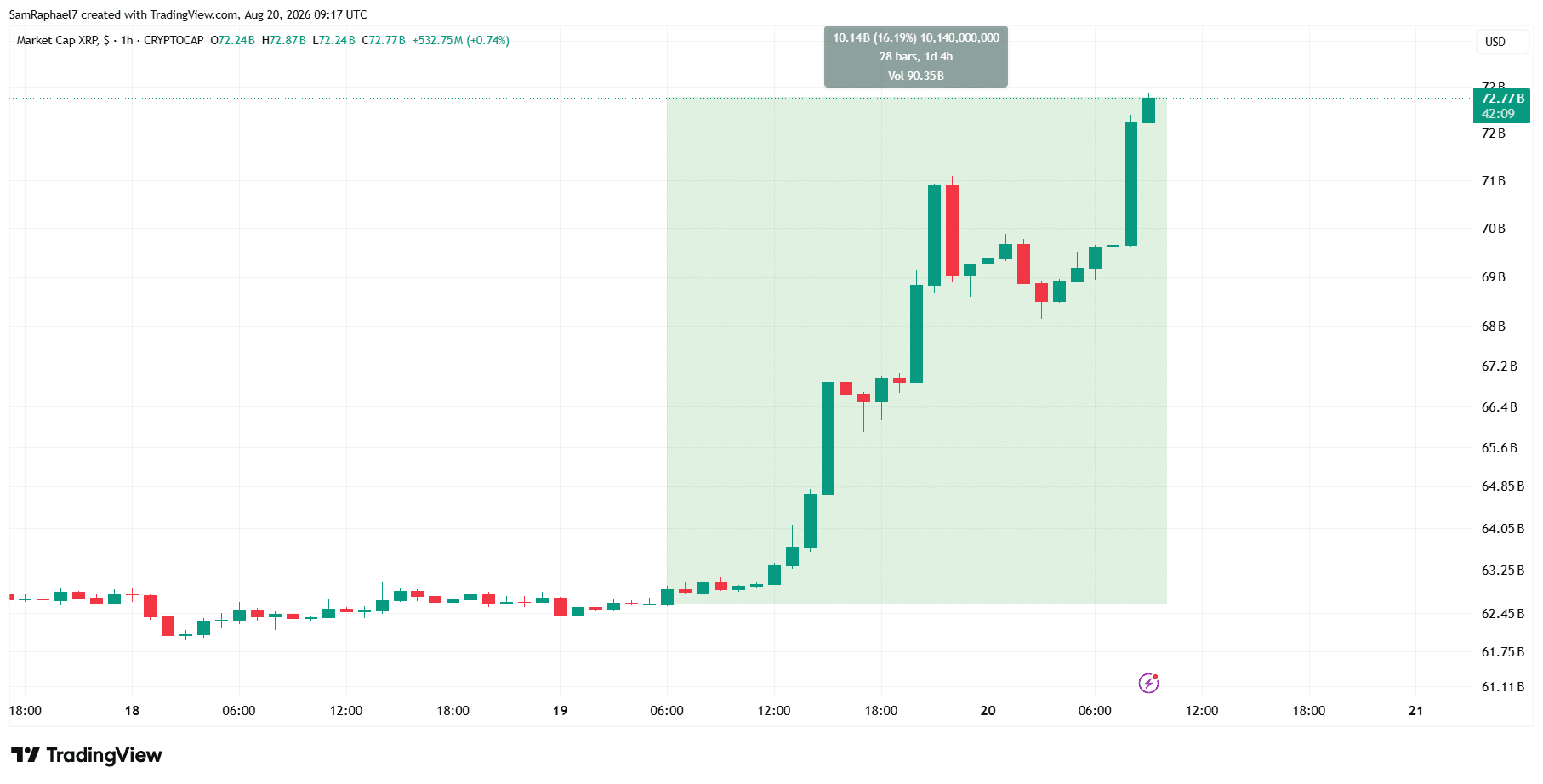
XRP recently added $10 billion to its market value in a single day as its price jumped 15% amid a broader recovery across the crypto market. 

Several positive developments have helped lift market sentiment and bring buyers back into risk assets. The crypto market gained $161 billion yesterday and has added another $58 billion so far today, taking its total value to a three-month high of $2.41 trillion.

This recovery came as the US Treasury announced plans to double its liquidity-support operations, with President Trump also meeting with crypto executives at the White House. Notably, Bitcoin has moved above $72,000 for the first time since early June.

XRP Adds $10 Billion to Its Market Value

XRP has leveraged the recovery to push above $1. The token reached $1.16 earlier today before falling back to around $1.15. Over the past 24 hours, XRP has added $10.14 billion to its market value. Notably, it gained $6.53 billion yesterday alone and has added more than $3.6 billion today.

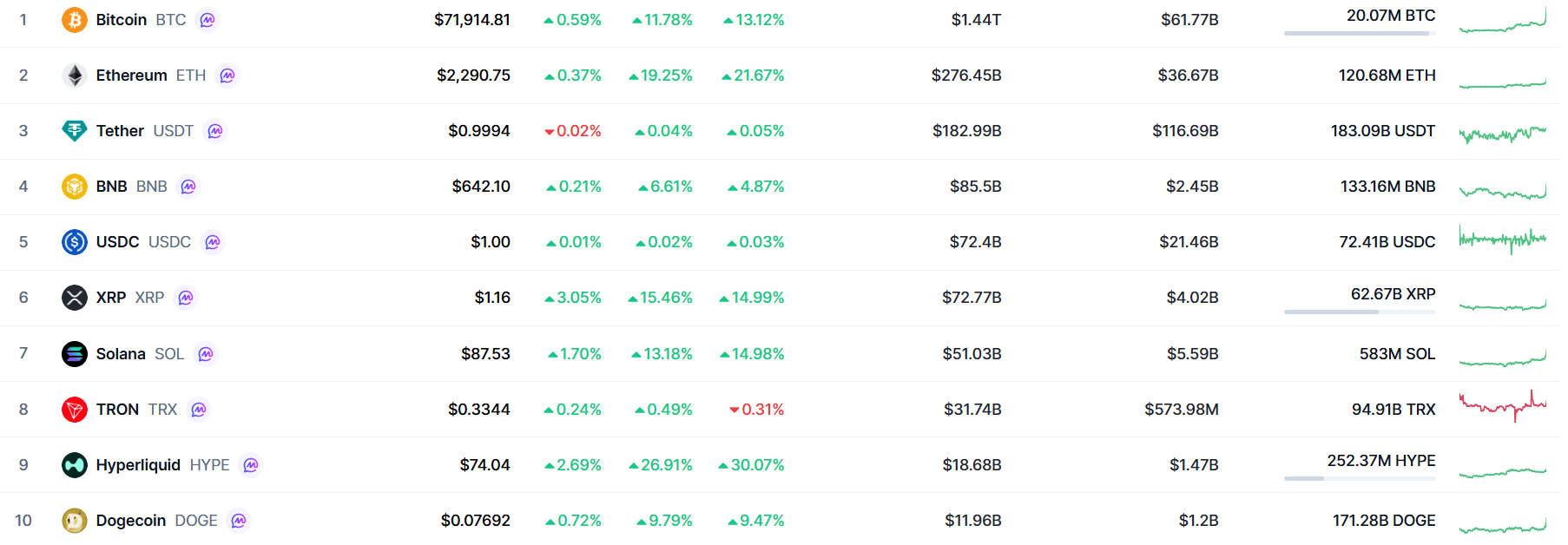
With the recent rally, XRP’s market capitalization has surged to $72.77 billion, its highest level since July 4. XRP has also gained 15.46% over the past 24 hours, making it the third-biggest gainer among the top 10 crypto assets by market value.

XRP Adds $10B to Its Market Value

The latest rally has pushed XRP into fifth place among the top 10 crypto assets, putting it ahead of USDC. However, CoinMarketCap had not updated its rankings at press time.

XRP has also performed better than BNB during the recent market recovery. Still, the gap between the two assets remains wide. BNB currently has a market value of $85.5 billion, compared with XRP’s $72.77 billion.

XRP would therefore need to add about $12.73 billion to its market value to match BNB. Based on the current figures, the token would need to gain another 18%, taking its price to about $1.36, to reach BNB’s current market value.

XRP Ranks Fifth Among Top 10 Crypto Assets

Catalysts Behind the Rally

The recent recovery has several key drivers. For one, under Secretary Scott Bessent, the Treasury announced plans to at least double its liquidity-support operations for longer-dated Treasuries, increasing each operation from roughly $2 billion to at least $4 billion.

The Treasury plans to start the larger operations around Sept. 9 and continue them into early November. The announcement came after the 30-year Treasury yield climbed to a multi-year high near 5.34%. The yield later fell toward roughly 5.2%, while bond prices rose and market liquidity improved.

Meanwhile, the initial price gains triggered a large wave of forced buying as traders holding short positions faced liquidations. Around $2.7 billion to $3 billion in crypto short positions were liquidated across the market within roughly 24 hours. 

When exchanges closed these losing short positions, traders had to buy back the assets they had sold. This forced buying added more upward pressure and helped push the wider market higher.

White House Meeting Adds to Crypto Optimism

Political and regulatory developments have also helped improve sentiment. President Trump recently met with crypto executives, including representatives connected to Coinbase, Gemini, Ripple, Chainlink Labs, and other companies, during a White House event.

Trump also urged Congress to move forward with a fair version of the Digital Asset Market Clarity Act, an important piece of proposed crypto market-structure legislation. 

The meeting added to other recent signs of a more supportive US policy approach toward digital assets. Recent SEC proposals have also focused on easing some rules around digital-asset fundraising and exemptions.

Crypto Founder Says Cardano to $3 is a Question of When, Not If

0

Jure Karamarko, founder of Cardano-based token SongMarketCap, believes ADA will eventually reclaim the $3 level.

In a recent tweet, Karamarko said the possibility of Cardano surpassing $3 is a question of when, not if, highlighting his strongly bullish outlook for the coin. In his view, Cardano has the potential to reclaim and eventually exceed the key price level.

Cardano Rebounds as Crypto Market Recovers

Karamarko’s comment comes as Cardano attempts to recover from a prolonged period of weakness and return to levels last seen during the 2021 crypto bull market. Yesterday, ADA surged more than 10% and briefly moved above $0.19 as momentum returned to the broader crypto market.

Meanwhile, the wider market also staged a sharp recovery, with total crypto market capitalization rising 8.7% to $2.37 trillion. Bitcoin reclaimed $70,000 before pulling back slightly, while Ethereum moved above $2,000 and traded around $2,252.

Consequently, Cardano’s rally did not occur in isolation. The broader market recovery provided additional momentum for ADA and encouraged investors to reconsider the possibility of a much larger rebound.

ADA Faces a 1,530% Rally to Reach $3.10

Notably, the $3 level is not new territory for Cardano. ADA reached an all-time high of $3.10 in September 2021 during the previous crypto bull market. However, the token now trades far below that peak, at $0.1840. From this level, ADA would need to rally roughly 1,530% to reclaim its previous all-time high.

Karamarko is not alone in identifying $3 as a potential target for Cardano. Technical analysts and long-term forecasts have also pointed to the possibility.

For instance, TradingView analyst OceanStaker previously identified a Power of Three (PO3) pattern that could potentially support a move toward $3. Similarly, Telegaon has projected that ADA could cross $3 and potentially reach $3.24 by 2028. 

What Could Drive Cardano Toward $3?

Several factors could support a sustained Cardano recovery. First, another broad crypto bull market could increase demand for ADA. Historically, the token has benefited from stronger market-wide risk appetite and increased capital flows into altcoins.

Additionally, Cardano founder Charles Hoskinson has maintained his confidence in ADA’s long-term potential. While discussing ADA’s previous performance, Hoskinson recalled how ADA climbed from $0.025 to $3.10 in 2021.

Furthermore, Hoskinson has suggested that the crypto industry could enter another major bull market driven by a new market narrative. If that scenario materializes, ADA could benefit from renewed investor interest and stronger market momentum. Moreover, Cardano is strengthening its DeFi ecosystem and attracting more users through initiatives such as RealFi and the AlphaGrowth PRIME proposal. 

Although Karamarko considers $3 “a matter of when rather than if,” investors should treat long-term crypto forecasts cautiously because market conditions, regulation, adoption and sentiment can change significantly.

XRP ETF Takes A 6% Share As Bitwise Products Record $300M Volume

0

Bitwise crypto investment products recorded about $300 million in combined trading volume on Aug. 19, with the Bitwise XRP ETF making up roughly 6% of the total. 

This comes as the broader crypto market remains under pressure, with the market losing about $580 billion in value this year. Despite the consistent decline, crypto investment products have continued to draw renewed investor attention.

Bitwise ETFs Post $300 Million in Volume

Hunter Horsley, CEO of Bitwise, revealed the figures in a recent disclosure on X and highlighted the top five contributors to the company’s total ETF volume. 

Specifically, the Bitwise Bitcoin ETF (BITB) led the group with $156 million in trading volume, followed by the Bitwise Solana ETF (BSOL) with $58 million.

Meanwhile, the company’s Hyperliquid ETF (BHYP) ranked third with $45 million, while the Ethereum ETF (ETHW) followed with $35 million. 

The Bitwise XRP ETF (XRP) ranked fifth, recording about $20 million in trading volume on Aug. 19. Based on Bitwise’s figures, the XRP product accounted for 6.6% of the total trading volume across all Bitwise ETFs.

XRP ETF Volume Reaches Highest Level Since May

Data from Sosovalue, a crypto analytics platform, put the Bitwise XRP ETF’s trading volume slightly higher at $22.77 million on Aug. 19. This marked the product’s highest single-day trading volume since May 14, when XRP traded at around $1.54.

Trading activity also picked up across the broader XRP ETF market. Notably, the five XRP ETF products together recorded $31.66 million in trading volume on Aug. 19, marking the highest daily figure since mid-June.

Bitwise Leads the XRP ETF Market Source Sosovalue
Bitwise Leads the XRP ETF Market | Source: Sosovalue

However, the jump in trading volume did not lead to a similar increase in new capital entering the Bitwise XRP ETF. The product recorded just $1.19 million in inflows on Aug. 19. This figure is well below the $7 million in inflows recorded on May 14, when the ETF posted a similar level of trading activity.

Bitwise XRP ETF Maintains Lead

Despite the relatively small inflow, the Bitwise XRP ETF still recorded the largest single-day inflow among all XRP ETFs on Aug. 19. The Franklin Templeton XRP ETF (XRPZ) followed with $1.16 million, while the other three XRP ETF products recorded no inflows.

The latest figures also bolster Bitwise’s position as the largest XRP ETF by both cumulative net inflows and net assets. Notably, the Bitwise product recently moved ahead of the Canary Capital XRP ETF (XRPC) and has continued to widen its lead.

For context, the Bitwise XRP ETF now has $515.9 million in cumulative net inflows, compared with $468 million for XRPC. This gives Bitwise nearly 34% of the total cumulative net inflows across all XRP ETFs.

The gap also extends to assets under management. The Bitwise XRP ETF holds approximately $322.71 million in net assets, compared with $247.73 million for XRPC. While the latest trading figures show renewed activity around XRP ETFs, Bitwise remains the leader in both investor inflows and total assets among XRP ETF products.

XRP News: President Trump Welcomes Ripple CEO at White House

0

U.S. President Donald Trump welcomed Ripple CEO Brad Garlinghouse to the White House on Wednesday.

This was during Trump’s gathering with crypto industry leaders to discuss the future of digital assets and financial markets. Garlinghouse was among the executives Trump specifically acknowledged in remarks.

Trump Highlights Crypto Leadership

Trump described the gathering as a meeting of a “who’s who” in finance, crypto and technology. He stressed his administration’s efforts to position the United States as a global leader in crypto and blockchain-based financial markets.

Alongside Ripple CEO, the meeting included Coinbase CEO Brian Armstrong, Chainlink co-founder Sergey Nazarov, and Kraken CEO Arjun Sethi. BitGo executives, Robinhood CEO Vlad Tenev, Nasdaq CEO Adena Friedman, and other major industry figures were also present.

Trump used the event to reiterate his administration’s support for crypto. Specifically, he said the United States had “ended the war on crypto” and was working to modernize financial rules so markets could incorporate blockchain technology.

He also pointed to the administration’s Strategic Bitcoin Reserve, Digital Asset Stockpile and stablecoin legislation as key components of its digital-asset agenda.

Garlinghouse: Crypto Is No Longer a Fringe Industry

After the meeting, Garlinghouse took to X to highlight the gathering’s significance. “Great to be back at the White House today,” he wrote, while also citing SEC Chairman Paul Atkins and CFTC Chairman Michael Selig.

Garlinghouse pointed to the increasing number of Americans holding digital assets, saying 67 million Americans now own crypto, representing nearly one in four people in the country.

“Crypto isn’t a fringe industry. And Washington, D.C., knows the crypto voter is alive and well,” Garlinghouse added.

He also praised Trump’s approach to the industry, saying the president’s “commitment to innovation and leadership around digital assets in the US has been profound.”

Ripple and Trump Have Met Before

Wednesday’s meeting is not the first time Garlinghouse has met Trump at the White House. In January 2025, shortly before Trump’s inauguration, Garlinghouse and Ripple Chief Legal Officer Stuart Alderoty met with Trump at the White House.

A few days later, Garlinghouse also met with Vice President JD Vance during events around Trump’s inauguration. He attended the first Crypto Ball, dinners with Trump and Vance, and a session at the Capitol.

Garlinghouse said these events showed growing optimism about crypto and blockchain in the U.S., especially after years of regulatory uncertainty.

The latest meeting further highlights Ripple’s presence among major crypto companies engaging directly with the U.S. administration as Washington continues developing its regulatory framework for digital assets.

For XRP holders, Garlinghouse’s participation is notable as Ripple continues expanding its payments and digital asset infrastructure while seeking a clearer regulatory environment for the crypto industry in the United States.

Cardano Finally Joins T. Rowe Price’s Active Crypto ETF After Initial Snub

0

Asset manager T. Rowe Price has quietly added Cardano to its Active Crypto ETF, placing the cryptocurrency alongside major assets such as Bitcoin and Ethereum.

The move follows the fund’s initial launch without Cardano, despite earlier filings indicating that T. Rowe Price could support the asset. TKNZ began trading on NYSE Arca in mid-July after the U.S. SEC approved the fund in June.

At launch, TKNZ held Bitcoin, Ethereum, BNB, Solana, XRP, Hyperliquid, Stellar, Dogecoin, USD Coin, and cash equivalents. Although T. Rowe Price had previously indicated that Cardano could qualify for inclusion, ADA was absent from the fund’s initial holdings.

However, the asset manager has now followed through by adding ADA to the portfolio.

Cardano Meets TKNZ’s Eligibility Requirements

Cardano’s inclusion is notable because TKNZ cannot invest in every cryptocurrency. Instead, the fund applies eligibility criteria covering regulatory classification, liquidity, custody, valuation, and an asset’s ability to be held and traded within a regulated investment product.

In addition, the fund’s prospectus excludes assets considered securities under U.S. federal law. Therefore, ADA’s inclusion indicates that T. Rowe Price considers Cardano eligible under the fund’s investment framework.

ADA Holds a Small Allocation

Despite its addition, Cardano currently accounts for only a small portion of TKNZ.

ADA ranks as the fund’s 10th-largest asset, with a 0.44% portfolio weighting, according to data from the fund’s website. Based on TKNZ’s reported $16.47 million in net assets, the allocation represents approximately $72,500 in Cardano.

Nevertheless, the significance of the move extends beyond the size of the investment. By including ADA in an actively managed product from a major asset manager, TKNZ provides traditional investors with another avenue to gain Cardano exposure through a regulated fund structure. 

Active Crypto ETF Holdings

Cardano’s Institutional Presence Expands

Meanwhile, T. Rowe Price’s move adds to Cardano’s growing presence in U.S.-based crypto investment products.

ADA has already appeared in several diversified crypto funds and index products, including the Bitwise 10 Crypto Index Fund (BITW), Grayscale Smart Contract Fund, and Hashdex Nasdaq CME Crypto Index ETF. Consequently, TKNZ’s addition further strengthens Cardano’s position within the institutional crypto-investment landscape.

In the meantime, ADA posted a strong performance yesterday, rallying more than 10% and briefly surpassing $0.19. However, the token has since surrendered some of those gains and currently trades at around $0.1838.

Despite the pullback, Cardano remains up 4.9% over the past 24 hours. Its trading volume has also surged 212% during the same period to $528.26 million, highlighting increased market activity around the asset. 

Binance, Upbit, Coinbase See Surging XRP Outflows, as Investors Pull $2B From Futures Market

0

XRP outflows have dominated major exchanges such as Binance, Upbit, and Coinbase, despite the persistent bearish pressure.

XRP continues to struggle, trading more than 72% below its all-time high of $3.66. However, despite the downtrend, investors have continued moving XRP off exchanges. This could reduce the amount of XRP available for immediate selling and, in turn, ease some of the selling pressure.

Binance, Upbit and Coinbase See XRP Outflows

Recent CoinGlass data confirms this trend. Over the past seven days, all major exchanges except Bitstamp and Gemini recorded net XRP outflows. 

Binance led the withdrawals, with investors moving $32.32 million worth of XRP off the exchange. Upbit followed with $23.94 million, while Coinbase recorded $8.12 million in outflows. Bybit ranked next with $6.91 million in withdrawals.

XRP Exchange Flows Coinglass
XRP Exchange Outflows | Source: Coinglass

Essentially, Binance, Upbit, and Coinbase alone accounted for $63.17 million in XRP outflows during the week. 

Other major exchanges also recorded withdrawals. Gate saw $1.25 million leave its platform, while OKX and Kraken recorded outflows of $1.20 million and $1.01 million, respectively. 

Bitstamp and Gemini were the only major exchanges to record inflows, but their figures remained small at $1.21 million and $230,000, respectively.

XRP Futures Flows Turn Negative

The XRP futures market has shown a different trend over the very short term, although its broader weekly figures also point to more money leaving than entering. 

Over the past eight hours, futures inflows jumped 352% to $3.27 million. The increase suggests that traders have recently taken greater interest in derivatives trading despite the weakness in XRP’s spot market.

XRP Futures Flows Coinglass
XRP Futures Flows | Source: Coinglass

However, the seven-day figure remains negative. Specifically, XRP futures recorded $2.01 billion in outflows over the past week, compared with $1.86 billion in inflows. 

This left the market with a net outflow of $149.42 million. In other words, despite the recent rise in short-term futures activity, more money has left the market than entered it over the past week.

XRP Clings to $1

The exchange outflows have come as XRP continues to struggle around the important $1 level. XRP currently trades at $1.0054 after moving between $0.9937 and $1.0083 during the latest daily session. Bears remain in control as the token continues its 30-day decline. XRP has also fallen 67.62% over the past 12 months.

Several technical levels now stand above the current price. The 20-day EMA at $1.0266 is the first major resistance XRP needs to clear. A move above it would bring the 50-day EMA at $1.0708 into focus, followed by the 100-day EMA at $1.1516. 

These levels could make a sustained recovery more difficult if XRP fails to break through them. On the downside, the $0.9877 cycle low remains the main near-term support level for traders.

XRP Below Key EMAs
XRP Below Key EMAs

XRP also continues to trail the wider crypto market. Over the past seven days, the price has declined 1.30%, while the broader market has gained 1.20%. 

The Federal Reserve’s July meeting minutes, due today, could contribute to the short-term outlook. The release may reveal the central bank’s approach to interest rates. Any signs that could support future rate cuts may provide some relief for risk assets, including cryptocurrencies.