
Home Blog Page 399

XRP Rich List Update Shows 78 New Accounts Bought 77M XRP in 1 Day

0

Data from the latest XRP rich list update shows that whale accounts may be reshuffling their balances as new accounts go on an accumulation spree.

While the XRP price has struggled in recent times, on-chain data confirms that whales have been reshuffling amid an impressive accumulation trend. For context, with the latest market-wide crash that pushed Bitcoin (BTC) below $90,000 again, XRP now trades at the lower end of the $2 mark, down 7.18% in the last 24 hours.

As the uncertainty in the market grows, whale investors are reshuffling their balances. Specifically, “Mullen,” an XRP community pundit, recently presented the latest data surrounding the top 10,000 wallets holding XRP. According to his disclosure, these wallets now hold 51.39 billion XRP, representing 85% of the circulating XRP supply.

78 New Wallets Amassed 77M XRP in a Day

Notably, further data confirms that of this figure, about 77.324 million tokens entered 78 new wallets in a single day, as whales embarked on an accumulation spree. Mullen’s chart shows that one particular wallet amassed 35 million XRP tokens in a day. 

One more account procured 3.63 million tokens, while six wallets accumulated 1.99 million XRP each. Interestingly, up to 44 new wallets amassed over 300 million XRP each, while 246 existing wallets increased their collective balance by 17.91 million XRP tokens.

Meanwhile, a few whale wallets also reduced their balances. For instance, one wallet moved out 2.819 million XRP on the same day, bringing its balance to 1.785 million XRP at the time of reporting. However, it bears mentioning that this account belongs to the exchange Bithumb. As a result, the outflow could be due to customer withdrawal or fund shuffling.

XRP Rich List Update Mullen
XRP Rich List Update | Mullen

Nonetheless, the more concerning pattern involved the noticeable depletion of funds across multiple accounts. In particular, as many as 78 wallets collectively moved out more than 108.5 million XRP. Most of these wallets transferred between 240 million and 241 million XRP each, effectively draining their balances.

Whales Accumulating Amid Shuffle Trend

With 78 new wallets accumulating and 78 existing wallets emptying their balances, this appears to be a reshuffling trend. Considering these developments, Mullen suggested that the XRP rich list is rotating, not shrinking. According to him, large whales have begun repositioning as they await the next move.

Meanwhile, on a larger timeframe, data confirms that these large investors may actually be accumulating more tokens over the past few months. Specifically, The Crypto Basic found late last month that addresses holding between 20 million and 100 million XRP, as well as those with 100 million to 500 million XRP, had amassed $7.81 billion in XRP since August.

Expert Predicts a Super Bullish Year for Cardano With a 2,478% Surge

0

A popular Cardano community figure has shared an extremely bullish outlook for ADA, predicting that the token could surge into double digits in 2026.

As 2025 winds down, many crypto analysts have begun releasing their forecasts for the new year. This comes amid a largely disappointing 2025.

Despite widespread expectations for strong rallies this year, the crypto market has struggled to gain momentum. For instance, Cardano’s price has plunged 43.7% this year, leaving it 87.52% below its all-time high of $3.10.

Analysts have pointed to several factors behind this sharp decline. Interestingly, Cardano founder Charles Hoskinson has openly accused certain institutions of manipulating the market and suppressing prices.

“ADA to Hit $10 Next Year”

With only a few weeks left before 2025 ends, Mintern, the “Chief Meme Officer (CMO)” of Cardano-based DEX MinSwap, expressed strong optimism about the coming year. He predicted that 2026 will be extremely bullish for Cardano and its native token, forecasting a surge to $10.

While ambitious, the $10 projection is not new in Cardano circles. Analysts such as Dan Gambardello and Ssebi have previously outlined similar targets. However, while earlier predictions have gone unfilled, Mintern asserts the move could play out as early as next year.

For context, the target exceeds ADA’s previous all-time high of $3.10 by an extraordinary margin. At its current price of $0.3878, ADA would need to rally by 2,478% to reach the $10 milestone.

What Could Push Cardano to $10

Although Mintern did not provide a detailed analysis to support his prediction, his comments mirror the growing sentiment among some community members who believe Cardano is entering a highly transformative phase.

Over the weekend, Hoskinson offered insight into what the community should expect in the coming months. He stated that the privacy-focused Midnight sidechain will “kill it” next year. At the same time, the team also plans to launch the Leios scalability upgrade and continue advancing the broader Cardano DeFi ecosystem in 2026.

Also, Hoskinson believes the U.S. Congress will finally pass the long-anticipated CLARITY Act by 2026, describing it as a key catalyst that could encourage major tech companies to adopt crypto.

In his view, this impending regulatory milestone could drive Bitcoin to $250,000 by year-end, triggering a rally that lifts altcoin prices as well. In particular, Hoskinson predicts the total crypto market could surge to a $10 trillion valuation once the CLARITY Act becomes law.

For now, Cardano continues to struggle alongside other major cryptocurrencies as December starts in the red. ADA has dropped 7.83% in the past 24 hours. Amid the downturn, community sentiment has weakened.

Notably, Changelly forecasts ADA could reach $10 by December 2031, while Telegaon expects it to reach that level by 2029.

Brandit Highlights Bitcoin’s Green Zone, Says Is It Time for Saylor’s Crew to Worry

Bitcoin nears historical support as veteran analyst Peter Brandt warns prices could slide toward lower channel levels.

Bitcoin (BTC) is trading at $86,032, marking a 0.7% decline over the past seven days. After briefly testing levels above $92,000 earlier in the week, the asset has since reversed, losing momentum toward the end of the observed 7-day period. Over the past 24 hours, Bitcoin has traded within a range of $85,694.01 to $91,904.65.

Despite the pullback, the crypto firstborn maintains a market capitalization of $1.72 trillion, supported by active trading volumes exceeding $62.7 billion in the last 24 hours. The decline comes amid broader market cooling, with the price structure showing increased volatility near the weekly peak followed by rapid sell-side pressure.

As BTC trades near the lower boundary of this week’s range, the next sessions will determine whether the current move evolves into deeper correction or stabilizes into a new support-building phase.

Where’s Bitcoin Headed?

On the technical end, veteran market analyst Peter Brandt has cautioned that Bitcoin is trading near the upper boundary of the lower green zone, a level that historically coincides with cycle bounces and moves towards the red resistance zone.

Based on his logarithmic trend model, BTC’s price is headed towards the level that has repeatedly acted as the support region for major market cycles in previous years.

An example is when Bitcoin hit $20,076 in December 2017 and reversed, but support at the lower boundary stopped further moves at around $3,100. Another attempt emerged in November 2021, when BTC price hit $69,290, but failed to hold, taking it back to the $15,500 level by November 2022. 

Brandt notes that the upper boundary of the lower green zone shows potential support beginning below the $70,000 level and extending toward the mid-$40,000 range.

Specifically, per the chart, first support is found at the $61,254 zone, extending down toward the $36,750 levels, while resistance exists near the upper boundary of the long-term channel in the roughly $222,246 to $333,369 area.

Interestingly, Brandt also referenced “Saylor’s shipmates,” which he may have directed at large institutional holders with heavy exposure like Saylor’s Strategy, suggesting that a move toward the support band could trigger concerns if leverage, cost basis, or investor pressure intensifies.

Meanwhile, a commenter responding to Brandt’s analysis argued that Bitcoin’s inability to reach the upper boundary of the long-term channel during its recent advance could signal broader weakness.

According to the remark, if the current rally is indeed losing strength, a break below the lower trend boundary remains a realistic outcome. Brandt added that while he personally may not favor this interpretation, the historical “priors” within the model support the possibility of such a downside move.

Bitcoin Liquidation Data

Notably, Bitcoin’s recent price volatility has produced a distinct liquidation pattern, with the majority of liquidations concentrated on the long side across the 4-hour, 12-hour, and 24-hour windows. This data indicates that the market has unwound aggressive long positioning as prices pulled back from weekly highs.

Screenshot 2025 12 01T110957171

Over the 4-hour period, approximately $20.37 million in leveraged positions faced liquidations. Of this, $18.12 million came from long traders, compared to just $2.25 million in short liquidations, highlighting short-term overexposure to upside bets.

The trend becomes more pronounced in the 12-hour window, where liquidations totaled $191.91 million. Long positions accounted for the overwhelming majority at $186.56 million, while short liquidations remained minimal at $5.35 million. This suggests that traders holding leveraged longs through the broader intraday downturn were hit hardest as the price retraced.

The 24-hour data reflects similar pressure, showing $205.50 million in total liquidations, with $188.55 million wiped from long positions versus $16.94 million from shorts. The imbalance across all timeframes signals that the market’s pullback primarily punished overleveraged bullish positioning.

$640 Million in Leveraged Positions Wiped Out as Bitcoin Plummets to $85K

0

The global cryptocurrency market came under sudden pressure on Monday after Bitcoin recorded a steep intraday decline.

The downturn triggered a wave of liquidations that erased hundreds of millions in leveraged positions across major exchanges.

Bitcoin Reverses Weekend Stability With Rapid Decline

Bitcoin had maintained relative stability over the weekend, hovering near $91,500 as it tested a key resistance zone near $93,000 mark. The price action marked a consolidation phase approaching the end of the month.

However, that stability unraveled quickly. On Monday, Bitcoin fell almost 5% in four hours, reaching $85,610 on Binance. Notably, the downturn came shortly after the asset posted its first positive weekly close in four weeks, finishing at $90,360.

This sharp reversal set the tone for broader market stress that soon followed.

Analysts Attribute Decline to Leverage Unwinding

As the sell-off intensified, analysts at The Kobeissi Letter attributed the move to a sudden surge in selling volume. They noted that this burst of activity triggered a chain reaction across leveraged positions, thereby amplifying the downward momentum.

The firm emphasized that the slump lacked an obvious news catalyst, reinforcing the view that current market weakness remains largely structural. Despite the volatility, they argued that the decline does not indicate a breakdown in the fundamentals of the cryptocurrency market.

Liquidations Surge as Over 218,000 Traders Are Wiped Out

Unsurprisingly, the rapid market shift had immediate consequences for traders using leverage. Data from Coinglass showed that over 218,000 traders were liquidated within 24 hours, with total liquidations reaching $640.34 million.

In particular, this wave of forced closures intensified in the last 12 hours, during which losses totaled $579.11 million. The majority of these liquidations targeted long positions, illustrating how abruptly bullish sentiment was reversed.

Crypto Market Liquidations

Long Traders Face the Heaviest Losses

Coinglass data revealed that within the 12-hour window, long positions accounted for $546.80 million of liquidations, compared to $32.31 million for short positions.

Over the full 24 hours, long liquidations totaled $565.56 million, while shorts contributed $74.78 million. This imbalance underscores how many traders had been positioned for further upside when the downturn struck.

Among individual liquidation events, the largest occurred on Binance, involving an ETH/USDC leveraged position worth $14.48 million. This, in turn, underscored the scale of exposure across major trading pairs during the sudden market correction.

In terms of asset-specific impact, Bitcoin saw the most significant liquidation volume, with $204.44 million erased. Following closely, Ethereum accounted for $159.58 million, while Zcash (ZEC) ranked third at $21.36 million, thereby reflecting how the broader market mirrored Bitcoin’s sharp intraday reversal.

Market Technician Says No Sugarcoating — XRP Is Done if It Closes Below This Level

0

XRP is showing bearish momentum, with a top market analyst highlighting the crucial moving average it must hold to avoid further declines.

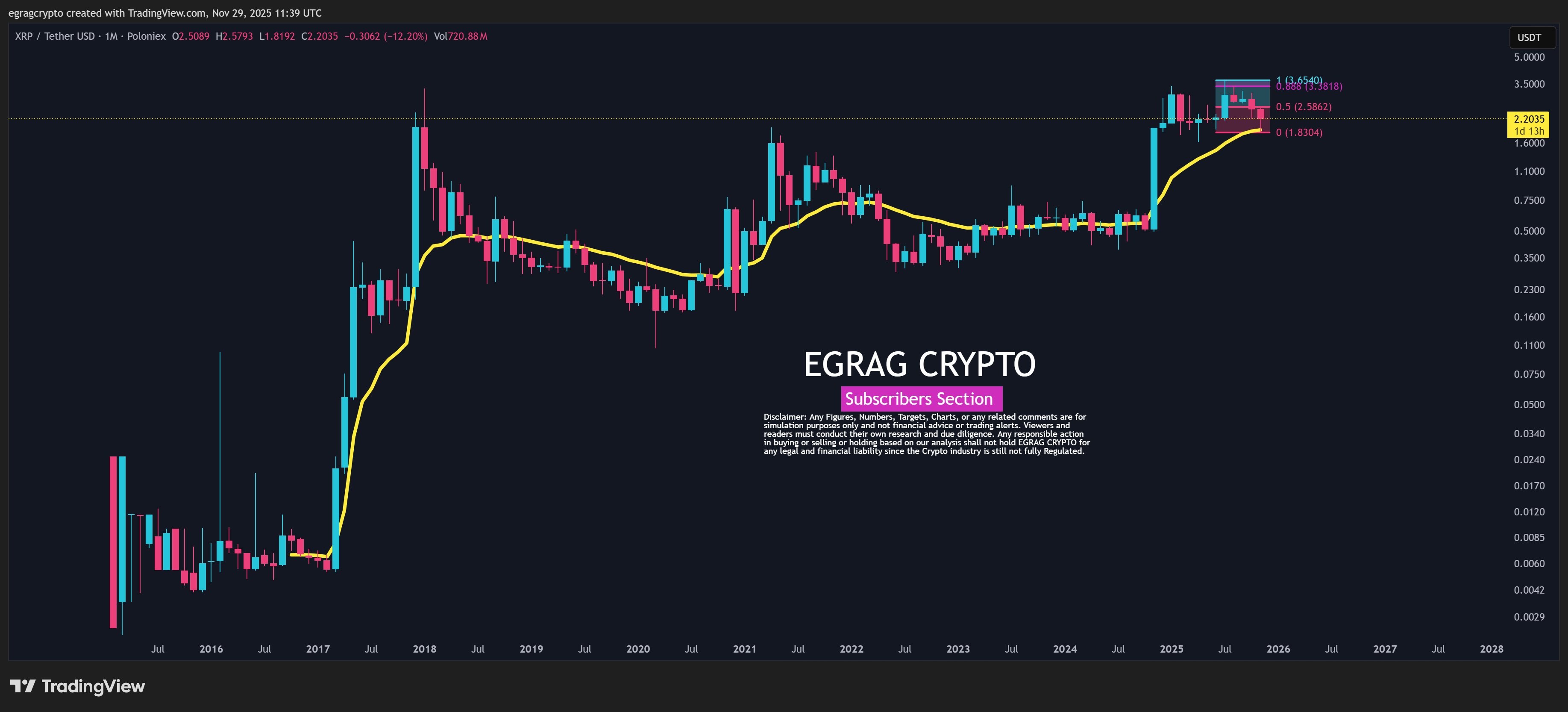
Notably, market technician Egrag Crypto recently spotlighted this development as XRP joins a broader bearish trend. After rebounding from $1.82 two weeks ago to stabilize around $2.20 for most of last week, the cryptocurrency has now corrected by over 7% over the past two days, trading close to the $2 price mark.

XRP Must Hold Critical EMA

Meanwhile, Egrag Crypto identified three possible scenarios for XRP, using Fibonacci levels and moving averages. Notably, one outcome is an intense capitulation in XRP if it closes below its 21-month exponential moving average (EMA).

He emphasized the need to stay above this indicator, suggesting that XRP is done for in the event that it closes below the 21 EMA. “No sugar-coating it,” he said.

At the time of writing, the 21 EMA stands at $1.907, which is 6.38% away from the current market price of $2.037. A close below would set XRP’s price on a path toward lower price targets, such as $1.55, as predicted by other analysts.

It bears mentioning that the analyst specifically mentioned a close below the 21 EMA. This indicates that while XRP could fall below it, it would need to remain below for a monthly close to confirm the downside.

Bullish Possibilities Remain

Nonetheless, bullish possibilities remain for XRP. Egrag Crypto shared what he described as bullish and super bullish scenarios for the coin using Fibonacci levels.

Specifically, he shared that a close above the 0.50 Fibonacci level highlighted in an accompanying chart would spell bullish momentum for XRP. Notably, this aligns with the $2.60 price mark, which is 27% away from the current price. However, he noted that XRP is not entirely free from a downside at this level.

XRP Analysis/Egrag Crypto

Meanwhile, he identified a super-bullish scenario in which XRP closes above the 0.88 Fib. level at $3.40. A retest of the January high would set up a strong upside momentum for the cryptocurrency, potentially taking it to unprecedented prices.

XRP Not Bearish in the Slightest

However, XRP remains in bearish territory with recent retracements. Specifically, its over 5% downturn has wiped out $16.74 million in leveraged positions in the past 24 hours, with $16.13 million being long traders.

Yet, analysts remain resolute that XRP could stun bears imminently. Charting Guy is among those with this sentiment, stating that XRP is not bearish in the slightest. He cited the asset’s trend above the 2021 peak of around $1.97 as an indication of its bullishness.

This builds on his stance that XRP was merely testing holders’ patience, and many are already folding. He suggested that XRP is in an accumulation phase and that a breakout to $8 would follow.

Hoskinson Says 2026 Will Be Breakout Year for Midnight, Leios, and Cardano DeFi

0

Charles Hoskinson, the founder of Cardano, is enthusiastic about 2026, suggesting it could be a major breakout year for Midnight and the network’s DeFi ecosystem. 

The Cardano founder made this bold assertion during a recent livestream, with excerpts later shared by popular community figure “Angry Crypto Show.”

In his commentary, Hoskinson stated that Cardano’s privacy-focused sidechain, Midnight, is “gonna kill it next year,” signaling his expectation for a significant milestone in 2026. 

Midnight Launch Underway 

Midnight serves as a central pillar of Cardano’s multi-chain vision, offering enhanced confidentiality features and programmable privacy for developers and enterprises. Introduced in 2023, the project is now moving closer to its official rollout, beginning on December 8 with the launch of the NIGHT token and its initial exchange listings.

According to the Midnight roadmap, the team plans to debut a federated mainnet by Q1 next year, enabling developers to begin testing their decentralized applications (dApps). Following this phase, an incentivized testnet is scheduled for the next quarter, allowing stake pool operators (SPOs) to stress-test the network ahead of its full mainnet deployment, which is projected for later in the year. 

Leios Update

Hoskinson also highlighted the imminent arrival of Leios, Cardano’s long-awaited scalability upgrade. Set for release next year, Leios aims to significantly boost transaction throughput.

This update follows his recent announcement of a new 24/7 development model to accelerate work on the scalability feature. Hoskinson views Leios as Cardano’s most urgent upgrade. Consequently, the around-the-clock development structure will allow teams across multiple time zones to work continuously to ensure the upgrade launches as planned next year. 

Great DeFi Progress for Cardano and Midnight 

Furthermore, Hoskinson noted that the DeFi ecosystem on both Midnight and Cardano will make major progress next year. The prospect of such development excites the Cardano community, which has long awaited it. 

At press time, Cardano-based DeFi projects hold a total value locked of $178 million, substantially lower than rival networks like Ethereum and Solana, which command $65.63 billion and $8.5 billion in TVL, respectively. 

However, the Cardano team is still working to introduce a Tier-1 stablecoin to the network to strengthen DeFi activity. Hoskinson is currently in discussions with Ripple executives about bringing RLUSD to Cardano, and reports indicate the talks are progressing.  

Potential Collaboration Between Cardano and Base 

Meanwhile, Hoskinson also hinted at a potential collaboration between Cardano and Coinbase’s L2 network Base. His comments suggest that early discussions are already underway and that both sides may explore technical or strategic integrations in the future. 

In his view, the Cardano ecosystem offers several technologies and capabilities that could meaningfully benefit the Coinbase-backed Base network. 

Top CEO Says ‘I’ll Take XRP for $1,000’ as Kiyosaki’s Warns Traditional Markets to Deflate

0

Jake Claver, CEO of Digital Ascension Group, has again suggested that XRP could one day reach the $1,000 mark. 

This time, the outlook came in response to Robert Kiyosaki’s latest macro warning. After Kiyosaki declared that Japan’s historic “carry trade” era is over.


Accordingly, he said global markets now face the risk of a major deflationary shock. To this, Claver replied, “I’ll take XRP for $1000, Bob.”

“Bubble Markets About to Deflate”

For decades, Japan’s near-zero interest rates powered the massive yen carry trade. It allowed investors to borrow cheaply and deploy capital into U.S. Treasuries, European bonds, emerging-market assets, tech stocks — and even crypto.

Now that Japan’s 10-year government bond yield has risen to 1.728%, its highest level since 2008, analysts warn that the unwind of this decades-long strategy could pull trillions back into Japanese bonds, draining liquidity from markets worldwide.

Still, Kiyosaki maintains a bullish view on scarce assets. He repeated his long-standing advice for investors to buy gold, silver, Bitcoin, and Ethereum. He sees them as hedges against inflation, currency instability, and systemic risks.

“I’ll Take XRP for $1,000.”

In response to Kiyosaki’s warning, Jake Claver wrote: “I’ll take XRP for $1000”. The remark reaffirms he belief that XRP’s price could soar to four-digit territory despite — or even because of — global financial stress.

Across multiple interviews this year, Claver has argued that XRP’s most dramatic price movements would likely occur during periods of macroeconomic disruption, when investors seek alternative settlement assets with deep liquidity and global utility.

In other words, his $1,000 comment echoes his long-standing belief that XRP’s true price discovery will occur when a major scarcity shock hits the market.

XRP’s Potential Role in Japan’s Reverse Carry Trade

Claver’s optimism is not isolated. As previously reported by The Crypto Basic, American model Bri Teresi also suggested that XRP could play a role in Japan’s emerging reverse yen carry trade.

On X, she highlighted XRP’s speed and programmability, noting that the Bank for International Settlements (BIS) recommends that settlement assets should turn over 8–10 times per day to support modern financial rails. Indeed, XRP meets and exceeds those benchmarks.

Teresi also pointed to SBI Remit’s use of XRP for faster cross-border payments and argued that Japan’s move away from decades of low interest rates makes efficient settlement assets more valuable.

ETF Demand and a Fast-Disappearing OTC Market

Claver also sees another catalyst for long-term XRP appreciation via ETF-driven supply absorption. He recently revealed that XRP spot ETFs have already begun “eating through” OTC and dark-pool supply far faster than anticipated.

As of last week, XRP ETFs held over 300 million XRP, representing $676 million in assets under management. Crucially, major issuers like BlackRock and Fidelity have not yet entered the market. According to Claver, once they do, XRP ETF demand could ultimately surpass Bitcoin’s.

A Glimpse of the Future: The Kraken $91 Candle

Last week, XRP briefly printed a candle at $91 on Kraken. Claver referenced this anomaly as an example of what real supply crunches look like in practice.

To him, spikes like this are not charting errors but previews of how violently XRP could move when institutional-scale orders hit public markets with insufficient liquidity.

When Can $1,000 XRP Happen?

Even with increasing attention on XRP’s role in liquidity stress scenarios, not everyone believes a $1,000 price point is coming soon. Some analysts maintain that such levels may take decades to materialize. 

A recent long-term projection from Changelly, for example, suggested that a four-digit XRP valuation may not appear until 2040.

Ripple Secures Singapore Approval to Expand Its Regulated Crypto Services

0

Ripple has secured approval from the Monetary Authority of Singapore (MAS) to expand the scope of activities allowed under its Major Payment Institution (MPI) license.

The approval applies to Ripple Markets APAC, the firm’s local subsidiary, according to a company statement.

Under the updated license, Ripple can now offer a broader suite of digital payment token services. Specifically, these include offerings linked to XRP and RLUSD, its recently launched stablecoin.

According to the company, the expansion will help meet the growing institutional demand for regulated digital solutions in Singapore.

Ripple President Monica Long welcomed MAS’s decision, saying Singapore’s clear regulatory framework gives digital asset firms a stable environment to grow.

She further noted that the expanded scope will allow Ripple to deepen its investment in Singapore. In turn, this will strengthen the infrastructure for fast, secure global transfers.

Ripple’s Licensing Progress in Singapore

This milestone builds on Ripple’s existing regulatory foothold. The firm obtained a full MPI license in 2024, placing its Singapore entity among a limited group of blockchain-focused institutions with such authorization. The company has maintained its Asia Pacific headquarters in Singapore since 2017.

Ripple’s expanded permissions also support its global payment platform. The system merges digital tokens with an international payout network and manages technical and compliance layers for clients. 

The updated license allows Ripple to offer end-to-end services, including collection, holding, token swaps, and payouts, through a single integration point. This reduces the need for clients to maintain separate infrastructure or additional banking partners.

Singapore’s Central Role in APAC Digital Asset Growth

Ripple says the move comes as digital asset activity accelerates across the Asia Pacific. Fiona Murray, the company’s Vice President and Managing Director for the region, stated that on-chain activity has climbed roughly 70% over the past year.

She added that Singapore remains central to this growth and is well-positioned to benefit from expanding institutional adoption.

Meanwhile, MAS continues to reinforce its position as a global leader in digital asset regulation. Its frameworks, such as the Payment Services Act, set clear standards for stablecoin issuers and crypto service providers.

Ripple says this clarity encourages responsible innovation while giving institutions confidence to adopt digital payment technologies.

Cardano Founder Teases “Fun” 2026 Plan for XRP, Calls XRP Holders Friendly

0

Cardano founder Charles Hoskinson has highlighted his positive relationship with the XRP community and revealed what he plans to deliver for its members next year. 

Speaking during a recent livestream, he highlighted the community’s friendliness, noting that this openness directly influenced the decision to include XRP holders in the Midnight airdrop campaign.

For context, the XRP Ledger (XRPL) was one of the eight supported blockchains selected for the Midnight airdrop. Out of the 24 billion NIGHT token supply, the team allocated 1.2 billion NIGHT to users who held at least $100 worth of XRP during the snapshot on June 11, 2025.

While some users have already claimed their NIGHT allocations, full distribution and trading will begin on December 8.

Cardano Founder’s Evolved Relationship with the XRP Army

Notably, including XRP in the Midnight airdrop would have seemed unlikely a few years ago, given the previously tense relationship between Hoskinson and parts of the XRP community.

Their clash stemmed from the long-running “ETHGate” controversy, which alleged that the Ethereum team influenced the SEC to target Ripple and XRP. Hoskinson consistently rejected these claims, calling them conspiracy theories. His stance triggered a heated back-and-forth.

However, the feud ended in November 2024 when the Cardano founder apologized to the XRP community. Hoskinson’s relationship with the XRP Army has improved since then. Now he openly describes the XRP community as “quite friendly.”

Beyond his words, he has backed this shift with action—meeting with Ripple executives and including XRP holders in the Midnight airdrop—demonstrating efforts to reconcile with the community.

Hoskinson Shares Fun 2026 Plan for XRP

Hoskinson also reaffirmed Cardano’s plan to build a decentralized finance (DeFi) layer for XRP, allowing holders to earn yield. Notably, platforms like Flare Network already offer yield-bearing opportunities for XRP. Hoskinson’s initiative seeks to expand DeFi opportunities for XRP holders. While he avoided sharing technical details, he stressed that the project will be “a lot of fun.”

Notably, Hoskinson revealed that the discussion will progress further in 2026, hinting at a tentative timeline for when the integration or related announcements could emerge.

Here Are New XRP Price Highs if All XRP ETFs Pull In 11 Million XRP Daily for One Year

0

The debut success of the Canary Capital XRP ETF (XRPC) has led to discussions surrounding how XRP’s price could react if other products see similar figures.

For context, on its first trading day, Canary’s XRPC absorbed more than 108.7 million XRP, worth about $245 million. Notably, the second day flow slowed but still brought in 11,926,251 XRP valued at roughly $27 million. After two days, the ETF now holds 120.69 million XRP, totaling about $275 million.

11M XRP Inflows Daily for a Year

Highlighting these figures, game designer Chad Steingraber projected what could happen if every XRP ETF attracted 11 million XRP each day. Specifically, he assumed 12 ETFs would take in this amount daily, which adds up to 132 million XRP every day. 

Using a five-day trading week, he calculated 666 million XRP leaving the market each week. He then projected 2.64 billion XRP moving into cold storage after one month. Over a full year, he estimated 31.68 billion XRP disappearing from the circulating supply.

From his comments, a community member developed an AI model that suggested that XRP could climb to $15,160. However, the model worked on the assumption that XRP has 31.68 billion XRP in circulation, with the ETFs locking up all these tokens over a year. This was unrealistic.

How Could the XRP Price React?

To address this, we leveraged Grok AI to create a new model based on more realistic starting points. Notably, Grok used a circulating supply of 60 billion XRP and a price of $2.25. 

In this model, the first month would see supply drop to 57.36 billion XRP, a 4.4% decline, with a projected price of $2.48. Month two fell to 54.72 billion XRP, 8.8% down, with a price of $2.97. Meanwhile, the third month listed 52.08 billion XRP with a 13.2% reduction and a price of $4.01. 

XRP Pricing Model from ETF Inflow Assumption

Interestingly, by the seventh month, supply had sunk to 41.52 billion XRP, and the price had increased to $29.45.  Month nine saw a drop to 36.24 billion XRP and a price spike to $85.10. For the 12th month, Grok ended with 28.32 billion XRP left in circulation and a projected XRP price of $420.18. With this, Grok measured a market value of about $11.9 trillion.

Grok explained that its method leveraged the stock-to-flow calculation, rising demand as ETF interest grows, and a gradual increase in a demand multiplier that reaches 3.0 by the 12th month. 

It also added a moderate scarcity adjustment to prevent extreme overestimates. Grok pointed out that the final numbers look aggressive yet still exist within the range of what a globally adopted and institutionally supported asset might reach.

An Important Disclaimer

However, the model sits on multiple unlikely assumptions. First, it expects every XRP ETF to bring in 11 million XRP daily for an entire year. 

Some proponents reminded Steingraber that this was unlikely, but he argued that strong competition could actually drive such flows in the first year. Nonetheless, even spot Bitcoin ETFs saw several days of outflows during their first month, despite intense competition.

His estimate also relied on 12 ETFs, even though only six additional spot XRP ETF applications remain under review in the United States. With the Canary Capital ETF included, the total number of spot products comes to seven, not twelve. Futures-based ETFs do not buy XRP, so they cannot contribute to these inflow totals.