
Home Blog Page 409

JPMorgan Recognizes Crypto as a Tradable Macro Asset

0

JPMorgan, which oversees roughly $5 trillion in client assets, says that cryptocurrencies are entering a new phase as institutional liquidity reshapes the market. 

In a recent research note, the bank argued that crypto is evolving into a tradable macro asset, moving beyond its roots in retail speculation and early-stage venture dynamics.

Institutional Liquidity Redefines Price Behavior

According to JPMorgan, the crypto market has shifted from its early model, where large private funding rounds set valuations long before public trading. Retail investors often entered late and absorbed most of the risk. Today, analysts observe a decline in retail activity alongside growing institutional participation.

“This shift is stabilizing flows, lowering volatility, and creating more reliable long-term pricing,” the report said. 

However, the bank also cautioned that market inefficiencies persist: liquidity remains uneven, contributing to sharp price swings. Macroeconomic conditions now play a greater role in crypto prices than Bitcoin’s traditional halving cycle, analysts added.

Consequently, JPMorgan estimates that Bitcoin could eventually reach $240,000, framing the asset as a multi-year growth play.

JPMorgan Research Note

JPMorgan Warns of MicroStrategy Delisting Risk

The research note surfaced shortly after JPMorgan warned that MicroStrategy (now Strategy) could be removed from major equity indices. The warning specifically mentioned the MSCI USA Index, citing the company’s vast Bitcoin holdings.

In particular, Strategy owns 649,870 BTC, worth $56.91 billion, making its balance sheet heavily dependent on a single asset. Its stock has fallen 40% in the past month, bringing its valuation close to the value of its Bitcoin holdings.

JPMorgan noted that the company’s narrow balance-sheet structure limits its ability to raise capital. Additionally, the bank highlighted a potential MSCI rule change that could exclude firms with more than half their assets in digital currencies.

JPMorgan Expands Its Own Bitcoin ETF Position

Despite its caution regarding MicroStrategy, JPMorgan has been expanding its own crypto exposure.

For instance, in a recent 13F filing, the bank disclosed holdings of 5,284,190 shares of BlackRock’s Bitcoin ETF, IBIT, worth $343 million as of September 30, representing a 64% increase from June.

The filing also revealed $68 million in call options and $133 million in put options linked to the ETF. These positions are spread across multiple business units, including those that serve high-net-worth clients.

Bitcoin Seen as Undervalued After October Sell-Off

JPMorgan analysts stated that Bitcoin currently trades at a discount relative to gold, following a 30% price drop in October from its recent all-time high of $126 000. This decline came after heavy futures liquidations and concerns stemming from a $128 million Balancer hack.

Analyst Nikolaos Panigirtzoglou noted that leverage in perpetual futures has since normalized. The bank added that gold’s surge above $4,000 per ounce brought higher volatility, while Bitcoin’s volatility eased.

On a risk-adjusted basis, JPMorgan estimates Bitcoin would need to reach roughly $170,000 to match gold’s private-sector investment value, suggesting meaningful upside over the next six to twelve months if current conditions persist.

Meanwhile, JPMorgan is also preparing to allow institutional clients to use Bitcoin directly as collateral for loans by the end of 2025. The bank currently accepts only crypto-linked ETFs. The expansion signals rising comfort with direct digital-asset exposure within regulated lending frameworks.
Here’s How Much XRP Supply is in Loss as XRP Trades at $2.15

0

Recent on-chain analysis from Glassnode has revealed the current rate of XRP and Bitcoin supply in the red.

Glassnode, a prominent digital asset analytical platform, released these recent statistics in an X post as the crypto market shows resilience. Bitcoin has held above $87,000, while altcoins have seen mixed price movements.

XRP Holder Profitability Sees Boost

The Glassnode tweet highlighted the profitability rates of some of the top cryptocurrencies by market cap to holders. It started off with the sector’s leader, Bitcoin, stating that 34.91% of its supply is at a loss.

Notably, BTC has a circulating supply of 19.95 million, according to CoinMarketCap, accounting for over 95% of the asset’s max supply. Notably, the Glassnode report shows that, of this figure, 6.96 million bitcoins are currently held at an unrealized loss. Consequently, a larger portion, about 65.09% of Bitcoin’s supply, is in profit, representing approximately 12.98 million BTC.

Meanwhile, about 36.70% of XRP’s supply is in the red. With its current circulating supply of 60.25 billion, this suggests that 22.1 billion tokens are unprofitable to holders at the present market standing.

Remarkably, an earlier report, barely a week ago, showed that 41.5% of the XRP supply is in the red, a figure last seen when prices trended at $0.50. At the time of this report, XRP changed hands at $2.15.

Its slight growth to $2.18 at press time has reduced this number, ensuring that 63.3% of XRP holders now have unrealized gains.

Large Chunk of Solana Supply in Loss

Glassnode also highlighted the rate of Solana and Ethereum supply in loss. Specifically, 38.37% of Ethereum’s 120.69 million circulating supply is in the red, with the other 61.63% (74.38 million ETH) held at unrealized gains.

Solana has the largest supply in loss among the listed cryptocurrencies. Notably, a staggering 74.84% of its circulating supply is unprofitable to holders, accounting for 418.55 million of its 559.26 million supply.

Notably, this suggests that most holders bought Solana either around the 2021 top or between last year and now. It also shows they ignored the token during the FTX implosion, which saw SOL capsize to $11 before the rebound.

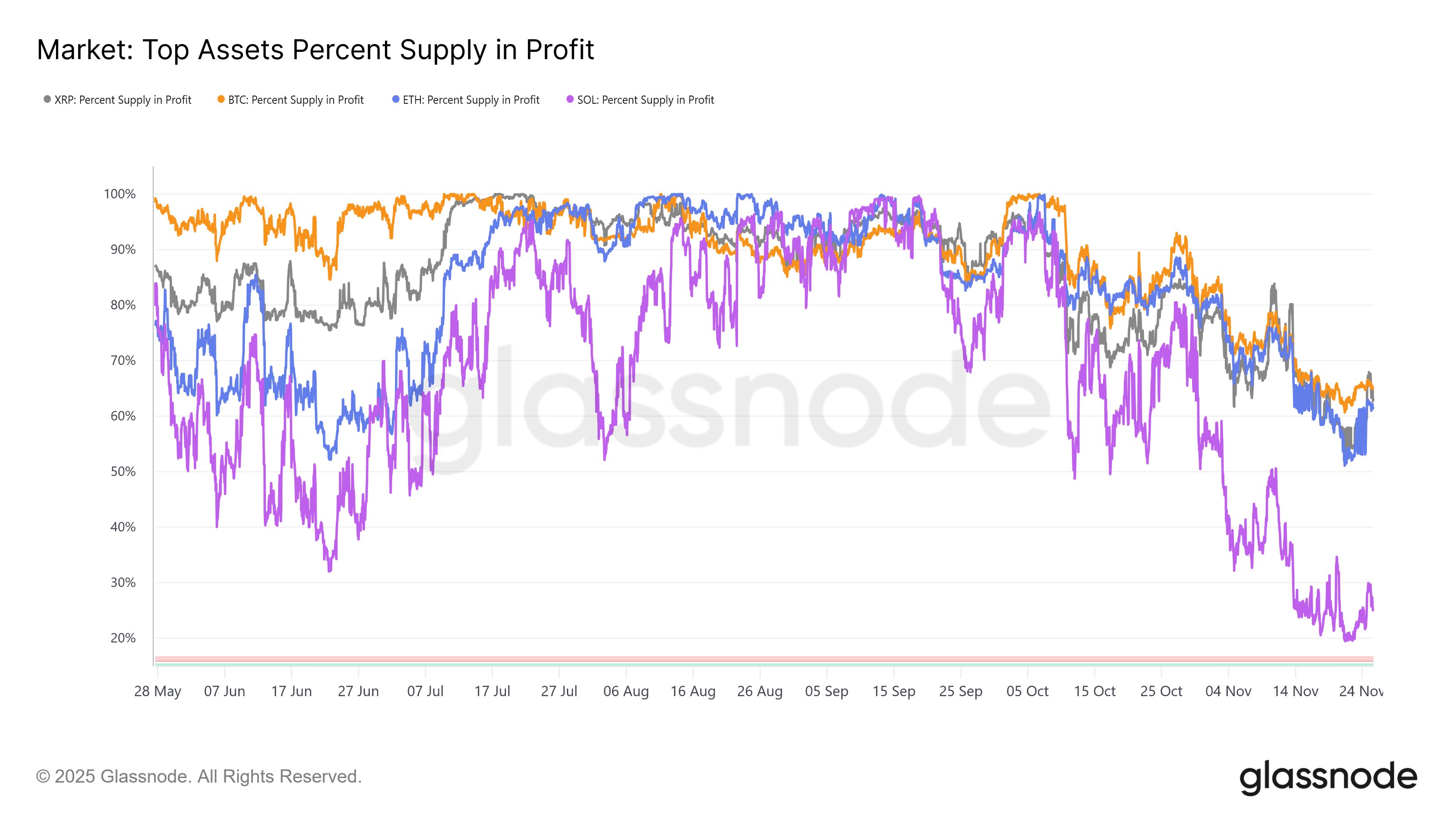
Meanwhile, an accompanying chart shows an elevated percent supply in profit for Bitcoin and XRP between May and October, before the recent price downturn pushed it lower.

However, Ethereum and Solana saw a lower percentage supply compared to BTC and XRP in May, but saw growth in between July and October. The recent correction hit SOL holders the hardest, forcing supply profitability to drop below 30% in November.

Top Asset Percent Supply in Profit/Glassnode

Remarkably, the percentage of supply in loss helps explain holder sentiment and potential market moves. Coins with more holders in loss are more likely to experience selloffs if harsh market conditions persist than those with more profitable users.

Analyst: This Is Exactly What I’m Preparing You for With XRP

0

Following a successful start to the week, XRP ETFs have again dominated discussions within the XRP community.

Notably, the XRP market now boasts four spot XRP ETFs, which contributed to the impressive inflows on Monday. Interestingly, this performance has only led to stronger speculations about how consistent ETF buying might impact XRP’s price trend. 

For context, Canary Capital led the ETF campaign with its product debut on Nov. 13, and three more XRP ETFs have since entered the market. Their early performance has encouraged these speculations, especially as investors expect additional issuers to launch competing funds. 

For Monday, Nov. 24, Bitwise CEO Hunter Horsley confirmed that roughly $18,000,000 in fresh inflows entered its ETF product (XRP) in a single day, pushing total inflows to around $135,000,000 within the fund’s first three days. 

Four XRP ETFs Absorb 80M XRP 

Meanwhile, game developer and well-known XRP community member Chad Steingraber, who has persistently monitored all four products since they launched, presented data across all products.

According to his data, on Monday, the Bitwise XRP ETF traded 1,452,944 shares worth $36,599,659. Franklin Templeton’s XRPZ recorded 965,203 units valued at $23,666,777. 

Meanwhile, Canary Capital’s XRPC followed with 783,825 shares totaling $18,772,608, while Grayscale’s GXRP traded 152,566 units worth $6,717,480. Altogether, the four funds moved $85,756,524 in trading volume that day.

Steingraber then discussed their Monday netflows. Specifically, Canary Capital added 3,193,377 XRP, Bitwise accumulated 7,837,631 XRP, Grayscale acquired 36,088,433 XRP, and Franklin Templeton secured 32,040,560 XRP. Their combined total reached 79,160,001 XRP in one day. 

This update marked the first day of inflow data for Grayscale’s GXRP and Franklin’s XRPZ. However, it represented the ninth trading day for Canary Capital’s XRPC and the fourth day for Bitwise’s XRP fund.

In a follow-up post, Steingraber estimated how much these ETFs could absorb if they kept this pace. Notably, he projected 80,000,000 XRP per day, 400,000,000 XRP across a five-day week, 1,600,000,000 XRP over a month, and 19,200,000,000 XRP in a year. 

“This is What I’m Trying to Prepare You For”

According to the market commentator, these numbers showed the scale of activity he had tried to prepare the XRP community for. “This is what I’m trying to prepare you for,” Steingraber said, referencing his consistency in tracking these ETFs’ performances.

He pointed out that these 80 million XRP inflows from the four funds corresponded with an $85 million volume and predicted that the market would eventually see multiple days of billion-dollar volumes, which would be more than 10 times the current figures. Naturally, these could lead to higher inflows.

However, while the funds may continue to attract steady inflows, keeping up 80 million XRP every day may be unrealistic. For instance, updated figures for Tuesday, Nov. 25, show that the four ETFs absorbed 16 million XRP worth $35.41 million, lower than the 80 million figure.

Notably, this total still looked strong but fell well short of the earlier projection. Nonetheless, some days could deliver inflows far above 80 million XRP, possibly balancing weaker sessions. However, no available data guarantees this pattern, leaving analysts to watch how ETF demand develops from here.

Analyst Shares XRP Route to 2 Digit-Price With Elliott Wave Structure

0

While XRP has faced resistance to its latest recovery effort, XForceGlobal believes it remains in an Elliott Wave structure that could push prices beyond $20.

For context, XRP tried to extend its recent rebound after jumping 8.71% to $2.22 on Nov. 24, buoyed by the launch of new XRP spot ETFs from Grayscale and Franklin Templeton. 

However, the altcoin met resistance at this $2.2 region and has slipped to $2.17 at press time. Despite this pullback, Elliott Wave analyst XForceGlobal maintains that XRP still follows a larger market structure that can eventually lift it toward much higher price levels.

XRP Now Following Its Alternative Route

According to XForceGlobal, XRP continues to move within a broader bullish setup that he has tracked for more than a year. He revisited this analysis after confirming that his earlier expectation of a clean five-wave impulse directly to the upside no longer fits current price action. 

Notably, he noted that the earlier scenario was the faster and more straightforward path higher. However, the alternative scenario, which he previously highlighted as the more realistic and more bullish route, now appears to guide the market.

For context, this second path forms what Elliott Wave theory calls a flat pattern. XForceGlobal explained that this structure forces the market to clear out inefficiencies before any meaningful rally begins. 

He highlighted the Oct. 10 crash, when multiple altcoins dropped 50% to 70% amid a broader market collapse. Specifically, XRP collapsed 43% to $1.58 on Bitstamp. 

Notably, this move created one of the biggest chart distortions in months and made wave counts harder to read. Nonetheless, after the 43% drop, XRP rebounded quickly above $2. XForceGlobal believes this rebound turned into a major positive signal for the long term.

Distortion on Traditional XRP Chart XForceGlobal
Distortion on Traditional XRP Chart | XForceGlobal

XRP Trading Within a Range 

To reduce the distortion, the analyst switched from the candlestick chart to the line chart, which removes extreme wicks and shows clearer closing prices. Looking at the four-hour line chart, he saw a range that XRP has followed for a full year. The altcoin has traded between $1.6 and $3.6 within this range since January.

XRP Trading Within a Range on 4H Line Chart

XForceGlobal suggested that this range was a sign of upward accumulation rather than weakness. The line chart also helped him confirm that XRP still completes a larger flat pattern and that the final C-wave needs a full five-wave structure before the market can move higher.

Two Possible Dip Scenarios Before Rebound

Based on his analysis, XRP now trades close to a major macro bottom as long as the market holds above key levels. He added that a flat structure can end in two ways. First, a running flat would allow XRP to reverse higher without breaking its previous low of around $1.6. However, this pattern rarely plays out. 

Meanwhile, the expanded flat represents the second option, where the price dips slightly below its earlier low before turning sharply upward. Such a dip could push XRP toward $1.4 before a recovery higher. The analyst noted that both variations act as fake-outs because they briefly mislead traders before the true trend resumes.

Either Scenario Leads to $20+ for Wave 3

Speaking further, XForceGlobal also called attention to smaller wave movements that could lead to a diagonal forming a Wave 1, followed by a completed Wave 2 and a developing sequence of Waves 3, 4, and 5. 

He said the last portion could even form an ending diagonal or combine into complex ABC or WXY structures. Such moves would also lead toward the $1.4 low. Notably, these setups often create several fake-outs, but the analyst believes this is part of how the market sets up for stronger moves.

Diagonal Wave Count XForceGlobal
Diagonal Wave Count | XForceGlobal

XForceGlobal acknowledged that Bitcoin (BTC) still leaves room for another downward step, which could create the deeper expanded flat to $1.4. Despite this, he noted that the overall structure still points upward. If XRP continues to follow this path, he expects Wave 3 to reach the $20 area and Wave 5 to move somewhere between $30 and $50.

XRP 1D Chart XForceGlobal
XRP 1D Chart | XForceGlobal

Texas Commits $5M to Bitcoin Amid BTC Expansion Strategy

0

The Texas state government has advanced its digital asset strategy with a $5 million investment in BlackRock’s spot Bitcoin ETF.

It has also reserved another $5 million for a direct Bitcoin purchase once its custody framework is complete.

The transaction occurred initially on November 20. Lee Bratcher, president of the Texas Blockchain Council, later shared the details in a post on X (formerly Twitter).

Bratcher said that Texas ultimately intends to self-custody its Bitcoin. However, the necessary operational systems are still being finalized. In the meantime, the state deployed the first $5 million into BlackRock’s IBIT ETF as an interim measure.

He also confirmed that the legislature approved a $10 million allocation. The rest of the funds, he added, will be deployed once the state finalizes its direct-ownership strategy.

Commenting on the development, Pierre Rochard, CEO of The Bitcoin Bond Company, observed that government attitudes toward Bitcoin have shifted in recent years.

He emphasized that whereas earlier discussions centered on potential restrictions, government participation in Bitcoin markets is now emerging as a realistic policy option. This shift, Rochard added, highlights the broader normalization of Bitcoin as an institutional asset.

Connection to Texas Bitcoin Reserve

The investment follows Texas’s approval of a formal Bitcoin reserve earlier in the year. Specifically, in June, Governor Gregg Abbott authorized the creation of a state-managed digital asset fund that would allow Bitcoin to be held as part of the state’s long-term portfolio.

The legislation restricts the reserve to assets with market capitalizations above $500 billion, a threshold Bitcoin meets, although the IBIT ETF itself does not.

Texas has not confirmed whether the IBIT purchase is part of that reserve plan. Nonetheless, the investment represents continued momentum behind the state’s broader digital asset agenda.

Ethereum May Be Added if Market Conditions Hold

Lawmakers have also signaled openness to expanding the reserve beyond Bitcoin. In October, Senator Charles Schwertner, an architect of the reserve legislation, stated that Ethereum could be considered for inclusion.

He noted that Ethereum would need to sustain a market capitalization above $500 billion for a continuous 24-month period before qualifying.

Texas Follows Wisconsin in Building Exposure to IBIT

Although Texas has gained attention for its Bitcoin initiative, it is not the first state to invest in IBIT. A regulatory filing reveals that Wisconsin acquired nearly $100 million in IBIT shares in May 2024.

Texas now joins a diverse group of institutional buyers that includes Harvard and Abu Dhabi, according to Bloomberg ETF analyst Eric Balachunas. Balachunas noted that this level of institutional breadth is uncommon for a fund launched less than two years ago.

Despite rising institutional interest, IBIT has continued to face market headwinds. The ETF is down approximately 10% year-to-date, reflecting broader volatility in the digital asset sector. As of the latest update, IBIT traded at $49.33, down 0.46% overnight.

$135 Million Flows Into New XRP ETF, Bitwise CEO Confirms

0

Bitwise CEO Hunter Horsley celebrates the strong early performance of the firm’s newly launched spot XRP ETF. 

In a post on X, Horsley highlighted the robust demand for the Bitwise XRP ETF (XRP), which began trading on NYSE Arca last week. He noted that the fund recorded $18 million in inflows yesterday alone. With this addition, the ETF has now amassed approximately $135 million in total inflows within its first three days of trading.

Significance of the Milestone 

This milestone is considered an impressive start for a newly launched crypto ETF, especially during a bearish market. It also signals genuine interest from institutions and traditional investors who prefer regulated exposure to holding XRP directly. 

As inflows soar, Bitwise will continue to acquire more XRP to back the ETF shares. Horsley expressed gratitude to investors for choosing Bitwise as the manager of their XRP exposure. 

Bitwise XRP ETF Performance 

As of November 24, the fund holds 77,144,674 XRP (77.14 million) backing the shares issued to investors. At current market prices, these holdings are worth $168.68 million. 

Bitwise also disclosed that 11.19 XRP backs each ETF share, giving investors direct exposure to the fourth-largest cryptocurrency by market cap. 

Bitwise XRP ETF
Bitwise XRP ETF

Cumulative Inflows Into XRP ETF 

The Bitwise fund is just one of several spot ETFs tied to XRP. Currently, four spot ETFs offer investors direct exposure to the cryptocurrency. They include the Canary XRP ETF (XRPC), Grayscale XRP Trust ETF (GXRP), Franklin Templeton XRP ETF (XRPZ), and the Bitwise XRP ETF (XRP).

Collectively, these products recorded net inflows of $35.41 million yesterday, pushing their cumulative inflows to $622.11 million, according to SoSoValue. Their combined net assets now stand at approximately $644.64 million, equivalent to roughly 0.49% of XRP’s total market cap. 

Meanwhile, more spot XRP ETFs, including the proposed funds from 21Shares, CoinShares, and WisdomTree, are still pending. Analysts suggest they could launch in the coming days or weeks. 

Millionaire Trader Says XRP to $8 Is Next Chapter, as Generational Wealth Journey Nears Its End

0

A prominent trader has projected where XRP could head during its next leg up, suggesting that the generational wealth journey is close to an end.

XRP continues to struggle after its sharp rise at the start of the year. It jumped by 580% to reach $3.4 in January 2025, but later slipped below that zone and has dealt with steady selling pressure around $2. XRP recently dropped under this level again and now trades at $2.18, leaving many holders frustrated.

Despite the recent weakness on the back of a broader market downturn, several pundits believe XRP still has room to run. One such pundit is well-known trader The Bearable Bull, who says XRP’s next major move could take it to $8. He called this coming phase the next chapter for XRP.

XRP Generational Wealth Journey Nears an End

In a post on X, The Bearable Bull said he expects XRP to climb toward $8 and called this stage the closing stretch of what many long-term investors once viewed as a path toward generational wealth. According to him, this would mark a new beginning for the XRP community. 

Speaking on his personal journey, he noted that he stayed anonymous for seven years while building several successful crypto businesses. According to him, privacy gave him room to speak openly, build quietly, and avoid the pressure that comes with sudden fame at a young age.

He explained that staying out of the spotlight protected him from the emotional strain of managing large amounts of money under public eyes. Privacy gave him the freedom to make mistakes without loud criticism. Now, he says he feels prepared to step forward and make a wider impact because he has reached the limits of what he could achieve while remaining unknown.

Meanwhile, in a subsequent message, The Bearable Bull said holding XRP for eight years challenged him more than most people realize. He said he often felt right about his views but still suffered financially from what he believes was government interference. Despite the hardship, he insists the struggle is about to pay off. The run to $8 could be the start of this new phase.

The XRP to $8 Target

Interestingly, other analysts have also projected the $8 target. In February, market analyst Dark Defender said XRP was forming a corrective Wave 2 in a five-wave pattern and predicted the fifth wave would lift the token to $8. 

Meanwhile, last November, analyst EGRAG Crypto said XRP could break above $8 if it captured 10% of the $5 trillion crypto market valuation that Ripple CEO Brad Garlinghouse projected at the time. 

However, another market commentator, Xena, said $8 is a reasonable goal for this year, but urged investors not to limit their expectations because she believes XRP could climb much higher. Notably, at $8, most XRP holders may not secure life-changing gains.

For context, roughly 5.96 million wallets, or 81.6% of all XRP wallets, hold 500 XRP or less. At today’s price of $1.94, 500 XRP equals about $970. If XRP reaches $8, that amount grows to $4,000. Essentially, should XRP grow to $8, over 81% of XRP wallets would only make $4,000 or less.

XRP Rich List
XRP Rich List

Notably, other analysts believe XRP has the potential to reach higher targets. For instance, EGRAG predicts possible long-term upside toward $27, levels where 500 XRP would be worth $13,500. However, hitting this price area would demand more from XRP.

In addition, while The Bearable Bull focuses on the push to $8, he also looks further ahead. Two months ago, he predicted that a BlackRock XRP ETF would eventually launch. At the time, he said he expected XRP to rise to $8 to $10, while still seeing a possible cycle peak at $27. Today, two spot XRP ETFs from Canary Capital and Bitwise have already launched, with more on the way.

Early Bitcoin Adopter Says You Could Retire Your Bloodline with XRP

0

Pumpius, who entered the Bitcoin market over a decade ago, now believes investors could retire their bloodlines with XRP.

The crypto market offers investors the chance to realize significant returns within relatively short periods, unlike the traditional stock market, where market participants typically hold their positions for years before realizing substantial gains.

This divergence is due to the greater volatility observed with cryptocurrencies, which could push an asset up by 300% within weeks. While Bitcoin (BTC), the original cryptocurrency, set the stage in 2009, market pundits have now turned their attention to altcoins like XRP, which they believe could deliver the gains most investors anticipate.

“XRP Could Retire Your Bloodline”

In one of his commentaries, Pumpius, who began investing in Bitcoin four years after its launch, suggested that XRP may be the next best thing for investors. 

Notably, XRP made its debut in mid-2012, three years after Bitcoin emerged. With XRP now over a decade old, some investors believe they have missed out on the profit they could have made if they invested earlier.

For context, with XRP currently trading for $2.18, the altcoin has gained 32,608% from its earliest trading price of $0.00587 in August 2013. As a result, an investor who committed $1,000 in 2013 would today be sitting on over $327,000. 

However, Pumpius believes any investor who enters the XRP market at the current level is still early. This aligns with a commentary from XRP community pundit BankXRP, who suggested last month that XRP investors were still early. 

Pumpius on X
Pumpius on X

Interestingly, Pumpius believes market participants who enter the market now are not only early, but they have an opportunity to record massive gains that could help them retire their families. “You’re not just early — You’re about to retire your entire bloodline,” the market pundit suggested in his disclosure.

“What’s Happening Right Now with XRP”

Pumpius argued that market participants are on the verge of building generational wealth, advising that they do not relent. He implied that only investors who “understand what’s happening right now with XRP” would realize why he has made the bold declaration. 

For instance, while Ripple has continued to make acquisitions and seal partnerships in an effort to cement its place in traditional finance, CEO Brad Garlinghouse recently revealed that XRP sits at the center of all these moves. This essentially goes against the narrative that Ripple is abandoning XRP.

Meanwhile, besides Ripple’s moves, institutional interest in XRP has continued to grow. Most recently, Canary Capital launched the first spot XRP ETF in the U.S., and the product has witnessed over $306 million worth of inflows over six days. Bitwise also launched its XRP ETF on Nov. 20, commanding $116 million in inflows over two days.

Additionally, Franklin Templeton, Grayscale, and other issuers plan to launch their respective products in the coming weeks. Market commentators believe the capital inflows from these ETF products could lead to massive price surges for XRP. Pumpius’ optimism hinges on these factors.

While most analysts have predicted a possible XRP rally to prices ranging from $10 to $13, Pumpius already has his eyes set on $100. In a July commentary, he argued that most investors will miss the XRP rally to $100. 

Analyst Says XRP Price to 3 Digits is Not a Dream—’It’s Math, Liquidity and Patience’

0

Market analyst 24HrsCrypto insists that the XRP to three-digit price target is not a far-fetched dream, suggesting that it relies on math, liquidity, and patience.

For months, XRP traded around the $2 region amid market uncertainty that dominated the scene. However, despite the weakness, most analysts believed a recovery was imminent. Some suggested that a rebound could drive the price toward $5, $10, or even $13, based on their market assessments.

However, others took a much more ambitious view, calling for audacious targets like an XRP to $100 surge. For instance, Black Swan Capitalist founder Versan Aljarrah suggested in September that the XRP to $100 run could begin with accumulation by large institutions.

Interestingly, this outlook remains alive despite XRP’s recent drop below the $2 support amid the current bearish environment. With XRP now trading at $1.92, the altcoin would need to climb more than 5,100% to reach the $100 mark. This gap has bolstered the skepticism among market participants. 

XRP to $100 Not a Dream

Nonetheless, market analyst 24HrsCrypto recently repeated his conviction that XRP can reach the target. “Rest assured, $100 XRP is not a dream. It’s math, liquidity, and patience,” he said in a post on X. Essentially, he sought to indicate that his view relies on measurable factors rather than blind optimism.

Meanwhile, besides XRP, Bitcoin (BTC) has also been a subject of ambitious price predictions. For instance, Ark Invest’s Cathie Wood argued earlier this year that Bitcoin could rally to $1.5 million by 2030, citing her firm’s projections.

24HrsCrypto believes that if Bitcoin could hit $1.5 million from the current price below $85,000, then XRP has the potential to reach $100. However, XRP could yield better returns if both outcomes materialize.

To illustrate this, the market analyst walked through an investment instance. He asked his audience to imagine placing $5,000 into XRP and holding it until 2030. He called this a fair comparison, even though he believes most investors misunderstand where Bitcoin’s future gains originate. 

24HrsCrypto then compared the future outcomes of Bitcoin and XRP with the original investment of $5,000. Under his scenario, Bitcoin at $1.5 million would return roughly $89,000, while XRP at $100 would produce about $259,000. 

“XRP Growth Comes from Utility”

The market pundit attributed this difference to the forces that drive value for each asset. He argued that Bitcoin grows mostly because of investor speculation, while XRP’s growth comes from “utility, settlement demand, and global liquidity needs.”

Essentially, he encouraged investors not to overlook XRP, which he believes is an asset built for real settlement and deep liquidity support. According to him, long-term belief and consistent strategy will always outperform hype-driven reactions.

Interestingly, 24HrsCrypto remains one of the market pundits consistently championing the XRP to $100 narrative. In October, he claimed that something big was coming for XRP, and that it could rally to the $100 price before 2030. Earlier that month, 24HrsCrypto had claimed that XRP could reach $100 by 2030, but suggested that he could be wrong, as the timeline may be shorter.

IMF Puts XRP as One of Three Possible Solutions to Cross-Border Settlement Issues

0

A 2023 IMF document placed XRP on a short list of technologies that could support future cross-border settlement systems.

The organization shared this view in a March 2023 report dubbed “Fintech Note, Trust Bridges and Money Flows: A Digital Marketplace to Improve Cross-Border Payments,” which discussed why global payments remain slow and costly and how digital money presents a better path forward. 

Notably, the analysis naturally led to XRP’s inclusion among the three models the IMF considers suitable for next-generation payment infrastructure. While the document is over two years old, it recently resurfaced within the XRP community.

Issues with Cross-border Payments

In its opening, the report identified a major payments issue. Specifically, it noted that international payments rely on fragile trust networks built on credit relationships between banks. 

For context, domestic payments flow more smoothly because central banks supply a shared settlement asset and a unified platform. However, once payments cross borders, these advantages disappear. 

This is because banks must create their own bilateral trust links, meet heavy compliance demands, and constantly evaluate counterparty risks. These challenges raise fees, slow transactions, and block access for many developing countries.

The IMF then mentioned how banks currently move money across borders. According to them, the two methods in use today are credit arrangements, where one bank issues an IOU to another, and pre-funding arrangements, where banks hold liquidity abroad to meet payment needs. 

However, both approaches raise costs and give a small group of large correspondent banks outsized control over the system. Central-bank swap lines help during crises, but they depend on political alignment and trust that many central banks do not share.

Tokenization Could Help Address Pain Points

After outlining these problems, the report highlighted tokenization as a promising alternative. Notably, digital tokens move through shared ledgers, which allow instant transfer of ownership without relying on complex bank-to-bank credit arrangements. 

This creates new responsibilities, such as verifying issuers, enforcing compliance rules, and managing user identities. The IMF suggests that digital gateways, which refer to regulated wallet providers and financial intermediaries, can simplify these tasks by acting as trust anchors for both issuers and users.

Importantly, this logic leads to the IMF’s main proposal: a global digital marketplace where different forms of tokenized money can move across borders and convert between currencies with greater speed and lower cost. 

In such a setup, users can move money across currencies as long as their gateways trust the underlying tokens. Market makers would handle currency conversions and improve liquidity.

XRP as One of Three Viable Models

Within this model, the IMF identified XRP as one of three possible settlement frameworks. The report highlighted a private settlement asset paired with a dedicated payment network and used XRP as the most notable example.

IMF Report Mentions XRP

The two remaining categories include an open-source model like Stellar and a model that relies on unbacked crypto paired with a payment layer, such as Strike, which leverages Bitcoin and the Lightning Network.

It bears mentioning that the IMF did not particularly recommend XRP or any specific system. Instead, it acknowledged that assets like XRP already operate as settlement tokens on purpose-built networks and could integrate into a larger marketplace for global digital payments.

Besides the IMF, other organizations have also touted XRP’s cross-border capabilities. In a report, cloud payment giant Volante mentioned XRP as one technology for facilitating cross-border payments. Earlier this year, the IIF called XRP and Ripple a viable alternative to existing cross-border payment options.