
Home Blog Page 445

Ripple CEO Says ‘On XRP’ Sounds Better,’ Here’s What he Means

0

Ripple CEO recently joined members of the XRP community in a lighthearted exchange on X about how best to phrase news developments related to XRP and the XRP Ledger.

The discussion centered on whether people should simply say “on XRP” or “on XRPL” when describing activity on the network.

“On XRP” Sounds Better

Notably, the exchange began when prominent XRP community member Mr. Intuitive posted the phrase “On XRPL.”

Validator Vet jokingly replied that saying “on XRP” actually sounds better, though anyone who uses that phrasing risks being corrected by the “terminology police.”

This refers to the long-running community habit of reminding others that XRP is the digital asset, while XRPL (the XRP Ledger) is the blockchain. This distinction is often emphasized in discussions about new projects or launches.

A good example is the June announcement of Circle’s USDC launching on the XRP Ledger. While some simply framed it as USDC launched on XRP, others insisted on the more technically accurate USDC launched on XRPL.

In other words, this subtle difference often sparks pedantic debates among community members.

Ripple CEO Agrees: “On XRP” Sounds Better

Interestingly, Ripple CEO Brad Garlinghouse joined the thread and agreed that “on XRP” sounds better than the more technically correct “on XRPL.”

Brad’s involvement gave the discussion more significance as he acknowledged the community sentiment. In essence, his comment signaled a vote of confidence in the validator’s lighthearted suggestion. Notably, Vet responded by saying, “Let’s do that from now on.”

“Best of Both Worlds”

Community member Krippenreiter later summarized the exchange by noting that the “XRP Ledger” offers the best of both worlds. He believes the simpler phrase “on XRP” performs better in headlines and draws more attention than “on XRPL.”

At the same time, Krippenreiter acknowledged that using the technically correct term “XRPL” still satisfies ecosystem purists.

Ultimately, the exchange highlights how language continues to shape branding and communication within the XRP community.

While “XRPL” is technically correct, even Ripple’s CEO admits that “on XRP” sounds more natural and better fits how people actually talk about the network.

This linguistic blending also shows up in broader conversations about XRP’s role in global payments. At the recent Ripple Swell conference, Canary Capital CEO Steven McClurg illustrated this point when he said the best way to think about XRP is through the XRP Ledger itself—a rising competitor to traditional Wall Street payment systems.
Pundit Identifies 10 Ways the Ripple and Mastercard Partnership Is Good for XRP

0

Ripple recently announced a partnership with global payment giant Mastercard, and pundits insist it could benefit XRP.

Ripple Partners with Mastercard

For context, Ripple revealed the partnership during the Ripple Swell 2025 in New York on Nov. 5, 2025. Notably, the collaboration involves Mastercard; WebBank, a U.S.-regulated financial institution that issues the Gemini Credit Card; and crypto exchange Gemini.

Together, they plan to pilot blockchain settlement for fiat-based credit card payments using Ripple’s stablecoin, RLUSD, which runs on the XRP Ledger (XRPL). According to Ripple, the initiative seeks to replace the conventional, slower financial rails with near-instant blockchain transactions.

Ripple explained that over the next few months, the partners will start the initial onboarding of RLUSD on the XRP Ledger once they secure the necessary regulatory approvals. They will also begin planning how to integrate the system into Mastercard and WebBank’s existing settlement processes.

Following the announcement, which has triggered considerable excitement within the XRP community, the pundit behind the community account XRP Investing shared ten reasons why this development could strongly benefit XRP.

Why This Collaboration is Good for XRP

First, the pundit noted that the partnership directly boosts XRPL adoption by connecting it to real-world finance. As Ripple uses XRPL to process Mastercard settlements, the firm shows how blockchain technology can operate in practical, everyday financial systems rather than remaining a niche experiment.

Second, XRP Investing believes the collaboration also strengthens Ripple’s credibility. Working with established financial leaders like Mastercard and WebBank indicates that Ripple’s technology meets the standards of major global institutions and can integrate with traditional banking.

The pundit noted for his third point that the partnership will likely drive higher transaction activity on XRPL. When Mastercard and WebBank move payments using RLUSD, the number of on-chain transactions could spike, giving XRP greater utility.

For his fourth point, he explained that the growing use of RLUSD, which recently surpassed $1 billion in circulation, will further increase demand for XRP. 

Meanwhile, according to XRP Investing’s fifth point, Ripple achieved a major regulatory win through this partnership. Specifically, Ripple will be creating a blockchain-based payment model that works within the framework of U.S. financial rules.

Five More Ways XRP Could Benefit

His sixth point argues that the collaboration bridges traditional finance systems and decentralized systems, with this development bolstering XRP’s reach. 

For the seventh point, the pundit added that the new partnership builds on Ripple’s earlier successes, such as the Gemini XRP Credit Card introduced in August. Notably, this launch set the stage for deeper cooperation with major institutions and proved XRP’s practical use in payment systems.

The eighth point suggests that the news will lift investor confidence and improve market sentiment around XRP. He also claimed that the development could bolster confidence in Ripple’s roadmap, as the firm persists with strategic acquisitions and useful partnerships.

In his ninth point, the pundit said the partnership may fuel broader ecosystem growth. He believes Ripple’s products, including Ripple Payments, will likely see more adoption.

Meanwhile, his tenth point projects that the partnership could lead to even larger institutional use cases. For context, once Mastercard’s pilot proves successful, other global banks and card issuers may adopt the same model. This will likely increase XRP’s presence in mainstream finance.

Bitcoin Now Facing Its Most “Critical Line of Defense”: Here’s How $101K Will Shape BTC’s Next Price

0

A recent analysis has highlighted the cruciality of the current Bitcoin price level and how its next move would shape the ongoing bull market cycle.

Bitcoin (BTC) is slowly becoming unprofitable for investors who purchased the asset at the start of the year. The premier asset has declined from its all-time high of $126,200 in October, reducing its year-to-date growth to 9.72%.

Yesterday, BTC dropped to a five-month low of below $100,000, spurred by US equity correction and profit-taking whales. Bitcoin reached an intraday low of $98,900 before rebounding to reclaim $101,000.

Bears Defeat $107,000 Stronghold

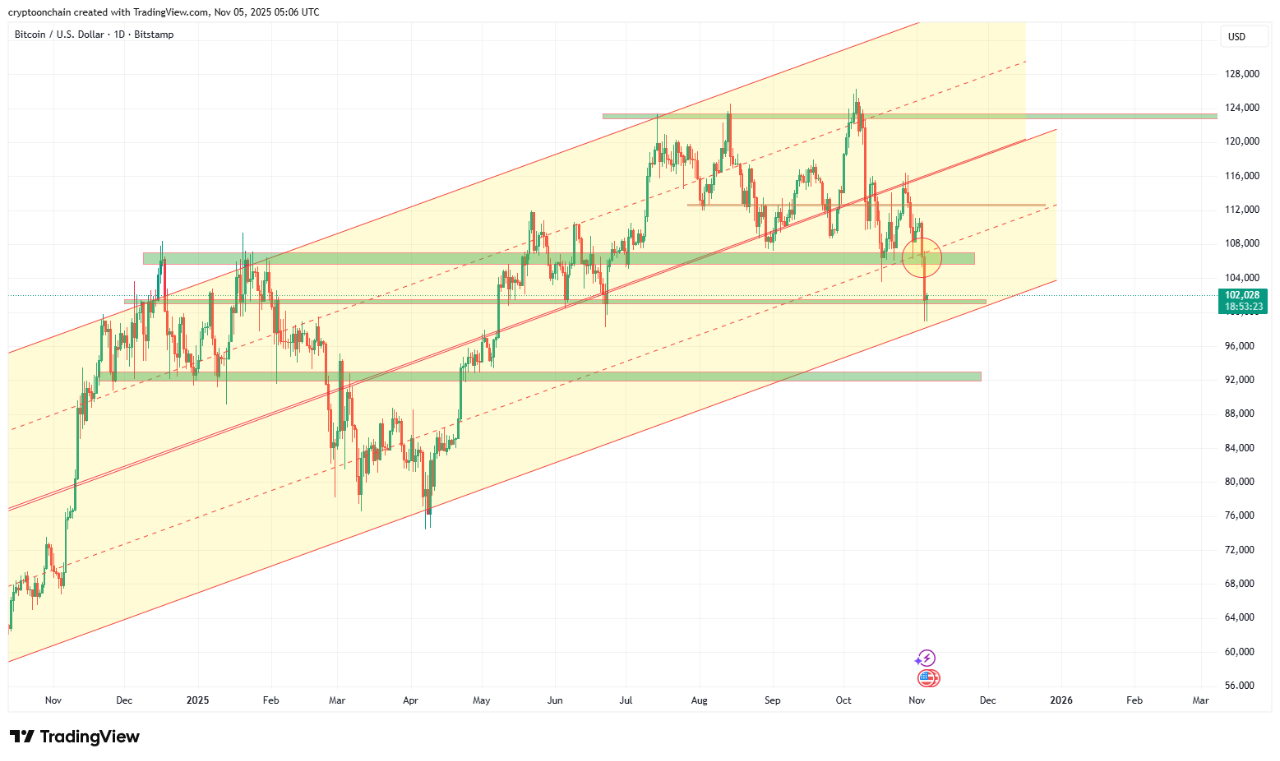
Notably, amid the current price action, Bitcoin lost the $107,000 support level after 130 days of consolidation, according to a Crypto Onchain report on CryptoQuant. The market leader ranged between the support and $123,000 from late June but breached the support with its drop below the psychological $100,000 level on Tuesday.

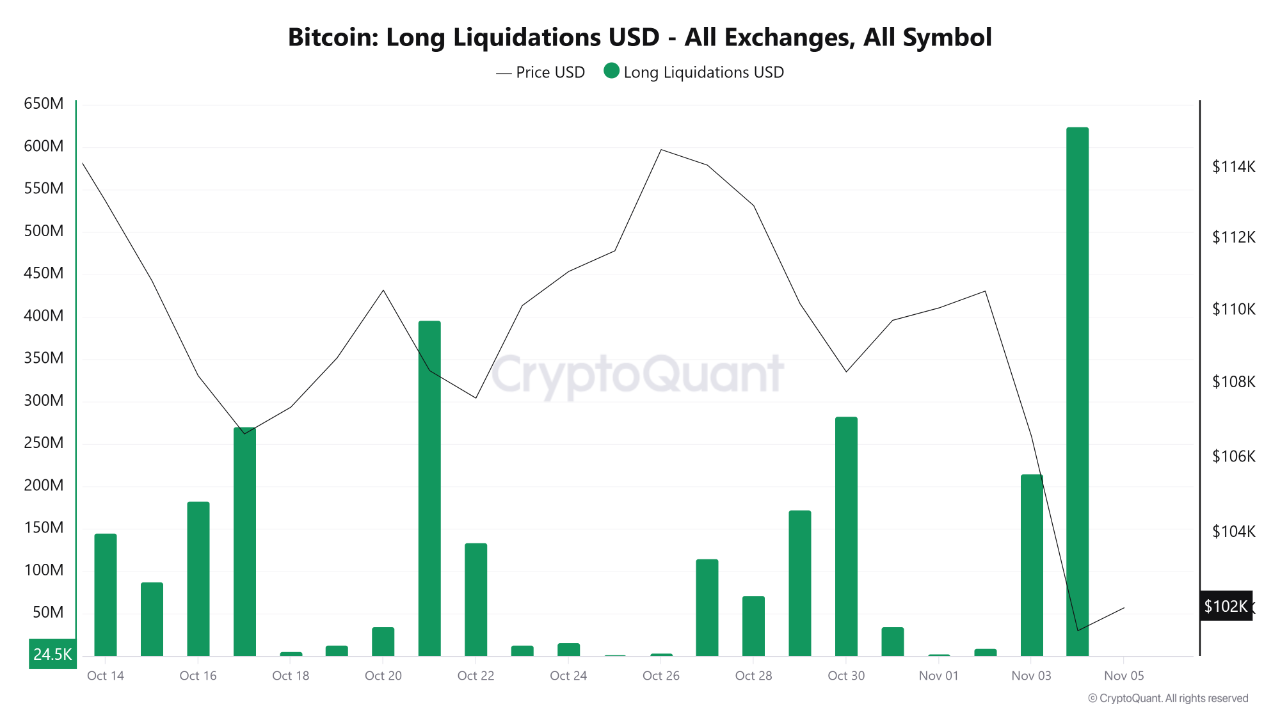
The correction sparked a rampage, particularly on long positions, chalking off over $640 million over the past 24 hours. Notably, the liquidation frenzy was the second largest since June 2021, with the October 10 bloodbath at the helm of history.

Bitcoin Liquidation Data

However, Bitcoin has shown resilience, recovering to $101,000 yesterday and further rallying to $102,730 at the time of writing. Meanwhile, Crypto Onchain identified a key detail about the $101,000 support, one that would determine its subsequent price action.

The Last Line of Defense for Bitcoin Bulls

Specifically, the analysis highlighted that bulls stepped in at $98,000 and pushed Bitcoin to its most critical level for bulls. This level aligns with the lower support trendline of an ascending channel in the daily timeframe.

Bitcoin Ascending Channel

The report noted that the $101,000 support line is more than a psychological line; it is the trendline that has determined Bitcoin’s market structure since October 2023.

Meanwhile, Crypto Onchain noted that defending the channel’s bottom would be decisive in Bitcoin’s near-term price trajectory. Defending the $101,000 support would spark a rebound, making the current dip a buy opportunity.

However, if Bitcoin does not hold this level and bearish momentum persists, it would defy its market structure, putting the bull run in jeopardy. This would mark steeper corrections to new lows for the largest cryptocurrency by market cap.

Could Bitcoin Hit $92,000?

Nonetheless, another analysis shows that there is a nearby CME gap that Bitcoin might fill. The futures market chart shows a gap between $92,000 and $93,000, which is 10% away from the current market price.

Bitcoin CME Gap at $92,000

Bitcoin has historically tended to fill these CME gaps before its next rally, and market observers are not ruling out the possibility. However, strong support around the current level could prevent this move and force BTC northwards.

Here’s How High XRP can Reach As a Result as Samson Mow Predicts BTC Violent Surge to $1M

0

XRP proponents are exploring potential price scenarios for their beloved coin in a market where Bitcoin reaches $1 million.

Numerous industry leaders have made the $1 million Bitcoin price prediction. However, the view shared by Samson Mow has drawn particular attention, as he projects a violent price explosion to that level.

In a recently surfaced video on X, Mow linked Bitcoin’s potential surge to the failure of fiat currencies. He argued that fiat currencies do not fail slowly and gradually, but rather implode spectacularly.

Based on this view, he suggested that Bitcoin’s path to $1 million won’t be a slow and steady climb. Instead, it will be a rapid and “violent upheaval” that could unfold over just weeks or months.

What Happens When Bitcoin Hits $1 Million?

As of today, Bitcoin is at $101,934, with a market capitalization of $2.13 trillion. Notably, this gives Bitcoin a dominant 59.32% share of the global $3.6 trillion cryptocurrency market.

Reaching $1 million per Bitcoin would require a massive price increase of 835%. At that level, Bitcoin would command a market cap of approximately $20 trillion. For context, gold currently has a market cap of around $30 trillion.

If Bitcoin reaches this milestone, the entire crypto market could be valued at around $33.7 trillion. This implies that the altcoin space, excluding Bitcoin, could be worth over $13 trillion.

This naturally raises curiosity about the potential valuation of top altcoins like XRP. Currently, XRP holds a 3.93% market share of the global crypto market, with a valuation of $141 billion and a price of $2.35.

What Could XRP’s Price Be?

If XRP maintains its current 3.93% market dominance while the overall altcoin market expands to $33.7 trillion, XRP would have a market capitalization of approximately $1.32 trillion.

Given XRP’s circulating supply of 59.97 billion tokens, this would imply a unit price of around $22.

Bitcoin and XRP Moving “Fast and Violently”

Considering Mow’s suggestion that Bitcoin will surge violently to $1 million, a domino effect could impact the altcoin space. XRP could experience a rapid price explosion to $22 within months, in line with Mow’s broader forecast.

A recent example underscores this volatility. On October 10, Bitcoin suddenly dropped from $122K to $102K, then recovered to $112K within hours. A similar pattern was seen with XRP, which crashed from $2.80 to $1.20 and then rebounded to $2.40.

This highlights Bitcoin’s well-established ability to drag altcoins in either direction.

Interestingly, XRP and other altcoins have historically shown a tendency to outperform Bitcoin’s momentum. If Bitcoin rises 835% to $1 million, XRP’s growth may match, or even exceed, that percentage.

For example, year-to-date, Bitcoin is up 14.5%, while XRP is up 13.33%. However, over the past year, Bitcoin has risen 57.37%, while XRP is up a staggering 327.84%—nearly six times Bitcoin’s performance.

In Sum

Ultimately, these are speculative estimates, and the real outcome for Bitcoin and XRP could be vastly different. Notably, many industry forecasts suggest Bitcoin could hit $1 million by 2030. By that time, XRP is expected by some to reach between $20 and $100.

XRP Macro Wick 2 Target $50 as Analyst Says XRP Still in a Bullish Phase

0

EGRAG Crypto, a well-regarded XRP community analyst, has insisted that XRP remains within a powerful accumulation zone.

His bullish disposition comes at a time when XRP has corrected with the rest of the crypto market amid widespread uncertainties. Specifically, between Nov. 3 and 4, the total crypto market cap lost nearly $350 billion, with XRP collapsing 13.16% within this period to the $2.2 price level.

XRP Still in a Bullish Position

However, despite the pullback, EGRAG has maintained confidence in XRP’s long-term prospects. In his latest analysis, EGRAG confirmed that he was presenting the commentary with zero fear in spite of the bloodbath that had just ravaged the market. 

According to him, he remains optimistic because nothing has changed on the higher timeframe, as XRP maintains its long-term bullish structure. He first called attention to data distortion that happened across multiple exchanges like Binance, Bitstamp, and Coinbase on Oct. 10. This distortion led to conflicting data, but he identified $1.4 as the Oct. 10 low.

Next, the market analyst revealed that as long as XRP holds above the $1.94 support area, it maintains its bullish structure. EGRAG noted that within this area, XRP remains in one of the most powerful accumulation zones investors have seen. He charged investors to take advantage of this level now that panic has set in, else they will regret it later.

Meanwhile, data from his chart shows that XRP still trades within a range it formed after the drop from $3.4 in January 2025. During the Oct. 10 crash, the altcoin collapsed to retest the lower trendline of this range, but the bulls defended the support at this area, with XRP immediately rebounding into the range.

XRP 3D Chart EGRAG Crypto
XRP 3D Chart | EGRAG Crypto

Micro Wick Target at $10; Macro Wick Target at $50

As XRP continues to trade within this structure, EGRAG remains bullish despite the altcoin now sitting closer to the lower trendline. According to him, if a recovery finally leads to an upward breakout, the first target, which he dubs Micro Wick 1, sits at $10. This represents a 326% increase from XRP’s current price of $2.34.

Meanwhile, he noted that if the ongoing correction marks a Macro Wave 2 pull, then the incoming Wave 3, which would represent the recovery push, would hit a target that is 1.618x the increase witnessed during Wave 1. Notably, this would put the upward target at a range between $14 and $25.

Speaking further, EGRAG also highlighted a possible Macro Wick 2 after the Micro Wick 1. He pointed out how some analysts have claimed that XRP could still drop to fill the downward wick on Binance that pushed prices to $0.77 on Oct. 10. Notably, during the Oct. 10 crash, the XRP price collapsed deeper to $0.77 on the Binance exchange.

However, EGRAG argued that if the market could fill the downward wick to $0.77 on Binance, then it could also fill the upward pick to $50 on Gemini. For context, shortly after it listed XRP for the first time in August 2023, Gemini saw a massive XRP price spike to $50 due to thin order books. According to EGRAG, if XRP moves toward filling wicks, then $50 is the real blowoff wick target.

Pundit Asks If XRP Is a ‘Nothing Burger,’ Why Is BlackRock at Ripple Swell

0

The ongoing Ripple Swell 2025 conference is stirring new conversations about XRP’s continued relevance, challenging critics who claim XRP has lost significance.

This discussion gained traction given the lineup of major institutions participating in the event. Amid the buzz, crypto commentator Digital Outlook questioned the persistent skepticism surrounding XRP, writing on X:

“If XRP is a ‘nothing burger,’ why is BlackRock at Swell?”

BlackRock’s Presence at Ripple Swell

Indeed, BlackRock’s Director of Digital Assets, Maxwell Stein, participated in a panel discussion at this year’s Swell conference. He discussed tokenization alongside other panelists, including Rory Callagy, Managing Director at Moody’s Investors Service; Nicola White, VP of Institutional Crypto at Robinhood.

In additional panel discussions, notable figures included Adena Friedman, Chair of Nasdaq; Hunter Horsley, CEO of Bitwise; Steven McClurg, CEO of Canary Capital; Luke Hoersten, Founder of Bitnomial; and Eric Balchunas, Senior ETF Analyst at Bloomberg.

Given this impressive lineup, community members argue that the growing institutional participation contradicts claims that XRP lacks a “real use case.”

As Digital Outlook summarized:

“Why are Treasury officials sitting front row? You don’t have to hear the handshake to know a deal just went down.”

This speculation reflects optimism that new collaborations could emerge from the participation of such major institutions at Ripple Swell, ones that potentially benefit XRP’s long-term outlook.

Stein Shares Views on Tokenization Demand Over the Next Decade

During the panel session, moderator Nikhilesh De asked where demand for tokenization is likely to come from over the next ten years.

BlackRock’s Stein explained that the long-term market will emerge from entities that already own traditional securities today. If the distinction between traditional and tokenized assets eventually disappears, the existing base of asset owners will drive adoption.

In the near term, however, Stein noted that the industry must still demonstrate the real utility of tokenization. He said early demand will likely come from two main groups:

  1. Investors seeking new forms of access or those who want exposure to assets regardless of geographic barriers.
  2. Participants seeking new forms of utility, such as the ability to perform financial functions currently limited to large institutions.

By showcasing these advantages through DeFi and other tokenized platforms, early adopters can generate the market momentum needed to attract larger, more traditional players over time.

XRP ETF Speculation Remains in the Background

Despite the attention surrounding BlackRock’s appearance, the firm has repeatedly stated it has no immediate plans for an XRP ETF.

Meanwhile, multiple issuers are now updating their XRP ETF filings, setting for a November launch. With Ripple’s Swell conference featuring major institutional leaders, speculation continues to grow.

While Stein’s comments did not confirm any such product, his mere presence at the event continues to fuel expectations.

Researcher Says Real XRP Value Will Be Revealed After Ripple IPO

0

Crypto researcher SMQKE claims financial giant SBI Holdings hinted that the true XRP value would only become clear once Ripple goes public. 

His claim built on SBI Holdings’ financial report for the quarter ending June 30, 2025, which the company published on July 31.

SMQKE argued that SBI linked XRP’s future price to Ripple’s long-anticipated initial public offering, but this claim was not particularly accurate due to an ambiguity. He shared two screenshots from the report and pointed to specific areas he believed confirmed his interpretation. 

SBI’s Financial Report

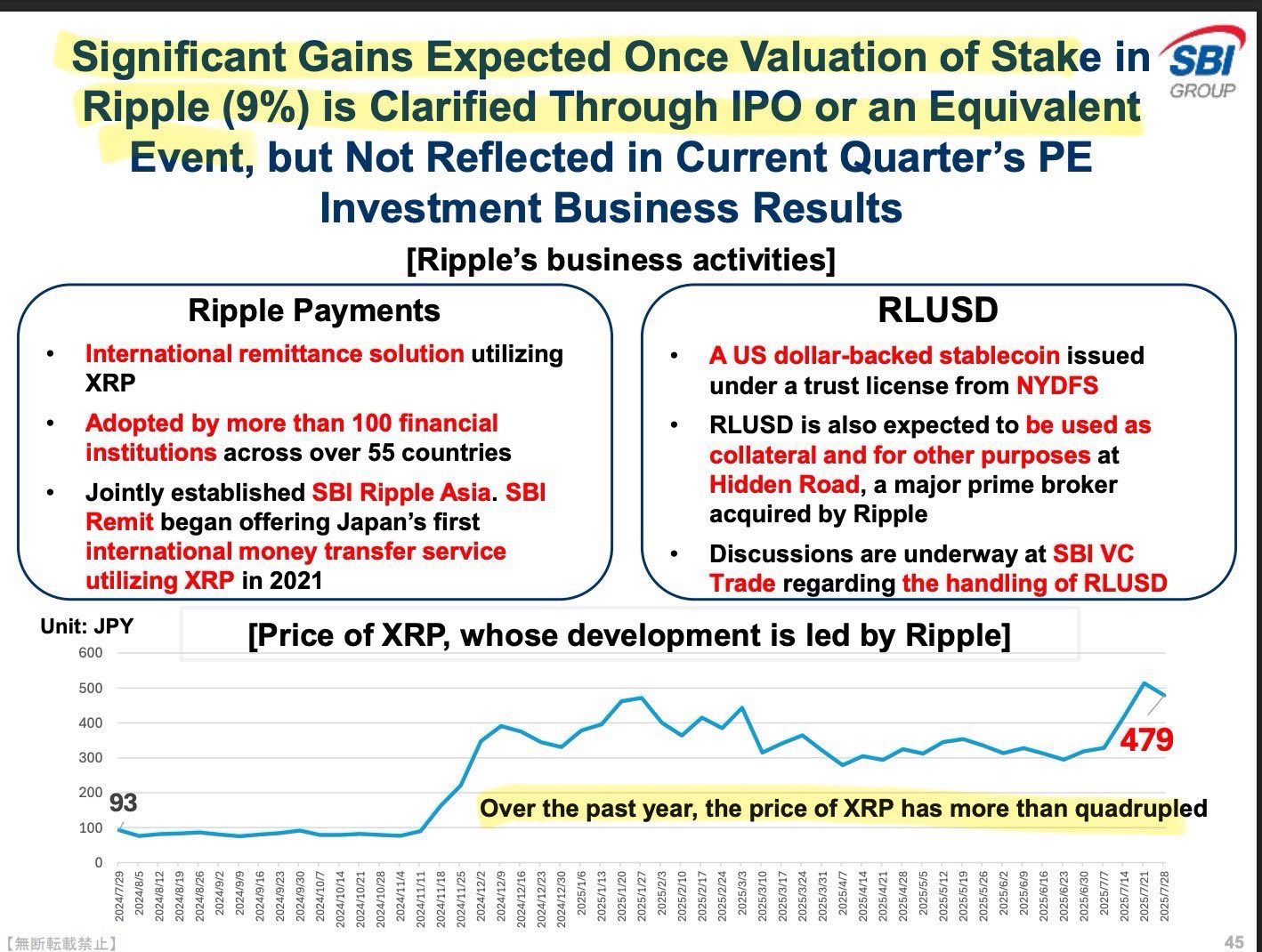
Specifically, in the first image SMQKE shared, SBI stated that it expects major returns once the value of its 9% stake in Ripple becomes clear following an IPO or equivalent financial event. 

However, SBI clarified that these potential gains do not yet appear in its private equity (PE) investment results for the quarter. The same report outlined Ripple’s major business areas, including its global payment solution powered by XRP. 

It also reminded readers that SBI Remit launched Japan’s first money transfer service using XRP in 2021 through the SBI Ripple Asia joint venture.

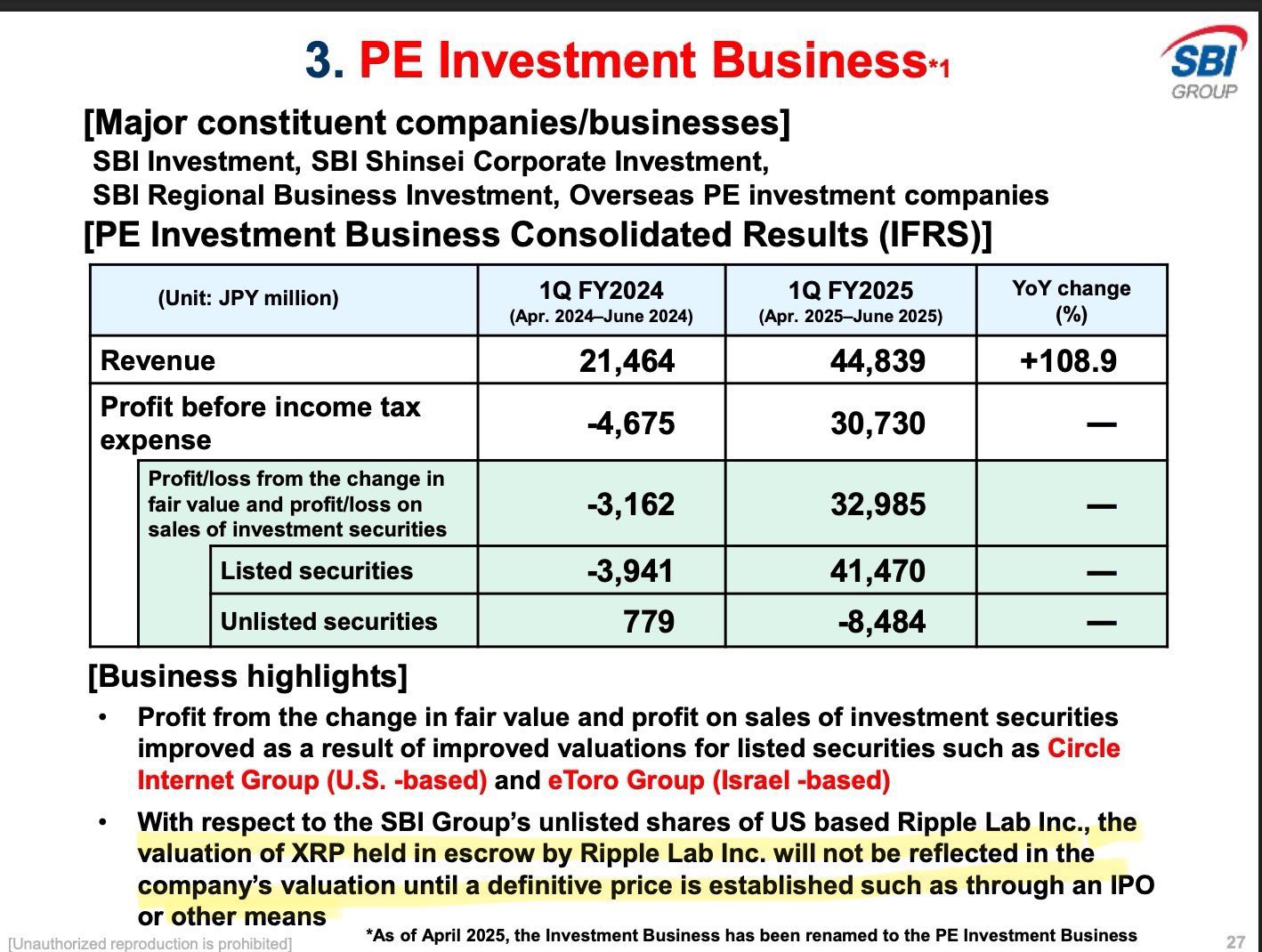
In the second image, SBI provided more details about its PE investment business. The report showed that revenue rose sharply year-over-year. SBI attributed this improvement mainly to higher valuations of listed securities such as Circle Internet Group and eToro Group.

The company also stated that it would not include the value of Ripple’s unlisted shares, or the XRP in Ripple’s escrow, in its valuation until a concrete market price is set, likely through an IPO or another defining event.

SMQKE Claims XRP Value Will be Revealed After Ripple IPO

In the first image, SMQKE highlighted the section that discussed potential gains once SBI’s 9% ownership in Ripple receives a defined valuation through an IPO or similar event. 

SBI Financial Report

Meanwhile, in the second, he spotlighted where the report noted that Ripple’s escrowed XRP holdings would not affect the company’s valuation until a firm market price emerges, possibly after Ripple goes public.

SBI Financial Report

He concluded that SBI referred to XRP’s real value emerging after Ripple’s IPO. However, SBI’s statements actually referred to the company’s equity stake in Ripple, not XRP’s market price. 

As one of Ripple’s largest shareholders, holding a 9% stake, SBI simply explained that it would wait for Ripple’s public valuation before including the worth of this stake in its financial records.

Optimism Around Ripple’s Use of XRP

Although SMQKE’s interpretation pushed beyond the report’s actual message, his comments come at a time when optimism around Ripple’s use of XRP is growing. Many community members have regained confidence that Ripple remains committed to XRP despite earlier worries that it might shift focus toward RLUSD.

Ripple’s recent moves support this renewed confidence. After the company finalized a $1.25 billion acquisition of prime brokerage platform Hidden Road, Ripple CEO Brad Garlinghouse reaffirmed that XRP remains central to Ripple’s operations.

In addition to this, Ripple also recently teamed up with Gemini to launch an XRP credit card. Moreover, when the firm announced that Ripple Prime had launched spot brokerage in the U.S., it highlighted RLUSD and XRP as two assets clients could trade over-the-counter.

Meanwhile, Ripple has clarified that it has no immediate plans to go public. The company says its finances remain strong and that its focus now lies on expanding through strategic partnerships and acquisitions rather than pursuing an IPO.

XRP Classified as Property by India High Court in Landmark Ruling

0

In a landmark ruling, the Madras High Court has recognized cryptocurrencies, including XRP, as property under Indian law.

The judgment, issued by Justice N. Anand Venkatesh, establishes that digital assets possess the essential characteristics of property: they are identifiable, transferable, and controllable through private keys.

The Case Behind the Judgment

The decision resulted from a lawsuit related to the 2024 cyberattack on the crypto exchange WazirX. The plaintiff, Rhutikumari, requested legal protection for 3,532.30 XRP tokens affected during the incident. Although some Ethereum-based assets were stolen in the hack, Rhutikumari’s XRP holdings remained recoverable.

The court ordered WazirX not to interfere with Rhutikumari’s XRP holdings until arbitration concludes.

Justice Venkatesh emphasized that cryptocurrency, though intangible, can still be “owned and enjoyed beneficially,” thereby equating it with property rights under civil law.

Legal Basis and Definition

The judgment draws on Section 2(47A) of the Income Tax Act, 1961, which identifies cryptocurrencies as Virtual Digital Assets (VDA).

Justice Venkatesh stated that such assets are uniquely identifiable and managed via private keys. Therefore, they fulfill the requirements of personal property under Indian law. Consequently, this interpretation grants holders enforceable ownership rights and protection against unauthorized interference.

Citing Global Legal Precedents

Justice Venkatesh referenced international rulings that similarly recognized crypto assets as property. Among them were:

  • Ruscoe v. Cryptopia (New Zealand, 2020)
  • AA v. Persons Unknown (United Kingdom, 2019)
  • SEC v. Ripple Labs (United States, 2023)

By aligning with these global cases, the court positioned India within an emerging international legal consensus that digital assets carry property rights, even though they exist only in digital form.

Ultimately, this paves the way for future laws concerning inheritance, custodial responsibility, and taxation of digital assets, offering certainty to investors and exchanges alike.

Call for a Balanced Regulatory Framework

Justice Venkatesh urged lawmakers to craft a balanced crypto regulation that secures consumer rights while encouraging innovation. He noted that, with this ruling, India now has the opportunity to develop a system that protects investors and promotes technological growth without imposing undue constraints on the digital economy.

Though cryptocurrencies remain outside the definition of legal tender, this ruling confirms their legitimate status as property. The decision bolsters confidence among crypto investors, developers, and startups in India’s rapidly growing Web3 sector.

By formally recognizing digital assets within the legal framework, the Madras High Court has established a critical precedent for digital ownership and investor protection in India’s evolving financial landscape.

Ripple Closes $500M Deal at Swell 2025, Valuation Hits $40B

0

Amid the ongoing Swell event, Ripple has secured a fresh $500 million in strategic funding, pushing its valuation to $40 billion.

The round was led by major financial heavyweights, including affiliates of Pantera Capital, Fortress Investment Group, Citadel Securities, Brevan Howard, Galaxy Digital, and Marshall Wace.

Ripple said the decision to accept new common equity reinforces partnerships with financial firms whose expertise aligns with its expanding suite of institutional products.

The raise follows Ripple’s $1 billion tender offer earlier this year, also at a $40 billion valuation. Given the latest investment, it implies steady investor confidence despite the broader crypto market downturn.

Record Expansion as Ripple Moves Beyond Payments

Notably, Ripple has described 2025 as a “record year of growth,” driven by rapid product expansion and six acquisitions in just over two years.

Originally launched in 2012 to speed up cross-border payments using XRP, Ripple has since broadened its scope across multiple verticals:

  • Stablecoins with the launch of RLUSD, a USD-backed stablecoin
  • Custody services for institutions (via Metaco and Palisade acquisitions)
  • Prime brokerage and liquidity solutions (Hidden Road)
  • Corporate treasury and settlement products (GTreasury)
  • Enterprise stablecoin infrastructure, strengthened through its recent acquisition of Rail

This growth and acquisitions highlight Ripple’s push to become a full-stack digital asset infrastructure provider rather than simply a payments company.

GENIUS Act Sparks New Adoption Cycle

Meanwhile, the fundraising comes amid a shift in U.S. regulatory tone following the election of President Donald Trump and the passage of the GENIUS Act — America’s new stablecoin framework.

Since the Act went into effect, fintechs, investment managers, and corporations have accelerated adoption of regulated stablecoins for eal-time settlement, treasury payments, collateral optimization, and global capital market operations.

Positioning XRP for Institutional Markets

With the new capital, Ripple aims to deepen institutional use of XRP in capital markets, leveraging the more crypto-friendly U.S. environment.

“This investment reflects Ripple’s incredible momentum and validation of the market opportunity we’re aggressively pursuing,” said CEO Brad Garlinghouse.

Interestingly, the funding arrives during a turbulent week for digital assets. Bitcoin briefly dropped to $98,900 for the first time since June and wiping billions from the broader market. XRP is also trading in the red, having lost 14% of its value over the past week.

Meanwhile, Ripple maintains that institutional demand for real-world asset-backed tokens and settlement technology continues to strengthen regardless of short-term volatility.

Here’s XRP Price if Ripple Captures 40% of B2B Payments Market Projected to Hit $50T by 2032

0

With Ripple targeting the B2B cross-border payments scene, the XRP price could see a massive boost if the firm captures 40% of the market.

Notably, when Western Union revealed plans to pilot its stablecoin on the Solana network, several figures in the crypto community took aim at XRP. They pointed out that Western Union chose Solana despite years of experimenting with the XRP Ledger (XRPL) tech.

Ripple Focusing on the Larger B2B Payments Segment

However, the XRP community has fired back. For instance, a community member named Anderson claimed that the market Ripple has chosen to focus on far outpaces Western Union’s in terms of size.

According to him, while Western Union mainly handles consumer-to-consumer (C2C) transactions, Ripple targets the much larger business-to-business (B2B) segment. Anderson claimed that the B2B market reached $187 trillion in 2024, but this was not quite accurate.

Notably, financial data firm FXC Intelligence revealed that the B2B cross-border payments market, which includes payments between companies in different countries that support global trade, stood at about $31.6 trillion in 2024. 

FXC Intelligence described the sector as opaque, which makes exact figures hard to determine. However, it expects the market to grow by 58%, reaching $50 trillion by 2032, with a compound annual growth rate of 5.9%.

What if Ripple Captured 40% of the B2B Payments Market?

Even though Anderson’s estimate missed the mark, his larger point remained valid. Ripple’s focus on the B2B space gives it a much bigger opportunity than Western Union’s consumer market. 

If Ripple expands to take a large share of the market, say 40%, this achievement could have some positive impact on the price of XRP, which serves as the gas token of the XRPL. However, the actual impact remains unclear.

So, we asked AI chatbot ChatGPT what might happen to XRP’s price if Ripple secures 40% of that projected $50 trillion B2B market by 2032. For context, this share would represent over $20 trillion in payments running through Ripple’s systems. At the time of the inquiry, XRP traded at $2.20.

Factors to Consider

ChatGPT noted that XRP’s value wouldn’t depend on the total $20 trillion in transaction volume but rather on the amount of liquidity needed to move that money smoothly. 

The chatbot noted that XRP would act as a bridge asset, quickly circulating to process multiple payments per day. Still, it said that high-value, high-frequency settlements would demand deep liquidity, possibly locking up tens or even hundreds of billions of dollars’ worth of XRP at any time.

Factors to Consider
Factors to Consider

The chatbot also highlighted that banks, payment providers, and corporations might hold XRP to maintain liquidity and reduce slippage. Such holdings could tighten supply and push prices higher.

Speaking further, ChatGPT added that speculation and institutional positioning would likely increase this effect. If XRP became a major part of a multi-trillion-dollar global payment network, rising adoption and investor confidence could feed into each other and drive prices higher.

According to ChatGPT, XRP’s speed of circulation or “velocity” would also be important. Specifically, the faster XRP changes hands, the less it needs to be worth per unit. But as more countries and institutions build payment corridors using XRP, each one would need deep liquidity pools.

XRP Price Projections

Based on these factors, ChatGPT outlined a bullish range of possible prices. In a moderate scenario where Ripple handles major corridors like USD/EUR and USD/JPY without total global control, XRP could reach $25 to $50. 

However, if Ripple becomes a mainstream settlement network for 30% to 40% of global B2B payments, the token could rise to between $100 and $500. In a more bullish case, where XRP becomes a global standard for cross-border liquidity, its price could soar past $1,000.

XRP Price Prediction ChatGPT
XRP Price Prediction | ChatGPT

ChatGPT explained that even at $100 per coin, XRP’s total market value would still be small compared to the trillions it helps move each year. Nonetheless, because XRP’s strength rests in its utility, not storage, this price level could still support turnover of more than $20 trillion annually.