
Home Blog Page 451

Bitcoin Price Under Pressure as Veteran Holders Send Billions to Exchanges

0

The recent Bitcoin decline below the $108,000 mark has coincided with major wallet activity from early adopters.

According to blockchain data shared by Lookonchain, long-time holders, aka ‘Bitcoin OGs’, have transferred large sums of BTC to major exchanges in recent weeks.

For instance, a whale known as “1011short” has transferred nearly 13,000 BTC worth approximately $1.48 billion. These assets were subsequently sent to Kraken, Binance, Coinbase, and Hyperliquid since October 1.

Meanwhile, another veteran investor, Owen Gunden, deposited 3,265 BTC, worth roughly $364.5 million, to Kraken after October 21. Despite these transfers, Gunden still controls 7,149 BTC, estimated at $766.54 million, in his wallet.

At the time of reporting, Bitcoin traded at $107,655, marking a 2.8% daily decline and a 7.2% loss over the week.

Saylor Set to Buy Bitcoin Despite Market Weakness

Although some older holders appear to be reducing exposure, MicroStrategy founder Michael Saylor is maintaining his bullish stance.

In a recent post on X, Saylor hinted at a potential Bitcoin purchase. Similar hints have historically preceded MicroStrategy’s acquisition announcement. Notably, last week it acquired 390 BTC for about $43.4 million at an average price of $111,053 per coin.

As of November 2, 2025, the company’s Bitcoin portfolio amounted to 640,808 BTC. This holding was valued at $70.7 billion, based on prevailing market prices. The firm’s average purchase price remains $74,032 per BTC. Consequently, this yields an unrealized gain of 49.03%, amounting to approximately $23.25 billion.

During an interview with CNBC last week, Saylor predicted Bitcoin could reach $150,000 by year-end. He further suggested that the cryptocurrency could reach $1 million within four to eight years. This estimate is based on a projected average annual growth rate of 30 percent over the next two decades.

Analysts See Possible Short-Term Recovery

Ali Martinez, the renowned crypto analyst, offered a technical perspective that suggests potential for a short-term rebound. Specifically, in his latest X post, he pointed out that Bitcoin appears to be forming a classic ascending triangle pattern on the four-hour chart.

According to Martinez, the price could retest support near $107,500 before attempting a move toward the $115,000 resistance level.

Cardano Founder Acknowledges XRP Community’s Sacrifice in Crypto’s Fight for Regulatory Clarity

0

Cardano founder Charles Hoskinson has commended the XRP community for its resilience and perseverance throughout the SEC legal tussle against Ripple. 

In a recent livestream, Cardano’s founder acknowledged the role XRP community members played in paving the way for the industry’s regulatory progress.

According to him, when the SEC sued Ripple, members of the XRP community did not plead for leniency or ask the regulator for more favorable treatment. Instead, they responded collectively as an ecosystem and faced the challenge head-on.

Hoskinson emphasized that the lawsuit cost Ripple hundreds of millions of dollars in legal expenses, noting that the company bore the brunt of the SEC’s enforcement actions on behalf of the broader cryptocurrency industry.

Excluding Binance, Hoskinson observed that few crypto projects have faced comparable regulatory scrutiny to Ripple and the XRP community. He suggested that the Ripple case was unique, as it helped clarify the legal standing of digital assets.

Ripple’s Victory Against SEC Boosts Industry Confidence

For context, the Ripple case originated from the SEC’s December 2020 lawsuit, which accused the company of violating U.S. laws through the sale of XRP. The lengthy legal battle saw Ripple spend over $150 million in legal fees. Members of the XRP community submitted key affidavits that contributed to the company’s partial court victory.

In a landmark ruling in July 2023, Judge Analisa Torres determined that Ripple’s programmatic XRP sales on digital exchanges did not constitute investment contracts. This ruling restored confidence across the crypto sector, particularly for other firms facing similar regulatory scrutiny.

Among them was Coinbase, which the SEC sued in June 2023, alleging that the exchange facilitated the trading of unregistered securities, including tokens such as Solana and Cardano.

Crypto Now on the Other Side of Regulatory Battle

Having endured years of regulatory scrutiny from the SEC, largely due to Ripple’s resilience and the XRP community’s efforts, Hoskinson emphasized that the crypto industry has now emerged on the other side of that regulatory battle.

Currently, industry stakeholders are participating in key discussions with policymakers on how to best regulate cryptocurrencies.

Last month, representatives from Ripple, Coinbase, Uniswap, Galaxy Digital, and Chainlink participated in a roundtable discussion with pro-crypto Senate Democrats on the Market Structure legislation. The proposed bill aims to clarify the respective roles of the SEC and CFTC in overseeing the digital asset industry.

Overall, Hoskinson stressed that the industry remains strong, having survived multiple enforcement actions brought by U.S. regulators.

Meanwhile, since reconciling with the XRP community, Hoskinson has praised the token’s founders and supporters for their authenticity and integrity. While he aims to offer XRP holders yield-bearing opportunities on Cardano, he recently enabled them to participate in the Midnight (NIGHT) airdrop.

Expert Says He Wants XRP to Succeed but Share What Bothers Him

0

Vibhu Norby, Head of Product Marketing at the Solana Foundation, claims he wishes for XRP to succeed, but the XRPL still lags in major metrics.

Notably, the XRP Ledger has been around for more than ten years, making it one of the earliest blockchain projects. However, its network has lagged in decentralized finance features.

XRPL DeFi Lags

This was largely due to how Ripple and other XRPL developers focused mainly on payments and efficiency in the early days. In recent years, the project has tried to catch up, eyeing smart contracts and staking, but its DeFi growth remains slower compared to newer competitors like Solana.

In his recent commentary, Norby said he genuinely wants Ripple and XRP to achieve massive success that could move the whole industry forward. However, he said many XRP proponents ignore data that clearly shows how far the project still has to go.

Concerning On-chain Numbers

Norby mentioned several figures from XRPScan to back his view. Specifically, he noted that daily active accounts on the XRPL have remained around 25,000 for the past three years, showing no major growth. In contrast, Solana now averages about 2.5 million daily active accounts, roughly 100 times more. 

He admitted that XRP’s number of successful payments has risen by about 50%, reaching around 1.5 million daily transactions, but stressed that Solana handles about 100 million transactions every day.

He also compared their transfer volumes. According to the Solana Foundation manager, the XRPL moves between $50 billion and $60 billion monthly, while Solana’s stablecoin transfers alone reached nearly $2 trillion in October. 

Norby kicked against circulating claims that Solana’s data comes from bots, saying both networks charge very low fees, so it doesn’t make sense to assume only one would attract automated activity. 

XRP Could Still Succeed

Meanwhile, he admitted that the XRPL could still succeed in the long run but called its current growth “mediocre,” considering how long it has existed and how much value it represents. Norby then urged XRP investors to seriously consider how long they are willing to wait for real progress.

His comments triggered responses from XRP community members. One investor argued that Norby’s comparison ignored the long-term effects of Ripple’s legal battle with the SEC, which began in December 2020. He asked whether being wrongfully sued shouldn’t count as a major factor slowing XRP’s development.

Another community member, Theophane, pointed out that XRPL’s activity started to rise significantly after First Ledger launched, noting that the increase in volume was visible on the charts. This indicates that once the right projects start emerging, the XRPL could catch up in DeFi metrics.

He said XRP’s DeFi ecosystem is still young and developing, which explains why Solana currently leads in volume and engagement. Theophane suggested that investors should remain patient, saying the next wave of XRPL adoption is only beginning.

XRP Community Figure Presents Improving Data

Brandon Jackson, another XRP supporter, presented data to counter some of Norby’s claims. He cited Messari’s Q3 2025 report, which showed 75,600 total daily active accounts on XRPL, with 25,300 senders and 50,300 receivers, double the figures from Q3 2022. 

He also mentioned that the network added 447,200 new addresses during the same period, a 46% increase quarter-over-quarter.

Jackson explained that XRPL’s design, which includes a one-XRP reserve and transaction fee burns, makes it resistant to bots, unlike Solana’s almost zero-cost system that encourages automated transactions. 

He said XRPL now handles about one million payments daily, roughly 55–60% of its total 1.8 million daily transactions. This represents an 8.9% quarterly increase and a 430% growth over two years, totaling about 300 million payments this year, with the network on track to exceed 400 million by the end of 2025.

He also noted that Ripple’s On-Demand Liquidity service processed $1.3 trillion in settlements during Q2 2025 through more than 300 partners, including Santander and SBI. He argued that Solana’s trading volume mostly comes from retail activity, DeFi swaps, and bot-driven trades, while XRP’s usage is primarily institutional.

Citing these metrics, Jackson insisted that the XRPL isn’t falling behind but rather growing stronger. He described it as an enterprise-grade, bot-resistant network that’s gaining speed, noting that transactions processed in 2025 already account for one-third of all payments in its history.

Analyst Says It’s Time for Shiba Inu to Rebound, Shares Three Targets

0

There is growing confidence in the Shiba Inu community that SHIB could be gearing for a price rebound after severe price consolidation.

Shiba Inu (SHIB) has struggled of late, a condition predominant in the broader crypto market. However, the meme coin’s underperformance appears more severe than some others.

After months of trending above the $0.000010 support, bears finally defeated the demand zone, adding one more zero to the token’s price. Furthermore, its 6% correction over the past 24 hours brings the 30-day negative trend to 24%, with Shiba Inu losing more than half of its value since the start of the year.

Optimism Remains for Shiba Inu

Meanwhile, market observers are still rooting for a bullish price development for Shiba Inu, with some suggesting the token always makes late moves. Analyst Saraah is among those sharing this optimistic sentiment, as he discovered a formation that could send SHIB higher.

In his recent Shiba Inu price prediction on TradingView, he expects a rebound from here, citing several formations on the SHIB/USDT 4-hour chart. An accompanying chart shows that the meme coin was trending near the tip of the descending triangle, which has suppressed its price since mid-October.

SHIB Price Analysis
SHIB Price Analysis

It bears mentioning that at the time of his analysis, Shiba Inu was very close to the neckline resistance. However, the capsize earlier today has pushed the token further downward, but it is still within the lower support level of the structure.

Moreover, the analyst highlighted that trading volume is rising, suggesting increased market activity around the token. Analysts believe this is a precursor to a massive price move, and Saraah thinks it could take the token higher.

Targets for a Breakout

Notably, the chart indicates potential targets for Shiba Inu in the event of a price rebound. It specifically highlighted three possible areas the token would rise to, one of which is a 15.4% move to $0.000001115.

The second point in this rebound is a rise to $0.00001172, representing a 21% growth from the current market price of $0.00000966. Subsequently, he expects Shiba Inu to appreciate to its final target of $0.00001220, which is 26% away from its current value.

Meanwhile, Bitcoin must remain stable for this move to occur. The pioneering cryptocurrency dropped to $107,000 today, pushing SHIB away from the breakout trendline to its current level. Historically, altcoins have followed the movement of BTC due to its large market dominance.

Shiba Inu’s macro-factors look promising, and a stable Bitcoin could drive the meme coin to make this move. Recall that $1.7 trillion asset manager T. Rowe Price recently filed for a spot SHIB ETF in the US, boosting confidence among enthusiasts.

Black Swan Capitalist Explains How XRP Could Reach Extremely High Prices, Up to $10,000

0

XRP long-term valuation continues to spark debate across the crypto community.

According to Versan Aljarrah, founder of Black Swan Capitalist, understanding how XRP could reach extremely high price levels, up to potentially $10,000 per coin, requires a shift away from conventional thinking.

In a detailed breakdown, he argues that XRP’s design as a global liquidity engine makes high valuations not speculative fantasies, but mathematical outcomes tied to utility and global demand.

XRP is for Global Liquidity, Not Speculation

Aljarrah explains that many people still evaluate XRP as if it were a stock or commodity. However, the XRPL architects did not create XRP to behave like traditional assets, in his view.

He stressed XRP was to serve as a universal settlement tool capable of bridging hundreds of trillions of dollars in value across borders, currencies, and tokenized markets.

To assess XRP’s potential correctly, he says, one must examine how the XRP Ledger works, especially its ability to be divided into tiny units and the bigger economic purpose it serves.

The Power of Fractionalization: Why XRP Can Scale to $10,000

Aljarrah says one of XRP’s key, but often misunderstood, features is its divisibility. Specifically, one could divide each XRP into 1,000,000 drops. This means that even at $10,000 per XRP, a single drop would still be worth about one cent.

This feature allows XRP to remain usable at any price level. Whether XRP trades at $0.50, $500, or $50,000, transactions occur in drops, ensuring both micro and macro payments remain seamless.

This is why the belief that XRP must remain “cheap to be useful” is a misconception, according to Aljarrah. The higher the price per XRP, the more liquidity the system can support with fewer tokens. Accordingly, higher valuations can improve efficiency.

For example:

  • At $1 per XRP, settling $1 billion requires 1 billion XRP.
  • At $10,000 per XRP, it requires only 100,000 XRP.

Notably, fewer units moving across the network translates into lower volatility, reduced slippage, and faster settlement—exactly what institutions and global payment corridors need.

In other words, high value is where XRP’s architecture aligns perfectly with the demands of global liquidity markets.

Global Market Math: Why a High Price Becomes Necessary

Furthermore, Aljarrah notes that XRP’s total supply is 100 billion. However, the actual usable supply for global liquidity is significantly smaller due to long-term holdings, institutional custody, reserves, and private allocations.

He highlights the scale of global markets:

  • $7 trillion settles daily in the FX markets
  • $600 trillion in global derivatives
  • $150 trillion in annual cross-border payments

According to Aljarrah, even if XRP handles just 1% of these markets, the value it must represent is in the trillions. Given its finite supply, the per-unit price must rise to keep the network balanced. 

Aljarrah also emphasizes that banks and central institutions don’t need full units of XRP. All they need to settle is fractional drops. This flexibility allows XRP to power micropayments, institutional transfers, and tokenized asset settlements, all using the same ledger.

He compares this to fractional ownership of gold: one ounce can represent thousands of dollars in derivative or digital claims. In his view, XRP works similarly, but with instant settlement and cryptographic precision.

XRP as a Global Monetary Tool

Aljarrah suggests that as XRP gains worldwide adoption, its value will move away from speculation and be based on real usage. Factors such as transaction speed, liquidity needs, and the amount of value it transfers will determine its price.

With XRP already being considered in bank systems, tokenized markets, and international financial discussions, Aljarrah stresses that it could serve as a true global currency rather than merely a trading asset.

Shiba Inu Team Unveils Good News for SHIB Holders

0

Shiba Inu ecosystem team, through its marketing lead Lucie, has unveiled a significant milestone for its primary token, SHIB.  

In an X post titled, “Good News for SHIB Holders,” marketing lead Lucie celebrated Shiba Inu’s inclusion in the FTSE Grayscale Crypto Sectors Framework, a classification system jointly developed by Grayscale Investments and FTSE Russell. 

Notably, Shiba Inu was listed under the Consumer & Culture” crypto sector. According to Lucie, this classification highlights Shiba Inu among the crypto projects contributing to community, culture, and entertainment within the digital asset space. 

Shiba Inu’s Future Is Real 

For context, Grayscale and FTSE launched the crypto index framework in 2023 as part of efforts to expose investors to assets beyond Bitcoin and Ethereum. The index classified cryptocurrencies into five distinct niches, such as financials, smart contracts, currencies, utilities & services, as well as consumer & culture. 

At the time, the consumer and culture niche featured tokens like ImmutableX (IMX), Decentraland (MANA), and ApeCoin (APE). However, Shiba Inu was not mentioned at that time. 

Notably, Grayscale has now listed Shiba Inu under the Consumer & Culture sector in its latest report. According to Lucie, the inclusion of Shiba Inu in the framework reaffirms that the project’s foundation is strong, its vision remains alive, and its future is undeniably real. 

Shiba Inu Eligible for a Spot ETF 

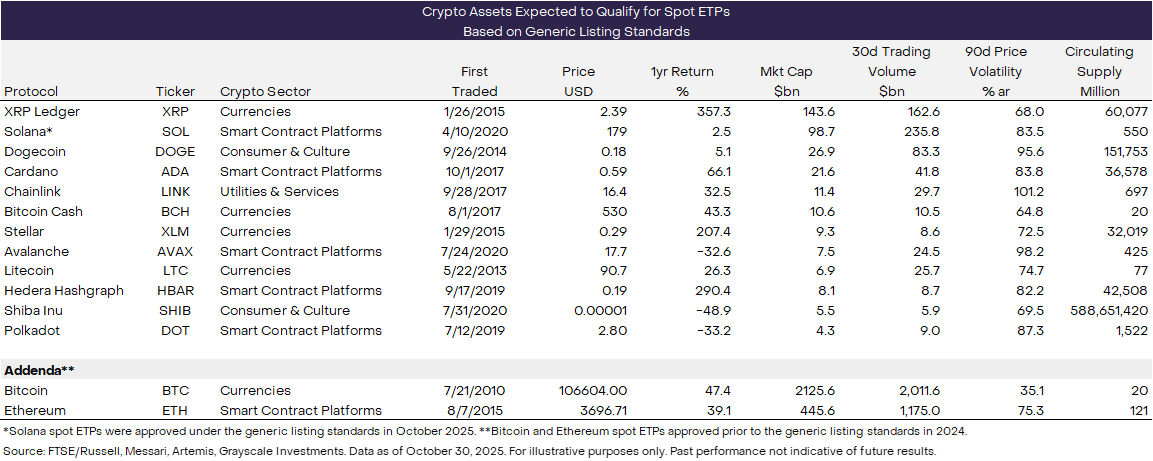
Meanwhile, the Grayscale report showcases crypto assets that meet the SEC’s Generic Listing Standards (GLS) framework, positioning them as potential candidates for spot ETPs.

According to the report, the GLS framework, approved in September, enables exchanges to list and trade crypto ETPs without seeking individual approval for each token. Under this framework, tokens could be approved for an ETF as long as they satisfy a specific set of generic criteria, alongside an effective registration statement.  

Notably, at least 11 cryptocurrencies across four sectors qualify for spot ETPs under the SEC’s approved Generic Listing Standards (GLS) framework. In the Consumer & Culture sector, Shiba Inu and Dogecoin are the only assets recognized.

From the FTSE Grayscale Currencies sector, XRP, Litecoin, Stellar, and Bitcoin Cash meet the GLS requirements for spot ETFs, according to Grayscale.

Within the Smart Contract Platforms niche, Polkadot, Cardano, Solana, and Avalanche qualify as eligible tokens. Lastly, Chainlink stands as the sole representative from the Utilities & Services sector that qualifies for a spot ETP.  

Grayscale highlights Shiba Inu Among Cryptos Eligible for Spot ETF

In the meantime, Solana and Litecoin ETFs are currently trading in the U.S., with other cryptocurrencies, such as Cardano, XRP, Dogecoin, and Bitcoin Cash, awaiting approval. 

No Standalone SHIB ETF Application in the US 

Despite the push to have Grayscale launch a spot ETF tied to SHIB, Shiba Inu still does not have an exclusive spot ETF application in the U.S. However, leading asset manager T. Rowe Price recently highlighted Shiba Inu among the cryptos that could feature in its Active Crypto ETF. 

Beyond the U.S., Valour Inc. launched a SEK-denominated ETP linked to Shiba Inu’s price action in Europe. Although Grayscale highlights Shiba Inu among the tokens eligible for a spot ETP under the GLS framework, it remains uncertain whether the asset manager would follow through with a registration statement. 

Aster Jumps 30% After CZ Reveals $2M Personal Purchase

0

The native token of decentralized perpetuals exchange Aster (ASTER) climbed more than 30% on Sunday after Binance’s Changpeng “CZ” Zhao disclosed that he had bought over $2 million worth of the asset.

Before Zhao’s post, Aster traded at $0.91. Within an hour of his announcement on X, the price rose above $1.20, marking a sharp intraday gain.

“I am not a trader. I buy and hold,” Zhao wrote, signaling his long-term confidence in the project.

Market Reaction

The crypto market responded swiftly to Zhao’s disclosure of his Aster investment. Aster’s token climbed to $1.07, recording double-digit gains shortly after the announcement. Meanwhile, BNB, the native cryptocurrency of Binance Smart Chain, also rose more than 5% to $1,123, reflecting renewed optimism across Zhao-linked assets.

Aster price chart CoinMarketCap

Aster’s Rise Amid Perpetual Exchange Boom

Aster has rapidly gained attention among decentralized perpetual exchanges, a sector that has seen significant expansion in 2025.

According to Defillama, the platform processed over $70 billion in trades during the past week, surpassing that of rival Hyperliquid.

However, some analysts have questioned the reliability of those numbers. 0xngmi, the pseudonymous head of DefiLlama, temporarily removed Aster’s trading data after failing to verify the reported volumes. 

DefiLlama later relisted Aster’s statistics while developing a new method to validate perpetual exchange data, leaving the figures under continued review.

Zhao’s Role, Legal Battles, and Renewed Influence

Aster is backed by YZi Labs, a family office managed by Zhao, and his connection to the project is therefore both financial and reputational. His public support and recent return to prominence have significantly shaped market sentiment around Aster.

However, Zhao’s influence follows a turbulent legal chapter. He resigned as Binance CEO after pleading guilty to violations of U.S. banking laws and served a four-month prison sentence. 

Following his release, Zhao received a presidential pardon from U.S. President Donald Trump on October 23, 2025, as reported by The Crypto Basic.

4,287 Buy Orders on Coinbase Amass 2.37M XRP By Single Entity

0

An entity has leveraged a TWAP strategy to amass nearly $7 million worth of XRP across thousands of buy orders on Coinbase.

Market analyst and order book expert Dom first called attention to this interesting market behavior in a recent post on X. Notably, XRP purchases worth millions typically dominate exchanges on occasion, triggering no suspicions, but the recent buy orders caught the attention of market observers due to the manner of execution.

Entity Purchases Nearly $7M in XRP Using TWAP

Specifically, Dom confirmed that a trader had turned on some sort of Time-Weighted Average Price (TWAP) trading algorithm for XRP on Coinbase. He highlighted the XRP incident shortly after calling attention to an early TWAP that accumulated 30,000 Ethereum (ETH) over an hour on Binance.

For the XRP TWAP, data shows that the trading algorithm placed orders to buy 638 XRP tokens worth $1,588 about 4,287 times on Coinbase. Put together, these buy orders amount to a whopping 2.735 million XRP tokens, currently worth over $6.8 million at the current XRP price of $2.49 per token.

For the uninitiated, A TWAP is a trading method where traders use a bot to spread a large order in smaller bits over a set period. Notably, instead of placing one large trade that could move the market, it breaks the order into smaller trades executed at regular intervals.

Importantly, the goal is to get an average price close to the market’s typical price during that time. This approach helps traders, especially institutions, buy or sell steadily without causing sudden price swings.

Impact of the TWAP Order

Data from an accompanying chart shared by Dom shows that the $6.8 million purchase spread across 4,287 buy orders had a massive impact on the XRP Cumulative Volume Delta (CVD) on Coinbase. Notably, the CVD measures the difference between the cumulative buy and sell orders on an exchange.

XRP CVD and Price on Coinbase Dom
XRP CVD and Price on Coinbase | Dom

The large purchase led to a rapid spike on the Coinbase CVD from 11 AM on Oct. 31 to 11:45 AM, pushing the metric close to 14 million XRP. Interestingly, the CVDs of other crypto exchanges, including Binance, Bybit, OKX, Upbit, and Kraken, remained between -2 million and 2 million XRP within this period.

This development also had an observable impact on the XRP price on Coinbase. Specifically, while XRP traded around $2.545 on other exchanges, it rose to $2.555 on Coinbase, pushing the Coinbase Premium up. 

Notably, this aligns with a recent commentary from Vincent Van Code, who suggested last month that, with the XRP reserve available on Binance order books, a single $15 million buy order could push prices to $15. The latest TWAP order, worth nearly $7 million, aimed to avoid such large price swings, as noted by Dom.

Bitcoin Price Dips Below $108,000 as $463 Million in Liquidations Sweep the Market

0

Bitcoin fell sharply below $108,000 on Monday, triggering one of the largest liquidation waves seen in weeks. 

The move extended the weakness seen at the end of October, and reignited fears of short-term volatility in the broader crypto sector.

According to CoinMarketCap, Bitcoin was last changing hands near $107,482, down 2.85% over the past 24 hours. The move wiped out leveraged positions across exchanges, resulting in over $463 million in liquidations, according to Coinglass data.

A total of 173,765 traders were liquidated during the downturn. Among them, long positions took the biggest hit, losing about $405.27 million. Short positions incurred losses of approximately $57.97 million. The single largest liquidation occurred on Hyperliquid, where a BTCUSDT order worth $8.43 million evaporated.

The widespread liquidations underscored growing trader anxiety following a shift in macroeconomic sentiment.

Fed Uncertainty and Stronger Dollar Weigh on Crypto Market

Analysts attributed a mix of macroeconomic pressures to Bitcoin’s latest drop. A firmer U.S. dollar and reduced confidence in a faster Federal Reserve rate-cut cycle have weakened risk appetite across financial markets.

Last week, the Fed reduced its benchmark lending rate by 0.25 percentage points. This adjustment brought the rate to a range of 3.75%–4%, the lowest level in three years. However, Fed Chair Jerome Powell warned that an additional cut in December is “not guaranteed,” signaling a more cautious stance on monetary easing.

The rate decision came as the U.S. government shutdown reached its one-month mark, delaying key labor and inflation data. Economists described the Fed as “flying blind,” navigating policy decisions without updated figures on the job market.

Altcoins Follow Bitcoin’s Lead

Bitcoin’s slide rippled through the broader crypto market. Ethereum fell nearly 5% to $3,710, while XRP declined around 4% to $2.45. The total cryptocurrency market capitalization slipped by 3.64% to $3.59 trillion.

Market observers described the current weakness as a continuation of October’s soft close, not an isolated correction.

Crypto prices in red including Bitcoin
Crypto prices in red, including Bitcoin

MicroStrategy Hints at Potential New Bitcoin Purchase

Despite the bearish tone, institutional activity remains a key talking point. MicroStrategy founder Michael Saylor once again sparked speculation about fresh Bitcoin accumulation by posting “November’s color is orange” on X (formerly Twitter).

MicroStrategy holds 640,808 BTC valued at around $70.7 billion as of November 2, 2025. The firm’s average purchase price stands at $74,032 per coin, resulting in an unrealized profit of approximately 49%, or $23.25 billion. 

Based on historical trends, analysts anticipate a new purchase announcement will arrive soon.

Cardano Founder Blames ADA Users for DeFi Woes: “Our TVL Would Be $5-10 Billion Minimum”

0

Charles Hoskinson, the founder of the Cardano network, has fired a shot at the ADA community for contributing to their DeFi shortcomings.

Notably, he highlighted this in his recent podcast, as he suggested that Cardano users are contributing to the struggles in decentralized finance (DeFi). Hoskinson noted that the total value locked on the chain would be between seven and eight digits had ADA users adopted their native DeFi platforms.

Cardano DeFi Struggles: Community Part of the Problem

Notably, Cardano lags in decentralized finance compared to its status and counterparts. As a utility network, it ranks the lowest among smart contract native chains in its pedigree by a considerable margin, with new and emerging ecosystems still outperforming Cardano.

ADA ranks 10th on the cryptocurrency market cap ranking, with a valuation of $20.6 billion. No other asset in the bracket, aside from Dogecoin and XRP, which lack native DeFi functionalities, has a total value locked (TVL) of less than $5 billion. However, Cardano has just $262 million, ranking 24th by chain on DeFiLlama.

Several industry commentators, including Hoskinson, have attributed this problem to various ecosystem shortcomings. However, yesterday, the founder introduced a new perspective. Specifically, he noted that it is a “fundamental problem” that even ADA users are not using Cardano-native DeFi products.

Hoskinson questioned how they would be able to convince users of Solana, Ethereum, and other chains to “come and play in our backyard if our own people and our own ecosystem aren’t using our DeFi products.”

Cardano TVL Would Have Been Much Larger

Meanwhile, Hoskinson emphasized that this concern needs proper deliberation within the community, and the reason for the truancy needs to be explained. Notably, he cited several potential problems, including a lack of technical know-how, security issues, poor user experience, and low yields.

Furthermore, he insisted that addressing this menace would substantially boost DeFi usage. Specifically, he noted that Cardano’s TVL should be at least $5 to $10 billion, rather than the current figure.

Notably, a $10 billion ADA TVL represents an impressive 3,716% increase from the $262 million figure reported by DeFiLlama, potentially taking the chain to third in the current ranking, just behind Ethereum ($84.22 billion) and Solana ($11.17 billion).

Reactions also supported this narrative. A user highlighted that Cardano has enough users and capital to build a thriving DeFi ecosystem independently, but holders are not actively participating in the chain.

This conversation contributes to the growing effort to increase Cardano’s TVL. Recall that Cardano is working to unlock Bitcoin and XRP DeFi, teased to change their struggling state in the sector.