
Home Blog Page 462

XRP Open Interest Just Reset Again: Here’s What Happened the Last Time This Occurred

0

XRP open interest on Binance has again reset to yearly lows, giving the XRP market more room to breathe.

This is largely due to the Oct. 10 market crash, which triggered massive liquidations across the market and gave long-term holders a clean slate. According to CryptoQuant analyst Pelin Ay, the market might be setting up for a rally similar to the one that pushed XRP to above the $3.55 peak in July.

XRP Open Interest Drops to April Lows

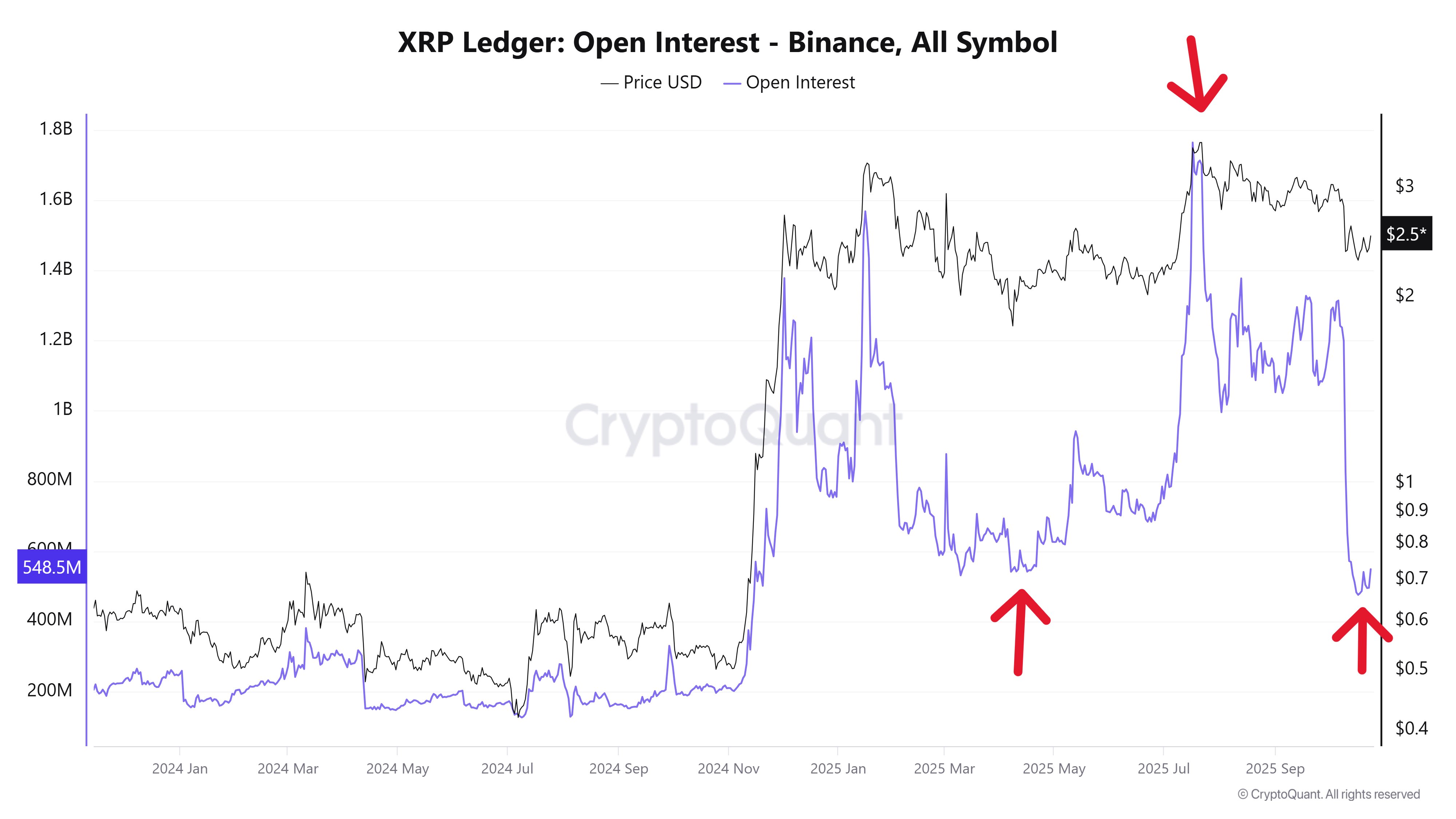
In her latest analysis, Ay explained that XRP Open Interest (OI), which tracks active futures contracts, has fallen back to the same level it reached in April/May 2025. When this happened in April, XRP traded at much lower prices, yet OI is now just as low while the token holds steady around $2.5. 

Ay believes this shows that strong holders are in control while speculative trading activity has thinned out. In simple terms, more buyers are choosing to hold actual XRP rather than play the futures market.
XRP Open Interest on Binance CryptoQuant
XRP Open Interest on Binance | CryptoQuant

She pointed out that when OI hit its bottom in April, XRP quickly climbed to $3.5 as trading volume picked up. For context, XRP open interest on Binance dropped to a low of $541.5 million on April 16. At this point, XRP traded for a range of $1.8 to $2. However, as OI recovered, prices soared to a peak of $3.55 by July.

Recently, XRP open interest has dropped to $494 million, down from the $1.3 billion peak recorded on Oct. 6, four days before the market crash. Notably, on this day, total figures stood at $3 billion. With OI now back at similar lows, Ay thinks the setup looks very similar to the April/May one.

Support and Resistance Areas to Watch

She said that such deep OI drops usually mean one of two things: either leverage has been flushed from the system, giving the market room to rise again, or traders have shifted their focus from futures to spot trading. Since XRP still trades near $2.5, she leans toward the first explanation and sees it as the early stage of a new uptrend.

Meanwhile, Ay highlighted the $2.20 to $2.40 area as a short-term buying zone. According to her, as long as XRP stays above that range, the broader bullish trend remains intact. 

Further, the analyst identified $1.85 as the major structural support that formed during the last consolidation phase. At the same time, the $0.60 to $0.70 area stands as the deeper psychological floor tied to previous OI lows.

On the upside, Ay sees the $2.80 to $3.00 band as the first resistance to watch. If XRP breaks through that range, she expects momentum to build quickly. The next test sits between $3.30 and $3.50, which marks the peak from the last rally and serves as a critical zone. 

A Possible XRP Run to $4.5

Clearing this level alongside a rise in XRP open interest could lead to a full breakout phase. Based on earlier patterns, she sees $4.20 to $4.50 as a realistic price ceiling if this move repeats.

Ay also noted that XRP’s strong price despite weak OI suggests that many short sellers might be trapped. If OI starts to climb again, those short positions could add fuel to the next leg up. 

She estimates that even a 25% rise in OI sustained over several days could spark a rapid surge toward $3.5, possibly extending the rally to $4.5 once that barrier breaks. However, analysts like Blockchain Backer believe XRP’s short-term price action may be leaning bearish.

Ripple Model Is To Spend Money In a Way To Maximize XRP Value: Ripple CTO Once Said

0

The XRP community has unearthed a past statement in which Ripple CTO David Schwartz said the company pursues business models that benefit XRP’s price.

Specifically, Schwartz made the comment exactly eight years ago, on October 27, 2017. Yet it continues to resonate within the XRP community today. 

Schwartz’s 2017 Insight on Ripple’s Strategy

Back in 2017, Schwartz explained how Ripple evaluates spending decisions to maximize the value of XRP over time.

He posed a hypothetical scenario suggesting that if Ripple had the opportunity to spend $100 million and reasonably expected it would increase XRP’s price by a penny over time, the company would consider doing so.

When asked whether Ripple even had $100 million in cash at the time, Schwartz said he couldn’t disclose the company’s finances but assured that Ripple was financially strong.

In parallel, he added that Ripple’s approach is to invest money strategically to maximize the value of its XRP holdings, and that this strategy is open and well-known. In his words:

“Ripple’s business model is to spend money in a way that allows the company to get maximum value for its stash of XRP. This is not a secret.”

Ripple’s Valuation and Crypto Holdings

That comment now carries significant weight. As of 2024, Ripple’s valuation stood at $11.3 billion, according to reports confirming its $500 million share buyback from early investors and employees.

The firm disclosed it held over $1 billion in cash and a crypto portfolio worth $25 billion, largely dominated by XRP. At the time, Ripple CEO Brad Garlinghouse also emphasized that the company remained financially strong, and consequently, it was not pursuing a U.S. IPO.

Ripple’s XRP Holdings Cross $100 Billion in 2025

According to data from Ripple’s API, as of October 27, 2025, the company holds:

  • 35,000,000,005 XRP in escrow, worth approximately $92.75 billion, and
  • 4,968,498,761 XRP in a spendable balance, worth over $13 billion.

Together, Ripple controls nearly $106 billion in XRP, marking one of the largest crypto reserves held by any company globally.

The Vision Remains Relevant Today

Meanwhile, Schwartz’s words that Ripple’s mission is to deploy resources to enhance the long-term value of XRP have further manifested in the company’s acquisition strategy.

In his latest statement, Ripple CEO Brad Garlinghouse stressed that XRP remains key to the company’s long-term vision while celebrating the completion of its $1.25 billion acquisition of Hidden Road (now Ripple Prime).

Notably, Hidden Road is part of Ripple’s five acquisitions over the past years, including GTreasury ($1B), Rail ($200M), Standard Custody (undisclosed), and Metaco ($250M).

While these deals often highlight Ripple USD (RLUSD) as a utility token, Garlinghouse stressed,

“XRP sits at the center of everything Ripple does.”

Ripple President Monica Long echoed this, noting that Ripple Prime is exploring integrating XRP alongside RLUSD as collateral for prime brokerage services. This further confirms XRP’s continued central role in Ripple’s financial ecosystem.

Wealth Manager Suggests New Launch Date for XRP ETFs

0

President of NovaDius Wealth Management, Nate Geraci, has suggested that spot XRP ETFs could potentially debut as early as next month.

Geraci shared this optimistic outlook via a viral meme that illustrates the current state of spot crypto ETFs. In the image, a massive dam labeled “Government Shutdown” holds back a flood of “Spot Crypto ETFs” from reaching “Investors.” 

This depiction aligns with the understanding that the ongoing government shutdown has stalled the approval and launch of several spot crypto ETFs, including those tied to XRP. 

Government Shutdown Preventing Wave of ETF Launch

Meanwhile, Geraci hinted that the government shutdown could end within the next two weeks, potentially lifting the dam and opening the floodgates for the launch of spot XRP ETFs. He also noted that other spot crypto-related ETFs, such as those focused on Litecoin and Solana, would debut in the same timeframe. 

SEC Suspends ETF Approvals Amid Government Shutdown 

Indeed, the U.S. government shutdown, which began on October 1, affected the operations of key federal agencies, including the SEC. This comes after the U.S. Congress failed to approve funding legislation for 2026. 

Following the shutdown, the SEC suspended most of its operations, leaving only a few staff to respond to inquiries and combat fraud and market manipulation. However, the Corporation of Finance division, which is responsible for approving or disapproving spot ETFs, was also affected by the shutdown. 

Consequently, the commission is not expected to decide the fate of the XRP ETFs until the government shutdown is lifted.

When Will SEC Approve XRP ETF?

Meanwhile, Geraci has hinted that this could happen over the next two weeks, possibly by early November. However, it remains unclear whether this would come to fruition. 

The timeline coincides with the SEC’s final decision deadline for Franklin Templeton’s XRP ETF, which was initially scheduled for November 14, 2025. According to experts like Eleanor Terrett, these deadlines are no longer effective since the SEC approved the Generic Listing Standard framework. 

As a result, the SEC could decide to issue a decision on the ETFs at any time. However, this is most likely to occur once the government shutdown ends.

Meanwhile, bettors on Polymarket predict that the ongoing government shutdown will end on or before November 23, 2025. This projection aligns with a similar forecast from prominent XRP community figure Vincent Van Code.

He believes that even after the shutdown ends, the SEC could take up to four additional weeks to approve the pending spot crypto ETFs, potentially placing the XRP ETF approval window in late November or December. 

Potential timeline for end of US government shutdown
Potential timeline for the end of the US government shutdown | Polymarket

Kyrgyzstan Launches Stablecoin, Builds Crypto Reserve, and Pilots CBDC

0

Kyrgyzstan has introduced a new stablecoin, KGST, pegged 1:1 to the national currency, the som. 

Additionally, the country has established a national cryptocurrency reserve to support its expanding blockchain ecosystem.

KGST Built on BNB Chain

The newly introduced KGST stablecoin operates on the BNB Chain, one of the world’s largest blockchain networks. The launch ceremony, held last Friday, was attended by President Sadyr Japarov and former Binance CEO Changpeng “CZ” Zhao.

In a post on X (formerly Twitter), Zhao, who has been serving as a strategic adviser to Kyrgyzstan’s crypto committee since April, noted that BNB will be included in the upcoming national crypto reserve.

According to local media outlet KG24, the national crypto committee has been directed to ensure KGST’s listing on international exchanges. Moreover, the committee is expected to submit a detailed proposal for a national crypto reserve within two months.

Kyrgyzstan Plans Digital Som Pilot

Alongside the stablecoin launch, the National Bank of the Kyrgyz Republic (NBKR) has confirmed plans to pilot a central bank digital currency (CBDC). The pilot program, referred to as the digital som project, will unfold in three phases.

The initial phase will connect commercial banks for interbank transfers. The second will integrate the system with the Central Treasury to handle government and social payments. The final stage will test offline and low-connectivity transactions to ensure inclusion in rural areas.

Upon successful completion of all phases, the central bank aims to implement a national rollout. However, the final decision on issuing a CBDC will come after evaluations are completed by 2026.

More than 100 countries are exploring CBDCs. However, only three nations have launched fully operational digital currencies so far: the Bahamas’ Sand Dollar, Nigeria’s e-Naira, and Jamaica’s JAM-DEX, as tracked by CBDCTracker.org.

Building a Foundation for Digital Finance

Moreover, President Japarov has emphasized the importance of education and innovation in supporting the country’s digital transformation. He has directed the Ministry of Science and Higher Education to design programs focused on financial literacy, blockchain technology, and artificial intelligence. 

In support, Binance Academy will collaborate with 10 Kyrgyz universities to deliver localized training content. The Binance app will also be fully localized for Kyrgyz users, according to CZ.

A Strategic Bet on Transparency and Growth

Kyrgyzstan’s blockchain initiatives aim to attract foreign investment, increase financial transparency, and expand government efficiency. Officials say these digital reforms will also enhance trust in banking and create new economic opportunities.

With the KGST stablecoin now live and CBDC trials on the horizon, Kyrgyzstan is determined to establish itself as a global leader in digital finance innovation.

A $10M Buy on Binance Could Push XRP to $15 — Here’s How

0

A well-known XRP community figure recently called attention to a tightening XRP liquidity on Binance, arguing that a large buy could push prices up.

Notably, XRP has recently recovered to above $2.6 after days of range-bound price action. While the rebound looks encouraging, some in the community note that XRP may be facing a major supply crunch that could send its price soaring in the near future.

XRP Supply Tightening on Binance?

Software engineer Vincent Van Code called attention to this issue in a recent discussion. Specifically, he claimed that Binance, one of the largest crypto exchanges in the world, currently holds only about four million XRP on its order book. However, there is no confirmation for this claim. This is especially strange considering Binance’s position in the industry.

According to him, anyone trying to buy 10 million XRP directly from the exchange would start at $2.60 and likely push the price up to $15 before completing the purchase. 

This is due to the theory that the 10 million buy order would first clear the 4 million token available supply and then push prices upward. Nonetheless, this remains unconfirmed at press time, as XRP generally boasts much higher liquidity. Interestingly, even on Coinbase, the XRP supply appears to be shrinking rapidly.

Van Code explained that large investors usually avoid creating this kind of price spike by buying through over-the-counter (OTC) or wholesale channels instead of trading directly on public exchanges. 

OTC Desks Also Drying Up

For context, these private markets allow big investors to buy or sell massive amounts of XRP without causing sudden moves in the market. OTC deals typically happen off-exchange at negotiated prices, keeping the market steady and avoiding panic-driven fluctuations.

However, Van Code noted that the situation is changing. He said the supply in OTC and wholesale markets is drying up because most investors now prefer to hold their XRP rather than sell. 

With this tightening supply, even big buyers are struggling to find enough tokens without driving the price higher. According to him, trading bots currently help manage small market buys to prevent sharp price jumps. “It will be interesting to see what happens next,” he said.

Responding to this, one investor agreed and described the OTC market as the “canary in the coal mine” for XRP’s liquidity. They explained that if whales can no longer buy 10 million XRP without pushing prices sky-high, it’s a sign that the available supply has nearly vanished. 

The commenter compared the current situation to a slow burn leading to an inevitable explosion, suggesting that a strong rally could be close. Notably, Van Code supported this argument.

How Institutions Use OTC Desks for XRP Trades

Meanwhile, another individual questioned whether these OTC trades gave big investors an unfair advantage over retail traders, asking if such deals amounted to manipulation.

In response, Van Code affirmed that it does not particularly translate to market manipulation. He said that if someone tried to sell 5 million XRP directly on the open market, the sale would immediately crash the price and cost the seller 5 to 10% in losses. 

Instead, the seller contacts an OTC dealer who connects them with a buyer interested in purchasing a similar or larger amount. Both parties agree on a price close to the current market rate, complete the deal privately, and pay the dealer a small fee for arranging it.

Van Code added that this example shows why thin order books and low liquidity often cause delays or big price swings during large transactions — a problem XRP and the XRP Ledger were originally built to solve.

Cardano Will Probably Double “Out of Nowhere”: Crypto Expert

0

Cardano permabull Dan Gambardello has continued to hint at an explosive Cardano move, recently arguing that the token could increase twofold out of nowhere.

His analysis sounds a clarion call to those sleeping on Cardano, especially as the token enters a recovery state. After a few weeks of a sideways price trend, ADA has started to recoup lost ground, rallying over 3% over the past 24 hours.

A Glimpse of Things to Come for Cardano

Nonetheless, Gambardello suggested that this is just the start for Cardano. He shared in his Cardano price prediction that while many are still trying to observe the token’s price action, it will double “out of nowhere.”

Specifically, he predicted that this unexpected rally would take Cardano’s price to between $1 and $1.30, representing an increase of 47% to 91% from its current market price of $0.679. Notably, it would take the asset’s price to a level last seen in December 2024.

People Will Sell, but ADA Will Keep Increasing

Meanwhile, he noted that when this price spike occurs, people will sell, viewing it as a short-term move. He stated that many will see the rally past $1 as another “macro fake-out,” resulting in a sell-off.

However, Cardano will continue to thrive even with the sales. Notably, this aligns with the view that the market moves in the opposite direction to crowd sentiment, with such contrarian play widely known to benefit the brave.

Moreover, the top analyst emphasized that this resilience would prompt people to reevaluate their bearish positions and trigger panic buying. When they do, prices will consolidate.

He added that the same cycle of selling during brief dips and buying the top would continue with Cardano persistently climbing to higher prices.

How High Can Cardano Go?

Gambardello has been a longstanding macro bull and has predicted that Cardano will rally significantly in the mid- to long-term. While he did not mention any target for this continued ADA climb, his past analysis did.

He recently suggested that Cardano will reach $7.5 this cycle and further provided the best ways to scale out, indicating his confidence in the move. He also believes that $10 is a realistic target for Cardano.

Other analysts also share similar price targets. For instance, stake pool operator Ssebi highlighted that Cardano at $10 is cooking, tapping widespread adoption and ETF prospects to drive this rally.

Community Reactions

Meanwhile, some met Gambardello’s prediction with optimism, and others disagreed. A reaction highlighted that ADA has trended poorly against Bitcoin and that the token isn’t worth holding. Another user also mentioned that ADA has no users.

Nonetheless, other reactions concur with the projection, noting that patient ADA holders will win. Another user agrees with the sudden move, insisting that ADA moves when no one expects it. Others also believe Cardano’s technology and community will catalyze this surprising move.

Here’s How High Cardano Needs to Go If You Plan a $1M Retirement with 50,000 ADA

0

The prospect of retiring on cryptocurrencies is gaining momentum, and Cardano holders are among those hoping their ADA bags deliver such upside.

Cardano has joined a broader market recovery today, rallying 5% over the past 24 hours to reach $0.6861. The current bullish momentum is a deviation from the previous bearish price action in recent weeks, which saw ADA retest $0.279.

Nevertheless, holders are looking beyond the current price development, as they express commitment to Cardano’s long-term potential, which some believe could help them retire. Bearing this in mind, we recently analyzed the prospects of retiring as an ADA millionaire and how this could happen with 50,000 tokens.

What It Takes to Buy 50,000 ADA

We have established that Cardano trades at $0.6861 with a market cap of $24.58 billion. The current market price is a 48% discount from its December 2024 high of $1.32 and a staggering 78% drop from its August 2021 all-time high of $3.106.

This means that buying 50,000 ADA is cheaper now than at those points. However, one would have also acquired it more cheaply if they had purchased the cryptocurrency at some point this month.

For perspective, one would buy 50,000 ADA at the current price of $0.6861 for a total of $34,305. If they bought at $1.32 in December 2024, it would have cost $66,000. At its all-time high of $3.106, the same stash would be worth $155,300.

Nonetheless, if the investor bought 50,000 ADA when the token crashed to $0.279 on October 10, the user would have spent only $13,950. This suggests the importance of buying the dips and how it positions buyers for more gains during periods of price increase.

Retiring With $1M and How to Do So With 50,000 ADA

Meanwhile, $1 million is a reasonable amount of money for those looking to retire from work. Many might find this moderate, while others might believe it is enough; it all depends on one’s lifestyle, age, and location.

For Cardano to make one rich in seven figures, it would have to grow considerably from the current price. Recall that 50,000 ADA currently costs $34,305. Hence, reaching $1 million would result in an impressive 2,815% growth.

If we apply the same percentage growth to Cardano’s price, it suggests that ADA would have to grow by 2,815% from $0.6861 to make one a millionaire. Specifically, this results in a price of $20 per coin.

Cardano to $20?

Interestingly, analysts have predicted that Cardano could reach $20 soon, one of whom is Altcoin Oracle. The delegated representative (DRep) emphasized that ADA could achieve this 2,815% growth if Cardano becomes the primary Bitcoin DeFi enabler.

Meanwhile, Changelly predicts that Cardano could reach $20 by December 2033 in a bullish case, which is 8 years away.

Changelly Cardano Prediction

Western Union Explores Stablecoins for International Transfers

0

Global payments leader Western Union is preparing to launch a stablecoin-based settlement pilot, marking its most significant move toward blockchain-powered remittances.

Specifically, the pilot aims to improve the company’s approach to managing its extensive payment network, which processes 70 million transactions quarterly across 200 countries and serves over 150 million customers worldwide.

Speaking during the firm’s third-quarter earnings call, CEO Devin McGranahan stated that the program will explore using blockchain-based settlement channels to reduce dependence on traditional banking intermediaries.

He emphasized that blockchain can speed up cross-border payments, lower costs, and improve transparency while maintaining compliance and customer trust. 

McGranahan added that the decision follows several months of exploration into digital assets and blockchain applications. The company had previously hinted at using stablecoins but delayed the effort due to regulatory uncertainty and concerns about volatility.

Regulatory Clarity Enables Innovation

Western Union’s renewed confidence stems from the recent passage of the GENIUS Act. Indeed, the legislation provides a more transparent regulatory framework for stablecoins, thereby supporting the company’s enhanced outlook.

McGranahan said the new legislation gives companies like Western Union “the clarity needed to innovate responsibly” within the financial system. 

Stablecoins are tools to streamline settlements and reduce transaction costs in the remittance sector.

Stablecoins Gain Momentum Across Financial Institutions

In April, the U.S. Treasury Department reported that the stablecoin market, which has surpassed $300 billion, could grow to $2 trillion by 2028. This surge highlights growing institutional and consumer confidence in blockchain-based payment systems.

Western Union believes stablecoins could particularly help customers in high-inflation markets, where holding U.S. dollar–backed assets preserves value.

“Access to stable dollar assets is meaningful for many users globally,” the company said in a statement.

Competitors Accelerate Blockchain Adoption

Western Union’s move follows similar developments among major payment firms. For instance, Early Warning Services, the parent company of Zelle, recently announced plans to integrate stablecoins for cross-border payments. Meanwhile, MoneyGram is preparing to launch a USDC-based app in Colombia, offering near-instant savings and transfers.

On the crypto side, Crypto.com has partnered with Morpho, a leading DeFi lending protocol, to introduce stablecoin lending markets on its Cronos blockchain.

The collaboration will let users deposit wrapped Bitcoin and Ethereum as collateral and borrow stablecoins within the same ecosystem.

Banks Join the Stablecoin Race

Traditional banks are also entering the stablecoin arena. In August, Citigroup announced plans to develop a Citi-branded stablecoin and explore tokenized deposits designed to enable uninterrupted settlement services for corporate clients.

In June, JPMorgan introduced JPMD deposit tokens to streamline blockchain-based payments for institutional clients.

Shiba Inu in November: Here’s How SHIB Has Performed

0

With Shiba Inu enduring a double-digit decline this October, investors are now shifting their focus to November in hopes of a potential recovery.

October has historically been a strong month for Shiba Inu and the broader crypto market, often delivering major price rallies. Many leading tokens, including SHIB, achieved their all-time highs in past Octobers.

Specifically, Shiba Inu reached its peak price of $0.00008845 in October 2021. Due to the bullish performance of crypto assets in October, investors nicknamed the month “Uptober.”

However, this year, Shiba Inu has struggled to meet expectations, much like most other crypto assets. The meme-based token is down 10.4% month-to-date, reflecting the broader crypto slowdown..

Shiba Inu Historical Trend in November

With hopes for a bullish Uptober fading, investors are now turning to November in anticipation of a potential market rebound. Amid these rising expectations, we examined data from CryptoRank highlighting Shiba Inu’s historical November performance and what investors might anticipate next month.

Although SHIB launched in August 2020, its first recorded November performance came in 2021, just a month after hitting its all-time high. That November, SHIB closed with a 29.6% decline, following an extraordinary 833.6% surge in October.

Shiba Inu posted another loss the following year, closing November 2022 with another 24.8% decline. However, the trend shifted in 2023 and 2024, as SHIB closed both Novembers in positive territory, up 6.62% in 2023 and a notable 48.8% in 2024.

Overall, Shiba Inu has an average growth rate of 0.26% in November. If history repeats itself, there are expectations that Shiba Inu could post modest gains next month.

SHIB monthly performance

Will SHIB Rally Next Month?

While the two-year trend of November gains and the average growth rate of 0.26% have fueled optimism for another positive month ahead, past performance does not guarantee future results.

As observed earlier, investors’ expectations of an October rally were high on the first day of the month. However, macroeconomic events, particularly the China-U.S. trade war, dealt a heavy blow to the broader crypto market, with Shiba Inu losing 10.4% of its value this month alone.

Currently, Shiba Inu is trading at $0.00001060 per token, up 4.71% over the past 24 hours and 3.87% over the past week.

As November approaches, investors will be watching key catalysts that could help drive a stronger performance next month.

Factors such as accelerated token burns, increased adoption of Shibarium, major product launches or integrations, a potential SHIB-related ETF filing in the U.S., and overall market strength could all contribute to renewed bullish momentum for the token.

Ripple CEO Confirms That XRP Is the Heart of Ripple’s Strategy

0

Ripple CEO Brad Garlinghouse has recently stressed that XRP remains the heartbeat of the company’s long-term vision. 

Garlinghouse made this known while celebrating the completion of the Hidden Road deal. For context, Ripple announced last week that it has completed the acquisition of Hidden Road for around $1.25 billion. Accordingly, Hidden Road has now rebranded to Ripple Prime.

Celebrating the acquisition, Garlinghouse noted that Hidden Road represents part of Ripple’s five major acquisitions over the past two years. The company’s recent expansion streak includes the $1 billion purchase of treasury management firm GTreasury (October 2025) and the $200 million acquisition of stablecoin-focused payment provider Rail (August 2025).

In addition, the company completed the purchase of regulated custodian Standard Custody for an undisclosed amount (June 2024) and the $250 million acquisition of Swiss-based digital asset custody firm Metaco (May 2023).

XRP Is Ripple’s Heart

While most of these deals, particularly Hidden Road, fronted Ripple USD (RLUSD) stablecoin as the token utility token, Garlinghouse reminded the crypto community that everything it does still revolves around XRP.

“XRP sits at the center of everything Ripple does,” he said, adding, “Lock in.”

His statement reaffirms the importance of XRP to Ripple’s broader goal of building an internet of value.

Ripple President Monica Long also reinforced XRP’s central role in the company’s expanding financial ecosystem. In a statement, Long confirmed that Ripple Prime is actively exploring ways to integrate XRP alongside RLUSD as a collateral asset within its prime brokerage offerings.

Amid this effort, she teased that the future is bright for XRP, especially as Ripple expands its footprint across value transfer, prime brokerage, and asset custody.

Ripple’s Use of XRP

Notably, XRP has long been a bridge asset in Ripple’s payment system. Institutional clients have leveraged the token in facilitating cross-border settlements.

However, Ripple has expanded its ecosystem with services such as real-world asset tokenization, asset custody, and prime brokerage. The launch of RLUSD in December led some to suggest XRP’s role is diminishing.

Meanwhile, Garlinghouse has made it clear that XRP remains central to the company’s operations, despite concerns that RLUSD might be prioritized over the token.

Critics had argued that XRP was being relegated to covering transaction fees on the XRPL. But Garlinghouse’s latest statement reaffirmed that XRP is the “heartbeat” of Ripple.

To reinforce this commitment, Ripple recently partnered with major players, including SBI and Kraken, to invest $1 billion in creating the world’s largest corporate XRP treasury, Evernorth.

The company has already sent over 200 million XRP to Evernorth’s corporate reserve. Ripple’s chairman, Chris Larsen, also invested 50 million XRP in the initiative.