
Home Blog Page 490

Expert Shares Why XRP Price Could Be Worth More in the Future

0

Analyst Austin Hilton outlined five key reasons XRP remains a significant asset and why its value could increase over time. 

In a nine-minute video shared on X, Hilton first highlighted the bearish trend across the crypto market that has impacted assets like Bitcoin, Ethereum, and XRP.

For context, XRP has continued to trade below the $3 mark, with one token currently at $2.82. It is down 6.72% over the past week.

Factors That Could Boost XRP Value

Despite XRP’s recent bearish performance, Hilton outlined five key factors that reinforce the token’s long-term potential and strengthen his conviction that its price will rise in the future.

Cross-Border Payments and Remittance Efficiency

The pundit suggested that one of XRP’s most powerful use cases lies in cross-border payment. According to him, Ripple’s international payment solution is faster, cheaper, and more efficient than traditional systems like SWIFT.

He suggested that by using XRP as a bridge currency for these transactions, Ripple eliminates the need for pre-funding accounts and reduces settlement times to around 3-5 seconds.

He reasons that as more institutions adopt Ripple’s payment system and leverage XRP for cross-border transactions, its value could rise over time.

XRP Use Case in Loyalty and Travel Program Integration

Hilton highlighted what he described as a surprising but increasingly relevant growth avenue for XRP: its use in loyalty and travel programs. He mentioned that Webus International established a $300 million XRP treasury to support on-chain travel vouchers and loyalty points through its subsidiary, WeTour.

The development stems from a partnership between Webus and Air China. Under the collaboration, 60 million PhoenixMiles loyalty members of Air China can pay for premium chauffeur and airport services directly in XRP.

He also mentioned that SBI VC Trade Japan also introduced a loyalty campaign that allows its users to earn XRP. In his view, this growing utility strengthens demand and diversifies XRP’s use cases beyond corporate finance to everyday customer utility.

Institutional Adoption and Treasury Use

Furthermore, Hilton stressed that XRP’s institutional adoption has been gaining momentum recently. He said institutions are now treating XRP as an operational and reserve asset.

Indeed, public companies, including Wellgistics Health, Webus International, and VivoPower, are establishing millions of dollars worth of XRP treasuries.

As more institutions adopt XRP as a reserve asset or bridge currency, this demand could impact the token’s price.

Regulatory Clarity and Ecosystem Growth

Additionally, Hilton mentioned how the resolution of the Ripple lawsuit ended the regulatory uncertainty plaguing XRP’s adoption and price action. Alongside the regulatory progress, he suggested that the growth of the XRP ecosystem is another factor that could drive the token’s price in the future.

Hilton highlighted that the number of wallets on the XRPL network and participating institutions within the ecosystem have been on the rise. At the moment, the number of addresses holding XRP stands at 7,088,320 (7.08 million).

Technological Features and Ledger Upgrades

Another pillar of XRP’s value proposition is the continuous evolution of its underlying technology, the XRP Ledger (XRPL). Hilton pointed out that XRPL’s use cases range from payments, stablecoin issuance, and asset tokenization to even decentralized finance (DeFi) applications.

He argued that the blockchain settles transactions within seconds compared to Bitcoin’s 10-minute confirmations or SWIFT’s multi-day processes. Hilton believes that these features strengthen Ripple’s case to handle a significant portion of international payments.

Essentially, Hilton sees potential for XRP’s value to grow due to various factors, including Ripple’s system.

Meanwhile, Ripple’s use of XRP for cross-border payments has recently come into question. Some critics suggest the company now favors its stablecoin, RLUSD. While RLUSD runs on the XRP network, the extent of its impact on XRP’s price remains uncertain.

SNEK Lead Dev Shares the Most Heart-Breaking Cardano Chart of All

0

ADA Orca, the lead developer of the SNEK meme coin and founder of Orca Labs, has highlighted a concerning trend in the Cardano ecosystem.

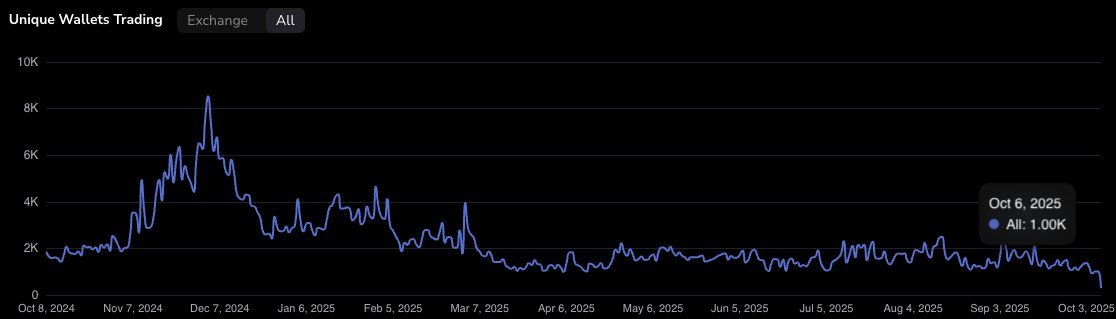
He pointed out what he described as the “most heart-breaking Cardano chart of all” in his Thursday tweet. Specifically, it showed a consistent decline in the unique wallets trading on Cardano since December 2024.

Dev Raises Cardano User Decline Concerns

His shared chart shows that the number of unique wallets on the Cardano ecosystem stands at just 1,000 addresses as of October 6, an over 87.5% decline from its peak above 8,000 late last year. For context, unique wallets show the total number of unique addresses interacting with a network over a specified timeframe.

Cardano Unique Wallets Decline | ADA Orca

During the Donald Trump-spurred rally between November and December 2024, the unique wallets trading on the Cardano network grew exponentially. It moved from under 2,000 in October to a peak of over 8,000, according to the chart.

However, things have turned south since then, with the number of addresses trading on Cardano continuing to decline. This metric dropped below 4,000 in February, and while it briefly reclaimed the level in March, it has trended even lower.

The downtrend suggests a shift in trading interest among market participants from Cardano, possibly to other chains. Notably, the number of unique users typically affects volume, helps generate network fees, and consequently impacts the price of the assets domiciled in the blockchain.

Unsustained Cardano Hype

Meanwhile, ADA Orca noted that several projects made efforts to revive user traction to the Cardano network, but none have had a lasting impact. He tied the spike in unique wallets in December 2024 to projects like Charles the Chad (CHAD), Agentic T (AGENT), and SUGR Token (SUGR).

The Cock Coin (COCK) hype in January also attracted users to Cardano. Notably, the coin surged to become the third-largest meme coin in the Cardano ecosystem in February, following its rapid price growth a month earlier.

However, the buzz quickly faded, and users have slowly exited the Cardano ecosystem for other chains with stronger narratives. “After that, it’s down only,” he noted.

Divided Cardano Ecosystem?

Meanwhile, some suggest that Cardano’s user woes have come from its internal crisis. Founder Charles Hoskinson has persistently been at loggerheads with a faction of the community, as some enthusiasts claim he is part of the network’s problem.

A recent feud with the SNEK community over exchange listing funding saw a user, Federico, claim that the Snek meme coin has contributed more to the ecosystem than Midnight. He contended that Cardano would be nothing without SNEK, citing its position as the largest Cardano-native token.

This came after Hoskinson disagreed on funding SNEK’s listing on exchanges using the ecosystem treasury. His disposition raised comments that the ecosystem has failed to promote its own, which typically fuels the lack of traction.

Nonetheless, Hoskinson recently stated that everything is getting better in the Cardano ecosystem. He had also claimed that Cardano is going to break the internet, insisting it is sound money.

Finance Expert Bet-David Mentions XRP as Possible Swift Replacement

0

Patrick Bet-David has spotlighted XRP as a potential candidate amid recent discussions about the possible replacement of SWIFT by more modern systems.

This discussion, spearheaded by American businessman and financial commentator Bet-David, came up in one of the latest episodes of the PBD Podcast featuring Tom Ellsworth, Chief Strategy Officer at PHP Agency, and Brandon Aceto, Head of Research for Valuetainment, as guests.

Notably, the podcast, which boasts over 2.77 million subscribers on YouTube, covered several major financial topics, including the New York Stock Exchange’s $2 billion investment in Polymarket and Bitcoin’s ongoing rally, which recently saw it surpass a new all-time high above $126,000.

Could SWIFT Be Replaced?

During the segment on Bitcoin’s rally, Bet-David asked Ellsworth if he thought another modern system could someday replace SWIFT. Interestingly, Ellsworth answered yes without hesitation. 

He explained that the financial industry constantly evolves and often replaces outdated systems with more modern ones. To make his point, Ellsworth mentioned how SOFR replaced the LIBOR benchmark. 

He said SWIFT has long served as a transport system for money transfers, but the rise of blockchain now makes room for newer, faster alternatives.

However, Ellsworth also made a comparison between wire transfers and ACH transfers. He pointed out that even though ACH is newer, wire transfers still move money faster. He used this instance to explain how newer systems sometimes complicate things instead of improving them.

Bet-David Spotlights XRP and Ripple

Bet-David agreed with Ellsworth’s take and called it a great observation. From there, he then spotlighted Ripple and XRP. 

He mentioned the huge amount of money recently flowing into Ripple and said that many people now see it as a serious alternative to SWIFT. He then asked Aceto what he thought about Ripple’s role in the future of global payments.

In response, Aceto said SWIFT has become an old and inefficient system. He explained that SWIFT doesn’t actually move money, as it only sends messages between banks that later adjust their ledgers. According to him, this setup causes delays and extra costs. 

In contrast, Ripple’s payment system and other blockchains allow money to move across borders in seconds and at very low fees. Aceto said this directly addresses SWIFT’s biggest weaknesses: speed and cost.

Responding, Bet-David noted that many others are also asking the same question about what might replace SWIFT. He mentioned that he and Ellsworth had met with someone recently who is involved with another cryptocurrency project.

Previous Discussions around XRP Replacing SWIFT

Notably, this isn’t the first time Bet-David has brought up XRP’s potential role in global payments. Back in March 2025, on a different PBD Podcast episode, he highlighted analyses from other experts who predicted that XRP could one day replace or disrupt SWIFT. 

He emphasized that the predictions did not come from him but from analysts and commentators in the crypto space. During the commentary, Bet-David pointed out XRP’s biggest advantages: transaction times of just three to five seconds and fees that cost only a fraction of a cent. 

He shared analysts’ calculations showing that SWIFT currently handles around $5 trillion in daily transactions, or about $1.25 quadrillion each year. Some experts suggested that if XRP captured just 5% to 10% of that volume, it could push the token’s price to $100 and generate about $125 trillion in yearly volume. 

In an even more ambitious scenario, where XRP completely replaces SWIFT, these analysts projected the token could reach $1,000 with a $10 trillion market cap. However, Bet-David clarified that these forecasts usually come from enthusiastic XRP proponents.

While the recent podcast explored the idea of XRP replacing SWIFT, new developments show that SWIFT is not standing still. Late last month, during the Sibos Conference in Frankfurt, SWIFT announced plans to build a blockchain-based shared ledger system in partnership with blockchain firm Consensys.

Deutsche Bank Analysts See Bitcoin Emerging as a Central Bank Reserve by 2030

0

The transformation of Bitcoin from a volatile digital asset into a credible financial instrument could soon reach a historic milestone.

According to Deutsche Bank analysts Marion Laboure and Camilla Siazon, the world’s largest cryptocurrency may become part of central bank reserve holdings by 2030.

In a recent research note, the analysts said Bitcoin is increasingly acting like gold, displaying reduced volatility, higher liquidity, and a predictable supply. They argue that these features make it suitable for long-term balance sheet management.

“Bitcoin could serve as a modern cornerstone of financial security, much like gold did in the 20th century,” they wrote.

Bitcoin and Gold Rise as Investors Seek Safe Havens

The Deutsche Bank report comes amid a strong rally in both Bitcoin and gold. Bitcoin recently hit an all-time high of $126,080, while Gold has surged above $4,000 per ounce.

Notably, both assets are benefiting from investors looking to diversify away from the U.S. dollar and traditional equities.

In particular, gold’s price has risen more than 50% in 2025, marking its fastest annual gain since 1979. Goldman Sachs now expects prices to reach $4,900 per ounce, citing persistent demand from sovereign institutions. 

Analysts say this pattern is now extending to Bitcoin as corporations and financial institutions begin treating it as a long-term store of value.

Institutional Confidence in Bitcoin Is Growing

For instance, corporations like Strategy, led by Michael Saylor, have become major advocates of Bitcoin as a strategic asset. The company has made Bitcoin a central part of its balance sheet strategy, a move that has inspired other firms to follow suit.

Deutsche Bank analysts believe this growing trend of Bitcoin treasuries is helping legitimize the asset in the eyes of global investors. The normalization of Bitcoin within institutional portfolios marks a significant step in its evolution from speculation to strategic allocation.

Although Bitcoin lacks physical backing, the analysts argue that the same can be said for gold. The key difference, they note, lies in the maturing crypto market.

With volatility at its lowest in years and liquidity expanding, the perception of Bitcoin among policymakers and investors is shifting.

Central Banks Explore Diversification Beyond Gold

Over the past decade, central banks, particularly in emerging economies, have been steadily increasing their gold reserves. The move serves as protection against geopolitical instability and a weakening U.S. dollar.

Deutsche Bank’s report suggests that Bitcoin could soon play a similar role in central bank portfolios. As market trust grows and regulations mature, analysts see digital assets complementing traditional reserves such as gold and foreign currencies.

Finally, the report notes an interesting paradox: while the S&P 500 has gained nearly 15% this year, capital continues to flow into ‘safe-haven’ assets such as gold and Bitcoin. This reflects growing caution amid global economic and political uncertainty.

Cardano Finally Launches Hydra 1.0.0 to Power Lightning-Fast Transactions

0

Cardano has achieved a significant advancement in its scalability roadmap with the official release of Hydra Node version 1.0.0. 

The release, which was recently unveiled by Cardano’s scaling team on GitHub, marks the transition of the Layer-2 scaling solution from experimental development to production readiness. 

Hydra’s Core Features 

For context, Hydra is an L2 scaling solution built on the Cardano blockchain. It operates through a protocol known as “Hydra Heads,” which allows participants to conduct transactions off-chain without adding congestion to the main Cardano network. This design significantly boosts transaction speed, scalability, and overall efficiency.  

Often described as Cardano’s side-chain for scaling, Hydra is designed to enhance transaction speed, cost efficiency, and scalability across the blockchain. Notably, the upgrade also unlocks new possibilities for decentralized applications and real-time payments. 

Last year, the Hydra system demonstrated the capability of processing more than 1 million transactions per second (TPS) during a Doom gaming test. Consequently, analysts noted its integration with Cardano would enhance the network’s ability to handle large-scale transactions, while keeping fees low. 

New Updates 

According to the team, the newly released version of Hydra comes with several features, refinements, and bug fixes. 

It enables transactions to be directly submitted to Hydra Heads, allows partial deposit support, fixes the outdated information issue within the TUI, and improves API response and HTTP API status codes, among other things. 

Other notable updates include enhancing Hydra’s capability with Cardano node 10.4.1, cardano-cli 10.8.0.0, and mithril 2524.0. The team also noted ongoing work to resolve the remaining “partial fanout” issue, which represents the biggest known challenge for Hydra. This challenge affects the spread of data across the system. 

Despite this, the team celebrated the release of Hydra 1.0.0 as one that provides a solid foundation for Cardano’s broader scalability roadmap. 

Cardano Founder Celebrates Launch of Hydra Node 1.0.0 

Meanwhile, Cardano founder Charles Hoskinson has spoken highly of Hydra, highlighting its ability to handle large amounts of transactions at an incredibly low cost. 

In January, when Solana suffered a network congestion issue, Hoskinson emphasized that upgrades like Hydra could handle such problems without any disruption or additional cost to builders. 

He recently celebrated the launch of Hydra 1.0.0 and expressed optimism about its future, noting that he expects the scaling solution to achieve significant progress in 2026. 

Amazon Once Did It, and XRP Could Too, Analyst Explains Why

0

A well-known technical analyst, ChartNerd, has made a case for why the price of XRP could reach the ambitious $27 level, citing Amazon’s massive surge.

In a tweet, he identified similarities between Amazon’s decade-long consolidation from 1999 to 2009 and XRP’s price movement from 2017 to 2025. The analyst suggested that XRP may be entering the same “pre-breakout” stage that led to Amazon’s massive surge beyond $20.

According to ChartNerd, Amazon reached an all-time high (ATH) in 1999, then spent nearly ten years consolidating before exploding upwards into a long-term rally. He pointed out that XRP hit its ATH in 2018 and has spent the past eight years consolidating below it.

With this close setup, he believes XRP price is setting the stage for what could be a similar move once resistance at $3 is ultimately conquered.

Why the $27 Target May Not Be Far-Fetched

The shared chart comparison highlights Amazon’s prolonged base formation before its exponential rise. It shows Amazon’s price remained trapped under resistance until its breakout.

Meanwhile, XRP’s current structure mirrors that same accumulation zone, with the token continuously challenging its long-standing resistance around $3.

XRP and Amazon historical charts

ChartNerd implies that if XRP follows Amazon’s historical trajectory, the breakout could trigger a parabolic rise, validating his $27 price target.

While some view the $27 target as overly optimistic, ChartNerd argues that market history often repeats itself, making it a logical expectation. Just as Amazon’s decade of patience rewarded long-term holders, XRP’s multi-year consolidation could serve as the launchpad for its next cycle.

For context, a surge from the present $2.80 to $27 implies an almost 10X outlook for XRP.

Other Calls for $27 XRP Price

Notably, other market watchers like analyst EGRAG have also called for the $27 price target. In his case, he cited strong similarities between current market trends and XRP’s 2017 breakout.

In one of his most recent updates, he used a long-term linear regression channel and Fibonacci extensions to reiterate a $27 target by the end of this year.

Triple-Digit XRP Outlook Based on Amazon Pattern

Interestingly, while ChartNerd and EGRAG call for $27, another analyst drawing similarities between XRP and Amazon is calling for an even more ambitious price level in the triple digits.

Nick Anderson of Bullrunners suggests that, like Amazon’s decade-long consolidation before its breakout, XRP could eventually climb to $100 or more.

Anderson points out that Amazon took nearly 3,800 days to break past its old highs, leading to a massive rally from around $5 to over $200. He believes XRP is currently in a similar “cup and handle” formation near its previous peak and could follow a comparable path.

Speaking on Anderson’s analysis, Brad Kimes of Digital Perspectives also highlighted the regulatory challenges both faced: Amazon with FTC scrutiny and XRP with the SEC.

Notably, according to Anderson’s estimate, at $100, holding just 10,000 XRP could turn investors into millionaires. Meanwhile, many analysts do not see XRP reaching this ambitious level anytime soon.

XRP Sees Unusual 4,000,000 Token Escrow Lock Mid-month

0

The XRP community has witnessed an unusual escrow lock outside of the typical Ripple schedule, with investors questioning the origin and intent.

Notably, market tracking resource Whale Alert first called attention to the development in a recent post on X. According to Whale Alert’s disclosure, an unknown wallet locked 4 million XRP worth $11.213 million in escrow. The transaction occurred on Oct. 9 at 16:16 UTC. 

Whale Alert on X
Whale Alert on X

While the volume pales in comparison to the typical 300 million to 500 million XRP Ripple locks up at the start of each month, the timing of this event has triggered community interest, leading to speculations about the origin and purpose of the lockup.

Flare Locks Up Millions of XRP in Escrow

Notably, a quick on-chain check confirmed that the escrow lockup came from layer-1 project Flare, with the transaction involving the Flare Core Vault (2) address. Interestingly, besides the latest 4 million XRP lockup, this address has locked up millions more since Sept. 24, the date of the first FXRP minting exercise.

For the uninitiated, Flare opened up minting for its FXRP project late last month, which promises to bring DeFi capabilities to XRP, including yield-generating staking features. They launched the minting phase on Sept. 24, and in just four hours, they hit the weekly cap of 5 million XRP, as reported by The Crypto Basic.

At this point, Flare’s escrow lockups began, as the address started with 16 batches of 250,000 XRP from 15:11 to 18:01 on Sept. 24. After this, the 250,000 XRP lockups resumed the next day and continued until Oct. 5. 

Flare followed up with two more lockups of greater volume, involving 4 million XRP each on Oct. 8 and then on Oct. 9, with the latest one being the transaction recently spotlighted by Whale Alert. 

FAssets Has Hit 20M XRP Milestone

Notably, data from XRPScan shows that so far, the Flare Core Vault (2) has locked up 15.5 million XRP worth $43.55 million at press time. This figure aligns with the subsequent minting exercise, as the Flare team introduced two more weekly caps of 5 million XRP each after market participants exhausted the first on Sept. 24. 

Flare Core Vault XRP in Escrow XRPScan

As reported by The Crypto Basic, by Oct. 9, the Flare team had bridged $43 million worth of XRP, representing the assets locked up in escrow. Interestingly, this figure has since increased to 20 million XRP worth $56.42 million at press time, with Flare having exhausted another 5 million XRP minting cap.

FXRP Circulating Supply

Now, network participants expect the project to lock up more XRP tokens to reflect the latest exercise. Notably, with Flare persistently locking up XRP in escrow, this would contribute to a drop in available XRP supply, lending credibility to the “supply shock” theory propagated by some community figures.

Luxembourg’s Sovereign Fund Becomes First in Eurozone to Invest in Bitcoin ETFs

0

Luxembourg’s FSIL, a Eurozone sovereign wealth fund, has allocated 1% of its portfolio to Bitcoin ETFs, marking a regional first.

With total assets of $880 million, FSIL’s 1% allocation to Bitcoin ETFs amounts to roughly $9 million. Though modest in size, the move signals growing confidence in digital assets among European financial institutions.

Finance Minister Gilles Roth disclosed details of the investment during the presentation of Luxembourg’s 2026 Budget at the Chambre des Députés.

Bob Kieffer, the country’s Director of the Treasury, confirmed the decision in a LinkedIn post, describing it as a practical step toward diversification.

Kieffer said the move reflects the government’s recognition of Bitcoin as a maturing asset class and its intent to maintain Luxembourg’s leadership in digital finance.

Policy Change Enables Crypto Exposure

This development follows the government’s approval of a revised investment policy in July 2025. The update allows FSIL to allocate up to 15% of its portfolio to alternative investments, including cryptocurrencies, private equity, and real estate.

However, the fund chooses ETFs instead of direct Bitcoin holdings to avoid custody and security risks. This approach provides regulated exposure while minimizing operational challenges.

“To avoid operational risks, the exposure to Bitcoin has been taken through a selection of ETFs,” Kieffer noted.

Strategic Diversification, Not Speculation

Kieffer described the decision as a balanced move rather than a speculative bet. He stated that the 1% allocation was carefully selected to align with FSIL’s risk profile and long-term strategy.

“This allocation strikes the right balance while signaling confidence in Bitcoin’s long-term potential,” he said.

Officials framed the move as part of FSIL’s broader goal to diversify income sources and support sustainable growth. The policy change also aims to help the fund address Luxembourg’s economic and environmental priorities.

Evolving Attitude Toward Digital Assets

Notably, the decision represents a shift in Luxembourg’s official stance on crypto. In May 2025, the country’s risk report labeled crypto firms as high-risk for money laundering. Despite that, local institutions have expanded their involvement in the digital economy.

By investing through ETFs, FSIL has chosen a controlled path that maintains compliance while testing opportunities in the digital asset space. This demonstrates Luxembourg’s ability to adapt policy without abandoning caution.

Crypto Interest Growing Across Europe

Meanwhile, Luxembourg’s decision adds momentum to a growing European trend. For instance, Norway’s sovereign wealth fund, the world’s largest, increased its indirect Bitcoin exposure by 192% last year.

Similarly, the Czech National Bank raised its stake in Coinbase, a U.S.-based crypto exchange, in mid-2025. In addition, a Swedish lawmaker proposed creating a Bitcoin reserve earlier this year.

Elsewhere, Finland, Georgia, and the United Kingdom also hold Bitcoin. Interestingly, most of those holdings came from criminal seizures, except Georgia, which owns 66 BTC as an investment asset.

Wall Street Set to Double Bitcoin Investments by 2028: Report

0

Over half of institutional investors plan to double their investments in cryptocurrencies like Bitcoin within the next three years, according to a new report from State Street.

The findings are part of the firm’s 2025 Digital Assets Outlook. The report highlights that asset managers and owners are shifting from merely experimenting with digital assets to fully integrating them into their investment strategies.

Tokenizing Private Markets Is the First Big Use Case

Notably, the report states that institutions are likely to begin using blockchain by tokenizing private equity and fixed income assets.

For context, tokenization allows traditionally illiquid assets, such as real estate, private company shares, to be converted into digital tokens on a blockchain.

This process makes such assets easier to trade, divide into smaller portions, and update in real time. Notably, State Street found that by 2030, most respondents expect that 10% to 24% of their portfolios will be tokenized.

Institutions Expect 40% Cost Savings from Blockchain Adoption

Transparency, efficiency, and cost reduction are among the key drivers behind blockchain adoption.

Over half of those surveyed cited greater visibility into asset data as a major advantage. Meanwhile, nearly one in two respondents anticipates cost savings of at least 40% by adopting digital asset infrastructure.

40% of Firms Now Have Dedicated Digital Asset Units

Donna Milrod, State Street’s Chief Product Officer, emphasized that more clients are redesigning their operations to incorporate digital assets. Many already have dedicated teams in place, and nearly one in five more plan to do the same.

Specifically, State Street revealed that 40% of institutions now have teams focused on digital assets.

This move encompasses a wide range of innovations. They include tokenized bonds and stocks, on-chain wrappers, Central Bank Digital Currencies (CBDCs), stablecoins, and tokenized cash. Milrod notes that this is not just a tech upgrade but a major strategic transformation across the entire industry.

Institutional Investors Already Hold Billions in Crypto

Institutional investors have already established a significant presence in the crypto space through ETFs and corporate treasuries. ETFs now hold over $188 billion in Bitcoin. Meanwhile, public firms hold $118 billion in BTC, and private firms hold $51 billion.

With digital asset investments projected to double by 2028 and tokenized markets expanding, the future of crypto adoption will be shaped more by large-scale institutional moves than by retail enthusiasm.

New Tech Working Together

The research also notes that many institutional leaders see generative AI and quantum computing as complementary technologies that could further streamline and automate investment operations.

50% of Institutions Plan to Increase Allocations to Bitcoin in a Year: State Street Report

0

A new report from State Street shows that institutional investors are steadily increasing their exposure to Bitcoin and other crypto assets. 

Specifically, the report found that 50% of the surveyed firms plan to raise their crypto allocations over the next 12 months, while another third intend to keep their positions unchanged. 

Meanwhile, nearly seven in ten institutions expect to boost their holdings within five years, and a quarter of them plan major increases. Notably, this trend shows how crypto assets are becoming more acceptable in global investment strategies.

Asset Managers and Owners Increasing Exposure to Crypto

The report notes that crypto assets currently make up 7% of institutional portfolios, but the number could more than double to 16% within three years. 

Interestingly, asset managers are leading the trend, taking bigger positions than asset owners. Specifically, 14% of managers hold between 2% and 5% of their portfolios in Bitcoin, compared to 7% of owners. 

Managers are also three times more likely to invest 5% or more of their assets in Ethereum. Moreover, 6% of managers hold at least 5% in smaller cryptocurrencies, meme coins, or NFTs, compared to just 1% of owners.

Further, tokenized assets are gaining ground. Per the report, asset managers have higher exposure to tokenized public and private assets, coming in at 6% and 5% respectively, while owners sit at 1% and 2%. 

Managers also hold more digital cash at 7%, compared to 2% for owners. Meanwhile, despite expressing caution, more than half of all respondents expect between 10% and 24% of all investments to be made through digital or tokenized assets by 2030.

Bitcoin and Crypto Delivering Impressive Returns

According to State Street, the respondents are seeing impressive returns from crypto assets. Expectedly, Bitcoin delivers the highest gains for 27% of respondents, and a quarter expect it to stay on top for the next three years. 

Notably, Ethereum follows closely, with 21% saying it’s currently their best performer and 22% expecting it to remain so. However, tokenized public and private assets deliver smaller returns, about 13% and 10%, but still play an important role in diversified portfolios.

In addition, institutions also believe mainstream adoption is approaching. For instance, 68% expect digital investments to become standard within ten years, more than double last year’s 29%. 

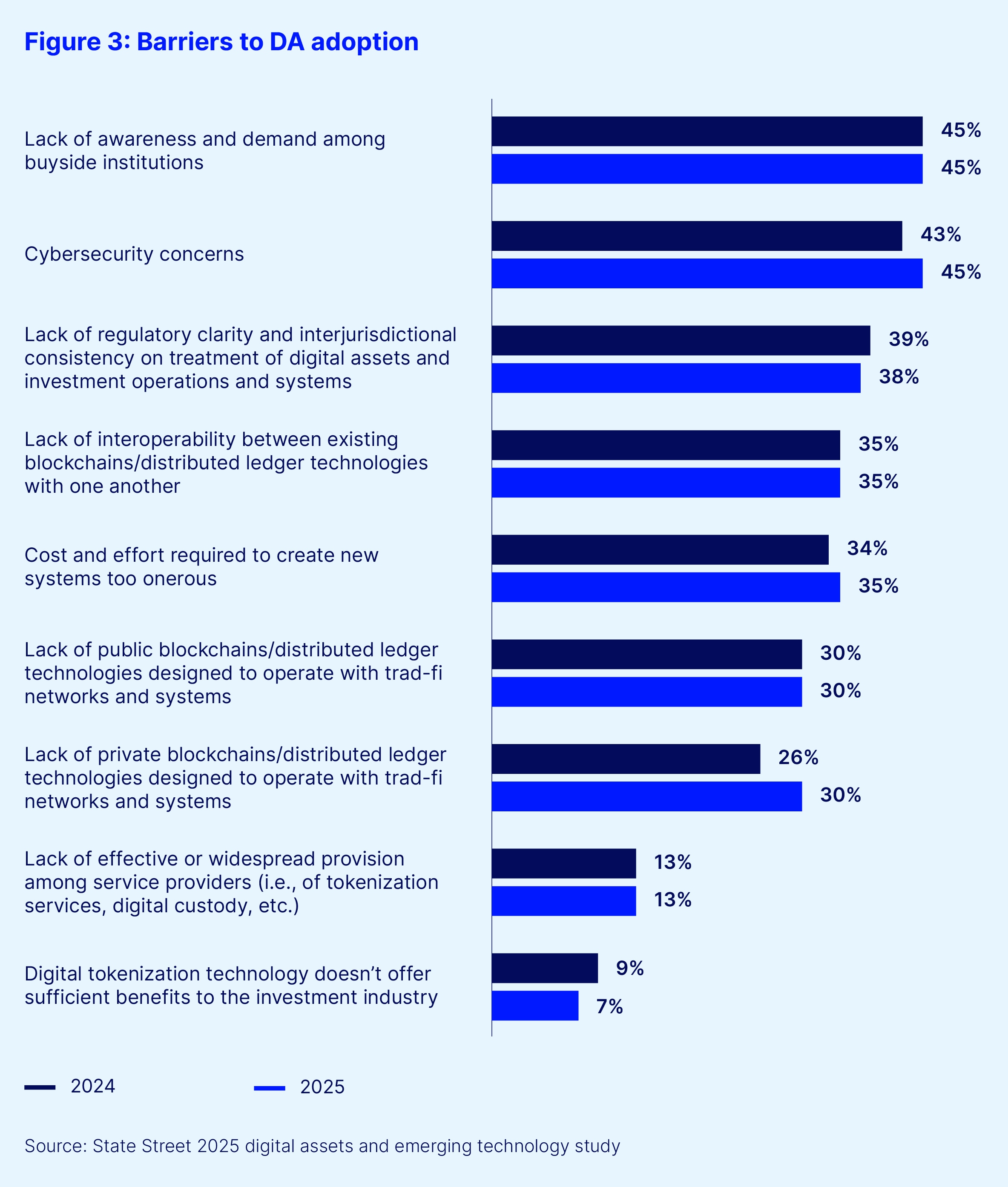
While most respondents cited challenges around cybersecurity, regulation, and education, they see crypto assets as long-term growth drivers. Respondents expect investment returns to improve by up to a third and anticipate cost savings between 23% and 37% as they include blockchain, automation, and AI into their operations.

Figure 3. barriers to da adoption

Global Surge in Institutional and Retail Crypto Adoption 

Interestingly, these institutional trends align with external data showing accelerating crypto adoption worldwide. For one, a September 2025 report from Chainalysis found that assets in tokenized funds jumped from $2 billion in August 2024 to over $7 billion a year later. 

In the United States, institutional confidence remains strong amid favorable policies. A June 2025 study from Coinlaw.io reported that 80% of U.S. institutional investors planned to increase crypto exposure in 2024, while partnerships between banks and crypto firms have grown by 52% since 2022. 

Chainalysis also revealed that North America handled $2.3 trillion in crypto transaction value between July 2024 and June 2025, with 26% of global activity coming from institutional trades such as ETF flows and portfolio rebalancing. 

Importantly, retail investors are showing the same momentum. A January 2025 research article from Security.org found that 28% of U.S. adults now own crypto, up from 27% the previous year. 

Crypto.com’s February 2025 report estimated that global crypto ownership reached 659 million by the end of 2024, a 13% jump from the year before. JPMorgan Chase Institute data through May 2025 showed that 17% of active checking account holders moved funds into crypto accounts, up two percentage points from early 2024.