Home Blog Page 527

WhiteBIT: Shaping The Web3 Future Beyond Traditional Sales

0

Business development in Web3 goes far beyond cold calls and closing deals—it’s about building the very foundation of the decentralized financial future. As the crypto space evolves, so does the role of a Business Development Manager (BDM), blending strategic thinking, technical depth, and global collaboration. For example, at WhiteBIT, the largest European cryptocurrency exchange by traffic, BDMs aren’t just selling products—they’re helping shape the next generation of financial infrastructure.

Web3 at Scale: From Deals to Global Infrastructure

In traditional industries, business development focuses on transactions—securing deals, increasing revenue, and expanding the customer base. But in Web3, the scale of work is significantly broader. At WhiteBIT, BDMs help build the foundational infrastructure that connects financial institutions, DAOs, fintech platforms, and communities across the globe.

Take the integration with the payment provider FINCI. This isn’t just another API handshake—it’s the creation of a powerful gateway that gives European users seamless access to the crypto ecosystem through familiar banking tools. It’s a leap toward mainstream trust and adoption of blockchain technologies.

Nowadays, WhiteBIT has over 1,300 institutional clients and multiple product lines tailored to diverse business needs.

Long-Term Strategic Partnerships Over One-Off Deals

Web3 is fundamentally collaborative. At WhiteBIT, the goal isn’t quick wins—it’s long-term impact.

Consider the recently announced partnership with Juventus, one of Europe’s most iconic football clubs. This wasn’t just a jersey sleeve partnership; it was a multi-layered collaboration aimed at developing a fan-driven digital economy. The result? A 30% surge in WhiteBIT Coin (WBT), driven not by marketing noise, but by community trust.

Multi-Directional Development Across the Ecosystem

WhiteBIT BDMs don’t sell a single product—they work across a full-stack crypto ecosystem with ready-made solutions, extensive infrastructure with everything clients and partners need for trading, favorable trading conditions, and strong marketing support (for listings). An example is Crypto-as-a-Service:

  • WhiteBIT empowers partners through Crypto-as-a-Service (CaaS), enabling them to launch branded crypto wallets, access over 340 digital assets and 900+ trading pairs, and deploy robust fiat-crypto gateways. These offerings also include custody services and turnkey KYC/AML solutions.

Here, the BDM’s role goes far beyond negotiation. They act as product architects, crafting custom solutions across regions—from European fintechs to Asian tech platforms. It’s about launching not just services, but entire financial ecosystems underpinned by crypto infrastructure.

  • Launchpad & Listing assist partners in launching and listing their tokens effectively;
  • Liquidity Providing sets up liquidity pools, backed by security audits from trusted partners like Hacken;
  • NFTs & Fan Engagement design cross-platform activations in collaboration with global brands.

This multi-directional approach makes every BDM a full-spectrum contributor to the broader Web3 movement.

Tech Fluency and Deep Trust

Today’s Web3 BDMs operate closer to engineers than traditional salespeople. BDM is a product architect who helps businesses understand the value of Web3 solutions and how these new features can enhance their offerings, especially as crypto adoption grows each year. At WhiteBIT, the BDM bridges business and technology by clearly explaining how smart contracts, API integrations, and tokenomics work—helping clients understand how these elements connect to their needs, while building trust through technical competence, clarity, and scalable solutions.

The deep API integration with FINCI, for example, goes far beyond surface-level connections. It forges operational synergy between banking systems and the crypto world, serving thousands of users with secure and seamless financial experiences.

Global Presence and Regulatory Reach

WhiteBIT operates legally in multiple jurisdictions—from Europe to Australia—and collaborates with banks, regulators, and compliance providers worldwide. For BDMs, this opens up near-limitless possibilities to initiate regulated crypto projects, partner with traditional institutions, and help navigate the complex KYC/AML landscape across regions.

This isn’t just globalization—it’s about building meaningful bridges between centralized finance and decentralized innovation.

Being a BDM at WhiteBIT is about far more than traditional business development. It’s about scaling global markets, launching transformative partnerships, and shaping the very infrastructure of Web3. Whether it’s onboarding banks to blockchain, integrating with fintech apps, or creating fan economies in the metaverse, every deal is a step toward wider adoption and industry evolution.

There’s no script for success in Web3—just innovation, strategy, and a clear mission: to build a future where crypto is accessible, trusted, and deeply integrated into everyday life. Those who want to shape the next era of Web3 can find their place here—explore current opportunities and join the mission.

Disclaimer: This Press release article is provided by the Client. The Client is solely responsible for this page’s content, quality, accuracy, products, advertising, or other materials. Readers should conduct their own research before taking any actions related to the material available on this page. The Crypto Basic is not responsible for the accuracy of info and any damage or loss caused or alleged to be caused by the use of or reliance on any content, goods, or services mentioned in this press release article.

Please note that The Crypto Basic does not endorse or support any content or product on this page. We strongly advise readers to conduct their own research before acting on any information presented here and assume full responsibility for their decisions. This article should not be considered investment advice.

LivLive Crypto Presale: RWAs, $2.5 Million Treasure Hunt And a 12X On Launch

0

Imagine walking to work and uncovering a token airdrop. Imagine leaving a review for a new cafe in your city and being rewarded with real-world assets (RWAs). Image earning tokens for attending a concert with friends. This is the reality being built through the LivLive presale.

LivLive’s crypto presale creates immediate upside, offering $LIVE at $0.02 with a confirmed launch price of $0.25, a 12x gain.

The LivLive protocol uses augmented reality (AR), blockchain, and AI to create an immersive, gamified digital layer where every action in the physical world is converted into rewards. Walking to work or meeting friends at a new venue becomes part of a game, earning XP, unlocking achievements, and competing in LivLive leagues and leaderboards.

The presale wristband bundles are divided into five tiers, with all tiers giving the holder full access to the LivLive AR protocol along with perks such as token airdrops and mining allocations.

The Presale Tiers: Airdrops, AR Quests and More

The LivLive crypto presale has five different tiers ranging in price from $250 to $10,000. All tiers can be purchased using either fiat currency or cryptocurrency. Following the purchase, each user receives an NFT key and a token allocation at $0.02 per token, with the launch price locked at $0.25. The wristbands will be shipped to holders once the presale concludes.

These wristbands unlock full access to the LivLive game layer world, allowing players to complete AR-based quests and earn XP. Rewards from these quests include $LIVE tokens and real-world assets such as luxury branded clothing, VIP experiences, exclusive merchandise, and more.

Every tier includes a $LIVE token allocation. Lower-tier bundles come with between $250 and $1,000 worth of tokens, while higher tiers offer airdrops valued from $5,000 to $10,000. In addition, a portion of the tokens in each bundle is allocated specifically for mining.

Since there is no staking, mining will be the primary method of releasing new tokens into circulation, putting early presale buyers in a powerful position within the ecosystem.

The wristbands also track physical movement and verify player actions. When a quest is completed, such as visiting a cafe or attending an event, the wristband confirms it and triggers a real reward. Higher-tier wristbands offer better reward multipliers, giving players more XP, more $LIVE, and greater influence across the LivLive platform.

LivLive Tokenomics: Mining and Transparency

The $LIVE token is the driving force behind the presale and the broader ecosystem. It enables transactions for users and businesses operating within the LivLive protocol, creating a liquid, decentralized digital asset that cannot be inflated by any central authority.

$LIVE is an ERC-20 token built on Ethereum with a capped total supply of five billion tokens. The supply is fixed, meaning no future dilution, and it operates within a fully transparent on-chain environment.

A massive 65% of the total $LIVE supply is allocated to presale buyers. There are no allocations set aside for insiders, ensuring that early community members have the strongest position in the ecosystem. This model aims to build a fairer distribution compared to typical token launches.

Instead of staking, $LIVE introduces a mining mechanism where tokens are released into circulation based on user activity. Wearing a LivLive wristband linked to the LivLive app, completing quests, and staying active in the protocol are the keys to unlocking mining rewards.

Mining strength is tied to the bundle tier. Higher-tier wristbands receive a larger portion of the mining allocation and can unlock more tokens over time. All token allocations and mining activity are visible on-chain, ensuring complete transparency and fairness across the ecosystem.

Join The LivLive AR Revolution Today

The LivLive world is blending the physical world with the digital one through  AR technology and immersive gamification. Every presale user will receive a wristband and various other perks that position them as leaders in the $LIVE token ecosystem. In addition to gaining access to LivLive quests and token rewards, presale participants will also receive NFT keys to virtual vaults, some of which contain part of the $2.5 million token giveaway.

Presale

X

Telegram

Discord

Disclaimer: This Press release article is provided by the Client. The Client is solely responsible for this page’s content, quality, accuracy, products, advertising, or other materials. Readers should conduct their own research before taking any actions related to the material available on this page. The Crypto Basic is not responsible for the accuracy of info and any damage or loss caused or alleged to be caused by the use of or reliance on any content, goods, or services mentioned in this press release article.

Please note that The Crypto Basic does not endorse or support any content or product on this page. We strongly advise readers to conduct their own research before acting on any information presented here and assume full responsibility for their decisions. This article should not be considered investment advice.

Top Analysts Say It’s Hard to Be Bearish on XRP After Looking at the Charts: “It Will Pump Soon”

0

Analyst Unipcs (aka Bonk Guy) admitted in a tweet that, while he does not currently hold or trade XRP, the chart is simply “hard to be bearish on.”

He highlighted how XRP has broken out of a significant downward trendline and continues to show strength at higher levels.

Notably, the four-hour chart he shared shows the price moving below a descending resistance line after hitting $3.66 in July. Attempts to surpass this resistance failed multiple times until the coin reached a local bottom at $2.69 on September 1.

Since then, XRP has continued to show strength, reclaiming the $3 level and attempting to establish solid support around the trendline.

Unipcs' XRP 4h chart
Unipcs’ XRP 4h chart

According to Unipcs, if the overall crypto market remains steady, XRP could see a strong upward move. He believes such a development would be positive for other altcoins as well.

At press time, XRP is trading at $3.01, with no notable price movement over the past day. Meanwhile, Bitcoin reclaimed the $117,000 mark earlier today, its highest price in the last four weeks. This new milestone could further boost the broader crypto market if bulls maintain control.

XRP Holds Key 50% Fib Level and 50-Day SMA

Separately, analyst Gonzo shared a detailed look at XRP’s setup. He also noted that the coin recently broke above a major trendline and successfully retested the breakout level. Currently, XRP is holding both the 50% Fibonacci retracement level (around $2.94–$3.00) and the 50-day moving average (SMA).

Gonzo suggested that these technical factors indicate underlying strength in XRP’s price structure.

Image

XRP/BTC as the Deciding Factor

In a follow-up update, Gonzo also highlighted XRP’s performance against Bitcoin as an important signal to watch. Notably, the XRP/BTC pair is still trading below a trendline but is holding support at the 50-day moving average.

If XRP/BTC breaks out above its resistance, it would confirm the bullish outlook and trigger a rally for XRP/USD. On the other hand, a rejection at this level could delay any further upward move.

XRP/BTC Chart by Gonzo

As Unipcs and Gonzo point to bullish setups, sentiment around XRP is warming up. Accordingly, if Bitcoin’s market conditions remain favorable and XRP/BTC breaks resistance, XRP could be among the next altcoins to post a strong move.

What Price to Expect?

While both analysts have remained silent about specific price targets for XRP, other market watchers have been more vocal.

For instance, technical analyst Dark Defender has set his sights on $5.85 as XRP’s next target following a breakout. Analyst EGRAG sees a range of $9 to $27 as attainable.

Meanwhile, those banking on fundamental developments, like Jake Claver, CEO of Digital Ascension Group, predict XRP could surge to $10 to $25 by year-end.

Claver pointed to several catalysts, including the Fed’s rate cuts, XRP ETF approvals, and institutional investment as factors creating a “perfect storm” for a double-digit price rally.

“Bitcoin Will 200x From Here,” Says Twenty One Capital CEO

0

Jack Mallers, co-founder and chief executive of Twenty One Capital, has made one of his boldest predictions yet for Bitcoin.

Speaking during a live interview on NYSE TV with host Kristen Scholer, Mallers was asked where he sees the world’s largest cryptocurrency heading. 

His reply was quick and confident: “Higher, higher.” When pressed to explain how much higher, he responded, “a lot higher.”

“Bitcoin Will 200x From Here”

Mallers then outlined the reasoning behind his optimism. According to him, global wealth held across various assets such as equities, real estate, precious metals, and fine art totals approximately $900 trillion.

Roughly half of this, he said, is used primarily as a savings mechanism. Families, investors, and institutions hold these assets to protect their wealth over time and against inflation. Bitcoin, in his view, is now competing for that very market.

“The digital asset is targeting a savings market worth $400–500 trillion,” Mallers explained. “Right now, Bitcoin represents just $2 trillion. In terms of purchasing power, the growth potential is staggering, 100 to 200 times from here.”

His remarks came as Bitcoin continued to trade strongly. At the time of writing, the cryptocurrency is currently trading at $115,575. The coin recorded a modest 0.49% gain over the past 24 hours and was up 1.32% for the week.

Twenty One Capital Boosts Bitcoin Holdings

Mallers’ vision is not just theoretical. His company, Twenty One Capital, is actively building one of the largest Bitcoin treasuries in the world.

Since debuting in April, the company has amassed 43,514 BTC, about 1,500 more than it initially anticipated. This larger-than-expected haul highlights how aggressively it has been buying Bitcoin. Based on current market prices, the stash is valued at roughly $5.04 billion.

Institutional backing remains a major strength for the firm. Its investors include notable crypto players like Tether and Bitfinex, as well as Japanese investment giant SoftBank.

In a bid to expand its market footprint, Twenty One Capital intends to merge with SPAC Cantor Equity Partners, which could help smooth the path toward becoming a publicly traded entity.

Competing With the Largest Bitcoin Holders

Twenty One Capital is part of a growing class of firms racing to secure Bitcoin as a treasury reserve asset. The model was popularized by Michael Saylor-led Strategy, which has amassed an astonishing 638,985 BTC since 2020, valued at nearly $74 billion.

While Strategy relied heavily on debt to build its holdings, Twenty One Capital has so far avoided that path. Its more conservative funding approach gives it flexibility during market swings. 

The firm’s Bitcoin reserves are now nearing those of MARA Holdings, a leading mining company with 52,477 BTC. Other mining giants, including Riot Platforms, CleanSpark, and Hut 8, also rank among the most significant corporate holders of Bitcoin.

Non-Crypto Companies Join the Bitcoin Movement

The race to accumulate Bitcoin is not limited to miners and treasury companies. An increasing number of traditional businesses are now allocating a portion of their reserves to cryptocurrency.

Japanese textile group Kitabo, medical technology company Semler Scientific, and electric vehicle manufacturer Volcon are among the latest non-crypto firms to disclose Bitcoin holdings. 

Cardano Founder Joins Senate Banking Committee Crypto Roundtable on Market Structure Bill

0

Cardano founder Charles Hoskinson has confirmed that he will participate in the Senate Banking Committee’s roundtable on crypto market structure legislation.

The meeting is taking place today, September 17, and will bring together lawmakers and key industry leaders to discuss the next phase of U.S. crypto asset regulation.

Responding to an update on X, Hoskinson wrote, “See everyone there,” confirming his participation in a discussion that could help shape the future legal framework for cryptocurrencies, including Cardano’s ADA.

Lawmakers Push Forward on Market Structure Legislation

The roundtable comes as U.S. lawmakers accelerate efforts to define how crypto assets should be regulated. Following the recent passage of the GENIUS Act, which established a federal framework for stablecoins, Congress is now turning its attention to a bill that will outline market structure rules for crypto trading and token classification.

In July, the House passed the Digital Asset Market Clarity Act, but Senate Democrats have resisted passing it unchanged. A new draft has emerged in an effort to attract bipartisan support.

Early versions of the bill address concerns from crypto firms about how regulations could affect open-source software and decentralized finance.

Notably, a central topic of discussion is how to distinguish between securities and commodities in the crypto space. The Senate’s draft is expected to incorporate lessons from the Ripple vs. SEC case, which treated initial token sales as securities while recognizing secondary-market tokens as commodities.

Other points of debate include disclosure requirements for blockchain projects and how to regulate decentralized protocols without stifling innovation.

Legislative Path Ahead

Essentially, the bill will establish clear regulatory boundaries for digital assets. It will also define which federal agencies, such as the CFTC, SEC, and FinCEN, will oversee different parts of the crypto market.

Notably, the bill is expected to elevate the Commodity Futures Trading Commission (CFTC) as a primary regulator.

After consultations, the Senate Committees on Banking and Agriculture must finalize and approve the bill. It will require 60 votes in the Senate, a high bar that necessitates bipartisan support.

Once passed, the bill will move to the House, which has already shown strong support for similar legislation and passed a previous amended version of the bill. Finally, it will go to President Trump for signing, potentially in late 2025.

Ultimately, Hoskinson’s attendance highlights the willingness of crypto leaders to engage directly with policymakers. Over the years, crypto executives have called for clearer rules that protect developers and encourage innovation.

US Financial Services Committee Chairman Reveals Possible Timeline for Congress to Pass CLARITY Act

0

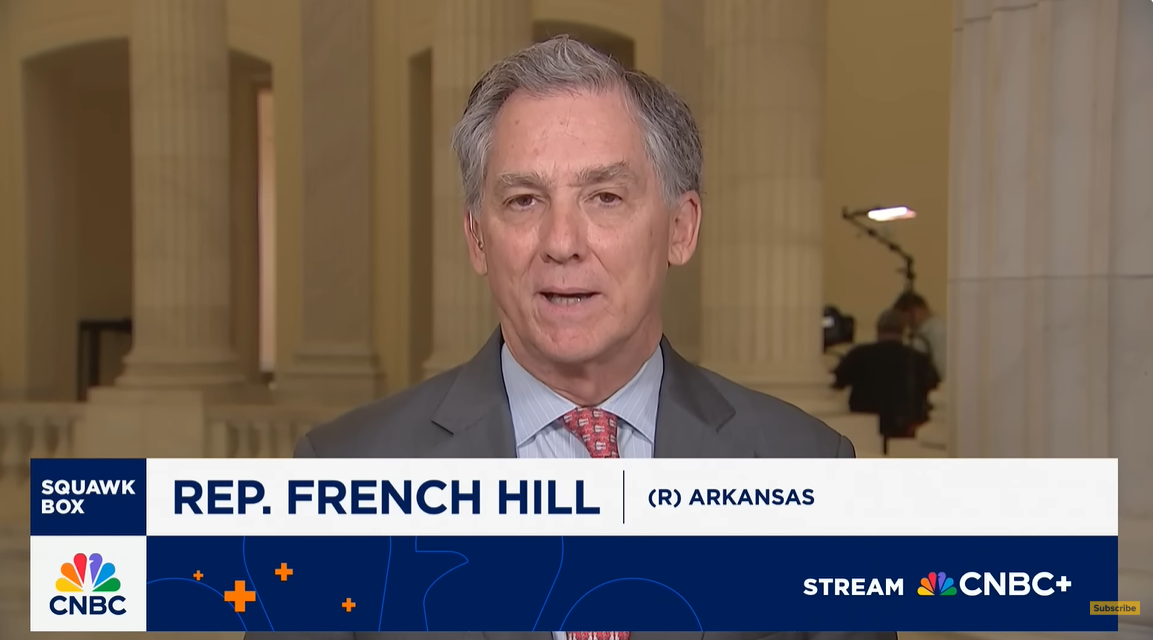
Financial Services Committee Chairman Rep. French Hill, a Republican from Arkansas, has revealed when Congress could move forward on the CLARITY Act. 

Hill made the comments during a live interview on CNBC’s Squawk Box, where he spoke about the progress of crypto legislation and the urgency for the U.S. to act before other regions pull ahead.

Hill appeared on the program to discuss crypto regulation as host Joe Kernen questioned him on whether Congress would move quickly on digital asset market structure laws. 

Rep Hill Confirms the Importance of Market Structure Laws

Kernen pointed out that Latin America and Europe are already advancing legislation while the U.S. risks losing ground. In response, Hill pointed out the bipartisan strength of the bill, looking to establish this structure. “We had more than 290 members come together to vote for the CLARITY Act,” he said.

For context, the legislation assigns oversight of digital commodities like Bitcoin and Ethereum to the CFTC. Meanwhile, it gives the SEC jurisdiction over tokens that rely on managerial efforts from centralized entities. It also mandates joint rulemaking between the two regulators to eliminate ambiguity and strengthen compliance standards.

Hill explained that the CLARITY Act works hand-in-hand with the GENIUS Act, the stablecoin bill signed into law by President Trump in July. He described the GENIUS Act as important but argued that stablecoin regulation alone is not enough. 

Rep French Hill on Squawk Box

The Congressman noted that without broader rules for custody, trading, and blockchain operations in financial services, the U.S. cannot expect to lead in fintech innovation. 

In his words, “I told President Trump back in July that if you sign the Genius Act and you pass it, it’s like passing a bill that authorizes the use of a cell phone but you have no cell towers.”

CLARITY Act Should Pass by Year-End

Hill also clarified that the Senate now holds the next move, with the Banking Committee led by Sen. Tim Scott and the Agriculture Committee under Sen. John Boozman expected to handle the bill. 

He said he wants to see the upper chamber move quickly and confirmed that discussions are already happening across party lines. 

“We hope that they will take prompt action on that this fall during the October and November time frame. I’d love to see the Clarity Act pass the Senate before the end of the year,” Hill revealed.

Updates on the CLARITY Act and Other Crypto Legislation

Notably, the CLARITY Act has gained significant traction since its introduction. Hill, along with House Agriculture Committee Chairman G.T. Thompson, unveiled the bill on May 29, 2025, with bipartisan backing. 

Interestingly, the House Financial Services and Agriculture Committees advanced it on June 10, and the full House passed it on July 17 with 294 votes in favor, including 78 Democrats. 

Alongside the CLARITY Act, the U.S. is looking at other important pieces of legislation. For instance, the GENIUS Act, introduced in February 2025 and signed into law on July 18, created the first structure for stablecoins on a federal level. It demands complete reserve backing and limits issuers to authorized entities. 

Another measure, the Anti-CBDC Surveillance State Act, also passed the House in 2025 and is awaiting Senate action. This bill seeks to block the Federal Reserve from launching a CBDC without approval from Congress.

XRP Historic 12-Year Trendline Shows It Could Surge to This Double Digits Price

0

A market technician has suggested that XRP could target a two-digit price if it repeats a historical trend of retesting a 12-year trendline.

For now, XRP is fighting to steady itself after a sharp pullback. It slipped to a low of $2.70 on Sept. 1 following a mid-July peak at $3.66. It has since recovered from the $2.70 low, climbing back above $3 as it now trades at $3.006. Notably, holding this level as solid support will decide if the recovery has real strength.

Meanwhile, for the bigger picture, a 12-year chart from trader Papa shows a massive rising channel that has guided XRP since 2013. The chart uses a logarithmic scale and includes parallel boundaries, a median line, and a 12-year trendline that connects every major top over the past decade.

XRP Price Action Around the 12-Year Trendline

The first notable point came in 2014, when XRP hit around $0.03 to $0.04. This peak lined up with the 12-year trendline, with XRP eventually collapsing after the resistance at this trendline. 

Notably, the next major move arrived in late 2017 and early 2018. Specifically, XRP exploded to $3.3, briefly breaking above the 12-year trendline and reaching the upper part of a new channel before crashing back down. 

XRP 1M Chart Papa
XRP 1M Chart | Papa

Meanwhile, from 2018 through 2020, XRP settled into the lower half of the channel, mostly between $0.11 and $0.50. Another rally emerged in 2021, driving the price to $1.96 by April. Papa marked this top as another rejection along the curved trendline, repeating the same pattern as 2014 and 2018.

The market then cooled again, leaving XRP stuck around $0.21 to $0.70 for nearly two years. Interestingly, a new climb began in late 2024 on the back of the market-wide push following President Donald Trump’s victory. This allowed XRP to reclaim the $1, $2, and $3 levels before the recent pullback.

Today, XRP has crossed the channel’s median and now sits at $3, pushing closer to long-term resistance. Papa believes the next breakout could take XRP to levels above $22, where the channel top and the 12-year trendline intersect, before a correction sets in.

XRP Short-Term Opportunities

Meanwhile, other analysts see shorter-term opportunities. Community commentator XRPunkie highlights an inverse head and shoulders pattern that has formed after 280 days of sideways action since December. He expects a breakout that could lift XRP to between $5 and $8. 

XRP 1D Chart XRPunkie
XRP 1D Chart | XRPunkie

Further, market strategist Ali Martinez mentioned a descending triangle that has shaped trading since the $3.66 high in July. Data from his chart shows that XRP briefly tested $3.35 in August but hit resistance. Martinez believes that if the current recovery breaks through, XRP could aim for $3.60.

Christopher Inks, CEO of TWC, described the drop to $2.70 in July as a spring that could trigger re-accumulation. He highlighted XRP’s recovery of its monthly pivot at $2.962 as encouraging, but stresses that the real test lies at $3.3825. 

Inks argued that a decisive close above this level would flip the Fibonacci cluster between $3.35 and $3.43 into support, setting up a potential run toward $4.42.

Here are Possible Timelines For Cardano to Reach $100–$300

0

Multiple expert predictions have presented timelines for Cardano to reach triple-digit prices despite the ambitious nature of this outlook.

For context, Cardano (ADA) currently changes hands at $0.8693, with 35.79 billion tokens in circulation and a market capitalization of roughly $31 billion. Despite its current valuation, some analysts, including Dan Gambardello, see the possibility of Cardano climbing toward $10. 

However, others have projected more audacious targets, suggesting ADA could one day reach between $100 and $300. Those price levels may not appear realistic in the short term and could take several market cycles, but some argue that the chance of Cardano eventually achieving them cannot be completely dismissed.

To put it in perspective, Cardano would need to gain between 11,403% and 34,410% from today’s price to land in this range. Amid these speculations, we asked Google Gemini and ChatGPT to project purely hypothetical timelines for ADA’s path toward $100 to $300. 

Google Gemini Presents Cardano Price Predictions

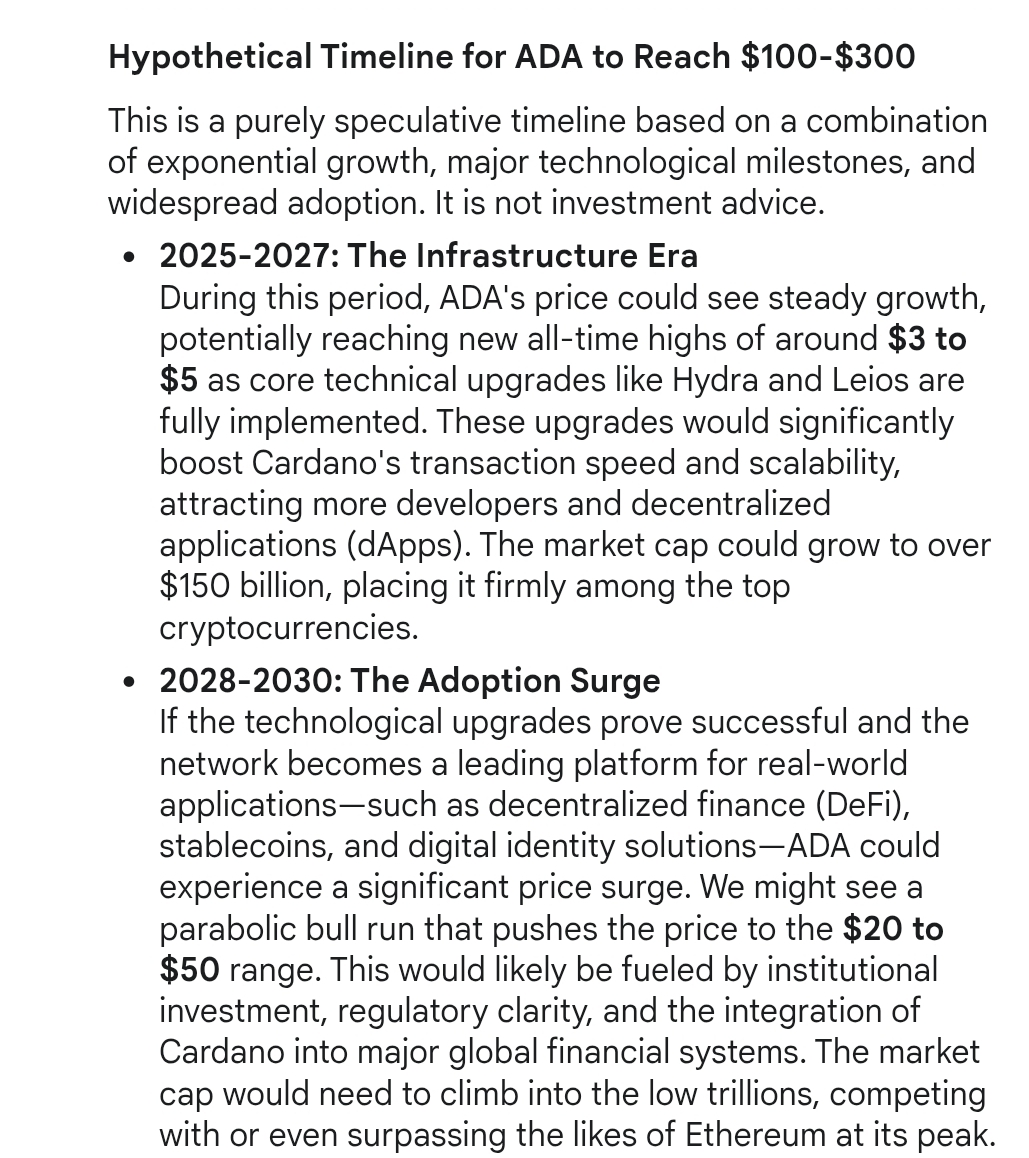
Interestingly, Google Gemini presented a three-stage journey. The first stage, which it described as the “infrastructure era” running from 2025 to 2027, would focus on technical progress. 

Gemini suggested ADA could climb to $3 to $5 during this time as upgrades like Hydra and Leios improve scalability and transaction speed. It explained that these upgrades would attract developers and dApps, pushing Cardano’s market cap beyond $150 billion.

Cardano Price Predictions Google Gemini

Further, for the years 2028 to 2030, Gemini predicted what it called an “adoption surge.” According to the chatbot, if Cardano proves its utility in areas like decentralized finance, stablecoins, and digital identity, the price could take off and land in the $20 to $50 range. 

Gemini pointed out that this phase would likely be driven by institutional investors, clearer regulations, and Cardano’s integration into global financial systems. Notably, a surge of that scale could lift its valuation into the trillions and put it on par with Ethereum’s best years.

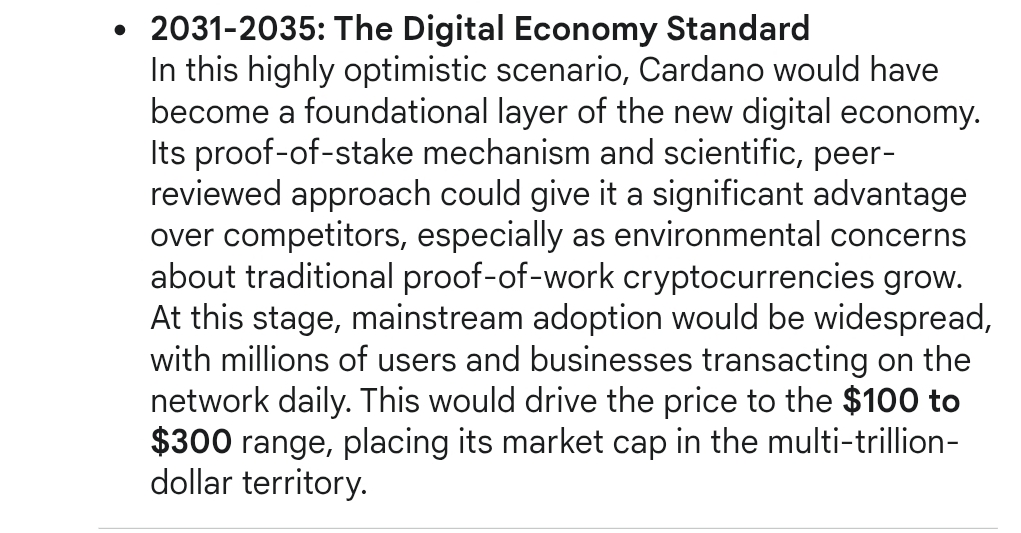
Finally, Gemini described 2031 to 2035 as a period when Cardano could serve as a standard layer for the digital economy. By this stage, ADA could handle millions of daily transactions for individuals and businesses worldwide. With this level of adoption, Gemini suggested ADA could reach between $100 and $300.

Cardano Price Predictions Google Gemini 2
Cardano Price Predictions | Google Gemini

ChatGPT Predicts Cardano Price

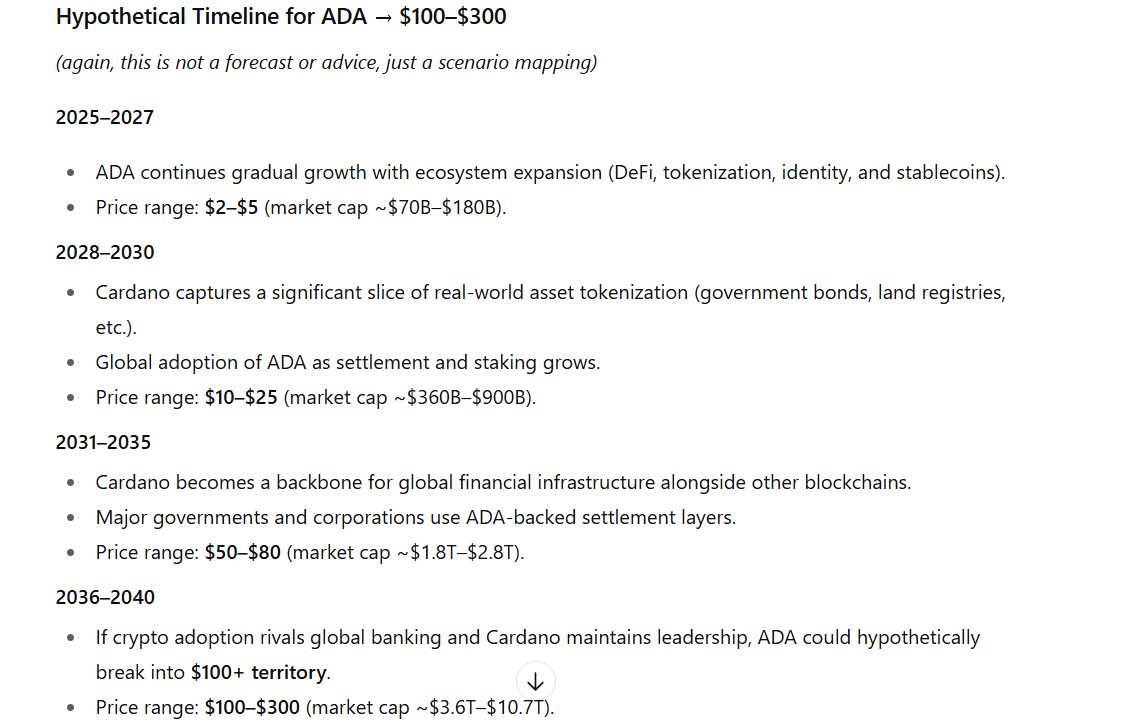
Meanwhile, ChatGPT expects a longer path. According to its projection, ADA’s current $31 billion market cap would need to expand to somewhere between $3.6 trillion and $10.7 trillion to reach $100 to $300. 

It then broke down its hypothetical timeline into several steps. Specifically, between 2025 and 2027, it sees ADA growing steadily with ecosystem development in DeFi, tokenization, identity, and stablecoins, potentially reaching $2 to $5, with a valuation of $70 billion to $180 billion. 

From 2028 to 2030, it believes Cardano could capture a share of real-world asset tokenization, including land registries and government bonds, which could push prices to $10 to $25 and lift its market cap to between $360 billion and $900 billion.

Cardano Price Predictions ChatGPT
Cardano Price Predictions | ChatGPT

However, looking at 2031 to 2035, ChatGPT predicts that governments and corporations may use ADA as part of global settlement systems. That adoption could raise the price to $50 to $80, supported by a $1.8 trillion to $2.8 trillion valuation. 

Notably, only between 2036 and 2040 did it see a chance for ADA to break the $100 mark, with the potential to reach as high as $300. It stressed that this outcome would require Cardano to hold onto a leadership role for more than a decade, with the crypto market itself growing into the tens of trillions.

Predictions from Changelly Analysts

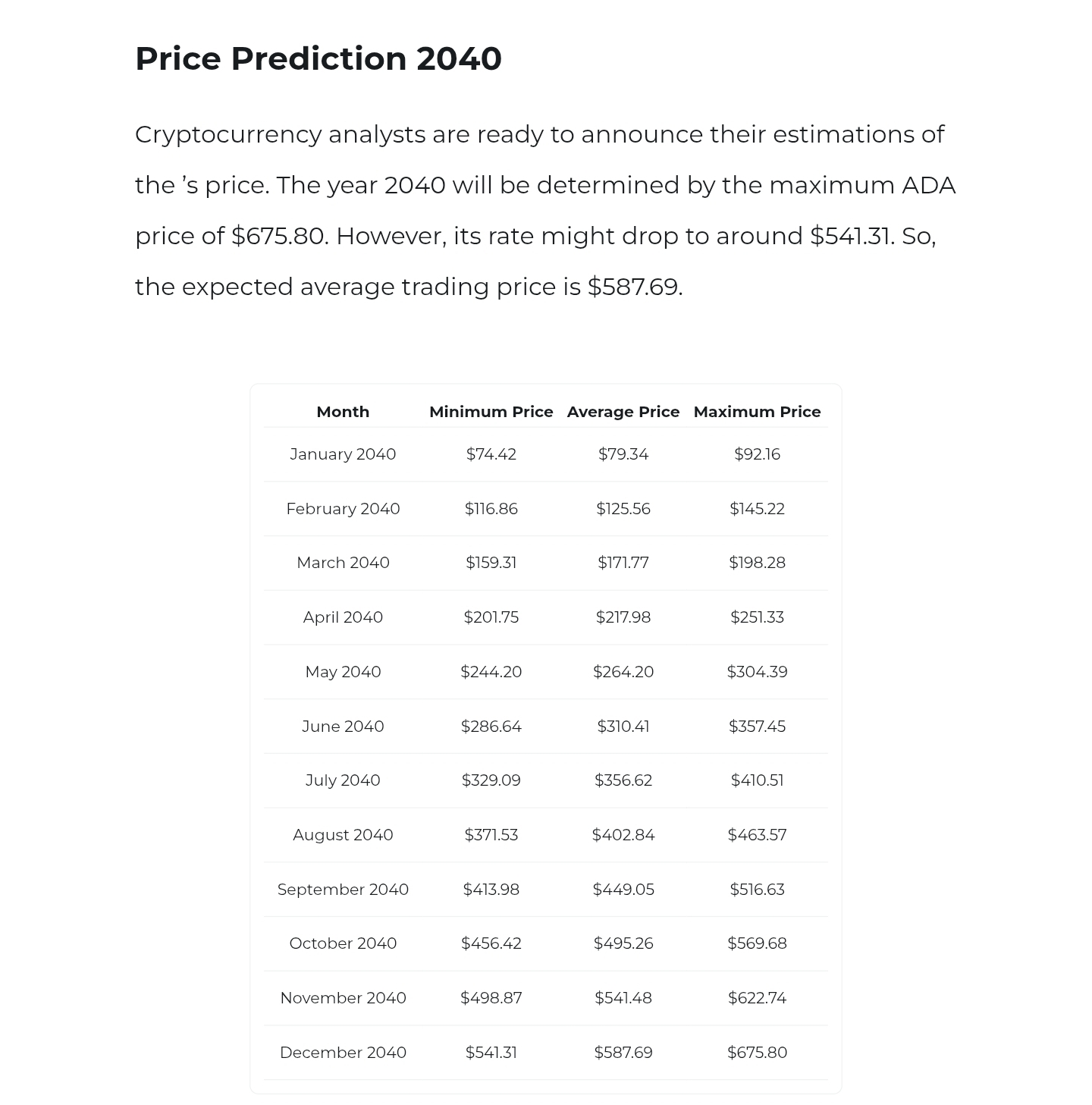
Remarkably, analysts at Changelly also hold similar sentiments. They predicted Cardano could open 2040 at $74 and cross the $100 mark by February. Their analysis then projects a peak of $304 by May 2040, showing that they expect Cardano to potentially exceed the $100 to $300 range by 2040.

Cardano Price Predictions Changelly
Cardano Price Predictions | Changelly

However, it is important to note that the projections are merely hypothetical, and Cardano may not be able to reach these targets at these timelines. As a result, investors should not consider them investment advice.

Santander’s Openbank Debuts Bitcoin and Crypto Trading in Germany

0

Openbank, the digital banking subsidiary of Spain’s Santander Group, has introduced cryptocurrency trading for customers in Germany. 

The move marks an important step for the bank as it seeks to integrate digital assets into mainstream investment platforms. 

According to Santander, the service will be extended to its home market, Spain, in the coming weeks.

Expanding Beyond Traditional Investments

Openbank customers in Germany can now buy, sell, and hold five of the most widely traded cryptocurrencies: Bitcoin (BTC), Ethereum (ETH), Litecoin (LTC), Polygon (MATIC), and Cardano (ADA). These digital assets are listed alongside existing investment options such as stocks, exchange-traded funds (ETFs), and mutual funds.

By combining traditional and digital assets under one platform, the bank aims to simplify portfolio management for retail investors.

Unified Investment Experience

A key feature of the new service is its integration within Santander’s own ecosystem. Unlike external crypto exchanges, Openbank clients do not need to transfer money to a third-party platform. This means that customers can keep all their financial products, including stocks, funds, and cryptocurrencies, within a single account.

Santander states that this design will enhance the trading experience and mitigate potential security concerns.

Fee Structure

To strengthen its appeal, Openbank has adopted a transparent fee structure. The platform charges 1.49 percent per transaction, with a minimum of one euro, but does not impose custody fees. This makes the offering competitive against major crypto exchanges while benefiting from the added trust of a regulated bank. 

By lowering barriers to entry, Santander aims to capture retail clients who may be curious about crypto but cautious about costs and risks.

Plans for Growth and Innovation

The launch in Germany is only the foundation of a longer-term strategy. Openbank confirmed that it plans to list additional cryptocurrencies and introduce features such as crypto-to-crypto conversions in the coming months.

These upcoming tools will allow investors to manage digital assets with greater flexibility.

Responding to Customer Demand

Coty de Monteverde, head of crypto at Grupo Santander, noted that the decision to add cryptocurrencies was a direct response to customer requests.

“We are expanding our platform to include the main cryptocurrencies because our clients asked for it,” she noted. According to her, the bank’s broader vision is to evolve in line with its customers’ financial preferences while maintaining the security and reliability of a regulated institution.

Building on Previous Initiatives

Notably, this is not Santander’s first step into the cryptocurrency sector. In 2023, its private banking arm in Switzerland began allowing clients to trade Bitcoin and Ethereum. 

At that time, Santander partnered with Swiss fintech firm Taurus to provide custody technology, ensuring secure storage of client assets. The new service in Germany builds on that experience, while bringing crypto access to a wider base of retail clients.

Analyst Predicts Explosive XRP Price for End of 2025 and Into 2026

0

A top analyst says XRP missing his $9 target for the end of this year would actually be more bullish for his higher 2026 goal.

Analyst Says XRP Missing $9 This Year is Bullish

In a recent update, Dr. Cat confirmed that the recent XRP weakness doesn’t rattle him. He explained that XRP price failing to hit the $6–$9 goal this year would not derail his outlook. Instead, he believes it would lay a substantial foundation for the push toward $20–$30 in 2026, which is more likely.

Earlier XRP Analyses

For context, earlier this month, Dr. Cat pointed out that XRP’s 12-hour and daily timeframes had not yet turned bullish, but he noted an important sign from the Ichimoku model. Notably, the Chikou Span had closed above price on the 12-hour chart, while the 4-hour chart had already flipped bullish. 

He said if this setup were on Bitcoin, he would expect four to five days of sideways movement before a breakout. However, since XRP often makes sudden moves, he gave it a 50/50 chance of shooting straight to a new all-time high as the 12-hour trend turned bullish. 

XRP Ichimoku Cloud Dr Cat
XRP Ichimoku Cloud | Dr Cat

He stressed that traders needed to watch the XRP/BTC pair closely, since the earliest it could flip bullish was Aug. 18. If that shift played out and Bitcoin climbed toward $140,000, he estimated XRP could reach around $6, with the XRP/BTC pair potentially rising to 4,135 satoshis.

Interestingly, his earlier analysis from July set the groundwork for this scenario. At the time, he said XRP had moved about 4.5 cents above the daily Kijun Sen and had not yet confirmed a close. He suggested price action carried more than an 80% chance of finding a bottom by July 26, with July 24 showing the strongest alignment in time cycles.

Dr. Cat applied this forecast to both the USD and BTC pairs. He also noted that the weekly, three-day, and monthly charts lined up well, provided support held, to coil up for a rally after Aug. 17. He described the late-July period as a strong opportunity to buy the dip and predicted a run to $9 between September and December.

XRP Run to $30 More Likely 

However, this $6 to $9 forecast for year-end is increasingly looking unlikely. Meanwhile, in his latest update today, Dr. Cat strengthened his long-term conviction. He raised his confidence level for 2026 targets from 85% to 90%. 

His projections remain the same: Bitcoin climbing toward $270,000 and XRP trading between $19 and $30. At the same time, he warned that the market could face a painful stretch in the coming months, which might convince many that a bear market has returned.