Home Blog Page 528

Pundit Explains Why XRP to $50 by December 2025 is Realistic

0

A market commentator has suggested that an XRP rally to $50 could materialize as early as December 2025 if the U.S. SEC approves XRP ETFs by October.

For context, in October 2025, the U.S. Securities and Exchange Commission (SEC) faces deadlines to decide on several XRP exchange-traded fund (ETF) applications. If the regulator signs off, spot XRP ETFs could debut in the fourth quarter. 

XRP ETFs Could Attract Billions in Inflows

Analysts believe this could attract institutional money, with some estimates suggesting inflows of billions of dollars in just a few weeks. This is because when Bitcoin ETFs arrived, they drew billions almost overnight. Interestingly, Ethereum ETFs followed the same pattern. 

Citing these developments, Steven McClurg, CEO of Canary Capital, expects XRP ETFs to follow suit, with at least $5 billion flowing in during the first month, potentially outperforming the Ethereum products. However, it remains unclear how these inflows will impact the XRP price, which currently stands at $3.00. 

In a recent analysis, XRP community figure Pumpius recently presented a case for why XRP could reach $50 if ETFs launch in October. He pointed out that the filings are not speculation. 

The Case for Capital Inflows

Specifically, at least six to seven major players, including Bitwise, Canary Capital, WisdomTree, and 21Shares, have already submitted official applications or amendments. Many of these filings came up right after Ripple’s legal victory over the SEC.

Notably, the timing of these applications aligns with an October decision window. Pumpius noted that the SEC must rule on filings such as WisdomTree’s by then, and because several issuers fall into the same review batch, approvals or denials could hit at once. 

If the agency gives the green light, multiple ETFs could roll out in Q4. Pumpius added that regulatory momentum makes this outcome more likely. The SEC has started publishing guidance for crypto ETFs, while exchanges are creating common listing standards. Together, these steps make it easier to approve products beyond Bitcoin and Ethereum.

Pumpius then highlighted McClurg’s estimates that $5 billion or more could move into XRP ETFs in the first month. Notably, this demand would collide with XRP’s unique supply structure. Roughly 35 to 36 billion XRP remain in escrow, while much of the supply in circulation sits with large holders and exchanges. 

In other words, the actual amount of XRP available to trade is much smaller than headline figures suggest. A sudden wave of institutional buying against this thin float could force sharp price jumps.

Pumpius also pointed to the derivatives markets. This year, both CME and Coinbase Derivatives launched regulated XRP futures, following the same pattern Bitcoin and Ethereum set before their ETFs. This created deeper liquidity and gave institutions another way to gain exposure, making the ETF runway even stronger.

How XRP Rally to $50 Could Materialize

He then calculated that if ETFs attract $5 to $8 billion in inflows by late November and another $5 to $10 billion arrives through futures arbitrage, investment advisor rebalancing, and corporate treasury allocations, XRP could face $10 to $18 billion in net demand by year-end. 

With a circulating supply of about 59 billion tokens, much of it locked or illiquid, these inflows could create extreme price pressure. Assets with larger and more liquid markets have posted multiple-fold gains under similar conditions, which means XRP could see a large push.

According to Pumpius, the $50 rally would rely on compounding forces. Specifically, the ETF approval would finally unlock sidelined money from pensions, wealth managers, and institutions that need compliant exposure. 

Once inflows start, rising prices push ETF assets under management higher, which then draws in more money. That feedback loop, alongside year-end positioning and investor FOMO, could drive a powerful rally.

FalconX Moves 413,075 Solana: Is Another Institutional Giant Accumulating SOL?

0

Solana is once again making headlines as speculation rises about another institution buying SOL tokens in bulk.

According to blockchain tracker Lookonchain, FalconX, a leading prime broker for digital assets, withdrew 413,075 SOL across multiple exchanges. The transfers, worth $98.4 million, came from Binance, OKX, Coinbase, and Bybit within an eight-hour window.

Large withdrawals of this nature are often interpreted as signals of institutional accumulation. While FalconX itself acts as a broker, the sheer scale of the transfers has fueled rumors that another major financial player may be building a significant Solana position through its services.

Pantera Capital Bets Big on Solana

The timing of these transactions has intensified speculation. Just one day earlier, Pantera Capital disclosed a massive $1.1 billion investment in Solana. At current prices, the hedge fund controls approximately 4.65 million SOL. This makes it one of the largest corporate holders of the token.

Pantera founder Dan Morehead told CNBC that Solana had consistently outperformed Bitcoin over the past four years. He described the token as the firm’s “biggest conviction bet” to date.

With Pantera openly disclosing its position, traders are now questioning whether FalconX’s massive withdrawals could signal another yet-to-be-named institution stepping into the market.

Breakdown of Top Institutional Holders

On-chain data confirms that several large players are accumulating Solana. At least seven companies are currently holding more than 15 million SOL tokens.

Leading the pack is Forward Industries, which owns about 6.82 million SOL worth roughly $1.61 billion. The company’s average purchase price is reported to be $232.

Pantera Capital follows closely with its newly disclosed 4.65 million SOL, making it the second-largest institutional holder. Sharps Technology ranks third, with holdings of 2.14 million SOL, valued at over $505 million. Right behind is DeFi Development Corp, which owns 2.03 million SOL worth around $478.88 million.

Other notable holders include Upexi, with an even 2 million SOL valued at $472.32 million, as well as Mercurity Fintech, which controls 1.08 million SOL valued at $255.76 million. 

Finally, iSpecimen Inc rounds out the list, holding exactly 1 million SOL, worth approximately $236.16 million. The rise of these heavyweight holders indicates a growing institutional alignment with Solana.

Market Performance and Analyst Outlook

At the time of writing, Solana (SOL) is trading at $237.43, just below a key resistance level at $239. The token has gained 0.6% in the past 24 hours and 8.7% over the past week.

Crypto analyst Ali Martinez notes that a decisive breakout above $239 could pave the way for further gains. He sets a mid-term target of $360 for SOL, while his long-term outlook suggests the token could eventually test $1,314, provided institutional demand continues to drive momentum.

XRP to $1,000 Re-emerges After CNBC Guest Says Ripple Going After SWIFT

0

Discussions about XRP to $1,000 have resurfaced in the XRP community following a recent CNBC interview that highlighted Ripple’s ambition to replace SWIFT.

During a Monday appearance on CNBC, Pantera Capital founder Dan Morehead discussed the progress of blockchain technology and noted Ripple’s mission to disrupt global financial messaging.

Morehead pointed out that Ripple is actively targeting SWIFT’s role in global finance, positioning itself as a competitor to modernize cross-border payments.

The comment, made before a global financial audience, has triggered intense reactions across the XRP community. 

In parallel, it revived speculation that XRP could someday capture a significant portion of SWIFT’s massive $5 trillion daily transaction volume—potentially justifying the XRP to $1,000 ambition.

XRP to $1,000 Vision Resurfaces

In light of Morehead’s remarks, XRP supporters have revisited an earlier prediction by Patrick Bet-David. For context, in March 2025, he outlined how XRP could theoretically reach $1,000 per token if it were to replace both SWIFT and FedNow as the core infrastructure for global payments.

Bet-David’s math:

  • SWIFT processes $5 trillion daily, or $1.25 quadrillion annually.
  • If Ripple captures even 10% of that, the XRP market could represent $125 trillion in transaction volume.

Assuming this drives a $10 trillion market cap for XRP, individual tokens could climb to $100 or even as high as $1,000. The high upside is contingent on XRP becoming the global standard for cross-border payments.

At the time, Bet-David acknowledged the analysis was speculative and biased by pro-XRP analysts. However, he maintained that the risk/reward narrative around XRP was too important to ignore.

Ripple Execs Double Down on Replacing SWIFT

Notably, Dan Morehead’s statement comes just months after multiple Ripple executives publicly confirmed that the company is not seeking to integrate with SWIFT, but to replace it entirely.

At the 2025 WEF, Ripple Vice President Eric van Miltenburg declared, “We’re building a SWIFT-like replacement.”

In June, Ripple CEO Brad Garlinghouse suggested that the XRP Ledger could handle 14% of SWIFT’s turnover within five years.

Ripple’s acquisition of prime brokerage firm Hidden Road has also been seen by some as a strategic move to bypass legacy systems like SWIFT.

XRP Price Hits $3.02 — Still a Long Way from Triple Digits

Despite the renewed bullish outlook, XRP remains far from the $1,000 price target. As of today, XRP is trading at $3.02, representing a 330x gap from the ultra-bullish scenario.

However, XRP’s recent upward momentum and growing institutional narrative continue to fuel optimism about significantly higher prices in the coming years.

Commentators like Armando Pantoja and Matthew Brienen have suggested it could take up to ten years for XRP to close the gap on the $1,000 price target. However, critics, particularly from the Bitcoin camp, believe triple-digit prices are completely unrealistic.

In response, members of the XRP community have argued that if Bitcoin can reach $1 million, as many believe it might, then XRP to $1,000 is not out of the question.

Is XRP the Next Bitcoin? BitBoy Weighs In

0

Famous crypto influencer Ben Armstrong, aka BitBoy, recently shared his perspective on whether XRP could become the next Bitcoin.

In a video shared on X, he explored the possibilities and challenges surrounding XRP’s future. On a general note, BitBoy argued that XRP could indeed become the next Bitcoin. However, he highlighted that it is important to define what it really means for XRP to be the “next Bitcoin.”

What Does “Next Bitcoin” Even Mean?

He suggested the phrase could have multiple interpretations. One possibility includes XRP becoming the number-one cryptocurrency by market cap, or surpassing Bitcoin in terms of speed, adoption, or decentralization.

According to BitBoy, while XRP excels in transaction speed compared to Bitcoin, it falls short in decentralization. “XRP is more centralized than Bitcoin,” he said, adding, “It’s not even close.”

To him, this is a key philosophical pillar where Bitcoin has a clear advantage. A major factor behind this view is the fact that Ripple controls a significant portion of the XRP supply.

For context, Ripple currently holds 35.3 billion XRP in escrow and 4.959 billion tokens in liquid supply. This brings Ripple’s holdings to 40.25 billion XRP, accounting for over 40% of XRP’s maximum supply.

XRP’s Edge: Speed and Banking Integration

Regardless of the centralization concern, one of XRP’s strongest selling points is its speed and efficiency. Notably, XRP transactions can settle in as little as 7 to 30 seconds, whereas traditional systems like the SWIFT network can take 5 to 7 business days.

Armstrong also noted that Ripple aims to revolutionize the global banking system by encouraging banks to use XRP for cross-border payments. He believes this ambition could be a game-changer for XRP’s adoption and long-term value.

XRP vs. Ethereum and Bitcoin: The Gap is Closing

Further, Armstrong pointed to XRP’s improving market position. For years, Ethereum was the only cryptocurrency close to challenging Bitcoin’s dominance. But with XRP jumping to $3, Armstrong observed that XRP is now about three times away from Ethereum’s market cap. Meanwhile, Ethereum is roughly four times away from Bitcoin’s.

This progress leads him to believe XRP could eventually surpass Ethereum. He also referenced XRP’s strong performance against both Bitcoin and Ethereum in recent months and noted that XRP briefly overtook Ethereum back in 2018.

Investment Perspective: $100K in Bitcoin or XRP?

From an investment standpoint, BitBoy is more bullish on XRP’s potential. He stated that if given the choice between holding one Bitcoin, worth over $117,000 today, or the equivalent value in XRP, he would choose XRP.

“XRP has much more juice in the tank,” he said, suggesting that the coin has a more explosive outlook from its current position than Bitcoin.

He pointed to upcoming catalysts such as Ripple’s IPO and the potential launch of an XRP ETF as factors that could significantly boost XRP’s market presence.

XRP Could Challenge Bitcoin Market Cap

Notably, Armstrong does not expect XRP to match Bitcoin’s price per coin or its level of decentralization. However, in terms of total market capitalization, he believes XRP could eventually challenge Bitcoin.

For context, Bitcoin’s market cap stands at $2.33 trillion, while XRP’s is just $180 billion, a gap of over $2.1 trillion.

Essentially, for XRP to rival Bitcoin, it would need to soar 12x to reach approximately $39. Given the formidable journey, Armstrong reminded viewers that the crypto scene can change dramatically over five to ten years.

While it may seem unlikely today for XRP to catch up to Bitcoin, he said the industry has repeatedly defied expectations.

“You’ve got to remember what a different world this will be 5–10 years from now. Right now, we’re looking at this and thinking, ‘Ah, it could never happen,’ but certainly, we’ve seen things happen in crypto that nobody thought would,” BitBoy concluded.

Why Shiba Inu Is Becoming a Risky Bet for its 1.5M Holders

0

In the Shiba Inu ecosystem, several factors ranging from leadership concerns to slow ecosystem growth highlight increasing risks for its 1.5 million holders. 

Shiba Inu remains among the most popular cryptocurrencies globally, retaining its position as the second-largest meme coin by market capitalization. It has grown from having just a few holders to more than 1.5 million on-chain holders within five years of its existence.

Although Shiba Inu has made significant progress in transitioning from a meme token into an ecosystem with multiple projects, several challenges are beginning to weaken confidence among investors.

Why Shiba Inu Is Becoming Riskier for Investors

Currently, issues such as leadership instability, sluggish ecosystem growth, and poor external engagement are making the project increasingly risky for holders. Below are the main reasons SHIB is becoming a less secure investment.

Absence of Shiba Inu Lead Developer

Shiba Inu’s pseudonymous lead developer Shytoshi Kusama has been noticeably absent from public discourse. He occasionally takes extended social media breaks without informing the community about his whereabouts, sparking concerns among holders.

Last month, he went silent on X for over a month, only resurfacing this week after growing speculation that he had abandoned the Shiba Inu project.

His return came just days after the Shibarium bridge suffered a roughly $3 million exploit. Although he did not directly address the concerns about the exploit, he reassured the community of his commitment to advancing SHIB.

Trust and Identity Concerns

Kusama’s continued reliance on anonymity has raised trust issues within the community. Since Shiba Inu’s launch in August 2020, no team member has revealed their real identity, with all communication conducted under pseudonyms.

While anonymous leadership may have been appealing in the project’s early days, it has become a liability as Shiba Inu attempts to establish itself as a legitimate ecosystem. Institutional investors and regulatory bodies often require clear accountability.

This may help explain why Shiba Inu has not yet seen a spot ETF application in the U.S., while competitors like Dogecoin have already attracted multiple filings.

Low Shibarium Volume and Recent Hack

Launched in August 2023, Shibarium’s initial success was outstanding. The Layer 2 blockchain reached 1 billion transactions in under two years after its launch. However, its volume has dropped significantly in recent times.

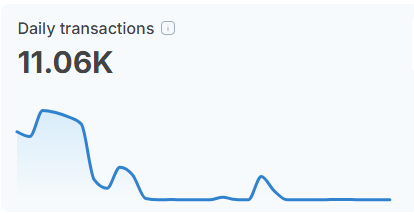
Since this month, Shibarium has processed an average of less than 1 million daily transactions, which is relatively low compared to its competitors. As of September 17, the network processed only 11,060 transactions over the past 24 hours.

Shibarium daily transactions

This declining transaction volume raises concerns about Shibarium’s adoption. It also raises questions about whether the network can genuinely become a hub for decentralized finance (DeFi) projects.

Amid falling volumes, Shibarium was recently hit by a major security breach, in which attackers exploited its bridge to siphon over $3 million. While developers quickly froze the staking function to contain the damage, the incident has further shaken user confidence in the platform’s security.

Lack of Strong Partnerships

A major shortcoming for Shiba Inu is its lack of influential partnerships in recent times. While other blockchain projects frequently secure collaborations with major companies and institutions, Shiba Inu has struggled in this area.

The few alliances it has formed have had a limited impact on adoption. Without strong external support, Shiba Inu risks stagnation in an increasingly competitive crypto landscape.

Team’s Involvement in Other ICOs and Promotions

Another red flag for investors is the apparent involvement of Shiba Inu team members in unrelated initial coin offerings (ICOs) and crypto promotions.

For instance, Kusama has publicly backed other cryptocurrency projects, including SHY and Position Exchange’s native token (POE). These actions raise questions about the team’s dedication to Shiba Inu.

Instead of dedicating full attention to SHIB’s roadmap, the team’s diversion into external ventures suggests that it may not be prioritizing the project’s long-term success.

Low Burn and Community Hype

Over the years, Shiba Inu’s price growth has been largely driven by community hype rather than strong fundamentals. Many holders believed its burn campaign could push SHIB to higher targets, such as $0.01.

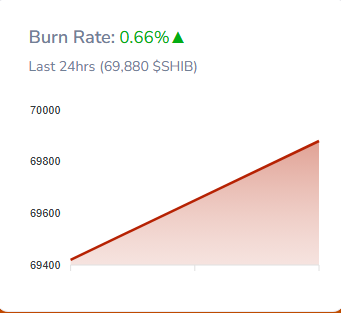
However, the burn campaign has lost momentum. For example, only 69,880 SHIB were burned in the past 24 hours, a minuscule amount considering there are still over 589 trillion tokens in circulation.

Shiba Inu burn volume

The low burn rate highlights the difficulty of sustaining price growth without more aggressive deflationary mechanisms or increased utility.

In Sum

While Shiba Inu retains a loyal community and a large holder base, the project is facing a growing list of challenges.

Leadership murkiness, declining network usage, a lack of strategic partnerships, and waning development focus are all increasing the risks for investors. Without renewed focus and stronger fundamentals, Shiba Inu may struggle to maintain relevance in the evolving crypto market.

Binance in Talks with DOJ to End Compliance Monitoring Requirement

0

Binance, the world’s largest crypto exchange, is reportedly seeking relief from strict oversight tied to its $4.3 billion settlement with the U.S. Department of Justice (DOJ).

Bloomberg reported that discussions are underway to lift the requirement of an independent compliance monitor, a measure imposed in 2023 after regulators accused Binance of major compliance lapses.

If approved, the move could significantly reduce the compliance burden on the exchange, which has faced years of legal and regulatory scrutiny.

Background on the 2023 Settlement

The settlement marked one of the most high-profile enforcement actions against a crypto firm. U.S. authorities accused Binance of weak safeguards against money laundering and other compliance failures.

In response, Binance admitted wrongdoing, agreed to pay $4.3 billion as penalties, and accepted a three-year monitoring period.

Importantly, the agreement applied to Binance’s global operations. Its U.S. affiliate, Binance.US, remained a separate entity outside the scope of the settlement.

DOJ’s Changing Stance on Monitors

The DOJ’s consideration to scale back oversight at Binance is not without precedent. In recent years, major companies such as Glencore, NatWest Group, and Austal Ltd. have seen their compliance oversight scaled back or re-evaluated by the DOJ, in some cases avoiding extended monitorships altogether.

This reflects a broader DOJ trend toward rethinking the use of independent monitors. Critics argue that monitorships often create heavy costs and disrupt normal business operations.

Regulatory Environment Shifts Under the Trump Administration

Binance’s negotiations come at a time when the U.S. political climate is shifting in favor of the crypto industry. Since President Donald Trump returned to office in January, his administration has advanced several initiatives to clarify rules for digital assets.

Among these is the GENIUS Stablecoin Act, a market-structure bill passed by the House of Representatives. There is also legislation to curb Central Bank Digital Currencies (CBDCs).

Together, these steps have been welcomed by the crypto sector as signs of a more supportive regulatory approach.

SEC and CFTC Adjust Their Policies

U.S. financial regulators are also signaling change. Securities and Exchange Commission (SEC) Chair Paul Atkins recently pledged to end “regulation through enforcement”. Instead, he promised to provide clearer, upfront guidance.

The SEC has since clarified that liquid staking tokens will generally not be treated as securities. This clarification provides much-needed certainty to investors and developers.

Meanwhile, the Commodity Futures Trading Commission (CFTC) has created a new pathway for foreign crypto exchanges to serve some U.S. clients through its Foreign Board of Trade program.

Expert Shares Bold XRP Price Target for Its ‘Phoenix Flight’

0

A well-known community analyst has suggested that XRP is looking to begin the “flight of the phoenix” to higher price levels.

Notably, XRP has been fighting to hold its ground in September. After reaching $3.66 in July 2025, it slipped to $2.70 on Sept. 1. Buyers then stepped in and pushed it back up to $3.00.

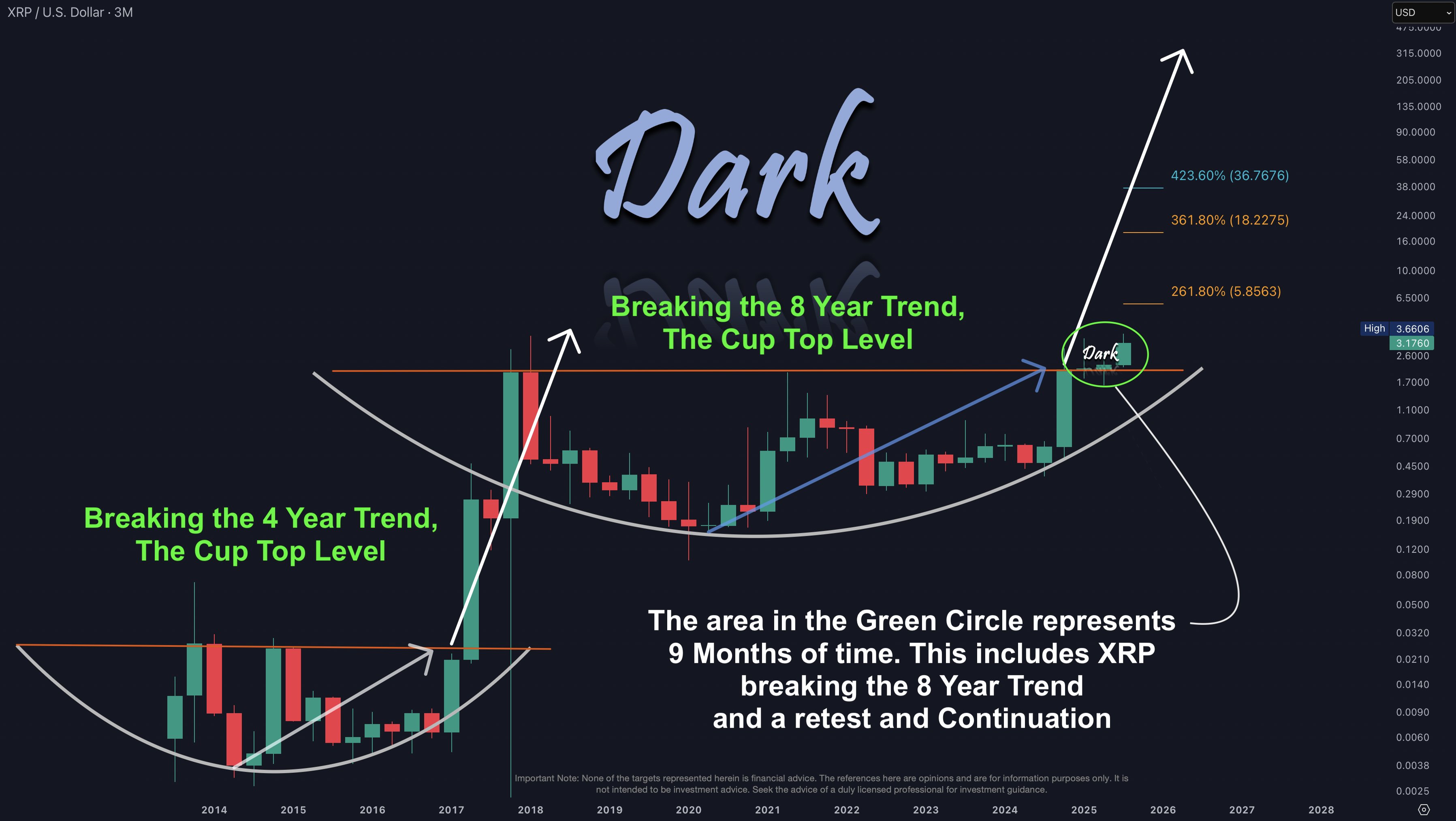
Interestingly, amid this position, analyst Dark Defender suggested that XRP was retesting a cup breakout and could soar to $36. To prove this, he shared a chart covering more than ten years of XRP’s history. 

XRP Forms Two Cup Patterns

Specifically, the market watcher highlighted two major cup patterns that dictated XRP’s long-term cycles. Notably, the first cycle ran from 2013 to 2017, forming a four-year consolidation. XRP finally broke through the neckline in mid-2017 when it surpassed the $0.024 resistance.

From here, it entered into the explosive rally that defined the 2017/2018 bull run. XRP eventually soared to a peak of $3.31 in January 2018 before witnessing a sharp collapse that led to the formation of the second cup.

Notably, this second cup formed over eight years, starting from 2018 and running into 2025. The neckline sat at around $2, almost the same level that capped the 2017 rally. This created a massive resistance line. 

XRP 3M Chart Dark Defender
XRP 3M Chart | Dark Defender

From 2018 through 2020, XRP formed the bottom of this larger structure. It then climbed steadily between 2021 and 2024, supported by a rising trendline that built the right side of the cup.

XRP Now Retesting Its Breakout

This setup came to a head in 2025, following the November 2024 rally. Notably, Dark Defender pointed out that XRP broke through the neckline earlier this year and then spent nine months retesting the breakout level around $2. 

Importantly, he marked this retest window with a green circle on the chart, showing how the pullback to $2.70 in September fits into the bigger picture. Now, XRP just needs to maintain the support at the neckline to secure an upward push toward greater levels when bulls take charge.

Specifically, when this happens, Dark Defender expects XRP to aim for Fibonacci extension levels at $5.86, $18.23, and even $36.77. He described this breakout as the “flight of the phoenix,” indicating what he sees as the start of a massive upward move.

Other Analysts Remain Bullish

Interestingly, other analysts are also equally bullish. For one, Stedas, a well-followed community voice, sees a bull flag forming on the weekly chart. He believes a clean break above $3.60 could lead to a sharp rally, with potential targets at $6, $13, and $23 before the year ends.

Meanwhile, CryptoInsightUK added that most top altcoins look ready for a strong run in the next leg of the market. He expects XRP to move quickly toward $4.20, highlighting the way it often rallies in sudden bursts after breaking resistance. 

XRP 1D Chart CryptoInsightUK
XRP 1D Chart | CryptoInsightUK

Tyler Hill, President of Fluence Global, shared projections from other analysts suggesting XRP could reach $8.50 by November. The analyst backed this call with Fibonacci levels at $4.45, $6.16, and $8.52, and also noted that the RSI remains bullish without showing signs of overheating.

Top Pundit Predicts $100 XRP Could Be a Flight to Safety

0

Pundit Zach Rector has triggered a new discussion about XRP reaching $100, referring to it as a “$100 XRP flight to safety.”

He attributes much of this potential to macroeconomic factors, particularly the poor condition of the U.S. economy, with fewer jobs available, and explains why people would seek flight to safety in promising assets like XRP, gold, and other tokens.

The U.S. Economy

For context, revised data from the Bureau of Labor Statistics shows that the U.S. economy is weaker than previously believed. In particular, 1.2 million fewer jobs were added over the past 16 months. 

Notably, for the first time in four years, there are more job seekers than available jobs. Also, unemployment is rising, and worker confidence has fallen to record lows. 

Inflation, while still below historical averages, is creeping up again, and consumers expect further increases. Meanwhile, businesses impacted by Trump-era tariffs are hesitant to hire and are passing higher costs on to consumers.

This economic downgrade has increased pressure on the Federal Reserve to cut interest rates. Markets now expect rate cuts at each of the three remaining meetings in 2025, historically a bullish signal for crypto.

Bullish for XRP and Crypto

Under these concerning economic conditions, Rector presents a bullish case for XRP. He pointed out that XRP pumped 580% just after Trump’s election. Rector also highlighted the historic performances of XLM, Hedera (HBAR), and even precious metals like gold and silver over the past year.

He said these assets have delivered some of the best performances as people seek flight to safety, viewing them as defensive measures amid the troubling economic conditions.

Meanwhile, Rector is especially bullish on XRP, forecasting a triple- to four-digit price outlook for the coin, which trades at $3.00 today.

He stressed that XRP has more bullish fundamentals supporting this outlook than just capital flight from concerning economic factors.

To Rector, an XRP price of $100 is inevitable. While he did not give an exact date for this to happen, he noted that the window of opportunity is now through the next five years.

Road to XRP $100 Not Unthinkable

For context, XRP demands a growth of over 3,290% from its current price to hit $100, something many critics dismiss. While ambitious, bullish XRP analysts like Rector believe it is possible.

Rector has previously explained how the road to triple- or four-digit prices for XRP may not be as ambitious as it seems.

He noted that relatively small inflows (tens of millions of dollars) have previously boosted XRP’s market cap by billions, with multipliers up to 900x. To him, this suggests that $100–300 billion in inflows—not trillions—could push XRP to $100.

Major Growth Drivers

Rector also expects XRP ETFs to attract $10–20 billion in the first year, exceeding JPMorgan’s $8 billion estimate. To him, this ETF demand could propel XRP to $20–30 by 2026 and beyond.

Moreover, he sees ETF inflows, U.S. market structure reforms, and Ripple’s banking license efforts as factors combining to push XRP toward $100.

Rector has also cited that with major advisors recommending 10–40% crypto allocations, trillions from retirement funds could enter the market, benefiting XRP.

SOL Forecast: $1.65B Treasury Move, $12.9B DeFi Growth Drive $300 Goal

0

Solana is once again in the spotlight as institutional capital and surging decentralized finance activity fuel bullish expectations for the token. A $1.65 billion treasury strategy backed by heavyweights like Galaxy Digital, Jump Crypto, and Multicoin Capital has underscored growing confidence in Solana’s long-term potential. At the same time, the network’s DeFi ecosystem has reached record highs, with total value locked climbing past $12 billion after nearly tripling in a year.

This convergence of large-scale institutional positioning and accelerating on-chain growth has sparked bold price projections, with analysts pointing to $300 as a realistic target if momentum holds. While market risks remain, the combination of deep liquidity commitments and thriving network fundamentals suggests Solana could be entering a defining phase in its market trajectory.

XYZVerse Raises $15M as Sports-Themed Meme Coin Gains Traction

XYZVerse is a unique meme coin that has already pulled in more than $15 million during its initial funding round signaling strong demand from crypto investors and sports fans alike.

Sports Meets Memes

Positioned at the intersection of sports culture and crypto speculation, XYZVerse blends the hype of meme coins with the energy of football, basketball, MMA, and esports fandoms. The project aims to carve out a niche community where both sports enthusiasts and crypto traders can rally behind a shared token.

Incremental Price Increase

The token, $XYZ, is currently priced at $0.0055. With each stage of the initial funding, the price climbs higher, ultimately targeting $0.02 by the close. The team has floated plans to list the token at $0.10 and hasn’t ruled out the possibility of a run to $1 if momentum holds.

Tokenomics and Deflationary Design

XYZVerse’s tokenomics aim to differentiate it from short-lived meme plays. 15% of supply is allocated to liquidity and 10% to community rewards like airdrops and bonuses. A planned deflationary burn will gradually remove 17.13% of the supply, potentially creating scarcity and supporting long-term value.

Beyond speculative hype, the team is leaning on credibility and structure: audited smart contracts and a roadmap that includes listings on major CEXs and DEXs. That foundation could position XYZVerse to outlast typical meme coin cycles.

With millions already raised and a roadmap designed around both hype and sustainability, XYZVerse is shaping up to be one of the more ambitious meme-driven projects in the current market.

 Join XYZVerse Presale Now

Solana (SOL)

Over the last 7 days SOL jumped 16.77% and now trades between 213.97 and 257.98. The 1-month gain reaches 29.73%, while the 6-month move sits at a huge 92.28%. Short term buyers are active, yet price still sits below this week’s peak, hinting at a pause after the rally.

The 10-day average is 241.90 and the 100-day average is 238.56, so the fast line is only 3.34 higher than the slow one. Momentum gauges read 43.97 and 27.10, both under neutral, and the signal line is slightly negative. This mix suggests the market is cooling but not broken. Bulls will point to the wide six-month rise, bears will note the soft momentum.

If SOL can close above 257.98 the path toward the nearest ceiling at 275.85 opens, adding about 18% from the mid-band. A push past 275.85 could target 319.86, a further 36% leap. Failure to hold 213.97 would drag price toward the floor at 187.83, a slide near 20%. A deeper dip to 143.82 would mean roughly 39% off current levels. Traders now watch whether momentum flips higher or breaks the first support.

Conclusion

$1.65 B reserves and growing DeFi activity push SOL toward $300; they look good, but XYZVerse (XYZ) emerges as the all-sport memecoin poised for even steeper gains in the 2025 run.

You can find more information about XYZVerse (XYZ) here:

Telegram

X

Disclaimer: This Press release article is provided by the Client. The Client is solely responsible for this page’s content, quality, accuracy, products, advertising, or other materials. Readers should conduct their own research before taking any actions related to the material available on this page. The Crypto Basic is not responsible for the accuracy of info and any damage or loss caused or alleged to be caused by the use of or reliance on any content, goods, or services mentioned in this press release article.

Please note that The Crypto Basic does not endorse or support any content or product on this page. We strongly advise readers to conduct their own research before acting on any information presented here and assume full responsibility for their decisions. This article should not be considered investment advice.

Eric Trump Calls Bitcoin ‘Modern-Day Gold’

0

Eric Trump, the second son of U.S. President Donald Trump and chief strategy officer of American Bitcoin, has made sweeping remarks about Bitcoin’s role in global finance. 

During an appearance on CNBC’s Squawk Box, he described the crypto as “a modern-day gold,” emphasizing its importance as both an investment vehicle and a store of value.

According to Eric, Bitcoin is no longer a niche investment. Instead, it has become a serious store of value for institutions, sovereign wealth funds, and ultra-wealthy families.

“It’s liquid, it’s powerful, and it’s a hedge against real estate,” Eric said. “That’s why companies across the Fortune 500 are pouring in.”

Nasdaq Debut Marks Milestone Moment

The bold remarks followed American Bitcoin’s much-anticipated debut on Nasdaq earlier this month, which generated strong market attention.

On its first day of trading, ABTC shares surged almost 85%, briefly touching $14 before settling lower. That early spike valued the company at around $5 billion, ranking it among the most eye-catching listings of 2025.

As of the latest trading session, American Bitcoin (ABTC) sits at $7.28, reflecting a modest 2.97% daily gain. While the stock price is down from its debut peak, analysts say the firm’s visibility and early momentum remain significant for a newly launched crypto venture.

Company Background and Growth Plans

American Bitcoin officially launched in March with a dual focus on mining and asset accumulation. The company, co-founded by Eric Trump and backed by Donald Trump Jr., has quickly positioned itself as a heavyweight in the sector.

Last month, Gryphon Digital Mining shareholders approved a merger with American Bitcoin, combining resources and technology to strengthen the new entity’s global mining capabilities. Industry experts say the merger provides the company with a stronger foundation to scale operations and compete with established players.

In June, American Bitcoin raised $220 million through a private placement, issuing 11 million new shares. The funds are earmarked for expanding its mining fleet and reinforcing its Bitcoin reserves, signaling aggressive growth ambitions.

Ownership and Management Structure

The company’s structure reflects both institutional and family involvement. Hut 8 Mining, one of North America’s largest crypto mining firms, holds an 80% controlling stake. The remaining 20% is managed by American Data Centers, an entity backed by the Trump brothers. 

As Chief Strategy Officer, Eric Trump has taken charge of charting the company’s long-term path. He has emphasized that American Bitcoin is not just another mining firm but a hybrid, dedicated to securing Bitcoin while actively holding it as a treasury asset.

Strengthening Bitcoin Reserves

Data from BitcoinTreasuries.net shows American Bitcoin already ranks among the world’s largest corporate holders of Bitcoin. The company currently owns 2,443 BTC, worth approximately $281.53 million at today’s prices.

By combining mining operations with significant Bitcoin holdings, American Bitcoin seeks to position itself as both a producer and long-term custodian of digital wealth. This strategy mirrors the playbook of other major corporate players who see value in accumulating reserves during market volatility.

Bold Prediction for Bitcoin’s Future

Alongside building the company, Eric Trump has been vocal about his personal outlook on the world’s largest cryptocurrency. 

At the Bitcoin Asia Conference in Hong Kong last month, he predicted Bitcoin could reach $1 million per coin in the coming years.

“There’s no question Bitcoin hits $1 million,” he said during a panel discussion. He pointed to surging institutional demand, limited supply, and growing global adoption as the main reasons for his bullish forecast.