Home Blog Page 529

Google Launches AI Payments Protocol with Stablecoin Support in Coinbase Partnership

0

Google has launched a new open-source AI payments system that lets AI apps easily send and receive money using regular payment methods and stablecoins.

This is a big step toward AIs handling payments directly and shows Big Tech’s growing interest in using blockchain for money transfers. Notably, Google has named the product Agent Payments Protocol (AP2).

Stablecoins Integrated into Google’s New Framework

The protocol supports credit and debit cards but stands out for its native stablecoin integration. To enable this, Google worked with crypto exchange Coinbase, which has been developing its own AI and crypto payment solutions.

Google also collaborated with the Ethereum Foundation and consulted more than 60 companies, including PayPal, Salesforce, and American Express. James Tromans, head of Web3 at Google Cloud, explained that the protocol was “built from the ground up” to bridge traditional payment infrastructure with next-generation crypto capabilities.

Enabling AI-to-AI Transactions

Notably, this initiative builds on Google’s April release of a framework that allows AI agents—specialized algorithms that perform tasks autonomously—to communicate with each other. The newly launched payments protocol improves this by making financial transactions between these AI agents secure and reliable.

Interestingly, the concept envisions a future where AI financial advisors can negotiate mortgages directly with AI representatives at banks or where personal shopper bots can purchase goods without human involvement. 

Commenting, Coinbase’s head of engineering, Erik Reppel, noted that the industry is working to make it possible for AI systems to “transmit value to each other.”

Big Tech’s Expanding Interest in Stablecoins

Google’s move aligns with the new trend among technology giants exploring stablecoin adoption. Specifically, companies like Apple, Amazon, Walmart, and Meta have investigated stablecoin integrations. Shopify has even announced plans to enable stablecoin payments for its merchants.

Notably, the expanding interest in stablecoin builds on the more crypto-friendly U.S. administration. In July, President Trump signed a landmark stablecoin regulation into law, granting new legitimacy to the crypto ecosystem.

Now, Google is combining AI with stablecoin payments. It seeks to place itself at the leading edge of next-gen finance where automated systems handle real-time transactions, transforming digital commerce and financial services.

Here’s How the $2.4M Shiba Inu Shibarium Hack Happened and What Comes Next

0

The Shiba Inu community recently faced one of its biggest setbacks after hackers drained millions from Shibarium, the ecosystem’s layer-2 blockchain. 

For context, the attack occurred on Sept. 12 and wiped out about $2.4 million in ETH and SHIB, according to an earlier report from The Crypto Basic. Blockchain security platform PeckShield first called the public’s attention to the exploit.

How the Shibarium Hack Occurred

Shortly after the breach, entrepreneur Mario Nawfal revealed how the exploit occurred. Specifically, he explained that the attackers took out a flash loan worth about $1 million in BONE tokens from ShibaSwap. 

Afterward, they then delegated those tokens to Shibarium validators, giving them two-thirds majority control. With this control, they signed a malicious state on the network and siphoned 224 ETH and more than 92 billion SHIB from the bridge. 

Shibarium Validator Compromise

In addition, Nawfal added that the attacker had already compromised ten out of twelve validator keys but still needed the flash-loaned BONE to reach the required majority.

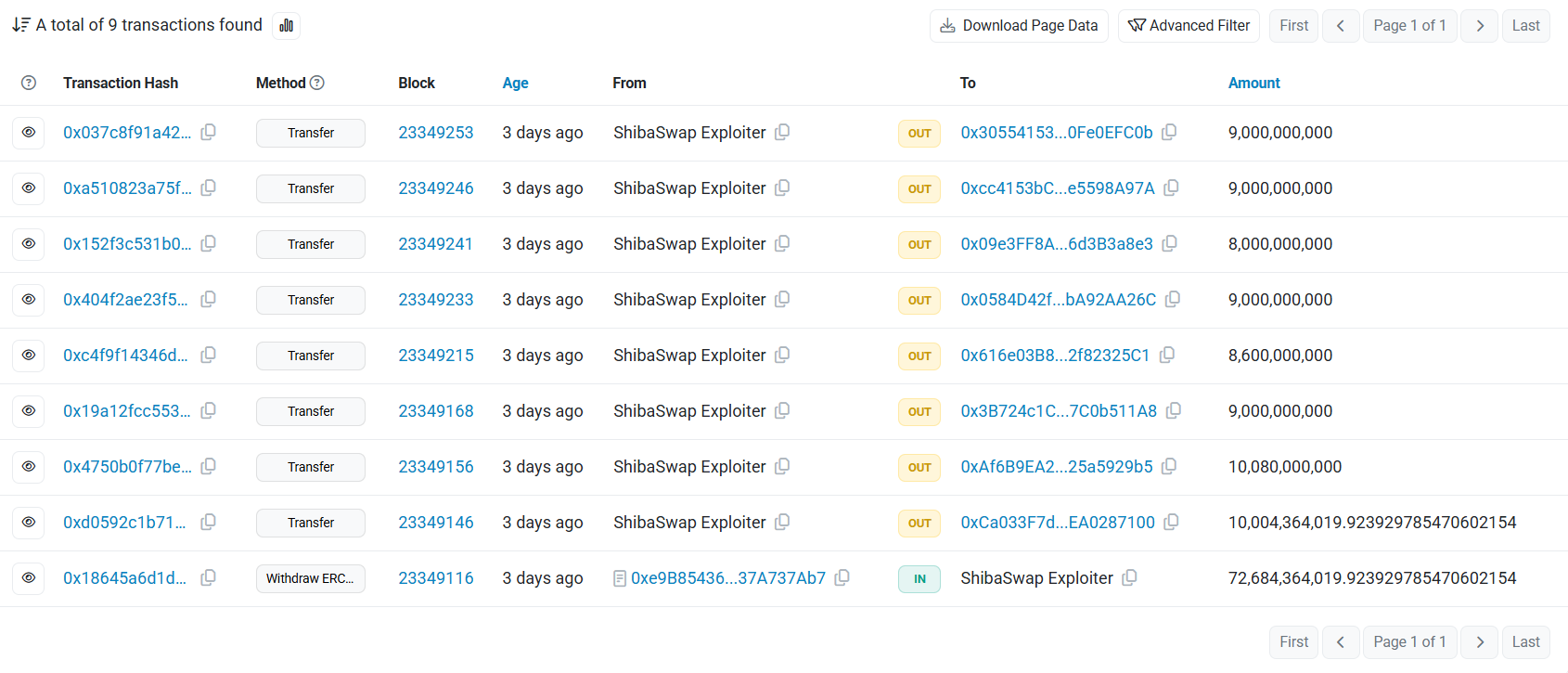
Blockchain data showed that the attacker used part of the stolen funds to repay the flash loan while keeping millions in profit. They also tried to dump around $700,000 worth of KNINE tokens, but every attempt failed after K9 Finance blacklisted their wallet.

As a result, the attackers will not be able to move or use the KNINE assets. Now, the K9 team has introduced a 5 ETH bounty for the attacker to return the KNINE tokens, on-chain data shows.

Meanwhile, in response to the broader exploit, the Shibarium team froze staking and unstaking, moved stake manager funds into a safer multisignature wallet, and brought in security firms Hexens, Seal911, and PeckShield to investigate.

A Merkle Root Exploit

Further, security analysts revealed further information following the exploit. For instance, Tikkala Security noted that several signer keys linked to ShibaSwap had leaked, which led to an even larger loss of about $2.8 million. 

The report explained that the attacker abused Merkle root checkpoints by inserting a seemingly valid root signed by ten addresses. Once the root went live, the attacker could pass off fake exit requests as legitimate and drain more funds across multiple transactions.

Pulse Digital also confirmed this and explained that the Merkle root effectively turned into a skeleton key for ShibaSwap’s rootchain manager contract. The contract treats the root as trustworthy, so once the attacker slipped in a compromised version, they could keep feeding it fabricated proofs and pulling assets out. 

Pulse Digital stressed that this kind of weakness shows poor governance and weak key management. They called for ShibaSwap to publish a full timeline of the incident, release the list of signer addresses, and commission an independent audit.

What’s Next: Shiba Inu Ecosystem Team Reacts

Meanwhile, developer Kaal Dhairya also addressed the situation, describing the exploit as a carefully planned attack that may have been in the works for months. 

He confirmed that the hacker bought more than 4.6 million BONE through the flash loan, seized validator signing keys, and then drained assets by signing a malicious state. 

Dhairya noted that the stolen BONE delegated to Validator 1 remained locked due to delays surrounding unstaking efforts. This accorded the team the opportunity to freeze those funds. According to him, the team immediately paused staking features and moved stake manager funds into a hardware wallet protected by a six-out-of-nine multisignature setup. 

The developer noted that they were still working to determine whether the breach came from a server compromise or a developer machine. According to Dhairya, authorities have joined the investigation, though the team remains open to negotiating with the hacker if they return the stolen funds.

Shiba Inu ecosystem marketer Lucie described the exploit as an example of social engineering, something that has struck many crypto projects before. She stressed that the developers are working around the clock with security experts and law enforcement to secure the network. 

Following the exploit, the hackers moved the Shiba Inu tokens to a central address and then routed them to multiple wallets. At press time, these wallets still hold the tokens, with the balance on each of them ranging from 8 billion to 10 billion SHIB.

Shibarium Hacker Wallets

100x Gem Hunter Shares XRP Price Prediction for the Next Major Pump

0

Well-known self-proclaimed 100x gem hunter Whale.Guru has shared an eye-popping XRP price prediction ahead of the next altcoin rebound.

After a brief rally over the weekend, the crypto market entered another corrective phase, with altcoins like XRP losing previously regained ground. However, with an impending rate cut in the U.S., hopes are high for a strong comeback.

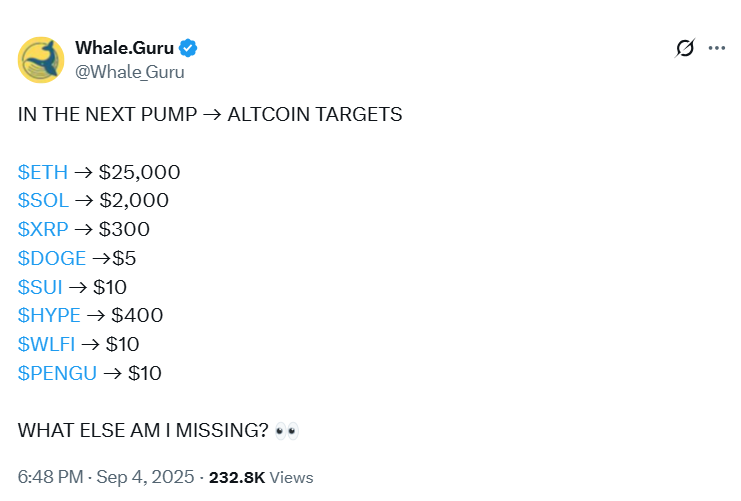
In a recent tweet, Whale.Guru shared his price targets for several major tokens in the next altcoin pump. Among them, XRP received the boldest prediction yet, with a forecasted surge to $300.

XRP Price Prediction from Whale Guru

As of today, XRP hovers just above the $3 mark. This means Whale.Guru expects a 100x move ahead for the third-largest cryptocurrency. 

Such a leap would catapult XRP into a league of its own. It would give it a multi-trillion-dollar valuation, approaching the size of gold’s total market cap.

XRP Road to $300

Specifically, a $300 XRP would represent a total market capitalization north of $18 trillion. This is more than the combined market caps of NVIDIA, Microsoft, Apple, and Google. Essentially, it suggests an unprecedented valuation for XRP.

This prediction comes at a time when XRP has gained attention beyond retail investors to include institutional players. The upcoming launch of XRP spot ETFs, expected next month, continues to spark excitement around the asset.

Industry insiders believe these ETFs could drive significant demand for XRP to propel its price into a new era. Moreover, institutions are increasingly launching XRP treasuries that accumulate the coin.

Combined with Ripple’s ongoing expansion into international banking corridors and its growing footprint in emerging markets, supporters believe XRP is building strong fundamentals alongside growing speculative interest.

Outlooks for Ethereum, Solana, and Dogecoin in the Altcoin Supercycle

Meanwhile, Whale.Guru’s tweet also set predictions for other large-cap tokens, hinting at an explosive altcoin supercycle. His forecasts include:

  • Ethereum (ETH): $25,000
  • Solana (SOL): $2,000
  • Dogecoin (DOGE): $5

These targets also represent ambitious multiples. Ethereum would need to rise 5.5x from its current price of around $4,500. Solana would need to grow 8.5x to hit $2,000.

In Dogecoin’s case, it would need a 19x surge from its current price of $0.26, bringing its market cap close to $1 trillion.

The forecast also included several smaller tokens like WLFI, HYPE, and PENGU, with price targets ranging from $10 to $400. Still, the $300 XRP price prediction remains the most audacious.

XRP Price Prediction from Other Analysts

While many analysts have speculated on XRP reaching $10, $20, or even $30 this cycle, few have ventured into triple-digit territory.

For example, market commentator Ash Crypto recently gave XRP a $5 to $8 target by year-end, assuming Bitcoin reaches the $150,000 to $200,000 range.

Other voices like Carl Moon and Zach Rector have floated $30 targets, citing historical patterns and the potential impact of ETFs. Yet none have matched Whale.Guru’s extraordinary level of conviction.

Earlier this year, analyst Javon Marks presented a $99 price outlook for XRP by the end of the cycle. However, his more recent predictions have been notably more conservative.

Others calling for triple-digit XRP prices often present it as a long-term possibility rather than a near-term expectation.

Meanwhile, critics continue to caution against such inflated projections, pointing to the substantial market capitalization such prices would imply.

Here’s Why This Exchange Data Shows XRP Breakout Could Be Coming

0

Fresh data from CryptoQuant shows that XRP exchange reserves on Binance have spiked to over 3.62 billion XRP.

The figure marks one of the largest single jumps in the past year. This surge comes even as the token’s price holds around $3.03. Market watcher Tom Tucker drew attention to the recent spike in XRP flowing to the Binance exchange in a tweet.

Tucker argued that the large inflows of tokens indicate that whales are repositioning. He claimed such movements often suggest preparations for higher trading activity or increased liquidity to precede significant price volatility.

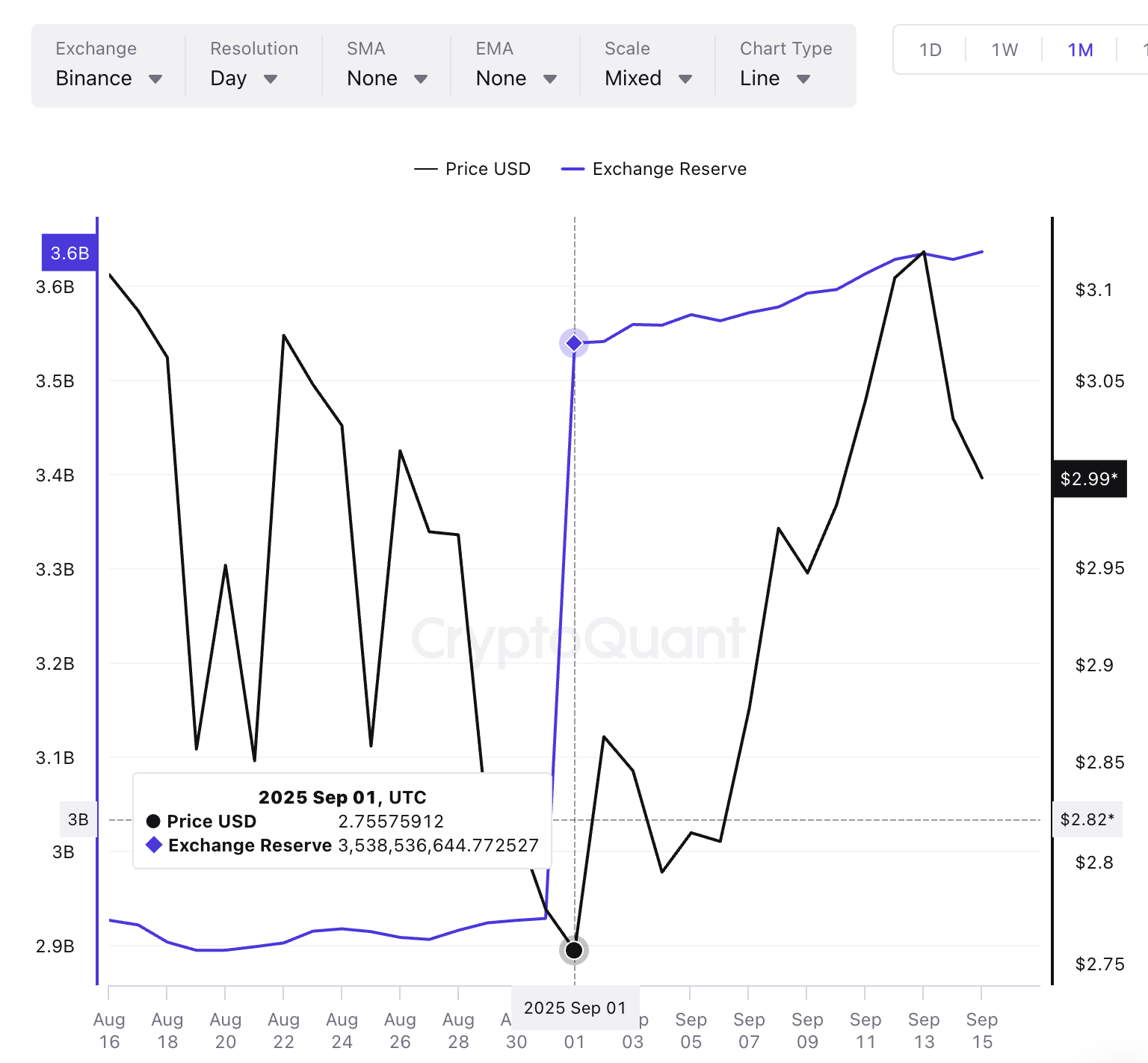
Meanwhile, a closer look at CryptoQuant’s data suggests the large spike in Binance’s XRP exchange reserves was observed on August 31, when over half a billion XRP tokens were added to the reserves in one day.

Binance XRP Reserve Explodes by 610M Tokens

For context, on August 31, XRP reserves on Binance stood at 2.9 billion tokens. In one fell swoop, the volume ballooned to 3.53 billion by September 1. This massive rise of 610 million XRP tokens coincided with XRP’s price falling to $2.69 on September 1.

XRP reserve on Binance | CryptoQuant

Flows of XRP In and Out of Binance

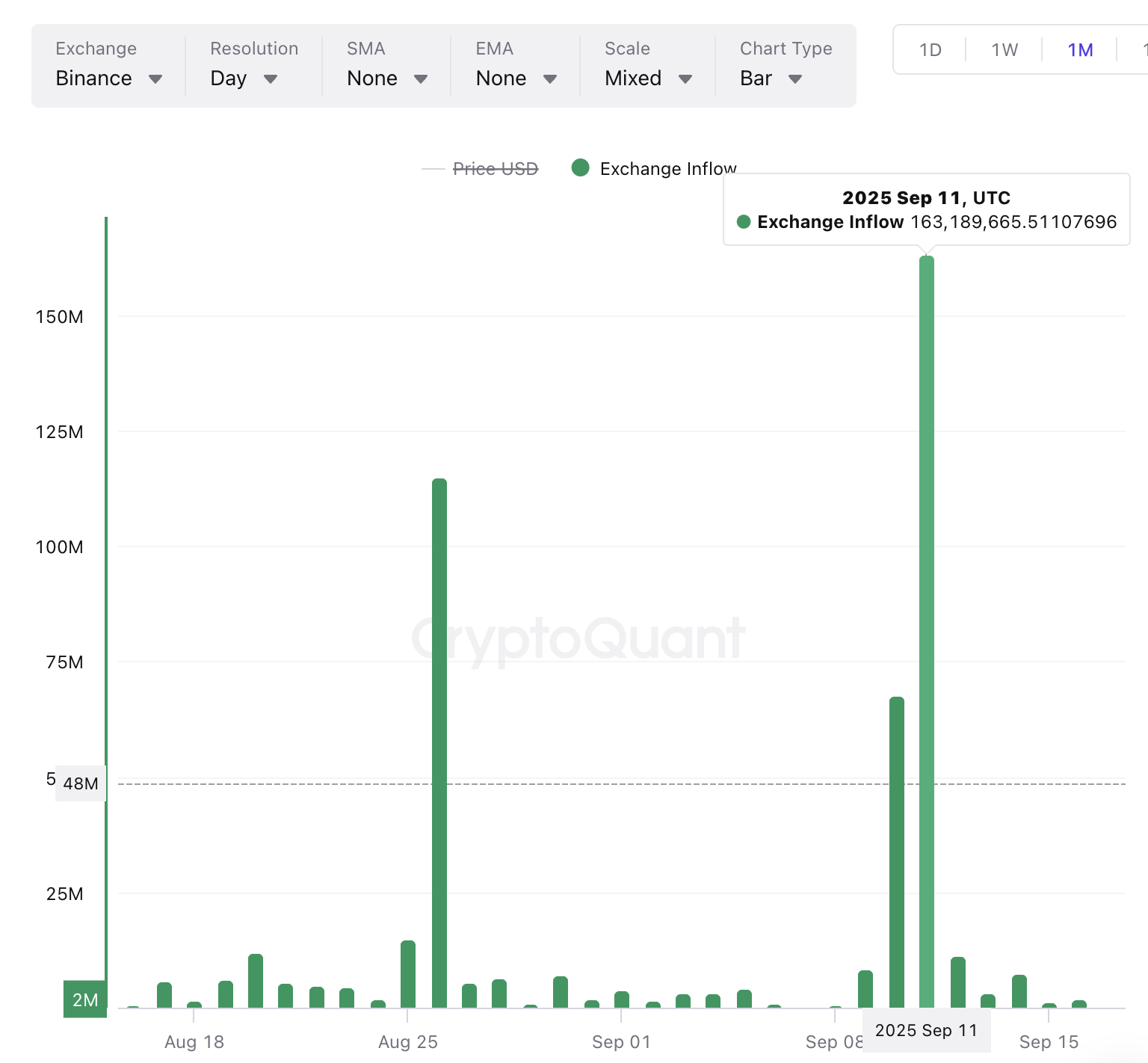
Interestingly, when looking at inflows of XRP to Binance during this period, the figures tell a different story. Specifically, CryptoQuant data shows only 1.8 million XRP entered Binance on August 31 and only 3.9 million entered on September 1.

A large spike in inflows was observed on August 26, with 115 million XRP deposited into the exchange that day. Yet, a similar quantity in outflows was also recorded on the same day.

In other words, these inflow and outflow figures fail to explain why Binance’s XRP reserves soared by over 600 million tokens between August 31 and September 1—from 2.92 billion tokens to 3.53 billion.

Given the scale of the reserve spike and the lack of matching inflow data, it’s worth questioning whether a similar data reporting error—like the one observed in June across multiple exchanges—may have occurred on September 1. Notably, in the previous incident (confirmed by CryptoQuant), a drastic drop was later attributed to a technical issue.

XRP Reserves Continue Climbing

Since then, Binance’s XRP reserves have further increased to 3.63 billion tokens at press time. Interestingly, this spike continued even as the price of XRP improved, reclaiming the $3 mark. Moreover, the exchange has seen increased influxes of XRP in the past few days.

For instance, on September 10, over 67 million XRP entered Binance; the next day, a more massive 163 million tokens entered. Interestingly, the exchange saw nearly equal volumes of outflows during the same period.

XRP inflow into Binance

Notably, the trend of substantial inflows and outflows on Binance has declined significantly in more recent days. Nonetheless, the exchange continues to hold a considerable trove of XRP.

Coinbase XRP Reserves Plunge by 581M Tokens

Separately, XRP reserves on Coinbase have dropped sharply by 581 million tokens in recent weeks. This decline has raised speculation about potential price manipulation and may be further contributing to bearish pressure on the asset.

Whales Dump 200M XRP

Meanwhile, additional data from Santiment highlights whales selling more XRP than buying. Market watcher Ali Martinez noted on Monday that whales offloaded 160 million tokens over the past two weeks. An earlier post on September 12 disclosed that whales dumped 40 million XRP within a 24-hour window.

What Does it Mean for XRP Price?

At the moment, despite the massive volume of XRP on exchanges and the pressure from whales, the price has remained resilient, reclaiming the $3 level.

This hints that buying demand is currently absorbing the extra supply. If this trend continues, it could set the stage for a strong breakout, as Tom Tucker suggested in his commentary on the trend.

Yet, continued heavy selling may cause the market to experience short-term downward pressure before any sustained rally.

Analyst Predicts XRP Price by November, Aligning with Fib. 3.618

0

A market analyst recently shared what he believes XRP price could rally to by November, aligning with a bullish Fibonacci level.

Currently, XRP is wrestling with the $3 mark, a level that has acted like a magnet for weeks. The price recently dipped below this zone but quickly bounced back, now trading close to $3.03, a delicate position.

XRP Eyeing Wedge Breakout 

Amid this struggle, well-known trader Papa shared a chart that suggests XRP may soon break free from the tug-of-war. Specifically, he believes his system points toward $8.50 by November, a target that matches the 3.618 Fibonacci extension at $8.5177.

For context, an accompanying chart shows that throughout 2024, XRP spent months in a quiet range between $0.49 and $0.65. However, this long stretch of sideways movement built the foundation for a massive breakout late in the year. 

When the breakout came on the back of the U.S. elections in November 2024, XRP skyrocketed straight into the $2.5 to $3.4 region. This surge culminated in a peak of $3.4 in January 2025. After the rally, XRP cooled down and shifted into consolidation through much of 2025. 

XRP 2W Chart Papa
XRP 2W Chart | Papa

The price swung back and forth between roughly $2 and $3.4 until a breakout led to a new peak of $3.66 by July 2025, before another drop to trade between $2.4 and $3.4. Within this range, XRP shaped a falling wedge, often seen as a bullish continuation signal. 

XRP Targets $8.5 by November

Right now, the coin sits just under the upper boundary of that wedge, pressing against long-term resistance drawn from the $3.66 peak. A break above the upper boundary and a push beyond $3.66 could set the stage for XRP’s upward push.

Notably, XRP’s Relative Strength Index soared during the initial rally, then eased into lower highs while price moved sideways. Lately, RSI has pushed back up to about 62, hinting that strength may be returning. A break of the RSI’s downtrend line would confirm that momentum has changed in favor of the bulls.

Data from the chart shows Papa’s roadmap alongside Fibonacci levels. Specifically, if XRP clears $3.64, the first stop sits at the 1.618 extension around $4.45. A stronger push could reach the 2.618 extension near $6.15, while the most ambitious target lies at the 3.618 extension around $8.52. From today’s $3.11, that would mean a gain of more than 170%.

Persistent Bullish XRP Outlook

Meanwhile, other traders also see reasons to stay bullish. Khonshu Arc said the September low near $2.7 is the level that keeps the bull run intact. He explained that if this low holds, XRP can aim for $4.30 to $5.00 under his Elliott Wave count. He marked $3.39 as the first sign of strength and warned that a break below $2.7 would invalidate the bullish setup.

XRP 1D Chart Khonshu Arc
XRP 1D Chart | Khonshu Arc

Analyst Ali Martinez added that the TD Sequential indicator recently flashed a buy signal. For the uninitiated, this typically signals that a bounce may be coming.

Also, Man of Bitcoin observed that XRP retested a descending trendline from above. He admitted the pullback looks deeper than normal for an early corrective wave but maintained the structure on his chart given how volatile XRP often behaves.

XRP 1h Chart Man of Bitcoin
XRP 1h Chart | Man of Bitcoin

Pantera’s Dan Morehead Confirms $1.1 Billion Solana Bet as Biggest Position

0

Pantera Capital is doubling down on Solana, with founder Dan Morehead revealing the hedge fund has invested $1.1 billion into the blockchain’s token.

In an interview with CNBC, he said Solana has outperformed Bitcoin over the past four years. This strong performance, he added, has made it Pantera’s biggest conviction bet to date.

From Bitcoin-Only to Solana-Heavy

Morehead explained that Pantera’s investment strategy has always adapted to shifts in the crypto market. The fund began as a Bitcoin-only vehicle, later built significant exposure to Ethereum, and now holds Solana as its largest position.

“Our biggest position is Solana. We’ve had huge positions in Ethereum in the past. At one point, we were fully in Bitcoin. Something could come out tomorrow,” Morehead told CNBC.

The remark highlights Pantera’s rotational strategy. Instead of being tied to a single digital asset, the firm reallocates capital toward whichever blockchain shows the strongest growth potential. Today, that happens to be Solana. Tomorrow, it could be another emerging protocol.

With $1.1 billion in Solana holdings—approximately 4.6 million tokens—Pantera is the largest corporate holder of SOL. It surpasses DeFi Development Corp’s known holdings of just over 2 million. According to Coingecko, DeFi Development Corp holds just over 2 million SOL.

Why Solana?

Morehead pointed to Solana’s speed, efficiency, and market performance as key drivers. He claimed the network could theoretically handle up to nine billion transactions daily, far more than global financial markets combined.

On-chain data also supports Solana’s growing footprint. According to DeFi Llama, the blockchain currently holds $33.59 billion worth of total value locked (TVL). Meanwhile, Solana-based decentralized exchanges such as Raydium, Jupiter, and Jito collectively process nearly $6 billion in daily trades. Solana has also become a leading hub for NFTs and meme tokens.

At the time of reporting, SOL was trading at about $236.48, down 0.05% on the day but up nearly 10% over the past week.

Bitcoin Outlook Still Bright

Although Pantera is betting big on Solana, Morehead emphasized he remains bullish on Bitcoin. He pointed out that the world’s first cryptocurrency has “roughly doubled every year” across its 12-year history.

Looking forward, he predicted Bitcoin could reach $750,000 within four to five years, citing its small share of global wealth as a reason for continued growth.

“It’s still a very low single-digit percentage of global wealth,” Morehead noted, suggesting that institutional adoption and wider use cases could drive higher valuations.

While he does not expect Bitcoin to hit $1 million soon, he believes such a milestone could be possible within his lifetime.

Citigroup Predicts Ethereum Price By Year-End

0

U.S.-listed banking titan Citigroup has issued a new outlook for Ethereum (ETH), predicting that the world’s second-largest crypto may close the year 2025 at $4,300.

That target is slightly below its current market level of around $4,500, signaling the bank’s cautious stance despite ongoing optimism.

Citigroup’s Ethereum Outlooks

Notably, the bank’s outlook is not one-dimensional. In its base case, Ethereum closes the year at $4,300. However, Citigroup also outlined a bull case of $6,400 for the Ethereum price, driven by strong adoption and capital inflows. In contrast, its bear case projects just $2,200, citing risks such as weaker network usage or tighter global liquidity.

This significant spread highlights the uncertainty surrounding Ethereum’s valuation, where both fundamental drivers and market sentiment play outsized roles.

Network Activity Still the Core Driver

Citi analysts stressed that network activity remains the foundation of Ether’s value. The more Ethereum is used for transactions, decentralized finance (DeFi), or applications, the greater the demand it generates. This rising demand, in turn, strengthens the value of its native token, ETH.

However, recent growth has shifted toward layer-2 scaling solutions such as rollups, sidechains, and off-chain systems. These platforms ease congestion on Ethereum’s main chain by processing transactions faster and more cheaply, then settling them on the base blockchain.

The concern, according to Citi, is that not all activity on these layer-2 systems directly benefits Ethereum itself.

Valuation Model Suggests ETH Is Overextended

To quantify this, Citi assumes that only 30% of layer-2 activity contributes meaningfully to Ethereum’s valuation. By this measure, Ether is currently trading above its fair value. 

The analysts believe the gap is explained by other factors, including steady inflows from institutional investors, as well as enthusiasm around tokenization projects and the growing role of stablecoins on Ethereum’s network.

ETFs Bring Mixed Impact

The introduction of Ethereum-focused exchange-traded funds (ETFs) has added another layer of complexity. Citi pointed out that while ETF flows for ETH remain smaller than Bitcoin, their price impact per invested dollar is actually greater.

Still, the bank expects Ether ETFs to draw limited inflows compared to Bitcoin, due to Ethereum’s smaller market capitalization and its relatively lower visibility among first-time crypto investors.

Macro Conditions Provide Little Lift

Beyond crypto-specific dynamics, Citi believes the macroeconomic backdrop offers little upside. With U.S. equities already trading close to the bank’s S&P 500 target of 6,600, there is limited room for risk assets, including cryptocurrencies, to gain from broader market momentum.

That means Ether’s price is likely to remain more influenced by network usage, investor flows, and adoption of new applications rather than traditional macro trends.

While Citigroup sees the ETH price dipping by year-end, other industry commentators like Tom Lee see it going as high as $12,000.

Pantera Capital CEO Says Ripple Is Going After SWIFT on CNBC

0

Pantera Capital CEO Dan Morehead, in a recent live interview on CNBC’s Squawk Box, highlighted Ripple’s ambitious goal of challenging the global banking messaging giant, SWIFT.

During the interview, Morehead discussed the growing landscape of blockchain projects and their varied applications. While focusing primarily on Pantera’s new Solana-focused treasury company, he took a moment to highlight that different cryptocurrencies serve different purposes.

Specifically, he noted that Ripple is targeting a major pain point in traditional finance—cross-border payments and messaging—by competing directly with SWIFT.

“There might be other use cases, you know, like Ripple’s going after SWIFT,” Morehead remarked.

Ripple’s Positioning Within the Blockchain Ecosystem

Notably, Morehead’s comments placed Ripple alongside other major blockchain projects, each serving distinct roles. He described Bitcoin as “digital gold,” primarily a store of value.

On the other hand, he characterized Solana as a high-performance blockchain with massive transaction throughput. As for Ripple, Morehead described it as a serious contender for modernizing cross-border payments and financial communication.

This perspective highlights the diversity within crypto technology, where no single project dominates all aspects of the industry.

Ripple VP: “We’re Building a SWIFT-Like Replacement”

Ripple’s attempt to disrupt SWIFT has long been a focal point for investors, notably the XRP Army.

In January, Ripple’s Senior VP Eric van Miltenburg stated at the 2025 World Economic Forum that Ripple aims to be a modern alternative to SWIFT for cross-border payments.

He called attention to Ripple’s focus on fast, compliant, and customer-driven infrastructure, targeting traditional financial institutions seeking innovation.

Meanwhile, at the XRPL Apex in June, Ripple CEO Brad Garlinghouse said the XRP Ledger could handle 14% of SWIFT’s transaction volume within five years.

Other Industry Commentary

Weighing in on these statements, popular XRP community figure Crypto Eri argued that Ripple’s approach is competitive rather than collaborative with SWIFT. This counters ongoing speculation that Ripple might integrate or partner with SWIFT systems.

Moreover, the XRP Army believes Ripple’s acquisition of Hidden Road is a strategic move to bypass legacy systems like SWIFT altogether.

Morehead’s remarks on live TV have sparked significant reaction in the XRP community.

Interestingly, other industry leaders share a similar view. In July, Teucrium CEO Sal Gilbertie said the firm launched its 2x Long Daily XRP ETF because he believes Ripple could “hopefully” replace SWIFT.

Speaking on the Thinking Crypto podcast, Gilbertie praised Ripple’s long-term focus on modernizing cross-border payments. He stressed that Ripple’s mission to upgrade outdated banking systems resonated with him, given his background in derivatives.

“Decades Later, It’s Still Just Vibes”

Meanwhile, it hasn’t all been praise for Ripple in its ambition to rival SWIFT. In March, Forbes published a scathing report, labeling Ripple a “good-for-nothing” and “zombie” project.

The article questioned Ripple’s long-standing promise to replace SWIFT, noting that over a decade later, the company is “still running pilot programs in small markets.”

Similar critical commentaries have emerged even within the crypto community. Chainlink proponents have recently questioned XRP’s relevance in the evolving crypto landscape.

They argue that decades later, it’s still running on hope, while projects like Chainlink are securing government collaborations.

While Ripple and XRP have landed high-level partnerships, critics argue they are falling behind on their core promises after years in the making.

Here’s Why Bitcoin Could Hit $750,000 in 5 Years

0

Pantera Capital founder Dan Morehead has predicted the price of Bitcoin in the next four or five years, sharing why it would attain the milestone.

The hedge fund manager shared his thoughts on the price targets for Bitcoin on Monday’s CNBC Squawk Box interview. He predicted that Bitcoin would continue to see higher prices, as it has done historically, targeting $750,000 in the next four to five years.

Bitcoin Poised for 548% Growth in 5 Years.

At the current Bitcoin price of $115,725, Morehead’s projected target of $750,000 would imply a 548% rally for Bitcoin. According to him, this feat is not new for Bitcoin, as it has been increasing two-fold every year over the past 12 years.

Notably, he expects this trend to continue for “a few more years” from now; hence, his anticipation that Bitcoin will land at $750,000 within the next four to five years.

Why the continued expansion? Morehead noted that it is because Bitcoin has more room for expansion. Considering its growing mainstream attention, Bitcoin’s share of global wealth remains significantly low. 

For context, the global financial wealth reached an all-time high of $305 trillion in 2024. With Bitcoin’s current market cap of $2.3 trillion, it accounts for just 0.75% of the total financial value held globally.

Morehead expects Bitcoin to capture more, predicting a rally to $750,000. Remarkably, this still pales in comparison with Strategy executive chairman Michael Saylor’s Bitcoin outlook. He predicted that BTC would capture 7% of the global wealth over the next 20 years to hit $13 million.

Much Higher Bitcoin Price?

Despite the bullish outlook, several other projections suggest much higher prices for Bitcoin in the same timeframe. Ark Invest’s Cathie Wood predicted that Bitcoin would rally to $1.5 million by 2030, which is double Morehead’s outlook.

Meanwhile, Coinbase CEO Brian Armstrong predicted that Bitcoin would reach at least $1 million by 2030, a projection that Robert Kiyosaki, author of Rich Dad Poor Dad, has also endorsed. Armstrong tapped institutional adoption and regulatory tailwinds to fuel this rally.

Solana Could Outperform Bitcoin and Ethereum

Notably, Morehead’s projection comes as Pantera Capital led the PIPE funding for Nasdaq-listed Helius Medical Technologies to create a Solana treasury reserve. They raised $500 million, which would be deployed to accumulate Solana.

Morehead noted that Solana is Pantera Capital’s largest holding, tapping the asset to continue to grow. He highlighted that SOL has outperformed Bitcoin over the last four years and expects the trend to continue.

The Pantera managing partner also noted that Solana would outperform Ethereum.

“I think Solana is one-twentieth of the market cap of Bitcoin. So, I think it can outperform over time, and it is our current opinion that it outperforms Ethereum,” Morehead stated.

Coinbase XRP Cold Wallets Drop from 52 to Just 6

0

Coinbase wallets holding XRP have dropped dramatically over the past three months, leading to mixed reactions among community members.

While XRP has continued to battle the bears at $3, the XRP holdings on Coinbase, America’s largest exchange, have witnessed a dramatic change over the past three months. Notably, Coinbase, which once had 970 million XRP in its cold wallets just three months ago, now only holds 98 million within these wallets.

For the uninitiated, an exchange uses cold wallets to store assets for the long term. These wallets usually hold customer deposits and reserve funds that the exchange doesn’t use for daily trading. On the other hand, hot wallets stay online and give the exchange quick access to funds for withdrawals and active trades.

Coinbase XRP Holdings Depleting

As of early June, Coinbase had up to 52 cold wallets holding XRP, according to findings from community pundit “XRP Liquidity,” who tracked these accounts at the time. The pundit confirmed that these 52 cold wallets held a total of 970 million XRP, currently worth $2.88 billion, with 10 wallets each holding 26.8 million XRP and 42 wallets each holding 16.8 million XRP.

However, since June, the cold wallets have persistently moved out millions of their XRP holdings. This is particularly strange, considering that cold wallets do not usually feature this much activity. Notably, such everyday movements are typical of hot wallets, which exchanges use for withdrawals and trading.

Coinbase XRP Movements

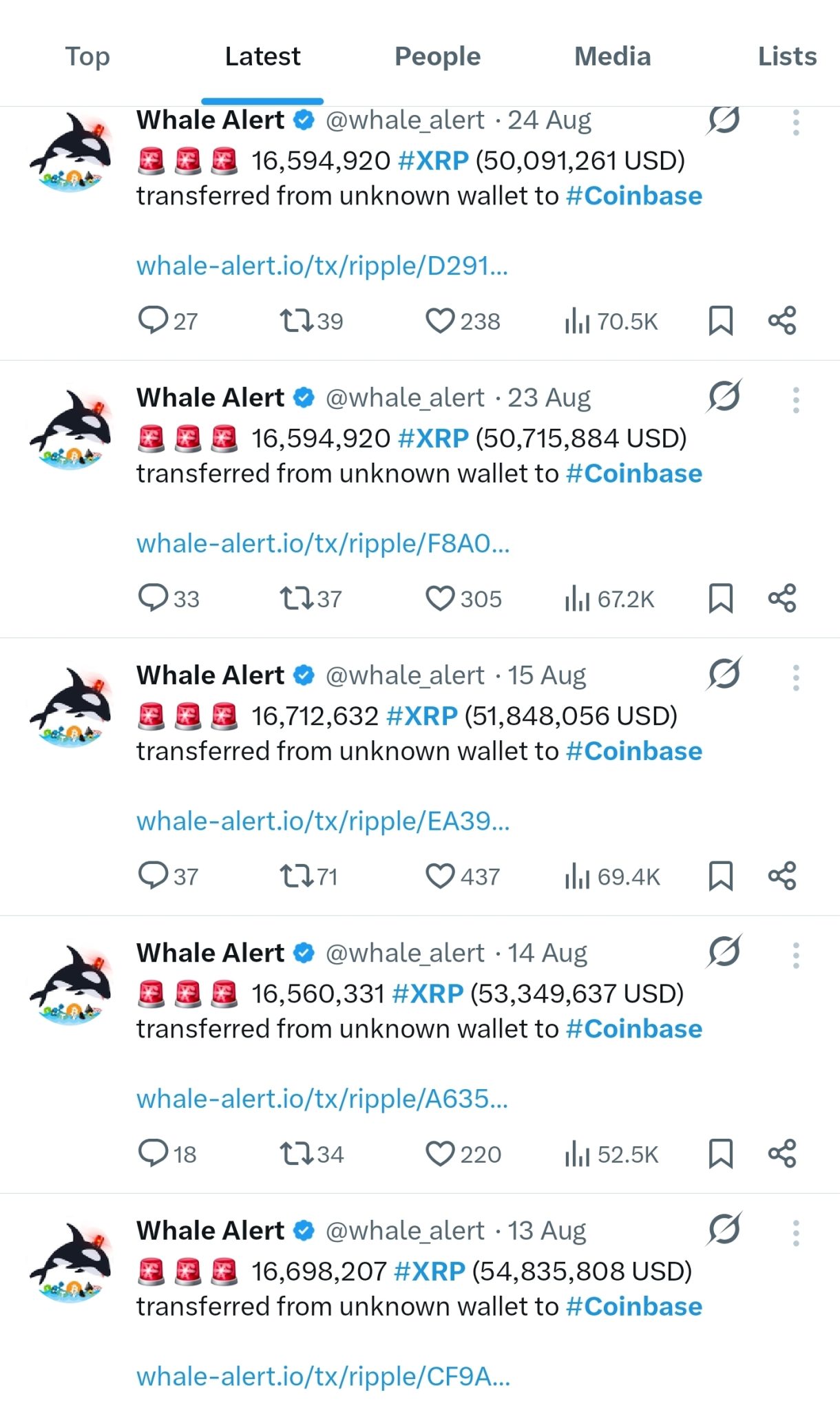
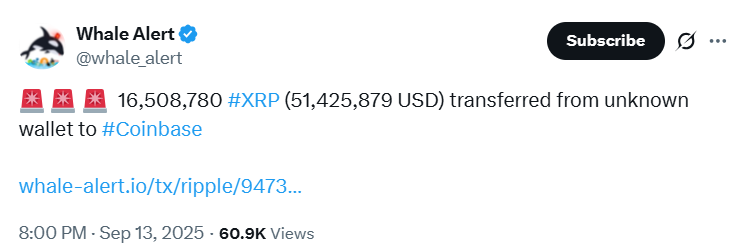
Interestingly, market tracking resource Whale Alert called attention to some of these transactions, with most of them, especially the ones from last month, involving 16M+ XRP. Recall that XRP Liquidity’s June analysis confirmed that up to 42 Coinbase wallets each held 16M+ XRP tokens. 

While Whale Alert called these wallets “unknown,” on-chain data confirmed that they were actually Coinbase’s cold wallets. 

Particularly, these cold wallets transferred the XRP tokens to Coinbase hot wallets, and then the hot wallets moved fractions to platforms such as Stake, Binance, and others, as well as unknown addresses. This indicates that the funds went toward meeting customer withdrawal requests.

Latest Transactions

The latest of these movements occurred on Sept. 13, when Coinbase (Cold 141) moved 16.5 million XRP to Coinbase (6), a hot wallet, at 18:59 UTC. The Coinbase (6) wallet has since used these tokens to meet withdrawal requests, currently holding just 35,924 XRP.

Coinbase XRP Movements Whale Alert
Coinbase XRP Movements | Whale Alert

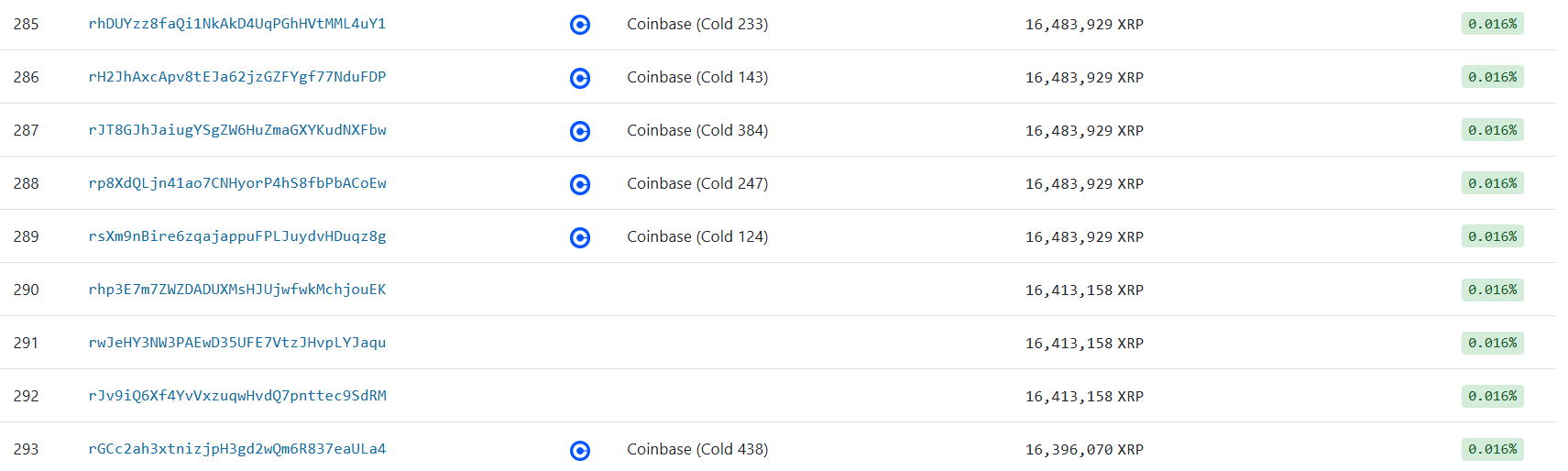
Amid the persistent outflows from Coinbase wallets, the exchange now has only six cold wallets on the XRPL, down from 52 in June, according to data from XRPScan. Notably, each of these wallets holds 16M+ XRP, totaling 98.81 million tokens. This represents an 89.8% drop from the 970 million XRP from June.

Coinbase XRP Cold Wallets XRPScan
Coinbase XRP Cold Wallets | XRPScan

At press time, there have been no announcements from Coinbase on the reason behind these movements, and they have not yet replied to a request for comment from The Crypto Basic.

Notably, some XRP community figures have suggested that large whales are behind the movements, projecting an imminent supply shock that could push prices to targets around $10. However, these comments remain unconfirmed as of this press.