Home Blog Page 550

Bitcoin Veteran Says 1 BTC Will Be Generational Wealth Next Decade

0

Bitcoin advocate Davinci Jeremie, who has supported the cryptocurrency since 2011, has declared that owning just one BTC will amount to generational wealth in the next decade. 

His outlook comes as Bitcoin trades at $109,000, near all-time highs, with multiple analysts projecting million-dollar valuations in the years ahead.

Holding 1 Full Bitcoin

Bitcoin’s capped supply of 21 million coins is central to the belief that it will become a luxury asset. With over 50 million millionaires worldwide, there simply isn’t enough Bitcoin for each to own one whole coin. This imbalance is fueling urgency among both retail investors and high-net-worth individuals.

Altcoin Daily’s Aaron Arnold recently urged millionaires to secure at least 1 BTC before it becomes unaffordable. Meanwhile, El Salvador’s President Nayib Bukele once noted that Bitcoin’s supply ensures not every millionaire can buy one. 

Even Eric Trump remarked that 0.5 BTC could become a life-changing sum, hinting at just how scarce one full coin might be in the coming decade.

BTC Projections Stretching Beyond $1 Million

For Bitcoin to become “generational wealth,” its price would need to soar into the millions. Forecasts from leading analysts and institutions already support this path.

Jack Dorsey, Robert Kiyosaki, Charles Hoskinson, Samson Mow, and many other industry voices have said Bitcoin will reach $1 million per coin. Most of them believe this will happen by 2030.

Meanwhile, institutions like ARK Invest have taken the 2030 outlook even further. It projects that Bitcoin will be worth $1.5 million by 2030 in its base case. Further, its bull case predicts a run to $2.4 million.

Michael Saylor, executive chairman of Strategy, is far more ambitious. Specifically, he expects Bitcoin to hit $13 million by 2045 as institutional adoption and supply constraints intensify.

These projections align with Jeremie’s call that one coin could indeed represent multi-generational wealth by the 2030s.

Institutional FOMO and Supply Squeeze

Meanwhile, the surge in Bitcoin adoption is another key driver. Over 100 public companies now hold BTC on their balance sheets. Specifically, public and private companies hold a combined Bitcoin portfolio worth over $150 billion. At the same time, U.S. spot Bitcoin ETFs have already accumulated 1.488 million BTC worth more than $162 billion. 

Yet, only about 450 new BTC are mined daily, most of which are immediately absorbed by ETFs and corporate treasuries.
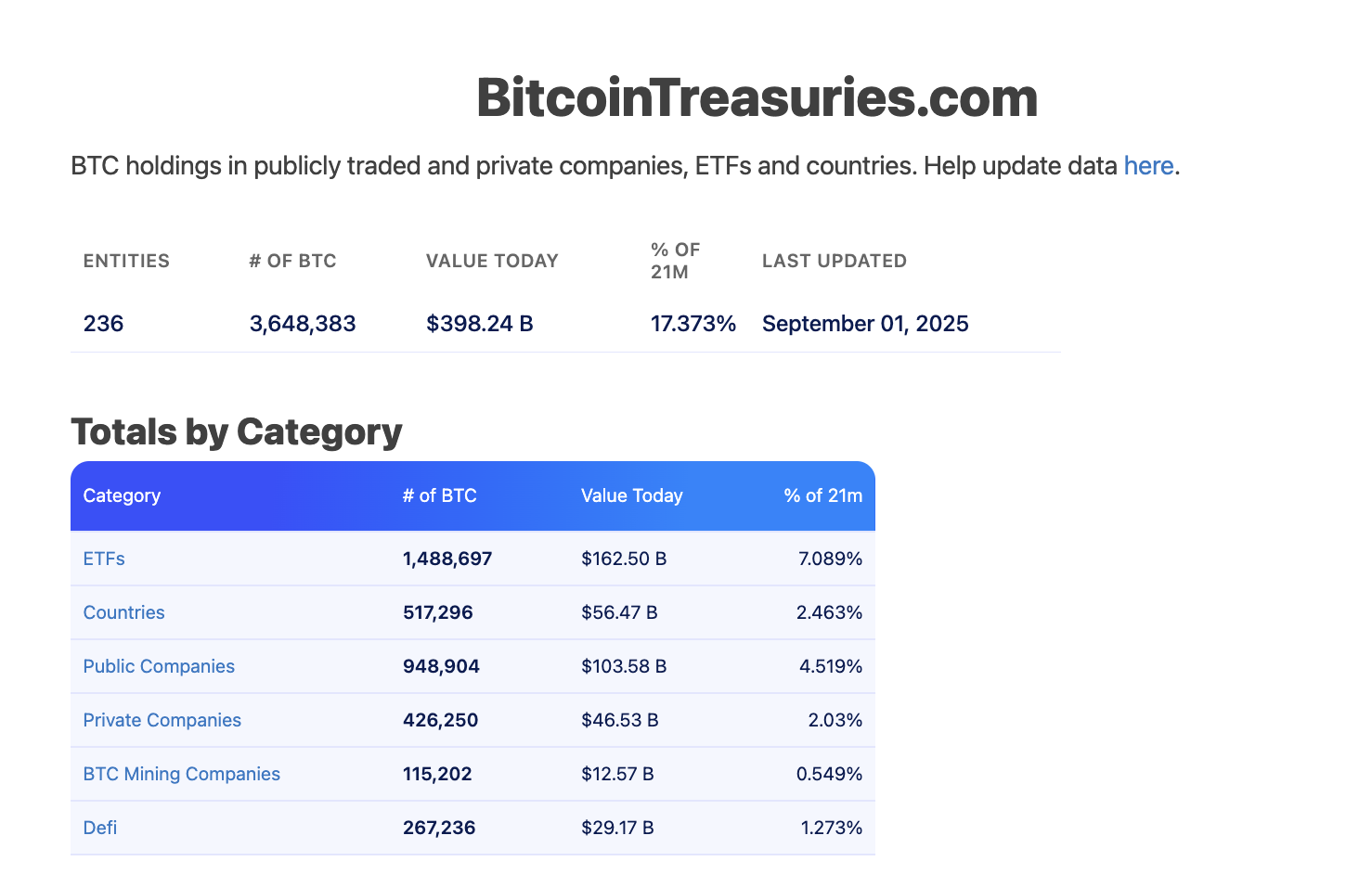
Bitcoin treasuries
Bitcoin treasuries

With supply dwindling and demand rising, Bitcoin’s value is set to compound, echoing earlier models such as the Stock-to-Flow and S-curve demand models. Both frameworks accurately predicted Bitcoin’s 2025 range near $100,000 and forecast much higher valuations in the coming decades.

From $109K to Generational Wealth

At today’s price of $109,000, Bitcoin is already out of reach for the average U.S. earner, whose annual salary is less than two-thirds of a single coin. If long-term forecasts materialize, owning 1 BTC could elevate holders into a position of wealth security for themselves and for future generations.

Eric Trump Hails WLFI Token Launch as a Major Milestone for the Future of Money

0

The utility token of Donald Trump’s family-affiliated project, World Liberty Financial (WLFI), has commenced trading on multiple crypto exchanges. 

WLFI began trading at 13:00 (UTC) today across major exchanges, including Binance and Bybit. These exchanges opened spot trading for WLFI under various pairs. For instance, Binance paired the token with the world’s two largest stablecoins – USDC and USDT – as part of efforts to drive its adoption among users. 

Eric Trump Confirms Launch 

Notably, American businessman and second son of U.S. President Eric Trump confirmed WLFI’s launch in a tweet today. 

He claims that the project aligns with the U.S. values and leadership in global finance. Moreover, he tagged the public launch of WLFI as a significant milestone in the evolution of money. 

WLFI Allocation 

For context, WLFI launched with an initial supply of 24.67 billion tokens, accounting for roughly 24.67% of its maximum 100 billion supply. 

The 24.67 billion tokens were allocated as follows: 10 billion WLFI to the World Liberty Financial ecosystem, 7.7 billion to Alt5 Sigma Corporation, 4 billion to ICO participants, and the remaining 2.88 billion for liquidity and marketing. 

The allocation to ICO participants represents only 20% of the amount they purchased during the initial sale. This move is part of efforts to mitigate volatility and prevent investors from dumping the tokens. 

Price Dips Amid Increased Volatility 

The token commenced trading at a unit price of $0.30, which translates to an initial market capitalization of $7.4 billion. Following its launch, the price skyrocketed to approximately $0.40. However, it has retraced significantly from this level and is currently trading at $0.2609. 

At the current price, the entire 24.67 billion WLFI in circulation is valued at approximately $6.43 billion. Since its launch, the token has garnered significant attention, with trading volume surging to over $1.28 billion. 

Interestingly, World Liberty Financial spent $2 million worth of its native dollar-pegged stablecoin, USD1, to acquire WLFI, demonstrating its confidence in the asset. 

Data from Lookonchain shows that the Trump family-backed project acquired 6.5 million WLFI at a unit price of $0.3078, with the aggregate cost totaling $2 million. Following the purchase, World Liberty Financial currently holds 19.965 billion WLFI, valued at $5.93 billion. 

Michael Saylor Says Whoever Gets The Most Bitcoin Wins

0

Strategy executive chairman Michael Saylor has suggested that he is not slowing down on stacking Bitcoin, noting that the largest holder wins.

It is a new month, but the same bullish Saylor. The Bitcoin evangelist remains keen on stacking the pioneering cryptocurrency despite recent bearish price action, which has seen it retrace over 10% from its all-time high of $124,457. 

In a tweet today, Saylor has reminded his 4.5 million followers that, in the end, what matters is how many bitcoins you have.

Who Holds the Most Bitcoin Wins

Saylor shared an AI-generated video of himself in a luxury car, appearing to be at a racing event. Accompanying the clip, directed by “Atlas Hodl’d,” is a popular quote from the Strategy chairman, where he stated that “whoever gets the most Bitcoin wins.”

Michael Saylor on X
Michael Saylor on X

The message is clear: Saylor wants more Bitcoin and is well in the race to stack more sats. His remarks suggest that Strategy is in the race to hold the most Bitcoin, and whoever does hit this feat has achieved staggering success.

It further aligns with his sentiment that Bitcoin is the “cyber Manhattan” and would continue to increase infinitely against the dollar. Recall that he had early vowed to buy the Bitcoin top forever, predicting it would reach $21 million per coin in the next 21 years.

Bitcoin Hungry Despite 632,457 BTC Bag

Meanwhile, this bullish comment comes despite Strategy’s large Bitcoin holdings. The business intelligence firm holds 632,456 BTC, worth $69 billion at the time of writing.

Remarkably, this is by far the largest stash of any public firm, as it holds nearly 13 times that of second-place Marathon Digital, which has 50,639 BTC ($5.5 billion).

Strategy had announced a purchase on three consecutive Mondays before today, demonstrating a commitment to buy Bitcoin by any means necessary. While he did not post any purchases on September 1, his clip reassures enthusiasts that Strategy has not backed down on its long-standing quest to buy more Bitcoin.

Interestingly, other treasury firms have taken up the challenge, adopting Strategy’s playbook to buy Bitcoin. For instance, Metaplanet bought 1,009 BTC ($112 million) today, bringing its holdings to 20,000 BTC.

Strategy Not After the Entire Bitcoin Supply Though

Despite Strategy’s commitment to hold more and more Bitcoin, Saylor has clarified that it does not plan to acquire all of its supply. Currently, the company holds 3.1% of BTC’s circulating supply, with Saylor aiming to more than double that figure to 7%.

He claimed that he wants other firms also to have a share of the scarce asset and benefit from the upsides of holding it. This is because he expects Bitcoin to grow by 29% annually over the next 21 years, making it the best-performing asset in existence.

Twenty One Capital CEO Jack Mallers Sees Bitcoin Reaching a $500 Trillion Market Cap

0

Jack Mallers, the co-founder and CEO of Twenty One Capital, recently suggested that Bitcoin could grow to a $500 trillion market cap.

Mallers said this while sharing his company’s vision in an interview with Bloomberg. He explained how Twenty One Capital plans to grow in the Bitcoin scene despite being one of the earliest firms to adopt the Bitcoin standard.

Jack Mallers Reveals Twenty One Capital’s Ambitious Plans

For context, Twenty One Capital launched in 2025 after merging with Cantor Equity Partners, a Nasdaq-listed SPAC. The company started with more than 42,000 BTC contributed by backers such as Tether, SoftBank Group, and Bitfinex, making it the third-largest corporate Bitcoin holder from day one. 

Now, with a pro-forma enterprise value of $3.6 billion, the company set a goal to increase its holdings to about 43,500 BTC while keeping its average purchase price near $87,280 per coin.

However, Jack Mallers clarified that the company plans to do much more than buy Bitcoin and hold it. “We want to be the best Bitcoin company in the world,” he said. He explained that Twenty One Capital would keep using its cash flow to acquire more Bitcoin while building financial products and services designed around the premier crypto asset.

During the interview, Mallers described a gap he sees in the market. On one side, firms like Coinbase focus on running exchanges that trade many cryptocurrencies. On the other side, companies like MicroStrategy buy and hold Bitcoin for their corporate treasuries, but stop there. 

Mallers, who is also the founder of Strike, believes Twenty One Capital can sit in the middle by raising capital, growing its Bitcoin reserves, and launching Bitcoin-based financial services. “That’s exactly the market hole we want to fill,” he said.

“Bitcoin Is a $500T Asset in the Making”

The 21 Capital CEO suggested that exchanges that do not focus only on Bitcoin are “missing the forest for the trees,” boldly claiming that “Bitcoin’s a $500 trillion asset in the making.”

Interestingly, this projection goes far beyond Michael Saylor’s well-known forecasts. Saylor, whose firm MicroStrategy pioneered the corporate Bitcoin treasury approach, has projected BTC could one day reach a $280 trillion market cap. In another prediction, he suggested Bitcoin could trade at $21 million per coin by 2046. 

Remarkably, Mallers’s vision suggests Bitcoin could go even higher, potentially reaching $25.11 million per coin based on the current circulating supply of around 19.91 million tokens.

Meanwhile, Mallers also pushed back against labeling Twenty One Capital as only a Bitcoin treasury company. He explained that the firm plans to raise capital, expand its Bitcoin reserves, develop products, and build cash-generating businesses, all with a strict focus on Bitcoin. 

He said this approach would combine the strengths of treasury accumulation with financial innovation, creating a model that is unlike any other in the crypto scene.

The company plans to trade on Nasdaq under the ticker “XXI” once it receives final regulatory and shareholder approvals. Mallers added that investors would have full transparency into the firm’s holdings through on-chain proof of reserves.

Negative Attacks on XRP Generate 10x Engagement, Analyst Reveals

0

A new analysis suggests that online attacks on XRP are unintentionally fueling its visibility and adoption.

Crypto analyst and podcast host Paul Barron highlighted new findings from his Market Sentiment Index (MSI), which tracks token-related conversations across social platforms.

According to Barron, whenever XRP comes under attack from rival communities, the negative chatter doesn’t suppress the asset. Instead, it multiplies its visibility tenfold through algorithmic engagement.

How the Feedback Loop Works

The study shows that each critical post or thread about XRP triggers a strong response from its community. This reaction boosts the token’s presence in platform algorithms, creating a feedback loop that further spreads the discussion.

Barron explained that whether the attacks come from Bitcoiners, Ethereum maximalists, or other camps, the outcome remains the same: XRP receives amplified attention.

Tribalism Fueling XRP Adoption Momentum

Crypto markets have long been known for tribal loyalty, but in XRP’s case, this dynamic is working in its favor. Negative narratives act as fuel for the community, keeping XRP a constant topic in digital asset conversations.

Barron noted that many critics may not realize their opposition is inadvertently strengthening XRP’s position in the ecosystem.

Community figure Diep Sanh recently echoed a similar sentiment. In his view, Bitcoin maximalists are unintentionally serving as a marketing engine for XRP. The more they criticize XRP, the more attention it gains.

Bitcoin figures such as Rajat Soni, Pierre Rochard, and Davinci Jeremie have repeatedly mocked XRP’s value, even calling it a “psychological operation”. Yet these attacks seem to amplify interest in XRP rather than diminish it.

Many now view the negative attention as free publicity, with some even thanking critics for driving awareness and discussion.

Data Validated by Real-World Experience

Responding to Barron’s points, Brad Kimes, founder of XRP Las Vegas, said the sentiment data aligns with what he has observed in practice. He explained that XRP Las Vegas, the largest XRP conference in the world, attempted to host its 2026 edition directly after Bitcoin Vegas at the Venetian, as a show of solidarity.

However, organizers blocked the event from being held at the same venue, which Kimes sees as evidence of resistance from rival camps.

Kimes suggested that the pushback stems from fear. He argued that while crypto has long been a speculative market, incoming legislation is steering the industry toward utility. According to him, this transition puts XRP in a strong position, since the asset and Ripple’s infrastructure are for real-world financial use cases.

Kimes also noted that the attacks rarely originate from the XRP community. Instead, XRP holders typically respond defensively to criticism, which in turn drives the engagement that Barron’s data revealed.

“Don’t Take Attacks Too Seriously”

Meanwhile, XRP also faces heavy criticism from quarters beyond the Bitcoin circles. More recently, Litecoin’s official X account mocked XRP, calling its hype a “cosmic delusion” and comparing its promise of global banking adoption to the foul smell of a comet. The post ridiculed the XRP-as-SWIFT-replacement narrative and claimed retail investors are being misled.

XRP supporters come out en masse to fire back, accusing Litecoin of seeking relevance. Litecoin later called for peace, urging the XRP community to stop taking posts too seriously. It highlighted that similar jokes about Solana and itself didn’t trigger such outrage.

Prior to this, members of the Chainlink community had also regularly attacked XRP for supposedly lacking adoption. The recent Chainlink partnership with the U.S. government has further amplified their criticisms, but the XRP Army has not backed down.

Here Are Major Reasons Behind Shiba Inu Struggles in 2025

0

With Shiba Inu losing over 40% of its value since January 2025, several factors have contributed to this downward pressure in SHIB. 

Earlier, many teased that 2025 would be the year Shiba Inu would embark on a multi-month rally to an all-time high. However, this expectation has fallen short as Shiba Inu has largely underperformed this year. 

For context, at the current price of $0.00001227, SHIB is down 42.2% year-to-date. It is currently trading at 86.15% below its ATH of $0.00008845. 

Key Factors Behind Shiba Inu 2025 Struggles 

Shiba Inu’s underperformance in 2025 is a result of a combination of internal and external market forces. Notably, the broader cryptocurrency market has been on shaky ground for most of 2025, resulting in substantial price declines. Macroeconomic pressures, including tariff wars and recession fears, have negatively impacted the performance of cryptocurrencies. 

Intense Meme Coin Competition 

Additionally, Shiba Inu is facing intense competition from meme coin rivals, including Dogecoin, PEPE, and BONK. As a result, some investors shifted their attention to these tokens, while SHIB experienced low demand. 

Fading Community Hype 

Shiba Inu no longer enjoys the same hype that pushed it to an all-time high of $0.00008845 in 2021. This hype has diminished, with investors liquidating their SHIB holdings and shifting their attention to newer coins 

With Shiba Inu failing to replicate its outstanding performance in 2021, most community members have lost interest in the asset. 

Fundamentals 

Shiba Inu has made significant progress in expanding its utility through projects like ShibaSwap and Shiba Eternity. Yet, its real-world use case is still low compared to that of established cryptocurrencies.  

Moreover, its token burn campaign, which many see as the fastest route to price appreciation, has not impacted SHIB’s value. While Shiba Inu burn tracker reports millions and billions of tokens burned daily, the amounts destroyed have been inconsequential in impacting the price. 

To put things into perspective, over 410.75 trillion SHIB tokens have been burned since 2021. Out of this total, Ethereum’s co-founder, Vitalik Buterin, burned the 410 trillion tokens in 2021.

It has been over four years since the transaction, and the community has not burned at least one trillion SHIB. Shiba Inu continues to maintain an enormous supply of roughly 589 trillion tokens, which impedes the chances of a significant rally. 

Government Policy and Regulation 

The crypto industry has made progress in terms of regulation. This is evident in the enactment of the GENIUS Act for stablecoins and the ongoing review of the market structure bill in the U.S. Senate. 

While the government has backed cryptocurrencies on several occasions, its tariff war did more damage to crypto assets, including SHIB, this year. 

Low Institutional Interest 

The lack of institutional interest in Shiba Inu has also contributed to the asset’s performance this year. While Shiba Inu has seen massive interest from retail investors, institutions have stayed away from the asset. This is evident in the lack of a spot ETF application for the cryptocurrency in the U.S. 

Meanwhile, asset managers are seeking to launch several spot ETFs focusing on Shiba Inu’s rival, like Dogecoin. A crypto exchange-traded fund (ETF) helps channel inflows from traditional and institutional investors into its underlying asset.

Leadership Issues 

Shiba Inu has been around since August 2020, but concerns about its leadership remain a major bone of contention. Following the disappearance of pseudonymous founder Ryoshi, another pseudonymous leader, Shytoshi Kusama, assumed leadership of the project. 

Despite this, Kusama has maintained the same anonymous leadership style, often communicating in vague terms. This has led to increased negative sentiment, with many questioning the project’s credibility. 

Missed Deadlines and Incomplete Projects

Shiba Inu’s ecosystem team has introduced several projects, including Shibarium and SHIB: The Metaverse, to transform the token from a meme coin to one with utility. However, most, such as SHIB: The Metaverse, are still in progress. 

Last year, Shiba Inu’s marketing lead, Lucie, confirmed that the team aims to complete all projects within the 2024/2025 timeframe. It’s only a few months until the end of this year, and anticipations continue to build for the proposed release.

Currently, there is no information about the proposed privacy Layer-3 blockchain, which is scheduled for a Q4 2025 launch. 

Overall, Shiba Inu’s underperformance in 2025 stems from a storm of market downturn, fading hype, and low institutional interest, among other factors. 

Charles Hoskinson Says His Life Depends on Cardano Winning Against Competitors Like Ethereum

0

Cardano founder Charles Hoskinson delivered another passionate speech on his commitment to ensuring that the Cardano ecosystem outperforms Ethereum.

Hoskinson, who also co-founded Ethereum, has been under intense scrutiny by a faction of the Cardano community for what they believe are his contributions to the stagnation of the ADA ecosystem. Some suggested he was a “cancer” and insisted that Cardano is better off without him.

However, as he has continued to emphasize, Cardano is his brainchild, and he does not wish for it to fade away. Hoskinson reiterated this in his AMA podcast on Sunday, assuring his commitment to ensuring that the network thrives.

Cardano Founder Says a Lot Is at Stake With Cardano’s Success

Some support Cardano due to their financial exposure, while others support it for its technology. However, for Hoskinson, it is because he is the founder, and a lot is at stake if his invention fails to thrive.

He reminded his listeners that he founded Cardano and has no benefit from seeing it burn down in flames. Furthermore, he emphasized that the rest of his life, brand, and legacy depend on the success or failure of the Cardano ecosystem.

Hoskinson Renews Ethereum Rivalry

Meanwhile, he assured that he wants Cardano to win, even against major competitors like Ethereum. He expressed discontent that Cardano ranks lower than Ethereum, adding that his goal is to enhance the state of affairs daily to ensure that the network displaces Ethereum.

Notably, this is not the first time Hoskinson has targeted his old endeavor. He has previously criticized Ethereum in favor of Cardano, arguing that his chain has better technology.

For context, he referred to the chain as a dictatorship controlled by co-founder Vitalik Buterin last year. In April, he raised doubts over Ethereum’s long-term viability, asserting that it would not last another 10 to 15 years. Some of the Cardano founder’s reasons for his claims were a poor choice of consensus mechanism and the adoption of layer 2 scaling solutions.

Remarkably, the bad blood dates back to 2014, when Buterin and the core team removed him as CEO over a disagreement regarding Ethereum’s roadmap. Hoskinson wanted Ethereum to function as a commercial and profitable entity, but Buterin vetoed the idea, opting instead for the ecosystem to exist as a non-profit organization. Hoskinson founded Cardano following his departure.

Currently, Ethereum is the second-largest cryptocurrency by market cap, with a valuation of $540 billion. On the other hand, Cardano ranks 10th with a market cap of $30 billion. For ADA to surpass Ethereum, ADA would need to rally by at least 1,700%, taking its price to $15.2.

Charles Hoskinson Highlights Internal Conflict

Further, Charles Hoskinson noted that there was once an internal conflict between the developers and the IOG team. This stunted the growth of the ecosystem, as implementations like smart contracts stalled.

However, integrations like the Midnight Network and Lace righted this wrong. He highlighted that the Glacier Drop has the scaling solution Hydra at its core, alongside Cardano smart contracts, aligning IOG with the challenges faced by builders.

“Now we had to fix a lot of broken windows along the way,” he added.

XRP Last Leg: Analyst Uses Fib and Regression Model to Predict When XRP May Hit $27 This Cycle

0

Analyst EGRAG insists that XRP has not yet reached its top for this cycle, using Fibonacci targets and a regression model to project higher targets.

Notably, XRP has witnessed volatility in recent months. After climbing to a new peak of $3.66 in July 2025 during the broader crypto market upsurge, it has since plunged below the $3 level amid a market-wide correction. 

Despite this downturn, crypto analyst EGRAG believes XRP might not have reached its final peak for this cycle. He used a combination of linear regression models and Fibonacci targets to suggest XRP could soar as high as $27 before the current cycle ends.

XRP Last Leg After the Blue X Print

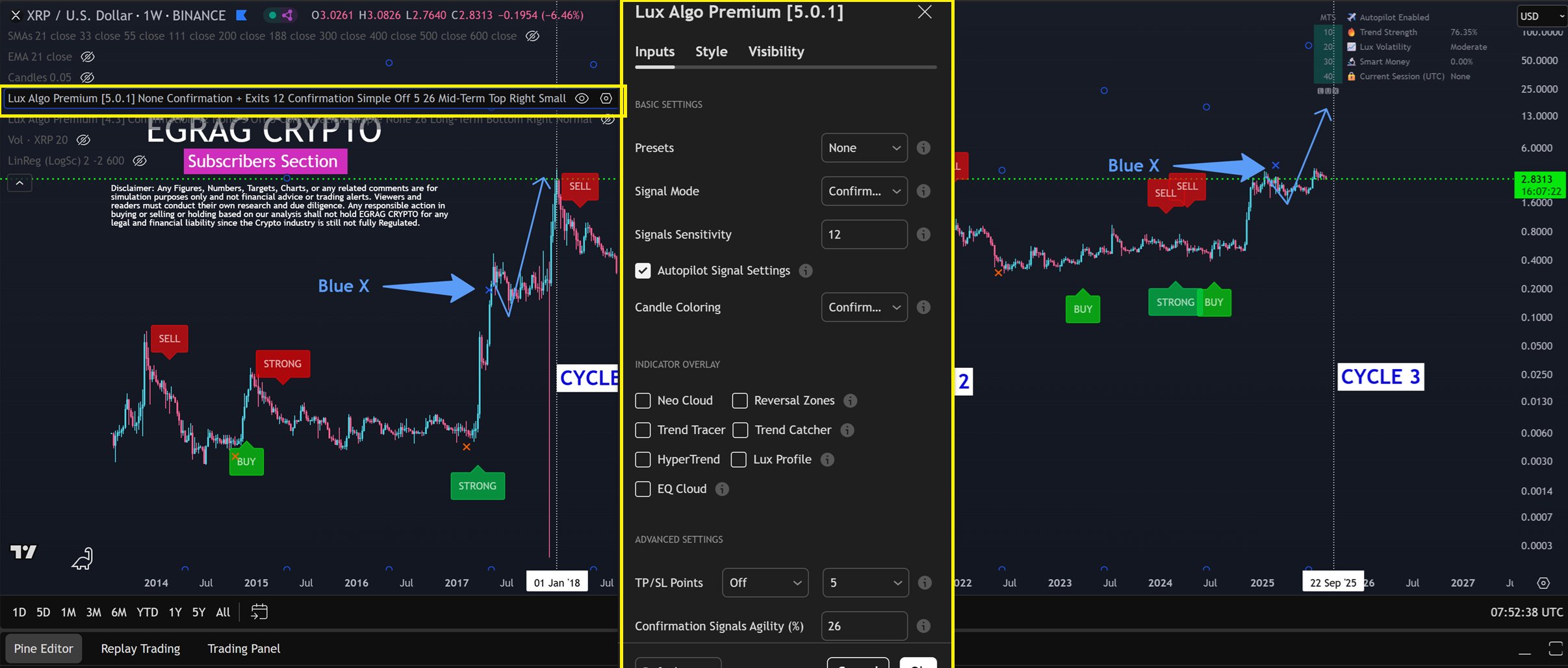
In his recent analysis, EGRAG pointed to a recurring pattern he discovered while using the Lux Algo indicator on XRP’s weekly chart. According to data from EGRAG’s chart, the appearance of the Blue X symbol often signals a short-term profit-taking point. 

XRP Lux Algo Premium Indicator

However, he explained that in previous cycles, the Blue X sometimes misled traders into thinking a cycle top had arrived when it had not. 

Specifically, what typically happens is that the Blue X prints when XRP hits a top, followed by a corrective phase to form a local bottom. However, after this correction, a strong upward push toward the true cycle peak emerges, which historically forms without any Blue X appearing at the top.

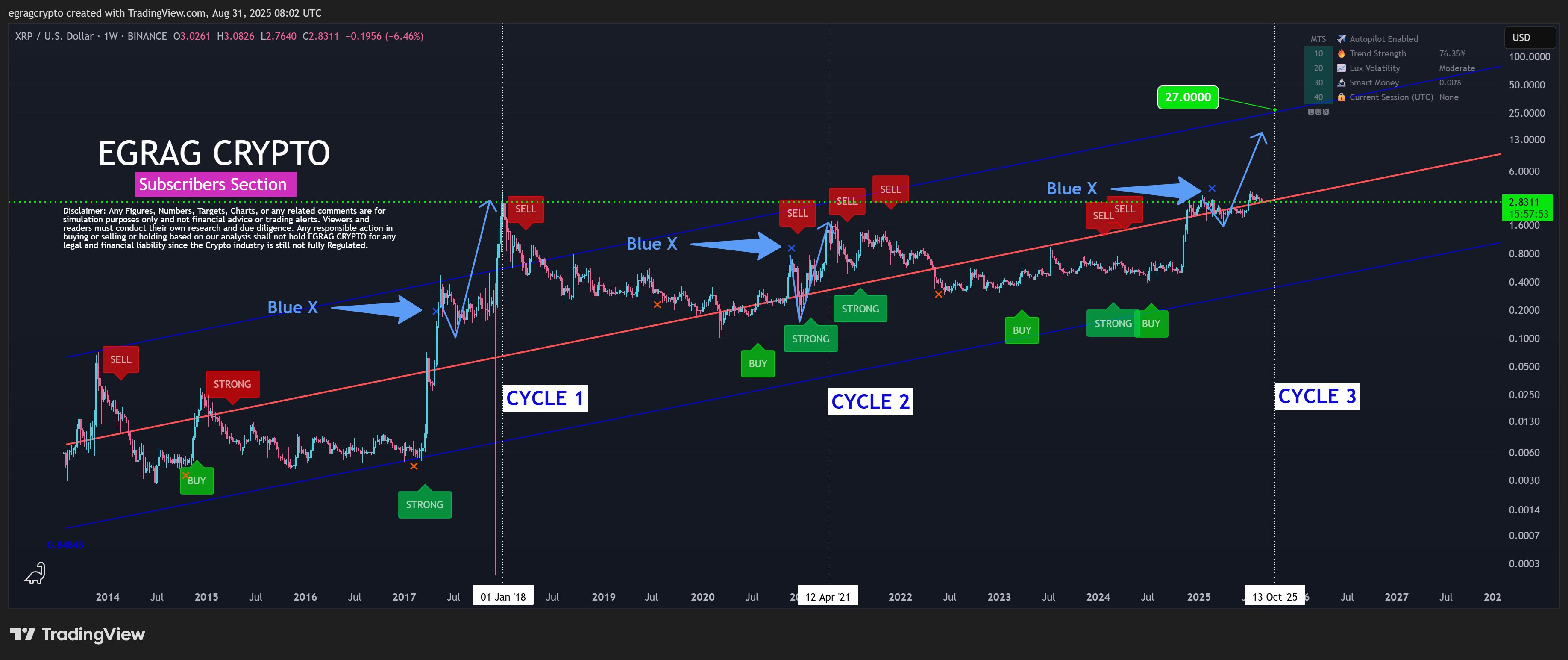
The chart covers XRP’s entire price history from 2013 to 2025, separated into three main cycles. Cycle 1 ended around January 2018, while Cycle 2 concluded in April 2021, both topping out near the upper boundary of a long-term linear regression channel. 

For context, in the 2017/2018 cycle, XRP printed the Blue X when it hit $0.3988 in May 2017. However, after the correction, the true cycle top emerged at $3.3 in January 2018. Also, in the 2020/2021 cycle, XRP saw the Blue X when it soared to $0.79 in November 2020. However, after the pullback, it rose to the true cycle top of $1.96 in April 2021.

XRP Blue X Prints in Previous Cycles EGRAG Crypto
XRP Blue X Prints in Previous Cycles | EGRAG Crypto

XRP Regression Channel and Fib Targets 

According to EGRAG, each cycle top happened near the upper boundary of a long-term linear regression channel. Notably, this channel features a red median line at its center and blue lines at the top and bottom marking two standard deviations away from the median. 

During both prior cycles, XRP’s price surged from the median line to the upper blue boundary before correcting sharply, creating the foundation for projecting the next cycle peak.

In this cycle, XRP saw the Blue X after it reached the $3.4 peak in January 2025. Now, amid the recent correction, XRP trades above the red median line but remains far below the upper blue band, which the model now projects to be near $27 by Oct. 13, 2025. 

Current Cycle Top EGRAG Crypto
Current Cycle Top | EGRAG Crypto

According to EGRAG, this aligns closely with Fibonacci extensions derived from both the 2017 and 2021 cycle peaks. The 2017 cycle top sits between the 1.618 and 1.88 Fibonacci levels at $20.46 and $49.44, while the 2021 peak aligns with the 2.414 and 2.618 levels at $23.49 and $34.08. The $27 target falls comfortably within both ranges.

Despite this optimistic projection, there is uncertainty. From its current level of around $2.72, XRP would need to rally more than 892% to reach $27. According to EGRAG, traders should lock in profits when possible.

Crypto Founder Says XRP Path to High Valuations Is Easier to Understand Than It Looks

0

Crypto founder Versan Aljarrah explains that an XRP path to high valuations is easier to understand than it appears.

He expressed this view during his latest appearance on the Digital Outlook podcast. Host Judy asked Aljarrah to explain why the price of the coin has not surged despite several bullish catalysts lining up.

She cited the conclusion of the SEC case against Ripple and new developments such as 401(k) accounts beginning to offer access to crypto. Meanwhile, XRP is currently trading at a loss over the past few weeks, at $2.80. This level is below the $3.60 level it reached before the announcement of the end of the Ripple lawsuit in August.

This has left many investors wondering why XRP has not experienced the explosive growth many influencers had predicted.

Why XRP Hasn’t Pumped Despite Positive News

Aljarrah, co-founder of Black Swan Capitalist, explained that the answer lies in the bigger picture of how XRP is designed and the current state of global adoption. According to him, XRP was engineered to be infinitely scalable, meaning—at least in theory—its price has no ceiling.

However, he noted that the full value of the token can only be unlocked once clear regulations are in place and major institutions are ready to migrate to the digital ecosystem. He said for now, there remains a “coordinated effort” to suppress the price. He suggested that past hurdles, such as the SEC lawsuit and market manipulation, are still weighing on XRP’s progress.

XRP Is More Than a Bridge Currency

Furthermore, Aljarrah noted that XRP is far more than a bridge currency for cross-border payments. He stressed that it was designed as a liquidity tool for the entire digital financial system, capable of supporting tokenized assets and debt instruments.

For this reason, he argued that XRP must eventually meet settlement demands across global networks and payment corridors.

Meanwhile, Aljarrah pointed to a past statement from Ripple suggesting that XRP was intended to become a reserve currency—a claim that was later quietly removed. He noted that institutions like JPMorgan and BlackRock, which he said are “working closely” with Ripple, are positioning themselves ahead of the market.

He added that the timing of XRP’s rise depends largely on regulatory clarity and institutional readiness. To him, XRP is still in its infancy when it comes to adoption.

“Path to High Valuation Easier Than It Looks”

In parallel, Aljarrah stated that the path to high valuations is more straightforward than many believe.

He explained that as assets, currencies, and contracts become tokenized, instant settlement at scale will become essential. XRP, through its On-Demand Liquidity (ODL) system, provides the infrastructure to supply that liquidity. This suggests that XRP’s price will rise in tandem with global demand for settlements.

Notably, Aljarrah has previously stated that XRP trading below $3 is unsustainable for a financial system that is rapidly moving toward trillions of dollars in tokenized assets and on-chain settlements.

He believes XRP must rise significantly in order to facilitate high-value transactions. In his latest remarks on the topic, he reinforced this idea by stating:

“If you were to answer the question about how XRP starts getting to these high valuations—like $100, $1,000, or even $100,000—it has to actually support the global financial ecosystem.”

Cardano Founder Says Cardano Eyeing Major Partnerships with WLFI’s USD1 and Chainlink

0

Cardano founder Charles Hoskinson has teased a major partnership with Chainlink and USD1 in a defining moment for the ADA ecosystem.

Notably, Hoskinson got the ADA system excited on Sunday, August 31, during his AMA, when he disclosed that Cardano is working on a series of cross-chain partnerships. He mentioned several prominent projects that the ecosystem is looking to form alliances with, including World Liberty Financial (WLFI) and Chainlink.

USD1 Coming to Cardano?

When asked when the USD1 token would launch on Cardano, Hoskinson stated that Cardano “can land that deal.” For the uninitiated, the USD1 is a stablecoin issued by the WLFI, a DeFi project inspired by President Donald Trump. The dollar-pegged cryptocurrency launched in March on the Ethereum and BNB chains before debuting on the Tron network in June.

Meanwhile, the stablecoin gained prominence upon launch, currently ranking as the fifth-largest stablecoin with its $2.67 billion market cap. And now, Hoskinson seems upbeat that USD1 would launch on Cardano.

He disclosed that IOG Chief of Staff J.J. Siler is in discussions with WLFI co-founder and CEO Zach Witkoff regarding the potential integration and could close the deal soon. If this happens, USD1 would become the biggest stablecoin in the Cardano ecosystem, potentially driving more user transactions on the network.

Cardano to “Handle” Chainlink Collaboration

Furthermore, Hoskinson also mentioned that Cardano is working on a partnership with Chainlink. However, this may take much longer, as he noted that the LINK team gave them an “absurd number for integration.”

Nonetheless, the founder noted that Cardano would “handle it” and “figure it out.” He further lauded Chainlink founder Sergey Nazarov, calling him “extremely smart” and a good negotiator. Hoskinson also noted that Chainlink is sitting on “a golden egg.”

Recall that the Chainlink ecosystem has been in the limelight lately amid growing institutional interest. It recently collaborated with the US Department of Commerce (DOC) to bring economic data on-chain.

Meanwhile, Hoskinson added one more chain he hopes to partner with. He noted that he also wants Cardano to integrate with Aave.

“I’d like USD1, I’d like Aave, I’d like Chainlink,” Hoskinson stated, adding that “there’s a bundle there,” and Cardano is working its way to partner with these projects.

Notably, Hoskinson emphasized that these partnerships and potential ecosystem upgrades are crucial for Cardano to remain relevant. He provided an example where the US government selected Chainlink to launch economic data because it had a specific required technology.

According to him, Cardano cannot succeed unless it matches the highly competitive cryptocurrency ecosystem. This sentiment is driving the strong push by the Cardano ecosystem to form several cross-chain partnerships.