Home Blog Page 559

Canary Capital Seeks SEC Approval for ETF on President Trump’s Memecoin

0

Asset manager Canary Capital has submitted an S-1 registration with the U.S. SEC to launch an exchange-traded fund (ETF) tied to President Donald Trump’s memecoin, TRUMP.

This move would give investors regulated exposure to one of the most politically driven tokens in the crypto market.

Trump Coin ETF Filing

The proposed Trump Coin ETF will track the price of TRUMP, a memecoin launched in January ahead of Trump’s inauguration. The fund would allow investors to buy the token through traditional brokerage accounts instead of relying solely on crypto exchanges.

Notably, as of today, TRUMP ranks among the six biggest meme coins in the crypto market. It has a market cap of $1.67 billion and a price of $8.37.

During the peak of the frenzy around TRUMP in January, the coin rose to become the second biggest meme coin, trailing only Dogecoin, with its price then at $75. As of today, it is trading at a staggering 89% below its all-time high. 

Meanwhile, multiple asset managers see potential in the coin as they file for ETFs related to it. Notably, details such as management fees and the listing venue were not disclosed in the filing.

Image

American-Made Crypto ETF Application

Alongside the Trump filing, Canary also applied for an “American-Made Crypto ETF” under the ticker MRCA. This product would track an index of U.S.-rooted cryptocurrencies such as XRP, Solana, Cardano, Chainlink, and Stellar, while excluding memecoins, stablecoins, and pegged tokens.

The fund plans to add staking rewards to its net asset value through third-party providers. Custody would be operated by a South Dakota trust company, with most assets stored in cold wallets.

SEC’s Delays on Crypto Funds

The filings come as the SEC continues to extend decision deadlines on multiple digital asset ETFs. New review dates for XRP, Solana, and Truth Social-linked funds now run into October 2025.

Canary itself has several pending ETF applications tied to SOL, XRP, SUI, TRX, and PENGU, all still awaiting review. While recent SEC guidance has clarified staking and custody rules, approvals remain slow-moving.

Ex Morgan Stanley Reveals Why Bitcoin is Down, Expects Very Sharp Uptrend Soon

0

Bitcoin has been under pressure in recent days, and Jordi Visser, a former Morgan Stanley Managing Director expects a sharp uptrend soon.

For context, BTC currently changes hands at $110,412, down 1.84% over the past 24 hours and 11% below its Aug. 14 peak of $124,517. Notably, the drop has erased gains from Federal Reserve Chair Jerome Powell’s dovish Jackson Hole speech. 

Bitcoin’s Price Struggles

Amid this downtrend, Anthony Pompliano invited Jordi Visser, CIO of Weiss Multi-Strategy Advisers and a former Morgan Stanley Managing Director, onto his podcast to share his take on Bitcoin’s recent struggles. 

Pompliano voiced the frustration many investors feel, asking why Bitcoin has failed to rise despite strong expectations for another rally. 

In addition to the waning sentiment, a massive whale sale of 24,000 BTC, worth more than $2.7 billion, also contributed to the latest decline and briefly pulled the price under $109,000 on Monday. 

Notably, the selloff sparked the year’s largest liquidation event, closing $900 million in leveraged trades across markets. At the same time, Bitcoin ETFs recorded six straight days of outflows from Aug. 15 to 22, draining $1.188 billion from the market.

Visser Explains Why Bitcoin is Down

Responding to Pompliano, Visser said he was surprised Bitcoin didn’t break higher when Ethereum surged past its old highs. For context, Ethereum jumped 14.33% on Aug. 22 and eventually claimed a new all-time high of $4,955 two days later, while Bitcoin managed only a 3.93% gain before turning lower.

Discussing this weakness, Visser pointed to Bitcoin’s close ties to the stock market and tech sector. He explained that when momentum in the AI trade slows, retail investors often pull money out of assets like Bitcoin. 

Moreover, changing expectations around Federal Reserve rate cuts also played a role. Specifically, markets had fully priced in a September cut just a week ago, but that probability has since dropped to around 70%, shaking investor confidence.

However, even with these setbacks, Visser emphasized that the broader setup still favors Bitcoin. He noted that strong PMI readings often line up with Bitcoin’s best rallies and argued that the same conditions are present now. 

Bitcoin Could See a Sharp Move Up

While he admitted that time is running short for a massive breakout this year, his outlook stayed bullish. “I’m still focused on this thing having a very, very sharp up move,” he remarked.

The macro investor also pointed out that hedge funds and institutions now play a bigger role in Bitcoin markets. They often use it as a liquid, round-the-clock hedge against tech exposure, which can create sharp swings. Still, he insisted that the momentum remains in Bitcoin’s favor: “All of the tailwinds are behind.”

Meanwhile, Visser argued that investors will eventually rotate into Bitcoin as traditional tech giants lose momentum. According to him, “everyone who’s looking for betas and technology is going to have to move into Bitcoin.”

Bitwise Seeks to Launch First-Ever Spot Chainlink ETF

0

Top asset manager Bitwise has filed a preliminary S-1 registration statement with the U.S. SEC to launch a Chainlink (LINK) spot ETF. 

The proposed fund will provide investors with direct exposure to Chainlink, without having to buy or custody the tokens themselves. According to the filing, the ETF’s investment objective is to track the spot market value of LINK, without the fees and other expenses. 

The net asset value (NAV) of the ETF is based on the CME CF Chainlink–Dollar Reference Rate – New York Variant. 

If the SEC approves the filing, the Bitwise Chainlink ETF will list and trade on a U.S.-based equities exchange. However, the exact name of the trading platform has not been disclosed. The asset manager has also yet to reveal the ticker symbol for the ETF. 

Bitwise to Provide Seed Funding 

Bitwise Investment Advisers, a subsidiary of Bitwise Asset Management, will serve as the sponsor and manager of the fund. Notably, Bitwise Asset Management has agreed to provide the seed funding to get the ETF started. However, the financial details of the seed investment remained confidential in the hours leading up to press time. 

The Chainlink tokens backing the trust will be held in Coinbase Custody. Each share of the proposed ETF will represent ownership of the Chainlink tokens held by the trust. 

The filing proposed that shares of the ETF be created and redeemed in large baskets, with each containing 10,000 shares. Given the magnitude of these transactions, the filing specified that authorized participants will handle the creation and redemption of these baskets. 

Like all investment products, investors of the Bitwise Chainlink ETF will pay an undisclosed management fee. Since it is a preliminary filing, Bitwise has not revealed the exact percentage of this fee. 

Although Chainlink is a Proof-of-Stake network, the filing did not indicate any plans to stake the LINK tokens of the trust, which could generate additional rewards for investors. 

First Spot ETF Filing for Chainlink?

Meanwhile, popular Bloomberg analyst Eric Balchunas suggested that the Bitwise filing is the first-ever spot ETF for Chainlink. He contrasted the Bitwise proposed ETF with a related product from Tuttle Capital. 

For context, the Tuttle Chainlink ETF is a leveraged product designed to give investors twice the daily exposure to LINK’s price movements. Unlike the Bitwise Chainlink ETF, Tuttle’s product will not hold LINK tokens. 

Cardano Charts Signal Possible Expansion Toward $2.50

0

Prominent market analysts see Cardano structure pointing to a potential expansion phase, with higher targets if momentum holds.

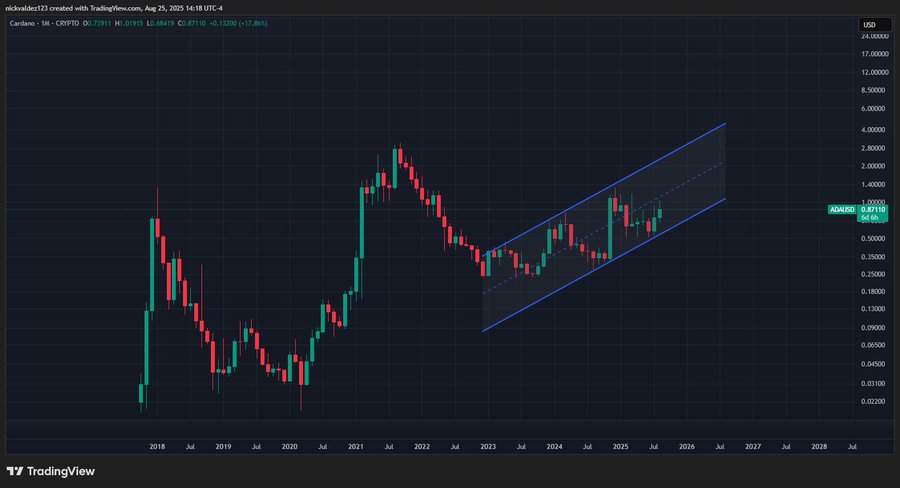
In a post on X, crypto analyst Deezy described the monthly chart as “incredibly bullish,” pointing to the continuation of a rising channel that has guided ADA since late 2022. He suggested that the top of the channel could align with $2.50, making that level the next significant target.

Notably, Cardano is trading at $0.8383, a 5% loss in the past day, reducing the monthly uptick to 1.2%. It opened the month at $0.73, climbed to $1.01, and dipped to $0.68 before recovering. This leaves ADA 27% above its monthly low but still about 72% below its all-time high of $3.10 in 2021.

Cardano’s Long-Term Rising Channel

The chart shared by Deezy shows ADA trading inside a long-term ascending parallel channel. The channel currently sets support near $0.60 and resistance around $1.30, with a midline at about $0.95. The structure highlights a gradual upward trend of higher highs and higher lows.

Deezy predicts Cardano to $25

The near-term focus is the resistance range between $0.95 and $1.02, which includes both the midline and the psychological $1 level. A sustained close above that zone could signal continuation toward the channel’s upper boundary and eventually the $2.50 projection. Notably, the analyst provided a more realistic target of $1.46, boldly telling followers to bookmark the price.

TapTools Highlights Elliott Wave Expansion

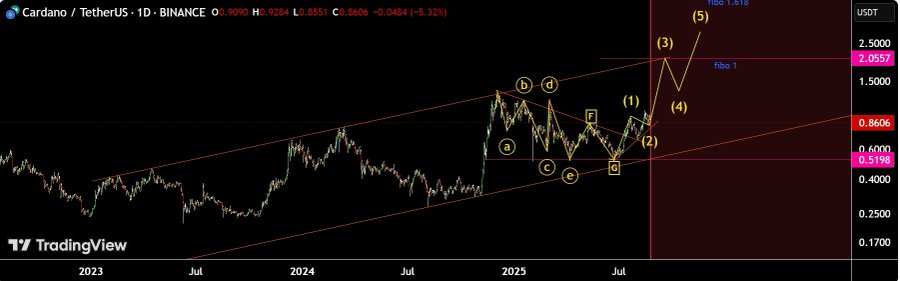
Meanwhile, TapTools provided additional analysis, noting that ADA’s chart appears to be following a clear Elliott Wave pattern within its broader rising channel. Their study suggests Cardano may have finished its accumulation phase and could now be entering a new expansion stage.

Cardanos Elliot Wave Structure
Cardano’s Elliot Wave Structure

The Elliott Wave count shared by TapTools identifies a base near $0.52, followed by a projected impulsive sequence. The structure points to a first major resistance around $2.05, marked at 1.0 Fibonacci level, and a possible continuation toward $2.50, at 1.6 Fib, if the wave cycle completes.

This perspective aligns with Deezy’s channel projection, as both analyses suggest higher levels if ADA continues respecting its long-term trend. However, a breakdown below $0.60 to $0.52 would invalidate the channel and weaken the bullish structure.

Other Analysts Predict Next ADA Move

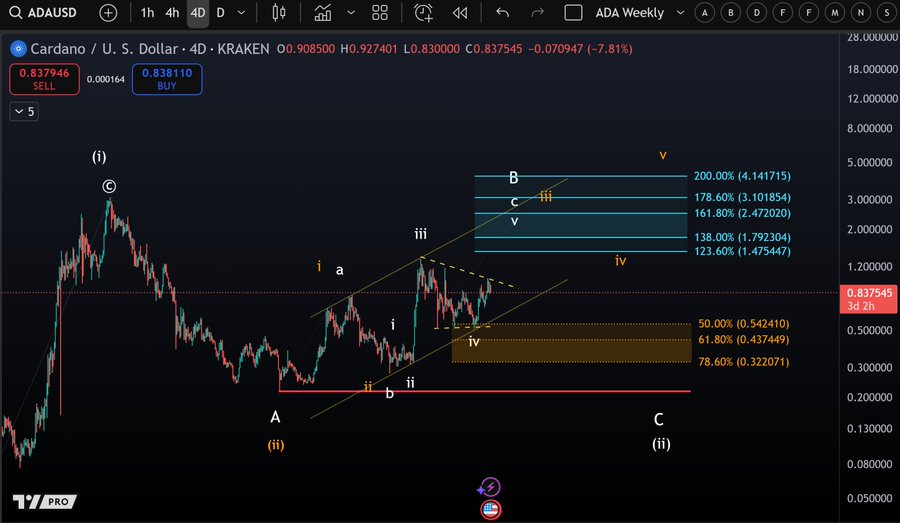
In a separate analysis, More Crypto Online noted that Cardano remains in a position for further gains as long as it holds above $0.51. The analysis highlights a key breakout level near $1, with potential upside targets at $1.47, $1.79, and $2.47, while warning that a move below $0.51 would undermine the bullish outlook.

Interestingly, his $2.47 prediction is similar to analyst CryptoGnojek’s projection of $2.00 and $2.50. 

More Crypto Online predicts ADA

Similarly, crypto analyst Alex Clay sees Cardano tracking a pattern similar to its 2019–2021 cycle, with the token now in a re-accumulation stage that could precede another breakout. 

His chart places ADA below the $1.00–$1.20 mid-zone, with major resistance between $2 and $3, the same area that capped its last rally. Clay notes that in 2020, ADA surged from under $0.10 to nearly $3, and a comparable move this cycle could push it past $5 if mid-zone resistance is cleared.

Meanwhile, Dan Gambardello likened Cardano’s lag to Ethereum’s 2021 run, when ADA eventually rallied 751% to record highs. He sees an inverse head-and-shoulders and broadening wedge forming, with a breakout above $1.20 potentially sending ADA toward $2.00 and beyond.

Pantera Capital Targets $1.25B to Create Largest US-Listed Solana Treasury

0

Global digital asset fund management Pantera Capital is preparing to raise $1.25 billion for a new Solana-focused treasury firm.

The initiative could establish the largest corporate Solana reserve to date. According to The Information, the company plans to convert a publicly traded business into a U.S.-listed Solana treasury vehicle. The new entity, tentatively named Solana Co., is expected to oversee one of the largest institutional holdings of Solana to date.

The fundraising plan will take place in two stages. Pantera aims to secure $500 million in the first phase, followed by an additional $750 million through a warrant issuance program.

If both rounds succeed, the treasury could reach $1.25 billion, far exceeding existing Solana corporate reserves.

Competitive Race Among Institutions

The development comes soon after news of another initiative involving Galaxy Digital, Jump Crypto, and Multicoin Capital. Bloomberg reported that these firms are collectively raising $1 billion to establish their own Solana treasury company.

Together, these initiatives show a broader shift in the market. Digital asset treasuries (DATs), once led by smaller players, are now attracting multi-billion-dollar commitments from established financial groups. This suggests that Solana is moving beyond retail adoption and into the balance sheets of large corporations.

Pantera’s Growing Commitment to Digital Treasuries

Pantera has been steadily increasing its involvement in Solana and other digital asset treasuries. Earlier this month, the firm disclosed that it had already invested over $300 million in treasury-focused ventures.

Most recently, Pantera participated in a $400 million private placement by Sharps Technology, which aims to build a significant Solana reserve. Beyond Solana, the company’s treasury portfolio includes a diverse range of tokens, such as Bitcoin, Ethereum, BNB, Toncoin, Hyperliquid, Sui, and Ethena.

According to Pantera, DATs have advantages over simply holding tokens or ETFs. They can generate yield and increase net asset value per share, which allows investors to accumulate more tokens over time. This compounding effect, the firm argues, makes treasuries a more attractive option than static holdings.

Growing Adoption Among Nasdaq-Listed Companies

While Pantera and other large asset managers are driving the latest wave, smaller Nasdaq-listed firms have also moved into Solana.

For instance, DeFi Development Corp pivoted from real estate to digital assets and in July doubled its Solana holdings to more than 163,000 SOL, valued at approximately $21 million.

In another case, edtech company Classover acquired 6,500 SOL as part of a $500 million convertible note plan to expand its token holdings and staking activity. 

Meanwhile, Canadian firms such as SOL Strategies and Torrent Capital collectively oversee more than $68 million in Solana reserves.

Public Solana Treasuries Near $700 Million

These corporate moves highlight the larger trend of Solana accumulation across the market. Institutional and corporate buying has already created a sizeable pool of reserves. Data from CoinGecko shows that public treasuries now hold about $695 million worth of SOL, equal to nearly 0.69% of the total circulating supply.

If Pantera’s $1.25 billion fundraising is completed, the weight of institutional reserves could grow dramatically. Such an expansion would elevate Solana into the ranks of blockchains with the deepest corporate backing, rivaling established assets like Bitcoin and Ethereum.

Solana Market Snapshot

The surge in public Solana treasuries is unfolding against a backdrop of ongoing price swings. At the latest update, Solana was trading at $188.67, reflecting a 5.38% daily decline. Over the past week, however, it recorded a 3.97% gain. 

These numbers illustrate that, while institutional reserves increase, Solana’s market price remains subject to short-term volatility.

Ripple Executives Publicly Back XRP, Bury ‘Ripple Won’t Use XRP’ Claims

0

Ripple leaders are openly embracing XRP following the launch of Gemini’s XRP rewards credit card.

The move counters repeated claims that the company avoids directly associating with the token and that they were slowly pivoting away from it.

Ripple Executives Show Loyalty to XRP

In a tweet, Ripple CTO David Schwartz shared a photo of himself holding the newly released Gemini XRP Credit Card while wearing XRP-branded apparel at a coffee shop named XRPresso. He captioned it, “Got my XRP belt on…”

Around the same time, Ripple CEO Brad Garlinghouse also posted about the card, calling its debut “what a time to be alive”. Garlinghouse encourages everyday use of the XRP card to earn 4% back in XRP.

Their visible support drew attention across the community, with many noting that it undercuts the long-standing criticism that Ripple distances itself from the token.

Inside the XRP Credit Card Launch

The XRP rewards credit card was developed through a partnership among Ripple, Gemini, WebBank, and Mastercard. It offers U.S. users more opportunities to earn and use the third-largest crypto asset.

Cardholders can earn up to 4% back in XRP on everyday essentials like gas, EV charging, and rideshares. Dining earns 3%, groceries 2%, and all other purchases 1%. In addition, select merchants featured in the Gemini app offer as much as 10% back on eligible purchases.

Notably, Gemini stated that holders earn 4% back on qualifying purchases in the 4% category, up to $300 in spending per calendar month. After reaching $300, they’ll earn 1% back on additional purchases for the rest of the month. The spending limit resets on the 1st of each month.

Rewards are distributed directly to users’ Gemini accounts, where they can be held, traded, or withdrawn. Gemini has also highlighted the upside of holding XRP rewards, pointing to data showing that users who held past XRP card earnings saw gains of more than 450%.

Gemini CEO Reacts

Notably, Gemini CEO Tyler Winklevoss described the card as a way for users to earn XRP while showcasing their enthusiasm and commitment to the ecosystem. Alongside the card launch, Gemini is also broadening support for Ripple’s RLUSD stablecoin.

RLUSD, already available on the exchange, can now be used as the base currency for all U.S. spot trading pairs. Garlinghouse added that the collaboration turns daily spending into a gateway to deeper engagement with both XRP and RLUSD.

XRP Community and Analysts Weigh In

The card’s rollout follows weeks of teasers from Gemini, including a New York City billboard campaign. Pro-XRP attorney John Deaton previously said the card could “outdo the rest” of crypto cards.

At the same time, analysts noted that its design directly ties XRP to consumer spending, creating ongoing demand for the token. Some have drawn comparisons to Visa’s 2023 partnership with Solana, which coincided with a major price rally for SOL. They believe something similar could follow for XRP.

Pundit Says XRP About to See the Most Hated Rally as XRP Becomes Fastest Asset to Hit $1B OI on CME

0

A market pundit suggests XRP is about to see the most hated rally in crypto after it reached a major Open Interest milestone on CME Group.

For context, the CME Group announced recently that its crypto asset market’s total open interest has surpassed the $30 billion mark. Among the assets that contributed to this feat, XRP emerged as the fastest one in CME history to reach $1 billion in open interest. 

CME Group Crypto Futures Milestones

XRP Becomes Fastest to Hit $1B OI on CME

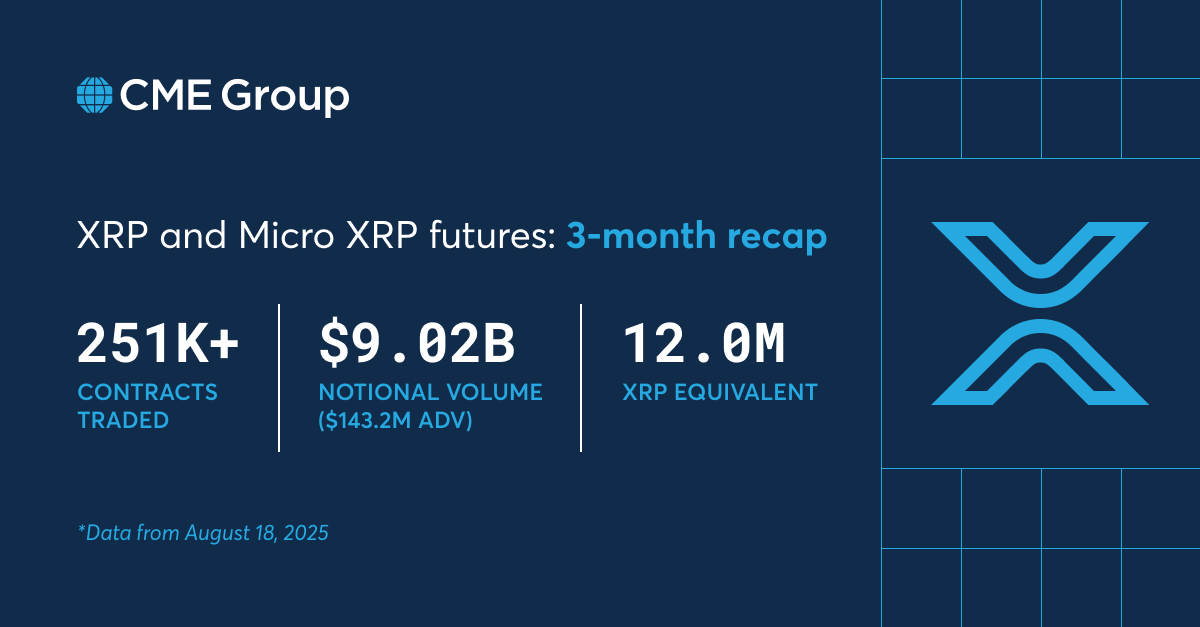
Interestingly, the XRP futures contracts hit this mark in just over three months after their launch on May 19, 2025, showing how quickly interest in XRP is building across both institutional and retail markets.

Also, CME reported that since the XRP futures launch, traders have moved 251,000 contracts with a combined notional volume of $9.02 billion. The contracts average $143 million in daily trading, with a one-day record of $235 million set in July. 

XRP Futures on CME Group

For context, CME offers two versions of the product: a standard contract of 50,000 XRP and a micro contract of 2,500 XRP, both cash-settled against the CME CF XRP-Dollar Reference Rate.

The rapid growth of these futures shows rising liquidity and tighter spreads, conditions that often lead to stronger institutional participation. Many analysts also believe this success strengthens the case for a U.S. spot XRP exchange-traded fund. 

Traders on Polymarket now give XRP an 82% chance of winning ETF approval before the end of 2025. The SEC has scheduled October as the decision date for several applications, including those from Canary Capital, WisdomTree, and Grayscale. These issuers have already amended their filings in preparation.

XRP About to See the Most Hated Rally in Crypto

Notably, speaking on the recent CME OI feat, crypto commentator Zach Rector said XRP could soon trigger what he called the most disliked rally in the crypto sector due to its long history of polarizing views. His take shows a belief that XRP could surge despite heavy skepticism from parts of the industry.

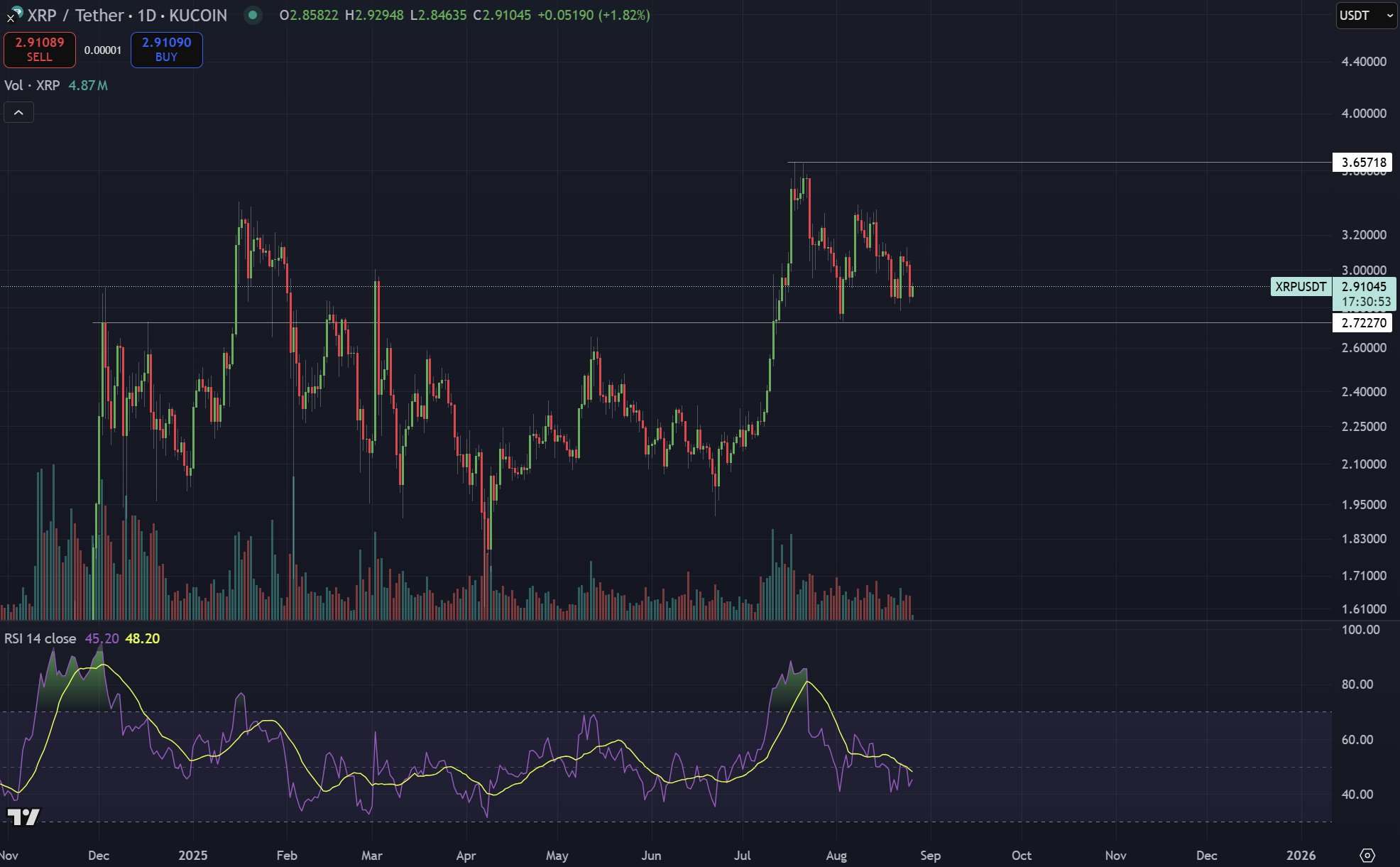
Meanwhile, market data shared by analyst CryptoInsightUK suggests such a rally might be imminent. He explained that XRP/USD continues to hold firm on the daily chart, with the relative strength index steady around 40. The analyst added that a few days of solid price action could confirm bullish momentum.

XRPUSDT CryptoInsightUK
XRPUSDT Chart | CryptoInsightUK

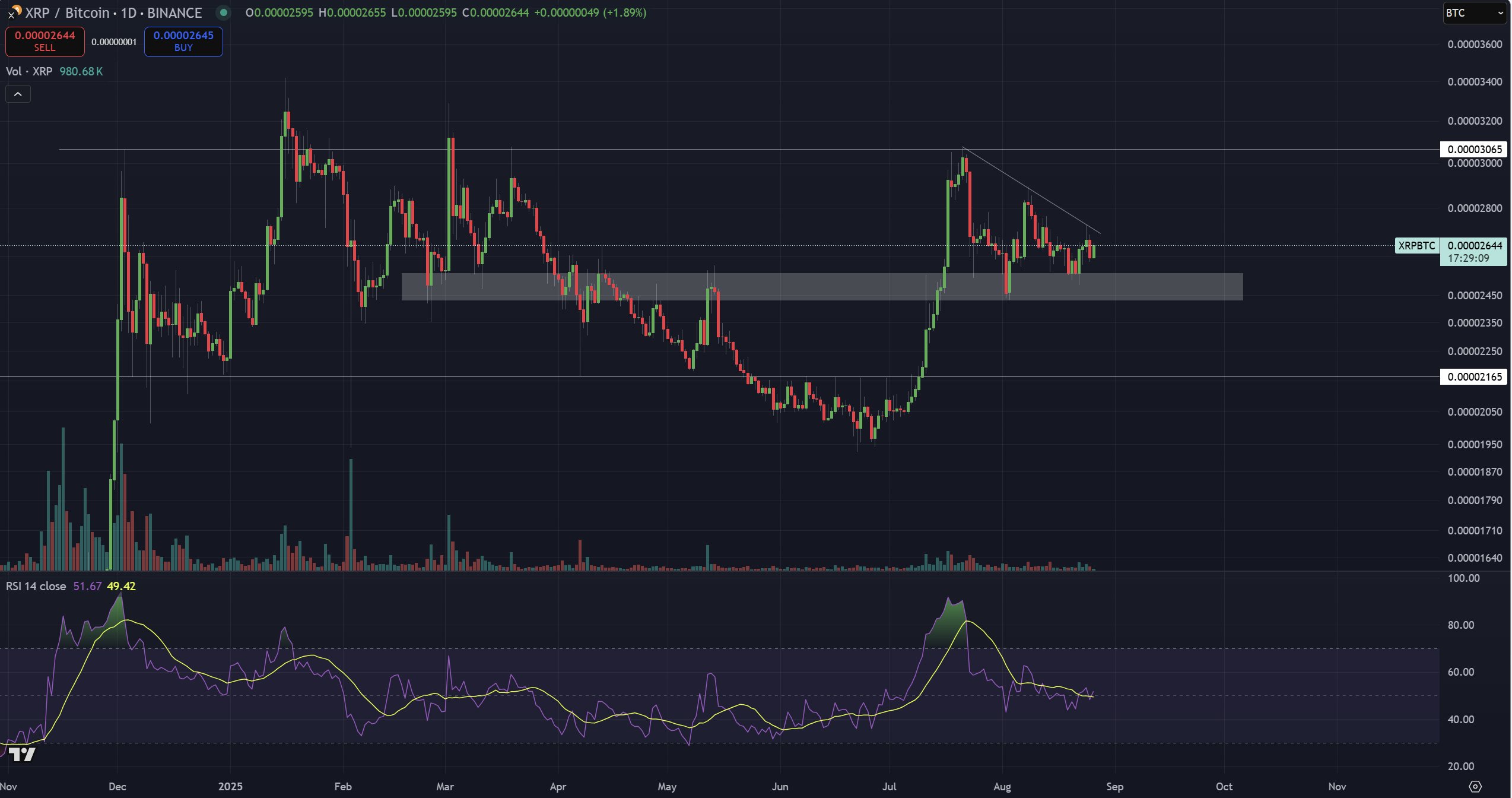
Also, on the XRP/BTC pair, he identified a bullish crossover on the daily RSI and stressed that XRP has held its ground even during recent sell-offs. He emphasized that XRP now sits at a level that has acted as resistance for six years, suggesting a breakout could happen if momentum builds.

XRPBTC Chart CryptoInsightUK

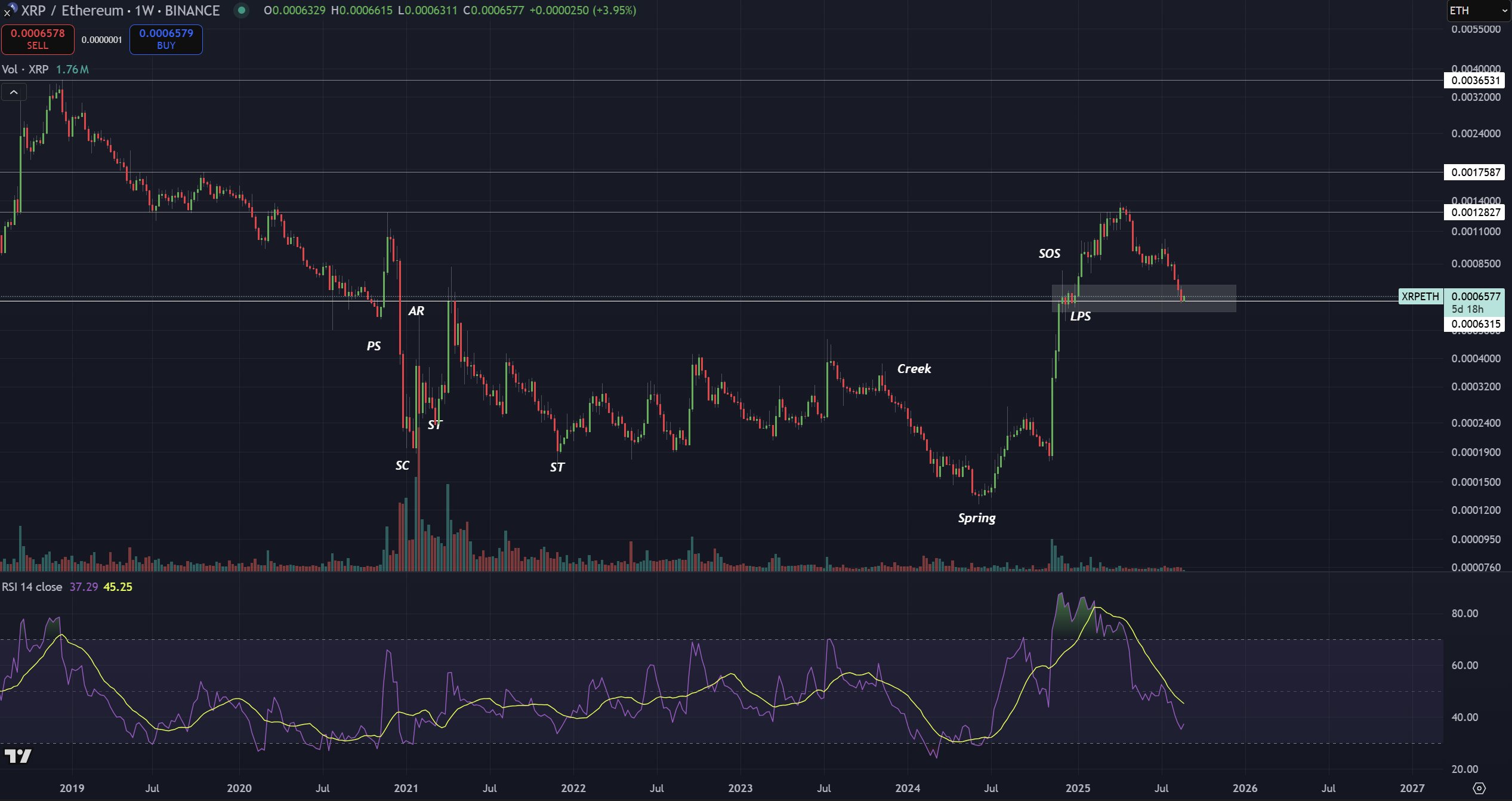
Looking at XRP/ETH, CryptoInsightUK highlighted that XRP has bounced multiple times from a multi-year resistance level that has flipped into support. He admitted that XRP is not yet in a clear uptrend but argued that it is beginning to stand apart from the wider crypto market.

XRPETH Chart CryptoInsightUK
XRPETH Chart | CryptoInsightUK

At press time, XRP trades at $2.9, down 0.87% in the last 24 hours. According to data from Coinglass, global XRP futures open interest remains strong at more than $7 billion despite a 4.23% drop in the past 24 hours.

Global Stock Exchanges Urge Crackdown on Tokenized Stocks

0

The World Federation of Exchanges has urged regulators in the U.S., Europe, and beyond to take action against tokenized stocks. The group warns these blockchain-based products may mislead investors, undermine trust in markets, and damage listed companies.

A powerful voice representing the world’s largest stock exchanges has stepped into the debate over tokenized equities. The World Federation of Exchanges (WFE), a London-based association of exchanges and clearinghouses, has warned regulators that these products pose new risks to investors and markets.

Tokenised equities are digital tokens built on blockchain that mirror traditional shares. While they claim to represent ownership in companies, investors holding them do not become actual shareholders. That means they miss out on voting rights, dividends, and other safeguards that come with real equity ownership.

WFE’s Warning to Global Regulators

The WFE recently issued a formal appeal urging regulators to respond swiftly. Its letter was directed to three major watchdogs: the SEC’s Crypto Task Force in the United States, the European Securities and Markets Authority (ESMA), and the Fintech Task Force of the International Organization of Securities Commissions (IOSCO).

The federation said it is “alarmed” by the number of crypto platforms and brokers offering or planning to offer tokenized U.S. stocks.

“These products are promoted as stock tokens or equivalents to listed shares, when in reality they are not,” the group warned.

WFE did not disclose the names of platforms involved but cautioned that companies whose shares are copied could face reputational harm if tokenised versions collapse or lose value.

Rising Interest from Crypto Platforms

Despite these concerns, the sector is drawing increasing interest from major trading platforms. Coinbase, the largest U.S. crypto exchange, has already approached the SEC for approval to launch tokenized equities for its users.

Similarly, Robinhood rolled out tokenised shares for customers in the European Union earlier this year.

Robinhood also announced plans to release tokens that mimic shares of private companies, including OpenAI. OpenAI, however, clarified it had no role in the offering and did not endorse the products.

Proponents argue that tokenised equities offer major advantages. They say tokens can reduce trading fees, enable faster settlement, and allow investors to trade outside traditional market hours. Supporters also highlight that blockchain infrastructure improves transaction transparency and efficiency.

Concerns from Traditional Exchanges

The WFE and its members remain unconvinced. According to the group, tokenised equities “mimic” stocks but lack the protections of regulated securities markets. That includes investor safeguards, disclosure requirements, and established rules for custody and settlement.

The group’s chief executive, Nandini Sukumar, said some listed companies have already raised concerns about the use of their names in these products. She warned that if tokenised equities fail, it could erode confidence not only in the tokens but also in the underlying companies.

Push for Stronger Oversight

The WFE has asked regulators to strengthen oversight of tokenised assets by applying traditional securities rules. It also urged authorities to provide a clearer legal framework that defines how ownership and custody should work in this new market.

Another priority, according to the group, is to stop these tokens from being advertised in a way that makes them appear identical to listed stocks.

In July, one SEC commissioner reiterated that even if stocks are tokenised, they remain subject to existing securities law. This indicates regulators are already moving toward stricter control of the space.

Balancing Innovation and Investor Protection

The debate highlights a growing challenge for financial watchdogs worldwide. On one side, innovation in blockchain and tokenization could modernize capital markets. On the other hand, the lack of legal clarity and investor safeguards poses serious risks.

The WFE’s intervention adds weight to the concerns of traditional market operators. As regulators study the issue, the future of tokenised equities will depend on whether rules can strike a balance between encouraging innovation and protecting investors.

Shiba Inu: Shibarium Activity Slumps as Transaction Volume Falls to 2-Month Low

0

Shiba Inu blockchain activity has taken a hit from the recent market downturn, with both transaction volume and new account creation plunging sharply. 

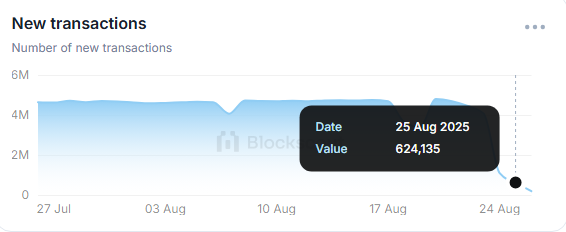
The latest market downturn has led to a sharp decline in activity on Shiba Inu’s official blockchain, Shibarium. Data from Shibariumscan shows that the Layer-2 (L2) blockchain processed 624,135 transactions yesterday. While significant, it marked its lowest volume over the past two months. 

Before yesterday, the last time Shibarium processed below 624,000 transactions was on June 4, 2025. At the time, Shibarium recorded only 63,780 transactions. However, that decline was short-lived. The daily transaction volume climbed to roughly 4 million until yesterday, when it plunged to 624,135. 

Shibarium daily transaction
Shibarium daily transactions

New Shibarium Accounts Decline While Active Accounts Increase 

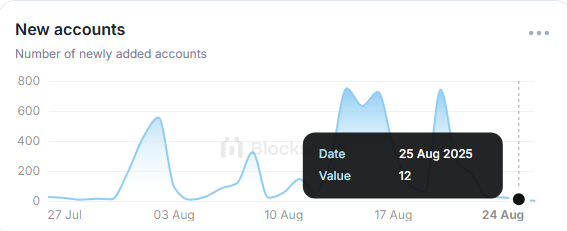
The decline in Shibarium network activity was also reflected in the number of new accounts added to the blockchain. According to the data, the number of new accounts on Shibarium dropped to 12 yesterday, representing a 47.82% drop from the previous day’s record of 23. For context, new accounts on Shibarium reached a 30-day peak of 752 on August 14.

Shibarium new account metric

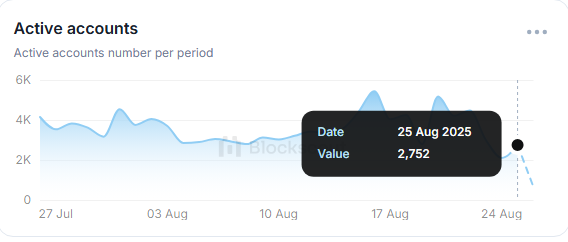
Despite the drop in transaction volume and new accounts yesterday, Shibarium still registered an uptick in active accounts. Notably, the number of active accounts reached 2,752 yesterday, up 30.86% from the previous day’s record of 2,103. 

Shibarium Active Accounts Metric

SHIB Dips Over 3% Amid Broader Market Collapse 

The development comes on the heels of a broader market downturn, which pushed SHIB’s price below the $0.000012 region. Even though the token has reclaimed $0.000012, it is still down 3.75% over the past 24 hours. Shiba Inu’s price has also dropped 13.24% over the past month. 

The decline in Shibarium’s network activity, particularly its new accounts and transaction volume, highlights how users typically react to broader market conditions. 

Shibarium’s Incredible Stats Since Launch  

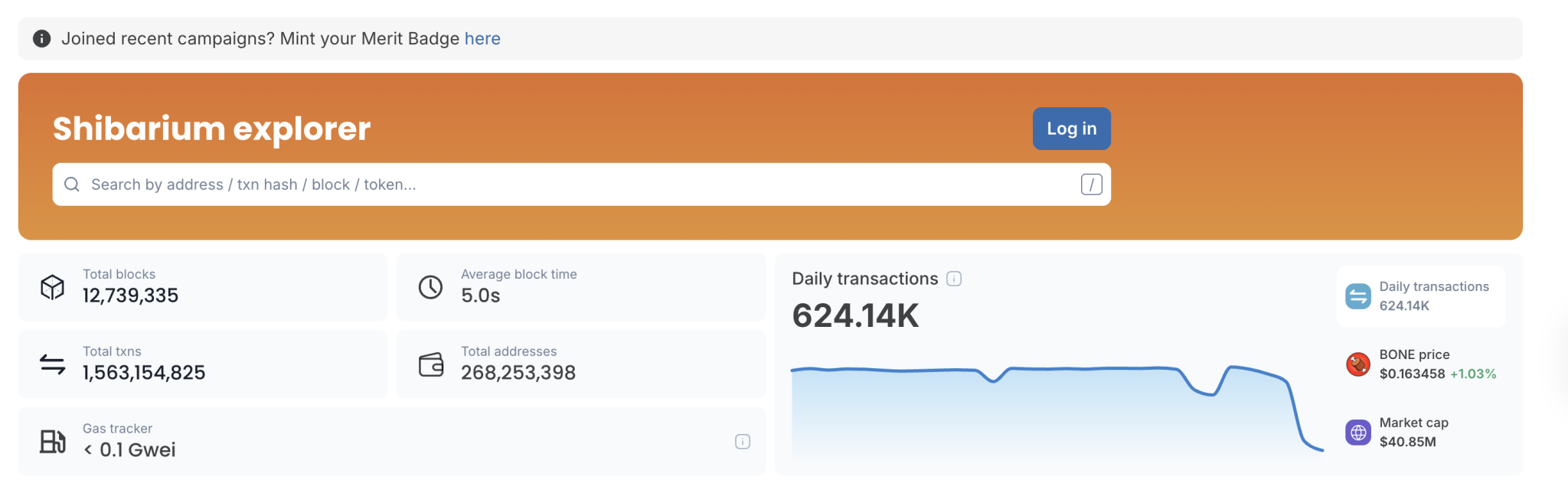
Despite the recent pullback, Shibarium has experienced an incredible performance since its August 2023 mainnet launch. So far, about 288,621 accounts have joined the network, while over 268.25 million wallets have interacted with the blockchain. 

It has processed over 1.56 billion transactions since its inception, outperforming several established blockchains, including Cardano, in this metric. Furthermore, roughly 12.74 million blocks have been minted on Shibarium. 

Shiba Inu Shibarium stats

History Suggests Cardano Could Rally to $5 but Must Hold This Level for Higher Prices

0

The Cardano bullish case hinges on a crucial level, and analysis suggests that higher prices may ensue if support holds.

Notably, technical analyst “More Crypto Online” highlighted this in his Monday commentary amid a broader market downtrend. Cardano further relapses from its moonshot to $1.02 a few weeks back, correcting 5% in the past 24 hours to its current price of $0.838.

Rebound to New Highs Possible if This Level Holds

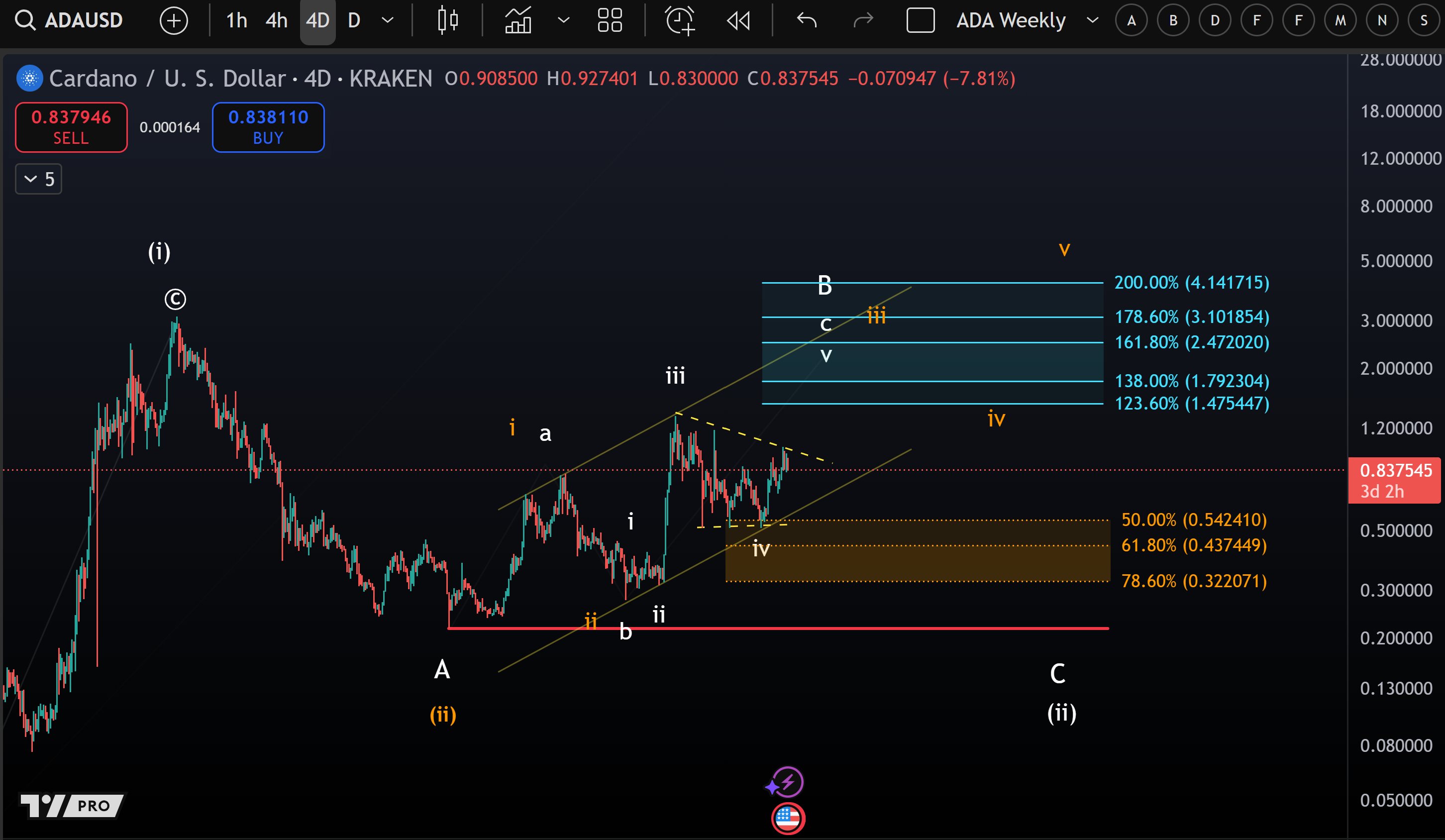
Meanwhile, the analyst shared that Cardano could rebound from the recent woes and target higher prices as long as it holds the $0.51 support. The mark, which would represent a 39% correction from the current market price, aligns with the lower boundary of an ascending channel highlighted on the 4-day chart.

For context, Cardano has trended within the wedge since its lows of $0.22 in June 2023, making higher highs and higher lows with the structure. It last rallied to the upper resistance of the ascending channel with its surge to $1.32 in December and has since then retraced, following another descending trendline within the channel.

Now, the mid-August price push to $1.02 marked the retest of the descending trendline, where ADA faced its recent rejection. This has contributed to the ongoing price consolidation. According to the market commentator, Cardano can displace the downward pressure and target higher prices if it sustains its trend above $0.51.

As earlier mentioned, the price mark is at the bottom of the channel and is also slightly below the 0.50 Fibonacci retracement level at $0.542, as highlighted in the accompanying chart.

Cardano Analysis/More Crypto Online

Targets for Cardano If It Rebounds

Further, More Crypto Online identified the higher price targets for Cardano if it holds $0.51 and reclaims bullish momentum. The first target is to break above the descending resistance trendline at around $1.

If this happens, Cardano will target further upside targets of $1.47, $1.79, and $2.47. At the current market price, this represents a 75.4%, 113.6%, and 194% uptick, respectively. Interestingly, the chart shows ADA could reach $3.10 and $4.14 in a bullish market condition.

Repeating Cyclical Pattern Points to $5 for Cardano

For analyst Crypto Target, the 10th-largest cryptocurrency by market cap is showing a similar price development to its previous cycle. He noted in a parallel commentary that in 2020, ADA followed a pattern of accumulation and re-accumulation before a rally to a major supply, and it seems to be recurring in the present chart.

ADA entered an accumulation zone in May 2022 after breaking below the mid-zone a month earlier. It consolidated within the range between then and October 2024, before breaking out in November to reclaim the mid-zone.

Cardano Recurring Price Pattern/Crypto Target

Meanwhile, the re-accumulation phase started between December’s high of $1.32 and has endured to this day, with the analyst suggesting a breakout is imminent. Notably, he predicted that the next rally would take Cardano past the mid-zone to the major supply zone around $3, culminating in a 258% rally from $0.838.

However, as seen in the previous cycle, Cardano could rally past the supply zone to unprecedented prices, specifically targeting a 496% uptick to $5. This aligns with a price outlook from Mr. Banana, who urged ADA holders not to sell until the $5 price target.