Home Blog Page 560

UAE Now Ranks Among Top State Bitcoin Holders With $700M From Mining

0

The United Arab Emirates now ranks among the world’s top government Bitcoin holders, securing $700 million in BTC through a state-backed mining initiative rather than market buys or seizures.

On Monday, blockchain intelligence firm Arkham revealed a cluster of Bitcoin wallets tied to the UAE government. Together, these wallets hold about $700 million worth of BTC. This substantial reserve marks the nation’s official entry into the ranks of state Bitcoin holders.

Mining, Not Buying: A Strategic Choice

While most governments gained Bitcoin by seizing it during investigations, the Emirates generated its stash through mining. This approach highlights a deliberate, organic path to building digital reserves.

According to Arkham, the mined Bitcoin was sourced from Citadel, a firm overseen by a conglomerate connected to the Abu Dhabi royal family. Unlike speculative acquisitions, this strategy built a reserve base from scratch, shielding the state from the price swings of open-market buys.

Investigators connected the mined Bitcoin to a facility on Al Reem Island, which was completed in just six months in 2022. Arkham confirmed its findings by cross-referencing on-chain mining activity with satellite images of the site. 

The mining center has already produced approximately 9,300 BTC since going operational. Of this amount, the UAE continues to hold at least 6,300 BTC. By keeping most of its mined Bitcoin, the UAE demonstrates that it views crypto reserves as a form of strategic asset, similar to gold or foreign currency reserves.

Where the UAE Stands in Global Bitcoin Rankings

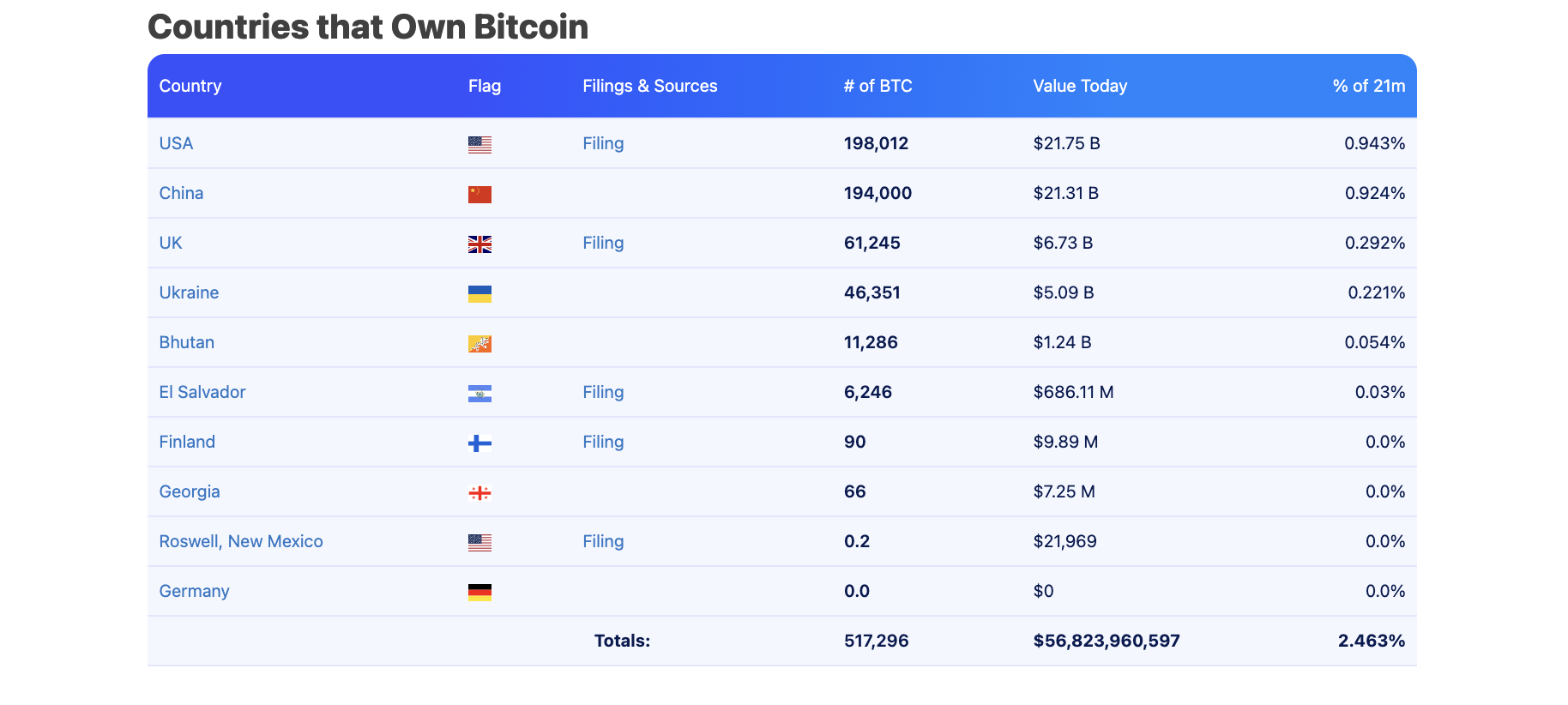
The UAE is now one of the top six governments worldwide in terms of Bitcoin holdings. It follows the United States, China, the United Kingdom, Ukraine, and Bhutan. At the same time, it has already surpassed El Salvador, despite the latter’s much-publicized adoption of Bitcoin as legal tender.

Meanwhile, the difference in scale is striking. The United States leads with 198,012 BTC, equal to $21.83 billion at current prices. China follows with 194,000 BTC, worth $21.38 billion. The United Kingdom has 61,245 BTC, valued at $6.75 billion. Ukraine holds 46,351 BTC, worth $5.11 billion, while Bhutan maintains 11,286 BTC, worth $1.24 billion.

While El Salvador has attracted significant media attention for its Bitcoin strategy, its actual holdings remain smaller than those of the UAE. El Salvador holds 6,246 BTC, worth $688.48 million.

Governments holding Bitcoin

Solana Could Outshine Ethereum in the Future of Stablecoins: REX Financial CEO

0

REX Financial CEO Greg King suggests that Solana could play a more significant role than Ethereum in the future of stablecoins. 

King made the assertion during an interview with Bloomberg’s ETF analyst Eric Balchunas. The interview, which was mainly focused on crypto ETFs, took an interesting turn when Balchunas highlighted that most people believe Ethereum to be the leading platform for tokenization and stablecoins. 

While mentioning Solana as one of the alternative cryptos gaining traction, Balchunas asked King to educate the average user about SOL’s potential. 

In response, King acknowledged Ethereum’s dominance, emphasizing that the coin ranks as the second-biggest cryptocurrency by market cap. Meanwhile, REX’s CEO positioned Solana as a major contender to ETH, noting that SOL is currently among the top five non-stablecoin cryptocurrencies. 

Despite ranking as the fifth non-stablecoin token, King stated that Solana is widely seen as a strong contender that could dethrone Ethereum in the global crypto ranking. However, he declined to participate in that debate, which he referred to as controversial. 

Why Solana Could Outshine Ethereum in the Stablecoin Market

Comparing both blockchains, King emphasized that Solana is faster than Ethereum. He said that the team behind Solana designed it for high-speed transactions, making the blockchain suitable for stablecoins. 

King suggested that people who believe Ethereum will remain the leading blockchain for stablecoins are mistaken. In his view, Solana, not Ethereum, could play a significant role in the future of the stablecoin market. 

Essentially, REX Financial’s CEO believes Solana’s speed and scalability will make it the leading platform for stablecoins in the future. 

The Stablecoin Market Today

Currently, Ethereum stands as the leading blockchain for stablecoins, hosting approximately $143.83 billion in stablecoin value. On the other hand, the total stablecoin market cap on Solana stands at just $11.81 billion, according to data from DeFiLlama.

TRON is another top contender in the stablecoin market with over $83 billion in value, ranking just behind Ethereum. Despite the huge difference, King is optimistic that Solana could outshine Ethereum in the future story of stablecoins. 

Longtime XRP Bull Says Selling Every Last Cent of XRP if it Touches $2, ‘This Isn’t a Joke Anymore’

0

The ongoing XRP dip is triggering a new wave of frustration among previously bullish investors, some of whom are now threatening to dump the coin for good.

On Monday, the price of XRP crashed to $2.82, nearing a new monthly low amid a broader crypto market bloodbath. During the same period, Bitcoin plummeted to $108,700—a level last seen in early July.

The decline has sparked renewed anxiety among market commentators who were initially optimistic about XRP’s long-term prospects.

“This Isn’t a Joke Anymore”

Leading this wave of criticism is widely followed influencer Crypto Bitlord. In a tweet on Monday, he declared that if XRP returns to $2, he would “sell every last cent” at market price and “turn the chart into a cliff.”

In other words, he intends to sell his holdings so aggressively that it could cause a steep price drop, dragging the value even lower and exacerbating panic among other investors.

Bitlord emphasized that such an event would represent a complete failure for XRP, leaving him with no choice but to walk away from the project entirely. He believes that if, after all this time, XRP returns to $2 rather than reach much higher targets, it’s proof that the investment has failed.

Notably, Bitlord claimed to have been invested in XRP for 12 years, likely since around 2013, near its initial launch. After more than a decade, he’s frustrated that the coin has never come close to the $100 mark, a price point he had hoped would bring life-changing wealth.

Bitlord expressed deep disappointment that his long-term commitment to XRP has cost him valuable time and emotional energy without delivering the returns he had envisioned.

“This isn’t a joke anymore,” he wrote, directing blame toward Ripple and adding, “We have lives to live.”

Previous Bullish View on XRP

Until recently, Bitlord was among the leading voices in the crypto community urging people to prioritize investing in XRP. In July 2024, he said, “For the love of God, buy XRP,” claiming a major development was imminent.

In a subsequent post, the veteran investor again expressed strong belief that millions of dollars could be made from XRP, saying it was poised for a historic price breakout.

These predictions largely materialized at the end of the year, when XRP jumped from the $0.50 range to the $3 level—surging nearly 600%. However, many have been hoping for continued progress since then, and the lack of it is once again stirring frustration.

Despite the ongoing dip, with XRP currently trading at $2.91, the coin remains up by 388% from last year. This is more than a 4X gain for those who bought just a year ago.

Community Reaction

Bitlord’s plan to dump XRP due to poor performance has sparked significant attention among other XRP supporters. Some criticized him for blaming XRP’s price action on Ripple’s efforts. Meanwhile, Bitlord responded that the company is not doing enough marketing, in his view.

Meanwhile, X user RegretfulVet remarked that if XRP falls to $2, he would take out the biggest loan ever to buy as many coins as possible, securing “cheap” bags for the next pump.

Bitlord replied by urging caution, suggesting that one should also consider the possibility that XRP could actually fail to deliver on its promises. However, it is unclear if the market analyst is currently just being sarcastic.

Bitcoin Price Forecast: Bitwise Sees $1.3M–$2.97M Range by 2035

0

Asset manager Bitwise has released its Bitcoin long-term capital market assumption, predicting its ultimate target in a bull case by 2035.

Notably, the August 25 report echoes the “buy the dip” sentiment as Bitcoin continues to consolidate. The premier crypto asset dropped below $110,000 on Monday for the first time since July, as selling pressure persists.

Bitcoin Targets 28.3% CAGR for the Next 10 Years: Bitwise

Bitwise projected a compounded yearly growth rate of 28.3% for Bitcoin over the next 10 years, insisting it would be the best-performing asset in the timeframe. This would extend its period of dominance over other traditional investment vehicles, as BTC has clearly outperformed most stocks and bonds over the last decade.

The projected growth would push the price of Bitcoin to $1,306,740 on a base market condition. This uptick, which represents a 1,085% growth from the current market price of $110,213, would mark an entrance into the seven-figure corridor for Bitcoin.

However, in a bullish market condition, Bitwise predicted that Bitcoin would reach $2.97 million per coin, representing a compound annual growth rate (CAGR) of 39.4%. From the current price, the upsurge culminates in a 2,601% appreciation.

Meanwhile, Bitcoin could trend below its current price in a bearish case. The report highlighted a 2% CAGR in this scenario, taking Bitcoin’s price to $88,005.

Bitcoin to Further Penetrate the Financial Market

Notably, the reported growth will see Bitcoin further penetrate the financial market. For context, the report noted that Bitcoin would capture 1% of the projected $216 trillion institutional investment assets market in a base case and 5% in a bullish case.

It would also capture 1% and 2% of the $115.6 trillion emerging market currencies sector by 2035 in a base and bull case, respectively. Additionally, 25% of institutional investors would buy Bitcoin as a store of value in a base case, while 50% would do so in a bull case, capturing a significant part of the projected $91.5 trillion market.

Bitcoin Price Outlook for 2035/Bitwise

Interestingly, this outlook shares a correlation with that of asset manager Ark Invest. The Cathie Wood-led firm predicted a rally to $1.2 million in a base case and $2.4 million in a bull case for Bitcoin, but in a shorter five-year timeframe.

Catalysts for This Bitcoin Growth

Furthermore, Bitwise highlighted possible facilitators of this bullish run. The Monday report shows that institutional demand for Bitcoin would enable this rally.

Notably, nation-states and corporate institutions have acquired a thirst for Bitcoin, one that has continued to grow lately. The World Bank shared that institutional investors control over $100 trillion and allocating between 1% and 5% of this staggering capital to Bitcoin would make the asset worth $1 trillion or $5 trillion.

Other catalysts for this price surge are the growing concerns of inflation. The report noted that this fiat-debased economic condition would drive the demand for hard money, favoring Bitcoin. Additionally, Bitwise also mentioned Bitcoin’s limited supply as another factor for its bullish outlook.

Report Based on Hot Demand

Remarkably, chief investment officer Matt Hougan revealed that the Bitwise first-ever Bitcoin market forecast report came on popular demand. He noted that large investors asked the asset manager 12 times this year for the report; hence, the release.

According to the CIO, even a half-trillion allocation to Bitcoin from these financial heavyweights would be real money.

Bitcoin ETFs Record Longest Outflow Streak Since April

0

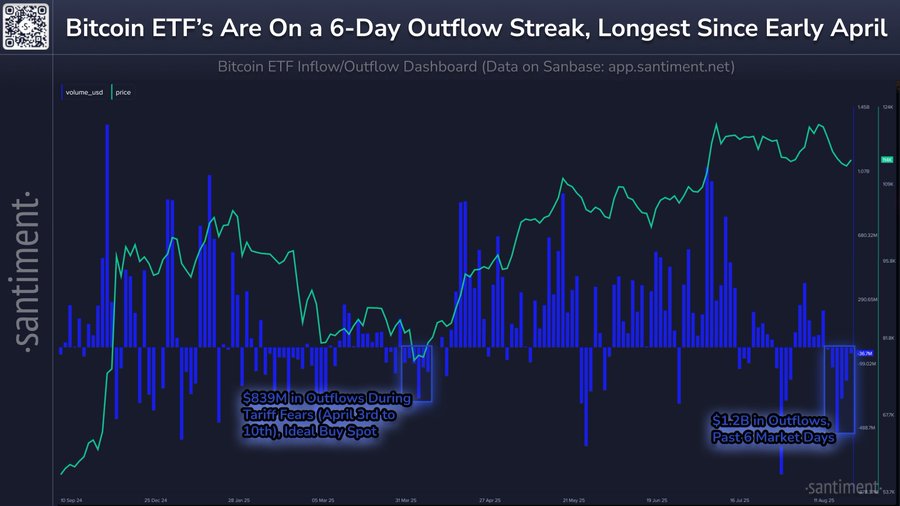
Bitcoin ETFs have logged six straight days of outflows, the longest streak since April, mounting pressure on Bitcoin’s short-term outlook.

According to on-chain and market analytics platform Santiment, the $1.2 billion outflow marks the longest withdrawal streak since early April, and it highlights growing pressure on Bitcoin’s short-term price performance.

The firm attributes much of the recent turbulence to retail traders, whose shifting sentiment appears to be steering ETF flows, in contrast to previous institutional-led outflows. These outflows have resulted in Bitcoin’s current volatility. Notably, Bitcoin trades at $110,067, a 1.8% loss in the past day, increasing the weekly loss to 4.3%.

Bitcoin ETFs’ Outflows Reach $1.2 Billion in Six Sessions.

Data from Santiment shows that Bitcoin ETFs lost an average of roughly $200 million per day over the past six trading sessions, culminating in the current $1.2 billion outflow streak. 

Bitcoin ETF data
Bitcoin ETF data

The latest ETF flow data shows that August began with strong investor demand, but sentiment shifted dramatically in mid-month. By August 14, BlackRock’s IBIT recorded a substantial inflow of more than $523 million.

However, that optimism was short-lived. Just days later, the market experienced one of its most aggressive redemption phases, with August 19 standing out as the heaviest single day of withdrawals, totaling more than $523 million across ETFs.

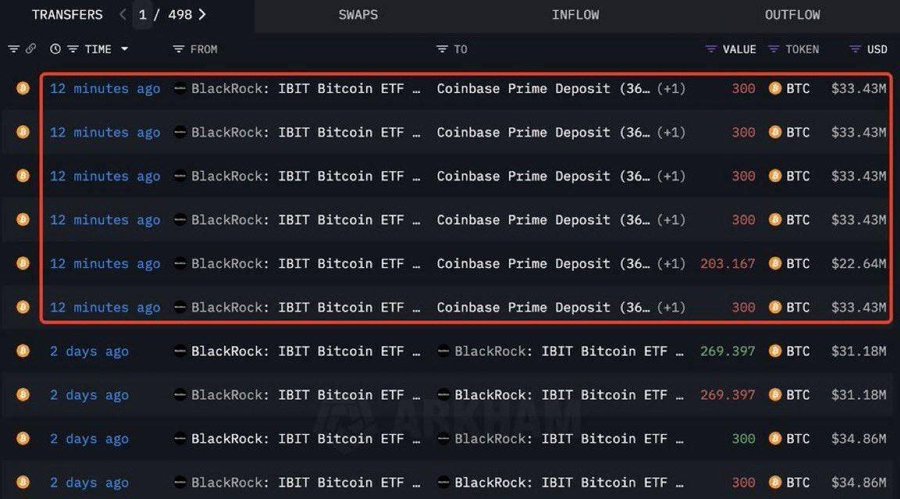
BlackRock’s IBIT and Fidelity’s FBTC accounted for the bulk of these exits, while Ark’s ARKB and Grayscale’s GBTC also posted significant redemptions, reinforcing the breadth of the selloff.

The outflow pressure spilled into August 20 and August 21, with combined outflow exceeding $510 million. IBIT lost $220 million on August 20, while Ark shed $75.7 million, contributing to a $315.9 million net outflow that day. Another $194.4 million exited the ecosystem on August 21, led by IBIT and FBTC.

Flows briefly stabilized on August 22, when ETF outflows collectively posted a near-flat $23 million. Fidelity’s FBTC attracted $50.9 million and Ark gained $65.7 million, while BlackRock’s IBIT still faced $198.8 million in redemptions. 

Meanwhile, momentum turned decisively positive yesterday, with broad-based inflows across major issuers. IBIT took in $63.4 million, Fidelity added $65.6 million, Bitwise brought $15.2 million, and Ark gained $61.2 million. Valkyrie’s BRRR also saw $6.3 million, bringing total inflows for the day to $219.1 million, the strongest rebound since mid-month.

Blackrock ETF outflow
BlackRock ETF outflow

April Outflows Provide Historical Comparison

The present sell-off is not without precedent. A similar cluster of outflows occurred between April 3 and April 10, when Bitcoin ETFs recorded $839 million in redemptions. Notably, macroeconomic concerns, particularly tariff-related headlines, drove the selloff. After that, the Bitcoin price rebounded. 

Santiment flagged the April sell-off as an “ideal buy spot,” arguing that ETF-driven withdrawals can sometimes signal local bottoms. This raises the question of whether the current trend could set up a comparable recovery once selling pressure subsides. 

Ethereum ETFs Stabilize as XRP and Others See Positive Flows

In a contrasting development, Ethereum ETFs experienced sharp swings this month. They saw record inflows of over $1 billion on August 11, led by BlackRock and Fidelity, but that momentum quickly reversed with steep outflows around mid-month.

The pressure eased soon after, as renewed demand helped funds rebound with strong inflows in the following days. That positive streak continued yesterday when ETFs collectively pulled in $443.9 million.

Meanwhile, XRP, Solana, and Cardano have attracted steady investor demand. CoinShares data showed XRP leading with $25 million in inflows last week, lifting its year-to-date total to $1.26 billion and assets under management (AUM) to $2.75 billion. 

Solana followed with $12 million, pushing its monthly inflows to $211 million and AUM to about $2.9 billion. At the same time, Cardano also secured fresh allocations.

Rumors Suggest Ripple Working with Swiss Bank on Tokenization Using XRP

0

Fresh speculation has emerged, suggesting Ripple and a Swiss Bank are exploring digital ID, compliance, and tokenization solutions using XRP.

These rumors materialized after an anonymous figure calling himself “Lord Belgrave” claimed to have leaked part of a confidential agreement. 

Rumors Suggest Ripple Working with Swiss Bank on Digital ID

Belgrave, who says he once worked as a Swiss banker, shared what he described as a section of a Mutual Non-Disclosure and Strategic Cooperation Agreement between a major Swiss bank and an American blockchain company. 

Notably, if his claims are accurate, the deal could involve Ripple and XRP in efforts to build new systems for digital identity, tokenized assets, and cross-border payments.

Belgrave said the excerpt he revealed came from the agreement’s purpose clause. Specifically, it outlined cooperation to design and test real-time financial infrastructure. 

This included cross-border transfers using neutral bridge assets, tokenization of regulated financial instruments, biometric identity integration, simulations of real-time gross settlement, and advanced liquidity channels for wholesale markets. 

He suggested that “neutral, protocol-agnostic” language pointed toward assets like XRP as a bridge. At the same time, the reference to tokenized instruments indicated large-scale products such as sovereign debt and exchange-traded funds, rather than retail crypto.

He also highlighted references to “multilayered liquidity corridors,” which he says relate to the linking of fiat networks, tokenized securities, central bank digital currencies, and neutral assets under a single global framework. According to him, the agreement presented a foundation for tokenized capital markets on a global scale.

Ripple’s Role Goes Beyond Remittances

Belgrave said the full agreement also covered governance, liability, and jurisdictional issues. However, he claimed he would only release parts of it gradually for personal safety. 

He argued that Ripple’s role in these projects went beyond remittance use cases. The anonymous commentator described it as an effort to build an institutional-grade settlement system. He claimed regulators had reviewed the document and that other bankers had seen similar material.

Expectedly, the claims quickly spread through the XRP community, with some linking the deal to institutions like JPMorgan and BlackRock. 

Belgrave suggested that the project combined biometric identity, tokenized asset settlement, and bridge technologies like the XRP Ledger (XRPL). Still, none of the companies he named have confirmed any involvement, and no official evidence has surfaced.

Industry Context Overlapping with These Rumors

Interestingly, industry context actually overlaps with some of these suggestions. For instance, JPMorgan has publicly called digital identity a major piece of Web3, calling for more secure and efficient verification methods. 

Meanwhile, Ripple has also been pushing deeper into compliance-driven projects and mainstream finance. In July 2025, the company applied for a U.S. national bank charter with the Office of the Comptroller of the Currency and a Federal Reserve master account to support its RLUSD stablecoin. 

In addition, Ripple has promoted custody solutions and tokenization, projecting that tokenized real-world assets could reach $19 trillion by 2033. The firm also acquired Metaco in May 2023 to push into the custody industry.

Further, the XRP Ledger has steadily advanced its digital identity features. In October 2024, validators approved the XLS-40 Decentralized Identifier amendment, introducing self-sovereign digital IDs for KYC and AML compliance. Earlier this year, a RippleX engineer announced the Credentials feature, which would allow lightweight verification for institutions while preserving privacy.

Notably, speaking on the latest speculations, attorney Bill Morgan said the rumor looked more believable than many others that have dominated the XRP community. However, this was not particularly an endorsement from him or a suggestion that Belgrave’s claims were actually true.

Despite the excitement, the story rests on unverified claims from one anonymous figure. Neither Ripple, JPMorgan, BlackRock, nor any Swiss bank has confirmed involvement, and no proof has been released publicly. This lack of evidence means investors should be cautious, even though the story aligns with Ripple’s compliance and tokenization strategy.

Ripple CEO Says What a Time to Be Alive XRP Family

0

Ripple CEO Brad Garlinghouse expresses excitement following the launch of the Gemini XRP Card. 

Garlinghouse joined members of the XRP community to celebrate the launch of a special XRP edition Gemini Credit Card. 

The card, which launched yesterday, allows users to earn up to 4% back in XRP on everyday purchases, such as rideshare, fuel, transit, and electric vehicle recharging. 

Ripple CEO Reacts 

Reacting to the development, Ripple’s CEO expressed amazement at the launch of the first-ever XRP rewards credit card. Celebrating the milestone, he remarked, ‘What a time to be alive, XRP family…’

Garlinghouse’s remark highlights how phenomenal it is that an XRP reward credit card has debuted, something that seemed unthinkable a few years ago. 

He encouraged his followers to use the Gemini credit card for everyday purchases and earn up to 4% back in XRP rewards. The tweet was accompanied by photos of Garlinghouse holding the credit card, with an XRP-branded cap visible on the table. 

Garlinghouse Gets the Whale Limit on His Card

Interestingly, Garlinghouse’s post caught the attention of Gemini’s co-founder Tyler Winklevoss, who offered him the “whale limit” on his XRP credit card. 

This suggests that Garlinghouse will receive the card’s highest daily spending limit. Tyler humorously stated that he learned that Garlinghouse was suited for the offer. 

For context, the XRP credit card was developed following a partnership among Ripple, Gemini, WebBank, and Mastercard. At the moment, the card is only available to users in the United States.

New users, particularly those who were approved on June 30, will get a welcome bonus of $200 in XRP. However, only those who spend a minimum of $3,000 within their first 90 days will be eligible for the welcome offer. 

The welcome bonus and other XRP rewards relating to the credit card will be distributed directly to users’ Gemini accounts. Once distributed, users can choose to withdraw, trade, or hold the XRP tokens within the exchange. 

Gemini Highlights XRP Growth 

Meanwhile, Gemini suggested that users could see the value of their XRP rewards skyrocket tremendously if they choose to hold their tokens. 

It referenced how Gemini Credit Card users who earned XRP rewards between October 8, 2021, and July 27, 2024, and held them through July 27, 2025, saw their holdings appreciate by more than 450%, following a tremendous spike in the asset’s price. 

Top Analyst Says XRP Won’t Stop at $4, Sees Path to $27 as XRP Sets to Close First-Ever Two Month Candle Above $2

0

Despite the recent market struggles, a top analyst has rejected claims that XRP may top out at $4 this cycle, presenting a higher two-digit target.

This bold suggestion came from EGRAG Crypto, an XRP permabull and prominent market analyst. According to EGRAG, XRP’s upside targets for this cycle remain extremely bullish, with $27 as the top goal, despite the recent struggles at the $3 mark.

EGRAG Dismisses $4 Top Claims

For context, Crypto Rover, another market watcher, made predictions on what he believes could be the price of several assets over the next two to four months, possibly coinciding with the market peak. Interestingly, Crypto Rover claimed XRP’s peak price could be around $3.2 to $4.8, marking only a 10% to 65% increase from here.

EGRAG’s recent commentary aims to dispute this suggestion, as he presented a chart analysis detailing Fibonacci extension levels for XRP. The analyst rejected the idea that XRP spent 72 two-month bars or 4,383 days persevering only to end up at a meager top of $4.13 and then slip into another bear market.

He pointed out that XRP is on the verge of establishing its most bullish close on the two-month timeframe, specifically the period from July to August 2025. Notably, EGRAG stressed that if XRP closed this two-month candle above the $2 mark, it would mark its highest two-month candle close in history. According to EGRAG, this could potentially set up for a nice run in the future.

XRP Fibonacci Targets

Today, XRP trades for $2.9. While it’s still battling to reclaim the $3 mark, closing the two-month candle at the $2.9 level is still within acceptable bullish limits. EGRAG then presented four upside targets for the rally that could emerge from here.

Specifically, the first target sits at the Fibonacci 1 level, aligning with the $3.31 all-time high from January 2021. XRP had already breached this level this year when it soared to $3.66 in July. A push above $3.31 again would bring XRP face-to-face with the recent $3.66 peak.

XRP Fibonacci Targets EGRAG Crypto
XRP Fibonacci Targets | EGRAG Crypto

Beyond this, EGRAG suggests a run toward $8 is on the horizon. The next target for the analyst is the 1.272 Fibonacci extension, which syncs with the $8.37 price. This would mark a 188% increase from the current price position, representing a new all-time high for XRP.

However, the market analyst believes this would not mark the top. He believes a further uptick toward $13.56 is in order. This target, which aligns with the Fibonacci 1.414 extension, would represent a 367% increase from the current XRP price and push XRP to two-digit levels for the first time in its history.

Meanwhile, EGRAG suggests the cycle top would be much higher, specifically at $27.17 or the 1.618 Fib extension. The analyst has consistently championed this target, reaffirming his conviction that a run to $27 is still in play last December. However, EGRAG expects a crash after this top materializes, possibly targeting $0.8.

XRP, Solana and Cardano Record Inflows Despite Bitcoin, Ethereum Seeing $1.44B Outflows

0

XRP, Solana, and Cardano buck the trend as investment products tied to Ethereum, Bitcoin record $1.44 billion in weekly outflows.

According to the latest CoinShares report, this marked the largest weekly outflow since March. Despite the downturn, ETP trading volumes surged to $38 billion, about 50% above this year’s average. This reflects heightened investor activity amid shifting U.S. monetary policy signals.

Bitcoin Faces Heavy Outflows

Specifically, investment products tied to Bitcoin led the market downturn, with $1 billion in outflows last week. Investor caution was amplified early in the week when fears about the Federal Reserve’s rate stance triggered withdrawals totaling $2 billion.

Although sentiment later improved, Bitcoin still ended the week deep in negative territory. Year-to-date, Bitcoin inflows represent just 11% of assets under management (AUM).

Ethereum Shows Stronger Resilience

Meanwhile, Ethereum stood out with a sharper mid-week recovery, limiting its weekly outflows to $440 million. ETH is fast emerging as the preferred institutional play, with $2.5 billion in inflows month-to-date, compared to Bitcoin’s $1 billion in net outflows. Ethereum’s year-to-date inflows now account for 26% of total AUM.

XRP, Solana Record Inflows

Outside the two market leaders, altcoins saw uneven demand. XRP-based investments attracted $25 million inflows for the week, bringing the month-to-date inflow to $173 million. The year-to-date inflow rose to $1.26 billion, with assets under management at $2.75 billion.

Solana investments also performed well, with $12 million in inflows last week. Month-to-date, Solana has attracted $211 million, with year-to-date inflows totaling $1.06 billion. Solana-based products now have an AUM of around $2.9 billion.

Cronos-based products saw $4.4 million in weekly inflows, bringing the year-to-date figure to $62 million and AUM to $92 million. Other crypto asset investments that recorded inflows last week included Cardano, Chainlink, and Litecoin.

On the other hand, Sui (-$12.9 million) and Toncoin (-$1.5 million) experienced outflows. Nevertheless, Sui’s year-to-date inflow remains strong at $121 million, with an AUM of $322 million.

Fed Policy Shifts Drive Market Volatility

The week’s outflows and late recovery were closely tied to U.S. monetary policy. Initial pessimism surrounding the Federal Reserve’s stance drove heavy selling. However, Fed Chair Jerome Powell’s Jackson Hole address sparked renewed inflows of $594 million toward the end of the week.

Regional Flow Breakdown

Regionally, the United States recorded the largest outflow for the week, with over $1.3 billion in withdrawals. Sweden followed distantly with $135.5 million in outflows, while Switzerland saw $11.8 million drained. Other regions, including Australia, Brazil, Canada, Hong Kong, and Germany, recorded positive flows for the week.

Japan’s Finance Minister Endorses Crypto for Investment Diversification

0

Japan’s Finance Minister Katsunobu Kato is urging the creation of a friendlier environment for digital assets. He believes cryptocurrencies can play a role in diversified portfolios if safeguards are in place.

Speaking at the WebX2025 digital assets forum in Tokyo, Kato expanded on this vision. He acknowledged the risks linked to digital currencies, including extreme volatility. However, he argued that these risks can be controlled if the right investment frameworks are introduced.

“Cryptocurrencies could be part of diversified investments,” Kato said. He added that clear rules and a supportive ecosystem would help investors adopt them with greater confidence.

He also warned against excessive restrictions that could block innovation and discourage entrepreneurs. According to Kato, the ministry’s goal is to design a framework balancing safety, innovation, and global competitiveness.

Debt Burden Adds Urgency to Alternative Investments

Kato’s remarks came at a time when Japan is dealing with a debt-to-GDP ratio surpassing 200%. This is one of the highest levels among developed nations. Economists fear that the burden could trigger financial repression, where governments manage debt using inflation, low interest rates, or currency depreciation.

Such conditions hurt returns on traditional safe assets such as government bonds and savings deposits. For many investors, this strengthens the case for alternative holdings such as cryptocurrencies, which provide potential real returns and portfolio diversification.

Regulatory Push: Japan Approves Yen-Backed Stablecoin

Japan has also made progress on regulation. The Financial Services Agency (FSA) recently approved the issuance of the first yen-denominated stablecoin. The coin, issued through Tokyo-based fintech JPYC, is expected to play a significant role in the domestic and international markets.

Analysts say yen-backed stablecoins can simplify cross-border settlements and attract institutional investors. Additionally, they can enhance liquidity for government bonds by serving as reliable collateral.

“Yen stablecoins can boost efficiency and build trust among institutions,” said Jamie Elkaleh, CMO at Bitget Wallet.

Taxation and Policy Reforms Under Review

Japan’s crypto investors currently face heavy taxation, with realized gains taxed at a maximum rate of 55%. Policymakers are now considering major reforms, including a separate taxation bracket that would lower the rate to 20%, aligning it closer with equity investments.

Meanwhile, the ruling Liberal Democratic Party (LDP) has proposed reforms to prevent insider trading in digital assets. These measures would apply rules similar to those in the stock market, ensuring that malicious actors cannot profit from confidential information.

Such reforms are seen as crucial steps toward making Japan’s crypto market safer, fairer, and more attractive to both local and international investors.

Global Leaders Converge at WebX2025

The WebX2025 forum, held on August 25–26 in Tokyo, highlighted Japan’s growing importance in the global digital assets sector. The event confirmed the presence of Prime Minister Shigeru Ishiba, Finance Minister Katsunobu Kato, and Tokyo’s Governor, along with many influential figures from the global crypto community.

Prominent industry leaders such as Changpeng “CZ” Zhao of Binance, Justin Sun of Tron, Galaxy Digital’s Mike Novogratz, and Arthur Hayes of Maelstrom were also in attendance.

U.S. Business Interest: Trump-Linked Crypto Expansion

International business interest in Japan’s crypto market is also increasing. According to recent reports, Eric Trump is expected to attend the Metaplanet Shareholder Meeting in Tokyo next month, where new capital-raising options will be debated.

In addition, American Bitcoin, a company backed by Eric Trump and Donald Trump Jr., has announced expansion plans in Japan and Hong Kong. Industry experts say the move signals growing foreign confidence in Japan’s evolving digital asset framework.

Japan’s approach to digital assets reflects both caution and ambition. By advancing reforms while fostering innovation, the country is building a stronger framework for a more resilient and globally competitive cryptocurrency market.