Home Blog Page 568

Top U.S. Exchange Gemini Hints at Something Big Coming for XRP

0

Top U.S. crypto exchange Gemini has stirred fresh excitement within the XRP community after posting a cryptic message on X. 

The platform tweeted “The neXt era of rewaRds is preParing to launch”, with the capitalized letters forming “XRP”. This has led many to believe that Gemini is preparing another major initiative centered on the third biggest crypto asset.

Recent Giveaway

This teaser comes shortly after Gemini concluded an XRP giveaway campaign. The exchange awarded 305 XRP, worth $1,000, to one lucky follower who followed its X account and liked an official post on August 7. 

At the time, the campaign coincided with XRP’s rebound to the $3.36 range after briefly dipping to $2.90. That rally was fueled by the official conclusion of Ripple’s lawsuit with the U.S. Securities and Exchange Commission (SEC).

Meanwhile, Gemini’s post announcing the giveaway winner had already hinted that something “BIG” was on the horizon. Now, the latest teaser appears to confirm that a new XRP-centered program could be launching in the weeks ahead.

Gemini’s Track Record with XRP Promotions

Gemini has consistently promoted XRP since listing the token in August 2023. Notable campaigns have included:

XRP Cashback via Gemini Credit Card, which allowed users to earn 2% back in XRP on purchases such as groceries.

The XRP Faucet, a limited-time initiative in August 2023, distributed 4,000 XRP daily, where verified users could claim 20 XRP each.

These past efforts highlight the exchange’s ongoing strategy to build engagement around XRP within its ecosystem after being late to the listing party. For context, Gemini only listed XRP for the first time in August 2023 after a judge ruled in the SEC case that XRP was not a security.

Other US Exchanges Supporting XRP

Meanwhile, Gemini is not the only U.S. exchange pushing XRP-related campaigns. In June 2025, Uphold rewarded large XRP holders with $100,000 worth of Zebec Network (ZBCN) tokens. Previously, Uphold had also run monthly sweepstakes offering up to 50,000 XRP.

With Gemini now teasing “the next era of rewards,” the XRP community is anticipating another campaign that could rival or surpass its earlier initiatives.

Meanwhile, anticipation for Gemini’s upcoming XRP initiative is reaching a fever pitch. Reacting to the latest post, one commenter, “QuantumUltrarunna,” expressed frustration with the continuous teasers. He urged the exchange to either announce the big news or stop teasing.

Others, like “Tim XRP,” said they are looking forward to the campaign, sharing how they have benefited significantly from previous initiatives.

Analyst Highlights New Cardano Targets After Retracement, Says Move Can Happen “Very Quickly”

0

A decisive move for Cardano could happen very quickly, as a top market analyst highlights possible bearish and bullish targets.

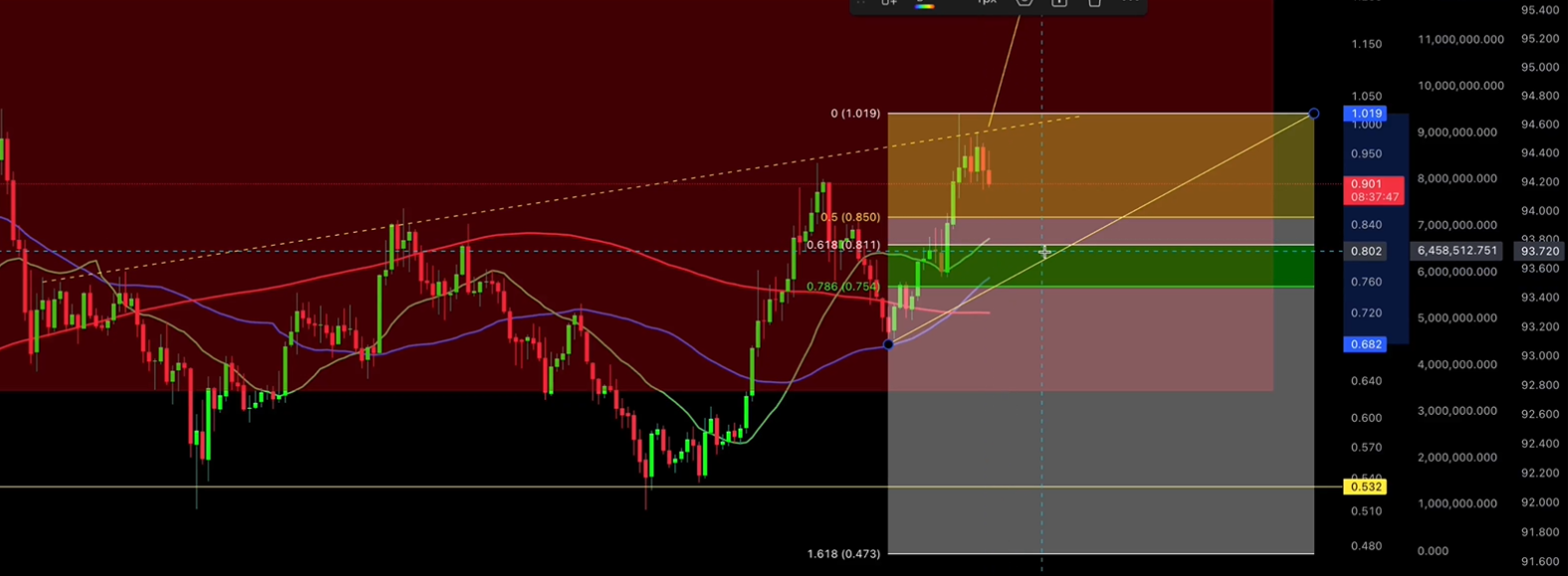
Amid Bitcoin’s recent drop to $113,000, Cardano recorded its second consecutive daily bearish closing yesterday despite temporarily becoming the 8th largest cryptocurrency by market cap. It has now reclined further from its multi-month high of $1.02 on August 14, retracing 16.6% to its current market price of $0.85.

Further Cardano Retracement Possible

Meanwhile, Cardano permabull Dan Gambardello said in his Tuesday analysis that the Cardano price manipulation could persist. He noted that ADA continues to trend below its bull market door, after seeing its bullish momentum curbed by a resistance neckline. According to him, prices could go lower.

Currently, Cardano trades above the 20-day and 50-day moving averages (MA) respectively at $0.82 and $76. Gambardello predicted that ADA could retest these areas in a high-low price swing if the bearish momentum persists, presenting a good entry opportunity.

He further employed a Fibonacci retracement to determine how low Cardano can go, based on the recent floor of $0.685 on August 2. This showed that ADA could drop to the golden pocket retracement level at $0.81 or further lower to the 0.78 Fib level at $0.75. This is in confluence with the earlier-mentioned moving averages.

Screenshot 2025 08 20 093006
Cardano Retracement Targets/Dan Gambardello

Cardano Bullish Move Could Happen Quickly

Nonetheless, the analyst insisted that Cardano could rebound from any of the areas if bulls step in quickly. He noted that finding support in any of the moving averages would set the tone for a higher price move to retest the trendline above $1.03, where it faced rejection last week.

Moreover, conquering this neckline resistance would further set ADA on the path to reaching the bull market door at $1.25 and beyond. If it breaks out of this zone, Gambardello shared that the next target is $2, insisting that this move could happen “very quickly.”

Notably, a rally from the current market price to $1.25 and $2 represents a 47% and 135% growth, respectively.

Much Higher Targets for Cardano

Remarkably, Gambardello had earlier projected higher price targets for Cardano should it rally past the bull market door at $1.25. He asserted that ADA would reach a new all-time high of $10.025 upon breakout, a 1,079% increase from the current price.

However, he also agreed earlier that $7.5 is a more realistic target for this Cardano bull cycle, expected to end in three to six months after Bitcoin’s peak. He leveraged analysis from Zero AI to forecast this target.

Dogecoin Mining Gets Major Boost as Thumzup Acquires Dogehash in $50M Stock Deal

0

Trump family-backed Thumzup Media is buying Dogecoin miner Dogehash in an all-stock deal, aiming to build a leading Dogecoin mining ecosystem.

On Tuesday, Thumzup Media, a Nasdaq-listed crypto-focused treasury firm, announced plans to acquire Dogecoin mining company Dogehash. The agreement will be executed through an all-stock transaction.

As part of the deal, Dogehash shareholders will receive 30.7 million Thumzup shares. Once completed, the miner will become Degohash Technologies Holdings and be listed on the Nasdaq under the ticker symbol “XDOG.”

Building a Dogecoin Ecosystem

Thumzup said Dogehash’s mining technology will be folded into its platform. The goal is to strengthen Dogecoin’s mining infrastructure and deliver competitive opportunities for miners.

In the press statement, CEO Robert Steele said that the company aims to go beyond mining. He highlighted plans to create a vertically integrated Dogecoin ecosystem, combining renewable-powered operations, scalable infrastructure, and utility-driven applications.

Recent Fundraising and Strategy Shift

The acquisition follows Thumzup’s $50 million capital raise, completed a few weeks ago. That funding went toward purchasing mining rigs, accumulating digital assets, and advancing its crypto-led strategy. 

Originally founded in 2020 as a social media marketing platform, Thumzup pivoted earlier this year. It now manages a crypto treasury and accepts Bitcoin payments for its users.

Crypto Industry Trend

Thumzup’s move mirrors a wider shift among public companies. Several firms, including American Bitcoin and Kindly MD, have added large Bitcoin holdings in recent months. Others, such as Bitmine Immersion and Sharplink, have funneled billions into Ethereum.

Altcoins like XRP and Solana are also seeing growing adoption as corporate treasury assets.

Market Reaction and Outlook

Thumzup shares closed at $5.01 on Tuesday, according to Yahoo Finance. The stock fell 41% in 24 hours but remains up 52% for the year. 

Upon finalizing the Dogehash acquisition, Thumzup and its new subsidiary will aim to establish themselves as a top Dogecoin mining platform, with the promise of stronger yields for the meme coin’s miners.

Coinbase CEO Hails XRP Perpetual Futures Launch as Great Progress

0

Coinbase CEO Brian Armstrong applauds the exchange’s move to add XRP and Solana to its perpetual futures offering in the United States. 

For context, Coinbase recently added XRP and Solana to the list of supported assets for perpetual-style futures. Notably, the inclusion of XRP and Solana raises the total number of assets available for perpetual futures to four. 

The San Francisco-based exchange launched the perpetual futures offering for U.S. customers last month, with initial support for Bitcoin and Ethereum. Less than a month after this launch, Coinbase has now expanded the offering to include XRP and Solana. 

Coinbase CEO Calls XRP and Solana Perpetual Futures US Launch Great Progress 

According to the announcement, U.S. traders can open and hold XRP perpetual futures, with a leverage of up to 5x and no monthly contract expiration. 

The XRP perpetual futures are offered through the Coinbase Derivatives platform, which is licensed by the Commodity Futures Trading Commission (CFTC). This implies that the perpetual futures offering for XRP and Solana will be regulated under CFTC rules. 

Reacting, Coinbase CEO Brian Armstrong applauded the initiative, describing the latest expansion in the United States as “great progress.” 

Previous Perpetual Futures Support 

Notably, the Coinbase perpetual futures offering has been available in several eligible countries other than the United States. 

In October 2023, the exchange granted customers in eligible international jurisdictions access to its perpetual futures offering, which initially supported four assets such as XRP, Litecoin, Bitcoin, and Ethereum. 

Despite launching perpetual futures in other countries, Coinbase did not introduce a similar offering in the U.S. due to regulatory concerns. As the United States makes significant progress in regulating the crypto market, Coinbase launched perpetual futures for U.S. customers last month, starting with Bitcoin and Ethereum. The exchange has now expanded the offering to include XRP and Solana. 

The perpetual futures offering is not the first time Coinbase has extended derivative support for XRP. Earlier this year, the leading exchange launched self-certified XRP futures in the United States. 

Here’s Why This XRP Fall Was Always on the Cards

0

XRP recently corrected sharply amid a broader market crash, but here’s why this collapse was always on the cards.

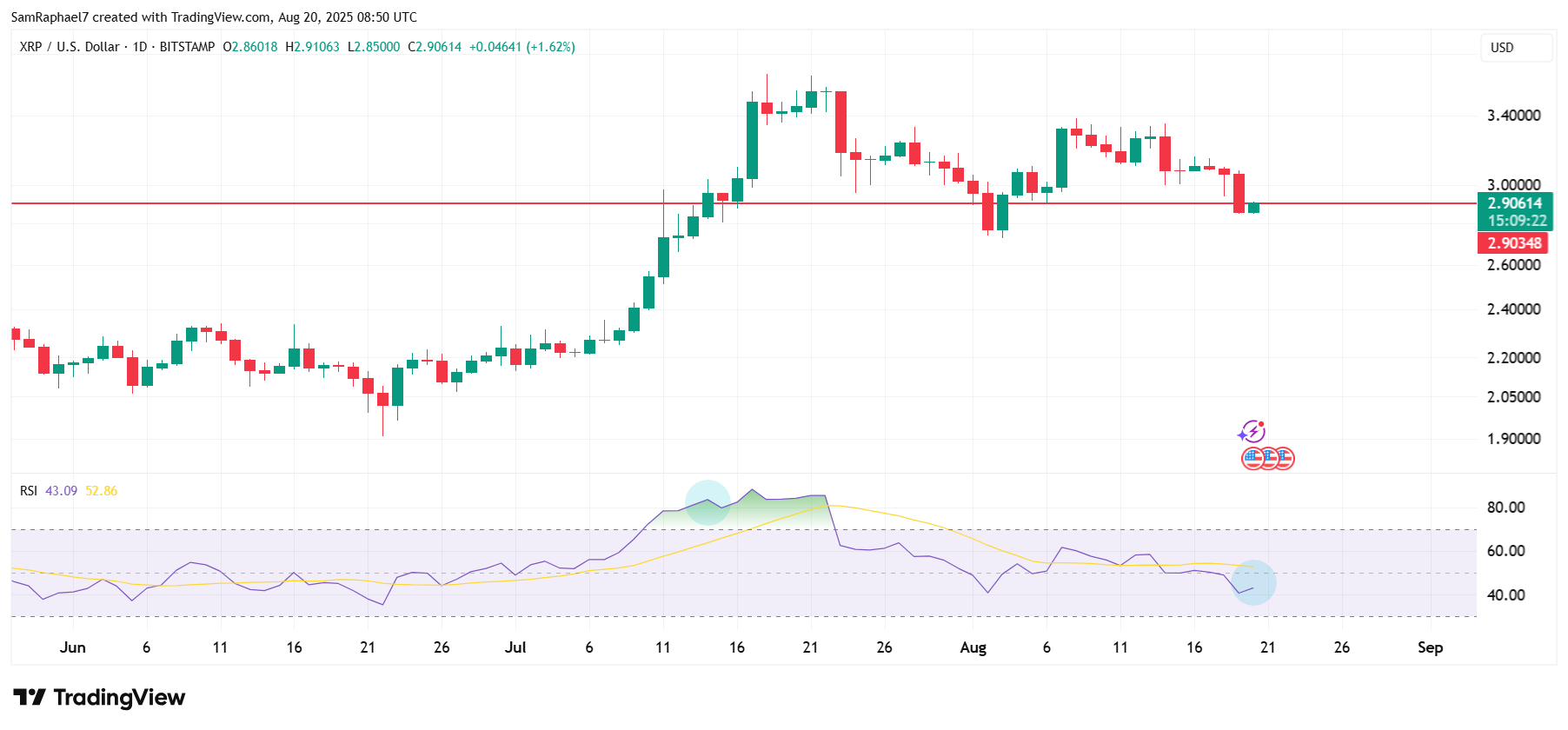
For context, the latest correction came after XRP claimed a new peak of $3.66 on July 18. It immediately gave up this level as August opened and continued to battle the bears above $3 until the recent drop made it lose the psychological mark. Specifically, XRP collapsed 6.62% yesterday, its largest daily loss in a month.

Profit-Taking Trend Among XRP Holders

However, before this drop, The Crypto Basic called attention to a market trend that actually pointed to a massive decline. Specifically, while XRP changed hands above $3, the report revealed that about 94% of XRP wallets were in profit. 

Nonetheless, the report noted that while this is an impressive metric in terms of profitability, it might point to a massive price crash in the short term, as most of the wallets that are now seeing gains could start executing profit-taking trades. This often leads to price declines.

Notably, historical data confirmed this pattern. For context, in January 2018, when XRP spiked to a new all-time high of $3.3, address profitability surpassed 90%. After this, XRP witnessed a steep drop, crashing by a massive 43.57% in January 2018 alone, and extended the downtrend to a 95.5% drop by the end of the correction.

This trend played out again after XRP recovered to the $1.96 high during the 2020/2021 bull run. Upon reaching this peak, XRP’s address profitability soared past 90% again. Expectedly, this led to another round of profit-taking trades, with XRP eventually collapsing by 85%.

XRP Showing Greater Resilience Now

Considering this trend, market analyst Winny argued that with XRP’s wallet profitability rising above 90% again, “someone” would eventually sell. This has since materialized, but not in full force. For context, an 85% collapse for XRP would lead to $0.45, and a 95% drop would result in a price of $0.15.

Notably, Winny suggested that this time might be different due to rapidly growing whale wallets, a spike in network activity, and positive chart patterns. While the profit-taking trades as well as the broader market downturn have pushed XRP below $3, it still holds firm at $2.9, now attempting to recover the psychological threshold.

XRP RSI Shows More Room for Growth

Despite it trading at $2.9 at press time, XRP’s daily RSI still stands at a low 43.05. Notably, when XRP traded for $2.9 in mid-July, its RSI was already overstretched at 83.69. However, it still saw a run to $3.66 days later. With the current 43.05 RSI value, XRP has much more room for growth. As a result, a recovery here could push prices to new highs.

Bernstein Forecasts $150K–$200K Bitcoin Amid Extended Bull Run

0

Bernstein analysts expect Bitcoin and other digital assets to remain in a prolonged bull cycle through 2027, driven by U.S. policy support and institutional adoption.

Bitcoin remains the anchor of Bernstein’s latest outlook on digital assets. The brokerage forecasts that the cryptocurrency could trade between $150,000 and $200,000 within the next year, despite recent pullbacks.

Last week, Bitcoin reached an all-time high of $124,457. Since then, it has fallen to around $112,000, marking a 5.5% drop over the past seven days. Analysts argue this volatility is typical in long bull markets and does not undermine the broader upward trend.

Bernstein believes the ongoing rally could extend into 2027, surpassing the traditional four-year cycle that has historically shaped crypto markets. Analysts link this extended run to growing institutional adoption and a strong push from the Trump administration to position the country as a global crypto hub.

For context, a presidential order now allows cryptocurrencies to be included in 401(k) retirement plans, opening the market to millions of Americans.

Meanwhile, SEC Chair Paul Atkins has introduced “Project Crypto,” an initiative aimed at creating simpler and clearer regulations for the industry. 

The GENIUS Act, passed last month, introduced the first federal framework for U.S. dollar-backed stablecoins. Together, these measures are seen as laying the foundation for sustained growth in the sector.

Altcoins Set to Join the Momentum

While Bitcoin dominates the outlook, Bernstein also expects other digital assets to play a significant role. The firm predicts that Ethereum and Solana could lead the next phase of the cycle. Their rise would be fueled by interest rate cuts, greater demand for decentralized finance, and renewed enthusiasm for staking.

Since April, Ethereum has surged more than 150%, while Solana has climbed nearly 70%. Analysts attribute this performance to the expanding use of blockchain platforms for smart contracts, decentralized finance, and tokenized payments.

The trend points to a broader market upswing, with capital potentially flowing beyond Bitcoin into leading altcoins, raising the prospect of a new “altcoin season.”

Institutional Platforms Powering Growth

Institutional adoption of digital assets is a central theme in Bernstein’s report. Trading platforms such as Coinbase and Robinhood are highlighted as beneficiaries of the bull cycle.

Coinbase (COIN), with a revised price target of $510, processed over $100 billion in trading volumes in July. This represented a 44% increase compared with the previous quarter. Its expansion into derivatives, along with the $2.9 billion acquisition of Deribit, positions the exchange to become what Bernstein calls an “everything exchange”. Analysts also highlighted Coinbase’s role in driving USDC adoption as a catalyst for growth.

Meanwhile, Robinhood (HOOD) saw its crypto trading volumes reach $16.8 billion in July, a 110% month-on-month increase. Bernstein raised its target for the company to $160. It cited the acquisition of Bitstamp and expansion into Europe as key growth drivers.

Stablecoins at the Heart of Digital Finance

Stablecoin issuer Circle also features in Bernstein’s analysis. The firm maintained its $230 price target for Circle’s stock. It expects this outlook based on the supply of USDC, which it projects will grow from $68 billion today to $99 billion in 2026 and $173 billion by 2027.

Analysts view Circle as a critical player in digital finance, with its Arc blockchain, partnerships with banks, and expanding role in on-chain payments making it a cornerstone of liquidity for decentralized markets.

A Multi-Year Digital Asset Supercycle

Essentially, Bernstein’s forecast paints a picture of a multi-year supercycle for Bitcoin and digital assets, extending well past earlier expectations. The brokerage believes the convergence of policy support, institutional adoption, and technological innovation will sustain growth into 2027, marking one of the longest bull runs in crypto’s history.

Expert Counters FUD About Tether With Evidence of U.S. Expansion and Strong Financial Ties

0

Tony Edward, the host of the Thinking Crypto podcast, pushes back on negative rumors surrounding the world’s largest stablecoin issuer, Tether. 

Yesterday, Edward slammed critics spreading FUD (fear, uncertainty, and doubt) about Tether, calling them paid actors, engagement farmers, and uninformed commentators. 

He defended Tether’s credibility by citing evidence of its ongoing expansion in the United States and its connections with prominent financial figures, including Secretary of Commerce Howard Lutnick. 

Evidence Backing Tether’s Credibility 

Edward noted that Lutnick, former CEO and President of Cantor Fitzgerald, revealed that the firm had independently reviewed Tether in 2024. Lutnick claimed that the review showed Tether has sufficient reserves to back USDT. Based on this conviction, Cantor Fitzgerald acquired a 5% stake in Tether. 

Edward also shared a report confirming that Cantor Fitzgerald’s Chairman, Brandon Lutnick, personally verified Tether’s reserves in May 2025. The second verification came after Cantor Fitzgerald began its relationship with the largest stablecoin issuer. 

A month before this verification, Tether, alongside Cantor Fitzgerald and SoftBank, launched Twenty One Capital, a Bitcoin investment company. The investment company made its debut with a whopping 42,000 BTC valued at around $3.6 billion at the time. 

Further, Edward recounted that U.S. President Donald Trump acknowledged Tether’s CEO Paolo Ardoino at the White House Digital Asset Summit. Notably, the stablecoin giant further enhanced its credibility by appointing former White House Crypto Council director Bo Hines as an advisor. 

Based on these events, Edward stressed that the FUDs about Tether reserves are baseless and financially motivated. 

Controversies Surrounding Tether 

For context, Tether has long been a major topic of debate in crypto circles. Many skeptics, including Justin Bons of Cyber Capital, question whether Tether’s USDT stablecoin is fully backed 1:1 by U.S. dollar reserves. 

These concerns soared in 2021 after the U.S. CFTC slammed a $42 million fine against Tether for providing misleading statements about the reserves backing its USDT stablecoin. 

Additionally, the company’s initial decision to publish only an attestation of its USDT reserves in 2021, rather than a full independent audit, fueled further skepticism. In response, Tether partnered with prominent accounting firm BDO Global in 2022 to begin publishing quarterly reports on its financial reserves.

Tether’s Q2 2025 report shows that the company’s total assets exceed its liabilities. According to the report, Tether has a total asset of $162.57 billion, with a liability of $157.1 billion. 

At the moment, the company is considering hiring one of the big four accounting firms–KPMG, Ernst & Young (EY), PricewaterhouseCoopers (PwC), or Deloitte–for a full financial audit, which will potentially address the concerns about its USDT reserve. 

Ethereum Dominates Monthly Stablecoin Transfer Volume With $521K Per User

0

Ethereum steadies its dominance in the stablecoin market, as it commands a staggering monthly transfer volume per holder.

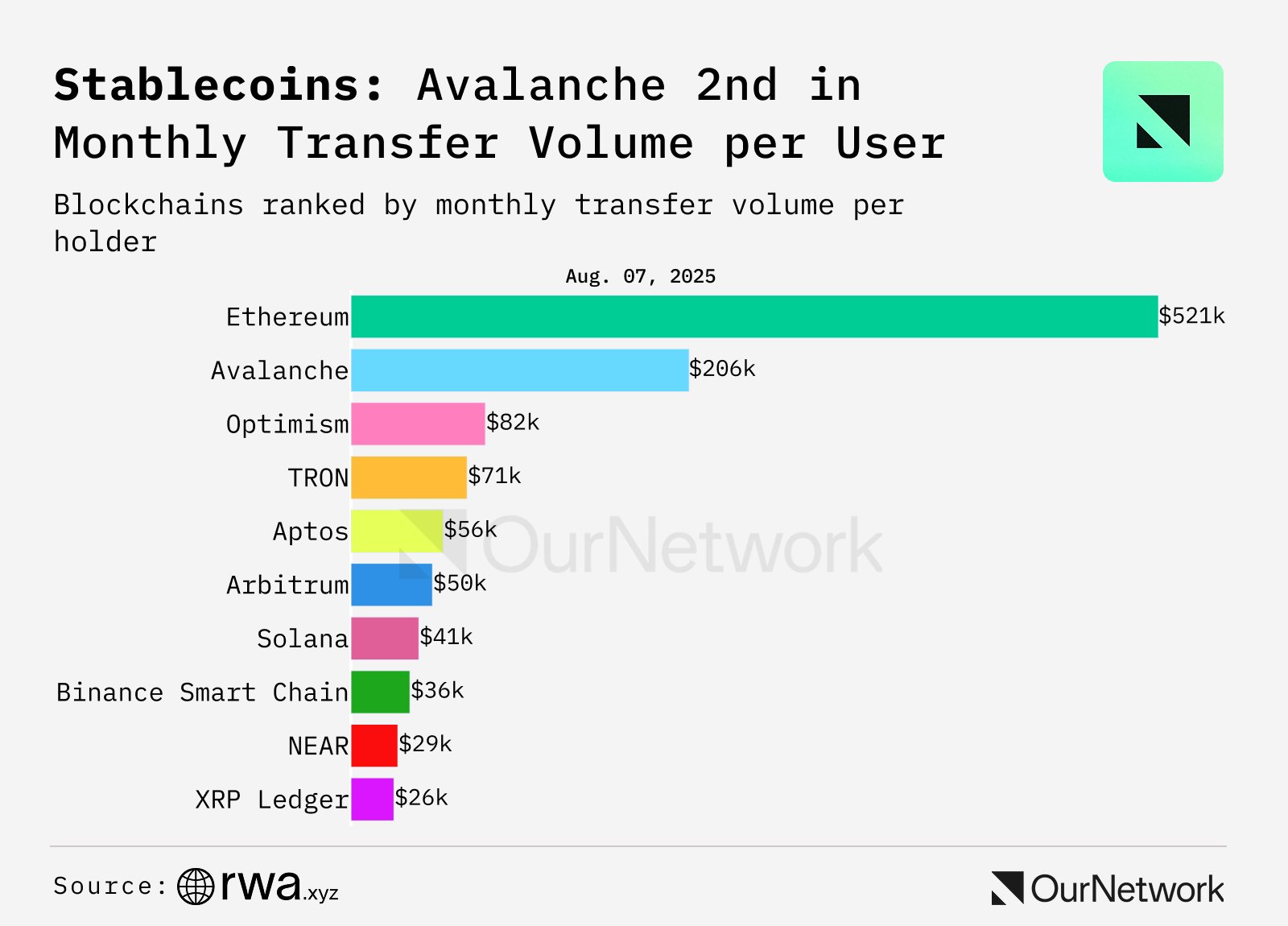
Stablecoins mostly flow on the Ethereum network, according to recent data from the on-chain analytical platform Our Network. The report, shared by the head of research at Onchain Foundation, Leon Waidemann, identified that Ethereum has the largest share of monthly stablecoin transactions in the crypto space.

Ethereum Averages $521K Stablecoin Transfer Per User

For context, the report ranked blockchains by monthly transfer volume per holder. Unsurprisingly, Ethereum led the chart, with an impressive $521,000 moved per holder over 30 days in the network.

Notably, this indicates that massive capital flows through Ethereum and stablecoins account for a considerable part of it. This comes as no surprise, as the smart contract-infused blockchain hosts 51% of the total stablecoin market cap, around $142.6 billion.

Meanwhile, this further confirms a trend of massive institutional stablecoin use case, especially on Ethereum. Fiat-pegged cryptocurrencies are gaining increasing attention from large financial institutions, which have identified their use case in settlements.

Interestingly, the total stablecoin market cap is slowly growing, as issuers inject more liquidity into the market in response to user demand. The total stablecoin market has grown to $275.5 billion, adding $9.06 billion (3.40%) in the past seven days alone.

The majority of these supplies are being transacted on Ethereum, providing use cases and fee revenue for the network. Some believe this would boost revenue, increase Ether’s utility, and consequently drive prices to unprecedented levels.

A New Contender to Ethereum’s Stablecoin Dominance?

Meanwhile, despite holding a mere 0.64% ($1.77 billion) of the stablecoin supply, Avalanche recorded an impressive monthly transfer volume per holder. Users moved stablecoins on the chain at an average volume of $206,000 per holder, signaling stablecoin interest on Avalanche.

Stablecoin Chain Ranking by Monthly Transfer Per Holder

Notably, Avalanche has expanded its stablecoin ecosystem lately in collaborations with institutional players. Visa recently announced adding Avalanche to its stablecoin settlement network, with Wyoming testing America’s first state-issued stablecoin, WYST, on the blockchain.

Other chains in the top five by monthly transfer volume per holder include Optimism at $82,000, Tron network at $71,000, and Aptos at $56,000. Meanwhile, the list featured other notable networks such as Solana, BNB, and the XRP Ledger, where users transferred an average of $41,000, $36,000, and $26,000, respectively, per holder.

Analyst Says XRP Is in Trouble: Here is Why

0

The recent market-wide downturn has pushed XRP below a critical ascending trendline, with one analyst suggesting trouble might be looming.

For context, the broader crypto market witnessed a massive crash on Aug. 19 following Bitcoin’s (BTC) sustained collapse, which pushed the premier crypto asset below the $116,000, $114,000, and $113,000 psychological levels in one fell swoop.

XRP Ascending Channel Breakdowns

Amid the cascading effect, XRP dropped to a two-week low of $2.84, fully relinquishing the $3 region. Now, market analyst Northstar insists XRP is in trouble, as this downward push resulted in a breakdown below a critical ascending trendline on the daily chart.

Historical data from his chart shows that this pattern has played out four times this year, and each time, XRP witnessed steeper declines. The first instance was during the major pullback from February, after XRP corrected from the $3.4 peak in January. 

XRP Ascending Channel Breakdown Northstar
XRP Ascending Channel Breakdown | Northstar

Amid the correction, it broke below an ascending trendline on Feb. 3, 2025. Following the breakdown, the bears eventually pushed XRP to a floor price of $2.26 on Feb. 7, culminating in a 19% crash.

When XRP recovered from the Feb. 7 low, it formed another ascending trendline. Nonetheless, a breakdown occurred on Feb. 21, leading to a steeper 28% decline to $1.94 by Feb. 28. Meanwhile, the third trendline breakdown materialized on March 26, with XRP crashing 22% to $1.89 by April 7.

From here, XRP witnessed the fourth ascending trendline during a recovery push to $2.65 in mid-May. After this, another breakdown emerged, pushing XRP to $1.9 by June, a level it recovered from to claim the latest $3.66 peak.

Another Steep Correction?

Now, Northstar’s chart reveals that a fifth breakdown has occurred amid the recent downtrend. As a result, the analyst expects XRP to have the same reaction as the last four times. For context, the average drop from the previous instances is 20%. If XRP records such a decline, its price could find a floor around the $2.4 mark.

Interestingly, this aligns with a recent commentary from EGRAG Crypto, a reputable analyst. EGRAG noted that if XRP pushes above $3.65, its price could soar higher. However, he said a drop below $2.65 could lead to steeper declines to the $2.34 level, close to the $2.4 mark.

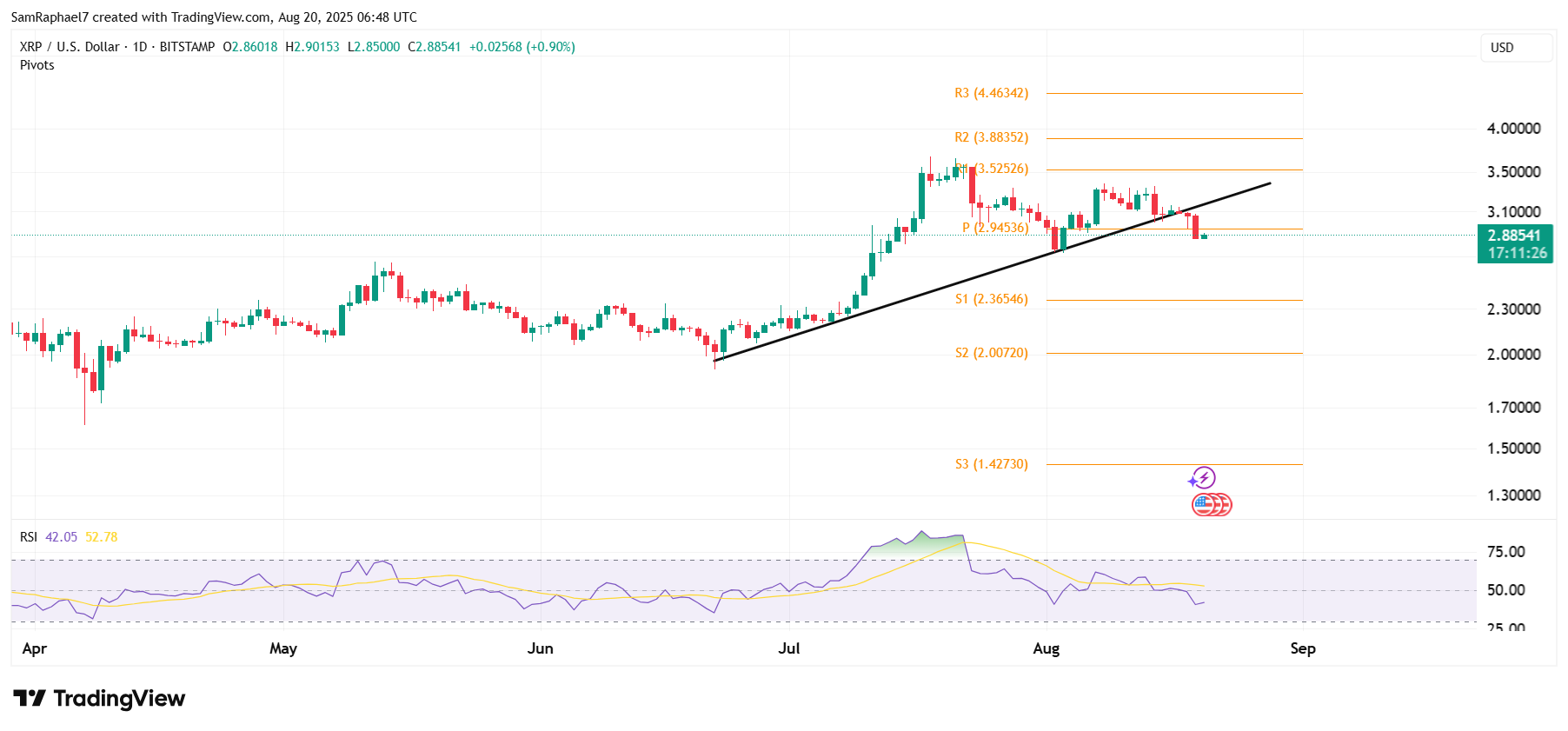
Also, a closer look at the daily XRP chart shows that XRP boasts its first major support around $2.36 (S1). Meanwhile, XRP may have a chance at overturning this bearish situation if it pushes above the ascending trendline. To do this, it must first reclaim and hold above the Pivot point at $2.94 and then aim for the $3.52 resistance.

XRP 1D Chart
XRP 1D Chart

EGRAG has also suggested that if XRP can close above $3.3 this month, its momentum could flip bullish. However, even if the asset collapses 20% toward $2.4, a recovery is not out of the question, as this could merely be a healthy correction. Currently trading for $2.88, XRP’s RSI remains 42, signaling there is more room for growth.

Atkins Says SEC to Begin Implementing President’s Crypto Recommendations Immediately

0

SEC Chair Paul Atkins announced that the agency will move quickly to implement the President’s Working Group recommendations on crypto regulation.

It aims to foster innovation and provide greater clarity in digital asset markets. Specifically, the initiative seeks to shift away from enforcement-led oversight toward a rules-based approach that balances investor protection with technological advancement.

Notably, Atkins made the disclosure during the Wyoming Blockchain Symposium. Central to this vision is the President’s Digital Assets Group, which will lead the next phase of digital asset regulation in the United States.

The group previously released a roadmap urging regulators to adopt a more collaborative and innovation-friendly approach. Atkins has reiterated the zeal to follow the recommendations as soon as possible.

Breaking from Past SEC Policies

This marks a significant departure from the policies of former Chair Gary Gensler, who set a stricter regulatory tone. Gensler frequently argued that most cryptocurrencies should be subject to existing securities laws. Critics claimed that under Gensler’s tenure, the SEC’s “regulation by enforcement” approach prompted many developers to move their projects overseas.

Atkins takes a different stance, arguing that only a small fraction of tokens should be classified as securities. According to him, what defines a security is not the token itself, but how it is marketed, packaged, and sold to investors.

Balancing Protection with Innovation

In his speech, Atkins emphasized the need to strike a balance between investor safety and technological progress. He said the SEC will design rules that are firm enough to curb fraud. However, these rules will also be flexible enough to adapt to evolving technology.

As part of this shift, the Commission plans to introduce safe harbor periods that will allow startups time to build before facing heavy compliance requirements. It will also create tailored exemptions for digital assets, providing a more flexible approach. This marks a shift away from the ‘one-size-fits-all’ model of traditional securities regulation.

In addition, the SEC will develop new disclosure frameworks that provide transparency to investors while reducing unnecessary barriers for innovators.

Atkins argued that these measures could enable projects such as initial coin offerings (ICOs), airdrops, network rewards, and decentralized applications to grow responsibly under regulatory supervision.

The venture capital community and advocacy organizations have welcomed the announcement. Firms such as Andreessen Horowitz and groups like the DeFi Education Fund have long urged regulators to create exemptions and safe harbors.

According to these groups, clearer rules will give developers confidence to innovate in the US instead of relocating their operations to more flexible jurisdictions. They argue that an updated framework is essential to maintain America’s leadership in the digital economy.

Cooperation Across Government

Furthermore, Atkins emphasized that the SEC will not act in isolation. Instead, it will work closely with Congress, the White House, and other federal agencies to ensure that US rules remain consistent, transparent, and aligned with global standards.

He noted that digital assets are already a global industry, and inconsistent rules within the US could drive innovation abroad.

Enforcement Still Focused on Fraud

While Atkins promised a more open approach, he made it clear that the SEC will continue to crack down on fraud, scams, and abusive practices. The difference, he said, lies in ensuring legitimate projects are not caught in broad enforcement sweeps.

Atkins acknowledged that the SEC alone cannot guarantee long-term clarity. True certainty for businesses, he explained, will depend on Congress passing new legislation that addresses the unique nature of digital assets. Until then, the SEC’s new framework will serve as a bridge.