Home Blog Page 57

Cardano Emerges as Fifth Fastest-Growing Blockchain for Real-World Assets

0

Cardano has emerged as one of the fastest-growing blockchains for real-world assets (RWAs), reinforcing its expanding role in the rapidly evolving tokenization sector.

According to data shared by the RWA Foundation, citing Token Terminal, Cardano ranked as the fifth fastest-growing blockchain by RWA value over the past 30 days. During the period, the value of tokenized real-world assets on the network surged 23.1% to $55.3 million.

The ranking tracks month-over-month growth in RWA value across leading blockchain ecosystems, providing insight into where tokenized assets are expanding at the fastest pace.

Cardano Outpaces Several Larger RWA Ecosystems

Despite hosting a smaller RWA market than several competing networks, Cardano outperformed many established blockchains in terms of growth.

For instance, Avalanche recorded a 22.6% increase, even though it maintains one of the largest RWA ecosystems at $2.5 billion. Sonic followed with 22.1% growth, bringing its RWA value to $124.2 million.

Meanwhile, Fraxtal expanded 18.4% to $39 million, while BNB Chain, which hosts the largest RWA market among the ranked blockchains at $9.2 billion, posted a 16.5% monthly increase. TON completed the top 10 with 6.4% growth, lifting its RWA value to $670.4 million.

Notably, four blockchain networks recorded even stronger monthly RWA growth. Robinhood Chain dominated the rankings with an extraordinary 11,416.2% surge, increasing its RWA value to $323.7 million. Tempo claimed second place with 74.3% growth, followed by Monad at 36.7% and Plume Network at 35.7%. 

Cardano Ranks Among Fastest-Growing Blockchains in July

Charles Hoskinson Says RWA Could Spur Crypto Growth 

The real-world asset sector continues to gain momentum as analysts project it could evolve into a multi-trillion-dollar industry over the coming years.

Specifically, Cardano founder Charles Hoskinson has projected that the RWA market could reach $10 trillion by 2030, fueled by the tokenization of traditional financial assets. He expects tokenized real-world assets to account for a substantial share of the crypto industry’s growth before the end of the decade.

Cardano Expands Its Presence in RWA Tokenization

As the RWA market grows, Cardano continues to position itself as a key infrastructure provider for asset tokenization.

Recently, the network participated in an initiative involving the London Stock Exchange, which introduced the MCM Fund I from Members Capital Management (MembersCap). While the investment was recorded on the London Stock Exchange’s private blockchain, Archax tokenized the fund on the Cardano blockchain.

Cardano has also continued to strengthen its RWA ecosystem through strategic partnerships. Earlier this year, Kinka partnered with EMURGO to issue gold-backed tokens on Cardano. In addition, EMURGO collaborated with compliant tokenization platforms, including Haus, OpenEden, and DigiFT, to bring tokenized assets such as private credit, U.S. government bonds, and insurance factoring onto the network.

Shiba Inu: Shibarium Activity Jump 78%, but SHIB Price Remains Under Pressure

0

Activity on Shibarium, Shiba Inu’s official Layer-2 blockchain, surged sharply over the past day, but SHIB’s price has yet to respond.

According to the latest data from Shibariumscan, Shibarium processed 1,180 daily transactions yesterday. This marks a notable recovery from 661 transactions recorded on July 21, the second-lowest daily transaction count for July.

As a result, daily transactions climbed 78.51% within just a few days, signaling renewed activity on the network after a period of sluggish usage.

Although the latest transaction count remains far below the millions of daily transactions Shibarium recorded during its peak periods, many market observers view the rebound as an encouraging sign.

The increase comes at a time when investors continue to search for a bullish catalyst capable of reversing SHIB’s prolonged price weakness. Even a modest improvement in network activity has sparked optimism that user engagement on Shibarium could gradually recover if the trend continues. 

Shibarium Transaction Activity

SHIB Price Fails to Respond to Network Improvement

Despite the jump in Shibarium transactions, Shiba Inu has not benefited from the renewed activity on the blockchain.

The broader cryptocurrency market experienced another sharp sell-off yesterday, dragging down several major assets, including SHIB. The token fell from an intraday high of $0.000004243 to a low of $0.000004102 before recovering slightly.

At press time, SHIB is trading at $0.000004189. Even with the rebound, the token remains down 1.28% over the past 24 hours, 8.21% over the past week, and 0.34% month-to-date.

Ecosystem Challenges Continue to Weigh on Sentiment

Meanwhile, the Shiba Inu ecosystem continues to face several challenges that have dampened investor confidence.

The ongoing bearish market has produced few positive developments for the project. Community members have also expressed concerns over the disappearance of several key team members from X, multiple ecosystem initiatives that remain unfinished, and persistently low SHIB burn activity.

Against this backdrop, Shibarium’s recent transaction rebound has fueled speculation that long-awaited positive catalysts could finally be emerging. However, the increase in network activity alone has not been enough to translate into higher SHIB prices.

Over 113B Shiba Inu Tokens Leave Exchange

Despite the weak price performance, investors continue to move SHIB off centralized exchanges.

Notably, more than 113 billion SHIB tokens have recently been withdrawn from exchanges, reducing the total exchange reserve to approximately 86.13 trillion SHIB.

Large exchange outflows are often interpreted as a sign that investors are transferring tokens into private wallets for longer-term holding rather than preparing to sell. While this trend has yet to trigger a price recovery, it suggests that some market participants remain confident in SHIB’s longer-term prospects even as the token continues to trade under bearish pressure.

658,600 ETH Worth $1.24B Leaves Exchanges as Ethereum Supply Tightens and Bullish Sentiment Builds

Ethereum (ETH) reserves are moving in different directions across major cryptocurrency exchanges. 

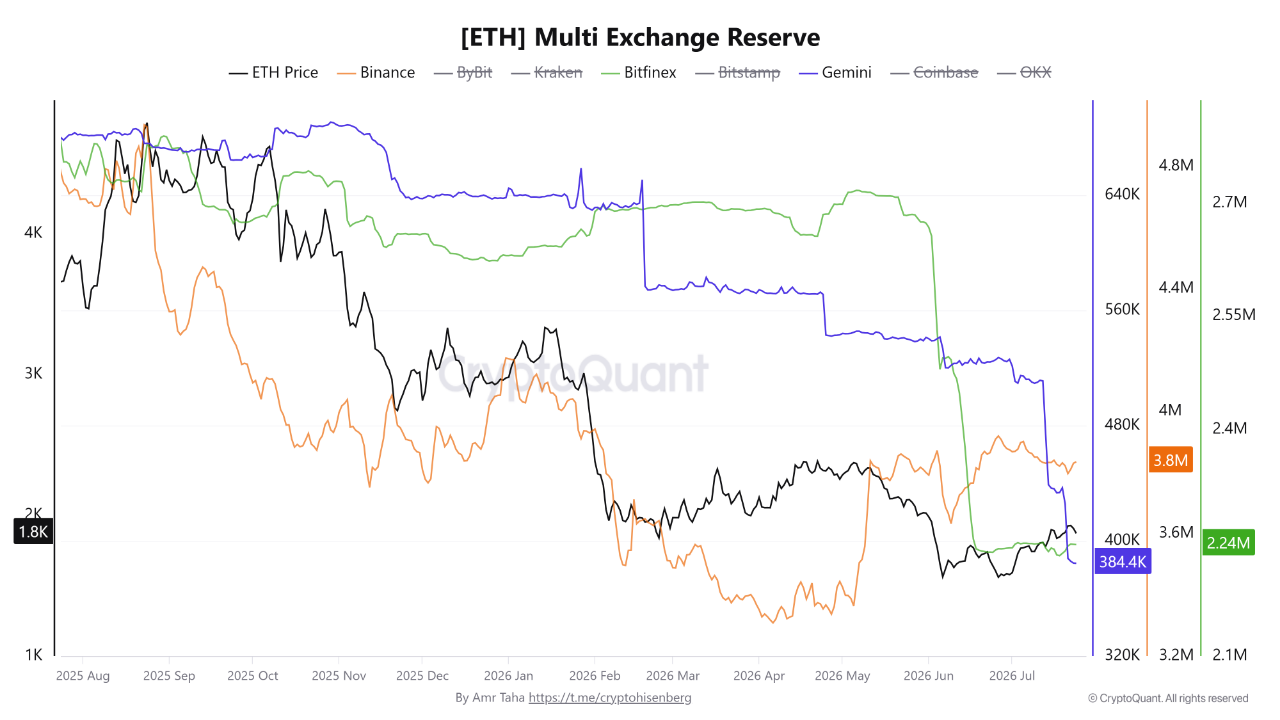
Gemini and Bitfinex have recorded significant outflows, while Binance’s holdings have remained mostly stable, according to CryptoQuant analyst Amr Taha.

658,600 Fewer ETH on Exchanges

Data shared by Taha shows Gemini’s Ethereum reserve fell to 384,400 ETH on July 24. This marks its lowest level since March 2024.

Notably, the exchange has lost about 188,600 ETH, or 32.9%, since holding 573,000 ETH on April 23.

Meanwhile, Bitfinex has also seen a major decline. Its Ethereum reserve dropped from 2.71 million ETH on May 11 to 2.24 million ETH. That represents a reduction of roughly 470,000 ETH, or 17.3%.

Meanwhile, Binance’s Ethereum reserves have remained largely unchanged at around 3.8 million ETH during the same period.

Together, Gemini and Bitfinex now hold about 658,600 fewer ETH than before. At Ethereum’s current price of around $1,880, the reduction is worth approximately $1.24 billion.

Taha said that falling exchange balances reduce the amount of ETH immediately available for trading. However, reserve movements alone do not show investor intent or predict Ethereum’s future price direction.

Binance Ethereum Funding Rates Reach Six-Month High as Market Sentiment Improves

In a separate market update, Arab Chain highlighted improving sentiment in Ethereum’s derivatives market.

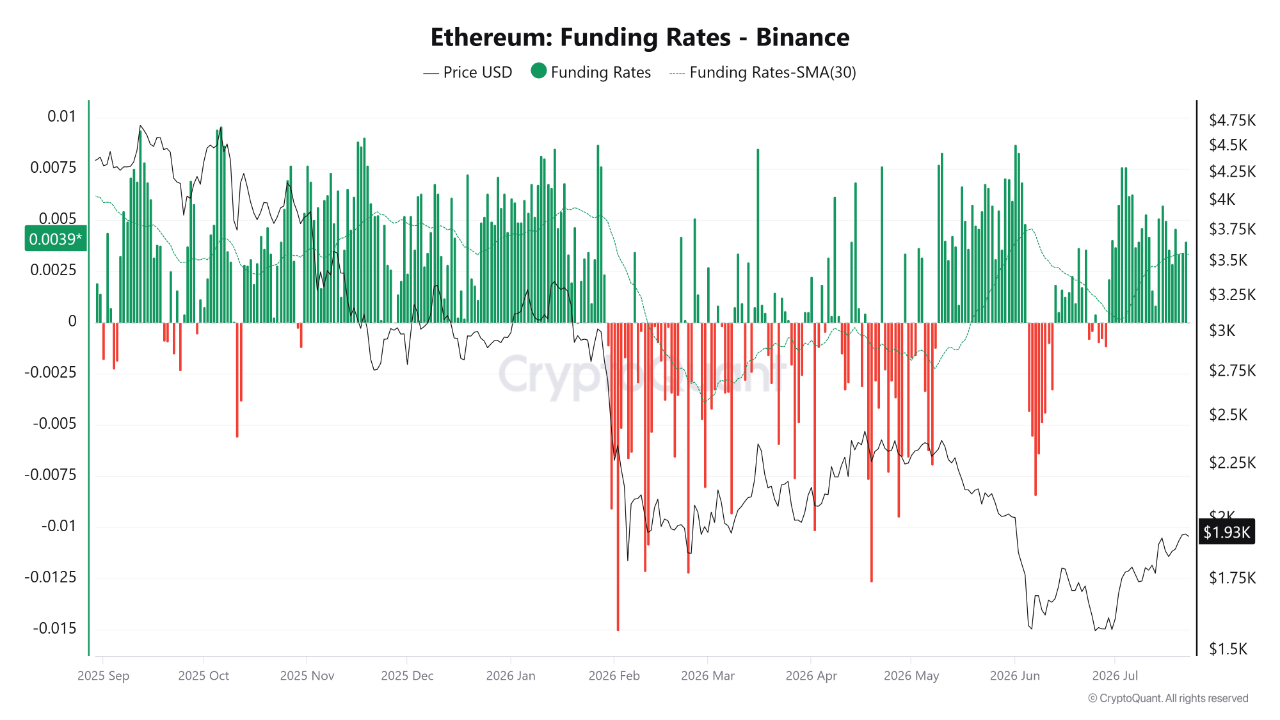
The 30-day simple moving average (SMA) of funding rates for Ethereum perpetual contracts on Binance has risen to approximately 0.00339. This is the highest level in six months, with ETH trading near $1,920.

Funding rates represent the cost traders pay to maintain leveraged positions. A rising positive funding rate usually signals stronger demand for long positions and growing bullish sentiment.

According to Arab Chain, the indicator has reversed after declining for several months. The shift comes as Ethereum has recently recovered in price.

ETH is trading at $1,885, down 2.3% over the past day but remains up 2.56% over the past week. Moreover, the monthly chart shows ETH is up 13%.

Essentially, the move in the derivative markets suggests traders are willing to pay to hold long positions, reflecting expectations that ETH could continue moving higher.

However, Arab Chain noted that funding rates are still below the elevated levels that have historically appeared before major market corrections.

He added that continued increases could signal rising leverage in the market. This may increase the risk of widespread liquidations if Ethereum faces a sharp price decline.

XRP Has Welcomed $800M Worth of Distributed RWA in 2026

0

The XRP ecosystem has welcomed over $800 million worth of distributed real-world assets this year amid the growing tokenization trend on the network.

The tokenization market has continued to grow in 2026, with its total value now exceeding $410 billion. Current data puts the market at $410.70 billion, made up of $36.72 billion in distributed asset value and $373.98 billion in represented asset value.

Growth has been especially strong in the distributed asset segment. At the beginning of the year, distributed asset value, excluding stablecoins, stood at $25.39 billion. It has since risen to $36.72 billion, as interest in tokenization has gained momentum throughout the year.

XRPL Adds Over $800 Million in Distributed RWA

The XRP Ledger has also benefited from the growing interest in tokenized assets. As more attention has moved toward the sector, the network has expanded the value of assets issued directly on the ledger.

Data shows that the XRP Ledger now holds $1.319 billion in distributed asset value when stablecoins are included. Without stablecoins, the figure stands at just $323.18 million.

The network began 2026 with $518 million in distributed real-world assets. Since then, that figure has climbed to $1.319 billion, meaning the XRP Ledger has added exactly $801 million in distributed RWAs this year. The increase shows the network’s growing role in the broader tokenization market.

Distributed RWA on XRP Ledger

RLUSD Leads the Growth

Ripple’s stablecoin, RLUSD, has driven most of the increase in distributed assets on the XRP Ledger. At the start of the year, RLUSD had a market capitalization of $235 million. It has since grown to $896 million, adding $661 million in value during 2026.

Ripple has supported this growth by increasing RLUSD minting on the XRP Ledger while burning more of the stablecoin on Ethereum. As a result, RLUSD now makes up 67.96% of the XRP Ledger’s total distributed asset value.

The stablecoin ecosystem on the network has also continued to expand. Combined stablecoin market capitalization on the XRP Ledger has reached $995 million, bringing it close to the $1 billion mark. 

Alongside RLUSD, Braza USDB contributes $69.44 million, BBRL accounts for $12 million, and USDC adds $5.8 million, with several other stablecoins making up the remainder. These assets have played an important role in increasing the ledger’s distributed asset value.

Total RWA on XRP Reaches $5.35 Billion

The XRP Ledger’s tokenized asset ecosystem extends beyond distributed assets. When represented asset value is included, the network now supports $5.35 billion in real-world assets, including stablecoins.

Several tokenized products account for much of that value. The largest is JMWH from Justoken, which is worth $2.229 billion. RLUSD follows with $876 million, while the Ondo Short-Term US Government Bond Fund contributes $222 million. The ASENA FIF – Single Tranche product also represents a significant share with $215.7 million.

These figures confirm how quickly the XRP Ledger’s tokenized asset ecosystem has expanded this year. RLUSD has led the growth in distributed assets, while several large tokenized financial products have strengthened the network’s represented asset value.

Bitcoin Recovery Strengthens as 57.5% of Supply Returns to Profit: Is the Bear Market Finally Over?

Bitcoin has recovered sharply over the past three weeks, and the share of coins back in profit has risen significantly.

Meanwhile, new CryptoQuant analysis suggests the market still has not reached the conditions that historically marked the end of bear markets.

Bitcoin Supply in Profit Rises to 57.5%

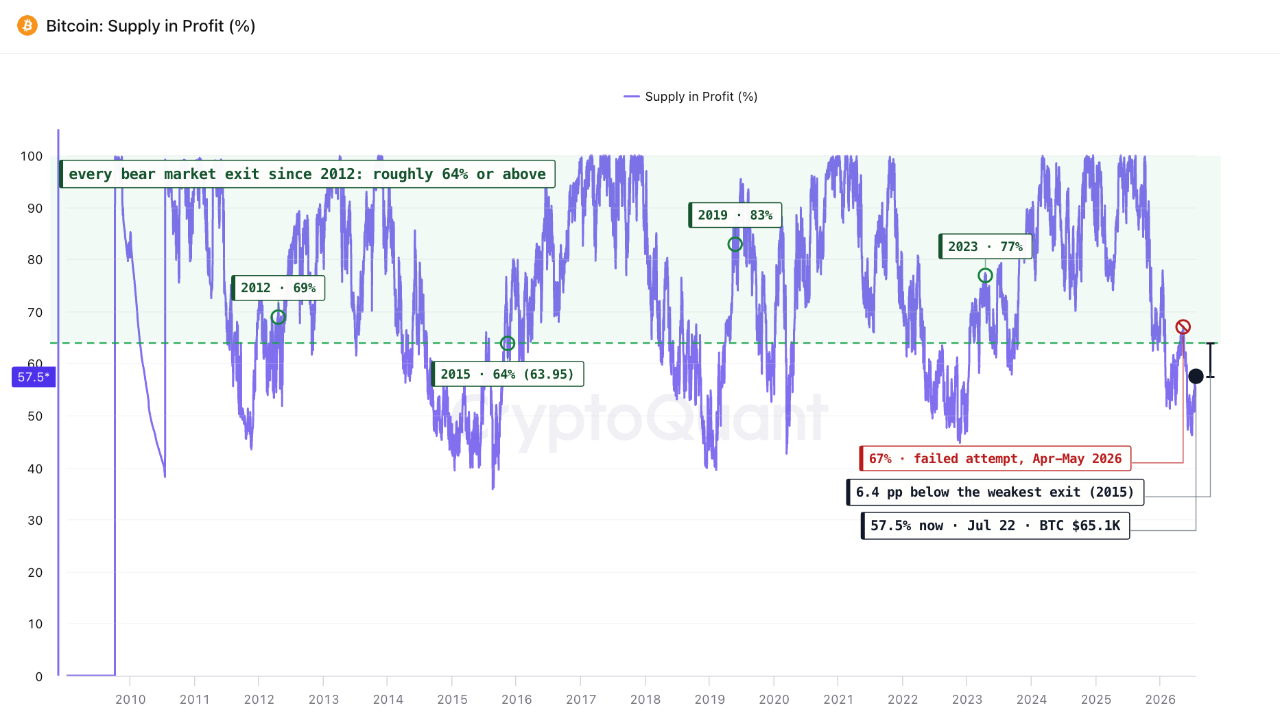
According to CryptoQuant author thechessONCHAIN, Bitcoin’s Supply in Profit—the percentage of BTC worth more than its acquisition price—rose to 57.5% as of July 22. That is up from 46.2% on June 30, the cycle low.

The increase means more than one in every 10 BTCs moved from a loss to a profit in about three weeks. Over the same period, Bitcoin’s price gained roughly 7% and traded near $65,100.

Meanwhile, the Short-Term Holder Spent Output Profit Ratio (SOPR) stood at 0.9997. This suggests recent buyers are mostly selling at break-even instead of taking meaningful profits or losses.

Historical Bear Market Exits Required Higher Profit Levels

Despite the improvement, the analyst said Bitcoin has not yet reached the levels that historically confirmed the end of bear markets.

Using the 30-day average Long-Term Holder SOPR reclaiming 1.0 as the regime-change signal, previous bear markets ended only after a much larger share of Bitcoin’s supply returned to profit:

  • April 2012: 69% of supply in profit
  • November 2015: 64%
  • May 2019: 83%
  • April 2023: 77%

In each case, at least 64% of Bitcoin’s supply was back in profit. The current reading is 57.5%.

The analyst also pointed to a failed recovery earlier in the current cycle. Between April 28 and June 1, the Long-Term Holder SOPR stayed above 1.0 for 35 consecutive days. During that period, Supply in Profit climbed to 67%. Both metrics later reversed lower.

The 30-day average Long-Term Holder SOPR has now fallen to 0.86. It has remained below 1.0 for 51 consecutive days, suggesting long-term holders are still not consistently realizing profits.

Selling Pressure Shifts to Newer Holders

The report also examined the source of current selling pressure. Bitcoin held for more than six months accounted for 12% to 16% of exchange inflows in early July as prices rebounded.

This suggested long-term holders were taking advantage of the rally to sell. That share has since dropped sharply to 0.8%, down from 5.6% a month earlier. The decline suggests selling by older holders has largely faded.

Instead, the remaining overhead supply comes from investors who accumulated Bitcoin between one month and two years ago. According to the analysis, their average acquisition prices range from about $72,000 to $101,000. That leaves many of these holders still underwater at current prices.

The analyst concluded that Bitcoin’s Supply in Profit would likely need to climb into the mid-60% range and remain there for longer than the failed 35-day recovery earlier this year.

Until then, the current rally is more likely to be a recovery within an ongoing bear market than confirmation of a market-cycle bottom.

Cardano Founder Agrees With Elizabeth Warren, Says Trump Should Stay Out of Crypto

0

Cardano founder Charles Hoskinson has argued that President Donald Trump should not actively participate in the cryptocurrency market while serving in office.

Hoskison’s comments came after Senator Elizabeth Warren urged lawmakers to reject the latest version of the Clarity Act, claiming it does not adequately prevent President Trump from financially benefiting from his crypto-related activities.

Warren Raises Conflict-of-Interest Concerns

According to Warren, the bill lacks sufficient safeguards to stop the president from profiting from cryptocurrency ventures while in office. She also argued that the legislation does not do enough to combat illicit finance or protect investors and the broader financial system.

Additionally, Warren described the proposal as a missed opportunity to address potential conflicts of interest involving Trump’s crypto businesses, which she claimed generated approximately $1.4 billion in revenue last year. 

It is worth noting that the U.S. President is associated with several cryptocurrency ventures, including the Official Trump meme coin and the World Liberty Financial project, which have fueled broader discussions about potential conflicts of interest. 

Cardano Founder Reacts 

Reacting to Warren’s criticism, Hoskinson revealed that he had expressed similar concerns more than a year ago during several interviews. He argued that the political approach to cryptocurrency regulation had been misguided from the outset.

According to Hoskinson, those decisions ultimately strengthened the narrative that cryptocurrency regulation revolves around President Trump, making bipartisan cooperation increasingly difficult.

He stressed that meaningful progress cannot occur if cryptocurrency becomes a partisan political issue.

Hoskinson Calls Trump “the Ultimate Insider”

In a follow-up statement, Hoskinson argued that no sitting president should participate directly in financial markets because of the extraordinary influence and privileged access associated with the office.

He stated that the president occupies a unique position of power and information, making Trump “the ultimate insider.” Although Hoskinson acknowledged that he rarely agrees with Senator Warren, he said her concerns about presidential involvement in financial markets were justified.

He added that stronger safeguards are necessary to prevent potential conflicts of interest and preserve public confidence in cryptocurrency policymaking.

Updated Clarity Act Introduces Ethics Restrictions

Meanwhile, the Clarity Act continues to attract significant attention in Washington.

Earlier this week, Republican lawmakers introduced an updated draft of the legislation that includes a new ethics provision. The proposal would prohibit the President, Vice President, members of Congress, and their spouses from issuing or sponsoring digital assets while serving in office.

Congressional leadership is reportedly aiming to bring the bill to a Senate floor vote before the upcoming August recess. However, a packed legislative schedule and continued Democratic criticism over the strength of the ethics provisions could delay its passage. 

XRP CEX Spot Demand Hits 8-Week Peak of $388M

0

While XRP has corrected from the recent $1.16 high, new market data shows that demand in the spot market has continued to improve.

Specifically, buying activity across centralized exchanges has climbed to its highest level in eight weeks, suggesting that many investors are still accumulating XRP despite the latest price decline.

Notably, the latest data also show a growing gap between the spot and derivatives markets. Spot buyers have become more active, while traders in the perpetual futures market continue to favor selling. 

Spot Buying Reaches Its Highest Level Since June

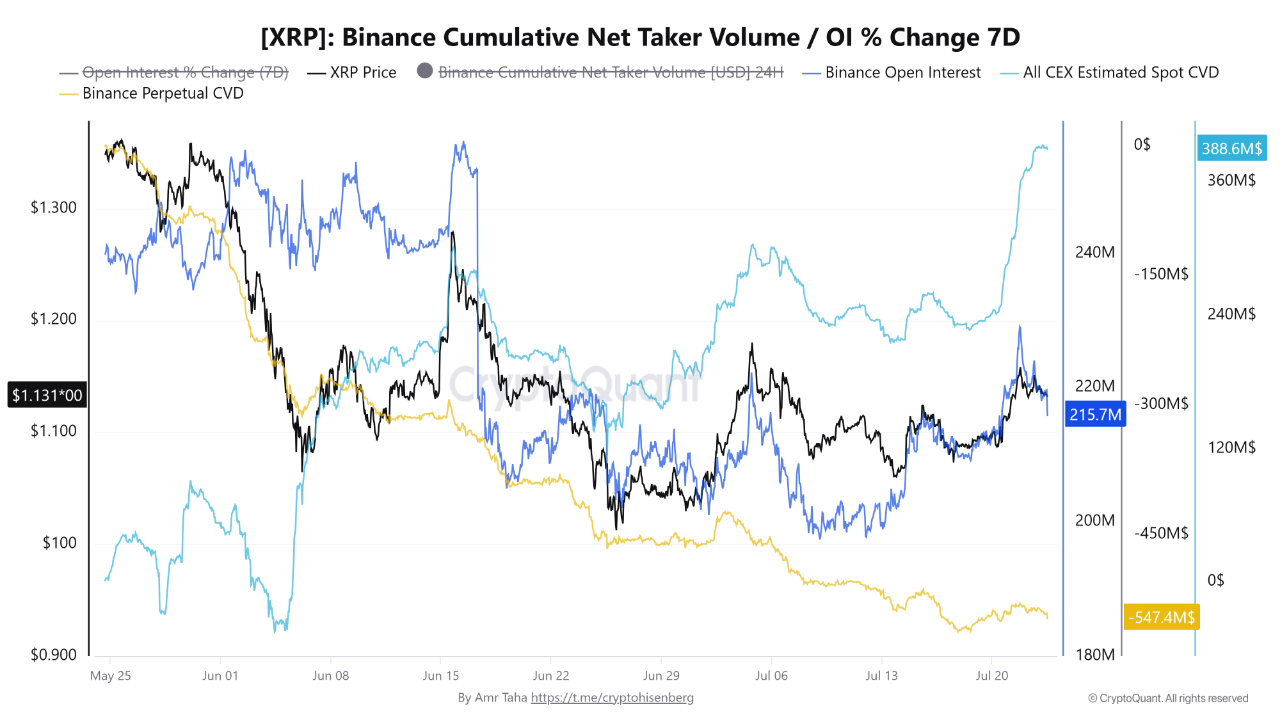
Data from July 23 shows that the All CEX Estimated Spot CVD climbed to about $388.6 million, its highest level since June 1. The increase shows a rise in aggressive buying across centralized spot exchanges, showing that buyers have returned to the market in greater numbers.

Meanwhile, the trend looks very different in the derivatives market. Notably, Binance Perpetual CVD remained deeply negative at around -$547.4 million, showing that perpetual futures traders continue to favor the sell side.

XRP CEX Spot CVD and Binance Perpetual CVD CryptoQuant
XRP CEX Spot CVD and Binance Perpetual CVD | CryptoQuant

Also, on Binance, XRP open interest increased from roughly $198 million on July 8 to about $215.7 million on July 23, marking a rise of nearly 9%.

Higher open interest alongside a deeply negative perpetual CVD suggests that traders are opening new leveraged short positions instead of simply closing existing long positions. 

However, open interest alone cannot show the direction of every new position, so it does not tell the full story by itself.

Spot trading also picked up across several major exchanges rather than on just one platform. On July 21, Coinbase recorded around $157 million in XRP spot trading volume, compared with roughly $111 million on Binance. 

This increase suggests that stronger spot demand is spread across multiple exchanges instead of being driven by a single market.

XRP Must Hold Above $1.10

In the short term, XRP continues to trade within a tight range after holding the support around $1.10. Buyers have not yet managed to push the price back above the immediate resistance at $1.11, leaving the token stuck in consolidation.

The current situation suggests that a move below $1.10 could send XRP toward $1.08. On the other hand, a break above $1.11 could open the door for a move to $1.13.

Technical indicators also send mixed signals. The RSI stands at 50, a neutral reading that does not give either buyers or sellers a clear advantage. 

XRP Holding Support
XRP Holding Support

However, the MACD still shows a modest buy signal with a reading of 0.001, keeping the bullish case alive. Looking at the broader trend, XRP has gained more than 7% in July and still trades above long-term ascending triangle support. 

If buyers regain control, XRP first needs to break above $1.1642. A successful move beyond that level could open the way to $1.2318 and then $1.2950, with longer-term resistance sitting near $1.4344. For now, holding above $1.10 remains important if bulls want to keep the current recovery attempt alive.

XRP Spot Buying Reaches June High While Binance Perpetual CVD Drops to -$547M

XRP is showing a widening gap between its spot and derivatives markets. 

Spot buying has reached its strongest level since early June, while leveraged traders on Binance continue increasing bearish bets. The trend was highlighted by CryptoQuant analyst Amr Taha.

XRP Spot Demand Hits Highest Level Since June

Data shared by Taha shows the All CEX Estimated Spot Cumulative Volume Delta (CVD) climbed to about $388.6 million on July 23. That is its highest level since June 1.

The metric tracks net aggressive buying and selling across centralized spot exchanges. The latest increase points to stronger buying pressure from spot traders.

The data suggests investors are becoming more active in buying XRP directly despite mixed sentiment in the derivatives market.

Binance Futures Traders Keep Adding Bearish Positions

While spot buying strengthened, Binance’s perpetual futures market told a different story. Binance Perpetual CVD fell to roughly -$547.4 million on July 23. This shows aggressive sell orders continued to dominate futures trading.

For comparison, the most negative reading in May was only around -$5 million. The sharp decline highlights a major increase in bearish positioning among leveraged traders.

The negative CVD suggests futures traders are increasingly betting against XRP even as spot investors continue accumulating the asset.

Open Interest Rises as Short Exposure Grows

The divergence becomes even more notable when combined with rising open interest. Binance XRP open interest increased from about $198 million on July 8 to $215.7 million on July 23. That represents a gain of nearly 9%.

According to Taha, rising open interest alongside deeply negative perpetual CVD suggests new leveraged short positions are entering the market. It is not simply a case of existing long positions being closed.

However, he noted that open interest alone cannot confirm the direction of every new position.

Coinbase Leads Spot Trading Volume

Spot trading activity also increased across major exchanges instead of being concentrated on a single platform.

On July 21, Coinbase recorded about $157 million in XRP spot trading volume. Binance recorded roughly $111 million over the same period. The figures suggest spot demand is broad-based, with buyers active across multiple exchanges.

XRP Spot and Futures Markets Send Mixed Signals

Overall, the data points to a market with sharply divided sentiment. Spot investors are showing renewed confidence by increasing purchases, while leveraged futures traders continue building bearish exposure.

Such divergences are often closely watched because a strong move in either direction can force one side of the market to unwind its positions. At press time, XRP is trading at $1.11, down 2.2% over the past day but up 2.44% over the past week.

CLARITY Act Could Have Bigger Impact on XRP Than Many Expect, Developer Says

Software developer Vincent Van Code believes the proposed CLARITY Act could have a bigger impact on XRP adoption than many people expect. 

He argues that, although XRP’s legal status is clearer today, important regulatory uncertainty still remains.

In a post on X, Van Code said the 2023 district court ruling in the SEC’s case against Ripple significantly reduced legal uncertainty. Notably, the court found that XRP sales on secondary markets are not securities.

He said the ruling has already encouraged more institutional activity. It has supported the expansion of Ripple’s On-Demand Liquidity (ODL) corridors, bank pilot programs, XRP exchange-traded fund (ETF) filings, and broader custody support.

Court Ruling Reduced Risk, but Uncertainty Remains

Van Code argued that the Ripple decision is still only a federal district court ruling, not a federal law. Because of that, he said, future legal and regulatory challenges remain possible.

He noted that the SEC could take different positions in future enforcement actions. Future court decisions or changes in administration could also narrow or revisit the ruling.

According to Van Code, this uncertainty continues to concern large financial institutions. Many of them require clear statutory guidance before committing significant capital or integrating digital assets into core financial products.

CLARITY Act Could Encourage More Institutions

Van Code said the CLARITY Act is designed to address this issue by putting digital asset classifications into federal law.

He added that banks and traditional financial institutions generally follow conservative compliance standards. As a result, many remain hesitant to hold large XRP positions or build major products based only on a court ruling.

Instead, some institutions have limited their XRP involvement to lower-risk activities. These include non-custodial services, pilot programs, and experimental use cases.

If passed, the CLARITY Act could remove much of the remaining regulatory uncertainty that risk-averse institutions continue to cite. Van Code believes this could support broader institutional adoption of XRP.

However, he emphasized that this is his personal analysis. He did not suggest that the legislation would necessarily have a direct impact on XRP’s market price.

CLARITY Act Advances in Senate

A new draft of the Digital Asset Market Clarity Act is circulating in the Senate as lawmakers make a final push to pass crypto market structure legislation before the August recess.

The latest draft includes a controversial ethics provision. It would bar the president and other senior government officials from holding direct crypto investments until 2029. The Department of Justice would be responsible for enforcing the rule.

Republicans say the provision reflects an agreement with President Donald Trump. However, many Democrats argue the restriction does not go far enough. Several have not yet committed to supporting the bill.

Beyond the ethics measure, the legislation would expand consumer protections and clarify how digital assets are regulated. It would also establish rules for crypto exchanges, support tokenized securities, and preserve protections for decentralized finance (DeFi) developers. Developers who do not control customer funds would remain exempt from money transmitter rules.

Republican leaders are expected to bring the bill to the Senate floor soon. However, it will likely need at least 10 Democratic votes to clear the Senate’s 60-vote threshold.

With Congress set to begin its summer recess in August, the coming weeks are the bill’s best opportunity to advance.

XRP and Bitcoin Excluded as S&P Launches Institutional Crypto Index Focused on Revenue-Generating Protocols

XRP and Bitcoin are left out as S&P Dow Jones Indices and Pantera Capital have launched the S&P Pantera Digital Asset Index, a new benchmark for institutional investors.

The index focuses on blockchain protocols that generate revenue through network activity. The benchmark tracks 18 digital assets, with Ethereum, BNB, Solana, Tron, and Hyperliquid among its largest holdings.

According to S&P Dow Jones Indices CEO Catherine Clay, the index uses principles similar to traditional equity benchmarks. It evaluates factors such as protocol revenue, liquidity, listing requirements, and operational maturity.

XRP and Bitcoin Excluded From Revenue-Based Index

During an interview with CNBC, Clay said Bitcoin was excluded because it does not operate as a revenue-generating protocol, even though it meets other eligibility requirements.

While she did not specifically discuss XRP, the index methodology also leaves it out because it does not meet the revenue-generation requirement.

Rather than tracking the largest cryptocurrencies by market capitalization, the index focuses on blockchain networks that generate revenue from actual protocol usage. It does not include returns generated through staking yields or other investment mechanisms.

New Benchmark Aims at Institutional Investors

S&P said the index seeks to give institutional investors and asset managers a trusted benchmark for the digital asset market. The methodology draws inspiration from traditional equity indexes, including benchmarks such as the S&P 500.

Notably, the market-cap-weighted index will be rebalanced every quarter. To reduce concentration risk, the largest asset is limited to a 35% weighting. Other assets cannot exceed a 20% allocation.

Clay said S&P developed the methodology with Pantera Capital. The index measures how blockchain protocols generate revenue from real network activity rather than from staking rewards or investment returns.

Index Focuses on Revenue, Not Crypto Market Size

The exclusion of XRP and Bitcoin reflects the index’s specific goal rather than a view on their market position or adoption.

Both assets remain among the largest cryptocurrencies by market capitalization. However, they fall outside the benchmark’s focus on protocol-generated revenue.

The launch provides another institutional reference point for digital assets. It gives investors an alternative to broad market-cap-based crypto indexes by highlighting blockchain networks with measurable operating revenue.