Home Blog Page 571

South Korea Suspends Crypto Lending Till Clear Guidelines

0

South Korea’s financial watchdog has ordered local crypto exchanges to halt lending services, citing investor risks and regulatory uncertainty.

South Korea’s Financial Services Commission (FSC) has stepped in to suspend crypto lending services across domestic exchanges. The order, issued Monday, requires platforms to pause lending activities starting Tuesday until new regulations are introduced.

The regulator explained that crypto-backed lending products are operating without clear legal backing. Officials also highlighted significant investor risks, including forced liquidations and sudden market disruptions.

Rapid Growth of Lending Products Raised Alarms

The suspension follows a surge of activity in the market. Earlier in July, Upbit introduced a product allowing users to borrow up to 80% of their assets, using popular cryptocurrencies such as Bitcoin, XRP, and Tether (USDT) as collateral.

Bithumb offered an even more aggressive model, letting clients borrow crypto worth four times their deposits. Several smaller exchanges quickly rolled out similar services, creating what regulators describe as an “unchecked lending boom.”

In just one month, 27,600 investors borrowed a combined 1.5 trillion won ($1.1 billion) through these services, according to the FSC’s official release. The regulator also noted that 13% of borrowers were forced into liquidation as a result of collateral values being eroded by price volatility.

Market Turbulence After USDT Lending

The FSC also flagged unusual price activity linked to USDT-based lending. Shortly after exchanges introduced these products, a sudden flood of sell orders caused Tether’s price to fall abnormally on local platforms.

Stablecoins are typically designed to stay pegged to $1. The drop, therefore, raised concerns about market manipulation and investor confidence. Officials warned that unregulated lending could destabilize markets further if left unchecked.

Previous Warnings Ignored

This latest move comes after repeated caution from the FSC. On July 31, regulators asked exchanges to reevaluate their lending businesses, stressing that such products exist in a legal “gray zone.”

Both Upbit and Bithumb briefly suspended services in response, but Bithumb soon resumed lending under stricter conditions. The FSC’s new directive, however, makes the suspension binding for all exchanges. Non-compliance will trigger on-site inspections and possible sanctions.

New Guidelines in the Works

Despite the suspension, regulators signaled they are not seeking to ban lending permanently. Instead, the FSC plans to introduce a clear regulatory framework for crypto lending.

The guidelines will focus on investor protection and transparency while integrating leveraged lending into the country’s broader digital asset ecosystem. Until then, exchanges are allowed to manage existing contracts, including loan repayments and maturity extensions.

Broader Shift in South Korea’s Crypto Policy

The suspension reflects a wider balancing act in South Korea’s approach to digital assets. While regulators are tightening control over high-risk activities, they are also creating new opportunities.

The government is currently drafting the Digital Asset Basic Act, which may formally authorize lending once safeguards are in place. At the same time, financial authorities are preparing to lift restrictions on institutional crypto trading and to approve the country’s first spot exchange-traded funds (ETFs).

President Lee Jae Myung’s administration has also signaled support for a won-pegged stablecoin market, part of efforts to build a regulated but innovative digital finance ecosystem.

The FSC’s latest intervention highlights South Korea’s cautious yet progressive path toward crypto regulation. The suspension may frustrate exchanges eager to expand services, but it highlights the government’s intent to prevent uncontrolled risks before allowing broader adoption.

Whale Makes $184,000,000 Profit Swing Trading Ethereum: Here’s How

0

Longling Capital sold Ethereum on Monday for millions of dollars, bringing its gains from swing trading the altcoin king to over $180 million.

Buy low and sell high—this has been the strategy that Longling Capital has employed for two years now on Ethereum. Yesterday, they continued to take profit after buying Ethereum’s bottom in March.

Ethereum Swing Trade Masterclass

Lookonchain shared data from Arkham, which shows that Longling Capital sold another 5,000 ETH ($21.56 million) on August 18 at 15:39 (UTC). Notably, this was the second Ethereum sale in four days as the firm ramped up its profit-taking ploy.

Interestingly, the investment institute has taken this path in the past two years. Lookonchain highlighted that they have a knack for buying the bottom and selling the top, realizing $184 million in profit from this trend.

For context, they have withdrawn 123,405 ETH ($290 million) from Binance at an average cost of $2,349 over the past two years. During the same period, they have deposited 70,800 ETH ($248 million) back to the exchange at an average price of $3,502, culminating in the $184 million profit.

An accompanying chart further identified the transactions, which have usually been sniper entries and exits. A recent example was how Longling Capital accumulated 54,005 ETH between December 2024 and March’s lows of around $1,840 and started selling following its rebound in May until yesterday.

Whale Buys Low and Sells High/Lookonchain

Whale Sells 18,783 ETH After Nearly 1 Year of Dormancy

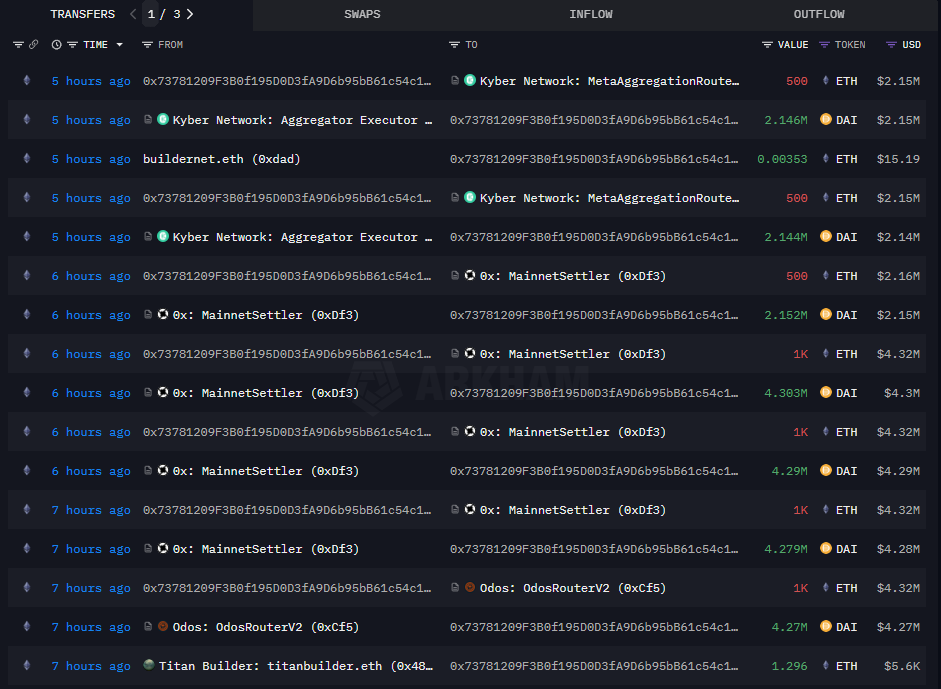
Other Ethereum holders are also selling as its price appears to be heading south. Among others, whale wallet “0x7378” resurrected after 355 days of inactivity and started selling its 18,782 ETH ($80.32 million) holding.

At the time of writing, it has sold 8,575 ETH ($37 million) and still holds 10,209 ETH ($43.32 million). Notably, the whale acquired the whole stash for $47.4 million a year ago and has made a profit of $32.9 million.

Screenshot 2025 08 19 081453
Whale Address “0x7378” Sells Ethereum

A similar event happened last week, with a whale activating after 10 years to shift its Ethereum holdings. The address moved at a gain of $1.5 million, as it received Ether in 2015 at a value of $103.

Meanwhile, Ethereum has corrected another 2% today, trading at $4,228 at the time of writing. Ether has now retraced 11.8% from its high of $4,793 in the previous week.

Ripple Moves 200,000,000 XRP to Unknown Address: Here’s Where the Funds Could be Heading

0

XRP worth millions of dollars has exchanged hands between Ripple and an unmarked address amid a sideways price trend.

While the market dumped, Ripple moved XRP. Whether it is selling or just shuffling, the hefty transaction has made the rounds within crypto circles.

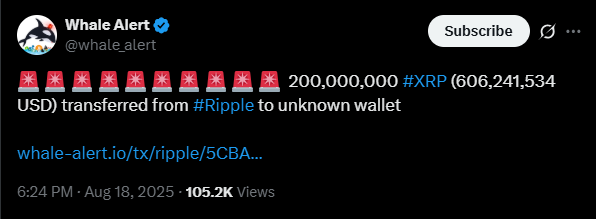
Whale Alert pointed to this transaction in a tweet on Monday, which involved the cross-border payment giant and an unidentified wallet. Specifically, a wallet tied to the firm moved 200 million XRP to a new destination.

Screenshot 2025 08 19 071018
Ripple Moves 200M XRP/Whale Alert

Transaction Details

Further analysis shows that the sending Ripple address was the “rBg2Fu” wallet, marked as Ripple (1) on XRPScan. At exactly 17:23 (UTC) on August 18, it moved 200,000,000 XRP, worth $606.2 million, to the receiving address “rJqiMb.”

While Whale Alert suggested that the recipient was an unknown address, data from XRPScan marked the address as Ripple (50), confirming it was another Ripple-affiliated wallet.

This indicates that the Monday transaction was an internal XRP move by Ripple. Notably, the firm does this for several purposes, such as to provide liquidity for its settlement venture, fund institutional deals, or merely shuffle reserves.

Nonetheless, the Ripple (50) address has a history of shifting received funds to another unmarked address, “raRVLN.” This wallet has usually transferred them to Binance for possible sales. As a result, while it still holds on to the stash at the time of writing, the 200M XRP received could end up on exchanges.

Shift Follows XRP Price Uncertainties

Meanwhile, what was more speculative about the internal shift was that it came on the back of a poor start to the week by the broader crypto market. Notably, Bitcoin dumped to $114,700 on Monday as long-term holders shifted $3.7 billion in BTC.

The onslaught did not spare XRP, which briefly fell below the $3 support before rebounding to trade at $3.01 at the time of writing. Notably, XRP has now dumped 21.6% from a high of $3.66 reached on July 18.

Remarkably, analysts have emphasized that XRP needs to reclaim levels between $3.30 and $3.40 or face further downsides to $2.60 or even $2. Nonetheless, there is strong support at $2.81, where 1.7 billion XRP serves as a demand wall.

Here Are the Two Big Decisions Facing XRP and Ripple This October

0

A renowned legal expert in the XRP community has highlighted two major regulatory events relating to XRP and Ripple expected in October. 

In a tweet, attorney Bill Morgan suggested that October could be an eventful month for XRP and Ripple, with two critical developments possibly happening around the same time. 

The legal expert shared this view after the U.S. SEC delayed its decision on multiple spot XRP exchange-traded funds (ETFs). 

In particular, the SEC postponed its decision on CoinShares XRP ETF, the Grayscale XRP Trust, and the 21Shares Core XRP ETF yesterday. Following the delay, the SEC extended its decision timeline for these ETFs to late October 2025. 

Two Big Decisions Coming for XRP and Ripple in October 

In reaction, Morgan emphasized that a lot could happen for XRP and Ripple in October. He highlighted two major regulatory events relating to XRP and Ripple that could land in the same month if approved. 

XRP ETF 

First, the pro-XRP lawyer pointed to the SEC’s recent decision to delay ruling on multiple XRP ETFs, pushing the deadline to October. 

It is worth mentioning that October is the final deadline for the SEC’s decision on several crypto-related ETFs, including the CoinShares and 21Shares XRP ETFs. The U.S. securities regulator must decide whether to approve or disapprove the XRP ETF by late October. 

Ripple’s National Bank Charter 

According to Morgan, the OCC’s decision on Ripple’s national banking charter application is another major event scheduled for October. The lawyer pointed out that Ripple applied to the OCC on July 2, seeking a national bank charter. 

Referencing the OCC rule, Morgan noted that the federal agency must decide within 120 days of the application. This means that the OCC’s decision on Ripple’s national banking license application could come by late October. 

According to the referenced document, the OCC may also issue this decision sooner, so long as the filing qualifies for an expedited review. However, Morgan stated that the OCC could also extend its decision timeline beyond October. 

Amid these pending developments, Morgan is optimistic that October could be a significant month for XRP and Ripple. While the SEC’s final decision deadline for most spot XRP ETFs falls in October, the OCC could decide the fate of Ripple’s application for a national bank charter in the same month. 

XRP Reaction to Potential ETF 

Meanwhile, financial commentator Zach Rector has shared his views on how XRP’s price could react to the approval of the spot ETFs. Rector noted that anticipation for these products could drive buying pressure, potentially pushing XRP’s price higher.

He suggested that if the ETFs launch, XRP might experience a slight pullback as traders who acquired the token before the approval may likely sell. 

However, the analyst expects this retracement to be temporary. In his view, consistent inflows into these products could result in a major rally for XRP, potentially pushing the token’s price to double-digit and beyond. 

Rector expects ETF inflows to drive XRP’s price to at least $10, aligning with targets set by several community experts. 

VanEck Maintains $180,000 Year-End Target for Bitcoin

0

Investment giant VanEck expects Bitcoin to reach $180,000 by the end of 2025, citing strong institutional demand and resilient market fundamentals.

In its latest Mid-August 2025 ChainCheck report, the firm projected a year-end price target of $180,000. The report explained that the months ahead bring both opportunities and risks.

Seasonal investor activity and wider economic shifts could either extend Bitcoin’s momentum or trigger profit-taking. Despite this uncertainty, VanEck reaffirmed its belief in Bitcoin’s ability to reach its ambitious target by year-end.

Institutional Demand Driving Growth

The firm highlighted several supportive trends, with institutional investment standing out as the strongest driver of Bitcoin’s growth. According to data from BitcoinTreasuries, 294 entities, including MicroStrategy, now control over 3.67 million BTC.

Meanwhile, U.S. spot Bitcoin ETFs have brought in $54.97 billion in net inflows, holding a combined $151.9 billion in assets. These figures show long-term investor confidence despite short-term volatility.

VanEck also emphasized that MicroStrategy’s steady commitment to Bitcoin has inspired waves of new institutional interest.

Profitability, Price Context, and Market Strength

Moreover, VanEck noted that 92% of on-chain Bitcoin holdings were already profitable before Bitcoin’s most recent all-time high. This widespread profitability supported the market during that temporary spike. 

For context, Bitcoin hit a record high of $124,457 on August 14. Since then, the price has retreated. At press time, it trades at $115,339, about 7.33% lower than that peak.

Although Ethereum has attracted strong institutional interest, VanEck believes Bitcoin’s market position remains stable. The decline in Ordinals activity has hurt BTC’s dominance, but institutional backing has kept volatility relatively low.

Mining Sector at Record Levels

Bitcoin mining continues to expand. Mining difficulty reached a new all-time high last month, yet revenues continue to climb.

The U.S. mining sector now controls a greater share of the global hashrate, signaling a more consolidated and competitive market. 

Building on this trend, VanEck also highlighted TeraWulf’s decision to scale back some of its Bitcoin operations. The firm acknowledged the adjustment but stressed it does not undermine the broader market outlook.

Potential Risks Ahead

Despite its optimism, VanEck acknowledged that challenges may arise. Corporate treasuries holding large Bitcoin reserves could spark market turbulence if low volatility persists.

The firm cautioned that prolonged stability might limit companies’ ability to raise capital for new purchases, which could amplify downward movements.

Overall, VanEck remains firmly bullish. The company expects Bitcoin to remain attractive to both retail and institutional investors through 2025.

With strong ETF inflows, expanding corporate treasuries, and resilient mining economics, VanEck sees $180,000 by year-end as a realistic target.

“The Chart Doesn’t Lie,” as XRP Historical Data Points to 777% Rally to $28

0

An experienced market analyst has suggested that XRP could be on the verge of a 777% push to two digits, citing historical data.

This recent analysis, which came from market watcher EGRAG, emerged before XRP’s latest battle to hold above $3. Specifically, on the back of sustained bearish pressure after the Aug. 14 peak of $3.35, XRP has continued to observe losses, eventually relinquishing the $3 mark on Aug. 18.

Right before this bearish price action, EGRAG shared a monthly chart showing that XRP is likely mirroring a historical pattern that has played out twice over the past eight years. Notably, each time it occurred during this period, the pattern has led to impressive price gains for XRP.

XRP’s Historical Pattern

For context, data from EGRAG’s chart indicates that in this trend, XRP often records two impressive price rallies to two different tops after visiting a multi-year ascending channel. Specifically, after the first impressive rally to the first cycle top, XRP typically consolidates before recording another rally to the second top, often higher than the first peak.

This pattern first played out during the 2017/2018 cycle. Here, XRP visited the ascending channel when it soared to a range of $0.0490 to $0.0690. From this point, it observed the initial rally to the first peak of $0.3988 in May 2017. After the first peak, XRP consolidated for six months before rising to the second peak of $3.3. Specifically, the duration between the first and second peaks was exactly 8 monthly bars or 245 days.

The trend emerged again in the 2020/2021 uptick. In this cycle, XRP dropped to revisit the ascending channel in November 2020. After this, it rallied to the first peak of $0.79 and then pulled back into consolidation. Following the consolidation, XRP recovered to the second peak of $1.96 in April 2021. Notably, the duration between the first and second peaks was five monthly bars or 151 days.

Now, EGRAG’s chart suggests the pattern is playing out again. In particular, XRP again visited the ascending channel when it dropped to $0.5 from April to November 2024. However, an impressive run occurred in November 2024, following the U.S. elections. Notably, XRP soared to the first peak of $3.4 in January 2025.

XRP 1M Chart EGRAG Crypto
XRP 1M Chart | EGRAG Crypto

XRP May Target $28 in September 2025

After the $3.4 peak, it pulled back to $2 and consolidated for six months before the recent recovery above $3. Data from the chart indicates that September 2025 will make it 8 monthly bars or 243 days since the first peak of $3.4. EGRAG believes the second peak could materialize during this month, especially if XRP follows the 2017/2018 trend. According to him, “the chart doesn’t lie.”

For the second peak in this cycle, the market analyst predicts a massive 777% increase, which could push the XRP price to $28.16. This aligns with a prediction from CrediBULL, another market watcher, who suggested that XRP may reach $28 as it has continued to follow a similar Elliott Wave pattern to Bitcoin (BTC).

Meanwhile, EGRAG also called attention to a strange development following the SEC and Ripple’s decision to end their long-standing battle. Since both parties filed to withdraw their appeals, Ripple CEO Brad Garlinghouse has failed to speak on the move. Notably, this has raised questions within the community.

Here’s XRP Price by 2050 as the XRPL Burns 985,000 XRP a Year

0

With the XRPL burning nearly 1 million XRP every year, how could this supply reduction impact XRP price by 2050?

Notably, XRP’s total supply today stands at 99,985,821,508 (99.985 billion) tokens, slightly lower than the original 100 billion that launched with the network. This drop comes from its built-in burn mechanism, which permanently destroys a fraction of XRP during every transaction. 

XRPL Burns Nearly 1M XRP Tokens a Year

However, the original architects did not design this system for its price impact. Despite this, several market watchers now believe that the ongoing supply reduction could help create a sense of scarcity that supports price growth.

On average, the network burns about 2,700 tokens each day, with occasional spikes. This figure adds up to nearly 985,500 XRP in a year. Notably, if this pace holds, the total amount burned over the next 25 years, specifically by Dec. 31, 2050, would reach around 25 million tokens. 

By then, the supply would slip from 99.985 billion to about 99.960 billion, a change of only 0.025%. While this number looks small, markets often react to the story rather than just the math. Specifically, a continuous decline in supply can trigger the perception of scarcity, which in turn can influence how investors value the asset.

However, the extent of such impact remains uncertain. As a result, we asked ChatGPT to model different outcomes through 2050. For context, XRP trades at $2.95 today. Considering this, the chatbot outlined three bullish scenarios based on adoption, liquidity growth, and global use cases.

XRP Price Prospects by 2050 With and Without Burns

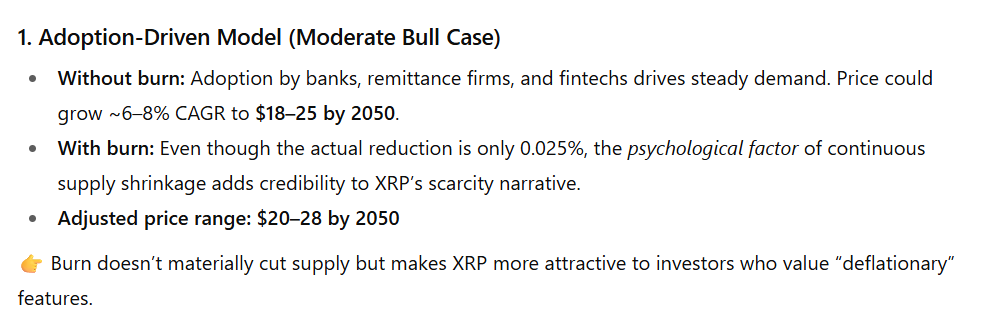
In the first scenario, it assumed that banks, remittance companies, and fintechs will adopt XRP over the next 25 years. In this scenario, even without the burn, a compound annual growth rate of 6-8% could lift prices to between $18 and $25 by 2050. 

XRP Adoption Driven Burn Model ChatGPT

However, with the burn adding a sense of shrinking supply, ChatGPT suggests that the range could move slightly higher to $20 to $28. Here, the burn acts less as a mathematical driver and more as a psychological one.

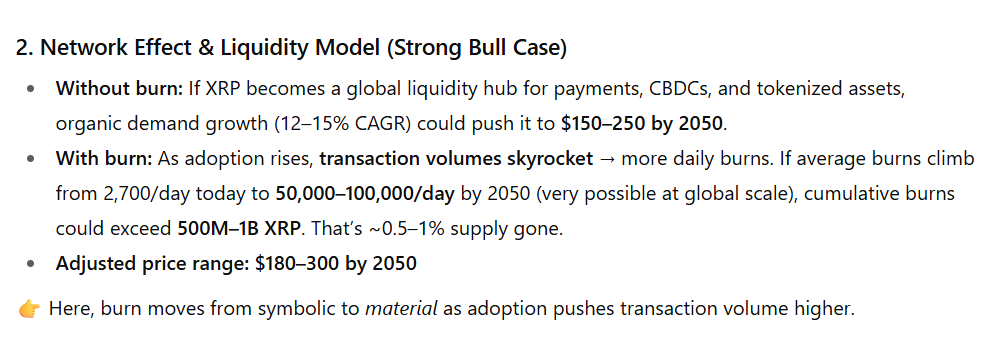
Meanwhile, the second scenario imagines XRP becoming a major liquidity hub for cross-border payments, central bank digital currencies, and tokenized assets. If adoption grows at 12-15% annually, XRP could climb to $150 to $250 by 2050. 

XRP Network Effect and Liquidity Model
XRP Network Effect and Liquidity Model | ChatGPT

ChatGPT suggested that at this level of use, daily burns would rise as well. If the average burn rate grew from today’s 2,700 to as high as 100,000 tokens a day, the network could permanently remove 500 million to 1 billion XRP. This amounts to roughly 1% of the supply, which could push the price range higher to between $180 and $300.

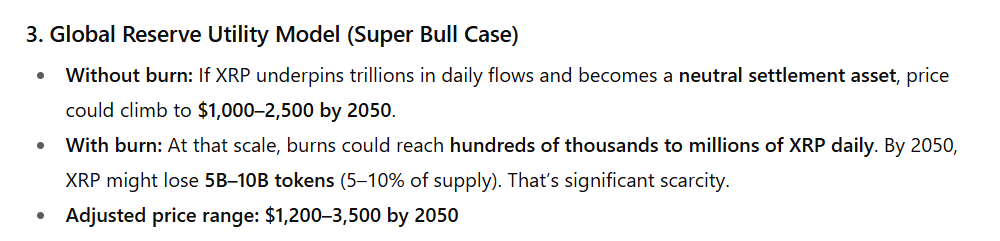
In the third scenario, ChatGPT noted that XRP could serve as a neutral global reserve settlement asset for trillions in daily flows. Under this outlook, it predicts XRP to rise $1,000 to $2,500 without factoring in the burn. 

XRP Price Global Reserve Utility Model ChatGPT
XRP Global Reserve Utility Model | ChatGPT

However, if activity grew so large that the network destroyed hundreds of thousands of tokens each day, XRP could lose 5 to 10 billion from its total supply. This 5-10% reduction would represent meaningful scarcity, raising potential valuations to $1,200 to $3,500.

LINK Soars 50% In Just Two Weeks. What’s Driving The Surge And Who’s Next?

0

Chainlink’s LINK token has been on a wild ride, grabbing attention as the market pulls back after the recent surge. Starting August near $16, it soared to $24 before easing slightly, sparking curiosity about whether this is a breakout or a brief spike.

Chainlink’s Price Surge And Key Catalysts

Looking at the numbers, LINK was trading at about $17 on August 5, dipped slightly mid-week, then started climbing steadily. By August 11, it hit $23.59, and peaked around $24 a few days later, marking a roughly 44% to 50% rise depending on the exact dates you pick in those two weeks.

Even after a minor pullback to around $21.69 by mid-August, as noted in recent market reports, the token held strong above $20, which analysts see as a key support.

The main driver? Chainlink’s new Reserves Program, converting oracle service fees into LINK and locking them, reducing sell pressure. This sparked whale buying, with large transactions spiking and pushing prices up, including a 10% jump to $23.97 on August 12.

Chainlink’s role in real-world asset (RWA) tokenization is also gaining traction, with its oracles bridging off-chain data for traditional finance. Recent partnerships, like one with ICE, and Wall Street interest are fueling optimism.

On-chain metrics back this momentum: Chainlink’s Total Value Secured (TVS) has surpassed $93B, up nearly 90% since the start of 2025, marking an all-time high. Meanwhile, the broader RWA tokenization market has grown past $25B in value, with RWA holders rising 14% in just the past month.

This surge feels rooted in fundamentals, not just hype. Chainlink’s ecosystem, built over years, positions it perfectly for RWA growth. Analysts see $30 as possible if momentum holds, based on past breakout patterns.

Shifts like LINK’s remind us how infrastructure tokens can deliver outsized moves when they solve real problems in crypto. That’s where something like Unich comes into view, operating in the OTC space for pre-launch tokens on Solana.

Unich: Another Infrastructure Play To Watch

Unich is a Solana-based OTC exchange who is reshaping pre-TGE token trading. The platform brings smart-contract–driven security to a market long plagued by trust-based scams. Traditional OTC deals often leave traders exposed, but Unich’s model eliminates that risk and delivers safer, transparent execution.

The results speak for themselves: in just six months since mainnet, the platform has processed over $1.2 billion in trading volume, generated $20 million in revenue, and attracted more than 5 million users across 190+ countries – milestones no OTC exchange had reached before its token launch.

Unich Pre-Market locks collateral from both buyers and sellers to prevent fraud, ensuring automatic compensation if deals fail post-TGE.  Meanwhile, Unich Pre-Order lets users trade with just 5% collateral, settling at a fixed price without liquidation risks.

The Unich IDO has recently launched, selling 100 million $UN tokens at $0.15 with an 11% referral program (8% USDT, 3% $UN) to grow its community.

In terms of token utilities, $UN offers fee discounts, 20-30% staking yields, early feature access, governance rights, and a burn mechanism using 30% of quarterly profits. At a $150M FDV, it’s undervalued compared to peers like AEVO ($4B peak). Early supporters can benefit from substantial upside potential as Unich scales, especially with planned top-tier CEX listings boosting visibility and liquidity.

$UN surged 5x to $0.80 within 24 hours of listing on Unich Pre-Market in July 2025, hitting a $0.99 ATH, and now trades at $0.70-0.75 with $14M total volume.

Back to the earlier subject, just as LINK’s 50% surge reflects its critical role in DeFi and RWA tokenization, Unich’s innovative approach to secure OTC trading on Solana, backed by proven traction, positions it for a potential breakout similar to LINK’s by its Q3/Q4 2025 TGE. Unich token sale, hence, is in the middle of the market’s attention at present.

Bhutan Moves 800 Bitcoin Worth $92M as BTC Price Dips

0

The Royal Government of Bhutan has transferred nearly 800 BTC to new wallets, sparking speculation about a possible sale.

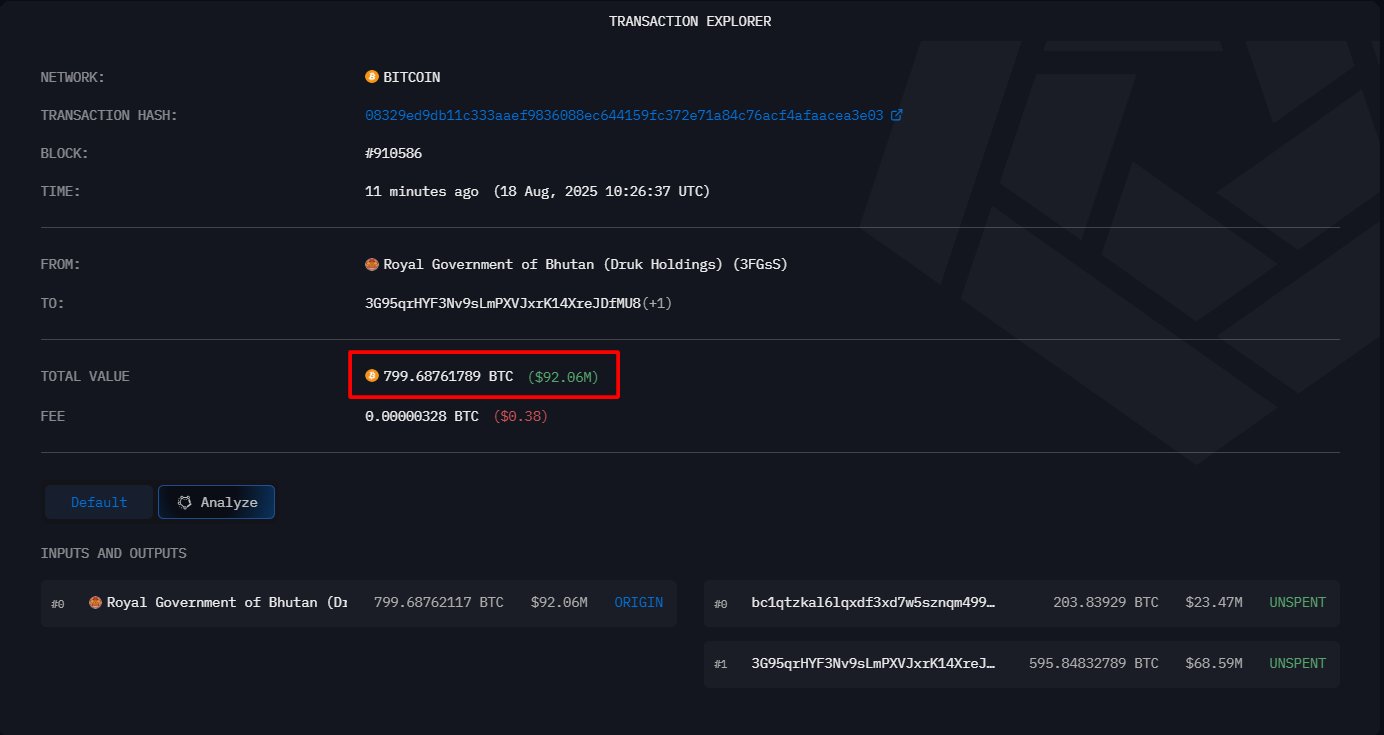
Blockchain analytics firm Arkham reported that Bhutan moved 799.69 BTC, valued at about $92.06 million, to two new wallets on August 18, 2025. The transfer was executed precisely at 10:26:37 UTC.

This marks the third transaction by Bhutan in August. On August 5, the government shifted 517 BTC to an unknown wallet. Later, on August 7, Arkham confirmed that the coins were sent to a Cobo Hot Wallet at an average price of $116,557 and were destined for sale. Cobo acts as a trusted custodian of Bhutan’s BTC.

A screenshot of Bhutan's last Bitcoin transfer
A screenshot of Bhutan’s last Bitcoin transfer

Possible Sale Through Binance?

Onchain Lens, another tracking platform, suggested the latest transfer may be headed for Binance. However, Bhutanese authorities have not confirmed any intention to sell. The repeated transactions have fueled speculation in the crypto community that the country could be reducing its reserves.

The transfers come as Bitcoin struggles to sustain its gains after reaching a record $124,474 on August 14, 2025. The token has since retreated, trading at $115,415, down 2.51% in 24 hours and nearly 4% over the week.

Bhutan Remains a Top Bitcoin Holder

Despite the recent transfers and market volatility, Bhutan still holds about 9,969 BTC, valued at roughly $1.15 billion. This places the country as the sixth-largest nation-state holder of Bitcoin, behind the United States (198,022 BTC), China (190,000 BTC), the United Kingdom (61,245 BTC), Ukraine (46,351 BTC), and North Korea (13,562 BTC).

A Different Path to Bitcoin Reserves

Bhutan’s place in this ranking is notable not just for the size of its holdings but also for how they were accumulated. While other governments mainly obtained Bitcoin through seizures or confiscations, Bhutan built much of its reserves through mining.

On-chain data links this activity to Ant Pool, with operations powered by the nation’s hydroelectric resources. This mining-based approach sets Bhutan apart from other state holders.

Analyst Says Bitcoin Is Ready for a Huge Bull Run to $600K, Citing Gold’s Trajectory

0

While Bitcoin undergoes a correction, industry observers are again calling for a historic comeback that could push its price toward $600,000.

Over the past few days, Bitcoin entered a cooling phase after hitting a new peak of $124,450 last week. The leading crypto retraced to $114,723 earlier today before recovering slightly to $115,300 at press time. Despite this correction, analysts suggest that Bitcoin is setting up for a “huge bull run.”

The Pattern Pointing to Bitcoin $600K

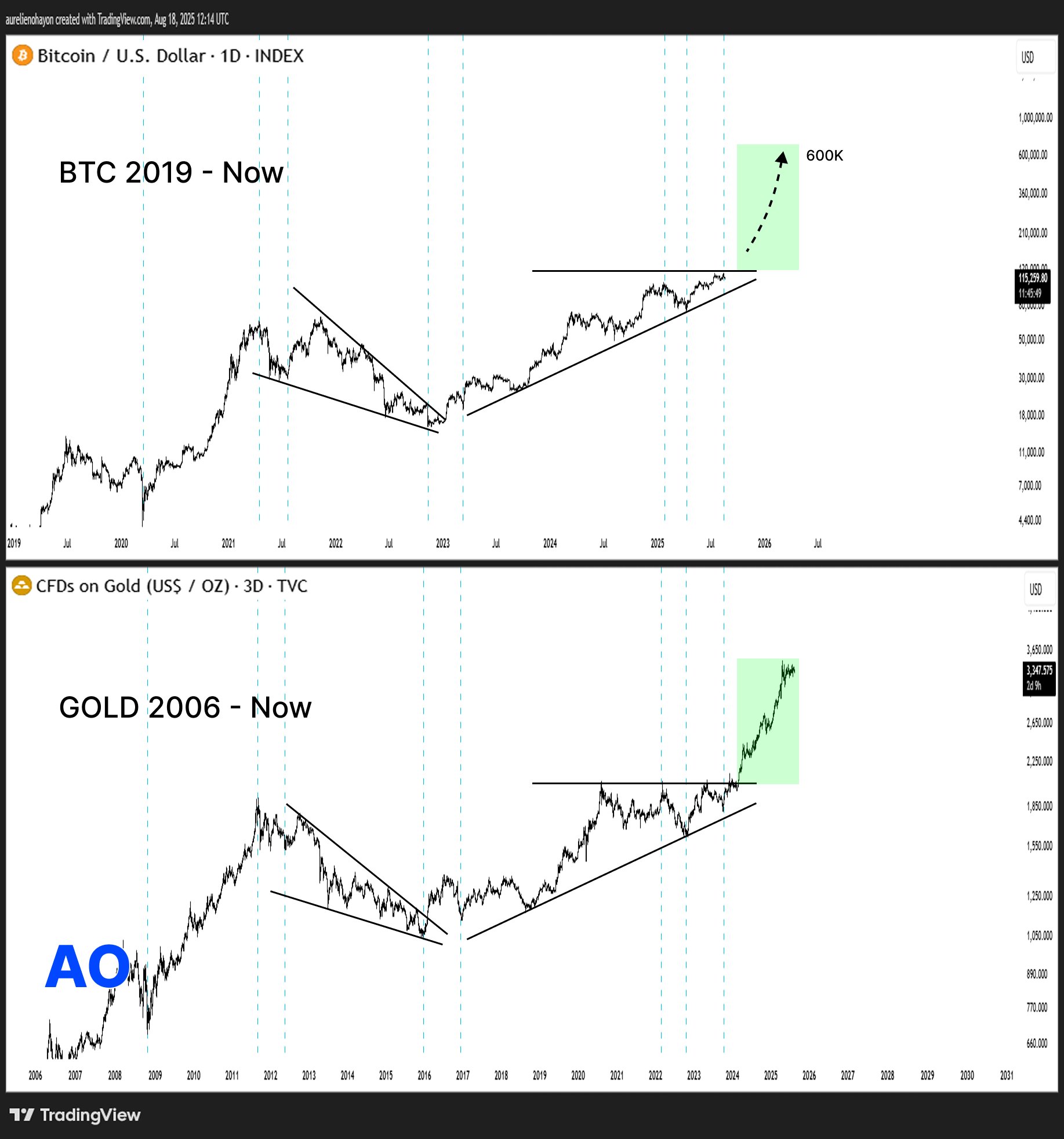
Bitcoin analyst AO compared the current Bitcoin chart to gold’s trajectory from 2006. Particularly, Gold consolidated in a similar wedge and ascending triangle structure before exploding to record highs. AO believes Bitcoin is mirroring that same pattern and is primed for a parabolic rally.

The analysis highlights that Bitcoin’s consolidation around $115,000 could serve as the launchpad for a monumental breakout. AO’s chart points to a surge toward $600,000 if Bitcoin fully mirrors gold’s historical pattern.

The chart shows that Bitcoin has followed a similar trajectory to gold since 2019, and the potential completion of the “missing legs” suggests a path to $600K. Gold had its breakout in 2024, and its pattern has shown an explosive uptrend since then.

According to AO’s chart, Bitcoin is at a similar inflection point, with a move above half a million dollars materializing by 2026.

AO's Bitcoin and gold chart
AO’s Bitcoin and gold chart

Interestingly, AO is not the only analyst who has drawn parallels between Bitcoin and gold’s long-term charts. Numerous market watchers have highlighted similar breakout patterns, though most have not projected a specific target price for Bitcoin at the end of the mirroring move.

Digital Gold Status to Be Cemented

AO has boldly suggested a $600,000 price target for Bitcoin, which would require a 421% increase from current levels. 

Notably, this would give Bitcoin a market capitalization of approximately $12 trillion, surpassing tech giants like Apple, Nvidia, and Google, and ranking just behind gold in global valuation.

In other words, such a development would further validate Bitcoin’s long-touted status as “digital gold.”

In an August 1 Bloomberg interview, VanEck CEO Jan van Eck reaffirmed his belief that Bitcoin could rival gold by capturing half of its market cap. He cited Bitcoin’s maturation and growing acceptance as a reserve asset.

Meanwhile, Mexican billionaire Ricardo Salinas Pliego believes Bitcoin will eventually surpass gold’s $22 trillion market cap. Given Bitcoin’s rapid growth of 156% in 2023 and 121% in 2024, compared to gold’s slower gains, Salinas argued that Bitcoin is steadily overtaking gold in both value and relevance.