Home Blog Page 573

Foreign Tourists To Convert Crypto to Thai Baht with New TouristDigiPay System

0

Thailand will introduce TouristDigiPay on August 18, enabling foreign visitors to convert cryptocurrency into Thai Baht for local spending.

The Thai government is rolling out a new digital payment programme called “TouristDigiPay”. The scheme is launching today, and it aims to attract more international travellers by allowing them to convert cryptocurrencies into Thai Baht for use during their stay.

Tourism, one of Thailand’s main economic drivers, has slowed in recent months, mainly due to a decline in visitors from China. Officials hope this initiative will give the sector a much-needed boost.

The official launch will be detailed at a press conference led by Deputy Prime Minister and Finance Minister Pichai Chunhavajira. Senior representatives from the Ministry of Finance, the Securities and Exchange Commission (SEC), the Anti-Money Laundering Office (AMLO), and the Ministry of Tourism and Sports will also be in attendance.

How the Scheme Will Work

Foreign tourists will need to open accounts with both a digital asset business regulated by the SEC and an e-money provider licensed by the Bank of Thailand. These steps are to ensure financial security and regulatory compliance.

A key feature of the scheme will be the new Tourist Wallet, developed by the Bank of Thailand in collaboration with e-money providers. It is designed for visitors from countries without cross-border payment systems, letting them pay easily through QR codes. Initially, it will serve as an e-money tool for currency conversion, with plans to later connect it to foreign debit and credit cards.

The service will operate under a regulatory sandbox, which will allow authorities to monitor risks while also encouraging innovation. Importantly, tourists will not pay merchants directly with crypto. Instead, their digital assets will be converted into baht before being spent.

Only non-resident tourists visiting Thailand will be eligible for the service. To participate, travellers must complete strict Know Your Customer (KYC) and Customer Due Diligence (CDD) checks in line with AMLO rules.

Spending Limits to Prevent Financial Crime

To mitigate risks such as money laundering and other financial crimes, strict transaction limits will be enforced. Merchants using card terminals will have a monthly cap of 500,000 baht per account. Meanwhile, smaller merchants will face a monthly ceiling of 50,000 baht. Moreover, transactions at high-risk businesses identified by AMLO will be banned.

Tourists will not be able to withdraw cash based on their top-up balances. They can only take out the remaining funds once they close their accounts. This rule is designed to tighten oversight.

The Thai government has been studying the use of digital assets in tourism for several months. The SEC recently concluded a public consultation on financial innovation, which closed for feedback on August 13.

Officials say this initiative marks a significant step toward combining digital finance with tourism. If successful, it could set a model for other countries looking to attract tech-savvy travellers.

Pierre Rochard Says Tokenization Won’t Drive XRP Value

0

Pierre Rochard, CEO of the Bitcoin Bond Company, has rejected claims that the growing tokenization sector would hold immense benefit for XRP and Ethereum.

For context, Ethereum and XRP are at the forefront of the growing tokenization market, with Bitwise recently suggesting that buying them is the cleanest way to invest in the sector. However, Rochard argues that the idea of securities tokenization driving demand for XRP and Ethereum has flaws.

Rochard Rejects XRP and Ethereum Tokenization Pitch

In a recent X post, Rochard said the current financial system already solves the problems that XRP and Ethereum claim to address. Specifically, he pointed to the Depository Trust & Clearing Corporation (DTCC), which clears and settles securities as a cooperative owned by its users. 

To him, institutions have no reason to abandon a proven system for one that burns fees to inflate token prices while still leaving operational costs in place. Building on this, Rochard described the tokenization pitch to institutions as dead on arrival.

The Bitcoin maxi also questioned what the strategy would look like if XRP and Ethereum turned to exchanges like NASDAQ or ICE instead of the DTCC. He noted that those venues already run smoothly and charge very low fees. 

According to him, with no clear advantage, the only remaining angle is to target people who can’t open brokerage accounts but can use crypto wallets. In his words, that model depends on squeezing fees from some of the world’s poorest investors, who already have the least to put into markets.

Beyond that, Rochard highlighted competition as another obstacle. He argued that because blockchain technology is open source, new networks can appear at any time, pushing fees lower and undercutting any profit model. He added that the contest will not be decided by utility but by marketing, where stablecoins like USDT on Tron already dominate instead of ETH or XRP.

Notably, in a follow-up commentary, Rochard insisted that making security tokens more useful might raise demand for those tokens themselves, but it does nothing to increase demand for ETH or XRP. 

DTCC Already Building on Ethereum

However, the DTCC itself is already building on Ethereum. In April, it announced that it had developed a tokenized collateral management platform, known as AppChain, to launch during its “Great Collateral Experiment” on April 23. 

The system aims to speed up collateral movements, improve liquidity, and create an open digital ecosystem for financial applications. The initiative runs on LF Decentralized Trust’s Besu platform, an enterprise-focused version of Ethereum designed for institutional use.

Rochard Recognizes XRP Utility 

Notably, being a Bitcoin maxi, Rochard has consistently criticized altcoins, with XRP being one of its frequent targets. In May, he called XRP a retail token that lacks institutional credibility. He acknowledged that XRP has utility but has continued to argue that utility alone does not lead to meaningful price growth. 

That same month, he questioned why anyone would hold XRP, Ethereum, or Solana when they could simply use the utility of those networks while keeping their money in Bitcoin or stablecoins. He insisted that none of these tokens has a solid value accrual model that justifies long-term holding.

Here Is Key Support Area Where About 1,704,745,581 XRP Could Stop the Downtrend

0

As downward pressure persists in the crypto market, a top analyst has highlighted the next crucial support area for XRP.

Specifically, Ali Martinez highlighted a massive demand wall for XRP amid its continued price correction. The third-largest crypto asset by market cap has dropped below the $3 support after reclaiming it eleven days ago, as its struggles continue.

Next Key Support for XRP

Martinez identified that $2.81 is the next crucial support area for XRP if the downtrend persists. Why so? Because the cost basis distribution heatmap shows that a staggering 1.7 billion XRP were accumulated there.

The analyst shared a chart from Glassnode, which shows massive XRP acquisition at a cost basis range of $2.811 and $2.818, serving as a massive support area for XRP should the sideways drive continue. From the current market price of $2.98, this represents a further 5.7% correction.

For context, the massive accumulation in the $2.81 region suggests that investors view the area as a good entry price, hence the large buy volume. Furthermore, they would likely hold their stash or buy more in the area, providing demand pressure that could possibly invalidate downtrends and spark a price rebound.

XRP Cost Basis Distribution Heatmap

Nonetheless, should prices turn bullish, the chart also shows that a crucial resistance lies ahead. About 1,041,000,989 XRP exchanged hands at a cost basis range of $3.26 and $3.27, which could provide selling pressure for XRP if it reclaims the area.

XRP Must Reclaim This Level to Avoid Steeper Corrections

Meanwhile, to provide further context on the crucial XRP levels to watch, Martinez leveraged technical price analysis. In a parallel X post, he shared a chart that identified the level XRP must reclaim to avoid a drop to $2.60 or even $2.

Specifically, he claimed that XRP could face a steeper decline if it does not reclaim the $3.30 price level. Notably, the area lies close to its January peak and has posed as a resistance for XRP in attempts on August 8 and 14 to reach higher prices.

If XRP fails to regain $3.30, Martinez suggested it could further retrace by 12.75% from its current price to the support at $2.60. There is also a risk of more downsides, specifically a 32.8% correction to $2.

XRP Trend Below $3.30 Resistance/Ali Martinez

Remarkably, this aligns with a price outlook from Michael van de Poppe, who also noted in a recent commentary that XRP needs to reclaim $3.40 or it crashes to $2.40.

XRP Could Still Rally to New All-Time High

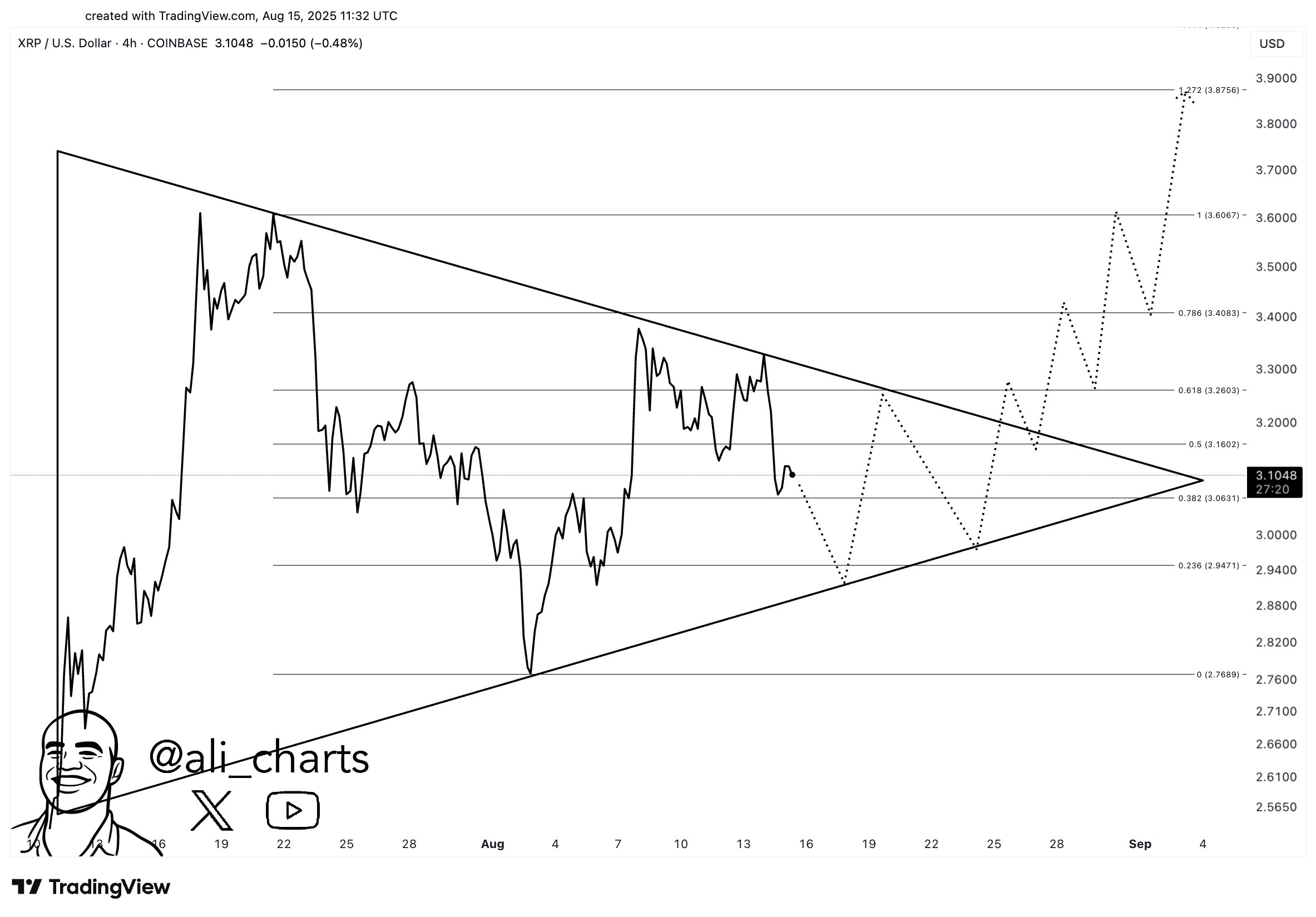
Nonetheless, XRP bulls can still push XRP to a new all-time high of $3.90, Martinez earlier mentioned. He shared that XRP trades within a symmetrical triangle and needs to break above $3.26 to spur further upside.

XRP Symmetrical Triangle Trend/Ali Martinez

If it does, XRP could surge to a new all-time high of $3.90, setting the pace for greater heights. Meanwhile, some of the projected higher prices include a rally to $4.47 and $7.

Investors May Soon Earn 4–7% Annual Yield on XRP Holdings

0

EVM-based protocol Flare is working with Firelight to provide XRP holders with up to 7% yield on their idle holdings.

This was revealed in a recent interview with Scott Melker, the Wolf of All Streets. Notably, Melker spoke with Hugo Philion, co-founder and CEO of Flare Labs, and Jesus Rodriguez, co-founder and CTO of Sentora, who is leading Firelight. 

Specifically, both projects are working together to introduce decentralized finance products that can finally give XRP holders access to lending, borrowing, and yield opportunities.

Flare and Firelight Tout Up to 7% Yield on XRP

During the discussion, Melker noted that XRP emerged originally as a token for cross-border payments. However, he stressed that this has changed, with more teams now building tools on and around XRP. He asked Philion why Flare chose to focus on XRP and what makes its network suitable for this type of product.

In response, Philion explained that Flare wants to give XRP holders the same kind of flexibility Ethereum users get through MakerDAO. When they lock XRP as collateral, investors could mint stablecoins, purchase other assets, or deploy funds into decentralized exchanges and lending pools to generate yield. 

The Flare Labs CEO said this approach allows people to turn a static asset into one that creates returns while also presenting exposure to different risks.

He also emphasized that Flare designed its system to avoid custodial risks. Through FXRP, the wrapped version of XRP on Flare, users can move tokens without relying on third parties. 

Moreover, validators secure the network collectively, which Philion argued makes the bridge highly decentralized. Although he admitted that many retail investors may still access yield through custodial exchanges, he stressed that Flare itself remains non-custodial.

Speaking further, Melker later asked about potential yields. Replying, Rodriguez revealed that tests show XRP could deliver annual returns in the 4% to 7% range. 

He believes the numbers are impressive, especially for an asset that has never offered yield and has long carried a zero cost of capital. Rodriguez also highlighted the idea of using restaking to create more advanced DeFi products, leading to deeper financial uses for XRP.

XRP Community Reacts

Interestingly, the interview drew comments from the XRP community. Brad Kimes from Digital Perspectives claimed that with this product, XRP holders may soon see the biggest release of idle liquidity in crypto. 

He compared it to unlocking a bond-like income stream from an asset that has historically sat without generating yield. Kimes described the development as a major milestone that could change how people use XRP.

In addition, attorney Bill Morgan also praised the proposal, noting that returns of 4% to 7% would be a welcome addition for long-term holders who currently gain nothing from their tokens.

However, Vet, a validator on the XRP Ledger’s dUNL, argued that the risk didn’t match the reward. He said that putting a volatile asset like XRP into yield strategies for only 7% doesn’t justify the exposure to third parties. He claimed that DeFi needs to move beyond short-term yield plays and gambling-style speculation.

Morgan responded with a suggestion that an ideal product would let people lock in their XRP long-term while safely borrowing against it when they need cash. This way, holders could preserve their positions while still accessing liquidity. Nonetheless, he acknowledged that such a product has yet to emerge.

Japan to Greenlight Yen-Pegged Stablecoin

0

Japan’s financial regulator is preparing to approve JPYC’s yen-backed stablecoin. The approval is expected from next month, with issuance beginning soon after.

Japan is entering a new chapter in digital finance. The Financial Services Agency (FSA) is preparing to give the green light to the country’s first stablecoin tied to the yen. According to a Nikkei report, the approval could come as early as this fall, setting the stage for a significant step in Japan’s financial innovation.

JPYC to Lead Stablecoin Launch

Tokyo-based fintech company JPYC will issue the stablecoin. The firm intends to complete its registration as a money transfer business with the FSA in August. Once the registration is successful, token sales will begin the following week.

Backing and Stability Mechanism

The JPYC stablecoin will maintain a one-to-one peg with the Japanese yen. To support this peg, the token will be backed by highly liquid assets, including bank deposits and Japanese government bonds. The approach seeks to build trust and ensure stability.

Practical Use Cases in Finance

JPYC envisions the stablecoin being used across multiple sectors. Possible applications include cross-border remittances, where fast and low-cost transfers are critical. Corporations may use the token for settlements, while decentralized finance (DeFi) projects could integrate it as a stable medium of exchange. The firm believes these use cases will drive demand and adoption.

Ambitious Growth Plan

JPYC aims to issue up to 1 trillion yen (approximately $6.78 billion) worth of stablecoins within the next three years. Interest is already emerging from hedge funds that see potential in the project. If successful, JPYC’s plan could position it as a major player in Japan’s evolving crypto ecosystem.

Japan’s Evolving Stablecoin Regulations

Japan has been ahead of many nations in setting rules for stablecoins. In June 2022, lawmakers amended the Payment Services Act to recognize fiat-pegged tokens as “Electronic Payment Instruments.”

The law restricts issuance to licensed banks, trust companies, and registered service providers.

In 2023, stablecoins were further classified as “currency-denominated assets,” clarifying their legal standing and giving investors greater confidence.

Rising Competition in the Stablecoin Market

JPYC is not alone in this race. Japan’s major banks and financial groups are also entering the space. Earlier this year, Sumitomo Mitsui Financial Group (SMBC), the country’s second-largest bank, announced plans to launch its own stablecoin in partnership with blockchain firm Ava Labs and custody provider Fireblocks.

Canary Capital CEO Says Bitcoin Has Over 50% Chance of Hitting $150K This Year

0

Steven McClurg, CEO of asset management firm Canary Capital, predicts that Bitcoin will clinch a new all-time high this year. 

2025 has been a bullish year for Bitcoin (BTC). The firstborn cryptocurrency has stunned the financial market with its record-breaking performance this year. 

Thanks to inflows from Bitcoin spot exchange-traded funds (ETFs) and public institutions adding it to their balance sheets, demand for BTC has skyrocketed since the beginning of this year, driving its price to an all-time high (ATH) of $124,457 last week. 

Despite this incredible performance, McClurg of Canary Capital believes Bitcoin could post even greater gains this year. 

Treasury Inflows Will Peak Soon 

In an interview with CNBC, the Canary Capital CEO stated that new inflows are driving Bitcoin’s price to greater heights. Specifically, he suggested that these inflows are emanating from treasury companies adding Bitcoin to their balance sheets.

Since MicroStrategy (now Strategy) bought into Bitcoin in 2020, the number of Bitcoin treasury companies has surged massively. Currently, at least 100 public companies have put Bitcoin on their balance sheet. 

Notably, corporate purchases tend to generate intense demand pressure on the asset, ultimately driving its price higher. According to McClurg, these treasury-driven Bitcoin acquisitions will peak in the next couple of months. 

Bitcoin to Hit $150K This Year 

Based on treasury-driven inflows, the CEO of Canary predicts a greater than 50% probability that Bitcoin’s price could reach the range of $140,000 – $150,000 this year. 

Essentially, McClurg sees Bitcoin reaching a new ATH of up to $150,000 before the next bear market kicks off by 2026. He attributed next year’s bear cycle to broader economic concerns, which could eventually spill into the crypto market. 

In the meantime, Bitcoin has plunged 7% from its all-time high of $124,457, with the coin currently trading at $115,741. Based on McClurg’s projection, Bitcoin would need to rally 20.95% to hit $140,000 and 29.59% to reach $150,000. 

Other 2025 Bitcoin Forecasts 

Meanwhile, McClurg’s $140,000–$150,000 forecast is even modest when compared to other 2025 projections for the asset. For instance, VanEck expects institutional inflows to push Bitcoin’s price to $180,000 in the last quarter of the year. 

Fundstrat’s Managing Partner Tom Lee predicted that Bitcoin would climb to a quarter of a million dollars–$250,000–by the year ending. Famous venture capitalist Chamath Palihapitiya sets a 2025 target of $500,000 for Bitcoin, representing a 332% rally from the current price. 

With just four months remaining in 2025, it remains uncertain whether Bitcoin will reach any of these ambitious 2025 targets before the year comes to a close. 

$5K in XRP if XRP Reaches $100, or $5K in Bitcoin if BTC Reaches $1M? Veteran Investor Explains the Best Option

0

A recent analysis by Steve Shultz, founder of ElijahStreams.com, has compared the potential five-year returns of investing $5,000 in Bitcoin versus XRP. 

He noted that while some investors may be drawn to Bitcoin due to projections for it to reach $1 million per coin, the numbers suggest XRP could offer far greater upside under certain conditions.

The Bitcoin Scenario

Notably, Bitcoin is trading at $117,000 at press time. Meanwhile, Shultz based his analysis on a Bitcoin trading price of $120,643. At this level, a $5,000 investment would buy only about 0.041 BTC. 

If Bitcoin were to rise to $1 million within five years, that same 0.041 BTC would be valued at around $41,400. The return is about 730% upside. Shultz noted that while impressive, it represents just over an eightfold increase from the initial investment.

Notably, numerous industry leaders have forecasted that the price of Bitcoin would trade at $1 million and above by 2030. Among those with this view are Cardano founder Charles Hoskinson and former Twitter CEO Jack Dorsey.

The XRP Scenario

On the other hand, at the time of Shultz’s analysis, XRP was trading near $3.20. Here, a $5,000 allocation would purchase approximately 1,558 XRP. If XRP were to reach $100 within the same five-year window, that position would be worth close to $155,800. 

The return here is more than 30 times the initial investment, which is also about five times the profit potential compared to Bitcoin.

Shultz’s comparison seeks to highlight that absolute price targets can be misleading if not weighed against percentage gains. He suggests that while Bitcoin’s million-dollar narrative is enticing, XRP’s path from low single digits to $100 would be far more rewarding for today’s buyers.

As a result, Shultz urges investors to consider XRP in their five-year investment plan rather than Bitcoin. 

XRP and Bitcoin investment scenarios by Steve Shultz

But Can XRP Reach $100 in Five Years?

Meanwhile, the question remains about XRP’s ability to reach $100 in five years. For context, XRP’s price needs to expand by over 3,050% from today’s price to reach $100.

According to Matthew Brienen, COO at CryptoCharged, XRP is “highly likely” to reach $100 by 2030. Meanwhile, Bitwise, in a detailed report to professional investors, analyzed that XRP may only reach a maximum of $29 by 2030.

Interestingly, some analysts in the XRP community, like Javon Marks, believe the coin could even reach $100 this year. 

While Shultz has based his 2030 outlook on XRP reaching $100, other prominent figures in the XRP community have used even bolder targets. For instance, Xena recently claimed XRP will create more millionaires at a $1,000 price per coin than Bitcoin would do at $1 million per coin. 

While ambitious, these XRP outlooks are often dismissed as inflated.

Pundit Predicts New XRP Price Target for Q2 2026

0

As investors prepare for the next phase of the bull run, popular crypto analyst Albie has set a new Q2 2026 price target for XRP. 

The analyst issued the projection in a recent tweet, where he laid out Q2 2026 price targets for different cryptocurrencies. According to Albie, XRP will trade at around $4 in the second quarter of 2026, precisely by April-June 2026

Reaching the $4 target would require XRP to rally by 27.38% from its current price of $3.14. The $4 projection translates to a market capitalization of $237.67 billion, assuming XRP’s supply remains at 59.41 billion tokens. 

The analyst also projected Q2 2026 targets for leading cryptocurrencies, including Bitcoin at $280,000, Ethereum at $7,500, Solana at $700, Dogecoin at $0.69, and Chainlink at $420. However, Albie did not outline the factors that could drive these cryptocurrencies, particularly XRP, to these ambitious targets. 

Next Phase of Bull Run?

The projected timeline for these predictions to materialize is set for a few months after the 2025 bull cycle. Although the market has cooled in recent weeks with no significant spikes, many investors remain confident that the next phase of the bull run is just around the corner. 

As such, they expect the prices of most assets like Bitcoin and XRP to reach lofty heights and potentially sustain much of those gains into the early months of next year. In the meantime, it remains uncertain whether Albie shares a similar sentiment. 

XRP to $4 Prediction 

Many experts have been projecting XRP’s imminent surge to the $4 price mark. Widely followed community expert Edoardo Farina teased that XRP could clinch the $4 target by mid-July. 

In the same month, another analyst, 24HRSCRYPTO, asserted that investors no longer had the opportunity to purchase XRP at $2 because the price was heading to $4. 

Notably, community expert Zach Rector predicted that XRP could hit the $4 target this year. Meanwhile, XRP has continued to trade around the $3 region over the past few weeks. It has had difficulty surpassing its previous ATH of $3.84, registered in January 2018. 

Despite this, investors believe the token will embark on a major rally and reach unprecedented levels, including the $4 target. This bold forecast is driven by the resolution of the Ripple lawsuit and the optimism regarding the potential approval of a spot ETF tied to XRP. 

Here’s How a $200 Monthly Shiba Inu Investment Could Grow Into $1M by 2050

0

As many investors dream of attaining millionaire status, we explored how a $200 monthly investment in Shiba Inu could make it possible by 2050.

Many investors are seeking different strategies to grow their crypto holdings into a $1 million portfolio. Although most early investors achieved this goal in previous market cycles, those who missed out are exploring how to earn $1 million by investing in assets like Shiba Inu. 

The investment goal of most investors is to achieve a return of $1 million over the next few years. To pursue this goal, analysts often suggest building early positions in high-growth assets and holding through potential market rallies. 

Investors with little capital are usually advised to adopt the DCA strategy to grow their crypto portfolio over a specific period. 

How a $200 Monthly Investment Can Become $1M by 2050 

Given this, we estimated how a $200 monthly Shiba Inu investment could become $1 million by 2050, approximately 25 years from now. This also translates to 300 months from today, August 2025. 

Investing $200 in Shiba Inu monthly means an investor would commit a total of $60,000 into SHIB over 300 months or 25 years. At the current price of $0.000013, this $60,000 is equivalent to 4,615,384,615 (4.61 billion) Shiba Inu, meaning that the $60,000 capital will procure roughly 4.61 billion tokens. 

For these 4.61 billion SHIB tokens to be worth $1 million by 2050, the price of Shiba Inu must climb to $0.000217 by then. The estimated $0.000217 target represents an increase of 1,569% from the current price of $0.000013. For context, the 4.61 billion SHIB portfolio would be worth $461,538 if the price reached $0.0001. 

Analysts Forecast When SHIB Will Hit $0.000217 

Although the $0.000217 target may seem conservative given Shiba Inu’s growth potential, it serves as a reference point for this analysis. 

Shiba Inu may clinch the target before the 2050 timeline, as several experts forecasted. For instance, Forbes teased that Shiba Inu could surpass the $0.0002 target by the end of this year. 

In one of our analyses, some analysts forecasted that Shiba Inu will climb to the $0.000217 level between 2028 and 2032. Meanwhile, popular crypto chartist Alan Santana projected that Shiba Inu will reach a new high of $0.000223 by the end of this year. 

Warning Note

While many analysts expect Shiba Inu to reach the $0.000217 target before 2050, the milestone may not be achieved within that time frame. Therefore, investors should not reference this analysis as investment advice, as no promises are made in this space. 

In the meantime, Shiba Inu has experienced a slight decline so far, amid a broader market collapse. At the current price of $0.000013, Shiba Inu is down 1.32% in the past 24 hours, 4.34% in the past week, and 11.11% over the past month.

More than $300,000 has been wiped out from the Shiba Inu market, with long positions reaching $201,460, while shorts total $105,000. 

Founder of X DAO Predicts XRP Price in the Next 3 to 6 Months

0

Rekt Fencer, founder of X DAO, has laid out his short-term targets for Bitcoin, Ethereum, XRP, and several other major assets.

This comes as the crypto market hopes for another round of bullish candles. Last week, Bitcoin hit a new all-time high at $124,400, but the momentum quickly reversed, and the price crashed to $117,000.

The turnaround similarly impacted the altcoin market. Meanwhile, hopes remain high that a comeback is imminent. Amid this, Fencer has shared his short-term outlook for various leading crypto assets. His forecast focuses on the next three to six months and, notably, he describes his targets as “conservative.”

How High Bitcoin and Ethereum Will Go

According to Fencer, Bitcoin could trade between $160,000 and $225,000 in the coming months. This range aligns with the views of other analysts on how high BTC could go this year. For instance, prominent crypto podcaster Mario Nawfal said Bitcoin could reach $225,000 by December.

Such a price level would push Bitcoin’s valuation past $4.4 trillion and place it above Microsoft, Apple, and Google.

Bitcoin’s momentum would also impact the global crypto space. Fencer believes Ethereum could climb into the $10,000 to $12,000 range. This aligns with the year-end forecast of Fundstrat’s chairman, Tom Lee, who projected $10,000 to $15,000 by December.

Notably, ETH is currently trading at $4,400. A run to $10,000 and $12,000 would raise its market cap to between $1.2 trillion and $1.44 trillion, which is enough to place it above Tesla and Berkshire Hathaway.

How High Will XRP Go?

For XRP, Fencer has set a target of $5.20 to $6.50 over the next three to six months. At those levels, XRP’s market cap would approach the $400 billion mark.

Fencer’s forecasts for XRP are more conservative compared to some ultra-bullish predictions of $10 to $30 by year-end. For instance, influencer Alex Cobb has said XRP could trade around $22 by December. Analyst Javon Marks sees a potential price of up to $99 within six months.

Solana, BNB, Cardano, and Dogecoin Projections

Beyond Bitcoin and Ethereum, Fencer sees Solana (SOL) surging to $700 to $950—a more than fourfold increase from its current price of around $175. Binance Coin (BNB) is expected to reach $1,100–$1,550, giving it a market cap of nearly $160 billion.

Dogecoin, the original meme coin, could rise to $1.50 to $2, according to Fencer. Notably, the price targets he has set for these assets would mark new all-time highs for each of them. However, for Cardano (ADA), Fencer projects a more modest increase to between $2.20 and $2.80—still below its 2021 all-time high of $3.10.

Outlooks for Other Altcoins

Fencer also shared promising outlooks for other top-ranking altcoins, including SUI and Chainlink (LINK). For SUI, which is currently trading under $4, he predicts a rise to between $8.30 and $11.

As for LINK, currently priced at $22, Fencer forecasts a surge to between $60 and $85—up to four times its present value.

The forecast also includes some high-risk meme tokens. Fencer expects HYPE to reach $120–$135, and PENGU to rise from $0.35 to $0.60.