Home Blog Page 591

Here’s How High XRP Can Go if Ethereum Surges 7X and Solana Does 10X

As the crypto market eyes the next leg of the bull cycle, prominent analyst Carl Moon has outlined bold targets for major altcoins, including XRP.

With over 1.5 million followers on X, Moon’s forecast is gaining attention across the crypto community. Notably, he expects key altcoins to outperform Bitcoin in the coming months, with some potentially achieving gains of 50X or more.

XRP to Hit $30 in Moon’s Altcoin Projection

Specifically, Carl Moon places XRP among the top performers of this cycle, predicting a 10X move from current levels. With XRP currently hovering near $3, this implies a price target of $30.

This $30 outlook aligns with the views of other market watchers like EGRAG, who projects a similar target based on historical patterns. For context, following a successful retest of the 21 EMA, EGRAG expects XRP to mirror previous bull cycles, potentially rallying to $11, $20, or even $30 if history repeats.

At $30, XRP would become a trillion-dollar crypto asset like Bitcoin. Specifically, XRP would command a market cap of over $1.78 trillion, placing it close to Facebook’s $1.9 trillion and ahead of Saudi Aramco’s $1.56 trillion valuation.

While this outlook is ambitious, some analysts have suggested XRP may not reach such lofty levels anytime soon. Altcoin Daily founder Aaron Arnold believes XRP may only reach $5 by 2026. Likewise, in a previous report, asset manager Bitwise projected that XRP could take until 2030 to hit $30.

Ethereum to $25,000, Solana to $1,700

Meanwhile, according to Carl Moon’s projections, Ethereum could rise 7X, taking it to approximately $25,200. Currently, ETH is trading at $3,622, up 42% over the past 30 days.

Carl also believes Solana could perform even better, with a potential 10X surge from current levels. This implies a price target of around $1,640.

Such gains would push Ethereum’s market cap above $3 trillion, while Solana could approach the $1 trillion mark.

Essentially, Carl’s outlook highlights a highly bullish scenario for altcoin market leaders Ethereum, XRP, and Solana, suggesting valuations that could put them in the same trillion-dollar territory as Bitcoin in the coming bull phase.

Outlook for Dogecoin, ADA, and TON

Carl Moon also projects strong gains for other top-tier altcoins. He expects Dogecoin (DOGE) to deliver an 8X return and sees a 3X surge for Cardano (ADA).

Notably, with ADA currently trading at $0.727, this projection implies it may still fall short of its $3 all-time high. However, some analysts, like Ali Martinez, have suggested ADA could reach $6 this cycle. For context, this is an over 8X increase from current levels.

Meanwhile, Carl also forecasts a 6X to 9X surge for altcoins such as Toncoin (TON), Litecoin (LTC), and TRON (TRX). As for the fast-growing Layer 1 smart contract network SUI, he predicts a massive 25X move, similar to his projections for several meme coins.

In particular, Moon’s most aggressive targets are reserved for meme-based tokens. He sees PENGU gaining 15X, MEE 37X, and KASTA 56X. He also teased the possibility of a 100X “gem,” saying he plans to reveal it soon.


Here Is How Much $50 in Shiba Inu at Its Lowest Price Is Now Worth

0

A mere $50 investment in Shiba Inu at its recorded all-time low would be worth a fortune now, as its price has rallied by multiple folds since then.

Shiba Inu, the second-largest meme coin by market cap, has joined a recent broader market downtrend, correcting 7.20% in the past seven days. Its price’s sideways trend becomes even more visible in higher timeframes, with SHIB having retraced by a staggering 42% since the start of the year, as it dropped out of the top 20 cryptocurrency ranking by market cap.

Further, data show that 62% of Shiba Inu holders are now at a loss, another indicator of its glaring price underperformance. Nonetheless, those who bought Shiba Inu way back are still sitting on a goldmine despite recent trends.

Shiba Inu Up by Several Million Percent from Its All-Time Low

As earlier highlighted, Shiba Inu has grown exponentially from its early days, turning lucky buyers into multi-millionaires. Notably, there have been stories of users who recorded massive returns on investments by buying SHIB before the crowd did.

Specifically, CoinMarketCap data indicates that Shiba Inu hit $0.00000000008165, its lowest recorded price, in September 2020, which was a few months after its launch. This means that any user who caught that dip would be up by several million percent at the current price of $0.00001220.

How Much a $50 Investment at the Time Would Be Worth Now

Notably, from the recorded low of $0.00000000008165, SHIB has rallied by a staggering 14,836,211%. This would have been far higher when the meme coin rallied to its all-time high of $0.00008854 in October 2021.

For context, this would have culminated in a 1,083,692,471% rally, surpassing Bitcoin’s all-time increase from its recorded lowest price. Notably, such an uptick can create generational wealth for a patient holder who bought Shiba Inu at that time.

For context, a $50 investment from Shiba Inu’s all-time low would buy 612,369,871,402 SHIB at the time. Currently, that would account for roughly 0.0010% of Shiba Inu’s 589.24 trillion circulating supply and place the holder at 74th among the top holders.

Furthermore, the 612,369,871,402 SHIB would be worth $7.47 million at the current price of $0.00001220. This represents an impressive ROI on the $50 invested.

At Shiba Inu’s all-time high of $0.00008854, the $50 investment would have been worth a jaw-dropping $54.2 million. Notably, if analysis is anything to go by, and Shiba Inu reclaims or surpasses its current all-time high, diamond-handed whales who bought at its lows would record more insane portfolio upsides.

Binance Founder CZ Seeks Dismissal of $1.76B FTX Lawsuit

0

Binance CZ asks a U.S. bankruptcy court to drop a $1.76 billion claim by FTX, arguing the case oversteps jurisdictional bounds.

Binance co-founder Changpeng Zhao (CZ) has moved to dismiss a lawsuit filed by the FTX estate seeking to recover $1.76 billion. The case, tied to a 2021 share repurchase deal, alleges Binance and its former executives received funds improperly transferred by Sam Bankman-Fried.

Zhao, in a filing submitted Monday in the U.S. Bankruptcy Court for the District of Delaware, challenged the court’s authority to hear the case. He emphasized that he is a UAE resident, and the disputed transactions took place outside the United States.

“No U.S. Nexus,” Zhao’s Lawyers Argue

According to Zhao’s legal team, neither the involved entities nor the financial transfers had U.S. roots. Binance’s affiliated companies operate out of overseas jurisdictions, such as Europe and the Caribbean. The funds, reportedly routed through Alameda Ltd., originated from a firm based in the British Virgin Islands.

Because of this, Zhao claims that U.S. bankruptcy law doesn’t apply. He labeled the attempt to stretch the law across borders as unsupported.

FTX Accuses Binance of Fraudulent Transfer

Notably, the FTX trust, along with FTX Digital Markets Ltd., filed the lawsuit in November 2024. They allege Zhao and other Binance executives received large sums in a share buyback deal with Bankman-Fried. Specifically, Binance is reported to have sold back 20% of its stake in FTX’s global entity and 18.4% in its U.S. division.

Two Binance executives named in the lawsuit also filed to be excluded from the case. Their filings echo Zhao’s arguments about jurisdiction and legal overreach.

Zhao Denies Role in FTX Collapse

Zhao’s filing described him as merely a “nominal counterparty” in the transaction. He argues the FTX estate is wrongfully blaming him and Binance for Sam Bankman-Fried’s misconduct and the company’s collapse.

CZ also noted that Binance and FTX had a short-lived business relationship. He said the firms parted ways due to “personal grievances,” which led to an equity-for-crypto settlement.

Jurisdiction and Legal Standards in Question

Zhao’s legal team argues that serving U.S. counsel on a foreign national doesn’t meet bankruptcy law requirements. They also claim the suit doesn’t meet legal standards for constructive fraud. They invoked safe harbor provisions under U.S. securities law that protect certain financial transactions from a clawback.

Zhao recently served a four-month sentence in the U.S. after pleading guilty to anti-money-laundering violations. Bankman-Fried, meanwhile, is serving a 25-year prison term for fraud and conspiracy tied to FTX’s downfall.

Zhao is represented by a law firm based in the United States. Meanwhile, the FTX estate has retained two separate legal teams to pursue the lawsuit.

Expert Says XRP Not Priced In for SEC Ripple Case Conclusion

0

As XRP trades at $2.95 and trends downward, analyst Zach Rector believes the current price fails to reflect a major catalyst approaching the market.

In a tweet, Rector argued that the final outcome of the long-running SEC vs. Ripple case has not yet been priced into XRP. According to him, many XRP holders remain in disbelief that the case could actually conclude soon.

Prevalent Disbelief in the XRP Community

Rector suggests there is a significant disconnect between current market sentiment and what could unfold in the Ripple vs. SEC case. He noted that even within the XRP community, there is a prevailing sense of doubt about the lawsuit reaching a final resolution soon.

To him, this negative sentiment indicates that the broader market is likely unprepared for the potential impact a final decision could have on XRP’s price.

However, other XRP commentators disagreed with Rector’s outlook, dismissing it as merely an opinion. Meanwhile, Rector maintained that his perspective remains valid, citing the abundance of bearish commentary across platforms like YouTube and X regarding the lawsuit’s conclusion.

Ripple Lawsuit Nearing End: Ex-SEC Lawyer

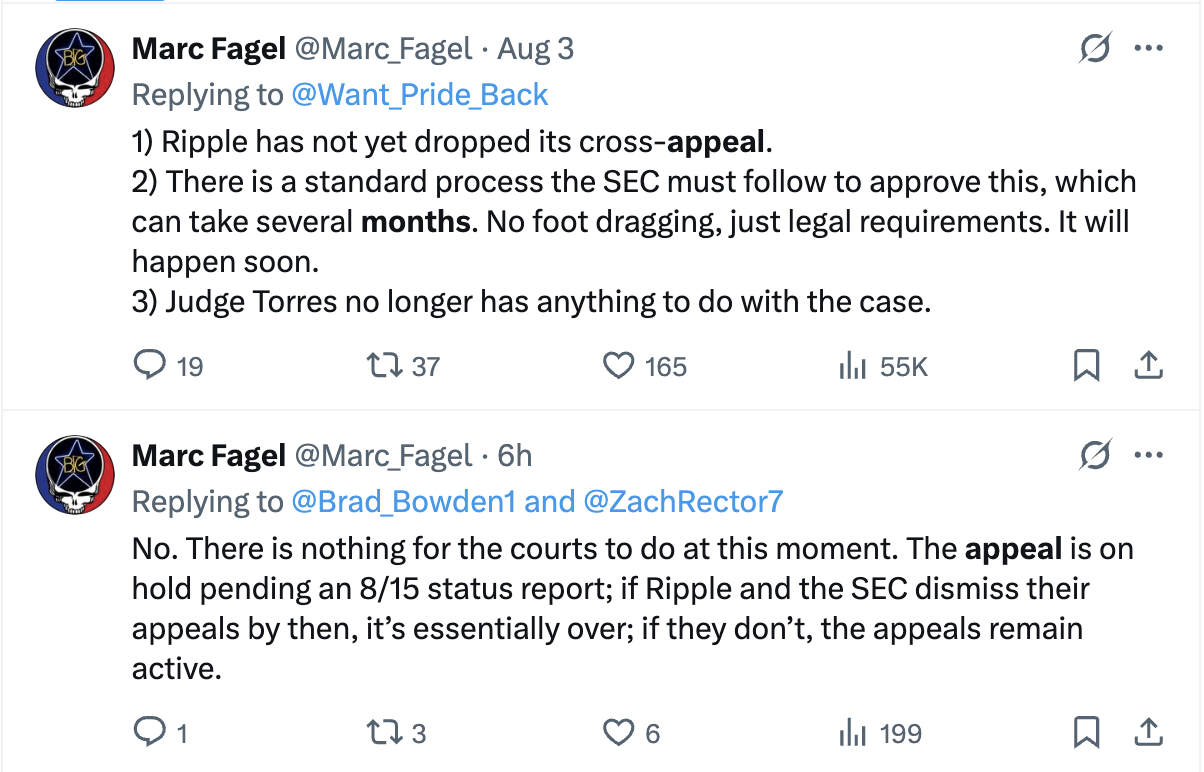
Notably, this discussion comes ahead of a key date—August 15—when both Ripple and the SEC will submit a status update regarding their pending appeal. Former SEC lawyer Marc Fagel previously confirmed that the appeal process is nearing completion, which has fueled speculation that a formal conclusion is imminent.

Ex SEC lawyer comments on Ripple SEC appeal
Ex-SEC lawyer comments on Ripple SEC appeal

The SEC vs. Ripple case has spanned nearly five years, casting a long shadow over XRP’s price potential. While the 2023 ruling confirmed that XRP is not a security, the legal battle over institutional sales and remedies has continued into 2025.

Market watchers suggest that mid-August may be when both parties drop their appeals. Ripple has already publicly disclosed its readiness to do so, while the SEC’s position remains undisclosed.

Ultimately, a final dismissal would mark the complete end of a lawsuit that has lingered for nearly half a decade.

According to Rector, the current hesitation from investors may represent a final window of opportunity to buy XRP at a low price before significant capital floods into the ecosystem.

ETF Inflows Could Multiply Impact

Adding to the potential upside is the anticipated approval of XRP spot ETFs, which could align with the resolution of the case.

As noted in Rector’s earlier analysis, even a modest $5 billion in ETF inflows could push XRP past $7, based on market cap multipliers.

In July, Ethereum funds pulled in $5.4 billion in inflows. If XRP follows a similar pattern, the resulting market cap boost could drive a price rally far beyond current levels to reach $10–$20 within a year, according to Rector.

ADA Staking Is Not a Security, Declares Cardano Founder After Latest SEC Guidance

0

Charles Hoskinson, the founder and CEO of Cardano research and development arm Input | Output, has boldly stated that ADA staking is not a security. 

He made this known while reacting to a press release from the SEC’s Division of Corporation Finance about liquid staking activities.

The division defined liquid staking as the process of staking cryptocurrencies via a service provider or software protocol and receiving a receipt representing the staked assets and expected returns.

Based on its analysis, the Corporation Finance division held that liquid staking does not involve the offer and sale of securities. Accordingly, the activity does not qualify as a security in itself.

ADA Staking is not a Security

Following the statement, Hoskinson cleverly remarked that ADA staking is not a security. A GIF of a man laughing accompanied the post, indicating that the Cardano founder was pleased with the SEC’s stance on crypto staking.

It is well known that Cardano has a built-in staking model, which is part of its consensus layer. This model allows ADA holders to earn rewards by delegating their tokens to staking pools within the network.

The ADA staking process does not meet the core criteria of the Howey Test, a longstanding standard used to determine whether a transaction constitutes a security. By staking ADA through Cardano’s model, users are neither “investing their funds” in a “common enterprise” nor “expecting profits solely from the efforts of others.”

Instead, they are simply delegating ADA to a staking pool and earning passive income for securing the network and validating transactions, not as a profit-sharing mechanism from an entity.

Therefore, Hoskinson is reassuring the Cardano community that native ADA staking does not fall under the SEC’s regulatory purview.

Project Crypto Already Yielding Results

For context, the SEC’s recent clarification is part of its recently launched Project Crypto initiative, which aims to modernize the rulebook of the SEC and transition the U.S. financial markets to an on-chain environment.

Less than a week after the SEC flagged off Project Crypto, Chairman Paul Atkins said the initiative is already yielding results, as evident in the clarification of liquid staking activities.

He reiterated that his leadership is committed to providing clear guidance on the application of federal securities laws to financial activities and emerging technologies.

Bitcoin Could Drop to $95K as RSI Signals Repeating Pattern

0

Analyst warns that Bitcoin may be facing a new correction. Notably, a key momentum indicator has triggered a signal that previously led to major price drops. 

In a post on X, prominent crypto analyst Ali Martinez mentioned that if the pattern repeats, Bitcoin could fall to $95,000 in the coming weeks.

Bitcoin’s Technical Indicator Flashes Bearish Signal

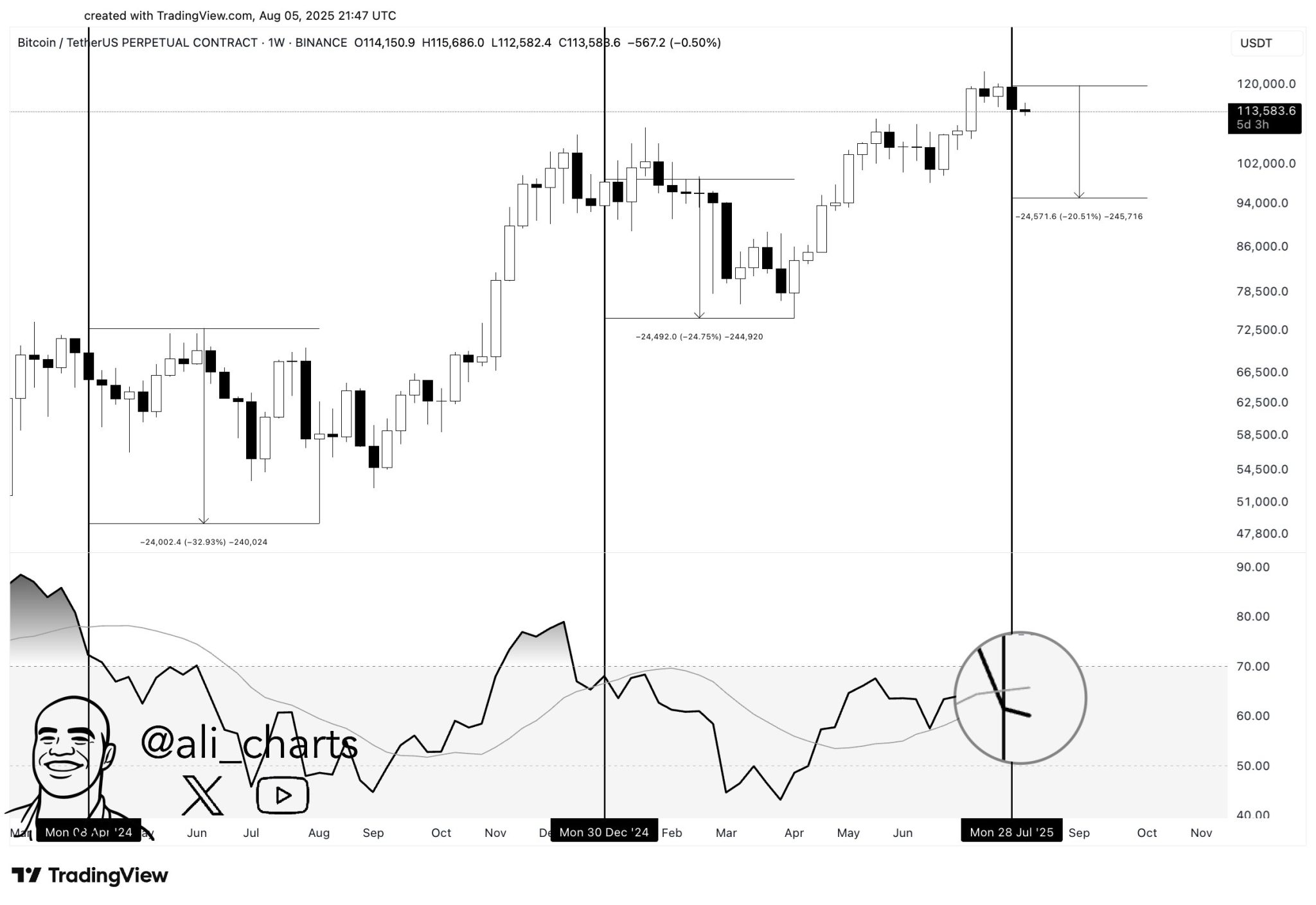
For context, Bitcoin’s weekly Relative Strength Index (RSI) has crossed below its 14-week simple moving average (SMA), a move that traders often view as a sign of weakening momentum. This bearish crossover occurred during the week of July 28, according to the chart shared by the analyst Ali.

Ali Martinezs Bitcoin analysis
Ali Martinez’s Bitcoin analysis

Martinez highlighted that the same signal appeared twice in 2024. Each time, it preceded a significant price correction in Bitcoin’s market. This repetition raises concerns that Bitcoin may be entering a similar downward phase.

Previous Signals Led to Significant Bitcoin Corrections

Specifically, in April 2024, after the RSI crossed below the 14-week SMA, Bitcoin dropped from a local high of around $72,000 to a low of about $47,800 by August 2024. That marked a 32.93% decline, equaling a loss of over $24,000. 

Later, in December 2024, the same crossover reappeared and was followed by a 24.75% correction. Bitcoin fell from nearly $99,000 to approximately $73,000 by April 2025, once again losing over $24,000 in value.

These two corrections showed consistency in terms of absolute dollar loss, even as the percentage declines varied. The recent crossover in July 2025 now shows Bitcoin slipping from a high of $118,000 to its current price of $113,929, a drop of nearly 4% so far. 

Martinez suggests that if the current trend follows past patterns, Bitcoin may be headed toward the $95,000 level, representing a drop of approximately 20% from the recent peak. Notably, Bitcoin trades at $114,203, a 3.4% drop in the past week, reducing the monthly gain to 4.7%. 

Meanwhile, Bitcoin has posted strong gains in 2025, reclaiming new highs and climbing steadily above key resistance levels. On July 14, Bitcoin reached a new all-time high above $123,000 but has since lost this peak.

What Is the Next Bitcoin Move?

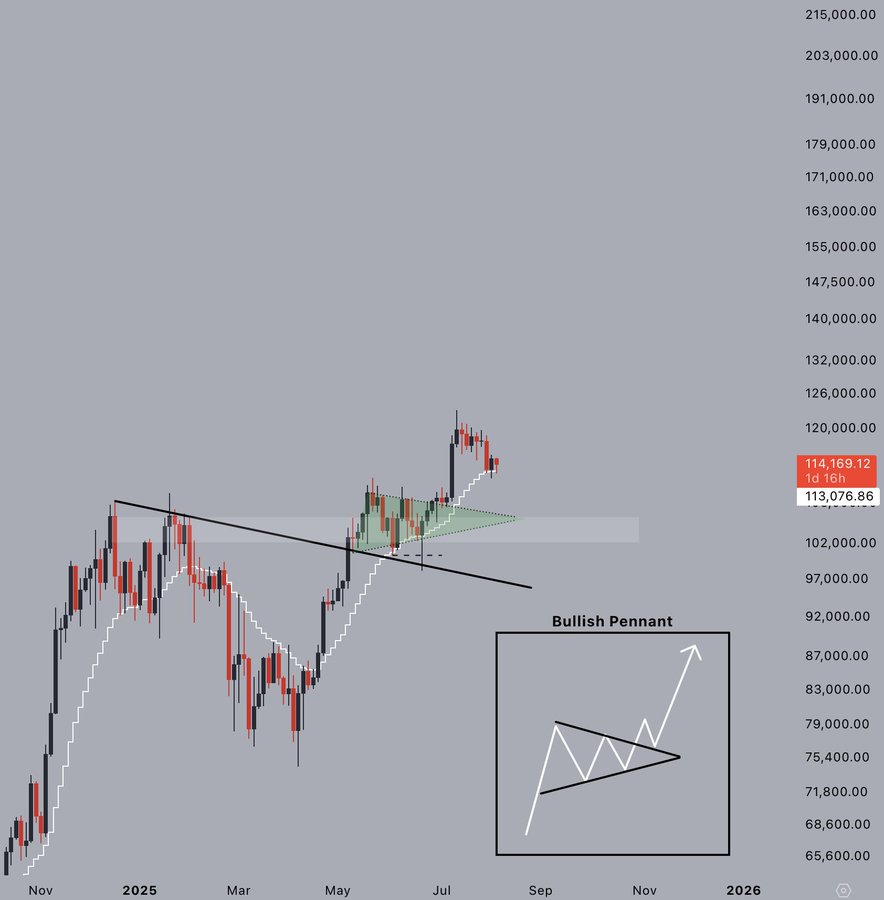
However, according to analyst Jelle, Bitcoin has officially broken out of a bullish pennant pattern and is now retesting the 50-day EMA around the $113,000–$114,000 range.  

Bitcoin broke out of a bullish pennant
Bitcoin broke out of a bullish pennant.

The breakout signals renewed bullish momentum, with the pennant’s target set at $130,000. As long as Bitcoin holds above the key support zone and the 50-day EMA, the technical structure supports a continuation of the uptrend.

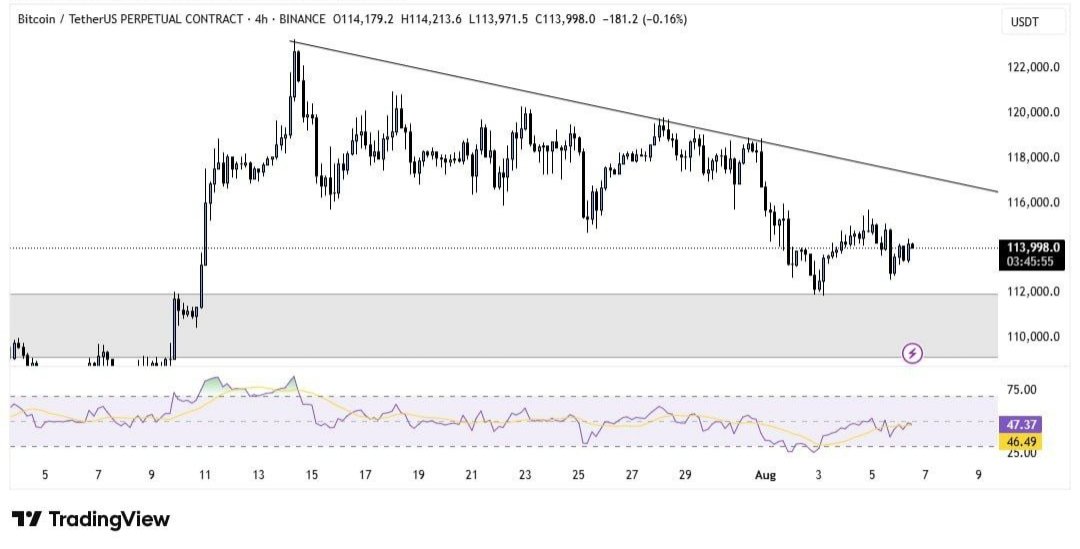
Another analyst, Mayank Dudeja, noted that Bitcoin is trading in a tight range between strong resistance at $114,500–$115,000 and key support at $112,000–$112,500. Although it recently bounced from the demand zone, it remains below the descending trendline, showing no clear bullish momentum. 

Bitcoin faces resistance at $115000

The RSI is neutral around 47, indicating weak buying pressure. The analyst noted that a breakout above $115,000 could trigger a rally toward $118,000–$120,000, but a drop below $112,000 may open the door to deeper losses toward $110,000 or $108,000.

Meanwhile, analyst Michael had earlier revealed that Bitcoin is retesting a multi-year trendline after hitting claiming the new peak above $123K. Now trading around $114,000, the analyst noted that Bitcoin’s price action around this long-term level could determine its next move. 

Notably, Ash Crypto suggests Bitcoin is mirroring its 2017 bull run, where it broke descending channels before surging from $7,900 to nearly $20,000. The analyst noted that BTC shows a similar setup to that final rally. Ash believes Bitcoin is entering a parabolic phase, with a potential breakout toward $150,000–$180,000 in the coming weeks.

Here’s How High XRP Could Go If the Total Crypto Market Cap Reaches $20T and XRP Maintains Its Share

The global crypto market is valued at over $3.7 trillion, and XRP is among the few crypto assets holding a notable share.

During the bull run, experts project the market could surpass $20 trillion in this cycle.

Interestingly, widely followed market commentators like Capt Toblerone have even suggested a potential valuation as high as $35 trillion. In such a promising market environment, bold price forecasts have emerged for top altcoins like XRP.

Given the prevailing bullish outlook for the market this season, this article explores the potential price of XRP in a scenario where the global crypto market hits $20 trillion and XRP maintains its current market share.

XRP’s Market Share

At the current global market valuation of $3.7 trillion, XRP accounts for approximately 4% of the market, with a market cap of around $123 billion. In comparison, Cardano contributes just 0.63% with its $20 billion market cap. BNB and Solana make up 2.78% and 2.29%, respectively.

The only assets ahead of XRP are Bitcoin, Ethereum, and the stablecoin USDT. Notably, Bitcoin controls 64% of the market with a valuation exceeding $2 trillion. Ethereum commands 9%, while USDT accounts for approximately 5%.

Should the crypto market reach $20 trillion and these assets maintain their current shares, their valuations would increase significantly.

XRP Price in a $20 Trillion Global Crypto Market

If XRP retains its 4% market share in a $20 trillion market, its market cap would rise to $800 billion (based on 4%). With a circulating supply of 58.93 billion tokens, this would translate to a unit price of approximately $13.57.

This would mark a new all-time high for XRP, which has been trading below its peak for over seven and a half years.

Notably, many analysts have projected that XRP could reach and potentially exceed the $13 mark this year. Some even suggest XRP could hit prices above $20 this cycle. Historically, price predictions for XRP were primarily based on technical analysis and historical performance.

However, with growing institutional adoption of XRP through ETFs and its inclusion in treasury reserves, many believe the token could outperform expectations.

Bitcoin, Ethereum, and Other Top Altcoins in a $20 Trillion Market

If Bitcoin maintains its 64% dominance, its market cap would rise to $12.8 trillion, implying a BTC price of over $644,000 per coin.

Ethereum would also reach the trillion-dollar milestone, with a projected valuation of $1.8 trillion if it retains its 9% share.

USDT would rise to $966 billion, nearing the $1 trillion mark. Meanwhile, BNB and Solana would hit historic highs, reaching $556 billion and $458 billion, respectively.

Interestingly, Cardano’s 0.63% market share would take its valuation to $126 billion, resulting in an ADA price of approximately $3.56. This isn’t far from Cardano’s previous all-time high of $3.10, which it reached with a market cap of $95 billion.

Finance Coach Shares XRP Investment Strategy That Made Him Financially Free

0

Coach JV, a prominent finance expert, has shared an investment strategy involving XRP and Bitcoin that granted him financial freedom.

Notably, the market pundit calls this his “Wealth Ecosystem,” and it revolves around five main holdings: XRP, Bitcoin, Stellar (XLM), Hedera (HBAR), and Solana (SOL). According to him, the trick is to keep emotions out of investing and make every dollar work with clear goals.

Wealth Ecosystem Involving XRP, Bitcoin, and Other Assets

Interestingly, while he includes Bitcoin and altcoins in his plan, his strategy for both classes differs. The pundit revealed he never sells Bitcoin. 

Instead, he uses it as collateral to take on low-risk leverage, then uses that borrowed money to buy assets that generate steady income. After paying off the leverage, he repeats the process. 

However, with altcoins, he sells off half of his holdings during price surges based on pre-set targets, staying away from hype or guesswork. Coach JV noted that he employs a rule-based approach and never lets emotions drive his decisions.

Interestingly, market analyst EGRAG Crypto has also suggested a similar strategy involving XRP. According to him, while he expects XRP to reach higher targets such as $33, investors should not try to time the top, but should instead take profit from lower pre-set targets. 

Coach JV employs a similar strategy. However, he revealed that instead of letting the profits he realized sit idle, he moves them into cash value life insurance, which he treats as a second layer of leverage. He then uses this insurance capital to buy dividend-paying assets. After paying down any leverage, he goes through the same cycle again. 

The finance coach confirmed using the same method during bear markets, by redirecting extra cash flow, after settling debts and must-pay expenses, back into solid deflationary assets and income-producing investments. 

According to Coach JV, this plan was responsible for making him financially free over five years, from 2020 to 2025. Meanwhile, looking ahead to 2025–2030, he said the same strategy would build lasting wealth for his family.

Similar Financial Commentaries

This is the latest commentary from the market commentator about gaining financial freedom. In most of his disclosures, Coach JV has continued to highlight XRP and Bitcoin as two of the best assets to hold. 

For instance, just a few days ago, he called out how many people waste hours scrolling through social media or financing expensive cars while ignoring basic steps like budgeting or investing in long-term assets. He believes that ten years of DCAing into assets like Bitcoin and XRP could change a family’s financial future forever.

Meanwhile, in July, he warned investors about common traps. Coach JV pointed out that chasing meme coins, thinking short-term, or relying solely on crypto without a broader financial plan would lead to failure. 

He encouraged investors to employ a strategy that focuses on real-world asset-backed crypto assets and combines them with life insurance, real estate, precious metals, and dividends. According to him, investors should keep their money moving and never let it sit idle.

MetaMask Eyes Stablecoin Launch in Partnership with Stripe

0

MetaMask may soon enter the stablecoin arena through a new proposal involving payments giant Stripe.

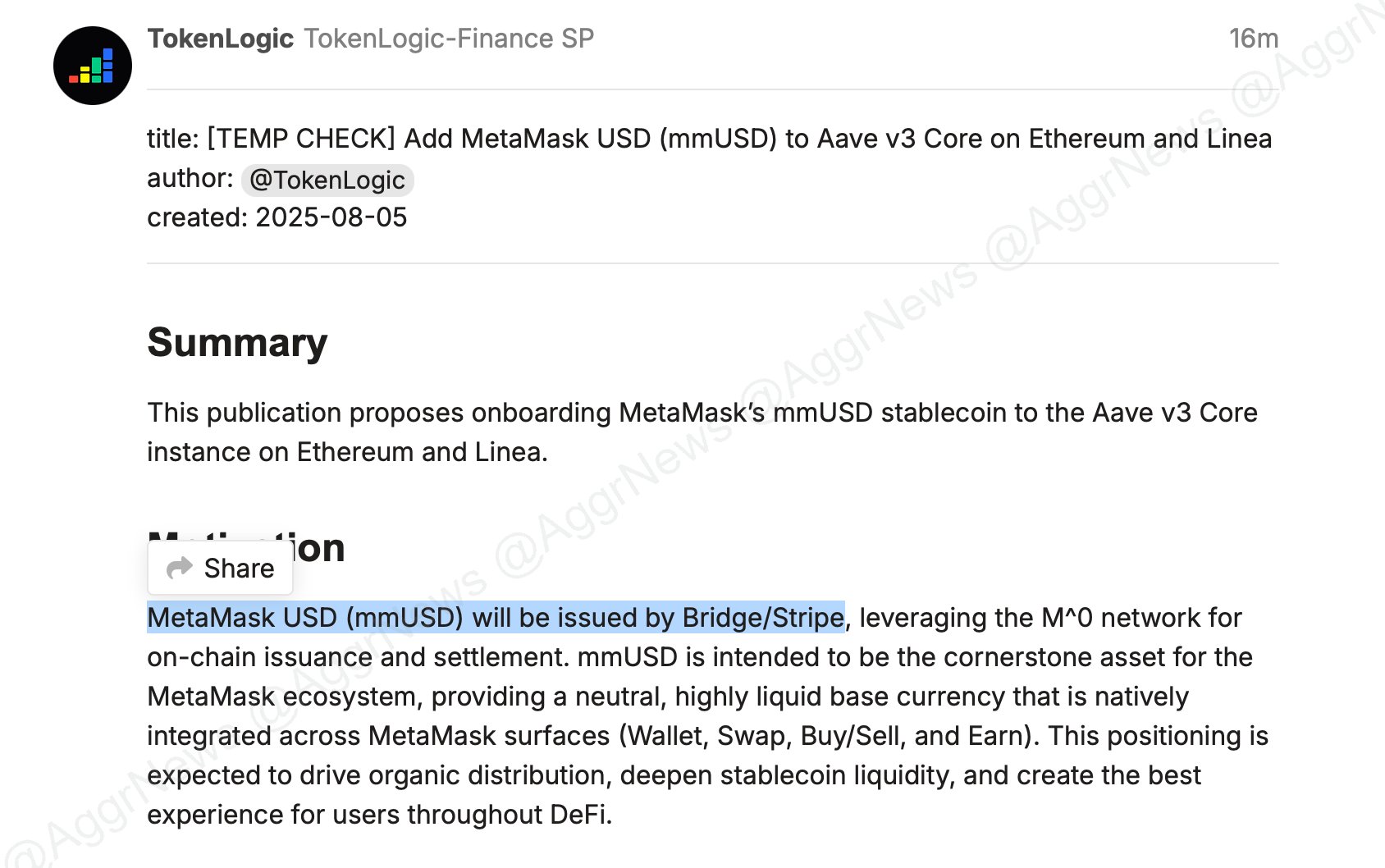
The renowned crypto custody solution is exploring the launch of a new stablecoin called MetaMask USD (mmUSD) in collaboration with Stripe, according to a recently published governance proposal. The proposed token would be pegged to the US dollar and integrated directly into MetaMask’s suite of decentralized tools.

The idea is to introduce a stable medium of exchange within decentralized applications. In turn, this helps users avoid the volatility typically associated with altcoin transactions.

Notably, the proposal also highlights plans to leverage Stripe’s financial infrastructure. This will facilitate easier and more reliable transfer of funds between traditional banking systems and blockchain-based platforms.

At the time of reporting, neither MetaMask nor Stripe has officially confirmed the project. However, the documentation suggests a strategic move to reduce friction in crypto payments and expand MetaMask’s role in the evolving Web3 ecosystem.

Proposal highlighting imminent MetaMask USD stablecoin | Source X
Proposal highlighting imminent MetaMask USD stablecoin | Source X: https://x.com/AggrNews/status/1952821245814182346

mmUSD to Anchor the MetaMask Ecosystem

According to the proposal, mmUSD would serve as a native currency within MetaMask’s product suite.

The stablecoin would be highly liquid and integrate directly across MetaMask’s tools. It would also use the M^0 network for off-chain issuance and settlement, optimizing speed and scalability.

This move positions mmUSD as a central pillar in MetaMask’s broader plan to deepen liquidity and drive organic adoption across DeFi markets.

Stablecoins: A Growing Force in Crypto

The MetaMask proposal comes amid the rapid growth of stablecoins, now valued at over $250 billion globally.

In 2020, that number was in the single-digit billions. Today, around 20 million addresses use stablecoins across public blockchains.

Federal Reserve Governor Christopher Waller recently acknowledged that 99% of stablecoins are pegged to the US dollar. This trend shows that crypto may extend the dollar’s reach, rather than replace it.

Former U.S. Comptroller of the Currency Brian Brooks echoed this view. He argued that stablecoins can help keep the US dollar as the world’s reserve currency by making it more available across borders.

MetaMask Card Lays the Groundwork for DeFi Payments

The proposal follows MetaMask’s launch of its crypto payment card, developed in partnership with Baanx and Mastercard.

The card enables users to spend crypto without extra steps, top-ups, or bank involvement while preserving the self-custody principle central to Web3.

Baanx executive Simon Jones described this shift as the rise of “non-custodial neobanking”, a model that empowers users to pay directly from their wallets without relinquishing control to traditional banks.

He emphasized that these innovations are foundational to driving mass adoption of stablecoins and making crypto more usable in everyday payments.

Investor Loses $3.05 Million in USDT to a Phishing Attack

0

A notable blockchain analytics platform noted that an investor just lost a significant amount of USDT in a malicious phishing attack.

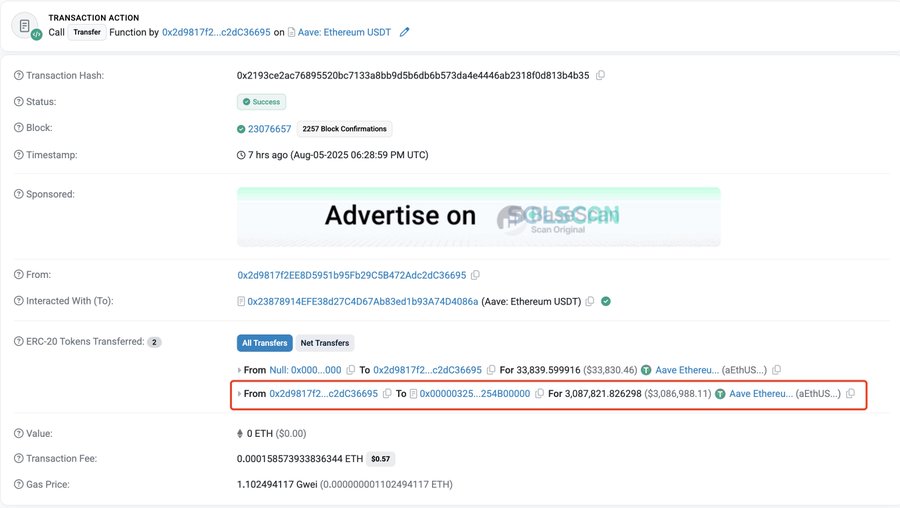
In a post on X, Lookonchain reveals that the crypto investor lost over $3 million in USDT after unknowingly approving a malicious transaction yesterday, August 5. 

According to the analytics platform, the attacker used a phishing exploit to access and transfer the funds from the victim’s Ethereum wallet. Blockchain data confirmed the incident.

$3 Million Lost in Single Phishing Attack

The attack took place at approximately 6:28 PM UTC yesterday. The wallet involved, 0x2…695, interacted with Aave’s Ethereum USDT contract during the incident.

Details of the hack
Details of the hack

According to on-chain data, the victim received 33,839 aEthUSDT earlier in the transaction, suggesting the attacker may have used a fake airdrop or deceptive token transfer as bait to initiate the exploit.

Meanwhile, the attacker received 3,087,821 aETHUSDT tokens, valued at roughly $3.05 million, from the victim’s wallet.

Afterward, the hacker moved the funds to two addresses. First, it moved 463,173 USDT to an address identified as “Fake_Phishing” and then moved the remaining 2.6 million USDT to an unidentified address.

The Fake_Phishing address appears to have sent 463K USDT to a dead address, while the unidentified address moved $2.6 million to several other addresses, swapped them for 730 ETH, and then staked these ETH tokens.

Lookonchain Encourages Vigilance

Following the loss, Lookonchain emphasized the importance of understanding transaction prompts before signing them, warning that a single careless click could result in the complete loss of wallet funds.

Notably, this case is not an isolated incident. Last year, a DeFi whale lost $55.47 million in DAI after signing a phishing transaction that transferred asset ownership to a scammer.  The funds, stored in Maker, became inaccessible once control shifted. The attacker quickly moved the DAI to a new wallet and began converting it to Ethereum.

Before that, a MakerDAO delegate lost $11 million in tokens, including USDe, to a phishing attack. Scam Sniffer reported that the attacker used multiple phishing signatures to trick the delegate’s wallet into approving malicious transactions.

Over $2 Billion Lost to Hackers in the first Half of 2025

Notably, incidents of stolen funds continue to rise. In the first half of 2025, crypto theft reached a record high as bad actors stole $2.1 billion across 75 attacks. The figure marks a 10% rise from H1 2022 and nearly matches the $2.2 billion stolen in all of 2024. 

The largest single incident was the Bybit hack, which accounted for $1.5 billion and was linked to North Korean threat actors. Another major breach involved Israeli-affiliated Predatory Sparrow, which targeted Iran’s Nobitex exchange during the Israel-Iran conflict, seizing $90 million and sending it to unusable addresses.