Home Blog Page 593

Brazil Sets Date for Historic Hearing on Bitcoin Reserve

Brazil, the largest economy in South America, is preparing to take a major step toward adopting Bitcoin as a strategic financial asset.

Specifically, the Chamber of Deputies has officially scheduled its first public hearing on the creation of a national Bitcoin reserve for August 20, 2025.

Parliament to Debate Bitcoin Bill

The public hearing will focus on Bill 4.501/2024, authored by Federal Deputy Eros Biondini. It was initially introduced in November 2024. The bill proposes that Brazil begin diversifying its sovereign assets by including Bitcoin and other secure crypto assets in its national reserves.

The initiative aims to modernize Brazil’s financial strategy and align it with emerging global trends. 

Economic Development Commission Backs the Proposal

Federal Deputy Luiz Philippe de Orleans e Bragança formally requested the public hearing through the Economic Development Commission (CDE). The session will take place in Plenary 5, Annex II of the Chamber of Deputies in Brasília, beginning at 4:00 p.m. on the opening day of the congressional term.

According to CDE announcements, the hearing marks a major milestone in advancing the bill toward potential approval and presidential sanction.

Experts and Institutions to Present Views

Notably, the hearing will feature participation from key stakeholders in Brazil’s financial and crypto sectors. Diego Kolling, Head of Bitcoin Strategy at Méliuz, and Rubens Sardenberg from FEBRABAN have already confirmed their attendance.

They have also extended invitations to representatives from Abcripto, the Central Bank of Brazil, the Ministry of Finance, and the Ministry of Development, Industry, Commerce, and Services. 

Their presence will provide broader insights into how Bitcoin integration could affect Brazil’s fiscal, monetary, and industrial policies.

Global Efforts

The success of this bill could position Brazil among the first major economies to formally adopt Bitcoin in its sovereign reserves. In the United States, similar proposals are under discussion. 

The president has shown support, having signed an executive order related to crypto reserves. Meanwhile, individual states like Texas have already passed laws supporting Bitcoin reserves.

In June, Texas became the first U.S. state to allocate public funds—$10 million—for purchasing BTC. Governor Greg Abbott signed the bill into law following bipartisan support in the Senate.

While Arizona and New Hampshire have passed similar bills, Texas was the first to fund and implement a dedicated Bitcoin reserve.

Beyond holding Bitcoin, other countries like France have drafted bills to launch Bitcoin mining at state-run nuclear facilities to utilize surplus energy.

The plan aims to convert wasted energy into state revenue, with projections estimating up to $150 million annually from one gigawatt of unused power. Notably, France lost €80 million in 2024 due to surplus energy inefficiencies.

AMINA Bank Becomes First Regulated Bank to Offer SUI Trading and Custody

0

Swiss-regulated AMINA Bank AG has launched custody and trading services for SUI, marking a global first in regulated banking support for the Sui blockchain.

This initiative reflects the bank’s strategy to give institutional clients early, compliant access to high-potential digital assets.

Meanwhile, the bank plans to introduce staking for SUI later this year. The offering will feature governance tools for deposits and withdrawals, no limits on trading volumes, and strict compliance safeguards.

Together, these capabilities will enable institutions to execute strategies at scale while meeting regulatory standards.

Institutional Adoption Accelerates

The rollout comes amid a surge in institutional engagement with SUI. Several ETF applications are moving forward, with Canary Capital’s SEC review and 21Shares’ Nasdaq listing bid already in progress.

In addition, SUI is planned for inclusion in Bitwise’s crypto index ETF. These developments indicate growing recognition of Sui as a viable asset for regulated investment products.

AMINA’s Chief Product Officer, Myles Harrison, says Sui’s design can replace traditional Web2 infrastructure, delivering speed, scalability, and efficiency beyond many competing Layer-1 networks.

SUI Price Trends and Major Corporate Endorsements

SUI has faced short-term price pressure, down 12% this week to $3.46, but network activity remains strong. In July 2025, Sui processed $224,181,854 in stablecoin transfers, topping Solana’s $210,196,551 over the same period.

As reported earlier by The Crypto Basic, U.S.-based Mill City Ventures has unveiled a $450 million private funding initiative as part of its new treasury strategy focused on SUI. The Nasdaq-listed firm intends to dedicate roughly 98% of that capital to SUI holdings. 

It has already secured 76,271,187 tokens at an average of $3.6389 each through a combination of over-the-counter purchases and in-kind arrangements with the Sui Foundation. The company also signaled it will continue expanding its position through additional open-market acquisitions.

Developer and Ecosystem Growth

The Sui Network’s growth is keeping pace with its rising institutional profile. Developer events in Paris, Athens, Istanbul, Bangkok, and Vietnam are expanding their reach and attracting fresh talent.

The Sui Summer 2025 campaign has already engaged nearly 3,000 developers, a 50% increase from 2024. With $2 billion in assets locked across its ecosystem and a technical foundation built for enterprises, the network is strengthening its position among the leading Layer-1 blockchains.

Indonesia Considers Bitcoin as Part of National Reserve

0

The office of the Indonesia Vice President held discussions with Bitcoin advocates to explore the possibility of using Bitcoin as a national reserve.

According to Bitcoin Indonesia on X, the meeting with pro-crypto officials marks a significant step in exploring digital assets at the sovereign level. The talks included a proposal to use Bitcoin mining as a reserve mechanism.

Although no official policy has been announced, Bitcoin Indonesia, the largest Bitcoin community in Asia, notes that officials expressed interest in further education efforts.

Exploring Bitcoin as a Strategic Asset

According to the group, the conversation focused on how Bitcoin could support economic strength and reserve diversification. Bitcoin Indonesia highlighted global macroeconomic trends and shared resources such as The Bitcoin Standard, The Fourth Turning, and Ray Dalio’s The Changing World Order.

Bitcoin Indonesia referenced Michael Saylor’s Bitcoin price forecast for 2045, tying it to the 100th anniversary of Indonesia’s independence. The symbolic alignment appeared to resonate with officials.

A representative from the Vice President’s office, Adhit, emphasized the need for continued public education on Bitcoin, highlighting it as an important step in Indonesia’s engagement with digital assets.


The group also echoes the idea that education is key to adoption, adding that Bitcoin Indonesia is committed to providing learning resources and outreach without cost.

Current Reserves and Regulatory Environment

Indonesia’s foreign reserves are traditionally composed of gold, U.S. dollars, and government bonds. Adding Bitcoin would represent a major change in strategy and place Indonesia among the few nations actively exploring digital assets at a sovereign level.

Earlier in July, Bank Indonesia (BI) reported a slight rise in the country’s foreign exchange reserves to $152.6 billion at the end of June 2025, up from $152.5 billion in May. This increase was driven by tax revenues, service income, and global bond issuances, as the central bank worked to stabilize the rupiah amid global financial uncertainty.

Notably, Indonesia just raised crypto transaction taxes from August 1, with domestic trades taxed at 0.21% and overseas trades at 1%. VAT on purchases is removed, but crypto mining faces a higher 2.2% VAT, and mining income will be taxed under regular income or corporate tax from 2026. The changes follow a surge in crypto activity, with over 650 trillion rupiah traded in 2024.

Regional and Global Context

Indonesia’s interest follows similar developments in other nations. El Salvador made headlines in 2021 by adopting Bitcoin as legal tender and adding it to its national reserves. Earlier this year, the country expanded its Bitcoin holdings to 6,067.

Kazakhstan is also considering crypto assets for its national investment strategy, including a state-backed reserve and stricter regulations. Central Bank Governor Timur Suleimenov said the plan, still under review, aims to diversify reserves by investing in crypto ETFs or blockchain firms, following global trends but with caution due to high risks.

Bhutan is also among the Asian countries exploring Bitcoin. Since starting Bitcoin mining in 2020, crypto has become central to Bhutan’s economy, contributing up to 40% of GDP. With 11,711 BTC valued at $1.3 billion, Bhutan now holds the world’s third-largest national Bitcoin reserve, managing it with hedge-fund-level precision.

Notably, Bitcoin Indonesia said the meeting was about ideas, not hype. The group left behind books and a conference T-shirt for Vice President Gibran Rakabuming Raka as part of a broader effort to drive public education and policy engagement.

Meanwhile, in March, Donald Trump created a Strategic Bitcoin Reserve, with the White House calling Bitcoin “digital gold.”

The U.S. currently holds 198,109 BTC ($17.5B), which will not be sold but may be increased cost-effectively. The move aims to give the U.S. strategic advantages, with Michael Saylor declaring America now holds the world’s largest Bitcoin reserve.

Here’s How Much Inflows Could Easily Push XRP Past $7 

Analyst Zach Rector recently presented a case for how a $5 billion inflow into XRP via ETFs could drive its price beyond even the $7 level.

Among the key drivers of this outlook are the upcoming Federal Reserve rate cuts and the anticipated launch of XRP ETFs.

Specifically, Rector cited data showing that the odds of a September rate cut have surged to 90%, with Goldman Sachs predicting three consecutive 25-basis-point cuts starting this fall. He expects the easing monetary environment to inject liquidity into the markets, benefiting XRP.

Notably, the expected rate cut would come at a time when XRP spot ETFs may attain SEC approval, creating a more fertile ground for a price surge. The performance of Bitcoin and Ethereum amid ETF inflows continues to fuel this perspective.

$5 Billion Inflows Could Propel XRP Above $7

Currently trading just above $3, Rector argued that XRP could experience a dramatic price surge if it captures even a fraction of the inflows seen by Ethereum ETFs.

Notably, Ethereum funds attracted $5.4 billion in inflows in July alone. Bitwise CIO Matt Hougan highlighted this figure in a recent tweet, drawing comparisons to Bitcoin. He noted that Ethereum is only about 20% the size of Bitcoin, making the scale of those inflows especially significant.

He suggested that if Bitcoin ETFs pulled in $27 billion in a single month, the price implications would be pronounced—emphasizing just how impactful those Ethereum flows really are. Indeed, ETH saw its best performance of the year in July as a result of those inflows.

Meanwhile, Rector argued that XRP may benefit even more from such massive ETF investments. He explained that if XRP ETFs launch this October and attracted a similar $5 billion, XRP’s market cap could increase by $250 billion. This would represent a 138% price gain, pushing XRP past $7 per token.

Rector also stated that this projection is conservative, based on a 50x market cap multiplier. He noted that this multiplier is significantly lower than some of the more optimistic estimates he previously discussed.

$10 to $20 XRP Within Reach

At the same time, Rector remains confident that XRP could reach $10 to $20 within a year of ETF approval, assuming inflows are on par with or exceed Ethereum’s recent figures.

Adding to the bullish outlook is the anticipated conclusion of the SEC’s lawsuit against Ripple. Rector said that once retail investors realize the Ripple case is finally over, optimism will fuel the next leg of the XRP rally.

Notably, the SEC and Ripple are expected to drop their appeals by mid-August. Former SEC lawyer Marc Fagel confirmed that the appeal process is nearing completion.

Many have highlighted August 15 as a potential date for an official resolution as the SEC and Ripple are to provide a status update to the appeals court by then.

Midnight Glacier Drop Claim Portal Now Open for XRP and Cardano Users

0

The team behind the Midnight Network has launched the claim portal for the Glacier Drop, opening up the first phase of the NIGHT token distribution. 

Following the launch, 33.6 million eligible addresses across eight major blockchains can now claim their free NIGHT tokens on the portal. The supported blockchains include XRP Ledger, Cardano, Solana, Bitcoin, BNB, Ethereum, Basic Attention Token, and Avalanche. 

Notably, the Glacier Drop portal went live just a day after Cardano founder Charles Hoskinson teased its launch in a cryptic tweet. It was captioned “tomorrow kids” and was accompanied by a GIF, which reads “So it begins.” 

Expectedly, the post elicited several reactions, with users suggesting that the team was preparing to launch the Glacier Drop claim portal. Interestingly, the portal has gone live, enabling eligible users to claim their NIGHT tokens. 

How to Claim NIGHT 

Users can claim their tokens in four steps. The first step involves visiting the claim portal and connecting the “origin address.” It is worth noting that the origin address is the same as the one that qualified for the airdrop. 

Upon connecting this address, users can provide a destination address to receive the free NIGHT allocations. To complete the claim, users must accept the terms and conditions and also sign the transactions. 

Phases of NIGHT Airdrop 

The Glacier Drop, which is the first phase of the claim, will last 60 days. Once this phase ends, the Scavenger Mine–the second phase–will commence immediately for the next 30 days. 

During this phase, users are required to complete computational tasks to earn a share of unclaimed tokens. Eligible users who missed the Glacier Drop will be presented with another opportunity to claim their tokens in a subsequent phase dubbed Lost-and-Found. Any unclaimed tokens after this event will be allocated to the Midnight treasury. 

ADA Holders Remain Biggest Gainers 

Although the Glacier Drop supports addresses from major blockchains, Cardano users will receive the lion’s share. As previously reported, 50% of NIGHT’s token supply, equivalent to 12 billion tokens, is reserved for ADA holders. 20% of the supply, translating to 4.8 billion tokens, will be allocated to eligible users on the Bitcoin network. 

The remaining 30% supply, or 7.2 billion NIGHT, will be split among Avalanche, XRPL, Solana, Basic Attention Token, BNB, and Ethereum users. 

According to sources, Over 33 million addresses are eligible for claims:

ADA: 1,072,307

BTC: 17,562,278

XRP: 2,213,942

ETH: 7,862,092

SOL: 3,465,122

BNB: 1,213,677

AVAX: 227,793

BAT: 24,605

Users’ individual holdings of eligible tokens at the time of the snapshot will determine the amount of tokens they will receive. 

Insane XRP Prediction: Why an Expert Thinks 1 XRP Could Be Worth $1,000,000

A recent thread by long-time crypto investor Pumpius proposed that 1 XRP could eventually be worth $1,000,000 per coin.

Indeed, that number sounds outrageous for a coin currently trading at just $2. However, the logic behind it is based on a future where XRP powers the backbone of a tokenized global economy.

“Ripple Is Quietly Tokenizing the Real World”

According to Pumpius, while other crypto projects chase social media attention and speculative pumps, Ripple is laying the groundwork for something bigger. He claims the company is quietly moving real-world assets (RWAs) onto the blockchain. Some of the initiatives he cites include:

  • A government-backed real estate tokenization pilot in Colombia
  • XRP Ledger upgrades like XLS-20 and XLS-30, enabling NFT and token issuance
  • Central bank digital currency (CBDC) infrastructure already deployed by Ripple
  • A $100 million commitment to tokenizing carbon markets
  • Collaborations with regulated firms like Archax and OpenEden

These developments suggest Ripple isn’t just building a payment solution but creating a platform for transferring all forms of value.

The Path to a Tokenized World Worth $1 Quadrillion

Furthermore, Pumpius cites forecasts from the Boston Consulting Group and Citi, which expect $16 trillion worth of RWAs to be tokenized by 2030. But he believes that’s only the beginning.

If global assets, including $300 trillion in real estate, $100 trillion in stocks, and over $100 trillion in bonds, along with currencies and commodities, are all brought on-chain, the tokenized economy could exceed $1 quadrillion in value. In such a world, a universal bridge asset would be necessary, and according to Pumpius, XRP is designed to fulfill that role.

XRP is Built for Movement, Not Storage

Unlike Bitcoin, which is often seen as a store of value, XRP is for high-speed value transfer. Its features include:

  • 3–5 second settlement times
  • A built-in decentralized exchange (DEX) and automated market maker (AMM)
  • Native support for multiple assets
  • Programmability through Hooks and sidechains
  • A regulatory-focused architecture

Suppose XRP becomes the core liquidity layer for cross-asset transfers in a fully tokenized world. In that case, each XRP might represent a fractional claim on a system that moves trillions in daily volume, in Pumpius’s view.

The Math Behind $1M XRP

With a total supply of 100 billion XRP, and much of it locked or burned, scarcity plays a role. Pumpius argues that if XRP facilitates global settlement at scale, a million-dollar valuation per coin is not a meme but a liquidity model driven by:

  • Massive asset flows
  • Limited supply
  • Dominance in cross-chain infrastructure

“You won’t buy a house with XRP,” he wrote. “Your house might be XRP.”

Skeptics will naturally dismiss the idea of $1 million per XRP as pure fantasy. However, history has shown that revolutionary technologies often begin with seemingly unthinkable projections.

Pumpius noted that just as few believed in the Internet’s impact in 1994, the idea of XRP powering a quadrillion-dollar tokenized economy may be either ahead of its time or right on time.

Previous Call for XRP to $1 Million

Meanwhile, the idea of XRP reaching $1 million price is not entirely new in the XRP community. In a viral video, XDC Foundation developer Quincy Jones proposed that XRP’s value could soar to $100, $100,000, or even $1 million, depending on the volume of assets issued on its network. 

He explained that XRP acts as a liquidity bridge between financial instruments, such as bonds, stocks, and currencies, meaning its value is directly linked to the volume of transactions it supports.

Using a hypothetical scenario involving $100 trillion in equity and $500 million in debt issued on the XRP Ledger, Jones suggested such demand could drive prices dramatically higher. Meanwhile, he acknowledged the speculative nature of these predictions.

Coinbase, PayPal Defend Stablecoin Rewards Despite GENIUS Act Ban

0

Coinbase and PayPal continue to offer USDC and PYUSD rewards despite the GENIUS Act’s interest ban, citing non-issuer status and revenue-sharing as legal cover.

On July 18, 2025, the Guiding and Establishing National Innovation for U.S. Stablecoins (GENIUS) Act became law, setting stricter oversight for the stablecoin industry.

Notably, one of its main clauses bans issuers from offering holders any form of interest or yield. According to legislators, this is intended to ensure stablecoins aren’t treated as bank deposits, which benefit from federal safeguards.

However, the law applies specifically to issuers, not to trading platforms or secondary market participants. This distinction has allowed some companies to design alternative reward structures that replicate yields without meeting the legal definition of interest.

How Coinbase and PayPal Are Responding

Leveraging this gap, Coinbase and PayPal have continued their reward programs. Coinbase currently offers U.S. customers about 4.1% annual rewards on USD Coin (USDC) holdings. Meanwhile, PayPal offers 3.7% per year on its PYUSD stablecoin through PayPal and Venmo.

Both firms emphasize that they are not the official issuers of these stablecoins. For context, Circle issues USDC, while Paxos issues PYUSD. The platforms state that their rewards derive from revenue-sharing arrangements related to broader platform operations, rather than from interest earned on user deposits.

Legal Justifications and Competitive Strategies

This legal reasoning forms the backbone of both companies’ public defense. On its latest earnings call, Coinbase CEO Brian Armstrong reaffirmed that rewards will continue, framing them as a competitive advantage that attracts and retains customers.

He emphasized that non-issuer status ensures Coinbase remains in compliance with the GENIUS Act. Armstrong also noted that customers value these benefits when deciding where to store their stablecoins.

PayPal CEO James Alexander Chriss delivered a similar message during his company’s earnings call. He described PYUSD rewards as central to customer growth and retention.

Although PYUSD is branded with PayPal’s name, Chriss clarified that it is technically a Paxos-issued product, meaning PayPal can legally maintain the rewards structure under current law.

Regulatory Context

In a press statement, a Senate staffer familiar with the legislation said that the GENIUS Act was intentionally narrow. Lawmakers wanted to address issuer-led interest programs without overreaching into secondary market activities. The official added that expanding the ban would require additional legislation.

The regulatory spotlight on stablecoins has been intense in recent years. Earlier this year, the SEC ended a 15-month investigation into PYUSD without enforcement action, signaling only a brief reprieve for PayPal.

The Road Ahead

Given the current legal framework, Coinbase and PayPal can continue their reward programs without violating the GENIUS Act. Unless Congress amends the law to include non-issuers, the opportunity for such programs to persist remains open.

Here are XRP Price Predictions for 2030 from Bitwise

0

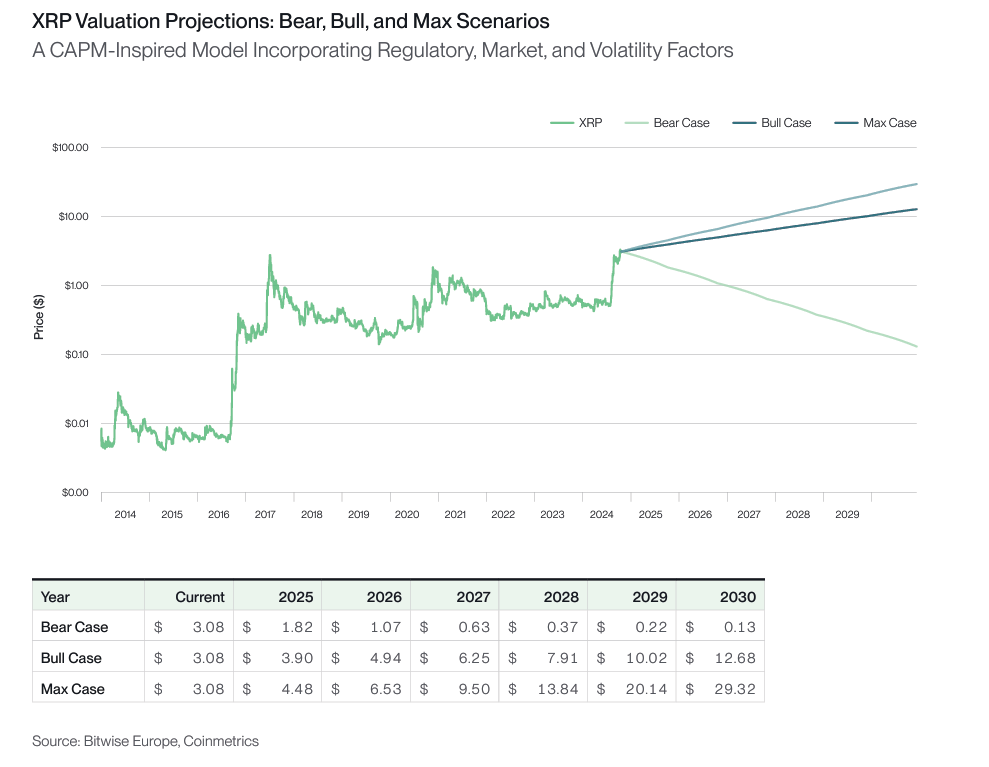
A recent investment report from Bitwise has projected several long-term XRP price predictions, presenting a data-driven forecast for where XRP could stand by 2030.

The firm used a valuation model inspired by the capital asset pricing model (CAPM) to build three price scenarios. Notably, each one reflects different outcomes for regulation, adoption, and overall market growth, offering a clear view of what could drive XRP’s value over the next five years.

Bitwise Valuation Metrics for XRP Pricing 

Interestingly, in its forecast, Bitwise included several important variables in its model. Specifically, the model factors in alpha (which captures XRP-specific drivers like regulatory clarity or major institutional partnerships), beta (which measures XRP’s link to the broader crypto market and sits at 1.92), and a market return assumption of 60%, based on Bitcoin climbing to $1 million by 2029. 

Moreover, the model also adjusts results through a volatility-based discount factor that changes depending on XRP’s historical risk profile.

XRP Price Predictions from Bitwise

Notably, in the bear case, Bitwise expects XRP to fall short in payments and tokenization. The model uses a -50% alpha and a 147% volatility rate, creating a discount factor of 0.23. This scenario produces a steep -59% annual return, with XRP sinking from $3.08 today to just $0.13 by 2030.

Meanwhile, for the bull case, Bitwise assumes XRP holds its current growth pace. The firm doesn’t expect explosive expansion but sees steady adoption and minimal regulatory setbacks. Also, with alpha at zero and volatility around 89%, the discount factor hits 0.41. This leads to a projected annual return of 27%, pushing XRP to about $12.68 by 2030.

However, in the max case, XRP could grab a meaningful slice of the global payments and tokenization markets. Bitwise sets alpha at 1% and assumes lower volatility of 75%, which brings the discount factor to 0.47. This results in a 46% annual return and a potential price of $29.32 in five years. 

XRP Price Predictions from Bitwise

At this level, XRP would carry a $2.9 trillion market cap, giving it roughly 13.8% of Bitcoin’s projected market size if Bitcoin reaches $1 million.

Bitwise stressed that XRP doesn’t need to dominate these markets to succeed. Notably, even a small share of trillion-dollar sectors like tokenization could deliver huge upside. The firm also pointed out that increased network use could amplify the burn rate of XRP fees, slowly reducing supply and adding long-term price pressure.

Bitwise Bullish on XRP Futures Growth 

Meanwhile, besides the XRP price predictions, the Bitwise report also analyzed XRP’s structure and long-term value drivers. 

For one, Bitwise broke down XRP’s on-chain into three main functions. Specifically, it powers transaction fees, supports the ledger’s spam control mechanism through reserve requirements, and serves as a bridge currency in multi-asset transfers. 

While some critics question XRP’s real-world utility, Bitwise noted that it sees steady progress in this regard. It pointed out that companies like SBI Remit and MoneyMatch already use XRP-based solutions for fast, cross-border transfers in parts of Asia and other underserved markets.

Bitwise further highlighted the XRP Ledger’s position in the race for asset tokenization. The network already supports tokenized assets and recently rolled out key features like automated market makers, decentralized identity tools, and multipurpose tokens. 

With these factors already in place, the asset manager sees a path for XRP to serve regulated financial institutions looking to tokenize real-world assets. In a previous report, Bitwise even suggested that buying XRP is a clean way of investing in the future of tokenization.

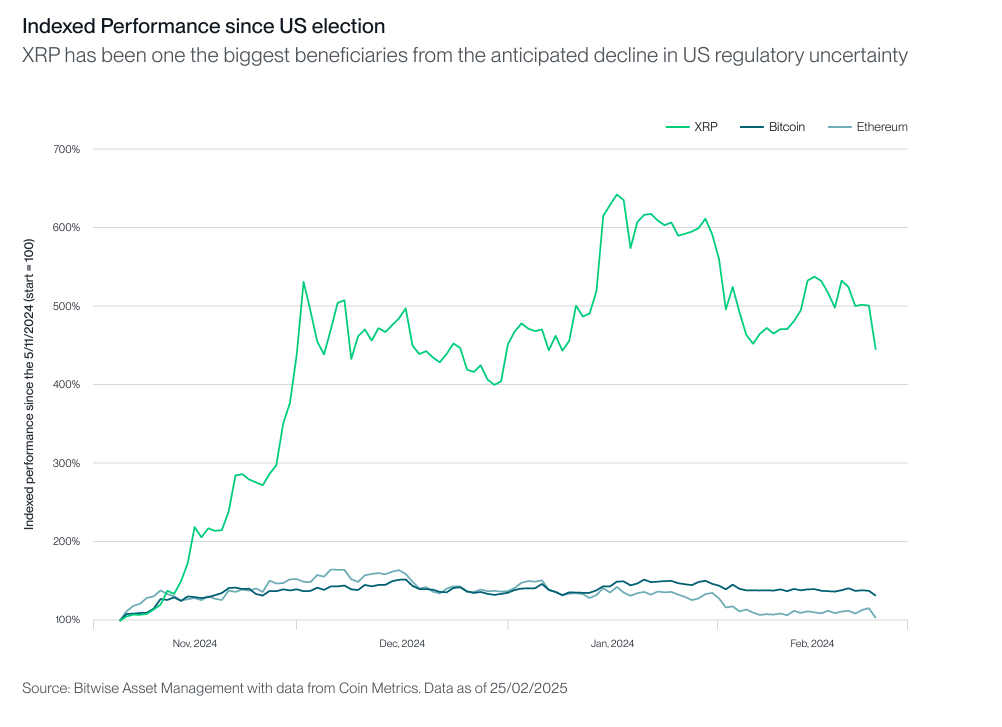
The firm also believes a clearer regulatory landscape will lead to more growth. Following the 2024 U.S. election and a more crypto-friendly administration, XRP gained over 400% in Q4. Bitwise links that rally to rising investor confidence now that legal threats have eased.

XRP Performance Following US Elections Bitwise
XRP Performance Following US Elections | Bitwise

Analyst Identifies Two Targets to Take Profit as Shiba Inu Signals Bullish Breakout After Closing Inside Volume Zone

0

Shiba Inu has reclaimed a key accumulation zone, signaling a potential breakout from a long consolidation phase. 

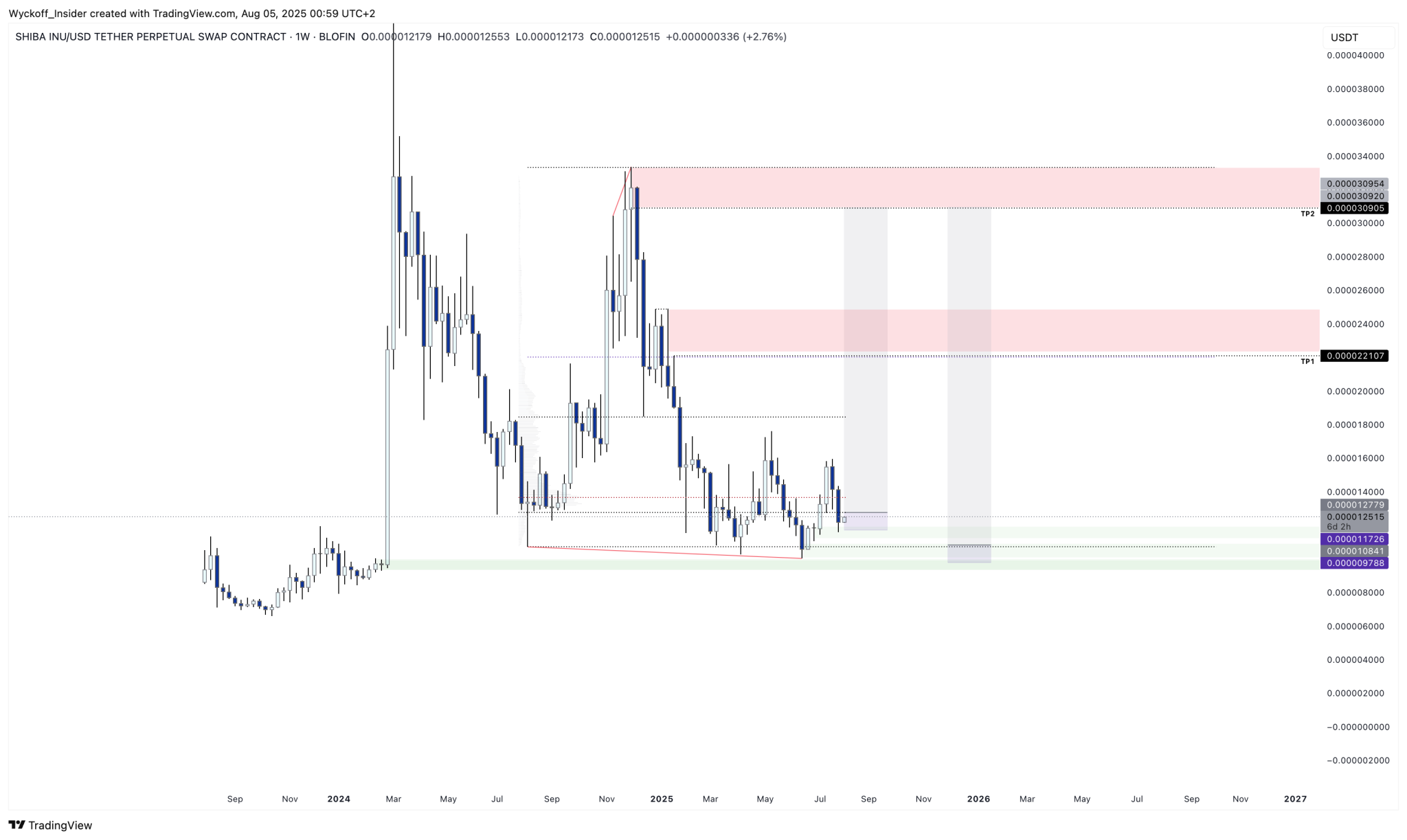
In a post on X, crypto analyst Wyckoff Insider highlighted the move, calling for a long entry based on the current price action. Meanwhile, SHIB is trading at $0.00001215, down by 1.5% in the last 24 hours and increasing its weekly loss to 11%.

Shiba Inu’s Daily Candle Confirms Entry into Volume Zone

According to Wyckoff Insider, a recent daily candle closed within a high-volume profile zone. This indicates that the price has re-entered a value area: a level where significant trading activity previously occurred. Analysts often interpret such price action as bullish, especially when supported by long-term accumulation.

Shiba Inu price analysis

This technical pattern typically indicates renewed buyer interest after a consolidation phase. Notably, the analysis outlines a long entry strategy, with the stop-loss placed just below the Last Point of Support, the final low that forms before a potential upward trend begins.

Accumulation Zone Provides Support Structure for SHIB

On the chart, SHIB has repeatedly tested a support zone between $0.000009788 and $0.000011726. This area has historically acted as a base for accumulation, where buyers absorb selling pressure. The chart also shows long wicks below this zone, suggesting failed breakdown attempts and increased demand at lower levels.

The Last Point of Support rests between $0.000011726 and $0.000011841. Wyckoff Insider recommends placing a stop-loss just below this level to manage downside risk if the structure fails.

SHIBA INU’s Upside Targets: $0.000022 and $0.000039

If the price holds above the support zone and continues upward, the first target is $0.000022107. This level coincides with previous resistance from late 2024. The second target is $0.000039005, which reflects the top of a larger supply zone formed during the peak rally.

Both levels represent key price points where SHIB faced historical selling pressure. Traders are watching for confirmation that the token can break through these zones and sustain higher prices.

Analyst Predicts Shiba Inu Rally

Despite the recent loss, analysts remain optimistic. Joe Swanson pointed to a developing cup-and-handle pattern on the daily chart, formed after SHIB rebounded from a June low of $0.00001002 to a July high of $0.00001597. 

He noted that the current pullback represents the handle, signaling a potential breakout. With ongoing whale accumulation, Swanson projected a 70% rally toward $0.00002150 once SHIB clears the pattern’s neckline at $0.00001715.

Despite this sentiment, Shiba Inu, currently ranked 22nd with a market cap of $7.26 billion and trading at $0.00001233, has slipped out of the top 20 cryptocurrencies, marking a significant decline from its former top 10 glory in 2021 and again briefly in 2024. 

Internal conflicts, anonymous leadership, and lack of institutional backing have all contributed to its downfall. While projects like Dogecoin have attracted ETF interest, SHIB remains retail-driven and burdened by an enormous token supply of 589 trillion. 

Despite the setbacks, the Shiba Inu team remains optimistic, with figures like Lucie encouraging long-term holders and hinting at ambitious price goals, including the dream of hitting $0.01.

Trump Plans Executive Order on Banks Discriminating Against Crypto Firms

0

The Trump administration is reportedly preparing an executive order that could impose stringent penalties on banks accused of closing accounts based on political beliefs or involvement with crypto.

The measure aims to end alleged discrimination against digital asset firms and politically active individuals alike.

Background: How the Banking-Crypto Rift Began

For years, cryptocurrency companies have claimed they were deliberately excluded from mainstream banking services. Specifically, they point to “Operation Chokepoint 2.0,” a term used by industry figures to describe banking practices under Biden’s administration.

According to them, these practices created an environment where digital asset firms faced sudden account terminations without clear justification.

However, banks reject these allegations, saying closures are tied to legal, regulatory, or financial risks. In particular, they point to anti-money laundering (AML) compliance, which allows them broad discretion over customer suitability.

Tensions escalated further during Biden’s term, as many crypto-related firms and individuals reported facing stricter banking restrictions. Industry leaders said these measures stifled innovation and limited access to essential financial services.

The Trump administration now seeks to reverse this trend, presenting itself as a defender of crypto interests.

Central to this shift was ending the use of “reputational risk” in customer assessments, a policy that allowed banks to deny service based on possible public image issues.

The “reputational risk” standard had given banks broad discretion to end relationships with certain industries, including companies in the digital asset (cryptocurrency) sector. Removing it reduced that discretion and signaled a more supportive regulatory stance toward digital assets.

This change has led more industry figures to share their experiences openly, bringing renewed attention to high-profile “debanking” cases.

High-Profile Victims of ‘Debanking’

Coinbase CEO Brian Armstrong said JPMorgan Chase warned clients in 2023 it would close accounts linked to primary cryptocurrency income.

Frax Finance founder Sam Kazemian, Gemini co-founder Tyler Winklevoss, Custodia Bank CEO Caitlin Long, and Bitcoin Foundation’s Charlie Shrem shared similar experiences. In November 2024, Elon Musk claimed 30 tech entrepreneurs had accounts shut down under earlier policies.

Traditional banks have long viewed cryptocurrencies with caution, citing volatility, regulatory uncertainty, and risks of fraud.

Meanwhile, crypto advocates argue that decentralized finance poses a threat to banks’ control over transactions and profits. These mounting tensions have paved the way for decisive federal action.

The Executive Order: Laws and Penalties in Focus

According to The Wall Street Journal, the White House executive order, expected within days, will direct federal bank regulators to investigate whether financial institutions have violated major federal laws.

These include the Equal Credit Opportunity Act, which prohibits credit discrimination; antitrust laws, which aim to maintain fair competition; and consumer protection statutes, which guard against unfair banking practices.

If violations are found, banks could face hefty fines, legally binding consent decrees, or other penalties. The measure is intended to deter institutions from using compliance rules as a pretext for politically motivated or industry-specific account closures.

Global Struggle Between Banks and Crypto

Globally, similar conflicts are emerging. In the UK, regulators recently banned a Coinbase ad campaign criticizing the financial system, underscoring a worldwide clash between traditional banking structures and the growing crypto economy.