Home Blog Page 598

XRP Market Cap Model Shows How Much Buy Order XRP Needs to Hit $90

0

A new XRP market cap multiplier model shows how much buy volume would be necessary to send the XRP price soaring to $90.

The model, which is still in development and its raw form, illustrates the predominant belief among XRP proponents that XRP’s market cap could grow astronomically with modest capital inflows. It also shows just how powerful capital inflows can be when liquidity is limited. 

XRP Surged to $90 with $10B in Buy Orders

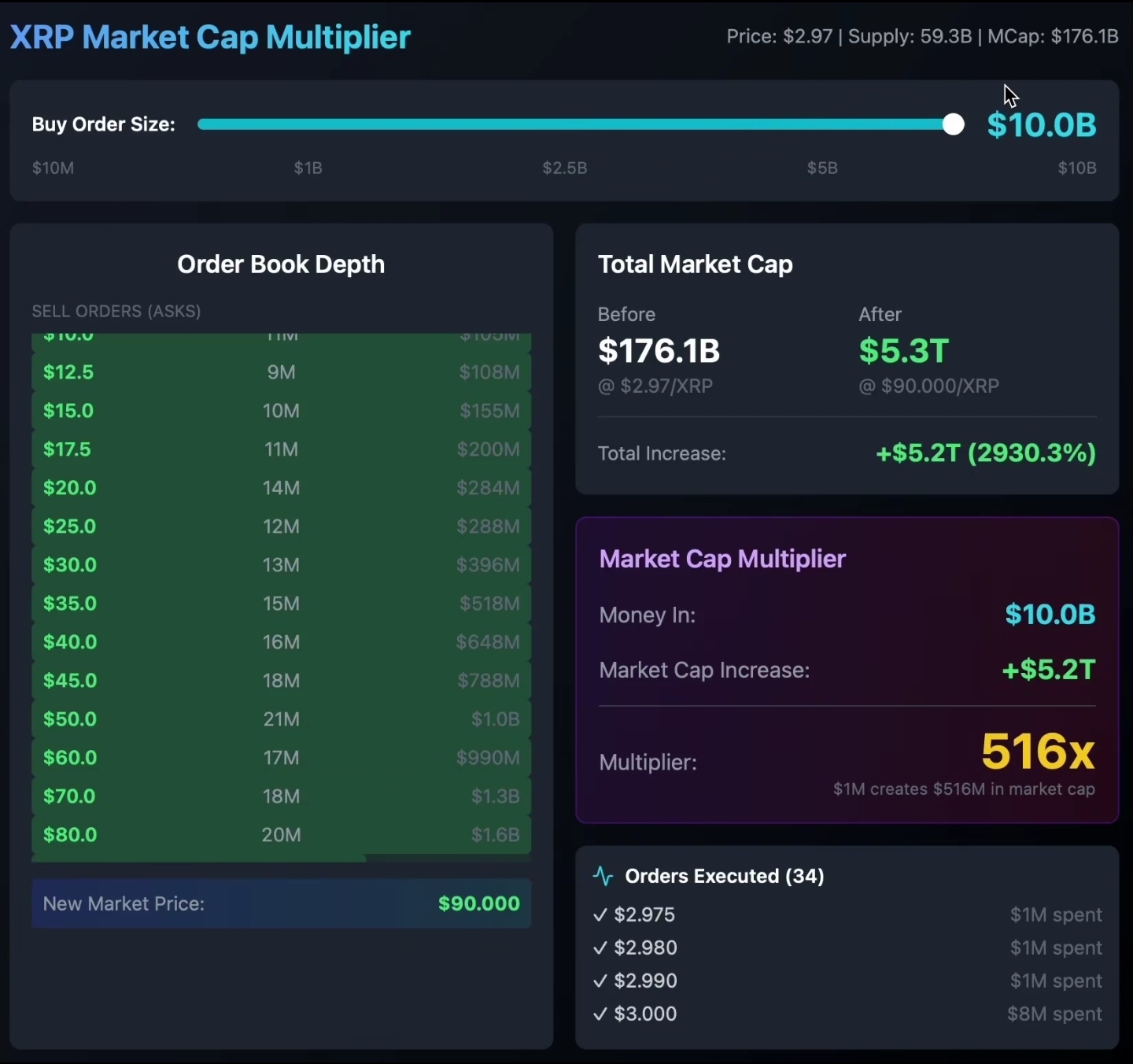
Phil Kwok, the co-founder of EasyA, unveiled the tool in a recent disclosure. In a particular scenario, he used a $10 billion input to test XRP’s response. Notably, at the time of the simulated buy, XRP traded at $2.97, with a total supply of 59.3 billion tokens, which put its market cap at $176.1 billion.

After the tool applied the $10 billion order, XRP’s price jumped to $90. This raised the market cap to $5.3 trillion, an increase of $5.2 trillion, or 2,930.3%. The model calculated a multiplier of 516x, showing that every $1 million worth of inflow could raise XRP’s market cap by $516 million under the right conditions.
XRP Market Cap Model

To reach the $90 target, the order cleared out multiplier layers of the sell-side order book, beginning at $2.975 and steadily buying up liquidity at each level. This sweep continued until it consumed all available asks up to $90. The process showed how little XRP is available for sale at higher prices and how this scarcity can drive explosive price moves.

Large Buy Orders with Thin Liquidity Could Catapult XRP to Higher Targets

Interestingly, Dom, a well-known analyst who studies order books closely, has pointed to this pattern for years. In late 2023, when XRP still traded below $1, he predicted that just $1 billion of buy pressure could push the price up by several dollars. 

Dom encouraged traders to look directly at the order book depth to see how little resistance existed beyond the early price levels.

Meanwhile, last December, when XRP surpassed $2, Dom pointed to the same mechanics behind the sharp price spike. He explained that thin liquidity allowed for steep, almost vertical price jumps as soon as serious buy pressure arrived. 

The market expert noted that most XRP holders set extremely high price targets and likely won’t sell even after big rallies, which only adds to the supply squeeze. He expected XRP to peak only when a flood of selling reappears.

Moreover, three months back, Dom shared a real-time example that showed the multiplier model in action. Specifically, he tracked $61 million in net buying pressure across top exchanges over 13 hours. 

Notably, this buying pressure added $16.6 billion to XRP’s market cap, resulting in a real-world multiplier of 272x. Highlighting this important instance, Dom stressed that market cap figures often mislead investors who don’t understand how liquidity impacts price moves.

Here is How High Shiba Inu Must Rise for SHIB to Clinch 3rd, 4th, or 5th Place in Crypto Rankings

0

Optimism about Shiba Inu’s potential push into the top five crypto rankings has been reignited as large investors indicate interest in SHIB.  

The broader Shiba Inu community eagerly anticipates SHIB’s potential ascent into the top five cryptocurrencies by market capitalization. Momentum behind this goal has surged since November 2024, when lead developer Shytoshi Kusama unveiled plans to propel SHIB into the top five rankings. 

Shiba Inu Lead’s Ambitious Aspiration 

As previously reported, the Shiba Inu lead referenced an AI-generated painting depicting a man conducting research at a cluttered desk overflowing with books. Commenting, Kusama noted that it reflects how he tries to use a small budget to give SHIB utility and take the token to the top five crypto rankings in less than five years. 

It’s been nine months since Kusama shared this aspiration, and SHIB has dropped from the 13th position, where it sat at the time, to the 22nd place. 

Nonetheless, some enthusiasts have remained optimistic about SHIB’s potential to break into the crypto top five. This optimism has soared lately as large holders shift huge amounts of tokens from exchanges like Coinbase and Binance. 

Last month, two unlabeled blockchain addresses withdrew 5 trillion SHIB and 110.34 billion tokens from Coinbase and Binance, respectively. 

For context, cracking the top 5 would place SHIB among the five largest cryptocurrencies in the world. This could see SHIB rank as either the first, second, third, fourth, or fifth-biggest cryptocurrency by market cap. 

Growth Required to Position SHIB in the 3rd, 4th, or 5th Crypto Rankings 

Despite sitting in the 22nd position, we explored how high the token must rise to ascend to the third, fourth, or fifth place in the global crypto ranking. 

Notably, Shiba Inu is still trying to stage a rebound after reacting negatively to Trump’s new tariff plan, which sent it crashing below $0.000012. However, SHIB has rebounded above $0.000012 and currently trades at $0.000012, translating to a market cap of $7.2 billion. 

Currently, XRP, USDT, and BNB occupy the third, fourth, and fifth spots with market caps of $178.48 billion, $163.85 billion, and $106.99 billion, respectively. For Shiba Inu to claim the third place and potentially overtake XRP, its market cap would need to surge approximately 2,386% to about $179 billion. 

Similarly, elevating SHIB into the fourth slot and usurping USDT would require a 2,177% increase to $164 billion, and cracking the top five by surpassing BNB would demand a 1,400% climb to $108 billion. 

If Shiba Inu’s supply remains stable at 589 trillion tokens, achieving valuations of $108 billion, $164 billion, or $179 billion would propel SHIB’s price to $0.000183, $0.000278, or $0.000303, respectively. 

ChatGPT Insights on Projections 

According to ChatGPT, Shiba Inu’s potential surge to these targets is within the realm of possibility. The AI chatbot speculated that SHIB will attain the $0.000183 target over the next six months or by February 2026, potentially driven by a strong altcoin season. 

It speculated that it would take within 1 – 3 years for the asset to reach a price range of $0.000278 – $0.000303. ChatGPT believes that SHIB would require a historic bull run and breakthroughs to achieve these targets. 

ChatGPT forecast for SHIB rally

Despite the bullish projection, caution is still required, given the volatility of the crypto market. Shiba Inu’s potential ascent to the third, fourth, or fifth place in the global crypto ranking could be hindered by the lack of institutional interest in the token. 

Shiba Inu has yet to get a single filing for a spot-based ETF, unlike other meme-based tokens, such as Dogecoin and Official Trump. Speculation suggests that the anonymous nature of Shiba Inu’s ecosystem team may be discouraging institutions from engaging with SHIB like other meme-based tokens. 

Here’s Why XRP Doesn’t Need to be Backed by Gold

0

Versan Aljarrah, XRP community pundit and host of the Black Swan Capitalist, has explained how he believes XRP could gain exposure to gold.

According to Aljarrah, this could happen not through a gold backing but with XRP acting as a bridge for gold-backed tokens on the XRP Ledger (XRPL). His comments follow a wave of community speculation suggesting XRP might eventually be tied to gold, an idea that has faced criticism for lacking technical support.

How XRP Could Create a Synthetic Link to Gold

In his latest commentary, Aljarrah clarified that XRP doesn’t need to carry a gold backing to benefit from its value. He believes XRP just needs to facilitate the movement of gold-pegged stablecoins on the XRPL. 

In doing so, XRP would gain a synthetic connection to tokenized assets like gold, oil, and others that enter the blockchain through XRPL. The market pundit sees this role as a way for XRP to cement its future relevance in global finance.

Notably, while the XRPL has not welcomed a slew of gold-backed assets, Meld Gold is currently leading the effort. The company is currently looking to introduce a gold-backed stablecoin on the XRPL.

For context, each token represents one gram of physical gold, stored securely by custodians such as MKS Pamp and Imperial Vaults. Meld Gold will allow the token to integrate real-world assets like gold and silver with XRPL’s DeFi tools, including its built-in decentralized exchange.

So far, Meld Gold is the only project looking to launch on the XRPL. Other gold-backed tokens, like PAX Gold (PAXG), hold strong reputations but haven’t launched on XRPL yet. Aljarrah sees a future where there is a flood of such tokens on the XRPL.

Persistent Calls for XRP to Bridge Gold-backed Tokens 

Notably, the Black Swan Capitalist host has persistently promoted the idea of XRP powering a gold-linked financial system. In May, he released a critique of today’s monetary structure. 

Aljarrah argued that tokenizing gold on-chain, particularly on XRPL, could lead to a more transparent and stable financial system. In that setup, XRP would serve as the asset connecting these tokenized gold units.

Meanwhile, five months ago, Aljarrah claimed that financial giants such as JP Morgan, BlackRock, the BIS, and the IMF had already made private decisions to place XRP at the center of a future monetary framework. While he suggested that XRP could act as the eventual bridge of this system, he failed to provide any evidence.

Theories of XRP Receiving a Gold Backing Lack Technical Support

These comments come as other community voices have floated theories of a future where XRP sees a gold backing. In February, Edoardo Farina from Alpha Lions Academy speculated that XRP could connect to U.S. gold reserves in Fort Knox. However, he admitted that his idea had no proof and remained purely theoretical.

Also, earlier this year, several XRP community members suggested that XRP would be supported by the gold price of around $2,953 at the time. This idea gained traction across social media, but like others before it, it lacked any technical support.

Matt Hamilton, former Director of Developer Relations at Ripple, has consistently pushed back against these claims. Starting in 2023, and continuing through 2024 and 2025, he firmly stated that XRP couldn’t be backed by gold. 

Here is XRP Price If Retirement Funds Allocate 1% to XRP

This article examines the potential impact on XRP if global retirement funds were to allocate 1% of their $50 trillion assets to the coin.

Recently, the prospects of institutions investing in XRP and holding it for the long term have gained traction. Over eight firms, including Trident Digital, Webus, and VivoPower, have announced plans to hold XRP as a treasury asset.

Amid this institutional frenzy, some suggest it may not be long before global retirement funds join the XRP investment train. Many already see XRP as a potential investment vehicle for retirement, with various ambitious predictions for the coin.

Now the question: What’s the potential price implications for XRP if global retirement funds were to allocate 1% of their assets to XRP?

The Scale of Retirement Funds

Global retirement funds collectively manage trillions of dollars in assets. Estimates put their total assets at around $50 trillion, encompassing public and private pension funds from countries across the world.

These funds invest conservatively to meet their long-term obligations, focusing on bonds, equities, and real estate. However, the growing acceptance of crypto assets as alternative investments is shifting this landscape.

Allocating even a small portion of such vast assets to XRP could generate significant capital inflows into the cryptocurrency. Given the sheer size of these funds, a 1% allocation translates into hundreds of billions of dollars entering the XRP market.

XRP Price If Retirement Funds Allocate 1%: Scenario 1

Currently, XRP is trading at around $3.00, with a circulating supply of approximately 59 billion tokens. This places its market capitalization near $165 billion.

If global retirement funds were to allocate 1% of their $50 trillion assets, that would equal a $500 billion investment in XRP. For context, this is roughly three times its current market cap.

Assuming a straightforward, linear price impact, this inflow could push XRP’s market capitalization to about $665 billion. In effect, this would translate into an estimated price of $11.28 per XRP.

However, market dynamics in crypto are rarely linear. Liquidity constraints, speculative momentum, and order book depth can amplify price movements well beyond such calculations.

Scenario 2: The Multiplier Effect on XRP Price

Historically, when large sums enter crypto markets like XRP, the price impact can multiply due to a phenomenon known as the multiplier effect.

Initial buying pressure often drives prices higher, attracting additional investors and creating momentum. Thin order books mean that to purchase significant amounts, buyers must accept higher prices, further escalating XRP’s value.

If we factor in a conservative multiplier effect, XRP’s price could rise anywhere from 1.5 to 3 times the linear estimate. This would place the potential price range between approximately $17 and $34 per XRP. A higher multiplier effect simultaneously means higher prices.

Challenges and Considerations for Retirement Funds

Until recently, regulatory uncertainty significantly slowed the adoption of cryptocurrencies like XRP in retirement portfolios. 

The U.S. Department of Labor’s 2022 guidance had discouraged fiduciaries from including crypto assets due to concerns over volatility, custody, and speculative risks.

However, the regulatory landscape has changed dramatically in 2025. The U.S. Department of Labor officially rescinded its 2022 crypto restrictions. It returned to a neutral position in May 2025 that neither endorses nor discourages crypto in retirement plans. This move aligns with similar easing by the Federal Reserve, FDIC, and OCC.

Ultimately, the possibility of global retirement funds allocating just 1% of their portfolios to XRP could transform its market. The size of these funds means such an investment would not only elevate XRP’s price dramatically but also boost its legitimacy as a long-term asset class.

Analyst Says XRP Will Create More Millionaires at $1,000 Than Bitcoin at $1M

0

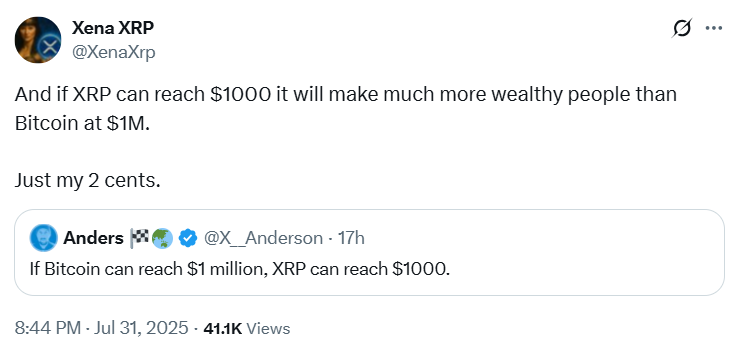
A notable XRP community pundit has suggested XRP will produce more millionaires at $1,000 than Bitcoin at $1 million.

This statement came from Xena, who has continued to express bullish sentiments around XRP. She responded to recent disclosures, arguing that if Bitcoin can reach $1 million, XRP could also hit $1,000. According to her, XRP will likely produce more millionaires if both assets reach their respective milestones.

Could XRP Produce More Millionaires?

Her statement points to prevalent sentiments around how much further XRP can grow from its current price and how much more buying power everyday investors have with XRP compared to Bitcoin. 

Xena on X
Xena on X

Right now, XRP trades at $2.96. At this price, an investor can pick up 1,000 XRP tokens with just $2,960. Meanwhile, if XRP hits $1,000 someday, the 1,000 tokens, currently worth $2,960, would turn into $1 million. 

In comparison, investing the same $2,960 in Bitcoin at its current price of $115,095 would only buy 0.0257 BTC. If Bitcoin climbs to $1 million, that investment would grow to just $25,717. 

This difference is the major reason some investors believe XRP offers a better chance at life-changing returns. However, XRP would only present better returns at $1,000 because it has a longer journey to this milestone than Bitcoin does to $1 million.

Xena’s comments came as a response to a disclosure from another well-known XRP proponent, Anderson. He argued that if Bitcoin can realistically reach $1 million, then XRP should have a fair shot at $1,000. 

His statement pointed to what many in the XRP community see as a double standard. Most people believe Bitcoin can hit $1 million, but these individuals still doubt XRP could ever reach $1,000.

Predictions of a Bitcoin Run to $1M+

Specifically, many experts and high-profile investors have backed Bitcoin’s long-term upside. Cathie Wood, CEO of ARK Invest, believes Bitcoin could reach $1 million by 2030. She has supported this view since 2022 and recently increased the target to $1.5 million, pointing to rising institutional adoption. 

Moreover, Fundstrat’s Tom Lee also sees Bitcoin hitting $1 million within a few years. He calls it a digital safe haven like gold and expects milestones of $150,000 and $500,000 within five years.

Meanwhile, Michael Saylor, who founded Strategy, has one of the boldest predictions. He believes Bitcoin could be worth $13 million by 2045. Notably, he bases this on the limited supply of BTC and the demand surges often seen after halving events, especially those expected in 2025 and 2026. 

Robert Kiyosaki, author of Rich Dad, Poor Dad, has said he expects Bitcoin to reach $1 million by 2035 due to rising U.S. debt and financial instability. Cardano’s founder, Charles Hoskinson, thinks Bitcoin could cross the $1 million mark before 2030 thanks to growing institutional interest from firms like BlackRock. 

Some Believe XRP Could Hit $1,000

For XRP, the outlook isn’t as widely accepted, but some predictions still exist. In April 2025, CryptoGuard’s COO said XRP could reach between $100 and $1,000 within the next decade. 

Changelly’s analysts forecast XRP could climb to $1,020 by May 2040. Also, most recently, in July 2025, EasyA’s founders discussed XRP potentially hitting $1,000, pointing to the expansion of the XRP DeFi ecosystem as a possible spark for such a rally.

However, the more extensive journey required for XRP to hit $1,000 has contributed to the growing skepticism. For context, while Bitcoin only needs to jump 768% from its current price to hit $1 million, XRP must surge by 33,683% to get to $1,000. 

Also, if Bitcoin hits its goal with a 19.9 million token supply, its market cap would land at $19.9 trillion, still below gold’s $22.4 trillion. On the other hand, XRP would reach a $59.3 trillion market cap at $1,000 with 59.3 billion tokens, more than double gold’s value.

LeveX Launches Quest System With Futures Credit Rewards

Community exchange introduces gamified trading challenges with up to $20,000 bonus rewards

LeveX recently launched its Quest system, adding gamified trading challenges that reward users with Futures Credit bonuses for completing volume milestones and platform tasks.

Quest System Features

The new system offers three quest types: Trading Volume Quests that reward cumulative trading activity, Journey Quests for new user onboarding, and Time Period Quests requiring consistent daily activity. Rewards are delivered through “Surprise Drops,” randomized bonuses within predetermined ranges that can reach up to $20,000 in Futures Credit.

“We wanted to add engaging reward mechanics that actually help our traders improve their strategies,” said Harvey Liu, CEO of LeveX. “The Futures Credit rewards provide real trading capital with loss protection, so users can test new approaches while keeping any profits they generate.”

Futures Credit Integration

Quest rewards primarily come as Futures Credit, bonus trading capital that covers up to 50% of trading fees, provides margin support, and absorbs losses while allowing users to withdraw all profits. This creates a low-risk environment for strategy development and position scaling.

The system includes real-time progress tracking, clear tier requirements, and automatic reward delivery when milestones are reached. Users have defined timeframes to claim and utilize earned rewards.

Platform Development

The Quest launch continues LeveX’s focus on community-requested features, following the recent introduction of Multi-Trade Mode and an expanded referral program. The exchange serves over 265,000 active traders with competitive fees and maintains an ‘A’ security rating.

“This adds another layer of value for our active trading community,” Liu noted. “It’s a straightforward way to earn additional trading capital while using the platform normally.”

About LeveX

LeveX is a crypto exchange founded in October 2023, serving traders globally with spot and futures markets, competitive fee structures, and community-focused features. The platform emphasizes transparency through Proof of Reserves and maintains strong security standards.

Disclaimer: This Press release article is provided by the Client. The Client is solely responsible for this page’s content, quality, accuracy, products, advertising, or other materials. Readers should conduct their own research before taking any actions related to the material available on this page. The Crypto Basic is not responsible for the accuracy of info and any damage or loss caused or alleged to be caused by the use of or reliance on any content, goods, or services mentioned in this press release article.

Please note that The Crypto Basic does not endorse or support any content or product on this page. We strongly advise readers to conduct their own research before acting on any information presented here and assume full responsibility for their decisions. This article should not be considered investment advice.

Expert Says a $3 XRP Can’t Sustain a Tokenized Future Worth Trillions; Price Must Rise

As stablecoins and tokenized assets scale into the trillions, a crypto founder argues that XRP current price is unsustainable for the financial role it’s expected to play.

This perspective comes from Versan Aljarrah, co-founder of Black Swan Capitalist. In a tweet, he stressed that the current price of around $3 is incompatible with its anticipated role in powering the next wave of tokenized finance.

Specifically, Aljarrah stated that if institutions and market participants will use stablecoins for purchasing Treasury debt, digitizing government expenditures, and settling trillions in tokenized assets, it won’t be possible to do so with XRP trading at $3.

This statement comes as global finance moves decisively toward on-chain settlement, with stablecoins and tokenized treasuries at the heart of the transformation. Given XRP’s role in this space, Aljarrah argues that its price must reflect its utility.

XRP Amid Trillions in Tokenized Assets

For years, Ripple has been positioning XRP as a central asset for real-world asset settlement, cross-border transactions, and institutional finance. Citi and Boston Consulting Group project the tokenization of traditional assets, from Treasuries to real estate, to reach $16 trillion by 2030.

At such valuation, the role of bridge assets like XRP becomes increasingly critical. A low unit price, as Aljarrah implies, would limit XRP’s scalability and capital efficiency in high-value, institutional-grade settlements.

For context, as the XRP Army often notes, XRP’s $174 billion market cap does not provide sufficient liquidity to handle transactions in the trillions. However, if the market cap rose, say, $59 trillion, it might.

At that massive scale, the implied unit price would align with $1,000 per XRP. As a result, proponents argue that the coin cannot remain low-priced if it is to play a meaningful role in global payments.

This echoes recent arguments from other XRP analysts, including Jake Claver, director of Digital Ascension Group, who predicts XRP could reach $1,500–$2,000 under certain global conditions.

Claver points to XRP’s potential role during financial crises, noting that institutions will require a liquid, neutral bridge asset. He argues that as legacy systems come under strain, XRP could emerge as the preferred solution for high-value settlements.

Stablecoin Backing and Expanding Treasury Markets

In May, U.S. Senator Bill Hagerty projected that firms issuing stablecoins could grow to be the largest holders of U.S. Treasuries by 2030. He sees them absorbing over $1 trillion in demand.

Meanwhile, Ripple has entered the stablecoin market with RLUSD, a dollar-backed token supported by U.S. Treasuries and cash equivalents. As of now, RLUSD has reached a market cap of $577 million in just eight months since its launch.

Earlier reports of Ripple’s $4–$5 billion bid to acquire USDC’s issuer Circle, though ultimately unsuccessful, highlight an intent to scale RLUSD into a major player, possibly rivaling USDT.

Should Ripple aggressively grow RLUSD, XRP could benefit further, as RLUSD runs on the XRP Ledger and uses XRP for transaction fees.

Combined with XRP serving as a bridge between tokenized stablecoins, real-world assets, and global currencies, XRP supporters believe a higher price is necessary to match the scale of liquidity required.

Enthusiasts often speculate that even if XRP were to handle just 1% of the multi-trillion-dollar volumes of financial giants like SWIFT, its price would need to rise substantially from the current ~$3 level.

Ripple’s acquisition of prime broker Hidden Road, which has connections to a U.S. settlement system handling $11 trillion in daily turnover, further fuels speculation and hope surrounding XRP’s price potential.

Cardano Could Soar to $6 Soon as ADA Repeats Historic Price Structure: Analyst

Cardano (ADA) could be on the verge of a substantial price surge, with leading analyst Ali Martinez pointing to a setup that resembles the 2020–2021 bull run.

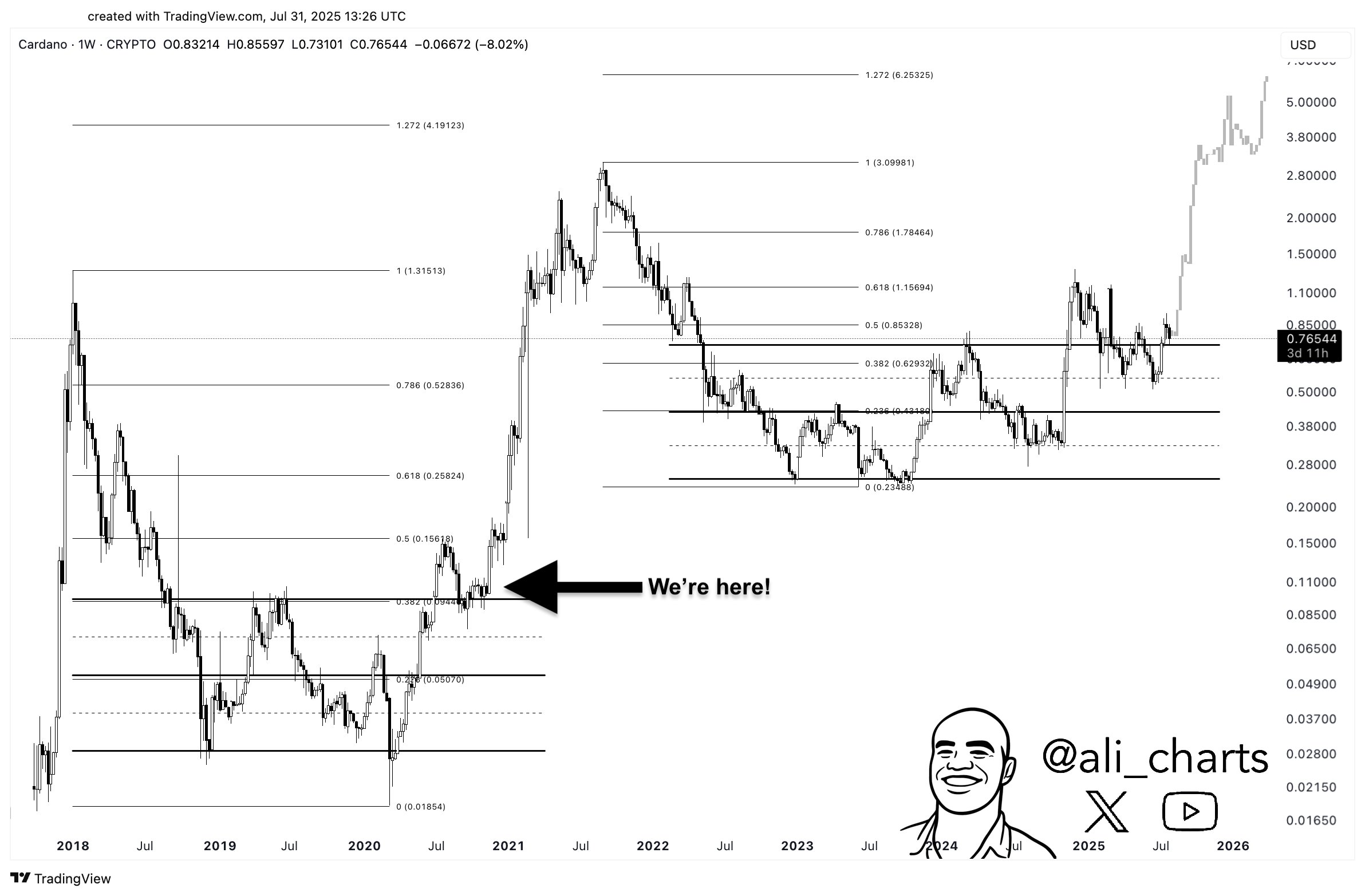
In a post on X today, Martinez shared a side-by-side comparison of ADA’s current trajectory and its historical price movement, suggesting that a breakout may be brewing.

Cardano Repeats History — Slowly

Martinez observed that ADA’s current price behavior mirrors its previous cycle, albeit with a slower pace of development. Despite this delay, there are structural similarities. This has raised expectations for a significant upward move in the coming months.

Martinez’s analysis uses Fibonacci extensions to compare ADA’s 2018–2021 and 2022–2025 cycles. Specifically, in the earlier run, Cardano soared from $0.0944, which aligned with the 0.382 Fibonacci level, to over $3, an impressive 32x jump.

Currently trading around $0.72, ADA is hovering just below the 0.5 Fibonacci retracement level at $0.85. According to Martinez, the current position is similar to the historic breakout that led to a 30x surge for ADA.

Notably, the projected Fibonacci targets point to potential upside levels for ADA, including reclaiming its previous cycle peak of $3.09 (1.0 extension) and a further expansion to $4.19 (1.272 extension). In the most bullish scenario, Cardano could rise to $6.25 or higher, aligning with the 1.272 Fibonacci level.

Cardano weekly chart by Ali Martinez

Though the market is moving more gradually this time, Martinez notes that the technical structure remains bullish. ADA initially broke out significantly in December 2024, surpassing $1.23 before cooling off. The coin has since struggled to regain bullish momentum following that retracement.

ADA Cup and Handle Pattern Supports Bullish Breakout

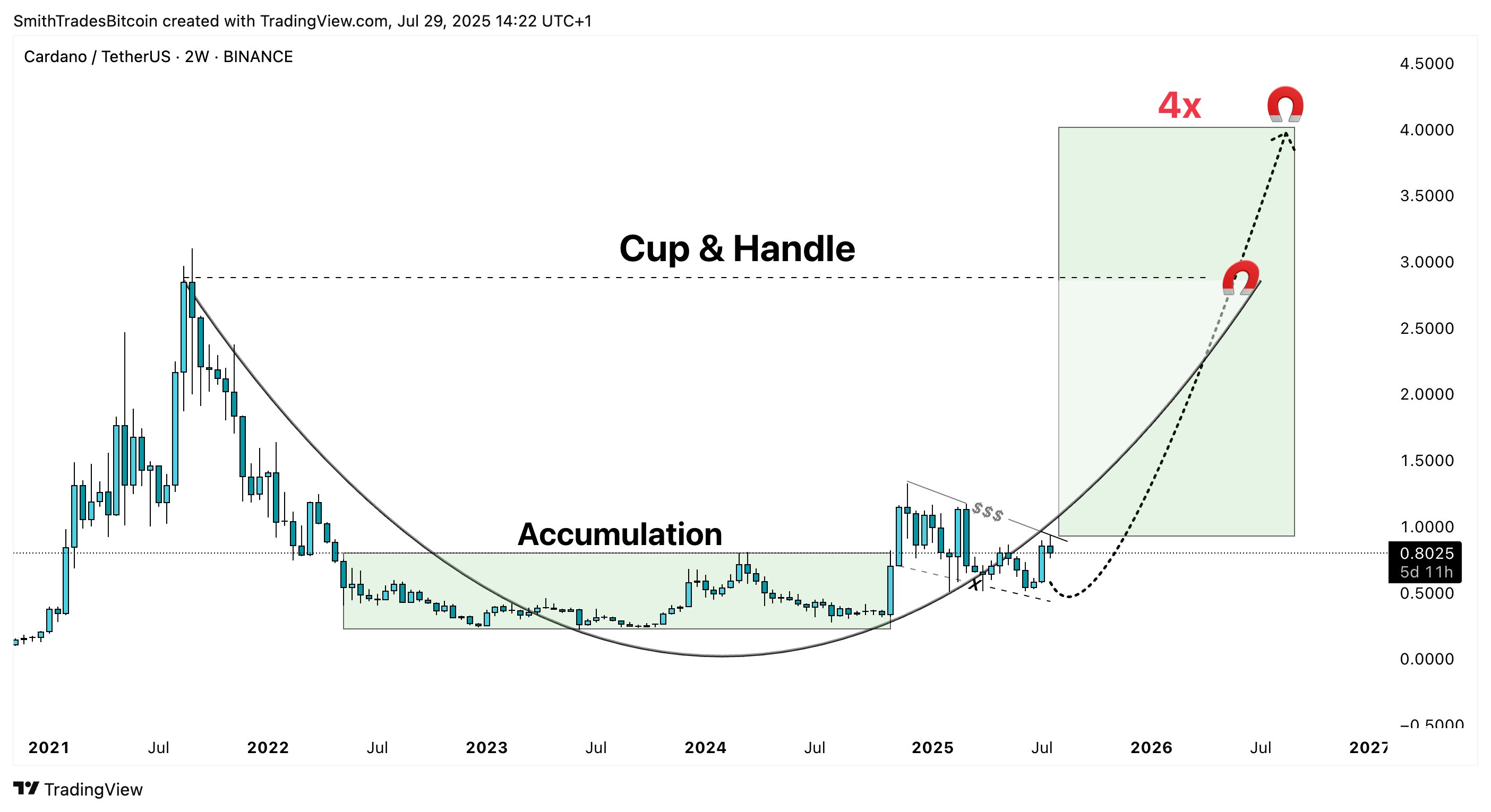
Other analysts, such as Crypto Smith, have also identified long-term bullish patterns. Smith recently pointed to a “cup and handle” formation on ADA’s chart. He also noted signs of whale accumulation tapering off, suggesting a major rally to $4 could follow.

Image

Developer Activity Strengthens Fundamentals

Meanwhile, on the development front, Cardano continues to demonstrate strong on-chain growth. The network has surpassed 300,000 deployed smart contracts. This marks a major milestone since smart contract functionality was introduced through the Alonzo upgrade less than four years ago.

The uptick in smart contract deployments underscores increased dApp adoption and growing developer engagement, adding fundamental support to ADA’s bullish technical outlook.

FCA to Unlock Crypto ETNs for UK Retail Investors in Major Policy Shift

0

The UK’s financial watchdog is preparing to lift restrictions on crypto exchange-traded notes (cETNs) for everyday investors, expanding access beyond institutional players for the first time. 

On Friday, the Financial Conduct Authority (FCA) announced it will soon allow retail investors in the UK to buy and trade crypto ETNs, a financial product previously available only to institutional investors.

The regulator said the decision reflects the growing mainstream adoption and understanding of crypto-backed financial instruments.

In a public statement, David Geale, Executive Director of Payments and Digital Finance at the FCA, noted that the market has changed since retail access to cETNs was restricted. He said that greater transparency and oversight now make it possible to give consumers more options, without compromising essential protections.

A Move Toward Global Harmonization

With this policy update, the UK joins countries like the United States, Canada, Hong Kong, and members of the European Union in opening up crypto-linked investment options to non-professional traders. However, only crypto ETNs listed on recognized investment exchanges (RIEs) approved by the FCA will qualify for retail access.

Unlike spot crypto ETFs in the U.S., which hold actual digital assets like Bitcoin or Ethereum, crypto ETNs do not. Instead, they are structured as debt obligations. Rather than owning the asset itself, the issuer promises to deliver returns that closely track the asset’s price, minus any associated costs. As a result, ETNs offer a way to gain exposure without directly holding the crypto.

Risk Warnings and Regulatory Safeguards

While the FCA’s decision introduces new opportunities for everyday investors, the agency has emphasized the need for caution. Crypto ETNs will not be covered under the Financial Services Compensation Scheme (FSCS), meaning consumers won’t have protection in the event of issuer failure.

Firms selling these products must comply with the FCA’s Consumer Duty rules. This means they must ensure that marketing and product design serve the best interests of customers. Additionally, financial promotion rules will remain in force, requiring clear, non-misleading disclosures about the risks involved.

Crypto Derivatives Ban Remains

Despite the updated stance on crypto ETNs, the FCA has reaffirmed its ban on retail trading of crypto derivatives, citing high risk and market volatility. The agency stated that it will continue to monitor the space and adjust its approach to high-risk products when necessary.

Over the years, the FCA has gradually eased its hardline stance on digital assets. Since January 2021, it has barred retail access to both crypto ETNs and derivatives.

In March 2024, it began allowing professional investors to access regulated cETNs listed on UK exchanges. Among these are products launched on the London Stock Exchange by 21Shares, WisdomTree, and Invesco.

While these products attracted modest trading volumes, analysts have predicted that retail access could significantly boost interest and liquidity. 

Broader Crypto Oversight in the Works

The UK government seeks to make the country a global hub for crypto innovation, and the FCA is playing a central role in this strategy.

To support this effort, a comprehensive regulatory framework covering stablecoins, staking, lending, custody, and trading platforms is currently under consultation. Its implementation will be by 2026.

Notably, the FCA has stated that the rollout for retail access to crypto ETNs will be by October this year.

US Crypto ETFs Pull In Record $12.8B in July as Bitcoin and Ethereum Drive Momentum

0

In July, US crypto ETFs brought in a record-breaking $12.8 billion in net inflows, marking their best month yet. 

Bloomberg’s senior ETF analyst, Eric Balchunas, disclosed this milestone in a recent post. He highlighted that the pace reached an average of $600 million per day, representing about twice the usual rate. 

US Crypto ETFs See Record $12.8B in Net Inflows

According to Balchunas, this surge pushed the group’s combined performance past that of any single ETF on the market, including the widely popular Vanguard S&P 500 ETF (VOO).

Notably, every ETF in the crypto category (excluding converted trusts) pulled in new capital, showing strong and widespread investor demand. Bitcoin and Ethereum led the charge, each contributing equally to the month’s total, the Bloomberg ETF expert confirmed.

Balchunas described the performance as the most dominant since the Philadelphia Eagles beat the Kansas City Chiefs in the Super Bowl, adding that matching this kind of momentum won’t be easy in the months ahead.

For context, Bitcoin ETFs saw $6.02 billion in net inflows during July, accounting for 47% of the total $12.8 billion. This made it the third-best month for Bitcoin ETFs, behind February 2024, which brought in $6.03 billion right after their launch, and November 2024, which pulled in $6.49 billion following Donald Trump’s election win. 

Ethereum ETFs also contributed largely to the $12.8 billion total, posting their strongest month ever. In July, they drew $5.43 billion in net inflows, 42% of the month’s total. This figure crushed the previous record of $2.08 billion set in December 2024 and showed the growing investor interest in Ethereum since ETF trading for the asset started in July 2024.

Following these inflows, Bitcoin ETFs now hold $152.01 billion in assets, representing 6.56% of Bitcoin’s total market cap. Meanwhile, Ethereum ETFs control $21.52 billion worth of the asset, equal to 4.77% of Ethereum’s market cap.

Bitcoin and Ethereum Price Performances in July

Despite the massive inflows, both Bitcoin and Ethereum struggled to hold their gains toward the end of the month. For instance, Bitcoin fell from a peak of $120,000 on July 22 to close the month at $115,750. Even with that late dip, it still gained 8% over July, largely thanks to its strong start. 

Meanwhile, Ethereum outperformed Bitcoin in terms of resilience, ending the month with a 48.76% gain despite similar pressure late in the month.

Despite this, some investors felt the price action did not reflect the large inflows. One market participant asked Balchunas whether the lack of stronger price movement had anything to do with where the ETF purchases happen or with Ethereum’s staking features. 

According to Balchunas, this question comes up often. He explained that US crypto ETFs operate with a strict 1:1 backing, meaning they actually hold the exact amount of crypto they represent; no lending, no synthetic exposure. He emphasized that every dollar in these ETFs links directly to real Bitcoin or Ethereum.

Balchunas also pointed out that Bitcoin has climbed nearly 300% since BlackRock filed for its ETF two years ago, and ETF demand has played a big role in that rise. He added that some longtime crypto holders may be selling out of frustration, now that Wall Street and government-linked institutions have embraced Bitcoin.