Home Blog Page 599

Saylor Calls Bitcoin “Digital Capital,” Says MicroStrategy Isn’t Trying to Own Entire BTC Supply

0

Strategy executive chairman Michael Saylor sees Bitcoin as a digital capital, which it leverages to build its business model. 

The Bitcoin maximalist was featured on CNBC’s Squawk Box today, where he provided insights into how the company has built a corporate finance framework around the premier asset. 

Strategy Business Model 

According to him, Strategy’s business model revolves around issuing digital credits like preferred stocks, while using the proceeds to accumulate Bitcoin, which he referred to as “digital capital.” 

True to this vision, the company has been using proceeds from its fundraisers to finance its Bitcoin purchases. Saylor disclosed the firm has completed four funding rounds this year alone, raising $500 million twice and a separate $1 billion. 

During the fourth preferred stock offering, MicroStrategy raised $2.5 billion. The offering, tagged as the largest U.S. IPO of 2025 by gross proceeds, saw MicroStrategy sell 28 million shares of Series A Perpetual Preferred Stock (STRC) at $90 apiece. 

Shortly after the offering, Strategy announced the purchase of 21,021 BTC for $2.46 billion on July 29. Following the purchase, the company’s Bitcoin stash grew to 628,791 BTC, currently valued at $71.91 billion. For context, Strategy’s 628,791 BTC stash is equivalent to roughly 3% of the entire 21 million Bitcoin supply. 

Given the remarkable gains Strategy has recorded from its Bitcoin holdings, Saylor emphasized that BTC is a 50-year duration asset. In his view, Bitcoin investors are positioned for decades of potential upside that could linger over a 50-year duration. 

MicroStrategy Doesn’t Want All of Bitcoin Supply 

When asked whether there will ever be enough Bitcoin for MicroStrategy, Saylor said he does not believe owning up to 7% of the Bitcoin supply is outrageous. He pointed out that BlackRock currently owns more BTC via its iShares Bitcoin Trust (IBIT) ETF, holding 740,896 BTC.  

Nonetheless, he stressed that MicroStrategy does not intend to own all the Bitcoin in the market. According to him, the company wants other entities to have a piece of the Bitcoin pie. 

Meanwhile, he highlighted the growing interest in the Bitcoin treasury movement among public firms. Per Saylor, the number of public firms holding Bitcoin has skyrocketed to over 160, up from just 60 last year. 

Notably, he remains confident that the premier asset could deliver an average annual return (ARR) of 30% yearly over the next 20 years, which he believes will raise BTC’s price to roughly $13 million. 

Kraken Shifts 82,277,388 XRP Worth $246M to Unknown Wallet

0

A transaction involving crypto exchange Kraken, an unidentified wallet, and a staggering amount of XRP is raising eyebrows in the crypto community.

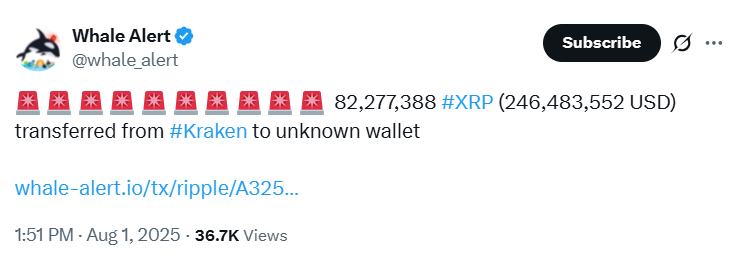
For context, Whale Alert reported on August 1 that Kraken has just moved 82,277,388 XRP, worth $246.4 million, to an unknown wallet. Considering the recent market standing and the direction of the transaction, reactions suggested that it was a whale buying the dip.

Whale Alert on X
Whale Alert on X

Kraken Transfers Millions of XRP to Unidentified Address

Notably, further details of the transaction showed it happened at exactly 12:50 (UTC) on Friday. Sending address “rLHzPs,” marked as a Kraken wallet, moved approximately $246.5 million to receiving address “rp7TCc,” whose identity remains unidentified according to Whale Alert.

Nonetheless, The Crypto Basic did additional research on the receiving address and identified that it also belonged to Kraken. Running the wallet through XRPScan, it showed that the address bears the name “Kraken (4).” Furthermore, it was activated by the sending address on December 16, 2024, confirming both wallets’ affiliation with Kraken.

Kraken Has Been Moving XRP Lately

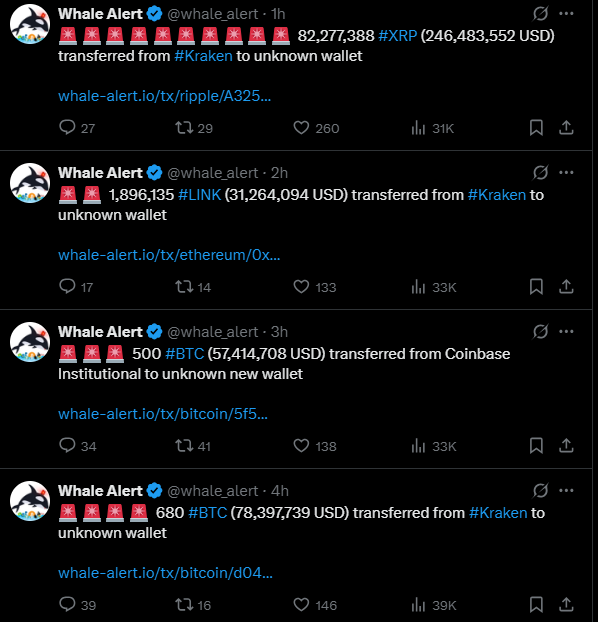
Further market insight revealed that Kraken has been shifting XRP lately. For context, Whale Alert also reported another transaction involving an unmarked address and Kraken today.

The said shuffle happened over 12 hours ago, data confirming it happened exactly at 00:44 (UTC) today. Notably, “rLHzPs,” which is the sending address from the earlier transaction, was part of this XRP shift, but this time as a receiving address.

The unmarked sending address, “rJHkpN,” moved 31,852,903 XRP ($95 million) to the Kraken address today, according to XRPScan. Interestingly, we discovered that the sending address in this transaction also has an affiliation with Kraken.

For context, XRPScan shows that address “rrhT2Hd” activated the sending address on July 10, 2024. Analysis also revealed that it was a “Kraken (1)” account that also activated it on June 21, 2024. 

In simpler terms, both transactions were just Kraken shifting funds from one wallet to another, probably from its hot wallet to a secured self-custody wallet for storage or vice versa.

Kraken Also Transferring Other Cryptocurrencies

Notably, Whale Alert reported several other transactions involving Kraken and an unknown wallet today. Kraken moved 1.89 million LINK ($31.2 million) to an unmarked address by 11:16 (UTC) and 680 BTC ($78.4 million) by 09:31 (UTC).

Kraken Moving Cryptocurrencies to New Addresses

Remarkably, all transactions involved moving the cryptocurrencies from the Kraken Cold Wallet to multiple trading platforms. At the time of writing, the specific reason behind these transactions remains unknown. Still, their direction suggests it is to provide liquidity, potentially due to sell-offs as the market crashes.

Researcher Says XRP Can Reach $1,000 If Bitcoin Can Reach $1 Million

A fresh debate has emerged in the crypto community about the prospect of XRP reaching $1,000 amid popular calls for Bitcoin to hit $1 million.

While the outlook of Bitcoin trading above $1 million has gained widespread acceptance, the idea of XRP reaching $1,000 has been met with great skepticism. Meanwhile, XRP proponents are not backing down from their outlook.

$1,000 XRP Means a $59 Trillion Market Cap

Notably, the discussion began when Quinten Francois, host of Coin Compass, ridiculed the idea of XRP ever hitting $1,000. He pointed to the token’s supply of over 59 billion, noting that such a price would mean $59 trillion market for XRP.

He stressed that this resulting market cap would be more than twice the U.S. GDP and over half of the global stock market value.

Despite this significant technical limitation, Francois highlighted that some people genuinely believe XRP will reach $1,000. “This is the level of IQ we’re up against,” he tweeted.

His comments sparked strong reactions from across the crypto space. Many other industry commentators sided with him, highlighting other popular inflated price expectations among the XRP Army, such as the $10,000 price target. Meanwhile, XRP supporters saw the dismissal as narrow-minded.

Why Can’t XRP Cap Be Twice the US GDP?

Dom Kwok, co-founder of the platform EasyA, challenged the notion that trillion-dollar valuations are off the table. “Why can it [XRP’s market cap] be twice the U.S. GDP or more than half the global stock market?” Kwok asked.

In his view, rejecting these possibilities isn’t grounded in logic but in a lack of imagination. He cautioned that taking such a narrow view could ultimately seem short-sighted in retrospect.

Other XRP proponents agree with Kwok’s view, arguing that XRP may someday surpass the barriers currently seen as limitations.

If Bitcoin Can Reach $1 Million, XRP Can Reach $1,000

Meanwhile, crypto researcher Anderson contributed to the conversation by comparing XRP’s potential to that of Bitcoin. He pointed out that if Bitcoin is considered capable of hitting $1 million, then a $1,000 price target for XRP shouldn’t be dismissed. 

Currently, Bitcoin trades around $115,500 with a market cap of approximately $2.3 trillion. XRP is exchanging hands at $2.94 with a $174 billion market cap, ranking third globally.

Anderson’s point is that if market sentiment and adoption can carry Bitcoin that far, there’s no reason XRP can’t follow a similar path.

Meanwhile, Bitcoin only needs to expand 10X from its current price to hit $1 million. This would bring its market cap near $21 trillion, still below the valuation of gold, the most valuable asset globally, with a $22 trillion cap.

On the other hand, XRP needs to grow by over 33,200% from its present level to hit $1,000, resulting in a market cap of $59 trillion that would exceed the combined valuation of gold, Bitcoin, Apple, NVIDIA, and Microsoft. 

This makes critics dismiss the projection as unrealistic, as such a price would put XRP ahead of other globally valuable assets.

Notably, some industry leaders who have forecasted XRP’s $1,000 price target have set timelines ranging from 2026 to 2035. Around this same time, many believe Bitcoin would hit $1 million.

Mill City Ventures Launches $450M SUI Treasury Strategy with Foundation Backing

0

Mill City Ventures III, Ltd. from United States has unveiled a $450 million private placement to spearhead a bold new treasury strategy centered on SUI, a fast-growing Layer 1 blockchain.

In a press statement, the Nasdaq-listed company announced it has completed a $450 million private investment in public equity (PIPE). It intends to allocate approximately 98% of the proceeds to building a robust SUI token treasury.

The company disclosed that it has bought 76,271,187 SUI tokens at an average cost of $3.6389 per token. This acquisition was accomplished through a combination of over-the-counter purchases and structured in-kind contributions in collaboration with the Sui Foundation. Mill City confirmed plans to continue accumulating SUI tokens on the open market.

Exclusive Partnership with Sui Foundation

What sets Mill City apart is its exclusive backing by the Sui Foundation, making it the only publicly disclosed crypto treasury strategy with direct foundation support. The foundation, dedicated to growing the SUI ecosystem, made an equivalent investment in the placement, signaling deep alignment.

Meanwhile, the company highlighted that its SUI-focused strategy goes beyond a simple portfolio investment. It now serves as a central component of its treasury management approach going forward.

Institutional Support and Leadership Overhaul

The funding round drew interest from a roster of prominent investors, including Galaxy Digital, Pantera Capital, Big Brain Holdings, Electric Capital, and GSR.

Karatage Opportunities, a London-based hedge fund specializing in digital asset markets, led the placement. Following the deal, Marius Barnett and Stephen Mackintosh, the firm’s co-founders, assumed key roles at Mill City. Barnett was appointed Chairman, while Mackintosh took on the role of Chief Investment Officer.

Notably, Galaxy Asset Management will serve as the Asset Manager for Mill City’s SUI treasury. Galaxy Digital CEO Mike Novogratz lauded the move as a “clean, liquid, and institutional-grade entry” into the crypto space. He specifically highlighted the pairing of SUI with experienced leadership as a key factor supporting that positioning.

What is SUI?

SUI is a next-generation Layer 1 blockchain built by Mysten Labs, leveraging Move, a programming language initially developed by Meta’s now-defunct blockchain division. Known for its high performance and developer-friendly ecosystem, SUI has attracted increasing interest from institutional and retail players.

As of the latest market update, SUI is trading at $3.50, down 10.33% on the day.

Institutional Crypto Treasury Trend

Mill City’s initiative aligns with the broader trend where forward-looking enterprises are incorporating digital assets into long-term financial planning.

Cryptocurrencies such as Bitcoin (BTC), Ethereum (ETH), and emerging platforms like SUI are increasingly being adopted as strategic treasury assets. They offer diversification, inflation hedging, and early exposure to transformative blockchain infrastructure.

As part of its broader treasury mandate, Mill City has committed to providing regular reporting on its SUI holdings and treasury activities, as it advances toward establishing the largest institutionally held and publicly disclosed SUI position in the market.

Analyst Says Shiba Inu Showing Bullish Potential as Recent Dip Leads to Cup and Handle Structure

0

Shiba Inu may be on a downward spiral, but analysts believe prices could rebound imminently as bullish indicators fuel optimism.

Particularly, SHIB is down by 8% in the past 24 hours, as the ripple effect of the FOMC outcome continues to weigh on the crypto market. On the daily timeframe, the meme coin has corrected for four consecutive days, and the current market points to the fifth.

The bearish momentum ensured it gave back most of its early gains in July at the closing stages of the month. For context, Shiba Inu opened at $0.00001142 in July and grew 39.8% to an intramonth high of $0.00001597 but retained just 8.9% of that gain with its monthly close of $0.00001244.

Bullish Structure Points to Rebound

Meanwhile, Joe Swanson shared in a July 31 X post that Shiba Inu still has bullish prospects. He suggested that the recent downtrend is part of a broader positive development evidenced in an accompanying chart.

Shiba Inu Cup-and-Handle Formation | Joe Swanson

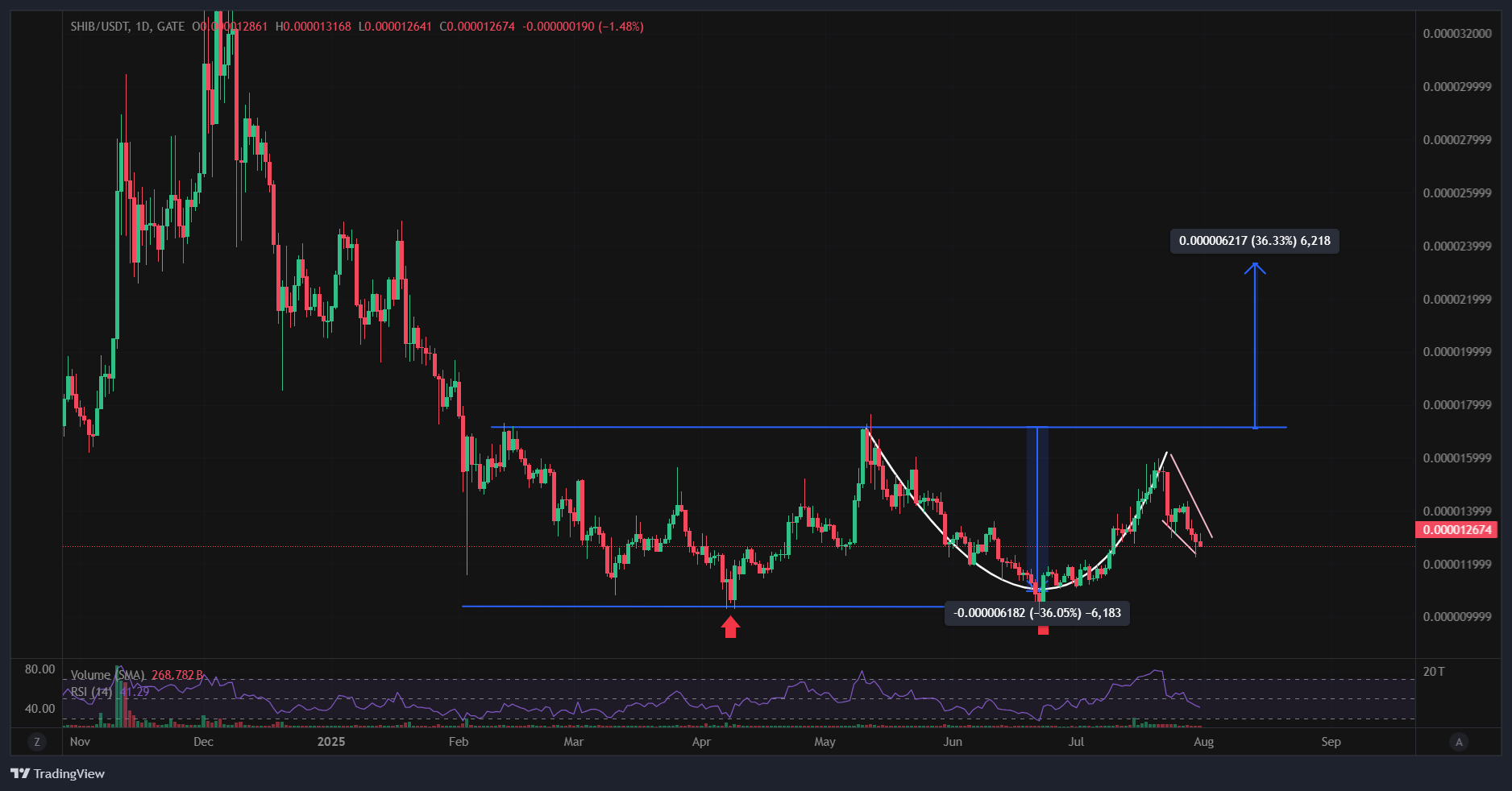
For context, he revealed that a classic cup-and-handle pattern is forming on the daily chart. For the uninitiated, the structure consists of a U-shaped price curve followed by a period of price consolidation in a channel.

The cup section started formed with Shiba Inu’s high of $0.00001765 in May, followed by a period of price correction. SHIB reached a low of $0.00001002 on June 22 but rebounded from the support to complete the curve with a surge to the high of $0.00001597 on July 21.

Per the chart, Shiba Inu is now on the structure’s handle. Swanson stated that the ongoing pullback aligns with the handle, suggesting that the pattern is nearing its completion.

Backed by momentum from ongoing whale accumulation, the market analyst predicted a breakout to greater heights. He asserted a 70% growth from the current market level, surpassing the cup-and-handle’s neckline at $0.00001715 to reach $0.00002150.

Double Bottom Backs Bullish Outlook

The analyst highlighted that a double-bottom price formation further backs his bullish outlook. His chart shows that Shiba Inu rejected lower prices at a critical support twice, a catalyst for upward momentum.

SHIB reached a low of $0.00001028 on April 7, amid a broader market price capitulation that wiped out billions on the day. However, the momentum around the area spurred a rebound to higher prices.

Notably, Shiba Inu retested the support again as highlighted earlier, while forming the cup curve, with the demand wall again buffering an apparent price weakness. Swanson suggests that the momentum from the double bottom, coupled with a possible breakout from the cup-and-handle structure, would launch Shiba Inu to new highs.

Interestingly, the analyst’s chart shows that Shiba Inu could rally beyond the 70% he mentioned. It identified that SHIB could grow to $0.00006217, representing a 414% surge from its current price of $0.00001209.

Meanwhile, analyst Javon Marks had earlier predicted further upsides to $0.000081, noting that the rally of over 500% will happen as Shiba Inu has held its breakout position.

Japanese Financial Giant Reveals Major XRP and Ripple Plans: ETFs, RLUSD, and IPO Hints

Japanese financial giant SBI Holdings has released a new investor presentation revealing significant developments related to XRP and Ripple. 

From ETF proposals and stablecoin initiatives to Ripple’s expanding global footprint, the report outlines a future that could strengthen XRP’s position in regulated finance. Notably, XRP community figure WrathofKahneman called attention to the report in a tweet. 

XRP-Linked ETFs Proposed for Tokyo Stock Exchange

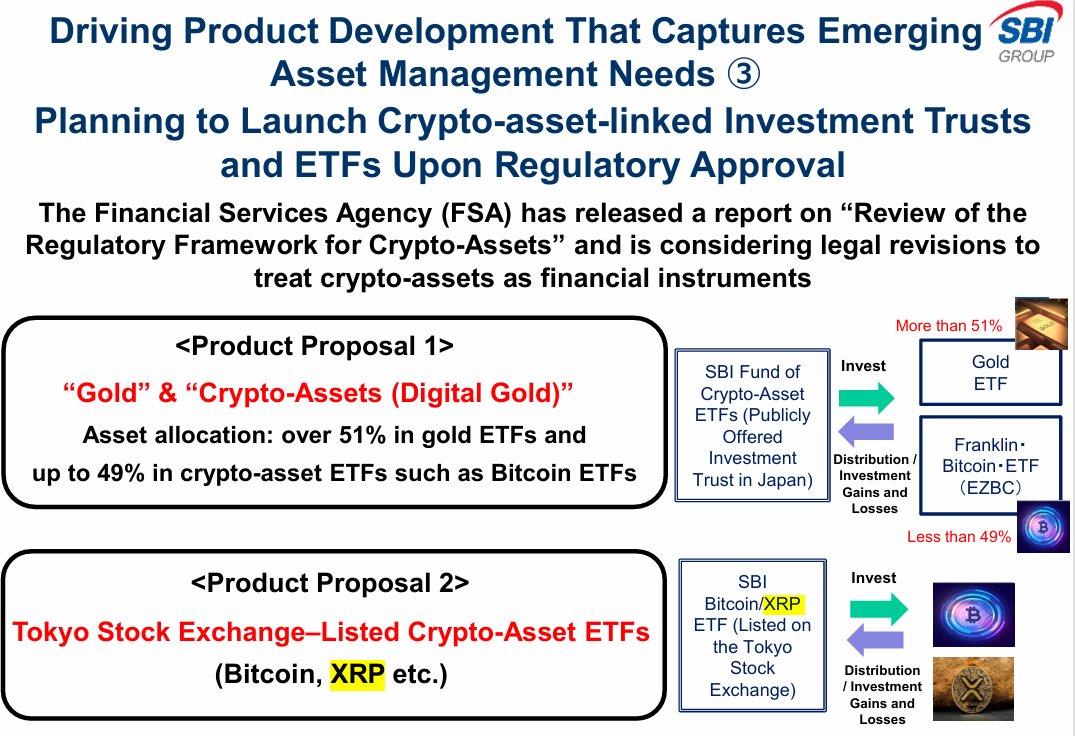
Among the most notable highlights is SBI’s proposal to launch crypto-asset ETFs on the Tokyo Stock Exchange, including products explicitly linked to XRP.

Two ETF models were proposed. The first is a hybrid “Digital Gold + Crypto-Asset” trust allocating over 51% to gold ETFs and up to 49% to crypto ETFs like Bitcoin. 

Meanwhile, the second proposed product involves a dedicated crypto ETF that would include assets like Bitcoin and XRP. SBI noted this product will be listed on the Tokyo Stock Exchange. This would mark one of the first regulated investment products in Japan to formally incorporate XRP.

SBI proposal for XRP ETF

Ripple’s RLUSD Stablecoin Coming to Japan

Furthermore, the report highlighted that SBI is preparing to handle RLUSD, Ripple’s USD-backed stablecoin, within the current fiscal year. Issued under a trust license from the New York Department of Financial Services (NYDFS), RLUSD is serving several roles:

  • Used for international remittances via Ripple Payments.
  • Act as collateral in institutional trading through Hidden Road, a prime broker Ripple recently acquired.
  • Potentially offered on SBI VC Trade, pending discussions.

This move supports SBI’s broader stablecoin strategy, which includes both USD-backed and JPY-backed models aimed at B2B expansion.

Ripple Payments in Use by 100+ Institutions

While the XRP community often touts adoption by over 300 financial institutions, SBI’s report specifies that more than 100 financial institutions across 55 countries are actively utilizing Ripple Payments, XRP’s primary use case for international remittances.

SBI Ripple Asia, the joint venture between the two companies, continues to lead innovation. Notably, SBI Remit began offering Japan’s first XRP-powered remittance service in 2021.

Interestingly, SBI owns a 9% stake in Ripple, and the report notes that a future IPO or equivalent event could significantly boost its valuation. However, this potential gain is not yet reflected in SBI’s current investment earnings, suggesting room for future upside.

Regulatory Easing

The report also noted that Japan’s Financial Services Agency (FSA) is reviewing revisions to its crypto regulatory framework. The turnaround potentially opens the door for crypto-assets like XRP to be classified as financial instruments. Ultimately, the regulatory easing could fast-track the launch of SBI’s ETF products and stablecoin integrations.

Shiba Inu Team Reacts as New Wallet Withdraws Over 110B SHIB From Binance

0

Lucie, the lead marketer for the Shiba Inu ecosystem, expresses excitement at reports of a new blockchain wallet withdrawing over 110 billion SHIB from Binance. 

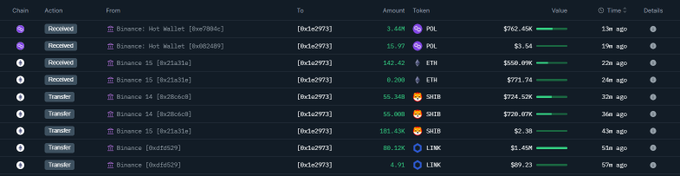
Yesterday, Onchain Lens reported that a newly created crypto address withdrew 110.34 billion SHIB tokens from Binance. The accompanying chart showed that Binance transferred the tokens from two of its wallets, Binance 14 and Binance 15, to the newly created address in three separate transactions. 

These transactions contained 181,430 SHIB, 55 billion SHIB, and another 55.34 billion tokens, bringing the total to over 110.34 billion SHIB. At the time of the transfer, the moved SHIB tokens were worth around $1.45 million.

Besides withdrawing SHIB, the entity behind the new wallet also withdrew other crypto assets, including 80,126 LINK ($1.46 million), 3.44 million MATIC ($762,000), and 142.62 ETH ($552,000) from the leading crypto exchange. 

New wallet withdraws over 110 billion SHIB from Binance

Lucie Reacts 

Meanwhile, the massive SHIB withdrawal attracted the attention of Lucie, the Shiba Inu ecosystem marketer. Reacting, she tweeted ‘SHIB’ accompanied by a smiling face with hearts emoji, expressing her excitement about the development. 

Transferring such a large amount of SHIB from Binance to a private wallet suggests long-term conviction. This implies the user does not intend to sell the SHIB tokens anytime soon. As of press time, all 110.34 billion SHIB tokens withdrawn from Binance remain in the wallet.

Last week, The Crypto Basic reported a similar development after an unknown wallet withdrew 5 trillion SHIB from Coinbase.

Good Timing? 

One notable aspect of this transaction is its timing. The move occurred as SHIB rebounded above the $0.000013 level shortly after dipping to $0.00001268 on July 30.

It’s possible the user behind the new wallet took advantage of this brief dip to acquire SHIB at discounted prices from Binance. 

SHIB Dips Over 7% as Trump Unveils New Tariff Plan 

In the meantime, the crypto market is witnessing a broader market sell-off, leading to the liquidation of $754 million over the past day. This comes after President Donald Trump unveiled a new tariff plan, subjecting most countries to higher tariffs.  

Expectedly, the financial markets reacted negatively to this development. In particular, the crypto market is down 4.51% over the past 24 hours to $3.72 trillion. 

Notably, Shiba Inu is also down 7.42% over the past day and currently changing hands at $0.00001212. It remains the 22nd biggest cryptocurrency with a market cap of $7.14 billion. 

Top Trader AguilaTrades Faces $40M Liquidation in Sudden Market Crash

0

AguilaTrades, a closely watched crypto trader, has suffered one of the most severe personal losses in recent memory, with nearly his entire portfolio wiped out in a massive liquidation on the Hyperliquid platform. 

According to blockchain analytics platform Lookonchain, his long position on Bitcoin (BTC) was closed during a sharp market downturn, one triggered by the Federal Reserve’s decision to delay interest rate cuts.

This wave of selling pressure set off a domino effect across cryptocurrency markets. According to Coinglass data, total liquidations reached approximately $630 million in just 24 hours.

Of that amount, $570.68 million came from long positions. For Bitcoin alone, long liquidations totaled $141.93 million, compared to only $7.4 million in short positions.

Market performance data from CoinMarketCap further highlights the volatility. The global market fell 3.82%, with Bitcoin down 3.03% and Ethereum (ETH) dropping 5.57%. These conditions ultimately sealed the fate of AguilaTrades’ position, pushing his total losses to nearly $40 million.

Leverage Turns Fatal in Volatile Markets

AguilaTrades had previously staged a significant comeback from losses amounting to $35 million, even momentarily posting a $3 million profit. However, on July 25, his aggressive BTC position, valued at around 720 BTC or $83.3 million, was liquidated, wiping out those gains and pushing him deeper into the red.

By the end of July, on-chain activity revealed four consecutive liquidations, cementing his current loss tally close to $40 million.

Crypto analyst Zia ul Haque weighed in, describing the incident as a cautionary tale. He explained that public profit-and-loss disclosures can invite “counter-trading” behavior, effectively turning once-successful strategies into traps in full view.

More Traders Hit: Wynn’s PEPE Bet Backfires

AguilaTrades wasn’t the only trader caught in the wave of liquidations. Another high-risk investor, James Wynn, also suffered heavy losses after his leveraged long position in PEPE was wiped out, according to data from Lookonchain.

Just a week earlier, Wynn had recorded his most significant profit of the year, earning over $500K. However, this short-lived success was quickly erased. His total losses now exceed $1 million, leaving only $14,850 in his trading account.

Winners Emerge from the Downturn

While long traders suffered, some bearish players profited handsomely. A trader using the wallet address 0xCB92 successfully shorted ETH using 20x leverage, reaping more than $3.7 million in gains.

This contrasting outcome showcases the razor-thin margin between profit and ruin in crypto derivatives trading, where extreme leverage magnifies both risk and reward.

The liquidations of AguilaTrades and others highlight the nature of leveraged crypto trading, particularly during periods of heightened market uncertainty. With central banks withholding expected rate cuts and global trade tensions escalating, traders are facing an increasingly unstable environment.

Cardano Founder Predicts the Global Crypto Market to Hit $10 Trillion After CLARITY Act Passes

0

Cardano founder says the next phase of crypto growth depends on Washington’s regulatory clarity and the entry of tech giants into the industry.

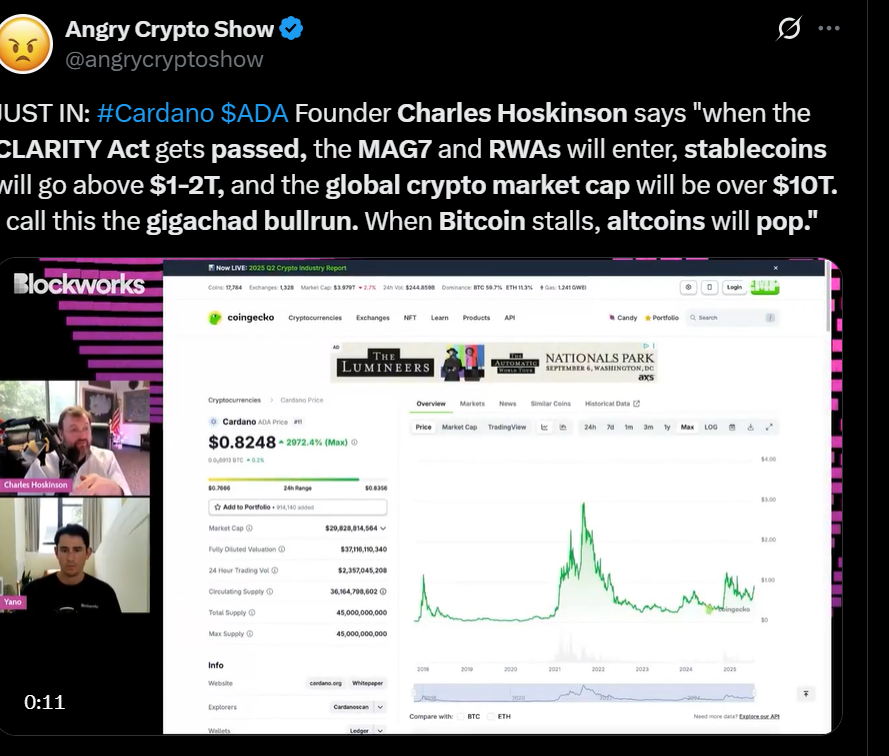
In a recent interview, Charles Hoskinson said the CLARITY Act could open the door to a massive market expansion, led by stablecoins, real-world assets, and major tech firms.

Regulatory Clarity Could Drive Market Expansion

Hoskinson pointed to the Digital Asset Market Clarity Act of 2025, commonly known as the CLARITY Act, as a potential turning point for the industry. The bill, which passed in the House of Representatives on July 17, aims to establish a clear regulatory structure for digital assets, including classification, trading, and oversight responsibilities.

Cardano cofounder predicts stablecoin surge
Cardano co-founder predicts stablecoin surge

The proposed law would define which agency, either the Securities and Exchange Commission (SEC) or the Commodity Futures Trading Commission (CFTC), regulates different types of assets. It would also introduce compliance standards for trading platforms and offer legal certainty for developers and investors.

Hoskinson Expects Entry of Big Tech and RWAs

Hoskinson said the passing of the bill could prompt entry from the so-called MAG7 companies, which include Microsoft, Apple, Google’s parent Alphabet, Amazon, Meta, Nvidia, and Tesla. These firms, he believes, may begin exploring or investing in blockchain and crypto assets once legal boundaries are clearly defined.

He also emphasized the growing role of real-world assets (RWAs), which are blockchain representations of tangible or financial assets like real estate or bonds. 

Predicting the growth in the industry, Hoskinson noted that when the CLARITY Act passes, the stablecoin market will surge above $1–2 trillion. Hoskinson is also very bullish on the global crypto market cap, expecting an uptick above $10 trillion. 

For context, the global crypto market cap stands at $3.803 trillion, after a massive 8.1% decline in the past day. Bitcoin dominance stands at 61.2% with a market cap of $2.80 trillion. A surge of the global crypto market cap to $10 trillion will push Bitcoin’s market cap to $6.12 trillion at this dominance rate, translating to a price of over $300,000 per BTC.

Stablecoin Growth Continues to Accelerate

Meanwhile, recent data supports Hoskinson’s outlook for stablecoins. The Kobeissi Letter reported that stablecoins now hold $149 billion in U.S. Treasuries, up 64% since Q1 2023. The total stablecoin market cap has doubled over the same period, reaching an estimated $240 billion.

This growth has positioned stablecoins as one of the largest external holders of U.S. debt. Analysts at Apollo noted that rising demand for dollar-based stablecoins could translate into greater demand for short-term Treasury bills.

The GENIUS Act, another federal initiative, has further supported the stablecoin market by allowing greater interoperability between digital currencies and the traditional financial system.

In furtherance of this act, Trump’s crypto adviser, Bo Hines, projected that the digital asset market could grow to between $15 trillion and $20 trillion in the coming years, up from its current $3.81 trillion valuation. 

Hines noted that the passage of the GENIUS Act could drive massive capital inflows. He believes the act lays the groundwork for innovations like tokenized public securities and 24/7 financial markets, with dollar-backed stablecoins becoming central to U.S. capital market access. 

Binance’s CZ to JPMorgan CEO: You Will Use Crypto Sooner or Later

0

Binance co-founder Changpeng Zhao reacted to the changing tone of JPMorgan CEO Jamie Dimon, as he shared that the bank would offer Bitcoin and crypto services.

Dimon shared on live television on Thursday that he is a fan of blockchain technology and stablecoins. While he still expressed slight skepticism towards Bitcoin, his comments suggest a gradual shift in sentiment towards the crypto sector.

Meanwhile, this caught the attention of Zhao, popularly known as CZ, who responded with “you will use crypto sooner or later.” Meanwhile, it remains unclear whether he directed his comment at Dimon or if it is one of his pro-crypto statements predicting widespread Bitcoin adoption.


JPMorgan to Offer Bitcoin and Crypto Services: CEO

Dimon told CNBC that JPMorgan would venture into stablecoins, a plan the firm had earlier disclosed. This builds on his earlier statement that JPMorgan will offer Bitcoin and crypto services to its customers.

Notably, JPMorgan has increasingly exposed itself to the digital asset industry lately, a strategy to tap into the promising sector. For context, the $4 trillion financial institution announced a partnership with Coinbase on July 30 to allow clients to link their bank accounts directly with the Coinbase wallet.

This would also enable JPMorgan customers to fund their Coinbase wallets directly from the bank and use their Chase credit cards on the trading platform. Per the announcement, the former will start in 2026, while the latter will debut in the fall of this year.

Remarkably, Dimon had also disclosed in May that its customers will soon be able to buy Bitcoin. However, he noted that JPMorgan will not provide custody services for the digital assets.

Stablecoins Have Some Upside Over Traditional Cash

The JPMorgan CEO reiterated his support for stablecoins yesterday, stating that he believes in the digital currency and blockchain technology as a whole. He compared stablecoins to mutual funds, noting that both could share similar rules.

Furthermore, Dimon highlighted that stablecoins may have some advantages over fiat, as they offer certain utilities that their traditional counterpart doesn’t. He noted that it is “programmable” and allows for automated transactions.

Nonetheless, he reaffirmed that he is not a personal believer in Bitcoin but noted that JPMorgan will “accommodate those things.” The CEO emphasized that the company’s focus is on servicing its customers over its personal preferences.

Notably, Dimon has been a long-standing Bitcoin skeptic. He once called Bitcoin a “fraud” and a “decentralized Ponzi scheme” and even asked for the shutdown of the crypto industry in 2023.

A core fuel for this antagonism is his belief that Bitcoin supports illegal activities like money laundering and sex trafficking. However, Bitcoin has thrived regardless, with its widespread adoption forcing Dimon’s hand to allow customers exposure.

Moreover, Dimon’s stablecoin acceptance echoes that seen in the United States. Congress passed the GENIUS Act on July 17, with Donald Trump signing the legislation a day later.