Home Blog Page 600

SEC Chair Vows to Establish Clear Crypto Rules in ‘Project Crypto’ Overhaul

0

The SEC Chair Paul Atkins has vowed to establish a clear regulatory framework for crypto assets, highlighting this as his top priority to position the U.S. as a global blockchain leader.

The 34th United States Securities and Exchange Commission (SEC) chair, Paul Atkins, noted that the “Project Crypto” initiative aims to modernize outdated securities rules and secure the U.S.’s position as a global leader in blockchain innovation. Atkins announced this on Thursday during a policy address in Washington.

Bringing Clarity to Crypto Regulation

He emphasized the need for “bright-line rules” that allow businesses to determine whether their crypto assets fall under securities laws or other classifications such as digital collectibles, commodities, or stablecoins.

Atkins emphasized that being designated as a security should not be viewed negatively, as it can give investors added benefits such as voting rights and access to distributions. 

As part of the reform, the SEC plans to introduce specific disclosures, exemptions, and safe harbors for token offerings, including ICOs, airdrops, and network-based rewards.

Rebuilding Domestic Crypto Markets

The SEC Chair criticized the trend of crypto projects moving offshore to avoid legal uncertainty in the U.S. He said the SEC aims to reverse that by encouraging innovation within American borders.

Furthermore, the SEC plans to support the tokenization of traditional financial instruments, such as stocks and bonds. Atkins revealed that many firms, including Wall Street giants and Silicon Valley tech startups, are ready to enter the U.S. crypto market if regulatory clarity improves.

More Options for Custody and Trading

Meanwhile, another central goal is to expand investor choices for where and how to hold and trade crypto assets. Atkins emphasized the importance of self-custody and directed the SEC staff to modernize custody rules for registered intermediaries.

He also criticized past SEC policies like SAB 121 and “Operation Chokepoint 2.0,” which limited the number of qualified custodial providers. New guidance could offer relief and reduce regulatory friction.

Paving the Way for Super-Apps

Atkins also wants to make it easier for platforms to operate as “super-apps” offering multiple financial services under one regulatory structure.

A broker-dealer, for example, should be able to offer trading in crypto securities, non-security tokens, traditional stocks, lending, and staking, all with a single license. He said the SEC would work with other regulators to streamline licensing and avoid duplicative compliance burdens.

Unlocking On-Chain Innovation

As part of the project crypto, the SEC will also update rules to accommodate decentralized finance (DeFi) and other on-chain software systems. Atkins said both centralized and decentralized protocols should have a place in U.S. markets.

He also suggested revisiting Regulation NMS to enable on-chain trading of tokenized securities, arguing that legacy frameworks should not stifle innovation.

Creating Space for Risk-Taking and New Ideas

Meanwhile, to foster faster innovation, the SEC Chair proposed a new “innovation exemption.” This would allow startups to go to market quickly under principles-based rules rather than rigid regulatory requirements.

Conditions could include regular reporting, use of compliant token standards, and restricted distribution to verified users. The goal is to ensure that business models with economic potential can launch without being blocked by red tape.

Atkins concluded by affirming the SEC’s commitment to transforming U.S. capital markets to accommodate blockchain technology and digital assets. The SEC is expected to release additional guidance and proposals in the coming months as Project Crypto takes shape.

Meanwhile, Atkins had earlier noted that crypto is now firmly part of the U.S. financial system, pointing to President Trump’s signing of the GENIUS Act as a key step toward regulatory clarity. He called it a major shift from past policies and noted that stablecoins could modernize the country’s outdated settlement system.

Cardano Surpasses 300K Live Smart Contracts on Mainnet

0

In an incredible achievement, the number of smart contracts currently live on the Cardano mainnet has surpassed 300,000. 

Popular crypto commentator Altcoin Daily shared the development in a tweet. The expansion comes less than four years after Cardano introduced smart contract functionality to its mainnet through the Alonzo hard fork. 

That hard fork rolled out the Plutus smart contract language on the Cardano mainnet. Since then, the number of contracts deployed on the mainnet has surpassed 300,000. Fresh data from the Cardano blockchain insight platform Alethea shows that the total number of live smart contracts on the mainnet now stands at 300,490. 

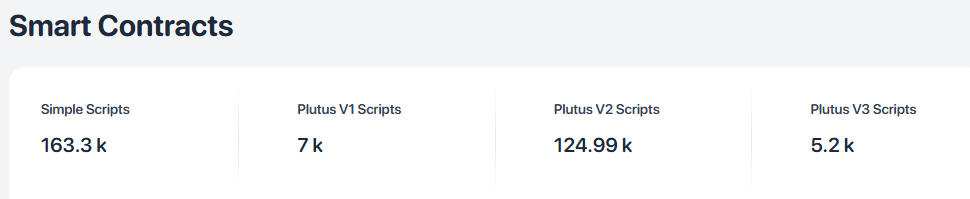
Simple Scripts has contributed 163,300 smart contracts, while Plutus V1 and V2 scripts have deployed 7,000 and 124,990 contracts, respectively, on the Cardano mainnet. However, the Plutus V3, which was introduced to the mainnet in August 2024, has added 5,200 smart contracts to the blockchain, according to Alethea data. 

Cardano live smart contracts

New Milestone Signals Increased Developer Activity 

For context, smart contracts are self-executing agreements on a blockchain created through lines of code. Based on the nature of smart contracts, they execute actions automatically following the terms of the said agreement without the involvement of an intermediary. 

Notably, developers have leveraged the smart contract functionality to create decentralized applications (dApps) interacting with the blockchain. Therefore, crossing the 300,000 milestone signals increased developer activity on the Cardano mainnet. 

Steady Smart Contract Growth Since Vasil Hard Fork 

Meanwhile, the development arm of the Cardano project has introduced several upgrades to enhance the network’s smart contract functionality over the years. 

This was evident following the rollout of the Vasil hard fork in September 2022. The upgrade improved the Plutus smart contract language, making it more efficient and cost-effective for developers to deploy dApps on the mainnet. 

Before the launch of Vasil, the number of contracts on the Cardano mainnet was around 63,490, with Plutus V1 Scripts accounting for 2,900 of this sum, as of July 11, 2022. 

However, the figure has soared to above 300,000 as of today, marking an increase of 373.28% over three years. 

In 2024 alone, nearly 100,000 smart contracts were added to the Cardano network. The Plutus V2 Scripts led the stats, recording an astounding 96,523 contracts from January to December 2024. 

Grayscale, VanEck, and Others Update Solana ETF Filings in Push for SEC Approval

0

Several asset managers have revised their filings for Solana exchange-traded funds, signaling forward movement toward potential approval from the U.S. Securities and Exchange Commission. 

This week, several leading financial firms, including Fidelity, Bitwise, Franklin Templeton, Grayscale, CoinShares, Canary Capital, and VanEck, submitted revised proposals to the U.S. SEC as part of a renewed bid to introduce spot Solana ETFs.

The updated S-1 registration statements reflect what market observers interpret as constructive engagement between issuers and the SEC.

In a post on X, Nate Geraci, president of NovaDius Wealth, noted that the amendments are relatively minor. However, he suggested they reflect a back-and-forth process aimed at refining prospectus language and meeting regulatory expectations.

Grayscale Discloses Fee Structure

For context, Grayscale stated that it intends to charge a 2.5% management fee for its Solana fund, payable not in fiat, but directly in SOL tokens. This approach aligns with Grayscale’s broader crypto-native strategy and offers a potential differentiator in an increasingly crowded ETF landscape.

Growing Pipeline of Crypto ETF Proposals

Beyond firm-level adjustments, the SEC is reviewing a growing number of crypto ETF applications. These include ETFs not only for Solana but also for assets such as XRP and Dogecoin.

As more proposals advance to the review stage, industry analysts believe that approval of even a single fund could pave the way for broader acceptance of digital asset investment products.

SEC Warms to Crypto Under New Leadership

The growing number of ETF applications is unfolding alongside broader policy updates from the SEC. Earlier this week, the agency approved in-kind redemptions for both Bitcoin and Ethereum spot ETFs. It also raised options limits for Bitcoin funds.

Building on the regulatory momentum, SEC Chair Paul Atkins introduced a new initiative dubbed “Project Crypto” on Thursday. The initiative, aimed at overhauling the agency’s outdated digital asset framework, marks a significant policy shift.

Most notably, Atkins stated that “most crypto assets are not securities”, a reversal from previous SEC positions that could open the door to broader ETF approvals across the crypto market.

This change in regulatory tone also reflects the Trump administration’s more accommodating stance toward digital assets. Industry watchers believe such a climate could accelerate approvals for a wide range of crypto ETFs.

Solana Price Snapshot

Amid ETF-related developments, Solana (SOL), the sixth-largest cryptocurrency by market capitalization, has shown mixed performance. As of press time, it was trading at $170.10, marking a 6% decrease over the past 24 hours and a 5% decrease over the past week. Despite short-term volatility, the token remains up 14.1% over the past month, trading within a broad range of $121 to $204.

Buterin Says Ethereum Must Never Go Down as ETH Turns 10 With Zero Downtime

0

Ethereum must never go offline, the co-founder said during the network’s 10th anniversary, highlighting its decade-long record of zero downtime and its mission to safeguard digital freedom.

Speaking during the network’s 10th anniversary livestream, industrial leader Buterin said constant uptime is critical to protecting digital rights and advancing human progress. The blockchain platform celebrated a decade online without a single interruption.

Ethereum at 10: A Decade of Reliability and Growth

Launched on July 30, 2015, Ethereum introduced the world’s first smart contract blockchain. It aimed to give developers an open platform to build decentralized applications (dApps) without intermediaries. 

Over the past 10 years, the network has processed billions of transactions, completed 16 major protocol upgrades, and powered entire sectors such as decentralized finance (DeFi), NFTs, and DAOs, according to Austin Griffith.

Despite network congestion and numerous challenges, Ethereum has never gone offline, an achievement that Vitalik Buterin emphasized as critical to the network’s goal of supporting global digital autonomy and human coordination. Notably, Vitalik stressed that Ethereum’s global, permissionless mission depends on constant uptime and censorship resistance. 

Ethereum’s Roadmap: From Impossible to Inevitable

Moreover, Tim Beiko of the Ethereum Foundation reviewed the network’s progress, noting that many innovations once considered unfeasible are now widely adopted. 

He pointed to Ethereum’s transition from proof of work to proof of stake, the rise of rollups, and the increasing use of zero-knowledge technologies as milestones that reflect the network’s adaptability.

Further, Beiko described Ethereum’s broader vision as turning “impossible” ideas into “inevitable” realities. Notably, this includes scaling solutions, secure identity systems, and global financial tools that operate without centralized control.

Community Voices and Global Reach

The livestream featured developers, artists, and entrepreneurs from across the world. Projects like PeoplePleaser’s Anime and ZK Passport’s privacy-focused ID solutions showed the range of applications being built on Ethereum.

In addition, co-founder Joseph Lubin emphasized Ethereum’s broad appeal across ideologies and industries, portraying it as a foundational platform where anyone can build freely, so long as it remains permissionless and resistant to censorship.

The Ethereum Foundation’s Evolving Role

Shaw and Tomasz, co-executive directors of the Ethereum Foundation, said the foundation now plays more of a support role as the community matures. With over 1 million validators spread across 70 countries, Ethereum has become increasingly decentralized.

They said the foundation would focus on stewarding Ethereum’s core values, which are privacy, decentralization, and user empowerment, while the broader community leads the next wave of development.

A New Decade Begins for Ethereum 

To mark the anniversary, a symbolic “Ethereum torch” NFT was passed across ten contributors before being permanently burned on-chain. The ceremony represented both the network’s decentralized history and its ongoing evolution.

As Ethereum enters its second decade, developers say the next priorities include improving user experience, enhancing privacy tools, and scaling to serve billions of users. However, one principle remains unchanged: Ethereum must always stay online.

Anniversary Fails to Propel Ethereum but Analysts Eye $400

Meanwhile, as it marks its 10-year anniversary, ETH is again approaching the $4,000 resistance zone despite a recent pullback, with market analyst Benjamin Cowen suggesting it may finally break through. After surging more than 50% over the past month, Ethereum is now trading at $3,671, down 4.8% in the past 24 hours. 

Cowen noted that Ethereum has repeatedly failed to clear the $4,000 level in 2024, citing three major rejections in March, May, and December. He attributed the struggle to a missed retest of key support, which Ethereum corrected with an April dip to $1,385. 

Since then, ETH has rebounded sharply but remains nearly 21% below its all-time high of $4,891 recorded in 2021. Cowen believes this recovery may provide the momentum needed to finally overcome the $4,000 barrier and set new highs.

US SEC Launches Project Crypto to Bring All Markets On-Chain

0

The US Securities and Exchange Commission has unveiled a new initiative aimed at bridging the US financial market with the digital space.

This disclosure came at the America First Policy Institute in Washington, DC, on Thursday. The regulator launched “Project Crypto” to modernize securities law to bring all US financial markets on-chain. This aligns with the vision of US President Donald Trump to make America the “crypto capital of the world.”

Speaking at the event, SEC Chair Paul Atkins outlined several initiatives that would drive this new course, insisting it was the priority of the commission under this leadership. Some of them include updating “antiquated” regulations, facilitating “super apps,” and enhancing crypto custody and trading.

Clear Regulations on Distribution and Custody

During his speech, Atkins directed the SEC Commissioners to prioritize the development of clear regulatory policies that would attract crypto distribution back to America. He noted that America has entered its golden age; hence, the days of pushing innovation offshore have ended.

Interestingly, Atkins stressed that most cryptocurrencies are not securities and promised that the agency would create clear guidelines on digital asset classification. He also noted that the SEC would enhance the tokenization efforts in America, working closely with firms pursuing the distribution of tokenized securities to provide the required support.

Furthermore, the US SEC would also modernize crypto custody and trading rights. According to the Chair Atkins, Americans have the right to self-custody their assets. While existing regulations do not have digital assets in mind, he noted that his administration would make the necessary changes.

US SEC to Facilitate Super Apps and On-Chain Software

Meanwhile, Atkins also disclosed that the SEC would encourage “super apps,” all-in-one platforms where intermediaries offer diverse securities and non-securities products. An example of this super app is the Base App launched by Coinbase to replace the Coinbase Wallet.

Platforms like Robinhood and Kraken have also launched similar products, allowing their users in specific locations to trade securities like tokenized stocks alongside crypto trading and other crypto-related products.

Again, Atkins highlighted the existence of obsolete regulations that guide the industry. To that effect, he has tasked his staff to update outdated laws to accommodate on-chain software systems and DeFi platforms.

Remarkably, the chair noted that these amendments would align with Trump’s vision and the mandate from the White House Digital Asset Working Group. Recall that the group released a 166-page report on Wednesday with recommendations for the US SEC and other regulators on enhancing the existence of blockchain technology innovations in America.

Here’s Why a BlackRock XRP ETF Filing Could Be Imminent After Ripple Latest Move

0

Digital asset researcher Anderson suggests that BlackRock could be gearing up to file for an XRP spot exchange-traded fund (ETF). 

He made this suggestion while reacting to reports that BlackRock’s Director of Digital Assets, Maxwell Stein, will be speaking at the Ripple Swell conference. 

The event, slated for November 4 – 5, will give attendees fresh insights from top financial institutions, including Nasdaq, BlackRock, Franklin Templeton, and BNY Mellon. 

Since Ripple unveiled the list of keynote speakers for its flagship event, which includes a BlackRock crypto executive, XRP commentators have been speculating that a BlackRock XRP ETF filing may be imminent. 

Anderson also shared this sentiment in a post on X. According to him, it appears “a BlackRock XRP ETF is getting close.”

Why BlackRock May Launch XRP ETF 

Notably, Nate Geraci, the president of NovaDius Wealth Management, also believes that the world’s largest asset manager will launch an XRP ETF.

In an X thread, Geraci argued that given its dominance in the Bitcoin and Ethereum ETF markets, BlackRock would not overlook two of the top-five non-stablecoin tokens: XRP and Solana. 

Notably, he expects BlackRock to launch index-based crypto ETFs, covering a basket of tokens, as well as exchange-traded funds linked to individual tokens. Moreover, he stressed that BlackRock’s potential launch of an XRP ETF would be business-driven  

Despite acknowledging ideological bias, claiming that “BlackRock is more bullish on Ethereum and views XRP as a scam,” he suggested that these concerns would be set aside in favor of business considerations. 

Geraci added that BlackRock might “open up flanks” if it refuses to launch additional spot ETFs, particularly one tied to XRP. In his view, if BlackRock declines to offer additional ETFs to the already existing Bitcoin and Ethereum funds, then the asset manager is implicitly telling investors that BTC and ETH will be the only winners in the market. 

However, he does not believe the world’s largest asset manager shares this sentiment. “If they truly believe that, then great. I suspect they don’t,” Geraci remarked. 

Will BlackRock Join the XRP ETF Trend? 

Since October 2024, several asset managers have applied with the SEC to launch spot XRP ETFs in the United States. At the moment, over 10 such applications from Franklin Templeton, CoinShares, and 21Shares are on the SEC’s desk awaiting approval. 

However, BlackRock has not shown interest in filing for an XRP ETF. Many initially suggested that BlackRock may be hesitant due to the regulatory uncertainty from the SEC v. Ripple lawsuit. 

However, the SEC and Ripple have agreed to withdraw their appeals from the Second Circuit and end this regulatory uncertainty. Despite this, BlackRock has not made a move concerning an XRP ETF. 

Meanwhile, with a BlackRock crypto executive among the list of speakers at the upcoming Ripple Swell conference, optimism remains high concerning the realization of an XRP ETF from the asset manager.

XRP Brings in More Revenue Than Ethereum for Coinbase, Q2 2025 Earnings Report Shows

0

The Coinbase Q2 2025 earnings report revealed that XRP brought in more revenue for the exchange than Ethereum did in the quarter.

Interestingly, XRP achieved this impressive feat despite having a smaller share of trading volume. Notably, only Bitcoin generated more revenue than XRP, placing the token in a strong second position.

Coinbase Q2 2025 Earnings Report Reveals Revenue Declines

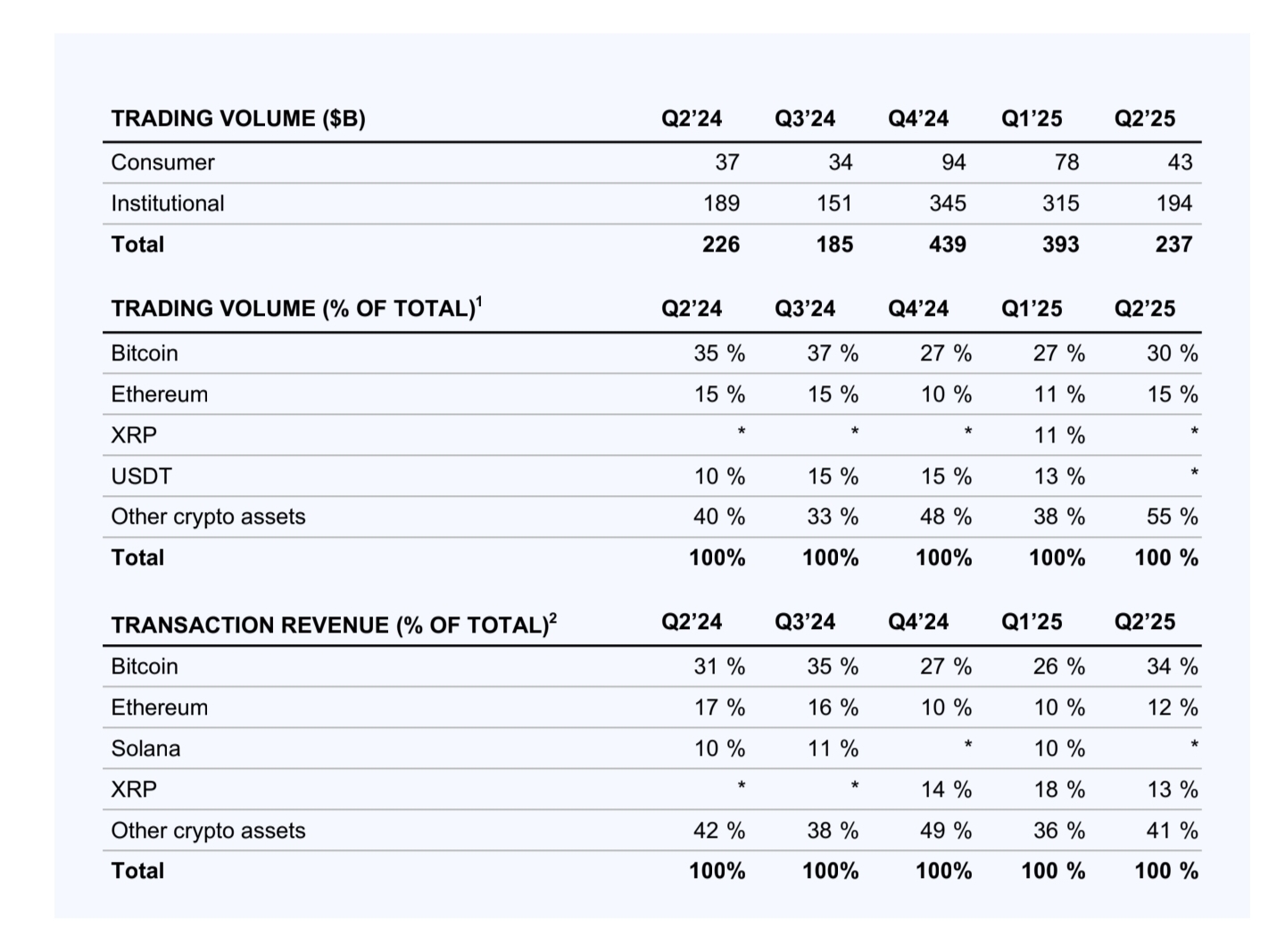
Data from the Coinbase Q2 2025 earnings report indicates that in the three months ending June 2025, the exchange reported total revenue of $1.5 billion, down 26% from the previous quarter. In addition, transaction revenue dropped to $764 million, a 39% decline quarter-over-quarter. Meanwhile, trading volume slid 40% to $237 billion. 

According to the company, most of this decline came from a drop in stablecoin pair trading, following a pricing adjustment Coinbase made in March to change its stablecoin strategy. 

In addition, consumer activity dropped across the board. Specifically, consumer trading volume fell 45% to $43 billion, and revenue from that segment slid 41% to $650 million. Institutional trading also slowed, with volume dropping 38% to $194 billion and revenue falling by the same percentage to $61 million. 

Meanwhile, Coinbase earned $54 million in “other transaction revenue,” which includes staking, subscriptions, and blockchain rewards.

XRP Accounts for Second-Largest Revenue Share

Notably, amid these discouraging figures, XRP stood out. It accounted for 13% of Coinbase’s transaction revenue, more than Ethereum’s 12%. XRP reached that mark even though its trading volume didn’t reach the 10% reporting threshold. 

XRP Beats Ethereum in Transaction Revenue Coinbase Q2 2025 Earnings
XRP Beats Ethereum in Transaction Revenue | Coinbase Q2 2025 Earnings

In contrast, Ethereum made up 15% of the total trading volume. Bitcoin led both categories, taking 34% of transaction revenue and 30% of trading volume. Solana didn’t break the 10% threshold for either metric, and USDT also stayed below that range.

Coinbase’s Historical Relationship with XRP

XRP’s current success on Coinbase comes after years of ups and downs. The exchange first listed XRP in February 2019 after deciding it didn’t qualify as a security. However, in December 2020, the SEC sued Ripple, claiming XRP was an unregistered security. In response, Coinbase suspended trading in January 2021, though users could still store the token in their wallets.

Nonetheless, Coinbase removed XRP from its Wallet product two years later due to low usage. Interestingly, after Judge Analisa Torres ruled in July 2023 that XRP was not a security in itself, Coinbase brought XRP back for trading. Today, it’s accounting for most of its transaction revenue.

Notably, after relisting XRP two years back, Coinbase took things further in XRP when it filed with the CFTC to launch XRP futures contracts and began trading them later that same month.

At press time, XRP ranks as the third most traded asset on Coinbase, with a 24-hour volume of $280.33 million, or 9.78% of the platform’s total. Bitcoin and Ethereum take the top two spots. 

Meanwhile, on Korea’s leading exchange, Upbit, XRP sees even stronger demand. It leads all assets with $529.46 million in daily volume, making up 17.38% of the platform’s trading. Strike holds second place, followed by Ethereum and Bitcoin.

Here is XRP Price if Ripple Becomes an XRP Treasury Company

0

Amid suggestions that Ripple should become an XRP treasury firm, we recently analyzed how XRP price could react to this development.

There’s growing talk within crypto circles that Ripple could change its business strategy and become an XRP treasury company, much like what MicroStrategy did with Bitcoin. 

Right now, Ripple holds 40.67 billion XRP, or 41% of the total supply, worth around $122 billion. Interestingly, this is more than MicroStrategy’s Bitcoin holdings, which stand at 628,791 BTC valued at about $72.6 billion. 

If Ripple shifts its focus toward holding XRP instead of selling, it could have an impact on XRP price. To assess this, we asked both ChatGPT and Google Gemini to run price projections based on the idea. 

ChatGPT Estimates XRP Price if Ripple Becomes an XRP Treasury Company

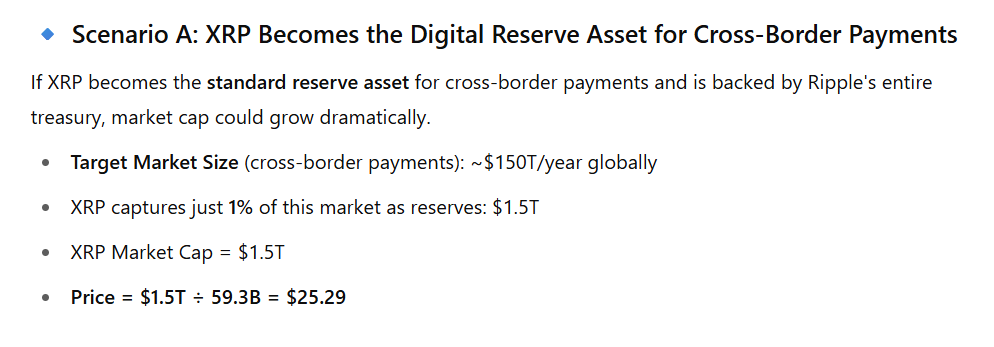
In its response, ChatGPT presented several bullish outcomes. In one scenario, XRP becomes a global reserve asset for cross-border payments. The global market for these payments is worth about $150 trillion each year. 

Notably, if XRP secures just 1% of that as reserve capital, it could push XRP’s market cap to $1.5 trillion. This would place XRP at $25.29 per token when divided by the 59.3 billion supply.

XRP Price Evaluation ChatGPT
XRP Price Evaluation | ChatGPT

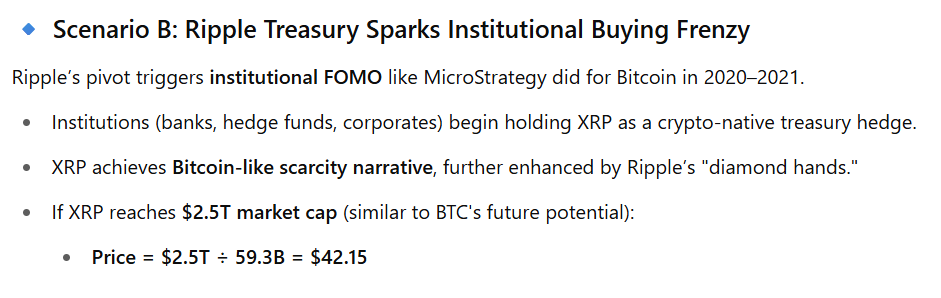
Meanwhile, another projection focused on institutional demand. If Ripple’s pivot leads to large-scale buying from banks, funds, and corporations, similar to what happened with Bitcoin in 2020 and 2021, XRP’s market cap could grow to $2.5 trillion. This would take the price to $42.15.

XRP Price Evaluation ChatGPT 2
XRP Price Evaluation | ChatGPT

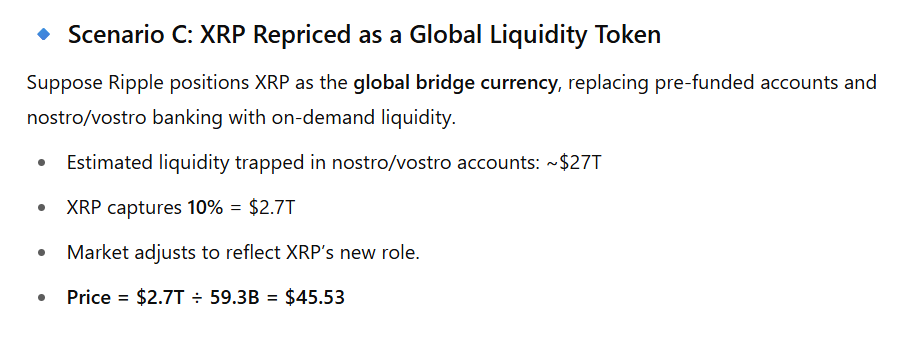
Further, ChatGPT also modeled a scenario where XRP replaces nostro and vostro accounts as the global bridge currency. These accounts currently hold around $27 trillion in idle liquidity. If XRP captures just 10% of that, it would add $2.7 trillion to the ecosystem, pushing prices to $45.53.

XRP Price Evaluation ChatGPT 3
XRP Price Evaluation | ChatGPT

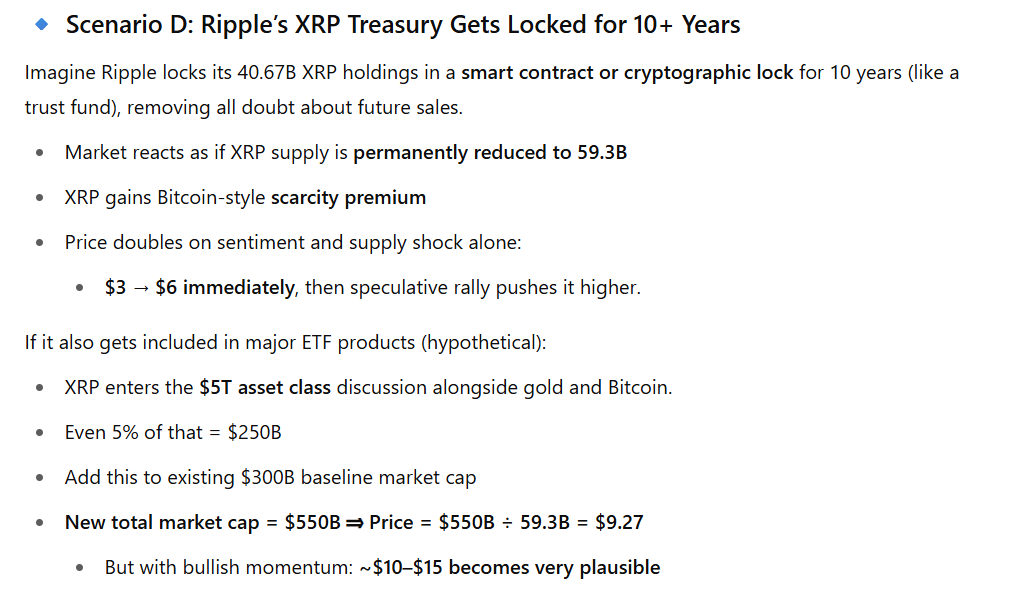
However, in a more conservative case, ChatGPT suggested that Ripple lock its entire 40.67 billion XRP stash for 10 years, which would remove all doubts about future supply. 

If the market sees XRP’s supply as permanently capped at 59.3 billion tokens, that could double the price from $3 to $6 based on sentiment alone. With additional momentum and possible inclusion in ETF products, the market cap could climb to $550 billion, placing XRP between $9.27 and $15.

XRP Price Evaluation ChatGPT 4
XRP Price Evaluation | ChatGPT

Google Gemini Projects XRP Price if Ripple Sets an XRP Treasury

Meanwhile, Google Gemini was more cautious in its projections. Gemini considered what would happen if Ripple permanently removed its 40.67 billion XRP from circulation. Under that condition, the market would spread the same $300 billion valuation across a smaller supply, raising the price to $5.06 per token.

Moreover, Gemini also looked at a potential “MicroStrategy premium.” It suggested that if the market treats Ripple like a treasury-focused firm and adds a 50% premium to its valuation, the market cap could jump to $450 billion. With the full 100 billion XRP supply, that would set the price at $4.50.

However, in a highly optimistic scenario, Gemini suggested that XRP gains a new image as a scarce, institutional-grade digital asset. If XRP reaches half of Bitcoin’s $2.3 trillion market cap, its price would hit $11.50. If it matches Bitcoin completely, the price will double to $23, considering the total supply.

Growing Adoption of XRP for Company Treasuries

Notably, in addition to the prospect of Ripple’s adoption, other firms have been establishing XRP treasuries. In July, Nature’s Miracle Holding Inc. was the latest to announce plans to invest up to $20 million into an XRP treasury strategy. 

In addition, Trident Digital Tech Holdings had disclosed a $500 million commitment, and Webus International added another $300 million. Companies like VivoPower International and Wellgistics Health are also building XRP reserves.

Amid this run, Bitwise CEO Hunter Horsley questioned if Ripple might fully become an XRP treasury company within a year. He noted that more companies could start holding XRP, which would tighten supply and naturally push prices higher.

How High Could XRP Go If Western Union and MoneyGram Start Using It for Settlements

0

XRP price may reach unprecedented heights if payment giants Western Union and MoneyGram start using it for settlements.

Western Union and MoneyGram’s Settlement Volume

Two of the major remittance companies that could leverage XRP for global payments are Western Union and MoneyGram. However, it remains unclear how much the XRP price could rise if these firms adopt it.

So, to explore the potential extent, we asked OpenAI’s ChatGPT. Interestingly, the chatbot responded with two extensive models based on transaction volume, liquidity needs, and investor behavior.

For context, Western Union and MoneyGram move more than $350 billion every year together. Of this figure, $150 billion comes from Western Union and over $200 billion from MoneyGram. These two firms dominate the global remittance market, so any serious adoption of XRP could carry huge implications.

XRP Price if Western Union and MoneyGram Used It

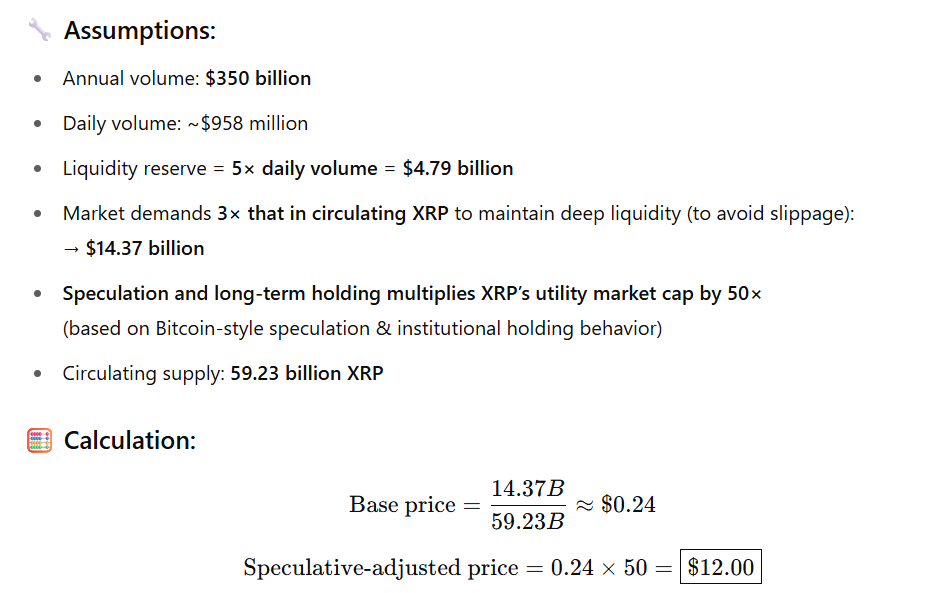
In its first model, ChatGPT assumed that both firms fully adopt XRP for settlement and hold large XRP reserves to support fast transactions. It is estimated that they would need about $4.79 billion worth of XRP as a base reserve, which the broader market would have to support with at least $14.37 billion in circulating liquidity to avoid slippage and delays. 

Then, it factored in the behavior of long-term investors and speculators, using a multiplier of 50. Notably, this is similar to how Bitcoin’s price rose as institutions began to buy and hold the token. According to ChatGPT, under this model, XRP could climb to around $12.

XRP Price if Western Union and MoneyGram Use It ChatGPT 2
XRP Price if Western Union and MoneyGram Use It | ChatGPT

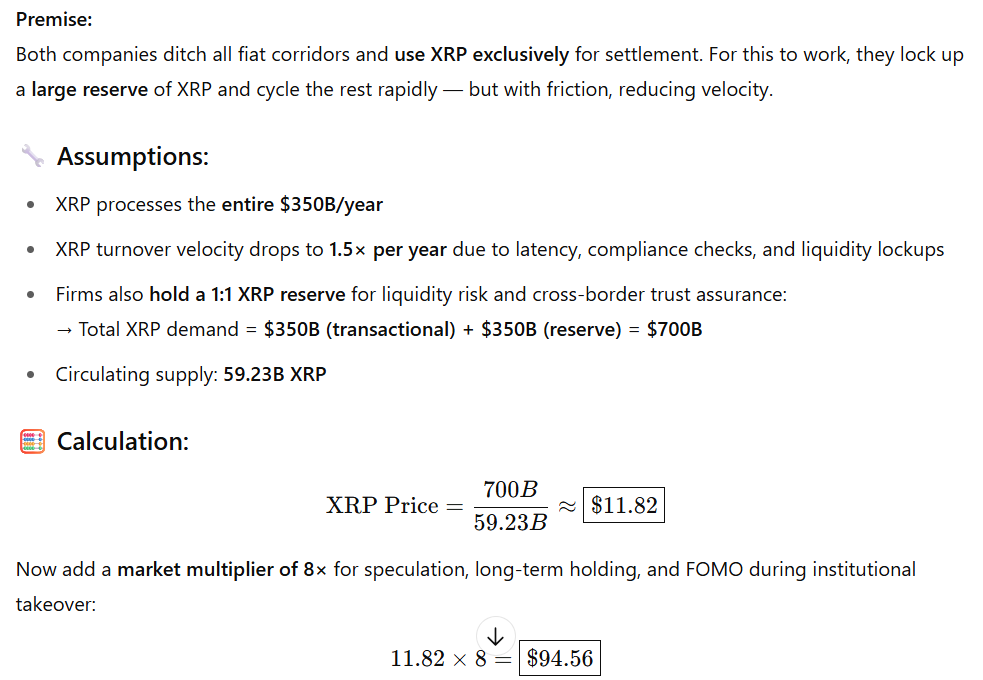
Meanwhile, in the second model, it is imagined that both companies ditch all fiat routes and use only XRP for every transaction. Since real-world transfers involve delays from regulations and liquidity locks, it has reduced XRP’s turnover rate to 1.5 times a year. 

Also, ChatGPT assumed that both companies would hold enough XRP to match their annual volume as a safety buffer. This brought the total demand to $700 billion. Dividing that by the 59.23 billion XRP in circulation, the model gave a base price of $11.82. 

However, with an added multiplier of 8 to reflect market hype, long-term holding, and institutional FOMO, the final price soared to $94.56.

XRP Price if Western Union and MoneyGram Use it ChatGPT 3
XRP Price if Western Union and MoneyGram Use it | ChatGPT

ChatGPT also clarified that these figures only show XRP’s value based on usage by Western Union and MoneyGram. They don’t include demand from other remittance firms, central bank digital currencies, or XRP’s deflationary supply changes. If those materialize, XRP could easily break the $100 mark.

Ripple’s Dealings with Western Union and MoneyGram

Interestingly, Ripple has already worked with both companies in the past. Back in 2019, it struck a deal with MoneyGram that allowed the remittance firm to use Ripple’s xRapid product to settle cross-border payments. 

Ripple even invested up to $50 million in MoneyGram’s equity. However, after the U.S. Securities and Exchange Commission filed a lawsuit against Ripple in 2020, MoneyGram paused its use of XRP and ended the partnership in early 2023.

Meanwhile, Ripple’s history with Western Union dates back to 2015, when the company tested Ripple’s tech as part of a pilot project. At the time, Western Union explored using xRapid and XRP to improve its payment systems. However, the company never moved forward with full adoption.

Expert Says Don’t Understand Why People Are Complaining About XRP Price Now

Leading voices in the XRP community are pushing back against the persistent complaints about XRP’s supposed lack of price movement.

In a tweet, crypto researcher Anderson expressed frustration with investors complaining about XRP’s price action. At the time of the post, XRP’s 24-hour performance was bearish, dipping to exactly $3 before bulls rescued it from breaching this psychological level.

Wednesday’s fall added to the frustration of those already complaining about the coin’s stalled bullish momentum since it touched $3.66 two weeks ago. Amid the dip, some traders disclosed new short positions on XRP, dampening hopes for an imminent price recovery.

Instead of Complaining, Look How Far XRP Has Come

However, Anderson believes the anxiety about XRP’s price performance is misplaced. He reminded market participants that the coin traded at just $0.5 eight months ago in November. Despite this over 6X increase in price, widespread complaints about its performance persist.

Anderson shared the view that many are hunting for overnight riches with XRP and lack the patience to hold for even a few months. Instead, they complain about a lack of movement, despite the coin ranking among the best-performing crypto assets in recent times.

Reacting to the post, other community members attempted to explain typical frustrations about XRP’s price action.

Some pointed out that the complaints come from comparing XRP to other trendy assets like Bitcoin and Ethereum, which dominate headlines. However, a close comparison over a five-year scale shows XRP leads these assets in return on investment.

Meanwhile, commentators like King Karan suggested that those complaining about XRP now may be investors who bought around $2 and haven’t secured life-changing gains like those who bought much lower at $0.5.

XRP Investors Frustrated Due to Too Much Moon Hype

Meanwhile, X user Theophilus pinned the blame on the XRP community itself. He pointed out that those frustrated with their investment listened to influencers claiming that millionaires would be made in XRP during this bull run.

He stressed that such expectations lead to disappointments, warning market participants against listening to influencers who inflate hopes unrealistically. X user Sasha Banichek agreed that many bought on “hopium,” adding that he is even one of them.

Indeed, wild XRP price predictions are a common theme in the crypto sphere, with many overlooking potential technical limitations for such price points.

For instance, Jake Claver, Director of Digital Ascension Group, has predicted XRP could surge as high as $2,000 within seven months. He maintains this outlook despite the fact that XRP would need to grow over 65,000% from its current level, resulting in a market cap of $118 trillion.

In July 2023, Shannon Thorp predicted that XRP’s price would soar to $100 to $500 within seven months. However, the timeline elapsed, and XRP’s price even dipped below the level it was before the ambitious forecast. Meanwhile, Thorp later owned up to her mistake after the forecasts failed.