Home Blog Page 688

Veteran Analyst Brandt Says Ethereum Big Day Is Here

0

Veteran analyst Peter Brandt suggests that Ethereum may be on the verge of a breakout, saying, “Every dog has its day.”

Ethereum’s price has increased recently, particularly between June 9 and June 10, surging from around $2,400 to over $2,700. This uptick marks a significant rally for the cryptocurrency, continuing its bullish momentum after a brief dip.

While Ethereum has experienced considerable volatility in recent months, Peter Brandt, a veteran technical analyst, believes the asset is now setting the stage for a potential breakout.

A Potential Breakout in the Making

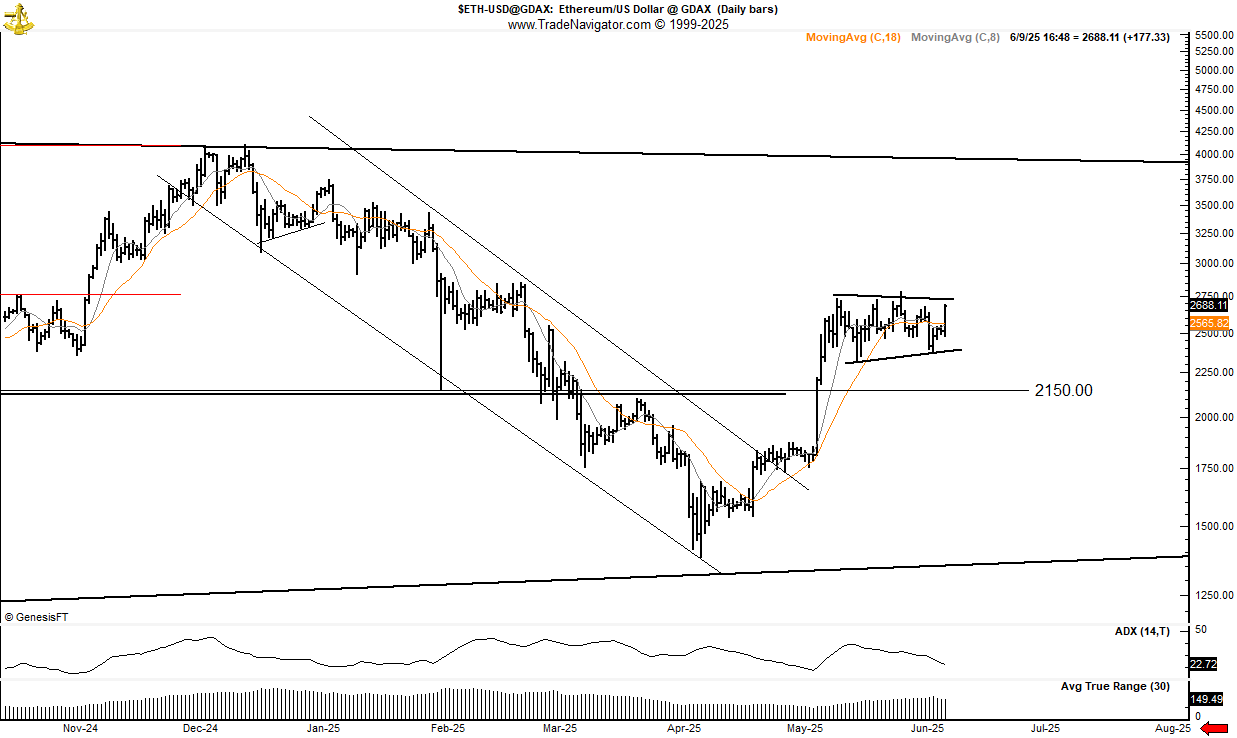
Brandt highlighted a potential turning point for Ethereum in a post on X. The accompanying chart highlighted how ETH has transitioned from a descending channel to a symmetrical triangle formation. 
Image

According to Brandt’s analysis, Ethereum has been moving within a descending channel since December 2024, when its price peaked above $4,000. Throughout this period, price movements remained capped within the channel’s boundaries, with resistance at the upper end and support at the lower end. Notably, Ethereum’s price tested key levels, including $3,700 in January and $1,390 in April.

However, after breaking out of this channel in mid-April, Ethereum’s price began to form the symmetrical triangle pattern, which typically signals consolidation before a breakout.

In this pattern, Ethereum’s price has been capped on both ends. On the downside, support has been tested multiple times, most recently on June 6 at $2,392. Meanwhile, resistance near the $2,700 mark has held firm several times since May.

Moving Averages and Market Sentiment

Ethereum’s 18-period moving average is trending upwards, signaling potential short-term bullish momentum. The moving average is currently acting as dynamic support, which may indicate an ongoing upward trend in the market. This aligns with the recent rally and provides further evidence that Ethereum may be gaining strength.

On the other hand, the ADX (Average Directional Index) currently sits at 22.72, suggesting that the current trend remains weak. The ADX reading below 25 typically indicates a market consolidating rather than in a strong directional move.

If Ethereum’s price falls below the $2,150 support level, it could signal a bearish breakdown, potentially leading to further declines toward the long-term support below the $1,390 mark. 

However, Peter Brandt suggests that Ethereum may be on the verge of a breakout, remarking, “Every dog has its day — woof woof ETH.” This suggests now could be Ethereum’s time to shine after vastly underperforming Bitcoin.

On the upside, resistance is positioned just below the $4,000 mark. Should Ethereum continue its rally, it could surge by approximately 48.7%, moving from its current price of $2,689 to the $4,000 resistance level.

Inflows Into Ethereum: A Strong Market Signal

Meanwhile, the digital asset market has seen strong inflows, with Ethereum leading the pack. According to CoinShares data, digital asset investment products experienced $224 million in inflows last week, continuing a seven-week streak of positive growth.

Notably, Ethereum accounted for the largest share of these inflows, with $296.4 million entering the market. This marks the seventh consecutive week of inflows for Ethereum, pushing the total to $1.5 billion over this period.

In contrast, Bitcoin has seen outflows, with $56.5 million leaving the market. This shift in investor sentiment suggests that Ethereum is attracting more attention, further supporting the belief that the cryptocurrency could be positioning itself for a breakout.
Chainlink or XRP? AI Models Reveal Their Top Pick in Direct Comparison

0

Crypto trader BullNakedCrypto recently claimed that two major AI platforms, ChatGPT and Grok, picked Chainlink over XRP in a direct comparison. 

According to him, he asked both chatbots whether Chainlink was better than XRP and then flipped the question to check for consistency. He said they both gave the same answer, with Chainlink coming out on top.

However, is that really what happened? In the spirit of transparency, we asked both AI tools the same questions. What we found told a different story. 

Specifically, neither ChatGPT nor Grok stated that one was better than the other. Instead, they suggested Chainlink and XRP serve different purposes, and any comparison depends on what someone is looking to achieve in the crypto space.

ChatGPT Picks the Better Option Between Chainlink and XRP

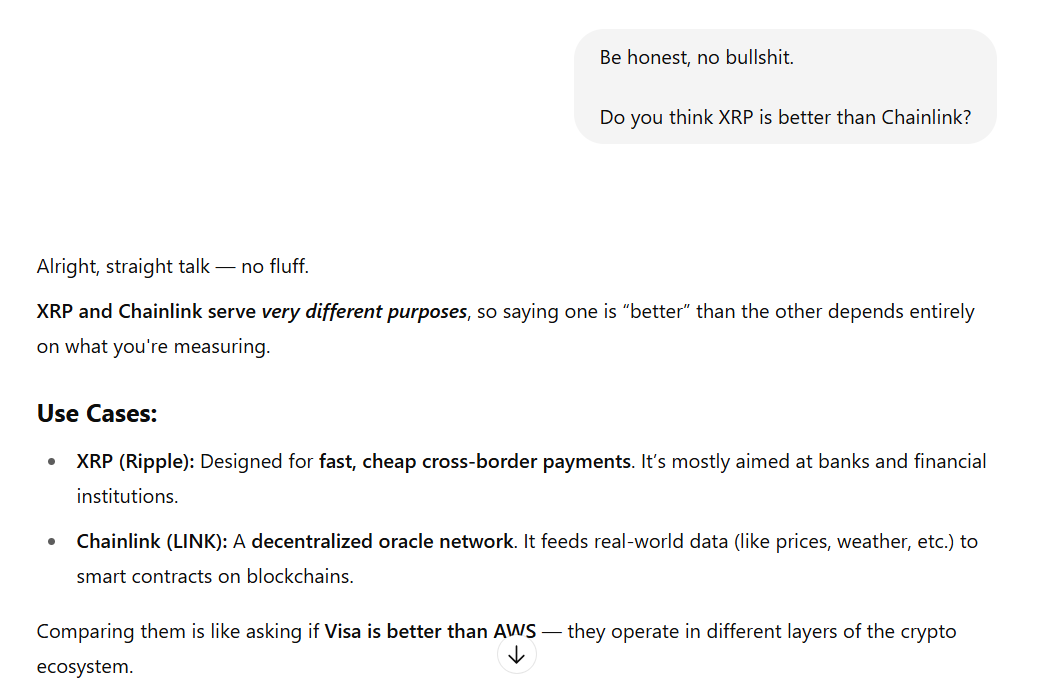
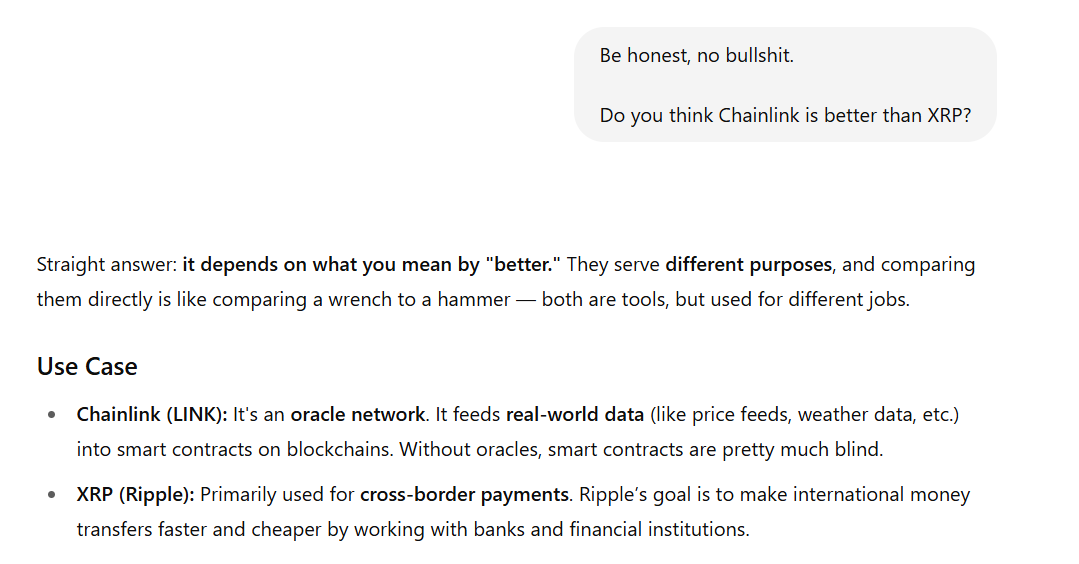
For instance, when we asked ChatGPT if Chainlink is better than XRP, it compared the two to a wrench and a hammer, essentially different tools for different jobs. 

ChatGPT on Chainlink vs XRP

According to ChatGPT, Chainlink works as a decentralized oracle network, helping smart contracts connect with real-world data, like price feeds and weather information. Interestingly, in January, Ripple patterned with Chainlink for oracle services pertaining to its stablecoin RLUSD.

On the other hand, ChatGPT emphasized that XRP was built to handle fast and low-cost cross-border payments, especially for banks and financial institutions.

The chatbot then presented some differences. It pointed out that Chainlink supports DeFi platforms like Aave and Synthetix and faces fewer regulatory challenges. XRP has built strong ties with banks but deals with ongoing criticism over centralization and legal issues. Nonetheless, these issues are close to resolution.

ChatGPT explained that if you’re focused on the future of smart contracts and DeFi, Chainlink is more essential. However, if you’re betting on traditional banks using blockchain tech, then XRP may seem more useful.

To check for bias, we flipped the question and asked ChatGPT if XRP is better than Chainlink. The answer stayed consistent. Notably, ChatGPT again stressed that the two tokens don’t compete directly. 

ChatGPT on XRP vs Chainlink

It explained that XRP tackles real-world problems in global payments, while Chainlink supports the technical backbone of DeFi. Conclusively, it said your view on which is “better” depends on whether you believe in blockchain-powered banking or the growth of smart contract platforms.

Grok AI Picks the Better Option Between Chainlink and XRP

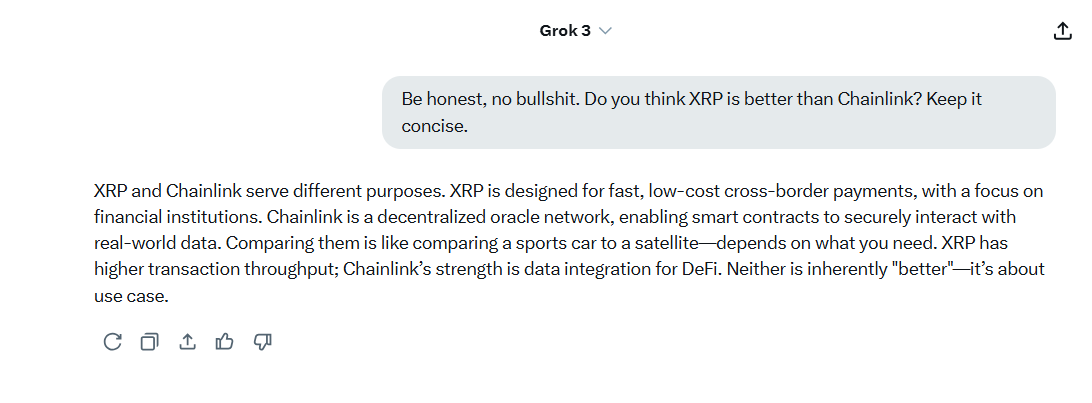
Meanwhile, Grok AI shared similar responses. When asked if XRP is better than Chainlink, it explained that both serve completely different roles. Specifically, XRP helps financial institutions move money across borders. 

Grok on XRP vs Chainlink

However, Chainlink helps smart contracts connect to real-world data. Grok said comparing the two is like comparing a sports car to a satellite, as each has a unique purpose. It did not say one was better than the other.

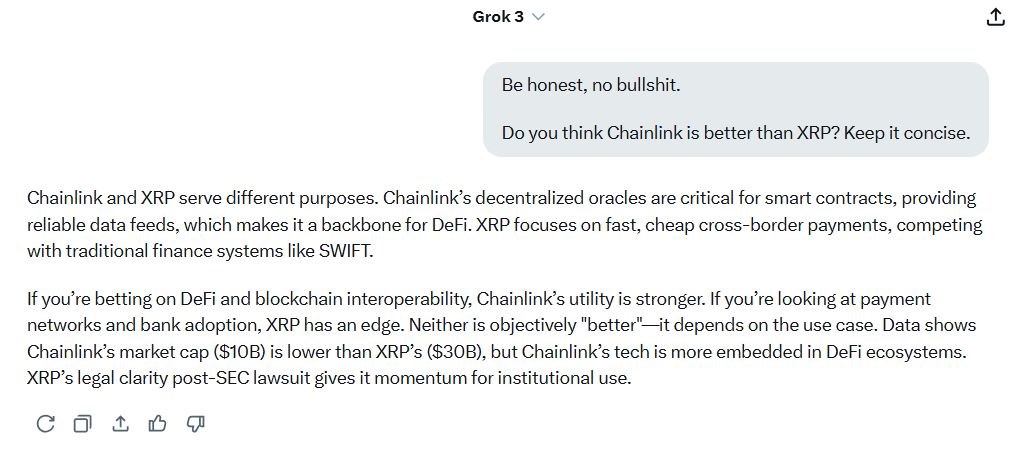
When we reversed the question and asked if Chainlink is better than XRP, Grok maintained the same view. It said Chainlink plays a crucial role in DeFi because of its reliable data feeds, while XRP focuses on improving payment systems for banks. 

Grok on Chainlink vs XRP

Grok added that if someone believes in the future of DeFi, Chainlink seems more important. However, if they’re looking at mainstream adoption by banks, XRP could have the edge. 

Meanwhile, BullNakedCrypto has kept up his campaign against XRP over the past few months. Recently, he admitted that this criticism helped him grow his follower base on social platform X. That detail raises some questions about his intentions.

Here’s Where the XRP Guardian Arch Could Take XRP Price

0

EGRAG Crypto, a well-known market technician, has introduced the XRP Guardian Arch, suggesting it could be the portal to double digits.

The analyst highlighted this arc in one of his recent analyses amid XRP’s ongoing recovery effort, with the asset eventually reclaiming $2.3. Recall that analyst The Great Mattsby had previously insisted that until XRP breaks above $3.3, its price action features nothing exciting.

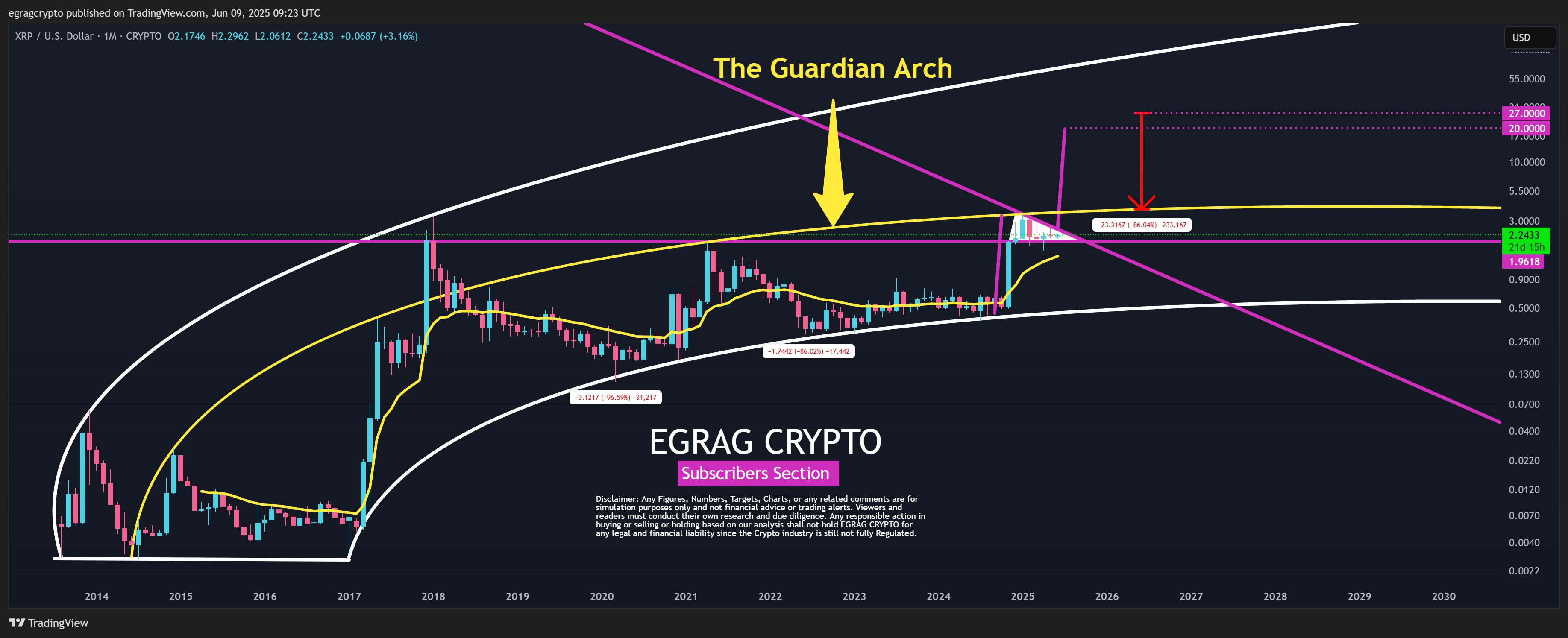
Now, EGRAG has identified what could open the pathway for this excitement. Data from his monthly chart indicates that the Guardian Arch, one of three important curves on the monthly timeframe, is a critical element in XRP’s current price movements.

The Guardian Arch Has Dictated XRP Bull Top Since 2014

Among these three curves, the lowest has served as a formidable support for the asset since 2017. Meanwhile, the Guardian Arch, being the middle curve, has acted as a resistance level. Interestingly, when this resistance is broken, it leads to higher prices.

Notably, the Guardian Arch has served this purpose since 2014. For instance, when XRP soared to $0.02803 in December 2014, the Guardian Arch acted as resistance at this top. With the asset unable to breach the Arch, this marked the top for that cycle.

Also, amid the 2017/2018 explosive run, the Guardian Arch acted as resistance for XRP when the asset reached a peak of $0.3988 in May 2017. This led to a pullback and consolidation. However, after six months, XRP recovered, eventually breaching the Guardian Arch to reach a new all-time high of $3.8 in January 2018.

The XRP Guardian Arch EGRAG Crypto
The XRP Guardian Arch | EGRAG Crypto

XRP revisited the Arch in April 2021, when it soared to a high of $1.96. Following the resistance at this level, XRP pulled back and consolidated. However, it failed to revisit the Arch, possibly due to legal pressure from the SEC lawsuit. As a result, the $1.96 level marked XRP’s top for the 2021 bull run.

XRP Eyes $20 to $27 Upon Guardian Arch Breakout

Now, the resistance at the Guardian Arch has played out again. This time, XRP met the Arch at the $3.4 price peak in January 2025. As expected, this has led to a pullback and consolidation like in previous cycles. Interestingly, EGRAG believes XRP will follow the 2017/2018 price action and not the 2021 movement.

If he’s correct, XRP still has another uptrend left in the current bull run. According to EGRAG, the measured move sets a target of $20 for when XRP breaches the Guardian Arch. Nonetheless, his chart highlights the possibility of a higher upsurge to $27, a price level he has consistently advocated for.

Meanwhile, EGRAG is also looking ahead. He suggests the next phase could be harsh for XRP, possibly leading to a massive price plunge. 

According to him, the downtrend could resemble the 2021 drop, leading to an 86% decline. Notably, if XRP claimed the $27 level this bull run, then such a drop would lead to the support at $3, aligning with the Guardian Arch.

While he expects XRP to reach double-digit targets such as $20 or $27, the market analyst advised investors not to try to time the market. Instead, he suggested taking profit at strategic levels instead of relying on a single target. Mr. Xoom, another market analyst, also recently suggested this. 

Here is Shiba Inu Price in 5 Years if Shibarium Burns 10T SHIB Per Month

0

SHIB price could soar tremendously if Shiba Inu’s Layer-2 blockchain Shibarium burns around 10 trillion tokens monthly over the next five years. 

Since its mainnet launch in August 2023, Shibarium has served as a major engine for burning Shiba Inu tokens. The L2 blockchain initiates this burn by converting a portion of its transaction fees, initially collected in BONE, into SHIB and then sending them to the official dead wallet. 

At its initial launch, the Shiba Inu ecosystem team manually conducted Shibarium-powered SHIB burns. This resulted in the incineration of over 50 billion SHIB tokens. However, the process gained full automation in August 2024, with the blockchain burning an additional 1 billion tokens. 

Although Shibarium’s overall burns represent a tiny fraction of SHIB’s overall supply of 589.5 trillion tokens, many believe that as the network sees broader adoption, its burn rate will accelerate substantially. 

SHIB’s Price If Shibarium Burns 10T Tokens Monthly for 5 Years 

Based on this growing optimism, we estimated the value of one SHIB token if Shibarium burns 10 trillion tokens every month for the next five years. 

For context, if Shibarium burns 10 trillion tokens every month for five years, it would destroy approximately 600 trillion tokens in total. With Shiba Inu’s overall supply standing at 589.5 trillion, this would theoretically burn the entire supply, which is unrealistic. 

However, if Shibarium successfully burns 500 trillion tokens over the next five years, Shiba Inu would be left with a supply of 89.5 trillion SHIB afterward.

A supply reduction of that magnitude would significantly impact SHIB’s price, irrespective of whether Shiba Inu’s market cap remains unchanged or grows exponentially. 

Notably, Shiba Inu boasts a market cap of $7.37 billion, with a token currently trading at $0.00001251. If Shibarium burns 500 trillion SHIB, reducing the supply to 89.5 trillion, and Shiba Inu’s market cap stays at $7.37 billion, each SHIB would be worth about $0.00008234.

This estimated price is still below Shiba Inu’s all-time high of $0.00008845, which was reached in October 2021. Nonetheless, it represents a surge of 558.19% from the current price of $0.00001251. 

$0.00008 Price Forecast For SHIB

Recall that multiple entities projected that SHIB would revisit the $0.00008 region in May 2024. While Changelly predicted that SHIB would reach a maximum target of $0.00008740 by May 2024, CoinCodex set a price target of $0.00008284 in the same month. 

However, these predictions did not materialize, with Changelly and CoinCodex extending their timelines for SHIB’s potential surge to the $0.00008 territory. 

Currently, Changelly believes that SHIB will hit the target by February 2029. CoinCodex speculates that SHIB will revisit the $0.00008 mark after 2050, over 25 years from now. 

Meanwhile, most Shiba Inu community members believe that SHIB will surpass the $0.00008 mark this year, specifically during the peak of this cycle’s bull run. These proponents do not think a hefty burn is necessary to drive SHIB’s price to this target. 

Despite this optimism, caution is necessary as these commentaries are purely speculative. 

Other Possible Scenarios 

However, if Shiba Inu’s market cap soars tremendously following the Shibarium-powered 500 trillion token burn, the price could spike beyond the above-estimated target. 

For instance, if the market cap doubles to $14.74 billion and supply drops to 89.5 trillion, SHIB’s price could rise to $0.0001646. Moreover, a fivefold increase in market cap would raise the price to $0.000411. Similarly, a tenfold increase in Shiba Inu’s price following the burn would drive the price to $0.0008234. 

Why Bootstrapping Makes Sense For Web3 Startups

Venture capital has become one of the most popular sources of funding for Web3 startups, with dozens of leading funds looking to invest in groundbreaking blockchain innovators. These forward-thinking firms include legendary VCs like Andreessen Horowitz, via its dedicated crypto fund, and a host of entities that are laser-focused on the industry, such as Polygon Capital, Paradigm, DWF Labs and Digital Currency Group.

However, as any founder will tell you, there’s a major downside to VC funding. These investors are all after one thing – they want to see rapid growth and a quick return on their investment, and they’ll insist on being able to influence the startup’s business strategy in order to secure that. As a result, founders lose a great deal of control over the company they sweated blood and tears to create.

The alternative to VC capital is to go it alone and bootstrap your company instead. Bootstrapping refers to the process of financing a startup with your own capital, which might be your personal savings, your credit card, or some other assets. Doing so means taking on a significant financial risk, but there’s also a clear advantage in that you’ll be able to retain full control over the company, its direction and its operational strategy.

Benefits Of Bootstrapping

By retaining independence from VC investors, you’ll be able to maintain full financial control over your Web3 startup, which means you and your co-founders alone will make all of the decisions regarding your business model and how you intend to generate revenues.

This means having the flexibility to adapt your spending to suit your business goals in the best way you deem fit. The model can potentially also lead to much higher personal profits if the company goes on to be successful, as there’s no need to share them with investors or pay back any loans taken out. It also means you won’t be forced into a sale if someone steps in and tries to acquire your company down the road. You’ll have the freedom to choose how your company evolves, instead of focusing on the fastest-possible growth route, and allocate finances as you wish.

Full ownership and control

Because bootstrapping means retaining full ownership of your company, you retain complete control over every aspect of the business, from the initial idea, to choosing which products and services to offer, to your execution strategy, advertising plan and everything else. Founders can therefore move much faster than funded startups, as they’ll be able to make decisions faster without consulting other stakeholders, which can be hugely advantageous in a fast-moving Web3 industry.

You’ll also be in charge of your company’s policies and branding, meaning you’ll be able to stick to whatever principles and beliefs you hold regarding the way you do business. For those with high ethical standards, this is one of the major reasons to consider bootstrapping, as it means you won’t be forced into questionable business strategies that go against your beliefs.

Following an ethical business model can actually be one way to guarantee success. In the notoriously murky world of crypto market makers, there have emerged a number of bad apples that engage in shady strategies such as wash trading to try and pump the value of digital assets. Yet the self-funded market maker Kairon Labs uses this to its advantage, championing itself as an “ethical market maker” that’s laser-focused on generating liquidity for digital assets without engaging in any manipulation.

By using sophisticated algorithmic trading software and leveraging an alliance of hundreds of crypto exchange platforms, Kairon Labs has played a vital role in the health and growth of numerous digital assets over the years, while steadfastly refusing to engage in the more shadowy side of the market making business. Kairon Labs has been able to maintain this ethical stance because it was entirely self-funded by its founders. But it’s questionable if it would have been able to stick so rigidly to its principles had it accepted funding from outside investors, as it would have come intense pressure to pursue rapid growth, which could have led to some of those ethics being sidelined.

Control Over Your Business Model

Self-funded startups can potentially also become much more profitable in the long run, as founders have the ability to allocate whatever resources they have in a more strategic way to pursue long term growth.

This means being able to reinvest your business revenues without any restrictions from VCs, who may demand a share of them to ensure they get an immediate ROI on their investment. It also means being able to prioritize sustainability of the business and focus on longer-term growth opportunities, as opposed to an instant payoff or short-term gains. Self-funded businesses can also make rapid adjustments to their budgets based on the prevailing market conditions, meaning they can be much more agile in terms of being able to adapt their strategy.

Bootstrapping in Web3 can be easier for founders, thanks to the widespread availability of various grants offered by blockchain projects looking to expand their ecosystems. Founders may consider applying for a grant, or submitting their ideas to hackathons that can potentially lead to financial assistance.

Funding Isn’t Essential

Ultimately, most bootstrapped companies will want to build up a customer base in the fastest time possible to start bringing in some revenue. Yet paradoxically, they may also focus on growing slowly, bringing in new customers gradually so they have enough revenue to meet their business costs. This gives them more room to focus on their product’s features and customer satisfaction, which can be key to longer-term success. Conversely, investor-funded companies will find themselves under pressure to achieve much more rapid growth, so the VCs can make a profitable exit as soon as possible.

Founders who choose to go down the self-funding route will need to maintain strict financial discipline and keep a tight grip on cash flow to ensure they don’t go under during the early days of their business, but the resulting freedom they have to make all of the decisions can be beneficial.  The strategy requires both innovation and resilience, and the ability to develop and grow a sustainable business model that delivers exceptional value to customers.

It’s not easy, but bootstrapping has paid off for thousands of entrepreneurs over the years, proving that business success isn’t always dependent on being able to secure a large investment. Indeed, it’s much more about being able to develop a viable product or service that can be delivered profitably, with the ability to grow and adapt in future, as the market evolves.

Chainlink Powers Cross-Border CBDC-Stablecoin Pilot Between Hong Kong and Australia

0

Chainlink (LINK) played a pivotal role in a successful pilot program that facilitated the exchange of two central bank digital currencies (CBDCs).

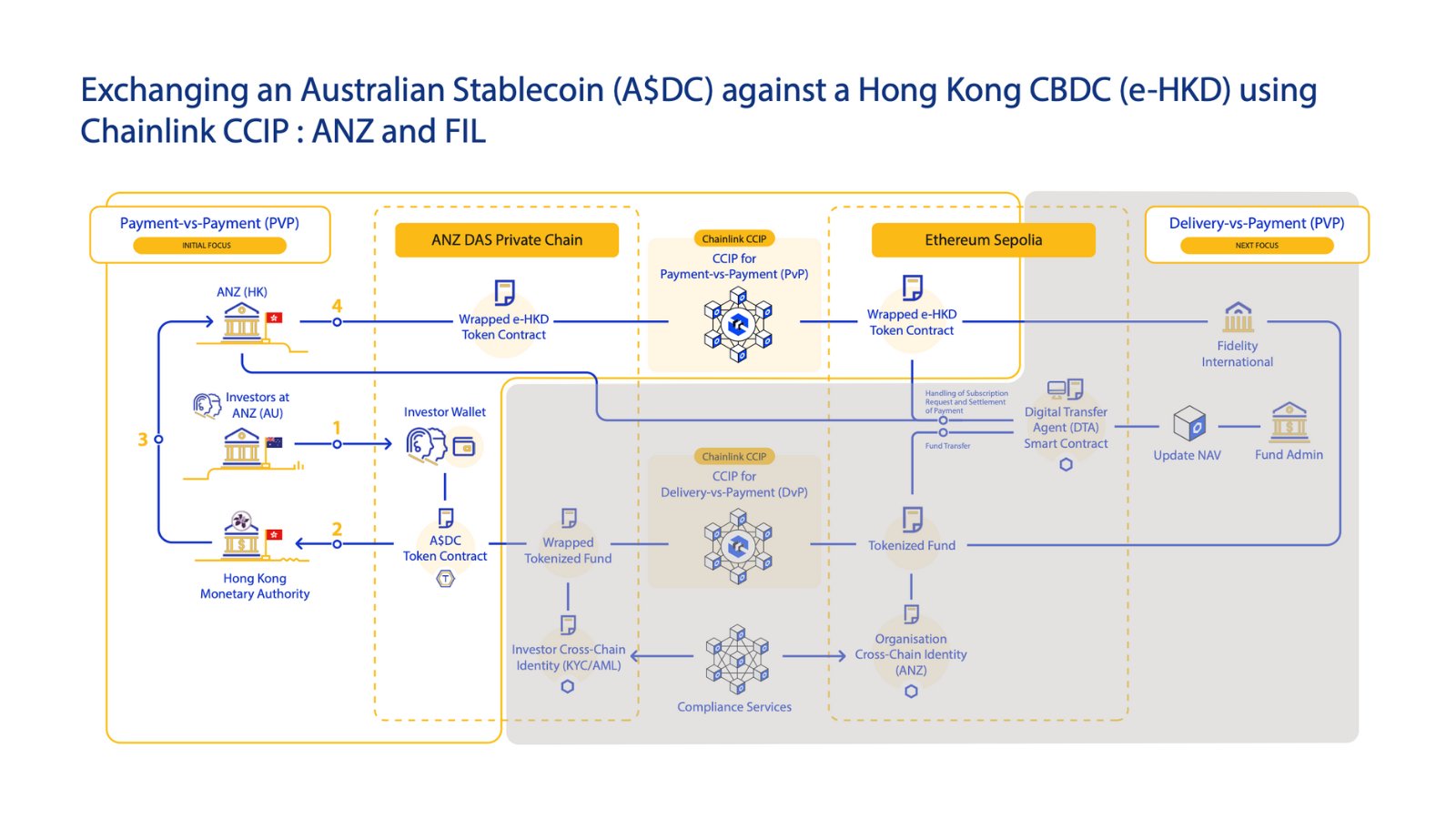
The pilot involved the Hong Kong digital dollar (e-HKD) and an Australian stablecoin. It was part of Phase 2 of the e-HKD+ Pilot Program, initiated by the Hong Kong Monetary Authority.

Chainlink’s Cross-Chain Interoperability Protocol enabled seamless transactions. It showcases how smart contract technology can bridge traditional finance and the decentralized finance ecosystem.

Image

Chainlink’s Role in Cross-Border Payments

At the heart of this milestone was Chainlink’s Cross-Chain Interoperability Protocol, which allowed the exchange between the two digital assets. The transaction used the Australian Stablecoin issued by the Australia and New Zealand Banking Group alongside the e-HKD. 

This integration was key in demonstrating how blockchain-based infrastructure can enhance the efficiency and security of international payments. Chainlink’s protocol effectively bridged the gap between different blockchain networks, providing a seamless experience for all parties involved.

Involvement of Financial Giants

The pilot’s success was further strengthened by the involvement of major financial institutions. Visa, Fidelity International, ANZ, and China Asset Management Company participated in the transaction framework. 

Each of these players contributed to the pilot’s execution and success, reinforcing the growing collaboration between traditional finance and decentralized technologies. This partnership highlights how established financial players are beginning to adopt and integrate blockchain and digital currency solutions into their existing systems.

Expansion of Blockchain Use in Traditional Finance

This pilot also comes when traditional financial institutions show increasing interest in blockchain and Web3 technologies. Recently, JP Morgan concluded its first transaction on a public chain, signaling a deeper commitment to the Web3 space. 

Using Chainlink’s technology to connect private and public networks, JP Morgan’s transaction with tokenized U.S. Treasuries on Ondo Finance demonstrates how blockchain is reshaping traditional finance.

Strategy Buys Additional 1,045 Bitcoin for $110M, Nears 600K BTC Holdings

The Michael Saylor-led Bitcoin company, Strategy, has announced a fresh acquisition of Bitcoin, bringing its holdings closer to 600,000 BTC.

In today’s announcement, Saylor disclosed that the company has added 1,045 BTC to its balance sheet. The acquisition cost approximately $110.2 million, translating to an average price of $105,426 per coin. With Bitcoin trading above $107K at press time, this latest purchase is currently in a profitable position.

This addition has raised Strategy’s Bitcoin portfolio to 582,000 BTC, acquired with a total investment of $40.8 billion. 

Notably, Strategy (formerly MicroStrategy) has been buying Bitcoin since September 2020. Based on its total investment relative to its holdings, the company’s average cost per Bitcoin now stands at $70,086.

With Bitcoin’s market value at $107,550 as of press time, Strategy is sitting on an unrealized profit of $21.8 billion, or approximately 53%. The company now holds a Bitcoin portfolio worth $62.59 billion, the largest among publicly traded firms.

How Strategy Funded Its Recent Bitcoin Purchase

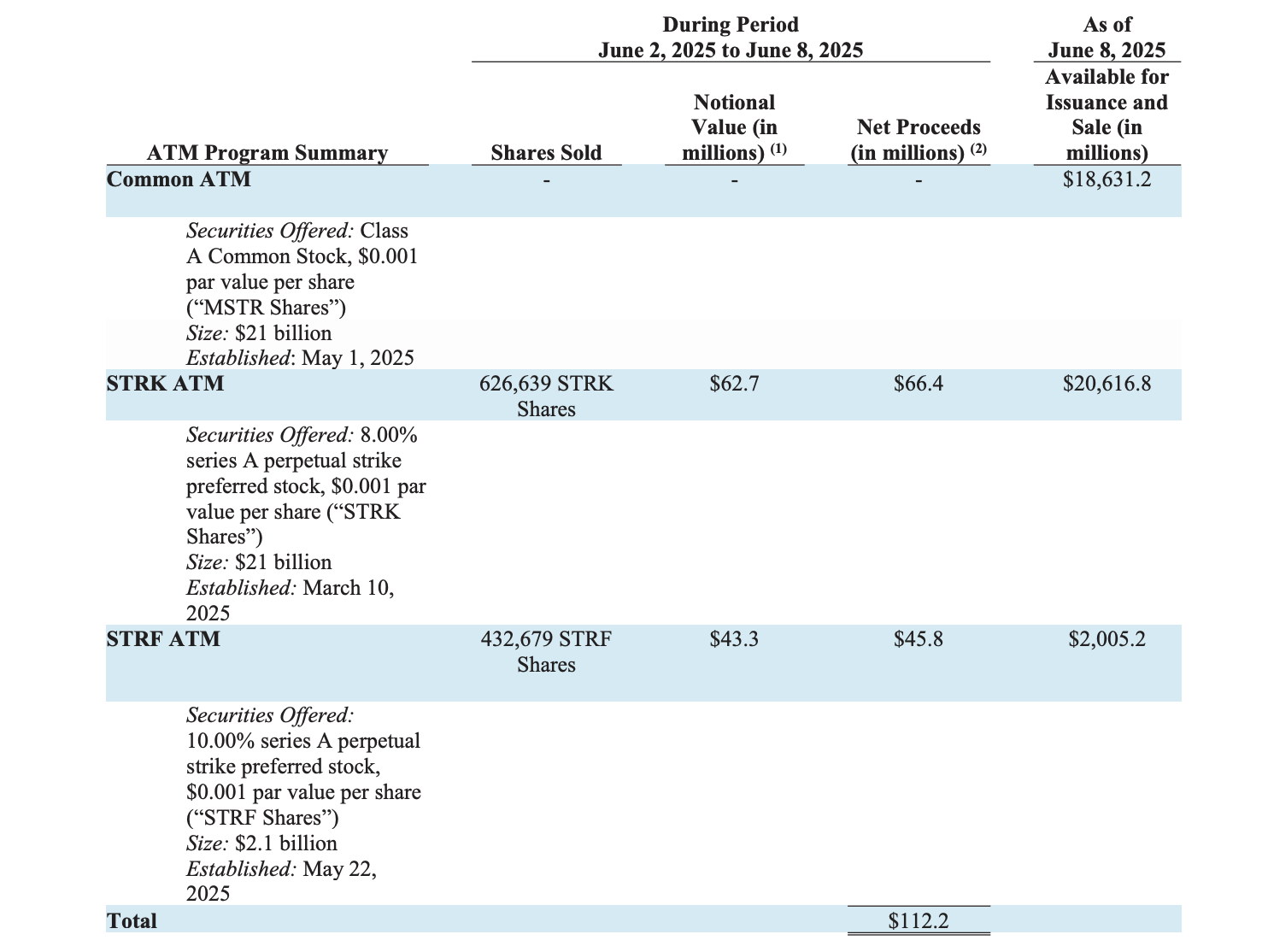
Strategy funded this latest acquisition through the sale of preferred equity under two active at-the-market (ATM) offerings. The company sold 626,639 STRK shares of its 8.00% Series A perpetual preferred stock, raising capital under its $21 billion STRK program, established in March 2025.

Additionally, Strategy sold 432,679 STRF shares of its 10.00% Series A perpetual preferred stock as part of its $2.1 billion STRF program launched in May 2025.

This marks Strategy’s second Bitcoin purchase this month, continuing the company’s ongoing weekly acquisition plan. On June 2, it announced the purchase of 705 BTC for $75 million at an average price of $106,495.

Saylor Bitcoin purchase funded through equity sale

Concerns Over Rising Unit Costs

However, with Strategy’s average Bitcoin acquisition cost now around $70,000, critics like Peter Schiff have raised concerns about increasing risk to investors. He argues that continued purchases in the $100K range raise the average cost per Bitcoin, increasing the company’s exposure to potential losses if the market dips.

During the most recent significant correction, Bitcoin dropped to $74,400, just above Strategy’s average cost of $70,089. If Bitcoin were to fall below that level, the entire holding would be in the red.

Some analysts warn that if major institutional players, especially miners, see their cost basis turn negative, it could trigger a bear market, as these entities might be forced to sell to minimize losses. The prevailing belief is that the market will remain bullish only as long as major holders stay profitable.

Ki Young Ju expressed a similar sentiment in an earlier analysis, noting at the time that miners’ cost basis was around $57K.

Meanwhile, Michael Saylor has reiterated that there are no plans to sell Bitcoin. His consistent acquisitions over the past five years support this stance.

Crypto Investment Products See $224M Inflows Led by Ethereum Amid Bitcoin Outflows

0

Digital asset investment products continue strong inflows, with Ethereum leading, while Bitcoin and other altcoins see moderate outflows.

According to data from CoinShares, last week, digital asset investment products saw $224 million in inflows, extending a seven-week streak of positive growth. 

This brings the total inflows over the past seven weeks to $11 billion. However, the pace of inflows has started to decelerate, reflecting growing uncertainty over U.S. monetary policy. 

Investors appear to be adopting a cautious, wait-and-see approach, particularly as the U.S. Federal Reserve’s signals on inflation remain unclear.

Ethereum’s Dominance and Bitcoin’s Decline

Interestingly, Ethereum continued its impressive performance, leading the pack with $296.4 million in inflows. This marks the seventh straight week of inflows for Ethereum, bringing the total within this period to $1.5 billion, or 10.5% of total AUM. 

Ethereum Leads Digital Assets Inflows
Ethereum Leads Digital Assets Inflows | CoinShares

The surge in Ethereum’s inflows represents the strongest inflows since last November’s U.S. election. In contrast, Bitcoin faced a second straight week of modest outflows, amounting to $56.5 million. This decline in Bitcoin investment products, combined with outflows from short-bitcoin products, shows a shift in sentiment amid ongoing policy uncertainty.

Altcoins and Multi-Asset Products

Also, the altcoin market has remained relatively subdued, with minor inflows observed in Sui, which attracted $1.1 million. On the other hand, XRP experienced its third consecutive week of outflows, totaling $6.6 million. 

Interestingly, XRP has maintained stronger year-to-date flows, which total $194 million, indicating consistent investor interest despite recent outflows. Meanwhile, multi-asset products saw $6.6 million in outflows for the week, with a year-to-date decline of $142 million. This suggests that investors are increasingly favoring single-asset investments, particularly in Bitcoin and Ethereum, over diversified portfolios.

Despite these market fluctuations, iShares ETFs experienced the highest inflows of any provider, with $330 million entering their products last week. This consistent growth in iShares’ inflows contrasts with the outflows seen from other providers like Grayscale Investments and Fidelity Wise Origin Bitcoin, which saw reductions of $16 million and $168 million, respectively.

Regional Breakdown of Investment Flows

The regional breakdown of inflows showed that the U.S. led the pack with $175 million, followed by Germany at $47.8 million. Switzerland, Canada, and Australia also saw significant investments, with $15.7 million, $9.8 million, and $6.5 million, in inflows respectively. 

However, the trend wasn’t universally positive. Brazil saw outflows of $9.2 million, and Hong Kong experienced outflows of $14.6 million, signaling a slowdown in their previously strong inflow activity. Notably, Hong Kong’s outflows mark the end of record-breaking inflows in the region.

Ripple Ally SBI Holdings Invests $50M in Circle IPO

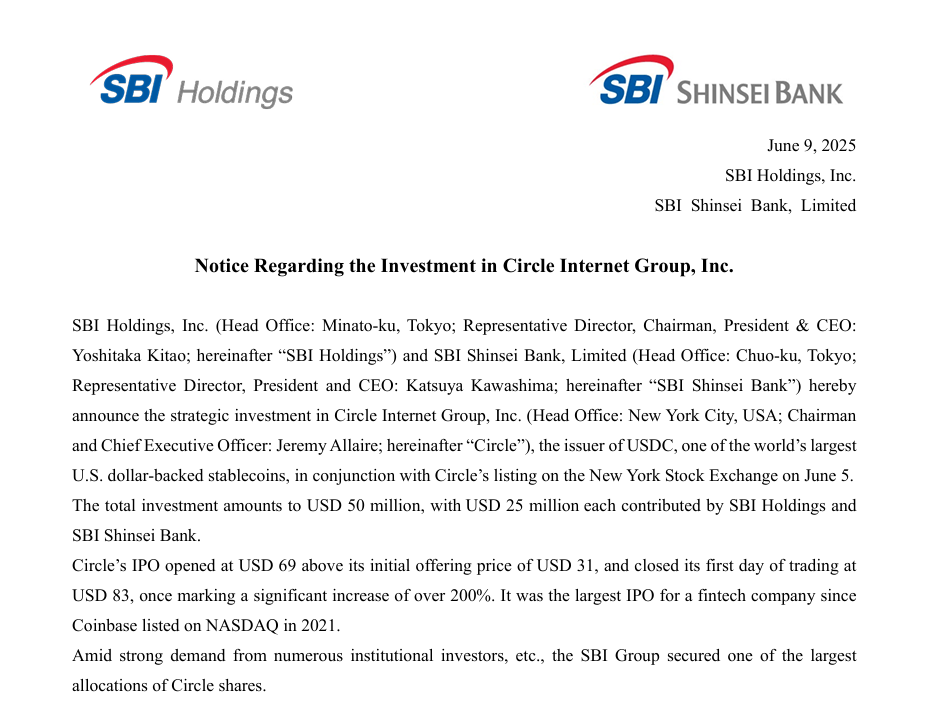
Ripple partner SBI Holdings and its affiliate SBI Shinsei Bank announced a multi-million-dollar investment in Circle, the issuer of USDC, following Circle’s IPO. 

SBI Holdings Now Betting on Circle

The investment, worth $50 million, was split equally, with both SBI Holdings and SBI Shinsei Bank contributing $25 million. This move follows the launch of Circle SBI Japan KK, a joint venture formed in March 2025 to push the adoption and circulation of USDC in the Japanese market.

The recent announcement, revealed in a press release today, shows the growing alliance between SBI Group and Circle, which began with a business agreement signed in November 2023. 

Ripple Ally SBI Holdings Announces Circle Investment

The relationship has since moved into collaborative efforts across various areas of digital finance, with SBI VC Trade, the crypto exchange subsidiary of SBI Group, becoming the first platform in Japan to offer USDC earlier this year publicly.

Circle’s Successful IPO

Notably, the backing from SBI Group comes on the heels of Circle’s successful market debut. Circle’s IPO officially launched on June 5, under the ticker symbol “CRCL”. 

Originally aiming to raise up to $6.71 billion at a price range of $24 to $26 per share, the offering was later upsized to 34 million shares at $31 each, exceeding revised expectations of $27 to $28. 

Interestingly, on its first day of trading, shares opened at $69 and closed at $83.23, pushing the company’s market cap to around $16.7 billion. The IPO, which raised between $1.05 billion and $1.1 billion, was one of the most successful fintech public offerings since Coinbase’s 2021 debut.

Notably, SBI Holdings’ move to acquire a significant stake in Circle coincides with strong investor demand, as the IPO was reportedly 25 times oversubscribed, according to a previous report from The Crypto Basic.

SBI’s Relationship with Ripple and Talks of Circle Acquisition 

The investment also indicates a growth in SBI’s crypto strategy. Historically, SBI has been one of Ripple’s most significant backers, with the Japanese conglomerate currently holding approximately 9% of Ripple’s shares. 

Since 2016, SBI and Ripple have collaborated through the joint venture SBI Ripple Asia, seeking to drive the adoption of XRP and the XRP Ledger across Asia. SBI has also made major investments in blockchain ventures, including R3 and Securitize.

Meanwhile, reports of Ripple exploring a potential acquisition of Circle have dwindled following Circle’s IPO. Ripple reportedly made a $4–5 billion offer, which Circle rejected. Ripple CEO Brad Garlinghouse debunked claims that the firm raised its offer to $20 billion.

Notably, by the time of Circle’s IPO, the company had achieved a valuation far exceeding the earlier offers, dampening speculation around a potential acquisition. However, some argue that Circle’s IPO does not automatically rule out a potential acquisition.

Expert Suggests XRP Is the Starlink of Crypto: Here’s Why

XRP influencer John Squire has triggered a conversation about blockchain utility and speed, using a metaphor that compares XRP to Starlink.

Specifically, Squire likened Bitcoin to a landline, while claiming Ethereum serves an updated purpose, calling it a cell phone. However, both still suffer from limitations in speed and flexibility. As a result, Squire argued that XRP fulfills that need, comparing it to Starlink, with no lag.

Explaining the Metaphor: Bitcoin as Landline and XRP as Starlink

In essence, the tweet frames Bitcoin as a foundational yet outdated system that is trusted, reliable, and secure, but slow, much like a landline. Meanwhile, like a mobile phone, Ethereum offers more advanced capabilities but still faces certain performance bottlenecks.

On the other hand, XRP is portrayed as Starlink: a futuristic, satellite-based internet system offering global coverage with minimal latency.

Importantly, the analogy is rooted in real-world network performance. Specifically, XRP consistently ranks among the fastest and cheapest blockchain networks for settlement. It confirms transactions in 3–5 seconds with fees under $0.01. 

This contrasts with Bitcoin’s 10-minute block times and Ethereum’s often congested and gas-fee-intensive environment. XRP’s architecture prioritizes fast, frictionless value transfer, aligning with the “no lag” concept. 

Furthermore, unlike Bitcoin, which relies on mining, the XRP Ledger uses a consensus protocol that allows rapid validation. This design has made XRP a favorite among banks, payment providers, and remittance services seeking near-instant cross-border settlement.

Meanwhile, Bitcoin continues to serve as a store of value for institutions and governments. Many now view BTC as a digital equivalent of gold suitable for national reserves.

On the other hand, Ethereum remains the backbone of decentralized finance (DeFi), smart contracts, NFTs, and real-world asset tokenization. While it faces competition in this space, Ethereum still dominates much of the innovation and infrastructure.

Some members of the XRP community believe XRP could eventually fulfill Bitcoin’s role as a store of value and strategic reserve. Figures like Panos Mekras continue to promote the XRP Ledger as the “OG” of DeFi, with others highlighting its potential in real-world asset tokenization.

XRP Community Reactions

Squire’s metaphor resonated with many XRP supporters, some of whom added their own humorous takes on how XRP compares to Bitcoin and Ethereum.

X user Jon called it a “perfect analogy.” He argues that Bitcoin laid the foundation, Ethereum brought flexibility, and XRP is the next step in the transition.

Likewise, X user Red Cocktail claimed that every era has its defining digital currency, and XRP stands out in the current era.

Another community member, Bruce Hunter, compared Bitcoin to a disk operating system, Ethereum to Windows 3.11, and XRP to Linux. This called attention to XRP’s efficiency and modern capabilities.

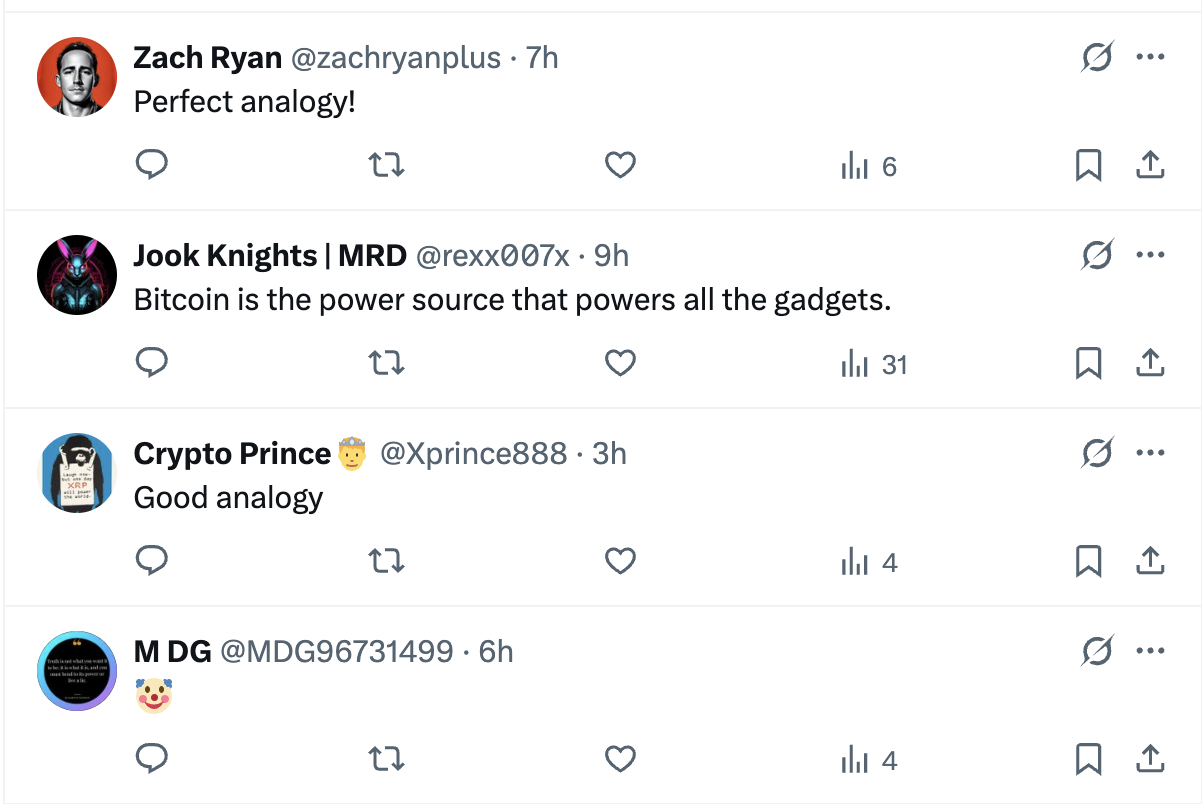
However, not everyone in the broader crypto community agreed with the characterization. Some mocked the metaphor, calling the poster a clown. Others argued that XRP’s price will never rise significantly, citing the massive number of tokens in circulation.

Varying reactions for Bitcoin and XRP communities