Home Blog Page 71

Hoskinson Recounts Cardano Rise From $0.025 to $3.10, Says He Hasn’t Lost Faith in ADA

0

Charles Hoskinson has defended Cardano’s long-term outlook, arguing that short-term price movements do not determine the quality of a project’s technology.

During a recent livestream, Hoskinson reflected on Cardano’s journey and highlighted ADA’s dramatic price history as evidence that market cycles are temporary, while strong fundamentals endure.

Price Rises and Falls, but Innovation Endures: Hoskinson

Hoskinson reminded the community that Cardano has repeatedly experienced both extreme rallies and deep corrections throughout its history. According to him, ADA once traded at $0.025 before climbing to $3.10 in 2021. Following ADA’s recent underperformance, critics are now declaring the token dead. 

However, he dismissed those claims, arguing that such price cycles are not unique to Cardano. He compared ADA’s history to Bitcoin’s repeated boom-and-bust cycles, stressing that temporary market declines do not invalidate a blockchain’s long-term potential.

Moreover, Hoskinson maintained that Cardano’s real competitive edge lies in its engineering philosophy. While competitors may copy individual features, Hoskinson argued that they cannot easily replicate Cardano’s focus on quality, creativity, and research-driven innovation. His comments appeared to target Ethereum, which he recently accused of adopting UTXO concepts without giving proper credit.

ADA Remains Under Pressure

Hoskinson’s comments come as ADA continues to face significant market pressure, keeping its price below $0.20. At the time of writing, ADA trades at $0.1691, representing a 94.54% decline from its all-time high of $3.10. With a market cap of $6.16 billion, ADA is ranked in the 15th position on the global crypto ranking. 

Although he acknowledged that Cardano has endured difficult periods that pushed its price sharply lower, Hoskinson emphasized that those setbacks never weakened his confidence in the project’s long-term direction. 

“I’ve never lost faith in the vision and the direction of things,” Hoskinson remarked. 

Previously, he revealed that the collapse in ADA’s price had reduced his personal wealth by more than $3 billion. Nonetheless, he remains confident that Cardano can recover from its current lows, regain lost value, and eventually compete for the top position on CoinMarketCap.

Real Utility Will Drive the Next Growth Phase

Hoskinson’s latest remarks reinforce his broader view that the cryptocurrency industry has entered a more mature stage. Speaking during an interview on The Breakdown, he argued that sustainable growth will come from solving real-world problems rather than relying on speculative price appreciation.

According to Hoskinson, the era of simply buying a token and expecting effortless tenfold gains overnight is largely over. In his view, blockchain networks must continuously earn market recognition by building useful products, expanding their ecosystems, and delivering lasting value.

As part of that vision, Hoskinson highlighted Midnight as one of Cardano’s most important long-term initiatives. He argued that if Midnight grows into a $10 billion ecosystem, it would prove Cardano’s ability to incubate large-scale blockchain platforms capable of attracting users, developers, and capital.

“If Midnight is a success, you’ll have a $10B thing on Cardano,” Hoskinson said, adding that the next logical step would be to build several more ecosystems of similar scale.

Cardano Advances RealFi Initiative

Meanwhile, Cardano has continued to expand its real-world use cases through the launch of RealFi Testnet Phase 1. The initiative aims to improve access to financial services for underserved populations by allowing participants to test key protocol features before the mainnet launch. 

During the testnet, users can swap supported test assets for test USDr, stake it to receive test sUSDr, and access yield and capital-efficiency layers, and later unstake their assets on what appears to be Cardano’s PreProd network. 

Institutions in Japan Turn to Bitcoin and XRP as SBI VC Trade Hits 2M Registered Accounts

0

SBI VC Trade is seeing increased retail and institutional adoption as Bitcoin and XRP expand their use cases in shareholder reward systems.

In an announcement, SBI VC Trade, the digital asset arm of Japanese financial giant SBI Holdings, disclosed reaching a notable user milestone. The number of accounts registered on the crypto platform has surpassed 2 million as demand for its products continues to grow.

Furthermore, SBI VC Trade also revealed increased institutional demand for Bitcoin and XRP, two of the largest cryptocurrencies by market cap. Companies are now using the duo to pay bonuses to their shareholders amid the yen weakness.

SBI VC Trade Hits 2 Million Users

The exchange announced that as of Monday, June 6, it has exceeded 2 million accounts. This meant it added 69,000 new users between March and now, as its number of users stood at 1.93 million then. 

Notably, the figure came from both the VCTRADE and Bitpoint service platforms, the report noted. Recall that Bitpoint Japan became part of the SBI Group through a merger in April 2026, which further strengthened the institution’s crypto push.

SBI VC Trade highlighted that the increase in accounts comes as it improves its services to clients. It claims it is the only electronic payment method exchange in Japan and continues to increase stablecoin handling, providing convenience for customers.

Bitcoin and XRP Boost SBIVC for Prime’s Institutional Adoption

The report also noted that SBIVC for Prime, SBI VC Trade’s corporate service, is seeing strong traction from companies, particularly as the yen weakens. For the uninitiated, the Japanese yen has dropped to near 40-year lows amid economic struggles.

Amid the local currency weakness, Bitcoin and XRP have emerged as strong alternatives for institutions to diversify their financial strategy. Also, they are increasingly using the two cryptocurrencies as a means of dividend and reward payments to shareholders.

SBI VC Trade further claimed it is the leader in staking service provision, boasting the highest number of coins available for staking. The service provides additional means of revenue generation for clients and increases the platform’s appeal.

SBI’s Stablecoin Push

SBI started its stablecoin push with the integration of USDC to its VCTRADE platform in March 2025. It also introduced the JPYSC, the first yen-denominated stablecoin in Japan. Most recently, SBI VC Trade officially brought the RLUSD stablecoin into Japan through a partnership with Ripple.

SBI VC Trade also plans to launch stablecoin lending services to its clients. Customers will soon be able to lend their stablecoins to the platform for a certain period and receive rewards.

This aligns with SBI VC Trade’s plans to become the leading crypto exchange in the industry. The exchange also plans to integrate two service brands by December.

Cardano Founder Accuses Ethereum of Copying UTXO Ideas Without Credit

Cardano founder Charles Hoskinson has criticized Ethereum developers over a new Ethereum Foundation proposal exploring native UTXO-style payments. 

He argued that Ethereum is adopting concepts Cardano has spent a decade developing without acknowledging its contributions.

The criticism followed a proposal by Ethereum Foundation developer Toni Wahrstätter titled “Native UTXOs on Ethereum”. The proposal suggests making payment transactions “one-shot objects” instead of permanent state entries.

According to Wahrstätter, borrowing elements of Bitcoin’s UTXO model could reduce Ethereum’s permanent state usage by about 99.8% for simple payment transactions. The design would preserve Ethereum’s existing account-based architecture.

Hoskinson Defends Cardano EUTXO Model

Responding on social media, Hoskinson said Cardano’s Extended UTXO (EUTXO) model is one of the biggest innovations in smart contract design.

“It’s not like I’ve been literally working on this topic for over 10 years,” he wrote. He also noted that Cardano once became the third-largest cryptocurrency by market capitalization and now serves millions of users.

Hoskinson further claimed that “it’s literally a crime in the Ethereum inner circles to mention Cardano.” He accused Ethereum developers of trying to replicate EUTXO concepts without giving Cardano credit.

During a follow-up livestream, Hoskinson expanded on his criticism. He said Cardano had already spent years solving challenges around UTXO-based smart contracts, including parallel transaction processing, reference inputs, and combining UTXO and account-based models.

He argued that Ethereum is now following a roadmap centered on technologies Cardano has been building since 2016.

Ethereum Proposal Targets More Efficient Payments

Indeed, Wahrstätter’s proposal does not mention Cardano. Instead, it describes the design as borrowing the one-time payment model introduced by Bitcoin.

The proposal introduces native UTXOs that would exist mainly in transaction history rather than permanent blockchain state. Each UTXO would include a source account, payment value, recipient address, and a protocol-assigned index to prevent double spending.

Instead of permanently storing every payment, the proposal records UTXO creation in event logs. Cryptographic proofs would be maintained through per-block commitment roots, reducing long-term storage requirements.

The design also integrates with the proposed EIP-8141 Frame Transactions architecture. This would allow UTXO inputs, account transfers, sponsorship mechanisms, and gas payments to be processed in a single transaction flow.

Hoskinson Predicts Ethereum Will Borrow More Ideas

Hoskinson argued that Ethereum has repeatedly dismissed Cardano’s innovations before later adopting similar concepts. He pointed to Cardano’s on-chain governance, treasury system, and the Ouroboros consensus family as examples of technologies Ethereum could eventually embrace.

He also highlighted Cardano’s privacy-focused Midnight project. According to Hoskinson, Ethereum will eventually move from hash-based cryptography to lattice-based cryptography as part of its post-quantum security roadmap.

While Hoskinson described the proposal as validation of Cardano’s technical direction, Wahrstätter presented it differently. His proposal aims to improve Ethereum’s scalability and state efficiency by adding UTXO-style payment mechanics alongside its existing account model, not replacing it.

Shiba Inu Team Most Active Voice in SHIB Community Disappears 

0

The broader Shiba Inu community has gone a full month without an active voice from the core team after Lucie, the ecosystem’s pseudonymous marketing lead and most active representative, disappeared from X.

For years, Lucie served as the primary bridge of communication between the Shiba Inu team and its community. However, she has not posted or interacted on the platform for exactly one month. As a result, the ecosystem currently lacks a regularly active team member on X, even as holders continue to seek updates on ongoing developments.

According to her X profile, Lucie’s last activity occurred on June 9, when she reposted a message from community figure Sand announcing that the ShibaSwap website had started loading again. Since then, she has remained completely silent, with no posts, replies, or reposts.

Lucie reposted
Lucie reposted

A Familiar Voice Falls Silent

Over the years, Lucie earned widespread respect within the Shiba Inu community through her consistent engagement. She regularly shared ecosystem updates, addressed community concerns, and encouraged holders during challenging market conditions.

In addition, she repeatedly expressed confidence in SHIB’s long-term prospects. On several occasions, Lucie argued that $0.01 remains a realistic long-term target. She also suggested that a future move toward $1 should not be ruled out, while emphasizing that achieving such milestones would require patience and continued ecosystem growth.

Due to her consistent presence, many community members came to view Lucie as the project’s most accessible public representative.

Lucie Joins Other Silent Shiba Inu Leaders

Lucie’s disappearance also reflects a broader pattern of inactivity among prominent Shiba Inu team members.

Lead developer and ambassador Shytoshi Kusama has not posted on X since May 13. At the time, he posted a message of admiration for fellow developer Kaal Dhairya. Meanwhile, Kaal Dhairya has also remained inactive on the platform since March 12, 2026.

Unlike Lucie, Kusama’s absence has a known explanation. He previously revealed that he has been focusing on an artificial intelligence initiative called R. OS, an independent project that operates outside the Shiba Inu ecosystem.

Nonetheless, the prolonged silence from several key figures has left the community with little direct communication from the project’s leadership.

Silence Comes as the Ecosystem Faces Growing Challenges

The communication gap comes at a particularly difficult time for the Shiba Inu ecosystem.

Several ecosystem projects remain unfinished, while internal disagreements have sparked fresh debates within the community. Meanwhile, the prices of major ecosystem tokens have continued to decline.

SHIB has fallen sharply in recent months, dropping out of the top 30 cryptocurrencies by market cap and trading below $0.0000045. Likewise, the ecosystem’s governance token, BONE, has struggled to regain momentum. After reaching an all-time high of $41.67, the token has plunged by 99.89% and now trades at around $0.045.

Against this backdrop, the continued silence from Lucie and other leading team members has fueled growing concern among some community members, many of whom await fresh updates and a clearer roadmap for the future of the Shiba Inu ecosystem. 

Bitcoin Bottom Signal Yet to Flash, Big Price Crash Still Ahead, On-Chain Data Shows

Latest on-chain data for Bitcoin suggests the leading crypto may not have reached its cycle bottom despite the current massive drawdowns.

This is because key historical indicators have yet to flash the signals that marked previous bear market lows. At the time of writing, Bitcoin traded at $63,150, up 0.5% over the past 24 hours and 6.75% over the last seven days.

Despite the recovery, the asset remains down 28% year-to-date and nearly 50% below its 2025 all-time high.

NUPL Indicator Has Yet to Confirm a Market Bottom

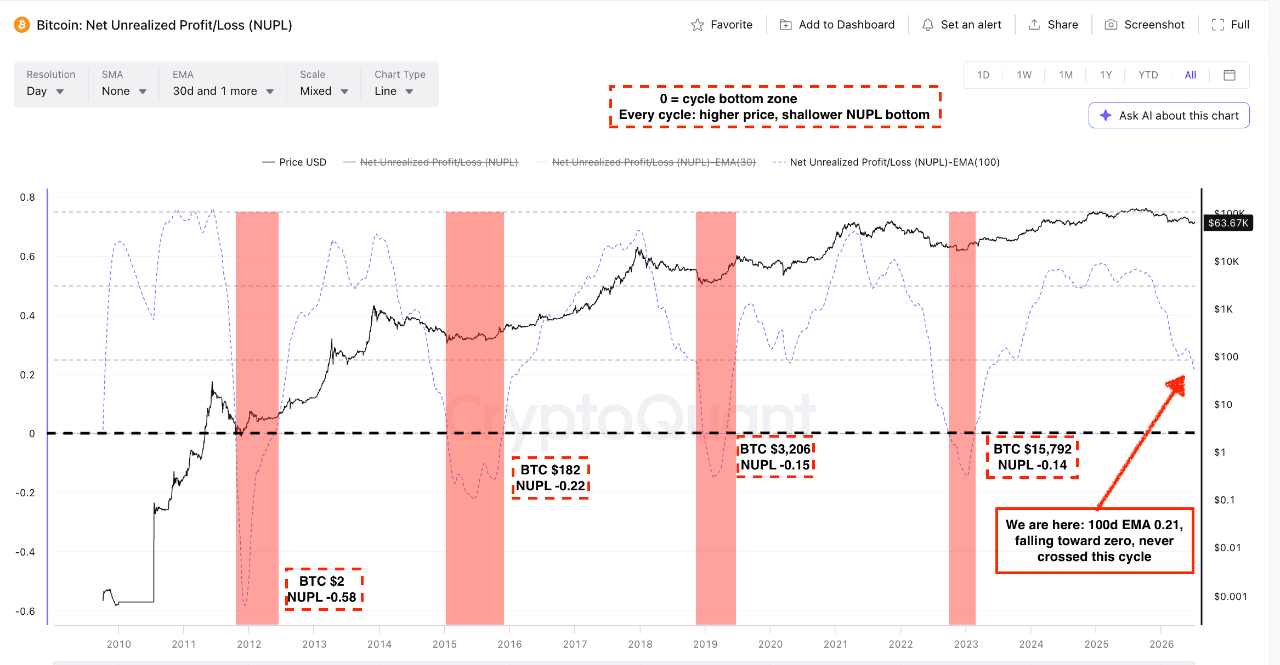
CryptoQuant author thechessONCHAIN highlighted Bitcoin’s Net Unrealized Profit/Loss (NUPL) as one of the market’s most reliable long-term cycle indicators.

NUPL measures the share of Bitcoin’s market capitalization that is sitting in unrealized profit. The metric currently stands at 0.158. Its 100-day exponential moving average (EMA) is at 0.215, while the 30-day EMA is at 0.155.

The 30-day EMA crossed below the 100-day EMA on June 2. Both indicators have continued to trend toward the zero line. Although the crossover points to weakening market momentum, it does not necessarily signal that Bitcoin has reached its bottom.

Notably, every major Bitcoin cycle low occurred only after the 100-day EMA of NUPL fell below zero. That happened during the 2011 bear market near $2, in January 2015 around $182, at the December 2018 low near $3,206, and during the FTX-driven bottom in November 2022 around $15,792.

Each bear market has produced a smaller negative NUPL reading. The indicator fell to -0.58 in 2011, -0.22 in 2015, and roughly -0.15 in both the 2018 and 2022 cycles.

However, this cycle has yet to produce a negative reading on the 100-day EMA. Accordingly, that leaves two possibilities.

Either the indicator eventually drops below zero, as it did in previous cycles, or Bitcoin forms its first major cycle bottom without the signal.

For the indicator to turn negative, Bitcoin’s price may need to fall once again. Bitcoin has already dropped 53% from its October 2025 peak of $126,200. However, that decline is still smaller than the drawdowns of up to 90% seen in previous cycles.

Loss-Holding Bitcoin Addresses Remain Below Past Bear Market Levels

Separately, market watcher Cyclop pointed to another historical bottom indicator that tracks the percentage of Bitcoin addresses holding coins at a loss.

According to the observation, 34% of Bitcoin addresses are currently underwater. That is well below the roughly 55% recorded at the 2018 market bottom and around 50% during the 2022 bear market low.

This could mean Bitcoin faces more downside or an extended period of weakness before a final cycle bottom appears.

Source: @nobrainflip on X

BTC Historical Signals Are Not Guarantees

Ultimately, these indicators are based on historical trends rather than certainty. Some industry commentators believe this cycle is different because Bitcoin has become a more mature asset. As a result, historical patterns may not repeat, and the massive drawdowns seen in previous cycles may not occur again.

Those who hold this view believe the $58,000 price low in June 2026 could mark the market’s bottom. Bitcoin is already up more than 7% from that low.

Shiba Inu Holder Growth Sparks Controversy as Holder Count Surpasses 1.67M

0

A fresh controversy has emerged within the Shiba Inu ecosystem after a community figure alleged that the network’s recent surge in wallet addresses does not reflect genuine adoption.

The development follows a sharp increase in Shiba Inu’s holder count. Earlier this month, the figure also surpassed the 1.6 million milestone. Since July 4, SHIB has added more than 75,000 wallet addresses, pushing the total number of holders to 1,675,551 (1.67 million). 

At first glance, the rapid growth signals rising adoption. However, The Dark Shib argued that the increase stems from an automated distribution mechanism rather than new investors joining the ecosystem.

Analyst Questions SHIB Holder Count Growth

According to The Dark Shib, the activity originates from TheShibBull, a verified smart contract created by decentralized exchange WoofSwap. The analyst claimed that the contract generates new wallet addresses and sends them small amounts of SHIB, causing blockchain tracking platforms to recognize those addresses as token holders.

Specifically, Dark Shib alleged that the contract uses blockchain data, including block hashes, to generate random Ethereum addresses before distributing as little as 1 SHIB to hundreds of wallets in each transaction. 

As a result, the holder count increases even though the addresses do not belong to users who intentionally purchased SHIB, actively participate in the ecosystem, or contribute to network activity.

The analyst stressed that wallet count alone does not accurately measure adoption. According to him, inactive wallets holding negligible amounts of SHIB should not be treated as evidence of genuine community expansion. 

Marketing Strategy? 

The analyst also questioned the contract’s administrative features, claiming that its owner can modify the amount of SHIB distributed and withdraw tokens held within the contract. Consequently, Dark Shib argued that the initiative cannot be viewed as a fully decentralized community effort.

Furthermore, the community member criticized WoofSwap for promoting SHIB holder milestones while simultaneously drawing attention to its RYOSHI token. The analyst suggested that the rising holder count may have been used as a marketing strategy to increase visibility for the affiliated project.

WoofSwap Defends TheShibBull Initiative

WoofSwap rejected the allegations and defended TheShibBull as a lighthearted community initiative rather than an attempt to mislead investors.

In response, the DEX argued that although the contract sends 1 SHIB to randomly generated wallets, anyone who eventually controls one of those addresses could discover the deposited tokens.

Moreover, WoofSwap said the initiative was intended to make the SHIB community more enjoyable rather than contribute to ongoing disputes. The project encouraged developers to build creative experiences for SHIB rather than criticizing existing initiatives, describing TheShibBull as a fun experiment designed to celebrate the ecosystem. 

Shiba Inu Holder Distribution Reveals Strong Whale Dominance

Meanwhile, Shiba Inu’s holder count increased by another 0.002% over the past 24 hours, reaching 1,675,551 addresses. Despite the expanding holder base, ownership remains concentrated among a relatively small number of large wallets.

Data from Etherscan shows that whales account for just 707 wallets, representing 0.04% of all holders, yet they control 94.52% of SHIB’s market cap of $2.55 billion.

In comparison, sharks comprise 2,861 wallets (0.17%) and hold 1.77% of the market cap, while dolphins represent 29,833 addresses (1.78%) and control 1.89% of the token’s value.

Smaller investors make up the overwhelming majority of SHIB holders. Fish wallets total 188,958 addresses (11.28%) and collectively control 1.35% of the market cap. Crabs account for 479,350 wallets (28.61%) and hold 0.41%.

Meanwhile, shrimp remains the largest holder category by wallet count. They comprise 973,906 addresses, representing 58.12% of all SHIB holders, but collectively control just 0.05% of the token’s market capitalization. 

Shiba Inu Tier Distribution

Overall, the distribution highlights a significant gap between Shiba Inu’s expanding holder count and its ownership structure, as a small group of whale wallets continues to dominate the vast majority of the token’s market exposure.

Whales Long Bitcoin With 40x Leverage as Strategy Dumps $216M BTC

Large crypto traders are maintaining bullish leveraged positions on Bitcoin and Ethereum despite selling pressure from Michael Saylor’s Strategy.

On X, blockchain analytics platform Lookonchain highlighted several high-leverage positions opened by whale wallets. The activity comes as Strategy continues reducing its Bitcoin holdings and BlackRock’s spot Bitcoin ETF records sustained outflows.

Whales Double Down on Bitcoin and Ethereum

Data from Hyperliquid explorer Hypurrscan confirms that several whale wallets recently opened aggressive leveraged long positions on Bitcoin and Ethereum.

One wallet, identified as 0x15a4, opened a 40x leveraged long on 1,000 BTC worth about $63.8 million. Another wallet, 0x7fba, opened a 10x leveraged long on 30,627 ETH valued at roughly $54.9 million. A third wallet, 0xe069, established a 20x leveraged long on 470.4 BTC worth around $30 million.

Source: hypurrscan.io

The positions suggest that some whale traders remain confident Bitcoin and Ethereum could move higher despite institutional selling pressure.

Strategy Sells Another 3,588 BTC

The whale activity comes as Michael Saylor’s Strategy continues trimming its Bitcoin holdings. Specifically, Strategy sold 3,588 BTC worth about $216 million last week.

The sale followed the disposal of 1,363 BTC on June 30 for approximately $80.77 million at an average price of $59,256. The latest transaction included the sale of 2,225 BTC on July 7 at an average price of $60,773, worth around $135.22 million.

Source: saylortracker

Based on Strategy’s average Bitcoin purchase price of $75,651, the latest sale resulted in a realized loss of more than $55 million. Despite the sale, Strategy still holds 843,775 BTC worth more than $53.44 billion, with an unrealized loss of $10.40 billion.

Trader Returns, Quickly Falls Into the Red

Lookonchain also highlighted the return of trader 0x15a4 after three months of inactivity. The trader opened a 40x leveraged long on 500 BTC worth roughly $31 million on Hyperliquid. Shortly afterward, Strategy announced its latest Bitcoin sale, helping push BTC lower.

As a result, the trader’s position showed an unrealized loss of about $463,000.

Bitmine Adds ETH as BlackRock Sees More Bitcoin Outflows

While Strategy has been reducing its Bitcoin exposure, Bitmine, chaired by Tom Lee, has continued accumulating Ethereum.

According to the company’s latest announcement, Bitmine purchased another 42,197 ETH worth about $74 million over the past week. This increased its total holdings to 5,742,237 ETH, valued at roughly $10.06 billion.

On July 2, BlackRock’s spot Bitcoin ETF recorded its tenth consecutive trading days of net outflows, totaling 35,980 BTC worth around $2.24 billion. Meanwhile, it recorded an inflow of $209.4 million yesterday.

Overall, some large institutions are reducing their Bitcoin exposure, while whale traders continue placing aggressive leveraged bets on a recovery in both Bitcoin and Ethereum.

XRP Spot Accumulation Lifts CVD to +$406M as Perpetual Selling Hits -$783M

0

XRP is showing a divergence between activity in the spot market and the derivatives market, as spot CVD across exchanges hit new highs.

Notably, buying pressure across centralized exchange (CEX) spot markets has increased over the past two months, while traders in Binance’s perpetual futures market have continued to favor the sell side.

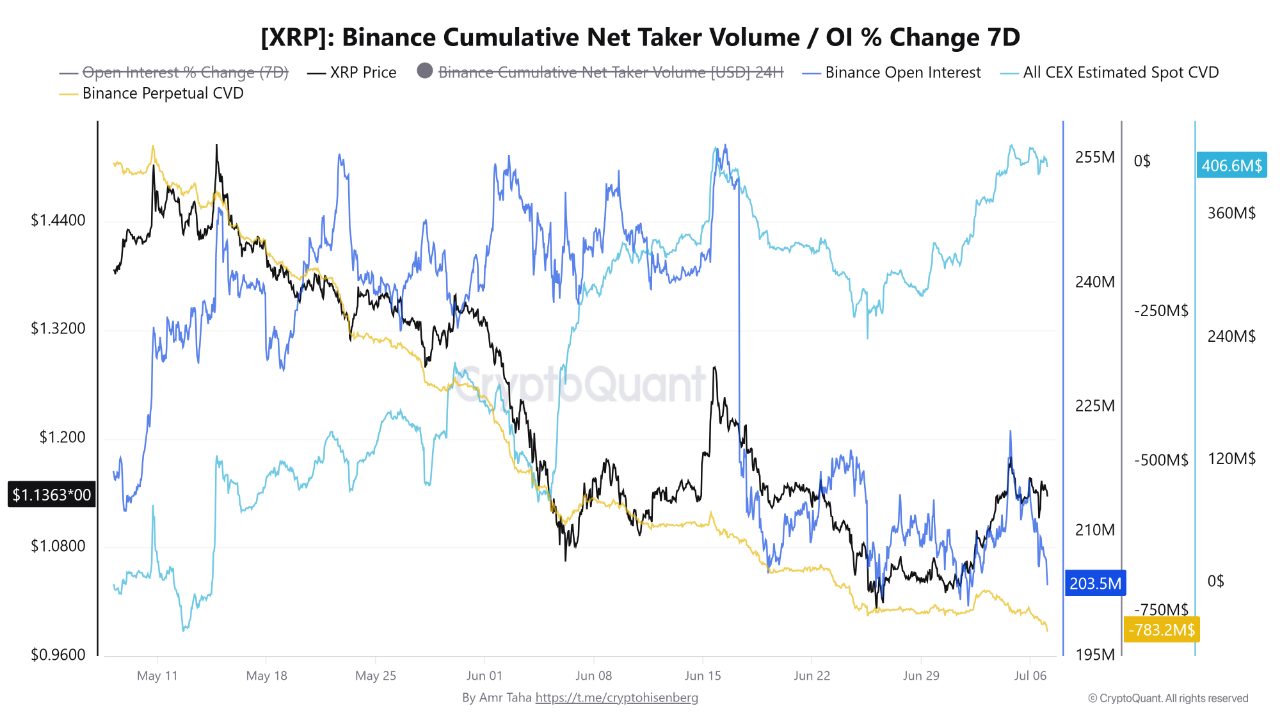
This is according to CryptoQuant data surrounding the cumulative volume delta (CVD). Specifically, across all centralized exchanges, the estimated Spot CVD climbed from about -$42 million on May 12 to +$406 million by July 7. 

This marks an improvement of roughly $448 million, and suggests that buyers have consistently absorbed available XRP supply during this period. The recent change confirms that the spot market may now be witnessing increased buying pressure. 

XRP Perpetual Market on Binance Shows Opposite Trend

While spot buying has picked up, Binance’s perpetual futures market shows the opposite trend. During the same period, Binance Perpetual CVD fell from around -$48 million to -$783 million, a decline of about $735 million.

XRP Spot CVD and Perpetual CVD Show Opposite Trends CryptoQuant
XRP Spot CVD and Perpetual CVD Show Opposite Trends | CryptoQuant

The data shows that perpetual traders have remained aggressively on the sell side. While spot buyers accumulated XRP across centralized exchanges, derivatives traders continued to reduce their exposure or maintain bearish positions.

Moreover, leverage has also continued to fall. Notably, Binance Open Interest dropped from roughly $255 million on May 22 to around $203 million on July 7. This represents a decrease of about $52 million, or slightly more than 20%.

Binance’s spot market has also started to show signs of recovery, although it has not yet moved into positive territory.

Binance Estimated Spot CVD improved from about -$212 million on June 25 to -$173 million on July 7, an increase of nearly $39 million. Essentially, selling pressure on Binance’s spot market has eased, but overall spot flows on the exchange remain negative.

XRP Pulls Back After Recovery

Meanwhile, XRP’s recent price action indicates that the latest rally that began earlier this month may now be losing momentum.

The token found support at $1.02 on July 1 before staging a massive recovery. During this rebound, XRP posted four straight intraday gains, its first streak of that length since March 2026, climbing to a high of $1.183 on July 4.

However, buyers could not push the rally beyond this level. XRP met resistance and has since continued to pull back, trading around $1.13 at press time. Despite the recent correction, the token remains more than 10% above its July 1 low.

Technical indicators also confirm that the recent upward move has started to weaken, although buyers still hold a slight advantage.

The Directional Moving Index (DMI) shows the +DI falling to 22.97, while the Average Directional Index (ADX) has dropped to 20.9. The lower ADX reading suggests that the strength of the current uptrend is beginning to fade.

XRP Rally Losing Momentum

However, the +DI remains above the -DI, which stands at 19.4. This means buyers still have the upper hand in the short term despite XRP moving toward a second consecutive red intraday candle.

Important XRP Price Levels to Watch

If XRP extends its current pullback, the first major support sits near the middle Bollinger Band at around $1.09, which matches the $1.10 support level. If sellers push the price below this area, XRP could revisit the July 1 low of $1.02.

On the upside, the first major obstacle remains the $1.18 region. This level acted as support during the mid-June pullback, but it has now turned into resistance. XRP’s latest recovery attempt also stalled in this area, which makes it an important level to watch.

The same resistance zone lines up with the upper Bollinger Band near $1.187. A successful move above both levels could give buyers enough momentum to target the $1.30 price level.

Shiba Inu Forms Death Cross but Whales Scoop 75,708,000,000 SHIB

0

Shiba Inu has formed a death cross on lower timeframes, but whales are aggressively buying the dip, offering fresh optimism for the price.

A death cross often happens when a long-term moving average moves above a short-term moving average. Typically, this crossing occurs between the 200- and 50-period MAs. Today, this interaction has happened, raising further concerns about the price trajectory of Shiba Inu (SHIB).

Shiba Inu Death Cross

On the 30-minute timeframe, the 200 MA has moved over the 50 MA, suggesting that earlier price recovery could be nearing its end. For context, Shiba Inu bounced from a low of $0.00000426 on Monday, forming a golden cross.

The 50 MA crossed the 200 MA, providing the momentum that pushed SHIB to a high of $0.00000447, a nearly 5% increase from the low. However, the meme coin could not overcome the resistance there, and a rejection followed.

Shiba Inu Death Cross

Since then, SHIB has slid lower to $0.00000436. During the course of this pullback, a death cross formed, casting doubts on the chances of a further recovery attempt. Typically, this crossing suggests that buying momentum is fading, which signals the end of an uptrend.

However, some see the signal as a lagging indicator. The argument is that it reflects what has already happened in the market, rather than providing hints of what to expect. This suggests that the downtrend is already priced in, and SHIB could not fall further due to the crossover.

Nonetheless, it remains a bearish indicator and one that Shiba Inu bulls would not want to see, especially as they hope for a sustained recovery. The fact that it also happened on lower timeframes further boosts confidence. If such a crossover appears on higher timeframes, it will confirm the bearishness and increase the chances of an impact on SHIB’s price.

Should prices trend lower, the critical support areas to watch for SHIB are at $0.00000241 and $0.00000155. Further bearish pressure could take the token to $0.0000010.

SHIB Whale Accumulation Presents Fresh Buying Pressure

Meanwhile, Shiba Inu whales continue to buy the dip. Over the past 24 hours, they have withdrawn another 75.7 billion SHIB tokens from exchanges.

Shiba Inu Exchange Netflow/CryptoQuant

CryptoQuant’s exchange netflow data confirms this. The metric measures the difference between exchange inflows and outflows and turns negative when the latter exceeds the former.

Exactly this scenario played out over the past day, with netflow showing a negative reading of 75.7 billion. This suggests that that was the net amount that traders withdrew from exchanges yesterday.

Notably, this pattern has persisted for a while now, highlighting the unrelenting accumulation effort from Shiba Inu investors. They continue to take advantage of the low price to move the token off exchanges to self-custody wallets for long-term holding.

This not only reduces selling pressure but also impacts the availability of the meme coin on exchanges. Additionally, it highlights the confidence among SHIB holders that the token could recover from recent downtrends and target higher prices.

The Bitwise Fund Becomes First XRP ETF to Hit $500M Netflow Milestone 

The Bitwise XRP fund has now crossed the $500 million cumulative net inflow mark, becoming the first XRP ETF to reach this milestone.

XRP ETFs have continued to impress with their sustained inflows despite the months-long price struggles, and one particular fund appears to be driving most of the capital gains over the past few weeks.

Specifically, the Bitwise XRP ETF (XRP) has persistently recorded net capital inflows this year, often contributing to the broader XRP ETF market’s impressive performance. As a result, the fund has now become the first XRP spot ETF to cross the $500 million marker.

How the Bitwise XRP ETF Has Fared

The Bitwise ETF started the year with zero flows on Jan. 2, its first trading day of 2026. However, as the month progressed, the fund pulled in $16.61 million on Jan. 5, contributing a 36% share to the $46.1 million total inflow recorded by XRP ETFs that day.

When the XRP ETF market saw its first daily outflow ever on Jan. 7, recording a capital exit of $40.8 million, the Bitwise product bucked the trend, seeing a modest $2.44 million worth of inflows that day. If anything, it helped reduce the outflows for that day.

Interestingly, the Bitwise XRP ETF scaled through January and February 2026 without any intraday outflow. 

During this period, the product saw $72.89 million worth of inflows in January, outpacing the overall market’s record of $15.59 million. In February, the fund saw $32.26 million, marking a 55% contribution to the ETF market’s $58.09 million figure.

The Bitwise ETF saw its first intraday outflow on March 6. Since its launch in late November 2025, the product has only recorded 7 days of intraday outflows. In contrast, the overall XRP ETF market has witnessed 19 days of intraday outflows since November 2025.

Journey to the $500M Milestone

Also, since it started trading publicly, the Bitwise XRP ETF has not seen a single month of outflows. After taking in $72.89 million in January and $32.26 million in February, the product saw inflows worth $7.02 million, $44.74 million, $49.48 million, and $27.98 million in March, April, May, and June, respectively.

Bitwise XRP ETF Monthly Performance Sosovalue
Bitwise XRP ETF Monthly Performance | Sosovalue

So far, in July, it has recorded $1.80 million, leading to a cumulative net inflow of $501.15 million at press time. The product first hit the $500 million milestone on June 29, when cumulative net inflow reached $505 million. It dropped below the mark at the start of July, but has since recovered above it.

Meanwhile, the Canary Capital XRP ETF (XRPC), which debuted first in the market and had a good early run, currently boasts a cumulative net inflow of $466.97 million, still below the $500 million mark. The Franklin Templeton ETF (XRPZ) comes third with $413.23 million in net inflows, while Grayscale’s GXRP now sees $131.46 million.

XRP ETFs Cumulative Net Inflows
XRP ETFs Cumulative Net Inflows | Sosovalue

Overall, total cumulative net inflows across all funds sit at $1.49 billion, now approaching the $1.5 billion milestone. Of this figure, the Bitwise product accounts for a 33% share, the largest for any single product.