Home Blog Page 713

Ethereum Eyes $3,600 With Flag Pattern Breakout as Open Interest Hits Record High

Ethereum surged 3.8%, approaching a bullish flag breakout with targets near $3,600. Derivatives data show rising open interest and growing bullish momentum.

As Bitcoin approaches $110,000 once again, Ethereum outperforms with a 3% surge, nearing a potential flag breakout. Will this rally propel Ethereum toward $3,600?

Ethereum Price Analysis

On the daily chart, Ethereum displays a sideways trend between two key Fibonacci levels. The 38.20% Fibonacci level near $2,400 acts as support, while the 50% level around $2,700 serves as the upper resistance.

Ethereum Price Chart

With a 3.81% price increase on Tuesday, Ethereum formed a bullish candle near the upper resistance level. This development boosts the potential for a breakout rally as the broader market recovers.

Currently, Ethereum is trading at $2,638, with a minor pullback of less than 1%, while maintaining bullish momentum. Supporting the breakout potential, the 50-day and 100-day EMA lines are on the verge of a positive crossover.

However, the daily RSI line hovers just below the overbought threshold, indicating a slight loss in momentum as it retraces from overbought territory. Still, the indicator remains positive, supporting the case for an upside breakout.

As Ethereum moves closer to a flag breakout, the pattern suggests a potential 33% rally toward $3,577. This bullish move could surpass the 78.60% Fibonacci level at $3,436.

Optimistically, this opens the door to reaching the 100% Fibonacci level near the psychological $4,000 mark. On the downside, critical support remains at the 38.20% Fibonacci level, followed by the 100-day EMA at $2,259.

ETH Derivatives Surge With Strong Optimism

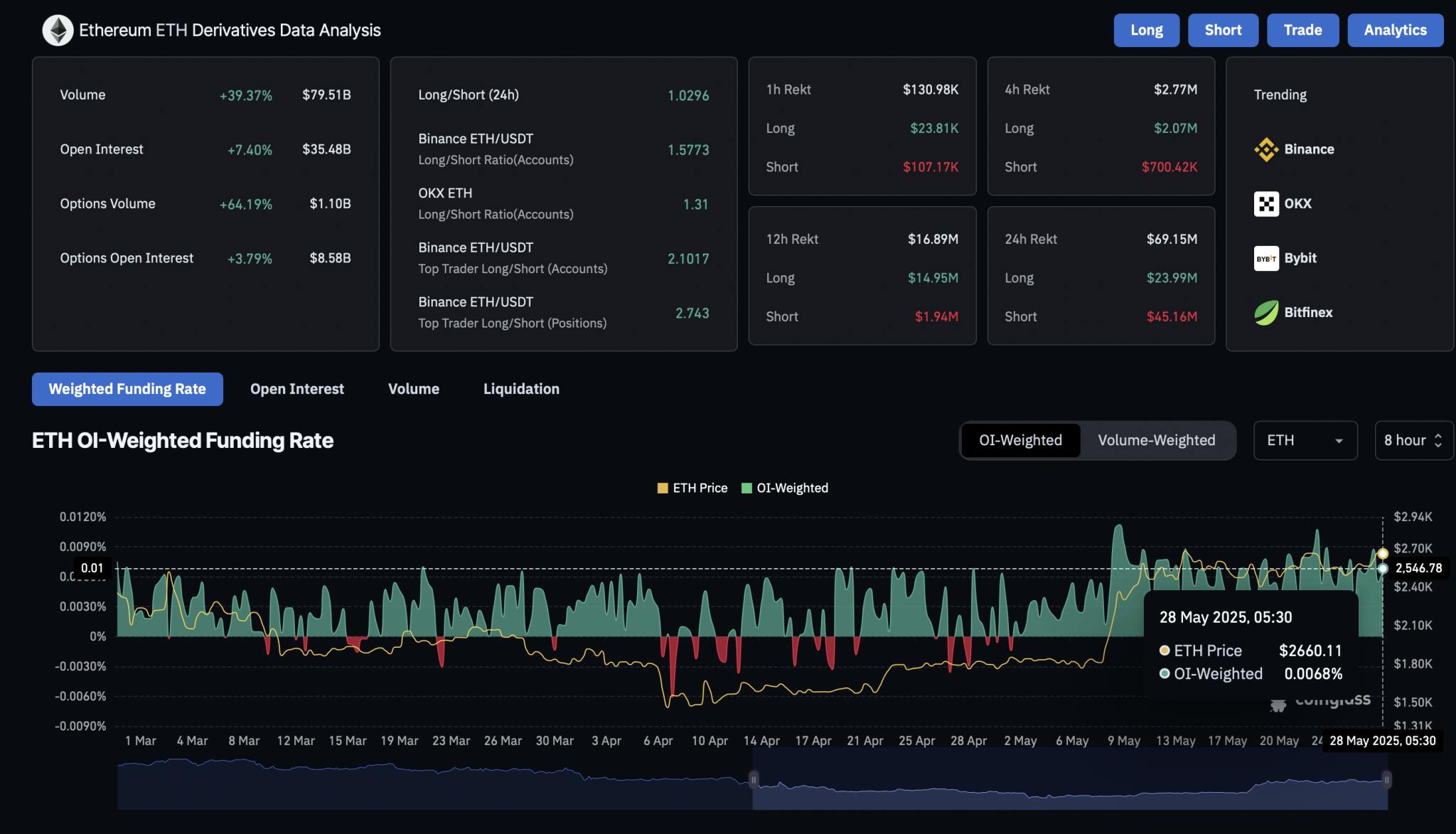
With the recent surge, bullish sentiment in the Ethereum derivatives market has grown significantly. According to Coinglass, ETH open interest has increased by 7.4% to $35.48 billion, setting a new all-time high, while trading volume jumped nearly 40% to $79.51 billion.
ETH Derivatives
ETH Derivatives

Notably, the options market has seen a major uptick, with a 64% increase in volume to $1.10 billion. Meanwhile, options open interest stands at $8.58 billion, a 3.79% rise.

As trading activity intensifies, the growing bullish sentiment is evident in the rising funding rate, which has reached 0.0068%. Additionally, the long-to-short ratio has climbed above 1.02%, indicating a shift in favor of bulls.

Interestingly, 24-hour liquidations show a larger wipeout of bearish positions, with short liquidations totaling $45.16 million compared to nearly $24 million in long liquidations.

The US Is on Its Way to Becoming a Bitcoin Superpower: Donald Trump’s Director of Digital Assets

0

Bo Hines, the White House’s Director of Digital Assets, has again emphasized the United States’ friendly disposition towards Bitcoin and the crypto industry.

At his appearance at the ongoing Bitcoin 2025 Conference, he noted that through its well-structured policies, the United States is on its way to becoming a Bitcoin superpower and the global crypto capital.

The United States Pushing for Regulatory Clarity

When asked by Miles Jennings, the conference’s coordinator, about the growing bipartisan support for Bitcoin and other innovations, such as stablecoins, Hines emphasized that this was a significant development for the industry in the United States. Notably, he expressed confidence that legislation like the GENIUS Act will pass, injecting capital into the digital asset market.

The GENIUS stablecoin act passed a vote last week and has moved to the next approval phase. Hines noted that the bipartisan support for the passage suggests a sense of unity for the first time in a while to foster digital asset innovation in the US.

He noted that the bill would replace outdated payment rails with stablecoin innovation, attracting capital to the crypto sector and serving as a tissue between the legacy financial system and the digital industry. Interestingly, David Sacks, the White House AI and crypto czar, shares a similar bias.

Sacks stated in a recent interview that the stablecoin bill would attract trillions of dollars in demand for the US Treasury. Notably, several entities are already tokenizing U.S. securities, increasing capital inflow into the U.S. economy.

The US Is Going All in on Bitcoin

Meanwhile, Hines highlighted that Bitcoin is the golden standard, calling the asset “digital gold.” The White House executive also noted that Bitcoin is the “immaculate conception,” and it fits into the commodities category.

Furthermore, he reiterated that America wants Bitcoin badly. Hence, he and the Crypto Working Group are seeking ways to acquire the asset in a neutral budget manner, as the president has stated. Recall that Donald Trump issued the condition while signing the bill to create a US strategic Bitcoin reserve in March.

Again, he assured that the US would not sell any of its BTC. Instead, it would harness the potential of the pioneering cryptocurrency on behalf of the American people. Notably, data from Bitcoin Treasuries shows that the United States holds the largest Bitcoin reserve among countries, with its stash at 198,012 BTC ($21 billion).

Hines also noted that the United States wants as much Bitcoin as it can possibly acquire, reestablishing its commitment to increase its holdings substantially. Currently, the working group is considering several options, including tariff revenues and profit from reassessing gold certificates.

Trump’s Crypto Czar Says Senator Warren Has ‘Pathological’ Hatred For Crypto

0

David Sacks, the crypto advisor to President Donald Trump, recently voiced criticism against Senator Elizabeth Warren during an interview on Fox News. 

Sacks argued that under the Biden administration, the crypto community faced heavy regulatory pressure and uncertainty. However, since President Trump took office, the environment for crypto innovation in the U.S. has significantly improved. 

According to Sacks, consumer and investor confidence in Bitcoin is at record highs, reversing years of legal challenges and what he described as unfair treatment of the sector.

Crypto Regulation and the Shift in U.S. Policy

In the interview, Sacks accused Senator Elizabeth Warren of exerting significant influence over the Biden administration’s crypto policies, claiming she sought to drive the cryptocurrency community offshore.

He argued that Warren harbored strong opposition to the crypto industry and resisted efforts to allow its growth within the United States. “For some reason, she has this pathological hatred of the crypto community,” Sacks said.

According to Sacks, this approach was misguided, as keeping innovation domestic makes it cheaper and more efficient. He credited President Donald Trump with reversing this trend by creating an environment where crypto innovation can thrive on U.S. soil.

He emphasized the importance of creating fair rules that the community can abide by, something he felt the Biden administration failed to deliver.

Meanwhile, Sacks stressed that innovation in crypto is not limited to Bitcoin alone. He noted ongoing bipartisan efforts in the Senate to pass a stablecoin bill, which would introduce digital dollars backed by blockchain technology. This legislation aims to strengthen the U.S. dollar’s dominance online and create new demand for U.S. Treasury securities. According to Sacks, this approach represents a broader vision for a more efficient and user-friendly financial system based on blockchain infrastructure.

Senator Warren’s Calls for Transparency 

For perspective, Senator Warren is well-known for her firm approach toward crypto regulations. She urged former U.S. Treasury Secretary Janet Yellen to ensure that all upcoming crypto regulatory policies incorporate anti-money laundering safeguards.

Warren has also previously challenged Sacks to clarify his personal financial interests related to crypto policies. In a March 6 letter, she requested detailed disclosures about his cryptocurrency holdings and the timing of asset sales connected to his investment firm, Craft Ventures. Warren’s concern focused on potential conflicts of interest stemming from Sacks’s advisory role in the Trump administration. 

In addition, Warren has openly criticized the Securities and Exchange Commission’s decisions to drop enforcement actions against major crypto platforms like Coinbase, Robinhood, and Kraken.

Warren further questioned the stablecoin legislation backed by President Trump, arguing it could serve to advance his financial interests. She drew attention to Trump’s decentralized finance project, World Liberty Financial, which recently launched the USD1 stablecoin on Ethereum and Binance’s BNB Chain.

Here Are Two Bullish Formations That Could Take Bitcoin Above $295,000

0

Analyst Mags identifies bullish patterns in the Bitcoin chart, signaling a potential new all-time high based on long-term trendlines.

Bitcoin recently moved from around $106,000 on May 22 to a peak just above $111,000. However, this gain faced resistance, and the price dropped to near $107,000 by May 25. Despite this volatility, analysts forecast significant upside potential later in 2025.

Technical Patterns Suggest Higher Price Targets

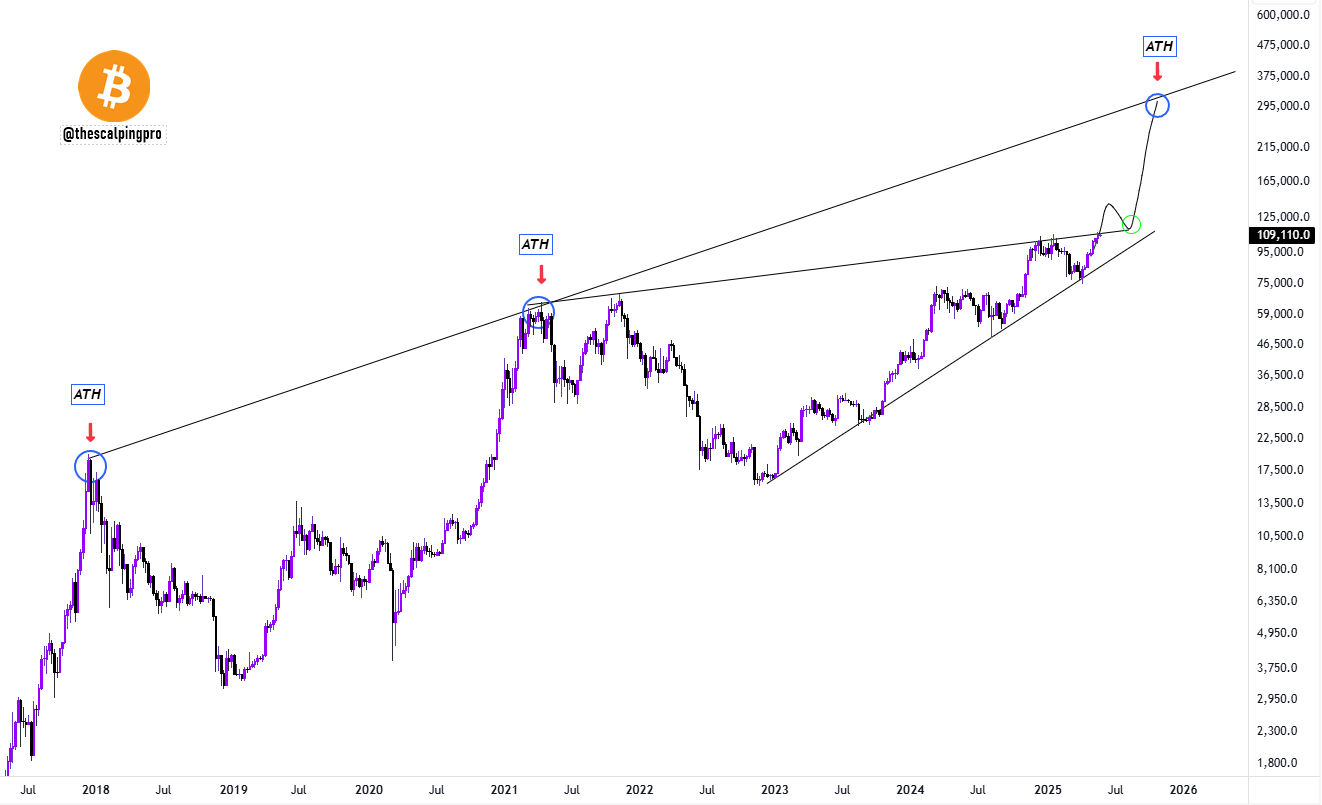
An analyst known as Mags highlights two key bullish formations shaping Bitcoin’s outlook: an ascending triangle and a rising wedge. Notably, the upper ascending trendline connects Bitcoin’s all-time highs (ATHs) starting with the December 2017 peak near $19,712.

This trendline also runs through the November 2021 ATH above $66,000, projecting toward another ATH around 2025 or 2026.

Image

Meanwhile, the ascending triangle is framed by two main upward trendlines. The lower trendline provides solid support, beginning in late 2022 and holding through multiple dips.

For instance, it supported Bitcoin at about $15,700 in November 2022, around $25,000 in September 2023, and near $76,000 in April 2025. On the upper side, resistance has repeatedly capped price rallies, holding below $35,000 and $75,000 in 2021, and more recently below $108,000 in late 2024.

Together, these patterns suggest Bitcoin may target a new peak between $295,000 and $300,000 by mid-to-late 2025. This would require a surge of approximately 170.6% from the current $109,003 price level.

Standard Chartered Projects Aggressive Growth

Supporting this view, Standard Chartered’s latest research anticipates strong Bitcoin performance through 2028. The bank forecasts Bitcoin reaching $200,000 by the end of 2025 and $300,000 in 2026. 

Furthermore, it expects Bitcoin to climb to $400,000 in 2027 and peak at $500,000 by 2028. This $500,000 level is projected to remain stable through 2029.

Institutional Influence Could Drive Market Expansion

At the recent Bitcoin Conference in Las Vegas, Strategy executive chairman Michael Saylor outlined key market dynamics affecting Bitcoin’s future valuation.

He highlighted the impact of growing Wall Street ownership on Bitcoin’s market cap, which could reach $20 trillion. According to Saylor, if Wall Street’s ownership rises from 5% to 10%, Bitcoin’s price could hit approximately $1 million per coin.

Saylor explained that at 5% ownership, Wall Street controls about $2.5 trillion of Bitcoin, while the remaining $47.5 trillion remains with global investors outside Wall Street. Increasing this share to 10% would imply a total market valuation near $20 trillion, with $18 trillion still held by non-Wall Street investors.

Grayscale Classifies XRP as a Currency Alongside Bitcoin as it Launches AI Crypto Sector

0

Prominent digital asset manager Grayscale Investments has introduced a dedicated Artificial Intelligence (AI) sector within its Crypto Sectors framework. 

In a blog post yesterday, the Grayscale Research team emphasized that it created the new AI sector due to the niche’s explosive growth over the past two years. 

Grayscale’s newly created Artificial Intelligence Crypto Sector features 20 tokens, boasting a combined market capitalization of $21 billion. This represents a surge of 366.66% from the sector’s valuation of $4.5 billion, recorded in Q1 2023. 

Following this remarkable growth, Grayscale characterized the Artificial Intelligence Crypto Sector as its sixth crypto segment. It is worth noting that the tokens in the new AI Crypto category focus on AI solutions. 

Tokens in Grayscale’s AI Sector 

The featured tokens include Bittensor (TAO), Render (RENDER), Worldcoin (WLD), Story Protocol (IP), Near (NEAR), Theta Network (THETA), AIOZ Network (AIOZ), Virtuals (VIRTUAL), Artificial Superintelligence Alliance (FET), and Grass (GRASS). 

Other tokens in the AI sector are Arkham Intelligence (ARKM), Kaito (KAITO), Golem (GLM), Akash (AKT), Livepeer (LPT), Venice.ai (VVV), Aethir (ATH), io.net (IO), ElizaOS (A16Z), and aixbt (AIXBT). 

Grayscale AI Crypto Sector Constituents

At the time of Grayscale’s announcement, TAO ranks as the largest token by market cap in the category, with a valuation of $3.8 billion and a fully diluted market cap of $9.3 billion. 

With Grayscale grouping these AI tokens into a specific category, investors can easily track the performance of the sector. They can also compare its performance with other sectors and decide how to allocate capital accordingly. 

Other Crypto Sectors Under Grayscale Framework 

Notably, Grayscale established the AI Crypto Sector using its proprietary Crypto Sectors framework. The investment company utilizes the framework to categorize crypto assets based on their respective functions. According to Grayscale, its Crypto Sectors framework is similar to the Global Industry Classification System (GICS), which categorizes public companies into various sectors. 

Currently, Grayscale categorizes the broader crypto market into six distinct sectors: currencies, financials, smart contract platforms, utilities and services, artificial intelligence, and Consumer & Culture. 

XRP and Bitcoin Classified as Currency 

Interestingly, Grayscale groups crypto tokens under these sectors based on their unique functions. For instance, digital assets like Bitcoin and XRP are placed in the Currency Sector. 

According to Grayscale, the Currency Sector comprises digital assets whose primary use case revolves around decentralized payments and stores of value. 

Grayscale Crypto Sectors

Notably, Bitcoin has long been seen as a store of value due to its capped supply and potential to appreciate in value over time. On the other hand, XRP is specifically known for its utility in cross-border settlements and has been leveraged for this purpose by top financial institutions. 

Michael Saylor Predicts When Bitcoin Price Will be $1,000,000 a Coin

0

At the Bitcoin Conference in Las Vegas, the executive chairman of Strategy, Michael Saylor, mentioned major market dynamics driving Bitcoin’s potential surge. 

Saylor emphasized that as Wall Street’s ownership of Bitcoin increases, the total market value is expected to expand significantly, possibly hitting $20 trillion. This valuation would place Bitcoin at approximately $1 million per coin.

Institutional Ownership and Market Dynamics

Saylor explained that when Wall Street owns 5% of all Bitcoin, the remaining 95%, which amounts to about $2.5 trillion, is held by others outside Wall Street.

He further stated that if Wall Street’s ownership rises to 10%, Bitcoin’s price could reach $1 million per coin. At that level, the total market value would be around $20 trillion, with nearly $18 trillion still owned by investors outside Wall Street across the world.

He further argued that such growth in institutional ownership enhances the asset’s value network, making hostile takeovers impossible. Notably, Saylor pointed out that increasing Bitcoin purchases would empower even those who disagree.

Interestingly, Strategy itself continues to deepen its Bitcoin holdings. The company recently added 4,020 BTC for around $427 million, averaging $106,237 per bitcoin. This brings Strategy’s total Bitcoin holdings to 580,250 BTC, acquired at an average price of $69,979. The cumulative investment now totals around $40.61 billion.

Bitcoin is Money, Everything Else is Credit

Additionally, at the conference, Michael Saylor received a Gemini Bitcoin Credit Card from the Winklevoss brothers, who joked about giving him the “whale limit.” In a response to Tyler Winklevoss’ X pos, Saylor emphasized a fundamental distinction between Bitcoin and traditional financial assets by stating that Bitcoin is money, while everything else is credit. 

Essentially, he meant that Bitcoin serves as a true form of money due to its intrinsic value, scarcity, and durability, functioning as a store of value and medium of exchange independent of any promises or backing.

In contrast, most other assets and currencies, including government-issued fiat, bank balances, bonds, and loans, represent credit or debt that depend on trust and the creditworthiness of an issuing entity.

Broader Market Predictions from Financial Watchers

Meanwhile, other prominent figures have also forecasted Bitcoin’s rise to $1 million, though timelines vary. Financial educator Robert Kiyosaki, author of Rich Dad, Poor Dad, sees Bitcoin reaching $1 million in the next decade, specifically by 2035.

His prediction is partly based on the escalating U.S. federal and credit card debt levels recorded in 2025, which could drive demand for alternative safe-haven assets, including precious metals and Bitcoin.

Investment strategist Lyn Alden supported the $1 million target but viewed the timeline differently. While agreeing with Ark Invest CEO Cathie Wood’s prediction of Bitcoin reaching seven figures by 2030, Alden considers this timeline too aggressive. Instead, she projects Bitcoin is more likely to hit $1 million closer to 2035.

Arthur Hayes, co-founder of BitMEX, presented a different perspective. He foresees Bitcoin hitting $1 million by 2028, driven by the accelerating breakdown of global financial integration, particularly between the U.S. and China.

Hayes highlights that increasing capital controls could push investors from traditional assets like U.S. Treasuries to decentralized hard assets, such as Bitcoin. He further noted Bitcoin’s advantage over gold as a bearer asset, enabling cross-border transfers without intermediaries or centralized oversight.

Cardano Founder Says I’d Love to See XRP DeFi Onto Cardano

0

Cardano founder Charles Hoskinson sees a multi-billion-dollar opportunity in Bitcoin and XRP DeFi, recently disclosing Cardano’s plans to move into the space.

Hoskinson has incessantly teased Cardano’s initiative to bring decentralized finance (DeFi) onto the Bitcoin network. Recently, he has added XRP to the picture, teasing a synergy with both networks to bring smart contract functionalities.

Speaking with Bitcoin.com’s Frederick Munanwa yesterday, the Cardano founder expressed his desire to see XRP DeFi on the Cardano blockchain. He stressed that it would unlock $140 billion worth of value for the layer 1 network.

XRP DeFi Coming to Cardano

Hoskinson has been basking in Cardano’s newfound bromance with the XRP ecosystem. After resolving its years-long rift with the blockchain community, he and Ripple, the largest contributor to the XRP ecosystem, have teased a partnership.

The Cardano founder noted that he has a strong relationship with Ripple and plans to introduce an innovation that has been lacking on the XRP Ledger, despite its extensive development.

He noted that Cardano would like to integrate smart contract features into the XRP Ledger, thereby expanding the network’s functionalities and unlocking billions of dollars for the Cardano ecosystem. Hoskinson specifically noted that he would love to see XRP DeFi on Cardano.

Notably, Hoskinson has previously elaborated on this strategy. In an earlier interview with a market analyst at eToro, he noted that Cardano developers would add a computational layer to the XRP Ledger, bridging DeFi features such as native lending and borrowing, among others.

Bitcoin DeFi Four Times Larger Than Ethereum and Solana Combined

Meanwhile, in his latest commentary, Hoskinson also reiterated that Bitcoin DeFi would be massive. Specifically, he argued that at its peak, it would be worth four times the combined value of Ethereum and Solana. Currently, the two chains have a cumulative TVL of $73.5 billion. 

Furthermore, he noted that Cardano is aggressively moving in that direction, as he identifies the innovation as the source of significant growth in terms of TVL and transaction volume in a competitive crypto landscape. Hoskinson also emphasized that the Cardano network has built-in advantages for this integration, like Cardano sharing the same UTXO design as Bitcoin.

Interestingly, several analysts have highlighted the potential for Cardano if it enables DeFi on Bitcoin. Altcoin Oracle, a Cardano Drep, has speculated that ADA would hit $20 per coin if it becomes the sole enabler to Bitcoin DeFi.

Cardano Founder Welcomes as Bitcoin DeFi Goes Live on Cardano

0

Cardano founder Charles Hoskinson recently reacted to a Bitcoin conference demo in Las Vegas that showed the emergence of Bitcoin DeFi powered by Cardano technology. 

The demo showcased Lace Wallet’s ability to let users swap native Bitcoin directly for Minswap tokens on Cardano within the same interface. 

This demonstration signals new possibilities for Bitcoin holders to engage with decentralized finance on Cardano without leaving their wallets. Reacting to the demo, Hoskinson remarked, “Welcome to the age of Bitcoin DeFi, brought to you by Cardano.”

Seamless Bitcoin to Cardano Token Swaps

The demo illustrated a user opening the Minswap decentralized application (DApp) inside Lace Wallet, authorizing it, and completing a BTC-to-Minswap token swap with a few clicks.

Notably, transaction fees were paid in Bitcoin via a Babel fees system managed by Fluid Tokens, which suggests a trust-minimized bridging or fee abstraction mechanism. This process allows Bitcoin holders to participate in Cardano DeFi while maintaining control over their assets.

This innovation represents one of the earliest practical examples of direct interaction between Bitcoin and Cardano DeFi from within a single wallet. The demonstration promotes increased interoperability, giving Bitcoin users access to lending, swapping, and trading functionalities across chains. 

Cardano and Bitcoin Partnership Advances 

Further advancing this collaboration, Input Output Global (IOG) CTO Romain Pellerin announced that the Cardinal protocol will soon enable USDC on Bitcoin to be brought into the Cardano ecosystem.

This allows stablecoins to be utilized within Cardano smart contracts while ensuring compliant confidentiality through the Midnight privacy protocol. Cardinal, designed for Bitcoin Cardano UTXO wrapping and Ordinals support, is nearing production readiness.

Recall, earlier in May, market analyst Dan Gambardello pointed to Cardano as the blockchain poised to unlock a secure framework for Bitcoin DeFi. This matches the ongoing partnership between Cardano’s EMURGO and BitcoinOS that started last year. Their collaboration focuses on enabling smart contract functionality for Bitcoin developers by leveraging Cardano’s network and Bitcoin’s liquidity.

XRP Integration Planned for Lace Wallet

In addition to Bitcoin support, Cardano plans to integrate XRP into Lace Wallet. Charles Hoskinson confirmed this during a recent AMA session, revealing that collaboration with Ripple’s team is progressing well. The integration will enable users to store, send, and receive XRP through Lace Wallet.

Lace launched on Cardano’s mainnet in April 2023, initially supporting only native Cardano assets like ADA. Since then, it has expanded to include Bitcoin support. Adding XRP support further develops Lace as a multi-chain wallet, though no specific timeline for this integration was provided.

Researcher Presents What He Calls Proof That R3 Uses XRP for Corda Settler

SMQKE, an XRP community figure and researcher, is rejuvenating community discussions on whether R3 still uses XRP for its Corda Settler platform. 

Notably, he presented videos and documents in an attempt to show that the platform still leverages XRP. Specifically, his findings trace the timeline of R3’s early integration of XRP. However, recent data indicates that the partnership might have quietly shifted direction over time.

Demo Videos Showing R3 Corda Settler Uses XRP

SMQKE shared a demo video R3 released on December 5, 2018, shortly after it launched Corda Settler. In the video, R3 demonstrated how the platform could settle payments using XRP. 

The demo showed two companies, Party A and Party B, engaging in a transaction where Party A requested payment in XRP. The flow involved fetching a real-time exchange rate, updating the obligation, and generating an XRP address. 

Party B then sent the payment, submitted the transaction hash to the oracle, and completed the settlement once the oracle verified the transfer on the XRP Ledger.

A second video, also released in December 2018, highlighted the technical setup behind the process. R3 used four Corda nodes: Party A, Party B, a notary cluster, and an oracle. The oracle hosted both an FX rate oracle and an XRP settlement oracle. 

Essentially, the walkthrough explained how an obligation in USD could be converted into XRP using live rates. After Party A added XRP settlement instructions, Party B executed the payment, and the oracle verified it by checking the XRP transaction hash.

Evidence from Multiple Documents 

Meanwhile, SMQKE also referred to a March 2021 report from Credit Suisse titled. The report noted that Corda Settler supported XRP and highlighted R3’s collaboration with SWIFT’s gpi initiative. 

In addition, SMQKE cited a February 2019 article by Carlo de Meijer, published on the TreasuryXL platform. The article stated clearly that R3 had selected XRP as the first settlement mechanism for Corda Settler. De Meijer explained that both R3 Corda and Ripple’s XRP shared an enterprise-oriented approach. 

He quoted R3 co-founder Todd McDonald, who said the XRP integration demonstrated the potential for interoperability between blockchain networks. McDonald stressed that the integration served as a live example, but the platform would remain open to various payment systems.

R3 Corda Settler Codebase Points to XRP

SMQKE also presented evidence from GitHub. He found a December 2018 update to the official Corda Settler repository. The documentation confirmed that XRP was the first, and at that time, only, supported settlement asset for off-ledger transactions. 

Interestingly, the readme file also described how Corda Settler could support any payment rail, as long as it provided cryptographic proof of payment.

Further, SMQKE quoted a passage from the book The Power of Micro Money Transfers. 

The author described Corda Settler as a solution that R3 launched in late 2018 to allow settlement using both traditional and blockchain-based assets. The book specifically noted that XRP was the first digital currency integrated into the platform.

There’s a Catch

Despite this solid evidence, many have argued that the context has changed since those early days. By mid-2019, R3 executives had already started clarifying their intent. 

While there is no evidence showing R3 depreciated XRP’s use or dumped the assets, in interviews, its executives stated that XRP served as an example, not a fixed component. R3 designed Corda Settler to support multiple currencies and assets, depending on client needs.

Moreover, in 2021, R3 began working closely with the XDC Network. That same year, R3 integrated XDC as the settlement token for its Decentralized Digital Asset Shared Ledger (DASL) Bridge. 

This development made XDC the default token for Corda-based trade finance applications. Some commentators argue that unlike XRP, XDC came with an ecosystem more tailored to R3’s enterprise clients in trade and supply chain finance.

By 2023, developers and blockchain analysts noted that R3 had deprecated its XRP support. No recent updates to the Corda SDK included XRP integration. On-chain data also showed no significant XRP transactions involving R3 or Corda Settler.

Ripple Submits New Letter to SEC: Details

Ripple has submitted an additional letter to the U.S. SEC, addressing a pivotal question about when a token should lose its security label.  

Stuart Alderoty, Ripple’s Chief Legal Officer, highlighted the company’s letter in a post on X. According to him, Ripple sent the letter to the SEC’s Crypto Task Force, which Commissioner Hester Peirce leads.

Ripple Addresses Question About Token’s Security Classification 

The letter focused on Peirce’s recent speech, The New Paradigm, in which she asked, “When does a digital asset separate from an investment contract?”

Responding to the question, Ripple drew on existing securities law analysis from prominent legal experts, such as Lewis Cohen et al. In that analysis, Cohen argued that the current U.S. investment contract law does not classify routine transfers of most fungible crypto assets in secondary markets as securities. 

Ripple emphasized that Judge Analisa Torres reinforced this view in her landmark decision in July 2023 in its case against the SEC. Specifically, while the judge ruled that Ripple’s sales of XRP to institutional clients constituted securities, she determined that the company’s secondary market sales of XRP did not constitute investment contracts. 

Moreover, Ripple mentioned that the judge also ruled that XRP is not a security in itself, even though it was previously sold to institutional investors as part of an investment contract. 

Congress, Not the SEC, Should Address Gaps in Securities Laws

Meanwhile, Ripple acknowledged the SEC’s concerns about the possibility of bad actors exploiting the current state of the law to evade accountability. Nonetheless, it emphasized that the U.S. Congress is responsible for filling any gaps in the law, rather than the SEC. 

“Lawmakers are in charge of establishing new legal standards. The SEC’s adherence to existing law would significantly reduce market confusion,” Ripple remarked. 

However, it stated that the SEC’s reliance on vague concepts, including the ‘sufficiently decentralized’ principle, could compound the market’s uncertainty. 

In establishing new laws to fill the gap in existing ones, Ripple suggested that Congress could consider the maturity of the network to determine when a token severs its initial investment contract ties.

It emphasized that once a token is mature, it can circulate within the market without requiring an exemption under securities law.   

Ripple Proposes Safe Harbor to Protect Good Actors 

Meanwhile, Ripple also proposed a safe harbor to protect good actors in the market. It believes the so-called safe harbor would not only reduce enforcement risks but also provide clear compliance guidance for market participants. 

When a Token Should Sever Ties to Its Initial Security Status

Furthermore, Ripple referenced existing law to clarify when a token initially sold under an investment contract ceases to be considered a security. According to Ripple, if a token was initially offered as part of an investment contract, subsequent sales of the asset should not be deemed a security unless both of the following conditions are met: 

  • When the issuer has not fulfilled the material promise it made to the original purchaser. 
  • If the current holder still has enforceable rights against the issuer tied to that promise. 

In conclusion, Ripple emphasized that tokens and networks that have operated transparently in broad, liquid markets for an extended period should not be subject to new securities law obligations, especially those related to disclosure and registration.

The company argued that such assets have become integrated into the financial system and no longer pose the regulatory risks that concern the SEC.

This is not the first time that Ripple has written to the SEC regarding crypto-related regulations. In March, it wrote a letter proposing three solutions to help the commission address the regulatory confusion in the crypto market.