Home Blog Page 712

It’s Going to Be Wild for Bitcoin: Lightspark CEO Explains Why

0

A supply shock is on the horizon for Bitcoin, with its scarce nature and growing demand serving as a major catalyst for the impending wild rally.

Lightspark CEO and co-founder David Marcus knows what’s coming for Bitcoin, the largest cryptocurrency by market cap. In a May 27 tweet, he suggested that things are going to get “so wild” from here on for the premier crypto asset.

Scarcity Is Real

Marcus identified a growing story of Bitcoin adoption among major financial players. The asset’s demand has gone institutional, so much so that Marcus has lost count of the number of companies racing to accumulate Bitcoin.

An interesting detail of this strong demand is that Bitcoin is a scarce resource. The 21-million-capped asset, widely known as digital gold, already has 94.6% of its total supply in circulation. With depleting exchange reserves and increased accumulation by firms and long-term holders, Bitcoin’s supply is nearly extinguished.

Meanwhile, Marcus highlighted that only 1.4 million Bitcoin tokens will be created in the next 115 years. For context, estimations show that miners will mint the last Bitcoin by 2140, precisely 115 years from now. 

At the current mining rate of 450 BTC per day, it would have taken less time to mine the last Bitcoin. However, due to the pre-programmed halving event, scheduled to occur periodically up to 2136, the issuance rate of the pioneering cryptocurrency would continue to decline, adding to its scarcity.

As a result, the Lightspark CEO noted that it is going to be wild for Bitcoin. The growing institutional acquisition of Bitcoin, combined with the limited available supply, would spark a supply shock and, consequently, a price explosion.

For perspective, several market enthusiasts have tipped Bitcoin to continue to grow due to the escalating adoption. Standard Chartered has predicted $200,000 by year’s end, Cathie Wood says $1.5 million by 2030, and Michael Salylor projected an ambitious $13 million by 2045.

Firms Are Massively Accumulating Bitcoin

In truth, companies are buying Bitcoin in no small amounts. Some use part of their reserve, others leverage growing interest from the legal financial sector to borrow funds and increase exposure, and others acquire using the Bitcoin spot exchange-traded funds (ETFs). Either way, institutions are becoming aware and stacking the priced digital asset.

For instance, Michael Saylor’s Strategy (formerly MicroStrategy) has been incessantly piling into Bitcoin, leveraging corporate notes and common share offerings to raise funds. It currently holds 580,250 BTC, valued at $62.87 billion.

Next, firms like Metaplanet and Marathon Digital are also employing a similar strategy as MicroStrategy to fund Bitcoin purchases. The former holds 7,800 BTC ($843 million), and the latter has 48,137 BTC ($5.2 billion).

Meanwhile, GameStop, Semler Scientific, and The Blockchain Group are also actively buying Bitcoin. Remarkably, all three are leveraging Strategy’s playbook, offering users indirect exposure to Bitcoin as a business intelligence firm.

In the Bitcoin ETF space, some prominent names are also gaining exposure to Bitcoin. Firms such as Goldman Sachs, Wells Fargo, Avenir Group, Barclays Bank, and Abu Dhabi’s sovereign wealth fund, Mubadala, hold investments in several spot ETFs, thereby indirectly acquiring Bitcoin.

Meanwhile, other notable companies are also teasing the creation of a Bitcoin treasury. Trump Media announced yesterday that it would raise $2.5 billion to acquire Bitcoin as a strategic reserve asset.

GameStop Joins Bitcoin Giants with Acquisition of 4,710 BTC Worth $513M

0

GameStop announced on Wednesday that it acquired approximately 4,500 Bitcoin tokens, marking its first purchase of the premier digital asset.

This move comes as the video game retailer seeks to leverage the increasing global adoption of crypto. The company’s filing did not specify the exact timeframe of these Bitcoin acquisitions.

Despite Bitcoin’s short-term price fluctuations, GameStop’s decision highlights its commitment to the crypto firstborn as a treasury reserve asset, following approval by its board earlier this year.

Treasury Reserve Plans and Funding Sources

GameStop’s board unanimously approved adding Bitcoin to its treasury reserves in March. According to the quarterly filing, the company plans to allocate some of its cash or proceeds from future debt or equity issuances toward Bitcoin purchases. However, it did not disclose the maximum amount of Bitcoin it might acquire.

Notably, GameStop gained widespread attention in 2021 due to a surge in its stock driven by a Reddit community called WallStreetBets. The retail investors behind this movement pushed shares up nearly 2,000% in less than a month.

GameStop’s Bitcoin acquisition mirrors recent moves by major market players in the crypto space. Notably, Strategy (formerly MicroStrategy) has made significant Bitcoin purchases as part of its treasury management strategy, even attracting other public companies and jurisdictions. 

Other Corporate and Institutional Bitcoin Acquisitions

Strategy, recognized as the largest corporate Bitcoin holder, itself increased its stake by adding 4,020 BTC this week. The firm now holds a total of 580,250 Bitcoins. Meanwhile, Brazil’s fintech company Méliuz became the first in the country to include Bitcoin in its treasury, acquiring over $28 million worth of BTC.

Similarly, Tether confirmed acquiring 4,812 Bitcoins worth around $458.7 million. This purchase was part of a business merger involving Cantor Equity Partners and Twenty One Capital. Tether’s average purchase price stood at $95,319.83 per Bitcoin.

Meanwhile, in Japan, Metaplanet is raising $50 million through zero-interest bonds to expand its Bitcoin holdings, with investors expecting returns upon bond redemption.

U.S. States and Other Entities Expand Bitcoin Reserves

In addition to private companies, U.S. states have also moved toward Bitcoin treasury reserves. Texas lawmakers approved Senate Bill 21 to create a Texas Strategic Bitcoin Reserve managed by the Texas Comptroller. The fund is restricted to crypto assets with at least a $500 billion market cap over the past year.

New Hampshire, located in the New England region of the U.S., became the first state in the country to approve a government-controlled reserve for Bitcoin and other cryptocurrencies. Governor Kelly Ayotte signed House Bill 302 into law, allowing the state to hold a limited portion of its treasury in Bitcoin or similar large-cap digital assets.

Meanwhile, Trump Media and Technology Group announced plans to raise $2.5 billion for a Bitcoin treasury. The company aims to sell $1.5 billion in common stock and $1 billion through convertible senior secured notes. This strategy follows a corporate model similar to that used by MicroStrategy.

Bitcoin Finally in 401(k)s as US Labor Department Lifts Crypto Restrictions for Retirement Plans

The U.S. Department of Labor (DOL) has rescinded its 2022 guidance that discouraged the inclusion of crypto options such as Bitcoin in 401(k) retirement plans.

This move could make crypto assets a standard component of American retirement portfolios, potentially unlocking access to over $7 trillion in retirement savings.

2022 Guidance Reversed

The original 2022 compliance release advised fiduciaries to exercise extreme caution when considering crypto investments, citing concerns about volatility, custody, and the speculative nature of crypto assets. This departed from the DOL’s historically neutral stance and was criticized as bureaucratic overreach.

The department’s latest action, announced on May 28, 2025, officially rescinds that guidance. It now reaffirms a neutral position, neither endorsing nor discouraging the inclusion of crypto in retirement plans by fiduciaries.

Labor Secretary Slams Biden-Era Policy as ‘Overreach’

Lori Chavez-DeRemer, confirmed as U.S. Labor Secretary in March, expressed disapproval of the prior administration’s approach to labor and investment policy. She criticized what she described as excessive government interference under the Biden Administration and emphasized that fiduciaries, not federal officials, should make investment decisions.

Her remarks reflect the Trump administration’s broader pivot toward crypto-friendly policies and reinforce growing confidence in the legitimacy of digital assets.

In April, the U.S. Federal Reserve withdrew key supervisory guidance on crypto, granting banks more freedom to engage with Bitcoin and other crypto assets. This policy shift ends the requirement for advance notice or special approval for crypto-related activities.

Additionally, the Fed, FDIC, and OCC jointly retracted earlier warnings about crypto risks, pivoting toward standardized oversight. Now, the Department of Labor has joined this trend of regulatory easing for crypto.

Bitcoin at $111K: Timing Favors Crypto Inclusion

The timing couldn’t be more favorable. Bitcoin recently reached a new all-time high of $111,970 in 2025. Analysts note that its impressive performance has shifted perceptions even among conservative investors, making it a more viable option for retirement strategies.

Interestingly, Coinbase CEO Brian Armstrong recently predicted that every American will eventually have crypto in their 401(k). This latest policy change brings that vision one step closer to reality.

BlackRock Bitcoin ETF Now 23rd Among Largest ETFs, Balchunas Says Next Youngest ETF in Top 25 is 12yrs Old

The BlackRock Bitcoin ETF has emerged as one of the most aggressively growing ETFs in the market, registering billions in net inflows over the past month. 

This achievement has pushed BlackRock’s iShares Bitcoin Trust (IBIT) to the 23rd position among the largest ETFs globally, with its total assets under management (AUM) now standing at $72.4 billion. 

BlackRock Bitcoin ETF Secures $9B in a Month

Nate Geraci, president of the ETF Store, brought attention to this impressive development, noting that IBIT has recorded inflows on 29 of the past 30 trading days, along with a 32-day streak without any outflows. Within this period, the product saw $9 billion in netflows.

Geraci mentioned how the ETF’s momentum has far exceeded early expectations. At the time of its launch, some industry watchers believed the entire spot Bitcoin ETF category might not exceed $10 billion in AUM. Yet, IBIT alone has now nearly matched that initial cap in net inflows in just one month.

Notably, data from Sosovalue confirms that IBIT’s consistent inflows began on April 14, when it attracted $36.72 million in net investments. Since then, it has experienced daily net inflows except May 13, when it recorded zero flows. 

Several significant intraday netflow surges contributed to the $9 billion milestone during this period. Specifically, on April 23, IBIT brought in $643.16 million in a single day. Five days later, on April 28, the ETF witnessed its highest single-day inflow of the year at $970.93 million. 

Interestingly, Bitcoin’s price on April 28 only showed a modest increase of 1.36%, closing at $95,000, indicating that institutional appetite for exposure to Bitcoin via the BlackRock Bitcoin ETF remained strong irrespective of the price action.

Meanwhile, the momentum continued into May. On May 2, the ETF drew in another $674.91 million. Later in the month, on May 22, it recorded an inflow of $877.18 million, outpacing VOO, the largest ETF by AUM. Most recently, on May 27, IBIT attracted an additional $409.26 million in net inflows, leading to the $72.4 billion in total assets.

IBIT Now 23rd Among Largest ETFs

Reacting to the impressive performance, Bloomberg senior ETF analyst Eric Balchunas spotlighted IBIT’s stunning rise. He highlighted that IBIT’s current AUM of $72 billion places it among the top 25 largest ETFs in the world, specifically at the 23rd position. 

He also pointed out the extraordinary nature of this achievement given that the BlackRock Bitcoin ETF is only a year old. The next youngest ETF within the top 25 is the iShares Core MSCI Emerging Markets ETF (IEMG), which launched back in October 2012. 

With its current AUM, the BlackRock Bitcoin ETF has now surpassed the Invesco S&P 500 Equal Weight ETF (RSP), which holds $72.1 billion in assets. 

However, IBIT still has significant ground to cover to break into the top 10 ETFs. To reach that milestone, it would need to exceed the Vanguard Total Bond Market ETF (BND), which currently ranks 10th with $126.8 billion in AUM. This means IBIT would require an additional $54.6 billion in net assets to secure a top-10 position.

Ripple CEO Says Bitcoin and XRP Communities Share More in Common

0

Ripple CEO Brad Garlinghouse calls for unity within the crypto industry shortly after the company donated the iconic Skull of Satoshi to the Bitcoin community. 

Ripple Donates Skull of Satoshi to the Bitcoin Community 

The leading San Francisco-based company captured the attention of the broader crypto by transforming a once-sharp criticism into a symbolic olive branch. 

In an interesting development, Ripple donated the iconic ‘Skull of Satoshi’ to the Bitcoin community at the ongoing 2025 Bitcoin Conference in Las Vegas. 

The official X account of the Bitcoin Conference confirmed the symbolic gesture via a tweet earlier today. According to the X post, the Skull of Satoshi will forever stay at the Bitcoin Museum in Nashville. 

Garlinghouse Reacts, Urges Unity in Crypto Industry   

Taking to X, Ripple CEO Brad Garlinghouse shed light on the rationale behind the donation. For context, critics have previously used the ‘Skull of Satoshi’ to criticize Bitcoin’s high-energy consumption proof-of-work algorithm. 


However, Garlinghouse indicated that the skull currently serves as a tribute to Bitcoin’s “incredible staying power” among many enthusiasts, including himself. 

As crypto gains mainstream adoption, Garlinghouse urged the broader crypto community to set aside its differences and collaborate on moving the industry to greater heights. 

He expects Ripple’s gesture to serve as a reminder to everyone that the industry’s communities, including Bitcoin and XRP, have more in common than they realize. 

Per the commentary, Ripple’s CEO suggests that the Skull of Satoshi should serve as a reminder that all crypto communities share common goals, like financial inclusion, regulatory clarity, and innovation. 

He argues that uniting around these objectives, rather than engaging in counterproductive rivalry, is imperative to moving the industry forward. 

Bitcoin and XRP Communities Feud 

The Bitcoin and XRP camps have been at loggerheads with each other over the past few years. Both camps sometimes take things to the extreme, including hurling insults at prominent stakeholders. 

In January, they had a serious clash over the United States’ crypto strategic reserve initiative. Pierre Rochard, the VP of research at Riots Platform, claimed that XRP and Ripple are the major obstacles toward the creation of a Strategic Bitcoin Reserve (SBR) in the U.S. 

Specifically, he alleged that Ripple was lobbying against SBR, as it had done with Bitcoin mining under the Biden administration. However, Garlinghouse refuted this claim, clarifying that Ripple is more supportive of a multi-coin reserve rather than one built around a particular coin. 

Although this feud has waned over the past few months, Ripple donated the Skull of Satoshi to the Bitcoin community as a peace offering while calling for unity within the global industry. 

SEC Formally Begins Review of WisdomTree XRP ETF Proposal

The U.S. Securities and Exchange Commission (SEC) has officially initiated proceedings to decide whether to approve the WisdomTree XRP Fund or not.

This move marks a significant step toward the potential launch of a spot XRP-based exchange-traded fund (ETF) in the United States. If approved, the fund would list on the Cboe BZX Exchange under the Commodity-Based Trust Shares rules.

For context, the Cboe BZX Exchange submitted a proposal to the SEC on February 6 to list and trade shares of the WisdomTree XRP Fund. The proposal was published in the Federal Register on February 26, opening a period for public comment.

Meanwhile, the filing has now entered a critical phase that brings it one step closer to approval.

SEC Opens Proceedings to Determine Approval

In a notice on May 27, the SEC stated it had formally begun proceedings to determine whether the proposed ETF meets the necessary legal and regulatory standards. This follows a prior decision on March 11, when the Commission extended the review period to allow more time for consideration.

Now, the SEC is specifically considering whether the proposal is consistent with Section 6(b)(5) of the Exchange Act, which requires that exchange rules prevent manipulative acts and fraud.

The Commission invites public comments on whether the proposal adequately addresses these concerns. Interested parties have 21 days from the date of the Federal Register publication to submit comments. A rebuttal period of 35 days is also provided for responses to other submissions.

Submissions could be via the SEC’s website or email, referencing file number SR-CboeBZX-2025-019.

Fund Details: XRP-Backed, Cash-Settled Shares

According to the filing, the WisdomTree XRP Fund aims to track the performance of XRP, using the CME CF Ripple-Dollar Reference Rate. The fund’s assets will consist solely of cash, XRP, and cash equivalents.

Shares will be created and redeemed in blocks of 5,000 through cash transactions with authorized participants. Additionally, daily valuation will occur at 4:00 p.m. ET, in line with the pricing benchmark methodology. The fund will not directly allow in-kind XRP redemptions or creations.

Ultimately, the WisdomTree XRP Fund could become one of the first XRP ETFs in the U.S. to offer direct exposure to XRP, potentially boosting institutional interest in the asset.

Beyond WisdomTree, other issuers seeking to offer XRP ETFs include Bitwise, Grayscale, and Franklin Templeton.

Here Are Key DOGE/XRP Levels to Break for a 113% Dogecoin Price Surge

0

An analyst on TradingView sees the Dogecoin and XRP pair showing signs of a bullish reversal, with support holding strong and volume increasing.

Dogecoin (DOGE) has experienced a volatile week, characterized by a short-term downward price trend but accompanied by emerging signs of bullish momentum, according to recent analysis. After starting the week around $0.22 on May 22, the cryptocurrency surged sharply to $0.25 the following day.

However, this was followed by a steady decline, with the current price at $0.2227, down 2.31% in the past 24 hours. Despite the overall dip, an analyst highlights potential technical indicators suggesting Dogecoin could be poised for a recovery and potentially outperform XRP. Notably, XRP is trading at $2.30

Key Support and Resistance Levels on DOGE/XRP

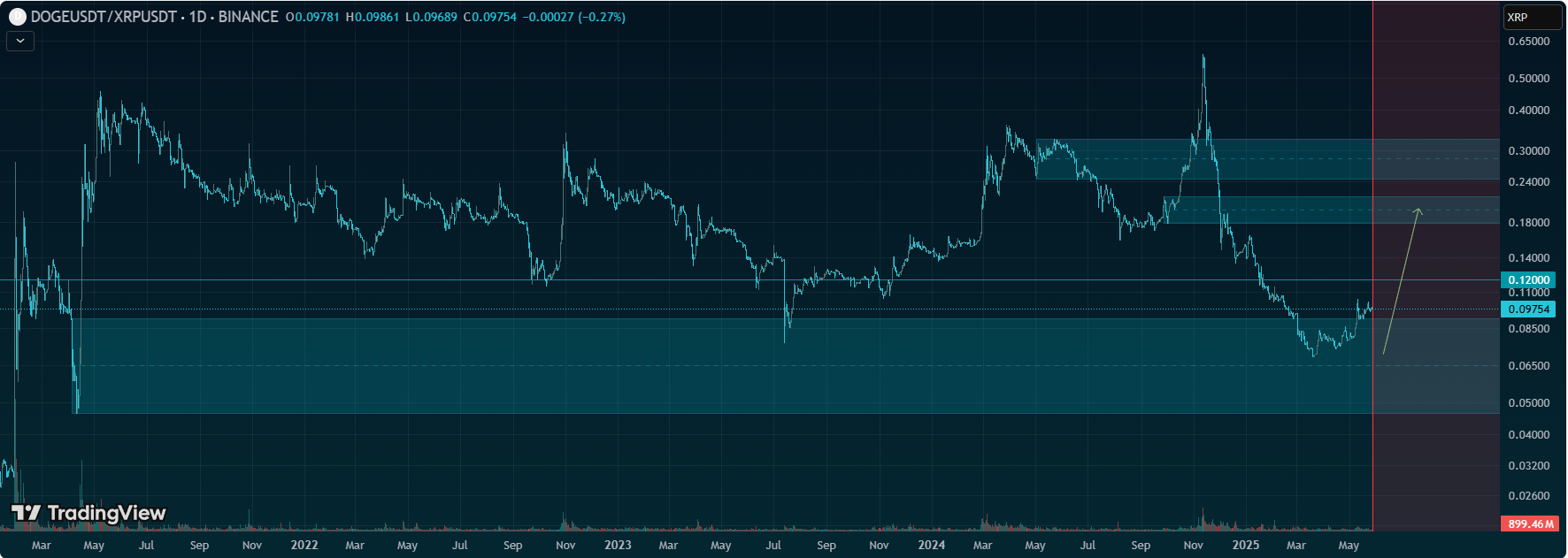
Analyst MergicNet on TradingView compared Dogecoin to XRP, pointing out that the DOGE/XRP trading pair shows potential signs of a bullish reversal. This outlook is based on the pair bouncing off a historic support zone between 0.075 and 0.085.

Notably, this support level has held since 2021, when the DOGE/XRP pair fell to 0.04 in April of that year. The support was tested again on July 14, 2023, with prices reaching 0.07 before rebounding to 0.36.

According to the analyst, the recent formation of a higher low indicates growing buying interest, and the price is attempting to break above the 0.10 resistance level.

Screenshot 2025 05 28T130603437
DOGE/XRP Price Chart

In addition to support, resistance zones at 0.17 and 0.24 for DOGE/XRP remain significant, having acted as supply zones. The analyst notes that increasing trading volume at the bottom of the recent price range, combined with an improving price structure, indicates rising buying pressure.

Momentum indicators also support this view: the Relative Strength Index (RSI) is recovering from oversold territory, while the Moving Average Convergence Divergence (MACD) is forming a bullish crossover.

The analyst states that if the price breaks and holds above 0.12, it could reach 0.16 and then 0.21. However, failure to break resistance may lead to retesting lower support levels.

In dollar terms, a projected 0.21 DOGE/XRP would imply a Dogecoin price of approximately $0.4830, assuming it significantly outperforms XRP. Relative to Dogecoin’s current price, this would represent a 113% price increase.


Growing Network Engagement for Dogecoin

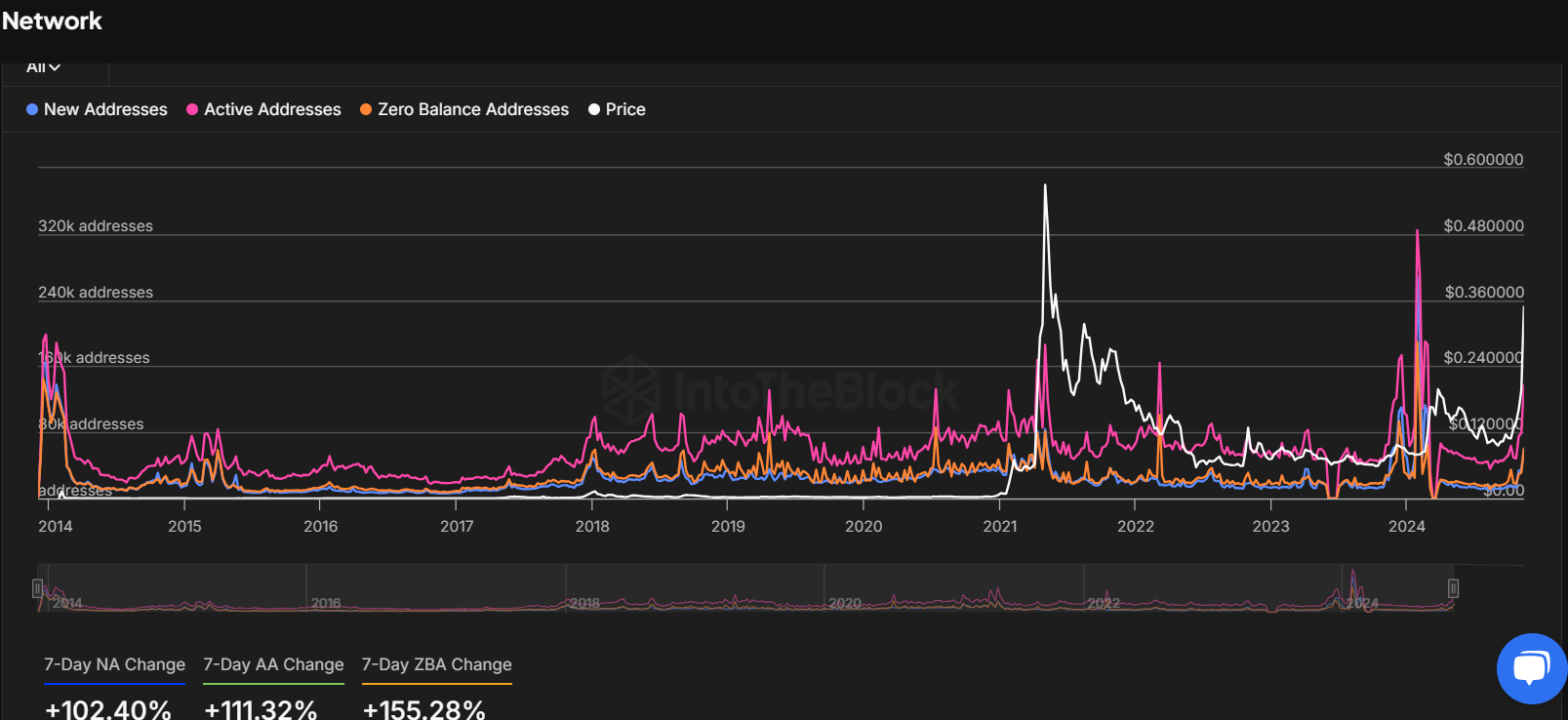
Further supporting the potential bullish momentum, recent on-chain data shows a notable increase in key Dogecoin network activity over the past week. The number of new addresses (NA) surged by 102.40%, reflecting a significant influx of new participants joining the network. 

Screenshot 2025 05 28T124852587
Dogecoin Daily Active Addresses

Meanwhile, active addresses (AA), which represent addresses involved in transactions, rose by 111.32%. This jump in transactional activity suggests higher engagement from existing holders, which often correlates with stronger market interest.

Additionally, zero balance addresses (ZBA) increased by 155.28%. While this metric does not directly imply transactional activity, it reflects changing wallet dynamics within the network. Taken together, these on-chain figures point to a more vibrant and liquid Dogecoin ecosystem.

Binance Coin (BNB) Nears $700 Resistance: Is $750 Next?

Binance Coin (BNB) hits $697 before pulling back, raising concerns of a bearish reversal. Will BNB correct to $637 or break higher to $750?

With an overnight price surge in the crypto market, Binance Coin nears the $700 psychological level. As BNB struggles to overcome this resistance, an intraday pullback of under 1% signals a possible bearish reversal. Could this lead to a retest of the $637 support level?

BNB Coin Price Analysis

On the daily chart, Binance Coin shows a bullish breakout following a short-term pullback, resulting in a price surge toward Tuesday’s peak at $697—however, the intraday pullback to $681 hints at a potential reversal.

Binance Coin Price Chart

Tuesday’s 24-hour high is very close to the previous swing high near $698. The proximity to the $700 psychological level creates a high supply zone, suggesting Binance Coin may experience short-term volatility.

Nonetheless, the recent bullish crossover of the 50-, 100-, and 200-day EMA lines has produced a positive alignment. Immediate dynamic support at the 50-day EMA sits at $636, near the $637 horizontal support level.

Additionally, the MACD and signal lines remain positively aligned above the centerline. However, their close proximity and converging movement indicate strong volatility and potential downside risks.

Price action traders can anticipate a bullish move if Binance Coin breaks above the $700 psychological level, with an immediate target of $750. Conversely, a pullback below Tuesday’s opening price of $674 could trigger a steeper correction.

Immediate support levels are near the $650 psychological mark, followed by the $637 horizontal support.

BNB Bulls Hold Strong in Derivatives Market

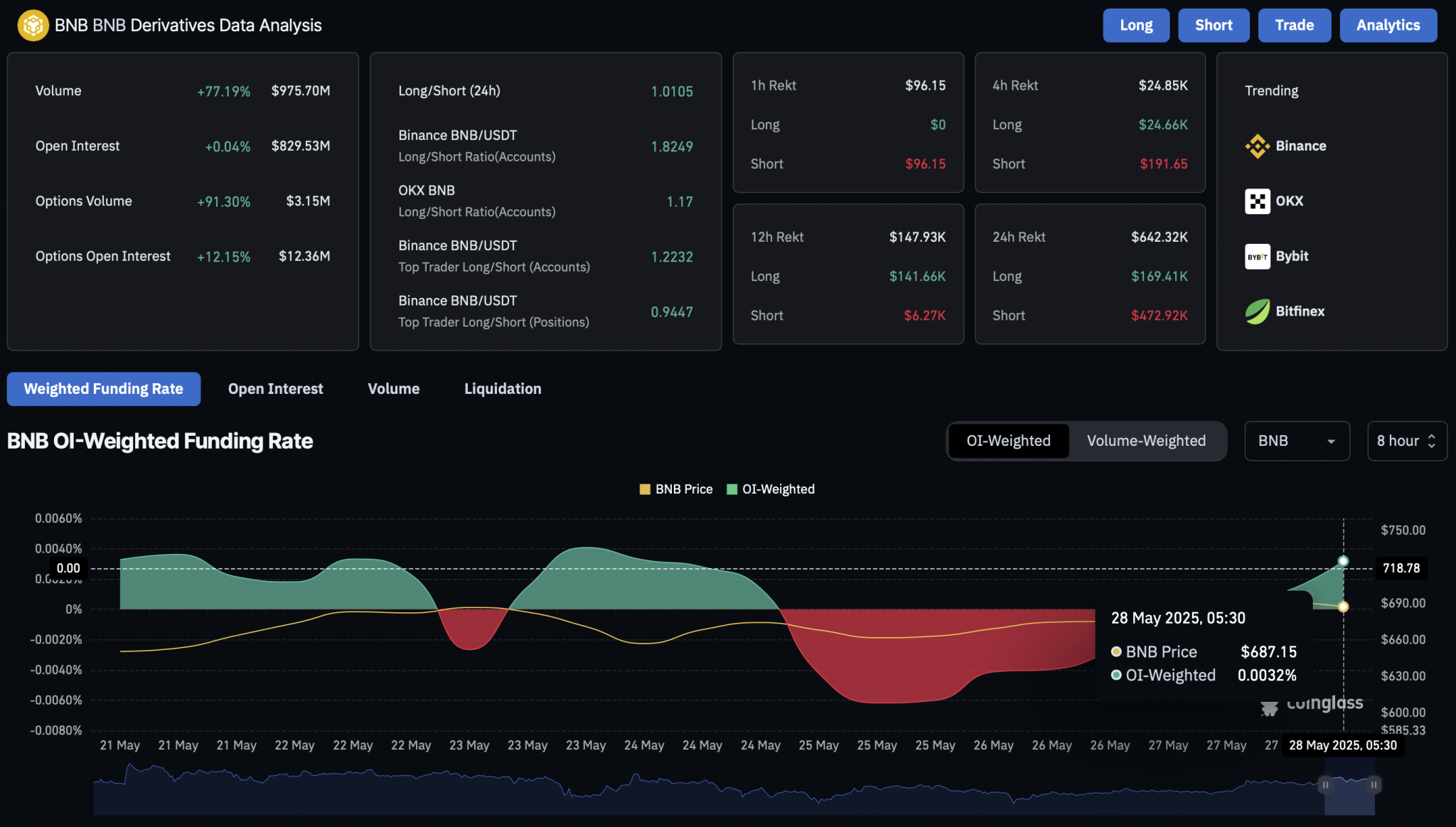
Despite short-term spot market volatility, BNB derivatives maintain strong bullish sentiment. According to Coinglass, open interest remains steady at $829.53 million, while options volume has surged 91.30% to $3.15 million.

Additionally, the bullish intent in the derivatives trade recovers as the over-weighted funding rate flips positive to 0.0032% and the long-to-short ratio surpasses the bullish threshold at 1. 

BNB derivatives
BNB derivatives

PEPE Risks Bearish Reversal as Whale Activity Suggests Profit-Taking

As Pepe trades between key Fibonacci levels, on-chain whale activity hints at profit-taking. Is a drop to $0.000010 imminent?

As meme coins struggle to rebound in the altcoin rally, Pepe faces a sharp downside risk. The frog-themed meme coin’s technical outlook indicates a potential pullback as bullish momentum fades.

PEPE Price Analysis

On the daily chart, PEPE shows a bullish breakout from a triangle pattern, reaching a high of $0.00001550. However, it is now consolidating between the 50% and 61.80% Fibonacci retracement levels, at $0.00001227 and $0.00001470, respectively.

PEPE Price Chart
PEPE Price Chart

The overall trend has resulted in a golden cross between the 50-day and 200-day EMA lines, signaling a trend reversal. Amid the short-term consolidation, the MACD line has dropped under its signal line, triggering a bearish crossover. This suggests a significant loss in bullish momentum, with increasing bearish histogram bars.

As a result, the technical indicators point to a potential pullback toward the 50% Fibonacci level at $0.00001227. However, given the overall weakness in the meme coin segment, the correction could extend to the 200-day EMA near the $0.000010 level.

On the upside, a recovery above the 61.80% Fibonacci level could open the path toward the 78.60% level at $0.00001903.

Pepe Whales Booking Profit?

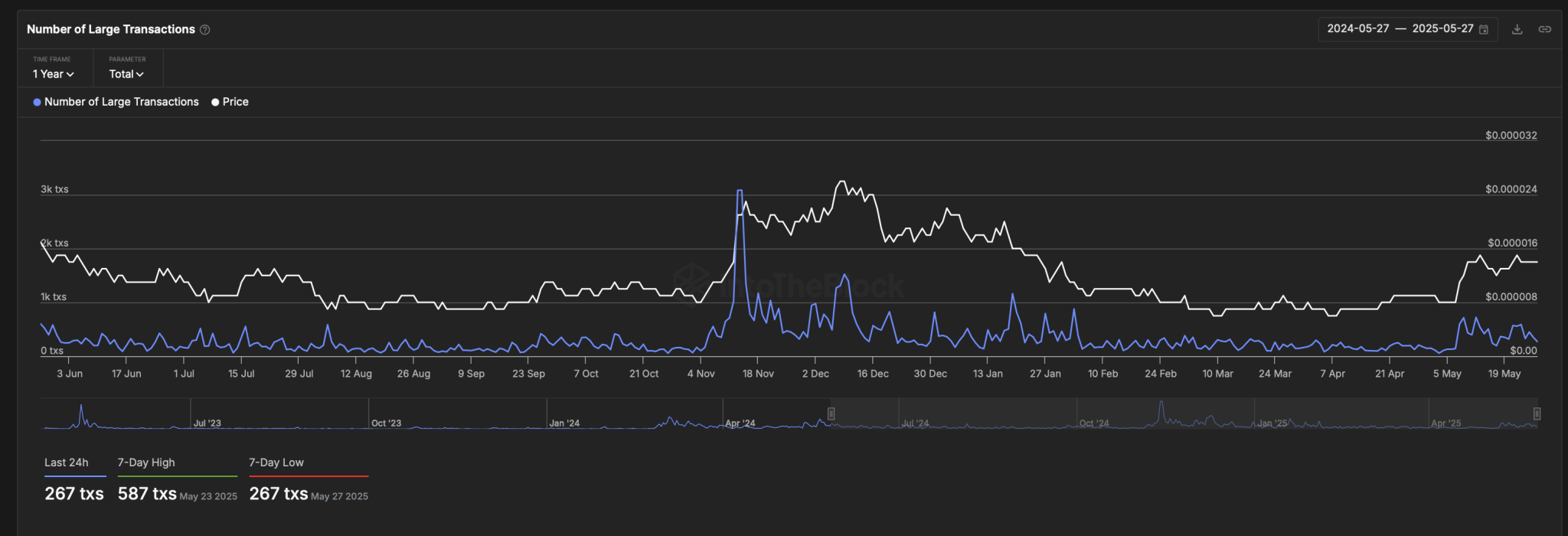
With Pepe at risk of a potential pullback, the number of large transactions has surged over the past month. According to IntoTheBlock data, whale transactions hit a 7-day high of 587 on May 23. As of the last 24 hours, the data recorded 267 transactions from whales.

The increased number of large transactions with a volume of more than $100,000 relates to heightened whale activity.

This trend is often associated with profit-taking and may suggest a local cycle top, similar to what was observed during the November 2024 rally.

Therefore, the recent spike in whale transactions following a short-term price surge raises the risk of a potential bearish reversal.

PEPE Number of Large Transactions

US Treasury Compares Ripple Stablecoin, USDT, and USDC in Recent Report

0

The US Department of the Treasury has highlighted the growing role of stablecoins in the Treasury market, specifically Ripple stablecoin RLUSD, USDT, and USDC.

Stablecoins are gaining significant attention in the United States, with their superior transactional capabilities compared to traditional financial systems being a major lure. A stablecoin bill, the GENIUS Act, has recently moved to the final approval stage in the US Senate as efforts to create a regulatory framework for the sector, teased to attract trillions of dollars to the US economy, gain momentum.

A presentation by the US Treasury Department to the TBAC highlighted the growing demand for stablecoins and their potential impact on the Treasury market. The report compared four major stablecoins, including USDT, USDC, and RLUSD.

Stablecoin Impact on US Treasury Bills

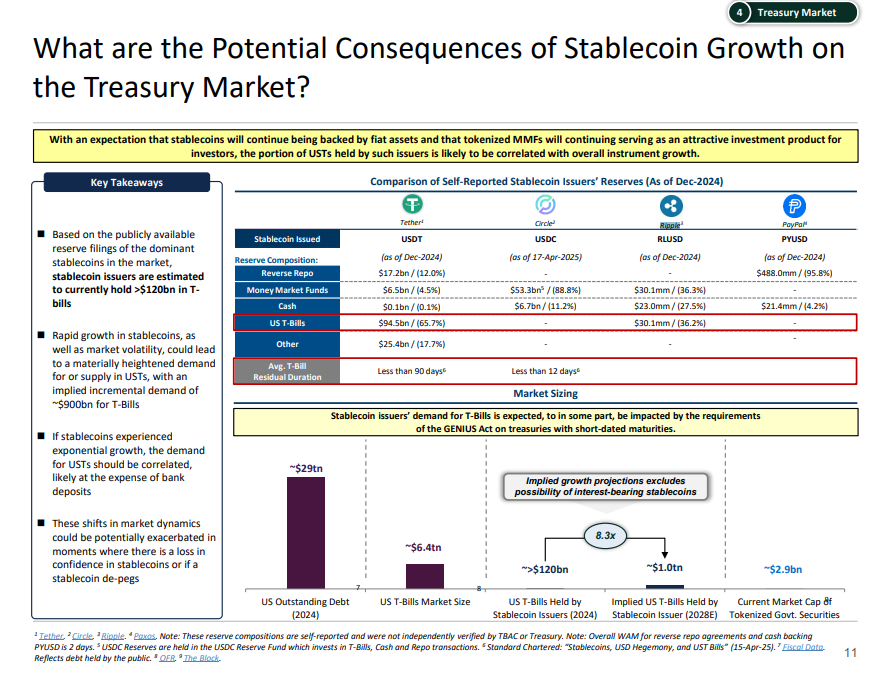
The presentation revealed the self-reported reserves of four major stablecoins, as reported by their issuers: Tether’s USDT, Circle’s USDC, Ripple’s RLUSD, and PayPal’s PYUSD. Notably, this was their reserve balance as of December 2024, with USDC being the only stablecoin for which the department used its figures as of 17 April 2025.

The report highlighted specific metrics, including the reverse repo, money market funds, cash, US T-Bills, and average T-Bill residual duration. 

For context, USDT’s reserve comprises $17.2 billion (12%) in reverse repurchase agreements (repo), $6.5 billion (4.5%) in the money market, $100 million in cash (0.1%), $94.5 billion (65.7%) in US Treasury bills, and $25.4 billion in other investments like Bitcoin.

Furthermore, USDC’s reserve consists of $53.3 billion (88.8%) in money market funds and $6.7 billion (11.2%) in cash. On the other hand, RLUSD is backed by $30.1 million (36.3%) in the money market, $23 million (27.5%) in cash, and $30.1 million (36.2%) in US Treasury bills.

PYUSD has a reported reverse repo of $488 million (95.8%) and $21.4 million (4.2%) in cash. Notably, this highlights the significant allocation to US Treasury bills among notable stablecoin issuers.

Excerpt from the US Treasury Stablecoin Report

Allocation to T-Bills Projected to Increase Exponentially

Interestingly, the US Treasury estimated that stablecoin issuers would continue to grow their allocation to T-bills as adoption increases. It noted that the requirements of the GENIUS Act, which is near passing, would impact stablecoin reserve exposure to the federal financial vehicle.

According to estimates, the value of US Treasury bills held by issuers is expected to increase 8.3 times from its $120 billion figure in 2024 to $1 trillion by 2028. This excludes the possibility of interest-bearing stablecoins, an act that both stablecoin regulations (GENIUS and STABLE Act) currently under consideration in the Senate prohibit.

Meanwhile, the stablecoin market has grown to a $250 billion sector, with a recent projection from CoinFund’s David Pakman suggesting it will hit $1 trillion by the end of 2025.