Home Blog Page 716

Here’s the Main Reason XRP Price May Continue to Rise Significantly

With XRP price showing minimal price movements in recent times, attention has shifted to its deflationary model and how it could help sustain price growth over time.

Popular XRP community researcher “SMQKE” recently reignited discussion on XRP’s long-term price potential by highlighting its deflationary design. In a tweet, SMQKE emphasized that XRP’s supply continually decreases due to its unique burn mechanism, making it fundamentally scarce.

The commentator also stressed that XRP is deflationary, adding that the token cannot be mined and that its supply is constantly shrinking. Supporting this claim, the tweet cited a statement from a published paper noting that anything limited in supply and actively used tends to become more expensive over time.

Deflation by Design: How XRP’s Supply Shrinks

Unlike many digital assets, XRP does not rely on mining. Instead, all 100 billion tokens were pre-issued at launch. What makes XRP notably deflationary is that a small portion, like 0.00001 XRP, is destroyed with every transaction. For context, this feature is to mitigate spam transactions.

Official documents from the XRP Ledger and Ripple-backed research confirm that this deflationary mechanism is built into the protocol’s core, with no system in place for inflation or token replenishment.

Notably, the XRP network has seen 13,919,025 XRP permanently removed from circulation since its inception. These tokens are neither redistributed nor collected by validators.

XRP proponents often argue that as transaction volume grows, the total circulating supply decreases, enhancing scarcity over time.

Meanwhile, despite the ongoing token burn, XRP’s total supply remains at 99,986,080,974 (approximately 99.98 billion). While many XRP supporters see this gradual reduction as bullish, critics often argue that it is inconsequential, as the overall supply remains nearly the same even after more than a decade of burns.

Expanding Utility as a Global Bridge Asset

Beyond its deflationary structure, XRP’s role as a bridge currency for global value exchange bolsters its long-term utility. The XRP Ledger supports the transfer of fiat currencies, cryptocurrencies, commodities, securities, and even loyalty points, making it one of the most versatile networks in the digital payments ecosystem.

Its speed and cost-efficiency are unmatched. XRP transactions settle in 3–5 seconds with fees averaging just $0.0002. This outperforms traditional networks like SWIFT, which can take days and cost up to $50 per transfer.

Competitive Edge Through Interoperability

XRP also maintains a strong position in the cross-border payments space thanks to its interoperability features. Its integration with projects like Axelar enables XRP to function across multiple blockchains, enhancing liquidity.

Analysts note that these interoperability bridges, along with XRP’s shrinking supply, contribute to its long-term value proposition.

Comparative analysis shows that XRP rivals centralized stablecoins like USDC and even emerging central bank digital currencies (CBDCs) by offering decentralization, lower fees, and superior cross-chain utility.
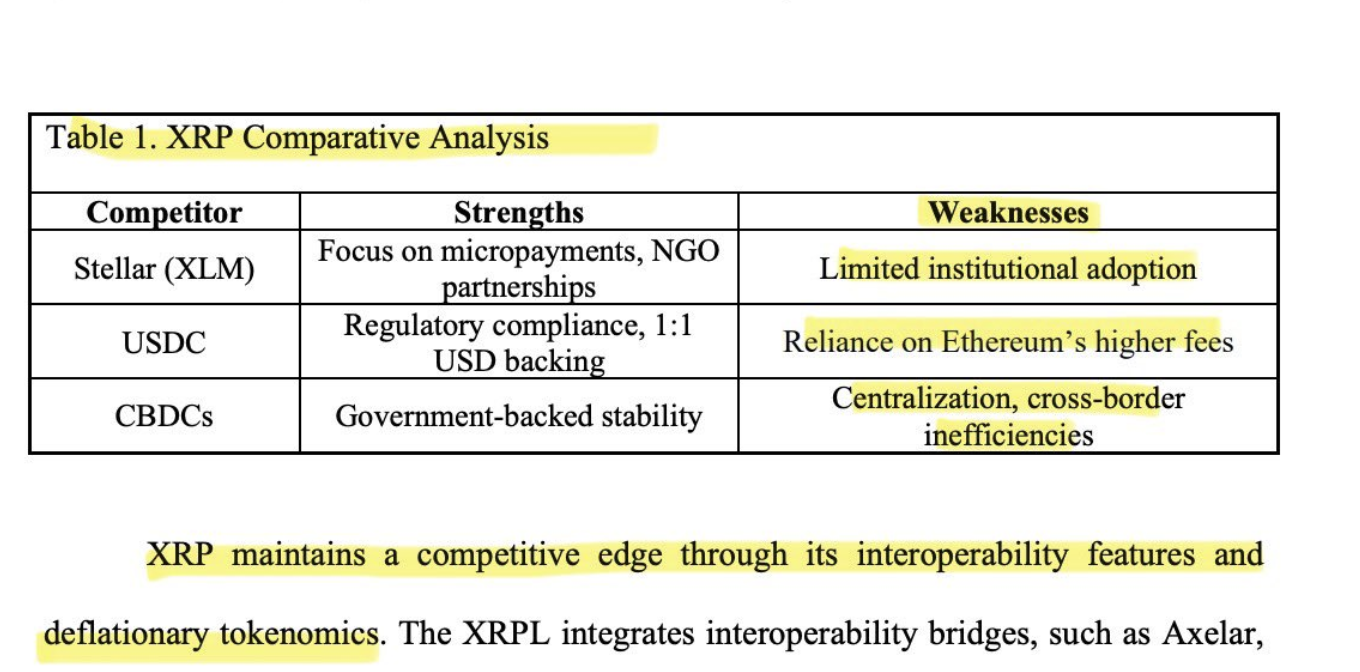
XRP competitor analysis | Source SMQKE's tweet
XRP competitor analysis | Source SMQKE’s tweet


What’s Next for XRP?

With rising institutional interest, expanding use cases, and an irreversible deflationary model, XRP’s fundamentals appear increasingly strong.

Proponents argue that as more transactions are processed and more XRP is burned, the token becomes scarcer, potentially leading to a supply shock if demand increases faster than expected.

At the time of writing, XRP is trading at $2.30, down 1.65% over the past 24 hours.

Crypto Pundit Alex Becker Says Cardano Could Outperform Solana This Cycle

0

Popular YouTuber and crypto analyst Alex Becker recently shared his outlook on major altcoins, suggesting Cardano could potentially outperform Solana in the current cycle.

Despite ADA trading at a significantly lower market cap compared to Solana (SOL), Becker suggested the token could deliver higher returns in the coming months. 

At the time of this writing, Cardano was consolidating between $0.735 and $0.765, after peaking at over $0.83 on May 23. In contrast, Solana held a price of $174.76 with a market capitalization nearing $91 billion, while Cardano’s valuation remained below $28 billion.

Becker Highlights ADA’s Upside Potential

In the YouTube video, Becker emphasized that while both ADA and SOL are strong platforms, Cardano may offer greater upside. He viewed Ethereum as a safer bet but added that ADA presented the chance for a 5x to 8x return. Notably, if ADA 8x’d from its current level, it would trade at approximately $6.10.

Becker, however, acknowledged Solana’s performance and stability but suggested investors might see more aggressive gains from ADA, Sui, and other mid-cap tokens. While praising Solana’s potential, he leaned toward Cardano when identifying entry points for higher-risk, high-reward trades.

In his analysis, Becker also mentioned other altcoins, including AVAX, which he believes will benefit from sports and gaming narratives. Chainlink was also highlighted for its utility, although he noted it continues to be overlooked by many market participants. Overall, Becker framed ADA as a strategic entry point saying, “I think Cardano is going to do great. You can’t go wrong with it.”

Becker Bets on ADA Despite Disdain Toward Community

Despite his often-critical tone toward the Cardano community, Becker has consistently maintained a bullish outlook on ADA. In March, he boldly predicted that Cardano could reach $5.

By April, Becker revealed he had accumulated significant amounts of ADA during market lows and was sitting on massive profits. While he sarcastically remarked that these gains made him feel “terrible” and “gross,” he acknowledged the strong upside potential, joking that a surge to $5 could elevate his wealth to “Dubai royalty” status.

Though often dismissive of Cardano holders, he’s expressed admiration for Charles Hoskinson, the project’s founder.

Still in April, Becker reinforced his optimism in a YouTube analysis where he named Cardano among eight coins he believes could rally fifteenfold by 2026. Despite his “feud” with the Cardano fan base, he admitted the token appears “extremely bullish” and highlighted the project’s standout technical qualities.

He described Cardano as “fast as hell” and among the most decentralized and reasonable blockchains after Ethereum. Citing its current undervaluation and growing ecosystem activity, Becker labeled ADA an “easy bet” and predicted it could soar to between $3 and $5 as bullish momentum accelerates.

Hoskinson Adds Institutional Context

Separately, Cardano founder Charles Hoskinson spoke on ADA’s positioning during an interview on the Gokhshtein podcast in March. He compared Cardano and XRP as resilient blue-chip assets, contrasting them with what he described as Solana’s mid-tier standing. 

According to Hoskinson, the U.S. government selected five cryptos for its strategic reserve: BTC, XRP, SOL, ETH, and ADA. He attributed the inclusion of ADA to its longevity and ability to weather market downturns.

Hoskinson acknowledged Solana’s recovery from the FTX collapse, noting its bounce from $8 to an all-time high of $294 in January 2025. He also recognized Solana and Ethereum as leading smart contract platforms. Despite calling Solana “mid,” he credited the network for its resilience, aligning with its selection in the U.S. reserve basket.

Analyst Suggests Bull Market Hasn’t Begun for ADA

While attention remains on ADA’s price, analysts continue to assess its long-term trajectory. Earlier this month, Dan Gambardello, founder of Crypto Capital Venture, shared a risk model suggesting ADA’s bull market has not yet started. His model placed Cardano’s long-term risk score at 37, which he labeled a “Moderate Buy.” 

The model emphasized that lower scores typically coincide with early-stage market cycles. Past data showed ADA climbing from these levels to over $1 in 2017 and past $3 in 2021. According to Gambardello, the current score indicates ADA remains in a buildup phase.

Here is Expected XRP Price Target After Six Months of Consolidation

A market analyst has shared his post-breakout XRP price target as the asset observes up to six months of consolidation.

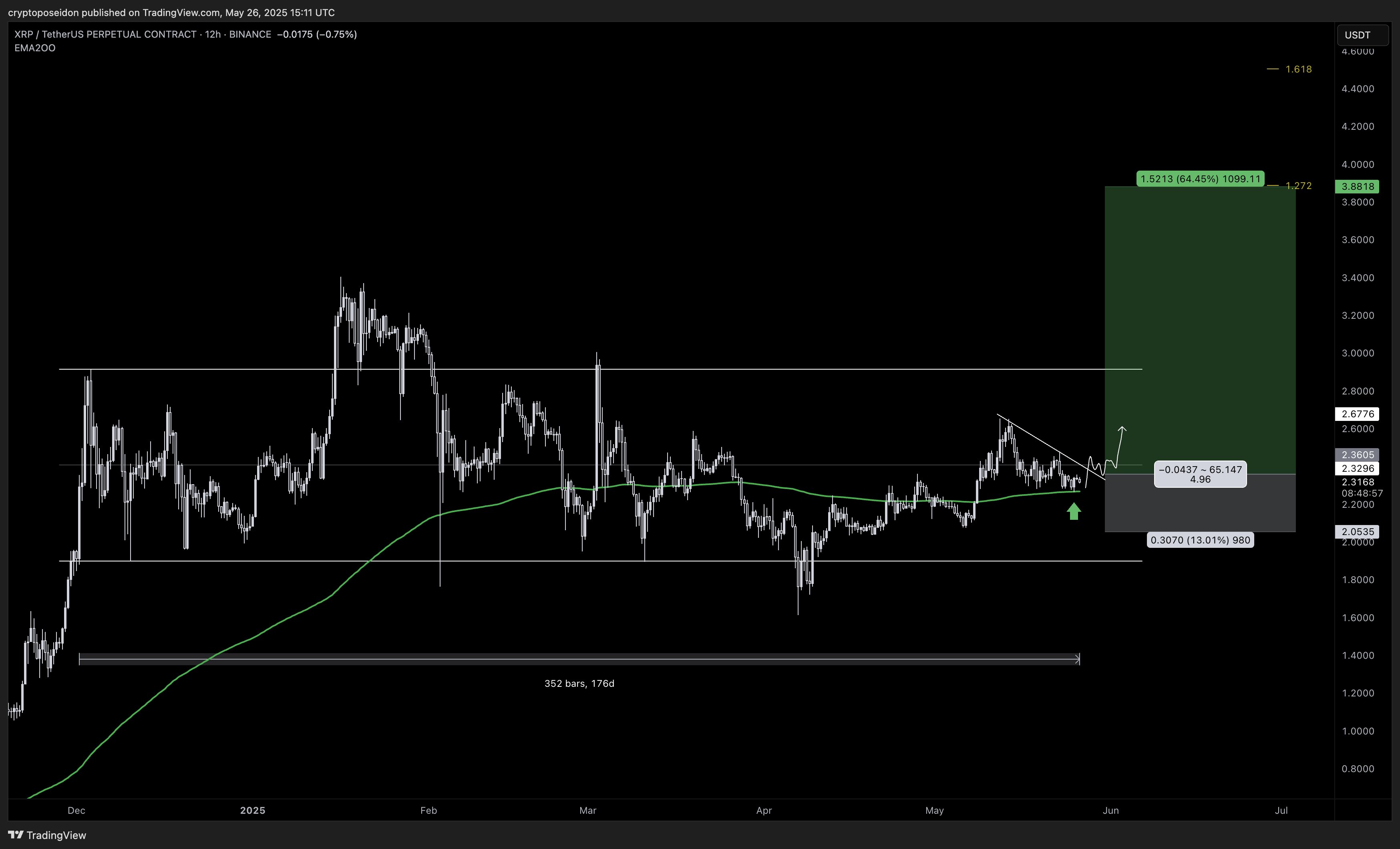
For context, this consolidation trend, highlighted by market watcher Poseidon on the 12-hour chart, began in December 2024 immediately after XRP’s explosive 480% surge to multi-year highs. 

Stuck in a Consolidation Range

Specifically, following President Donald Trump’s victory in November 2024, XRP rallied from $0.5 to a six-year peak of $2.9 by Dec. 3, 2024. After this top, the asset faced a pullback and slipped into a consolidation phase that has persisted for six months now.

Interestingly, data from Poseidon’s chart shows that the asset’s price has oscillated between the $2 and $3 levels during the consolidation. Notably, the bears have leveraged the $3 mark as resistance against a break above the consolidation, while the bulls use the $2 level as support against a break below.

XRP has occasionally pushed above and below these psychological levels, but the price quickly witnessed a spike in either buy or sell pressure that brought it back into the consolidation range. Particularly, a push to $3.3 occurred in January 2025, and a drop to $1.6 occurred last month.

In his recent analysis, Poseidon confirmed that XRP is re-consolidating within the $2 range. However, he pointed to three clear signs of strength, indicating that the asset could be on the verge of a bullish breakout.

XRP 12h Chart Poseidon
XRP 12h Chart | Poseidon

According to him, these signs include a failed breakdown, a reclamation of the 200 Exponential Moving Average (EMA) on the 12-hour chart, and a new higher high when XRP rose to $2.36 yesterday, Monday, May 26.

XRP to Targets $4 After Consolidation Breakout 

Citing these factors, he believes XRP is ready to break above the consolidation range. He identified a descending trendline that has capped XRP’s price movements since the May 12 high of $2.6, leading to lower highs. For the asset to break above this trendline, it has to surge past $2.4.

Poseidon believes this rise will confirm the breakout potential. According to the analyst, once this occurs, his next target for XRP is the $4 mark. With XRP currently trading for $2.3, it would need to rise 74% to claim $4. This price would represent a new all-time high for the asset.

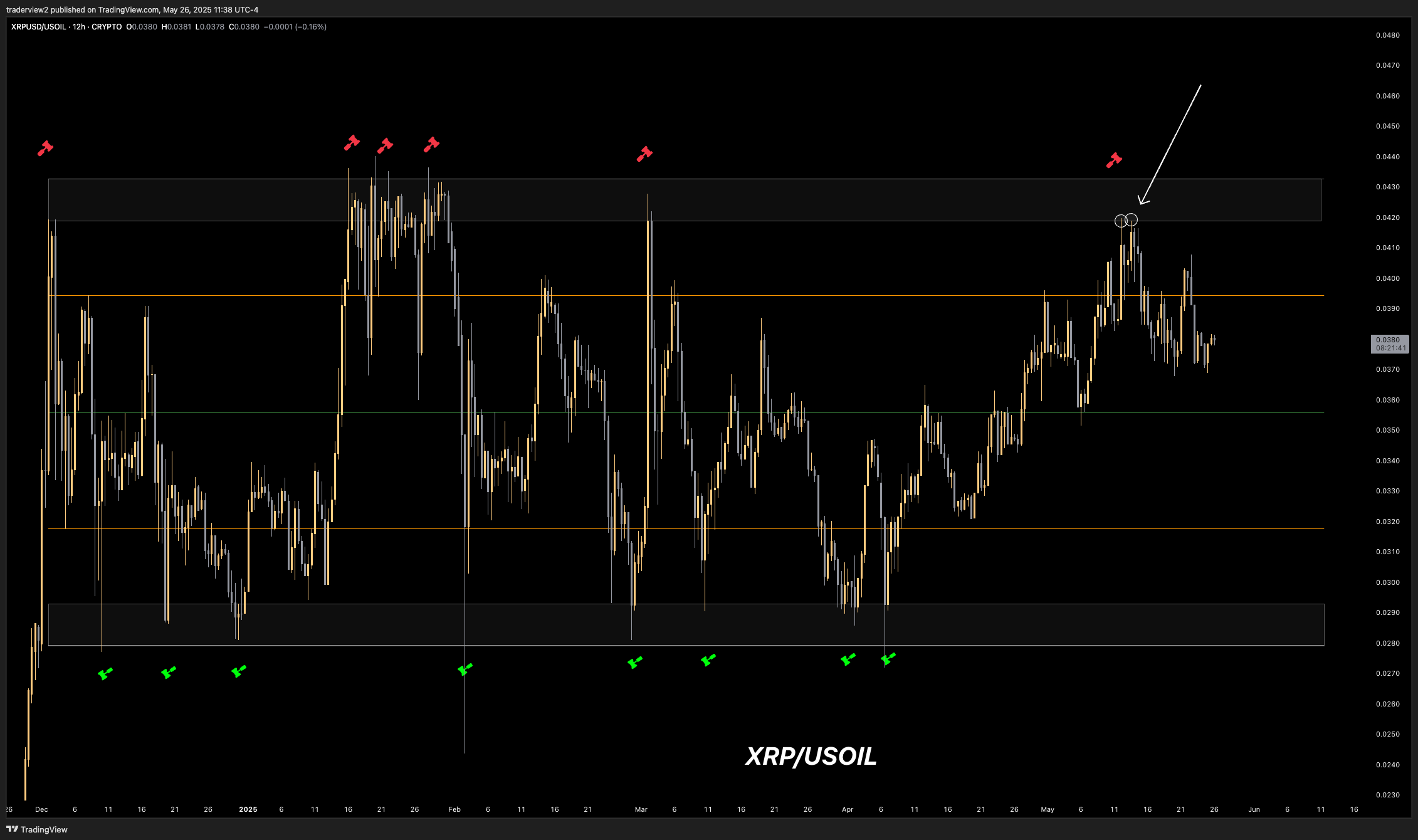
Meanwhile, market expert Dom (@traderview2) is also watching the XRP/USOIL pair for a potential breakout. He suggested that XRP shows strength here despite the noise. Notably, the asset has cooled since recently hitting a range high. 

XRPUSOIL 12h Chart Dom
XRPUSOIL 12h Chart | Dom

Interestingly, Dom has maintained the idea that once XRP breaks above this range high, its price will skyrocket further. According to him, this high represents the $2.47 level on the USD chart, aligning with Poseidon’s breakout mark. Dom believes any movement below this level is just noise.

Trump Media Denies Financial Times Report Claiming $3B Bitcoin Investment Plan

0

Trump Media & Technology Group (TMTG), led by President Donald Trump’s family, has denied recent reports claiming it was planning to raise $3 billion to invest in Bitcoin and other digital assets.

The denial follows a report by the Financial Times (FT) on May 26, which claimed the company aimed to raise $2 billion in equity and another $1 billion via a convertible bond.

However, TMTG has criticized the report. It stated that the publication relied on unreliable sources and criticized both the accuracy of the claims and the credibility of the sources cited in the article.

FT Report Cites Anonymous Sources on Alleged Plan

According to the Financial Times, six unnamed individuals familiar with the matter confirmed that TMTG had been preparing the multi-billion-dollar fundraising plan. The report added that the announcement could coincide with a crypto-focused event scheduled this week in Las Vegas.

U.S. Vice President JD Vance, Trump’s sons Donald Jr. and Eric, and crypto advisor David Sacks will attend the event.

The FT report also noted that ClearStreet and BTIG were among the brokerages considered potential underwriters for the proposed offering. It further reported that the size of the deal had been increased in recent weeks, allegedly due to growing demand. 

However, in its rebuttal to these claims, TMTG remarked that the Financial Times relied on poor reporting and even worse sources.

Ongoing Crypto Activity by TMTG and the Trump Family

While TMTG has refuted the recent $3 billion claim, the company has previously entered the digital asset space. In January, it launched Truth.Fi with a goal to allocate up to $250 million into Bitcoin, other cryptocurrencies, and exchange-traded funds.

Additionally, the company is working with Crypto.com as a custodian and intends to roll out a digital wallet and a native token linked to the Truth Social platform.

Furthermore, President Trump has maintained an active presence in crypto. Last week, he hosted a private gala dinner at his Washington-area resort for holders of his memecoin. Meanwhile, per FT, following his re-election, Trump transferred his 53 percent stake in TMTG to a revocable trust, controlled solely by his son Donald Jr.

Strategy Increases Bitcoin Holdings 

While Trump Media disputed claims of a crypto purchase, corporate activity in the digital asset space continued. Strategy, formerly MicroStrategy, recently acquired 4,020 BTC for approximately $427.1 million, bringing its total holdings to 580,250 BTC. 

The average purchase price across all acquisitions is $69,979 per Bitcoin, with a cumulative investment reaching $40.61 billion. As of May 25, 2025, the company reported a 16.8% year-to-date yield on its Bitcoin holdings. Strategy confirmed that proceeds from its Common ATM, STRK ATM, and STRF ATM offerings financed the latest purchase.

Expert Says People Who Learn About Shiba Inu Will Win as SHIB is a Complex Tech Investment

0

Popular community expert Luis Delgado (Del Crxpto) suggests that Shiba Inu has evolved into a complex tech investment in the crypto market. 

Many in the crypto industry continue to recognize Shiba Inu as a meme coin. Despite the Shiba Inu team’s efforts to transition the project from its meme-inspired origin into a utility ecosystem, this classification persists. 

Amid this, Delgado took to X to express that SHIB has become one of the most complex tech investments in crypto. 

Why Shiba Inu is a Complex Tech Investment

For context, Shiba Inu has grown from a meme coin into an ecosystem with utility projects like Shibarium, ShibaSwap, and SHIB: The Metaverse. 

Multi-Token Economy 

Notably, the Shiba Inu ecosystem operates a multi-token economy featuring assets such as SHIB, BONE, TREAT, and LEASH. Each Shiba Inu ecosystem token has its unique utility. For instance, while BONE serves ShibaSwap’s governance token and Shibarium’s gas fee token, TREAT is the ecosystem’s reward token. 

Advanced DEX

Interestingly, these tokens are tradeable across multiple exchanges, including ShibaSwap. Launched in 2021, ShibaSwap is the official decentralized exchange of the Shiba Inu ecosystem, which offers the community a safe place to trade tokens. Besides day-to-day token swaps, ShibaSwap also supports advanced features like liquidity farming and staking. 

Efficient L2 Blockchain 

Further, the team launched Shibarium, an L2 blockchain based on Ethereum, in 2023. Shibarium is designed to power the entire Shiba Inu ecosystem, and the team has already migrated some projects, such as ShibaSwap and Shiba Eternity, to the blockchain.

The developers behind Shibarium designed the blockchain to burn SHIB using a portion of its gas fee. Since its launch, Shibarium has incinerated more than 55 billion SHIB tokens, with more expected to be burned as users flock to the blockchain. 

Other initiatives supporting Delgado’s claim about Shiba Inu include SHIB: The Metaverse, Shib OS, and integrating the ecosystem tokens into multiple payment systems. It bears mentioning that Shiba Inu currently has a gaming universe with many games, such as Lap Dogs, Shiba Eternity, Agent Shiboshi, and Shiboshi Rush. 

How to Win with SHIB 

As Delgado characterizes Shiba Inu as a complex tech investment, he suggests that investors will only win by learning about the crypto project. This involves having a deep insight into Shiba Inu’s ecosystem projects to accurately understand the opportunities associated with each. 

Having a good understanding of Shiba Inu would help investors remain resilient and focus on the project’s long-term prospects rather than panic during every slight dip. 

Like most Shiba Inu proponents, Delgado believes that SHIB would stun the broader crypto market with a remarkable surge toward an ambitious target of $0.01. 

If SHIB hits this target, early investors who hold SHIB for the long term could be rewarded with life-changing gains. 

XRP Adoption Rate Matches 1992 Internet Levels, Expert Says We’re Still Early

Data shows XRP adoption rate matches the penetration levels of the internet as far back as 1992, showing how early the market is.

Much like crypto, the internet faced initial setbacks following the public launch of the Web in 1991. Notably, several publications at the time suggested it could be a bust. However, three decades later, the number of internet users has crossed 5 billion, about 68% of the global population, according to ITU data.

Current Crypto Adoption Matches 2002 Internet Levels

Cryptocurrency proponents have recently spotlighted this historical fact, highlighting a correlation with crypto adoption in recent times. For context, after Bitcoin launched in 2009, it faced widespread criticism shortly after. However, institutions are now increasingly gaining exposure to the asset class.

This same pattern is observed with other crypto assets, especially XRP, which boasts an important appeal in the payment sector. In a recent disclosure, Alpha Lions Academy founder and XRP proponent Edoardo Farina recently discussed this trend.

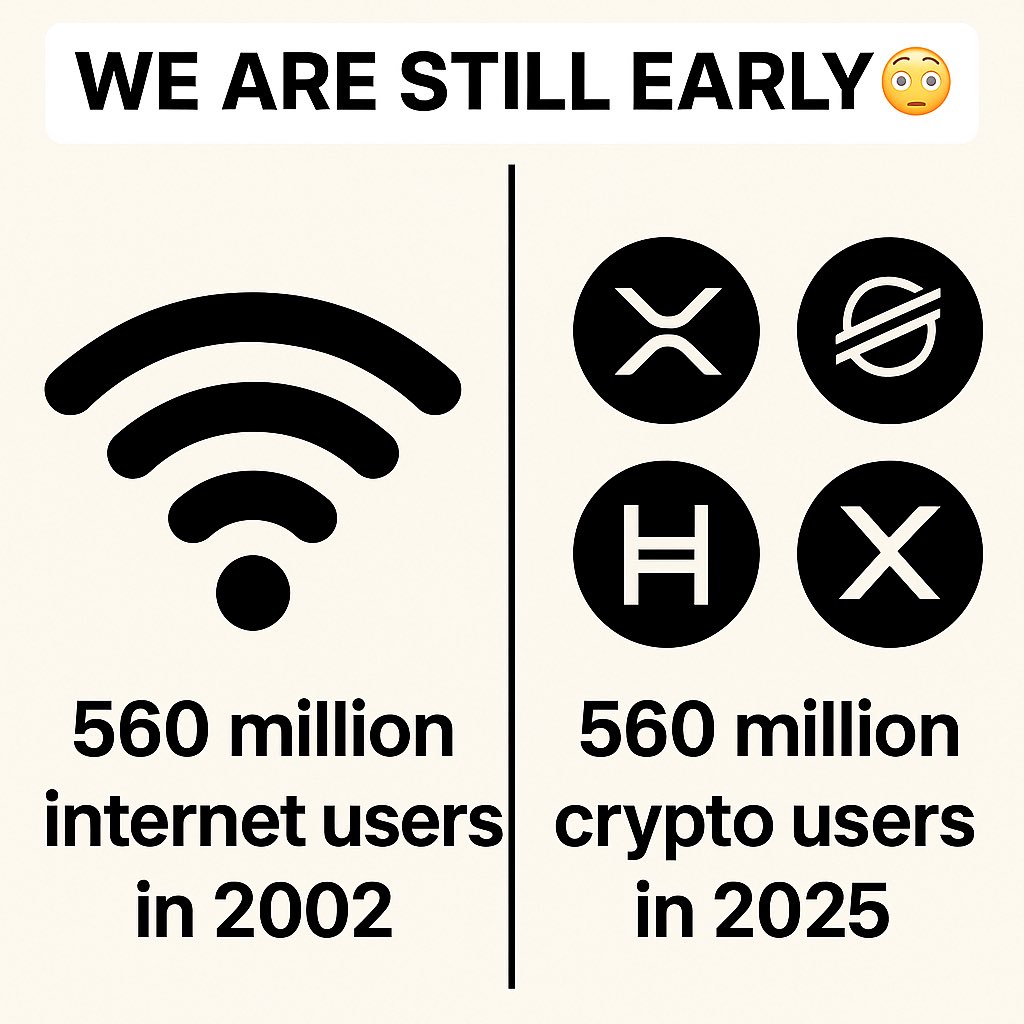
He shared a graphic comparing the current number of crypto users with the number of internet users in 2002, both around 560 million. This was an attempt to illustrate the idea that crypto is still in its early stages, much like the internet was back in 2002.

Internet Adoption Rate Compared to Crypto

Data from Triple-A confirms this claim. For context, the latest Triple-A crypto adoption report indicates about 560 million crypto owners by late 2024. Of this figure, 61% were males, while 39% were females. Meanwhile, 34% were between the years of 25 and 34.

Current XRP Adoption Matches 1992 Internet Levels

Interestingly, further data shows that the number of internet users was around 587 million in 2002, aligning with Farina’s disclosure. With internet users growing exponentially since then, the idea is that crypto ownership could see comparative growth.

Meanwhile, specifically for XRP, the trend confirms that investors are much earlier. Currently, there are about 6.5 million XRP wallets, according to on-chain data. However, the actual number of users could be significantly less, as most investors own multiple wallets for several purposes.

Nonetheless, for the sake of this assessment, we would consider an adoption rate of 6.5 million XRP users. Historical data indicates that the number of internet users hit the 6 million to 7 million range as far back as 2002, about 23 years ago. Today, this figure has grown 78,471% to above 5.5 billion.

Essentially, this highlights how early XRP is when compared to other growing trends like the internet. If the asset maintains its growth pace, it could observe a similar explosion in adoption, which could lead to higher demand and a subsequent price surge. 

Notably, XRP currently trades for $2.29. However, market experts believe the asset’s growth path could see it claim ambitious price targets such as $100 or even $1,000 in years to come if adoption persists.

XRP Could Soar 4,066% If Bitcoin Hits $500K: “Make the Right Choices,” Expert Says

Despite Bitcoin breaking records, seasoned crypto commentator Edoardo Farina argues that XRP offers far greater upside potential.

He downplayed Bitcoin’s recent surge to a new all-time high of $112,000, saying XRP remains a better-performing crypto. In a recent video, Farina claimed that Bitcoin’s rally offers little more than psychological satisfaction for most retail investors.

He asserted that the average investor doesn’t even own a whole Bitcoin. “Most people can’t afford $112K, and even a 5x from here isn’t life-changing unless you’re already wealthy,” he said.

XRP Delivers 600% Gains Quietly

While headlines focus on Bitcoin, Farina highlighted that XRP has quietly outperformed the market, delivering over 600% gains in just a few months. He pointed out that XRP traded sideways at $0.50 while Bitcoin hovered around $70K back in November 2024. Farina emphasized that those who chose BTC at that point are only up around 30%.

On the other hand, considering XRP’s current price of $2.40, the coin is up approximately 380%. At its recent peak of $3.34 before a retracement, XRP had gained 594%.

As a result, Farina suggests XRP has been a far more lucrative play for investors seeking real returns in a short time frame, despite regulatory scrutiny and mainstream skepticism.

XRP to $100 if Bitcoin Hits $500K?

Furthermore, Farina argued that the days of 50x or 100x returns via Bitcoin are long gone. He outlined a scenario in which Bitcoin reaches $500K, representing a 5x increase or roughly 355% growth from current levels.

Meanwhile, Farina pointed out that an investor could see a 10x return simply by holding Stellar (XLM) from $0.30 to $3. He also proposed a scenario where XRP rallies 4,066% from $2.40 to $100, should Bitcoin rise to $500K.

According to Farina, the risk-reward ratio doesn’t justify going all-in on BTC. In perspective, those holding 10,000 XRP worth just $24,00 would have a portfolio of $1 million. However, whether XRP can reach $100 remains a subject of serious debate in the crypto community.

The Final Word: Look Beyond the Hype

Meanwhile, Farina also questioned the sustainability of Bitcoin’s current rally. He attributes much of the price action to low liquidity and alleged artificial inflation via stablecoins like USDT.

Farina went further, calling Bitcoin “outdated technology” with “no real-world utility.” He criticized its slow transaction speeds, high fees, and inability to function as a daily currency.

He also claimed Bitcoin is not a store of value but a bait for retail investors, especially when institutions are preparing to cash out.

Instead, Farina suggests focusing on utility-driven projects like XRP, XLM, HBAR, and Algorand. He noted that financial institutions and central banks increasingly favor these technologies.

Ultimately, Farina stressed that just because Bitcoin hits a new high doesn’t mean it’s the best place to park your money. According to him, there’s nothing to celebrate unless one bought BTC at $1,000 or $5,000.

“Today, you’re better off investing in undervalued, high-utility assets like XRP. The returns are bigger, and the future is brighter,” he claimed.

Angel Investor Explains Why XRP Doesn’t Need $5 Trillion Liquidity to Hit $100 Per Coin

Angel investor Armando Pantoja breaks down the common misconception about XRP regarding market cap and inflow.

As XRP continues to gain institutional adoption, questions about its price potential persist. One of the most debated topics is whether XRP could realistically reach $100 per coin without requiring an unrealistic amount of capital inflow.

According to angel investor and crypto educator Armando Pantoja, the answer is a resounding yes. He emphasized that it all comes down to understanding the difference between market capitalization and liquidity inflow.

Market Cap vs. Money Inflow

Pantoja explains that many critics mistakenly believe XRP would need over $5 trillion in new capital to move from its current valuation to a $5.8 trillion market cap, a point that implies a price of $100 per token.

“That’s completely and utterly untrue,” Pantoja says. “Only about $20 to $30 billion would need to flow into XRP over a short period to push it toward that level.”

According to Pantoja, the misunderstanding stems from equating market capitalization directly with real money entering the market. In reality, market cap is calculated by multiplying the asset’s current price by its total supply.

This means a price increase, often triggered by relatively small buy orders in a thin liquidity environment, can dramatically inflate the market cap, even if only a modest amount of capital has changed hands.

Explaining Thin Liquidity in Crypto Using Real Estate

To explain the concept of thin liquidity, Pantoja illustrates how a small amount of money can have an outsized effect on price in a market like crypto.

“In a mature market, shifting prices takes a lot of capital. But crypto is still young. A little money goes a long way,” he noted.

To make the concept more tangible, he compared it to real estate. If one house in a neighborhood of 100 sells for much more than the others, the perceived value of the entire neighborhood increases, even though only one transaction occurred at the higher price.

More specifically, say there’s a neighborhood with 100 houses, each worth roughly $500,000, giving the area a total “market cap” of $50 million.

“Now, let’s say I really want to buy one of these houses. However, no one is selling. I offer $600,000, no deal. $700,000, still no. $800,000, nope. Finally, I offer $1 million, and the owner agrees,” Pantoja explains.

Instantly, all similar houses in the neighborhood are now considered to be worth $1 million based on comparable sales. That’s how markets operate; valuation is based on the last sale price multiplied by the total supply.

Essentially, if all the houses are now “worth” $1 million each, the neighborhood’s market cap becomes $100 million even though only $1 million actually changed hands. In reality, only $500,000 more than the previous valuation was spent, yet the perceived value of the entire neighborhood doubled.

Implications for XRP Investors

Pantoja uses this example to emphasize that XRP investors shouldn’t be misled by the notion that reaching a specific market cap requires a proportional amount of cash inflow. If demand spikes and supply is limited, even temporarily, the price of XRP can rise significantly with relatively limited capital.

According to Pantoja, the $100 target for XRP is not merely a dream, but a realistic scenario under the right market conditions.

Saylor Says Buy Bitcoin With Money You Can’t Afford to Lose as Strategy Buys Another 4,020 BTC

0

Strategy, formerly known as MicroStrategy, has continued to deepen its Bitcoin investment strategy with a recent acquisition of 4,020 BTC. 

The purchase, completed for approximately $427.1 million at an average price of $106,237 per bitcoin, adds to the company’s extensive digital asset holdings.

As of May 25, 2025, Strategy now holds a total of 580,250 BTC, acquired at an average cost of $69,979 per bitcoin, representing a cumulative investment of $40.61 billion. The company’s year-to-date Bitcoin yield stands at 16.8% in 2025. 

According to the Strategy, it financed these purchases through proceeds raised from its Common ATM, STRK ATM, and STRF ATM offerings.

This latest acquisition follows another substantial purchase made on May 19, where Strategy bought 7,390 BTC for nearly $765 million. 

Increasing Exposure Despite Market Fluctations

The rapid accumulation comes shortly after Bitcoin reached an all-time high on May 22, indicating Strategy’s ongoing commitment to increasing its BTC treasury even amid short-term market fluctuations.

Strategy co-founder Michael Saylor signaled the recent Bitcoin purchase in an X post shared a day earlier. In his post, Saylor stated that he only buys Bitcoin with money he can not afford to lose. Strategy co-founder Michael Saylor appeared to emphasize his strong conviction in Bitcoin’s long-term value.


The statement, while seemingly paradoxical, reflects a mindset where he considers Bitcoin not as a risky gamble but as a strategic asset with enduring potential. Saylor signals his belief that Bitcoin will continue to outperform over time, justifying its role as a core reserve asset.

Preferred Stock Offering Supports Bitcoin Strategy

Recall that following the May 19 acquisition, Strategy outlined plans to raise additional capital to support further Bitcoin purchases. On May 22, the company announced a $2.1 billion fundraising initiative through a preferred stock sale. 

The offering involves Strategy’s 10% Series A Perpetual Strife Preferred Stock (STRF) and is being facilitated through a sales agreement with Barclays Capital, TD Securities, and The Benchmark Company.

According to a filing, the appointed agents will execute sales in a measured approach, observing market conditions to determine optimal issuance timing. There are no minimum sales commitments from the agents. 

However, Strategy has targeted $2.1 billion in gross proceeds. From the total raised, 2% will be allocated to the agents as commission. The remaining funds are for general corporate use, which includes additional Bitcoin acquisitions and routine operational expenses.

Corporate Bitcoin Adoption Broadens Beyond Strategy

While Strategy continues to expand its Bitcoin reserves, other companies have followed suit. On May 16, Brazilian fintech company Méliuz became the first in the country to adopt Bitcoin as a treasury asset. 

Méliuz invested over $28 million into BTC, signaling a strategic shift in its financial management amid inflation and currency risk considerations.

Simultaneously, DayDayCook, a U.S.-listed firm, confirmed it had purchased 100 BTC and aims to grow its holdings to 500 BTC within six months, eventually targeting 5,000 BTC over the next three years. 

Currently, Bitcoin is trading at $109,743 today, reflecting a 1.98% gain in 24 hours and a 6.34% rise over the past week.

Can DOGE Hit $1 This Time, as Weekly Chart Mirrors Past Breakout Patterns

Dogecoin (DOGE) may be preparing for its next significant move, according to a technical pattern highlighted by crypto analyst “Surf” on X.

The analyst recently posted an update based on Dogecoin’s weekly chart, which revealed a familiar formation that has historically preceded explosive breakouts for the meme coin.

Dogecoin Repeating Wedge Patterns

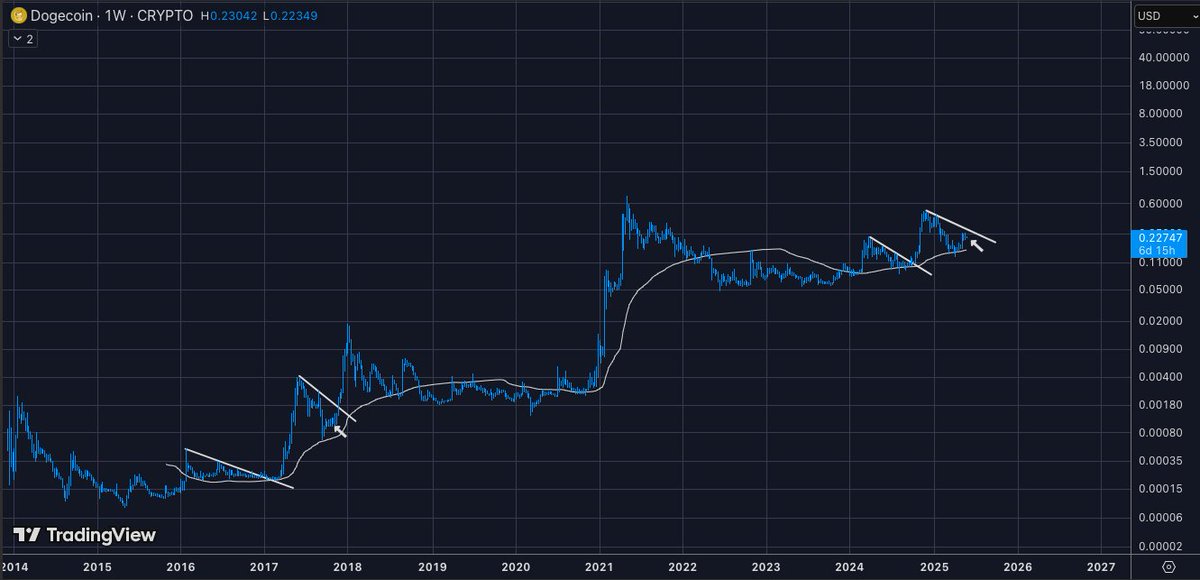
The chart tracks DOGE’s price action from 2014 to the present and outlines different falling wedge patterns, each followed by a major breakout. The first occurred in 2016, leading to a surge in 2017.

A second wedge formed between 2018 and 2020, before the monumental run in 2021. Now, a third similar formation appears to be nearing completion.

As of the latest weekly close, DOGE is trading around $0.22747 and is testing the upper boundary of the wedge, suggesting a possible breakout. Historically, similar technical setups in Dogecoin’s chart have preceded parabolic gains.

Image
Dogecoin weekly chart by Surf

If this pattern holds, Dogecoin could be set for another strong upward trend, especially as the broader market eyes potential altcoin momentum heading into the second half of 2025. While confirmation is key, the repeated structure bolsters bullish expectations.

However, the analyst did not provide insight into how high Dogecoin could go upon a confirmed breakout. Meanwhile, a growing consensus among other market observers suggests a potential run to the much-anticipated $1 level.

Responding to Surf’s update, one commenter remarked that not much work is left to be done before Dogecoin takes off. Another X user, Mark, remarked, “$1 is a magnet,” to which Surf expressed full agreement. Meanwhile, some commenters are lamenting the increasingly long wait time for the breakout.

Dogecoin Ready for Blast Off to Near $1

Interestingly, widely followed analyst Trader Tardigrade also shared a similarly promising outlook for Dogecoin, based on a three-day chart. In his analysis, Tardigrade highlighted a potential blast-off to near the $1 level.

His conviction also comes from historical occurrences, particularly in early and late 2024. During this time, Dogecoin broke out of a consolidation phase, surging 242.65% from $0.06613 in November 2023 to $0.2266 by March 2024. The price later retraced to the $0.08 level by August 2024, forming a six-month-long consolidation.

However, another breakout followed, this time even more powerful. From a low of $0.08083, DOGE surged approximately 500% to hit $0.4835 in December 2024.

Since that swing high, Dogecoin dropped to a low of $0.1315 in April 2025. Tardigrade’s chart suggests a bottom is now in. Dogecoin has already recovered significantly from this low and is currently trading at $0.22747.

Tardigrade suggests that the rally’s completion could see DOGE surpass its all-time high of $0.73, potentially reaching the long-awaited $1 level. According to him, Dogecoin is “ready for blast-off,” as the launchpad has already been built.

Market watcher Akbar Karimzsfeh expressed a similar sentiment in a separate analysis. However, he believes Dogecoin’s potential to surpass its previous peak hinges on a successful push above the $0.49 level, the area where DOGE faced resistance in December. 

While he acknowledges that Dogecoin is flashing a mix of explosive patterns, he still urges caution.