Home Blog Page 723

Two More XRP ETFs Suffer Setback as SEC Delays Decision on Bitwise and CoinShares XRP ETF Filings

0

The U.S. SEC has again delayed its decision on two spot-based XRP ETF applications from CoinShares and Bitwise. 

Famous Bloomberg Intelligence expert James Seyffart called the public’s attention to the SEC’s delayed decision on the CoinShares and Bitwise XRP ETFs. 

The SEC postponed decisions on Cboe BZX’s application to list shares of Bitwise’s XRP ETF and Nasdaq’s application to list CoinShares’ XRP ETF. 

Next Deadline

The SEC postponed the decision on the filings ahead of the second deadline scheduled for later this month. Data from Seyffart and his colleague Eric Balchunas showed that the second deadline for the Bitwise XRP ETF is May 25, while that of CoinShares is set for May 26, 2025. 

Based on the recent decisions, the proposed XRP ETF issuers will now look forward to the third deadline, which is slated for August 23 – 24, 2025. 

SEC Institutes Proceedings, Calls for Public Comments 

Meanwhile, a statement from the regulator confirmed that the commission had instituted proceedings on the applications to ascertain whether to approve or disapprove the ETFs tied to XRP. The instituted proceeding involves the SEC calling for public comment regarding the proposed funds. 

The commission aims to address some substantive questions relating to the XRP ETF proposals. Following the request, the public has 21 days to submit comments and 35 days to issue rebuttals on the filings once the SEC’s latest decision appears in the Federal Register. 

Other Delays 

In addition to the XRP ETF filings, the commission delayed its decision on other crypto-related exchange-traded funds, including the CoinShares Litecoin ETF and Fidelity’s in-kind Bitcoin filings. 

The development aligns with the SEC’s recent wave of delays on pending ETF applications tied to crypto assets. Recall that earlier this week, the regulator also postponed its decision on multiple crypto ETFs, including the Grayscale and 21Shares XRP ETFs. 

Following its recent wave of delays, the SEC is also expected to postpone its decision on Canary and WisdomTree’s XRP ETF applications, which were due on May 26 and May 27, respectively. 

Expected Move 

Meanwhile, these delayed decisions on XRP and other crypto ETFs did not come as a surprise to industry observers.

According to Seyffart’s analysis, the SEC might exhaust the entire 240-day review period before it approves or disapproves any pending spot crypto ETF applications.

He set June-July as the earliest date the SEC might approve these crypto ETFs. However, Seyffart suggested that the fund will likely launch in early Q4 2025. Specifically, he expects the SEC to approve the XRP ETFs for launch by mid-October 2025. 

Top Analyst Says XRP Still Has a 5x Left: Here’s His Target Before the Bull Run Ends

A notable market analyst still believes XRP has not reached its full potential for the ongoing bull market despite the ongoing consolidation.

In a recent episode of the Paul Barron Network podcast, host Paul Barron welcomed Tim Warren, a market analyst from the Investing Broz channel, to discuss the current state of various altcoins, including XRP. 

As Bitcoin continued to test new highs, recently surpassing the $111,000 mark, the industry experts discussed what this milestone could mean for altcoins moving in tandem, with XRP dominating the talks during the latter half of the discussion.

When Barron turned to XRP, he asked Warren if he was actively trading the token or just holding it for the long haul.

XRP Still Has Another 5x Left in It Toward $11 Target

In response, Warren confirmed that he is holding long-term. He called attention to past appearances on Barron’s show, noting how he had previously encouraged viewers not to lose faith in XRP during its lackluster performance last summer. 

At that time, he had predicted a surge, and now, despite months of sideways movement since January, the asset was once again approaching key resistance levels. Notably, data from his chart shows XRP is looking to break out of a bull flag in the daily timeframe.

XRP 1D Chart Tim Warren
XRP 1D Chart | Tim Warren

Warren pointed out that XRP had recently broken through a former lower high around the $2.55 mark but had since dipped back below it. Still, he maintained a bullish outlook, citing several technical indicators that suggested a pullback was likely before another upward move. 

He predicted that XRP might fall to around $2.20, but once it regained momentum and pushed past key resistance, he believes the token can rally to a minimum of $5.

Speaking further, Warren revealed his broader projection: a potential price point of $11 to $12 for XRP before the current bull market ends. Analysts like Ali Martinez have also projected a run to $11 for XRP.

Warren acknowledged that such a target would not equate to the 10x gains that other smaller-cap tokens could witness. However, he stressed that a four to fivefold return is still impressive, especially considering XRP’s already strong performance. Notably, the asset is already up 380% since November 2024.

Could Ripple’s Acquisition of Circle be Beneficial for XRP?

Notably, before the XRP analysis, Barron brought up Ripple’s reported interest in acquiring Circle, the issuer of the stablecoin USDC. He referenced a report that included comments from Gabriel Shapiro, founder of MetaLeX Labs, who warned that such a deal could be damaging to the broader crypto ecosystem. 

According to Barron, some critics from the Bitcoin community view the potential acquisition, which could come with an $11 billion price tag, as a move that might make Ripple the largest asset issuer across all blockchains. He said this raised questions about market competitiveness and regulatory pushback.

Barron asked Warren if this acquisition could trigger a rally for XRP, or if Ripple potentially offloading XRP to fund the deal could cause the token to crash.

Responding to this, Warren noted that he was not sure how Ripple would even finance such a large acquisition. According to him, if it meant liquidating XRP holdings, that could result in short-term bearish pressure. 

However, he dismissed long-standing fears that Ripple would dump its tokens on retail investors. Interestingly, he once supported this narrative but has since reconsidered it. 

Having had conversations with industry veterans, Warren now believes that Ripple will benefit better with XRP performing well. He concluded that even if some view the acquisition as bearish, he personally leaned toward it being a bullish development for the token.

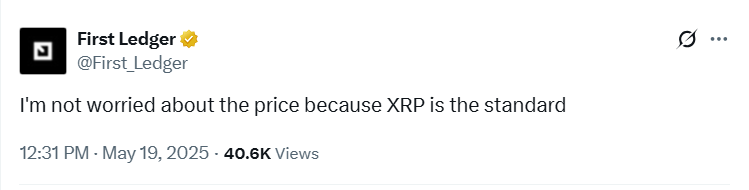
First Ledger Says Not Worried about XRP Price As XRP is The Standard

The price of XRP remains in a range-bound phase, but the team behind First Ledger is unbothered, claiming that XRP is the standard.

Notably, following its meteoric surge from late-2024 to early-2025, XRP has faced massive consolidation. Specifically, the asset rallied nearly 600% from November 2024 to a peak of $3.4 in January 2025. However, this peak introduced resistance, leading to a pullback and subsequent consolidation.

As a result, XRP has continued to trade in a range around the lower end of the $2 price level. This consolidation was initially a product of a broader market turbulence. However, despite a recent breakout that has seen Bitcoin (BTC) retest its all-time high figures, XRP maintains a low value.

Unbothered by Current Price Action

Amid this bearish connotation, the team behind First Ledger, an XRPL-based decentralized exchange platform, has indicated that they remain unbothered about XRP’s current price movements.

First Ledger on X
First Ledger on X

This recent commentary resonates with previous disclosures from community figures like Versan Aljarrah, host of The Black Swan Capitalist. Last August, while XRP languished at $0.5, Aljarrah insisted that price fluctuations are in fact distractions. According to him, they distract investors from XRP’s real value proposition.

Interestingly, other industry experts have also maintained a similar stance, but for assets such as Bitcoin. Earlier this year, specifically in January, Binance co-founder Changpeng “CZ” Zhao claimed Bitcoin price was a distraction despite earlier suggesting that 2025 could be a “send it year.”

“XRP is the Standard”

Experts like Aljarrah and CZ believe asset prices could be a distraction, as the real value lies in the technology behind the asset. Notably, the First Ledger team holds a similar sentiment. In their recent statement, they stressed that they are not concerned about current prices because XRP is the standard.

While they failed to highlight further details, previous commentaries within the XRP community suggest several proponents see XRP as the potential standard for cross-border payments. Crypto author Panos Mekras discussed this in a November 2023 comment, highlighting XRP’s ability to deliver low-cost and extremely fast transactions.

Meanwhile, within the same month, Versan Aljarrah boldly claimed that XRP’s prevalent price at the time is a price glitch, suggesting that its true value was much higher. Aljarrah also indicated that he believes this because he expects XRP to be the “global standard” for universal money.

Notably, these commentaries point to the sentiment within the community that the XRP price has the potential to reach greater levels. Pundits like BarriC have predicted that even a $100 price could mark a cheap entry point for XRP in the future. Meanwhile, CryptoGuard COO Matthew Brienen suggested XRP could reach $1,000 in ten years.

Here is the Number of Shiba Inu Addresses Holding Trillions Of SHIB for More Than a Year

0

Despite Shiba Inu’s recent price fluctuations, most investors have remained resilient, holding the token for more than a year.  

The Bitcoin-led relief rally has positively impacted the prices of major assets like Shiba Inu (SHIB). Fresh data from CoinMarketCap shows that SHIB’s price has soared by 5.87% over the past 24 hours to $0.00001542. 

However, its weekly performance is not impressive, as Shiba Inu’s price has only increased by 2.87% within this timeframe. Further, Shiba Inu has experienced a surge of 23.02% in the past 30 days. However, the canine-themed token is still down 27.1% year-to-date and 37.9% in the past six months. 

Despite this, investors’ faith in the asset has not declined, with many anticipating a massive price spike in the future. The growing confidence in Shiba Inu is reflected in the number of long-term investors currently backing the token. 

Addresses Holding 787T SHIB for Over a Year

Fresh data from IntoTheBlock (ITB) confirms that there are about 1.45 million Shiba Inu on-chain addresses holding SHIB. Of this amount, 1.13 million addresses are long-term holders who have held Shiba Inu for over a year. Based on the duration of their holdings, ITB labeled them as ‘holders.’ 

According to the data, these 1.13 million addresses hold a combined 787.39 trillion SHIB tokens, which represents 79.91% of the total 985.3 trillion SHIB held on–chain. The data shows that most Shiba Inu investors are holding the token for the long term. 

Shiba Inu Addresses by Ownership

While IntoTheBlock suggests that 1.13 million addresses hold about 787.39 trillion SHIB tokens, it is worth mentioning that this data comprises both active and inactive tokens, including those in Shiba Inu’s official burn address.  

The official burn wallet currently holds roughly 410.74 trillion SHIB tokens. Although these tokens have been permanently removed from circulation, they will still appear in on-chain data captured by blockchain analytics platforms like IntoTheBlock. 

Currently, Shiba Inu still has a circulating supply of approximately 589.25 trillion tokens. 

Short-Term SHIB Holders 

According to IntoTheBlock data, roughly 288,500 addresses have been holding a combined 171.59 trillion SHIB tokens for one to twelve months. Interestingly, ITB classified this category of Shiba Inu investors as ‘cruisers.’ 

On the other hand, 25,760 addresses are short-term traders who currently hold about 26.33 trillion SHIB for less than a month. 

Shiba Inu Addresses by Time Held

The significant number of long-term Shiba Inu holders and their holdings signal investors’ optimism in SHIB. Despite short-term price fluctuations, these investors have held on to their SHIB assets for an extended period. 

Their confidence is mainly driven by Shiba Inu’s prospects for huge price spikes, as observed in the 2021 market cycle. Another factor fueling investors’ optimism in Shiba Inu is the optimistic price projections from top experts. 

Notably, most analysts, like Eunice Wong, predict that SHIB’s price would climb to around $0.0001 this bull cycle, representing a surge of 548.5% from the current price. 

Shiba Inu Address Holdings in USD 

Meanwhile, IntoTheBlock also provided insight into the U.S. dollar value of investors’ Shiba Inu portfolios. Out of Shiba Inu’s total on-chain addresses, 203,500 hold SHIB worth less than $1, while 225,730 of these wallets control SHIB portfolios valued between $1 and $10. 

Nearly 568,000 addresses have Shiba Inu portfolios valued at around $10 – $100. About 350,900 addresses own tokens worth between $100 and $1,000, while 95,190 wallets hold SHIB worth $1,000 – $10,000. 

11,310 address control portfolios containing SHIB worth $10,000 and $100,000 each. However, the number of addresses holding $100,000 worth of tokens and above is even lower.

For instance, about 1,470 addresses hold SHIB valued between $100,000 and $1 million. In addition, 857 wallets hold SHIB worth $1 million to $10 million each. Only a few addresses, 71, hold Shiba Inu tokens worth $10 million and above. 

Shiba Inu Address Holdings in USD

Top US Exchange Says This Could Be the Last Chance to Grab XRP at Current Low Prices: Here’s Why

While XRP holds steady around the $2 mark after Bitcoin has made history, prominent market watchers believe June 2025 could change everything for XRP.

According to Martin Hiesboeck, Head of Research at U.S.-based Uphold exchange, the stars may be aligning for XRP’s next major breakout or its last calm before the storm.

Notably, the optimism relies on three major events scheduled for June. Hiesboeck suggested that the current price range could be the final entry point before another powerful movement. The Uphold exchange itself also shared this sentiment in a follow-up commentary to Hiesboeck’s analysis.

Spot XRP ETF Decision as a Game-Changer

One of the most closely watched dates is June 17, when the U.S. SEC could issue a ruling on Franklin Templeton’s spot XRP ETF application. After missing the original May decision window, anticipation has only grown. At least ten XRP ETF applications exist with a final decision timeline in October.

Hiesboeck noted that a green light from the SEC could catapult XRP into the mainstream financial ecosystem, much like Bitcoin surged after its ETF approvals in January 2024. 

While Ethereum’s ETF launch had less impact in mid-2024, proponents argue that XRP’s unique utility in cross-border payments and increasing institutional attention could fuel a more dramatic price reaction.

Fed’s June Meeting Could Trigger Altcoin Surge

Running almost in parallel with the ETF decision is the Federal Open Market Committee (FOMC) meeting on June 17–18. Here, traders are watching for potential interest rate cuts. 

Risk assets like crypto could benefit if the Fed adopts a more dovish policy in response to growing economic stress or global trade tension. Altcoins like XRP often outperform during liquidity-driven rallies, as investors rotate away from large-cap assets like Bitcoin in search of higher upside. Specifically, a rate cut could inject fresh momentum into the altcoin space.

XRPL APEX Conference May Reveal Ripple’s Next Big Move

The third piece of the puzzle is the XRPL APEX, an annual XRP developer summit scheduled for June 10–12 in Singapore. The event will feature Ripple executives and leading builders discussing the future of the XRP Ledger (XRPL).

The agenda hints at major updates, including integrations with artificial intelligence, cross-chain interoperability, DeFi, and real-world asset tokenization. 

According to Hiesboeck, if Ripple delivers any major product launches or partnerships, investor sentiment around XRP could soar, fueling a potential rally.

The Window May Be Closing

XRP has already demonstrated its ability to move fast, jumping from $0.50 on U.S. Election Day 2024 to a high of $3.39 within just two months. Since then, it has consolidated between $2 and $2.50. 

During this time, many traders have been on the sidelines waiting for a clear signal. Meanwhile, Uphold summed it up, saying, “June could be make-or-break for XRP.” 

As May draws to a close, Uphold suggests market participants may be seeing the final opportunity to acquire XRP at under $3. These three critical catalysts converging in a short span make market watchers believe the incoming month could mark XRP’s new breakout point as seen in November 2024.

Stablecoins Could Solve $7T in Global Fees: Scaramucci

0

Stablecoins have the potential to cut transaction costs globally and strengthen the U.S. dollar’s global position, according to Anthony Scaramucci.

Scaramucci, founder of SkyBridge Capital, emphasized the strategic role of stablecoins and emerging crypto legislation during a recent appearance on CNBC’s Squawk Box. 

While addressing Bitcoin’s price movement, he shifted focus toward how stablecoins could reduce global transaction costs and reinforce U.S. dollar dominance. Scaramucci underlined the bipartisan push behind new regulatory frameworks such as the Stable Act and the GENIUS Act.

For context, the legislation, supported by industry stakeholders, sets regulatory guidelines for stablecoins, digital tokens typically linked to the U.S. dollar or similar assets.

On Monday, the Senate approved the GENIUS Act in a 66-22 vote, moving forward legislation focused on crypto regulation. Despite earlier concerns from some Democrats over former President Donald Trump’s involvement in digital assets, 16 ultimately backed the bill.

Stablecoins Tied to U.S. Dollar Strength and Treasury Demand

Scaramucci noted that stablecoins like Circle and Tether are expanding their reserves with U.S. dollar-denominated assets, specifically U.S. Treasuries. He pointed out that Tether holds more U.S. Treasuries than countries like Germany or Japan. 

According to Scaramucci, this accumulation boosts demand for Treasuries and supports the global position of the U.S. dollar. He added that future legislation would likely expand these reserves further. This development aligns with a growing international financial strategy centered around U.S.-backed assets.

Cost Reduction and Future Use Cases of Blockchain Payment

Further into the conversation, Scaramucci stated that stablecoins could help cut the $7 trillion in global transaction fees, including credit card and wire transfer costs. He envisioned practical use cases, such as paying with stablecoins at venues like New York’s Hunt and Fish Club to bypass high credit card fees. 

He supported U.S. efforts to retain crypto innovation domestically, contrasting the current administration’s policies with what he described as speculative objections from the previous one.

White House Confident in Senate Passage

Notably, David Sacks, a senior adviser to U.S. President Donald Trump on both cryptocurrency and artificial intelligence, indicated that the administration anticipates bipartisan support for the stablecoin legislation in the Senate. 

Speaking to CNBC on May 21 after a crucial vote where 15 Democrats sided with Republicans to overcome the filibuster, Sacks expressed confidence in the bill’s ultimate passage.

David Sacks Says Stablecoin Bill Could Generate Trillions in Demand for US Treasuries

White House crypto advisor David Sacks says the U.S. could see a surge in demand for Treasuries “practically overnight” if the GENIUS Act stablecoin bill is passed.

Specifically, he claimed the move could generate trillions of dollars in demand for U.S. government debt.

From $200B to Multi-Trillion-Dollar Market

In an interview on CNBC, Sacks emphasized that the current $250 billion stablecoin market is largely unregulated. He argued that once a legal structure is in place, the market could expand to the multi-trillion-dollar level, driven by global demand for dollar-backed digital assets fully collateralized by U.S. Treasuries.

Notably, the GENIUS Act would require stablecoins to be fully backed by U.S. Treasuries or equivalent cash assets. It would also introduce anti-money laundering (AML) compliance standards and impose registration and auditing requirements for issuers exceeding $50 billion in market cap. At the moment, only Tether and Circle meet this rule.

Sacks’ prediction is already partly due to market behavior. Tether, the largest stablecoin issuer, disclosed on May 1 that it holds nearly $120 billion in U.S. Treasury securities. 

Interestingly, this figure places it ahead of countries like the UAE and Germany among the largest holders of the government asset, according to U.S. Treasury data.

This shows that even in the absence of regulation, stablecoin issuers are turning to U.S. Treasuries as a trusted reserve asset, a trend that could accelerate if the bill passes.

Bitwise CIO Matt Hougan echoed Sacks’ optimism, stating that the bill could kick off a multi-year bull run in crypto markets. He projects the stablecoin sector could reach $2.5 trillion “in no time,” driven by institutional adoption and legal certainty.

Meanwhile, other prominent commentators like Senator Bill Hagerty have an even bolder perspective. Hagerty asserted that stablecoin issuers could even emerge to be the largest holders of U.S. Treasuries.

Senate Momentum on Stablecoin Bill

Notably, the stablecoin bill is gaining bipartisan momentum. The Senate voted 66–32 to advance the legislation earlier this week, with 15 Democrats joining Republicans. The vote clears the path for a final vote, barring further amendments.

Despite bipartisan support, the bill faces criticism from most Democratic lawmakers. Senators Elizabeth Warren and Richard Blumenthal have voiced concerns over potential conflicts of interest.

Particularly, their concerns have been around World Liberty Financial’s USD1 stablecoin, which has ties to the Trump family.

Blumenthal warned that the bill, if unchecked, could allow foreign entities to exploit U.S. financial infrastructure under the guise of decentralization. Warren criticized the legislation for not including stronger guardrails to prevent political entanglements.

Meanwhile, Sacks declined to address the Trump family’s concerns directly but emphasized that the bill would help maintain U.S. dollar dominance and modernize the country’s payment rails.

Kraken to Launch Tokenized Trading for Apple, Tesla, and Nvidia Stocks on Solana

Kraken plans to tokenize and allow trading for about 50 Stocks and ETFs, including those of Apple, Tesla, and Nvidia, atop the Solana blockchain.

The Wall Street Journal recently reported that Kraken, a major U.S.-based crypto exchange, is preparing to launch a new service that will let international users trade tokenized versions of over 50 popular stocks and ETFs. Among the big names on the list are Apple, Tesla, and Nvidia. 

Kraken to Leverage Solana for Tokenized Stocks

Notably, the service will roll out in markets across Europe, Latin America, Africa, and Asia in the coming weeks. However, the exchange has confirmed that it will not be available in the U.S.

These digital tokens, which Kraken calls “xStocks,” will be based on the Solana blockchain. Each token will represent a real share of the stock or ETF it tracks. 

Kraken’s partner, Backed Finance, will buy and hold the actual stocks to back the tokens. For clarity, users will not own the physical shares themselves but can redeem the tokens for their cash value, helping keep prices in line with those of the real stocks.

Remarkably, what sets this apart from traditional investing is that these tokens can be traded 24/7, even when U.S. stock markets are closed. Kraken says the goal is to give investors outside the U.S. a more affordable and flexible way to access American markets. 

Solving an Accessibility Problem 

According to the Wall Street Journal, Kraken’s co-CEO, Arjun Sethi, pointed out that buying U.S. stocks from abroad often involves high fees and long processing times. This new setup seeks to address that.

Kraken’s plan also includes giving users more freedom over how they use these tokenized stocks. Eventually, investors may be able to move the tokens to personal crypto wallets or even use them on other platforms. Some might even use tokenized shares as collateral in crypto trading strategies.

Interestingly, this kind of idea is not entirely new, as Binance launched a similar project in 2021 but shut it down soon after due to regulatory pressure. However, Kraken says it is working with local regulators to avoid those same issues. 

According to The Wall Street Journal, the company is actively trying to make sure the rollout meets the legal requirements in each country where the service will be available.

Growing Tokenization Trends

Meanwhile, Kraken’s announcement is just one piece of a much bigger trend. Over the past year, some of the world’s biggest financial institutions have been moving into tokenized assets. 

In March 2024, BlackRock launched a digital liquidity fund on Ethereum that captured 30% of the $1.3 billion tokenized Treasury market in just six weeks. By July, that fund held $486 million in assets. Meanwhile, Citi partnered with SDX to explore tokenizing private equity, and HSBC launched tokenized gold for retail investors in Hong Kong.

Other major institutions like Goldman Sachs, JPMorgan, and Nasdaq are also getting involved. JPMorgan’s Onyx blockchain supports tokenized Treasuries and interbank payments, while Nasdaq teamed up with Verta to help bring tokenized assets into mainstream financial markets. 

JPMorgan also completed its first public tokenized Treasury transaction on Ondo earlier this month. Experts now expect that 80% of institutional investors will adopt tokenized assets by 2025.

Strategy Partners Barclays and TD Securities to Raise $2.1B for Additional Bitcoin Purchases

0

Leading business intelligence company Strategy (formerly MicroStrategy) announces plans to raise an additional $2.1 billion to grow its Bitcoin holdings. 

In a press release today, Strategy unveiled plans to raise $2.1 billion by selling shares of its 10% Series A Perpetual Strife Preferred Stock (STRF). The Crypto Basic also confirmed the development in an X post today.

Strategy Enters New Sales Agreement 

Consequently, on May 22, Strategy entered into a sales agreement with Barclays Capital, The Benchmark Company, and TD Securities. These financial institutions will be the sales agents for Strategy’s STRF offering. 

According to a prospectus filing, these agents will execute the sale on behalf of Strategy in a disciplined manner over an extended period. This indicates that they will closely watch the stock’s price and trading volume and only issue it under favorable conditions. 

STRF, which trades on the Nasdaq exchange, was worth $100.65 per share as of yesterday, May 21. While the agents are not required to meet any minimum sales goals, the Strategy aims to raise $2.1 billion via the offering. 

Plans to Buy More Bitcoins 

2% of the gross proceeds will be paid to the sales agents–TD Securities, Barclays, and the Benchmark Company. The remaining proceeds will be channeled to general corporate purposes, including acquiring additional Bitcoins and other routine expenses. 

It has become common for Strategy to fund its Bitcoin purchases using proceeds raised through the sales of its stocks. Through this effort, Strategy has grown its Bitcoin holdings to 576,230 BTC. Strategy’s Bitcoin holdings represent 2.9% of BTC’s circulating supply, which currently stands at 19.86 million coins. 

Strategy has been buying Bitcoin since August 2020 and is still poised to acquire more through the issuance of its STRF shares. The company has remained resilient in growing its Bitcoin stash despite reporting a Q1 2025 loss of $4.2 billion after adopting a new accounting method. 

Notably, the STRF offering is part of Strategy’s latest fundraising plan, which was recently unveiled. Strategy aims to raise $42 billion to fund more Bitcoin buys by issuing $21 billion worth of fixed income and another $21 billion in common shares. 

Bitcoin Soars to New ATH 

Meanwhile, the timing of the latest offering comes hours after Bitcoin registered a new all-time high (ATH). The premier cryptocurrency set an ATH of $111,861 in the early hours of today. 

Although Bitcoin has retraced slightly to around $110,000, the firstborn crypto is still up 3.68% in the past 24 hours, 8.9% in the past week, and 22.72% in 30 days. 

At the moment, Bitcoin is changing hands at $110,859, boasting a market cap of $2.2 billion. 

Two Stablecoins, MiCA-Compliant EURØP and Braza Group’s USDB, Debut on XRP Ledger

0

Two new fiat-backed stablecoins, EURØP and USDB, have launched on the XRP Ledger (XRPL). 

Their arrival follows the U.S. Senate’s advancement of the GENIUS Act, a bill focused on stablecoin regulation. Both digital assets aim to provide compliant, cross-border transaction solutions at a time of increasing scrutiny and regulatory clarity. 

MiCA-Compliant EURØP Introduced by Schuman Financial

Notably, European stablecoin finance firm Schuman Financial has launched EURØP on the XRPL as the first MiCA-compliant euro stablecoin to operate on this blockchain.

The company, regulated by the ACPR under the French Central Bank, confirmed that EURØP is fully backed by euros and redeemable. Additionally, KPMG audits its reserves, which are held at financial institutions such as Societe Generale.

The integration positions EURØP as a euro-native settlement asset, supporting enterprise-grade blockchain activity. Over the past decade, the XRP Ledger has processed over 3.3 billion transactions and maintains more than 200 validators. 

With these capabilities, EURØP can support a wide range of use cases, including decentralized finance applications, tokenized real-world assets, and both B2B and B2C payments. According to Ripple’s Managing Director for UK & Europe, Cassie Craddock, this move aligns with Europe’s evolving regulatory environment and increasing institutional adoption.

USDB Launches with Support from Braza Group

Meanwhile, Braza Group, a Brazilian financial services company, has introduced USDB, a USD-backed stablecoin that is now live on the XRPL. Pegged 1:1 to the U.S. dollar, USDB is backed by U.S. and Brazilian government bonds.

Braza reports that these assets undergo regular audits to ensure transparency and compliance. The company is already known for its operations in the Brazilian interbank market, moving over $1 billion in 24 hours this past April.

USDB joins Braza’s earlier stablecoin, BBRL, offering a unified infrastructure on XRPL. With both assets live, the company seeks to expand its blockchain-enabled financial services. Braza’s CEO, Marcelo Sacomori, stated that the new stablecoin will help mitigate currency volatility and enhance transaction speed for local and international users.

According to the firm, USDB facilitates swift, affordable global transfers, making it especially useful for individuals sending funds across borders or looking to safeguard their savings in a stable currency. Beyond remittances, it plays a key role in broadening access to digital finance, helping create a more inclusive and equitable financial ecosystem.