Home Blog Page 722

Pundit Says You Can Accumulate XRP Cheap Now, Soon Its Price Will Be $1,000 per Coin

Widely followed XRP commentator BarriC is again urging the crypto community to buy as much XRP as they can while the price remains low.

He emphasized that XRP is still undervalued below $3, but in the coming years, it could stabilize at a staggering $1,000 per coin.

XRP Below $3 Is a “Failure”? Not for Long, Says BarriC

In a recent tweet, BarriC presented a case for long-term accumulation. He argued that despite XRP trading at $2.35, many still consider its performance underwhelming. 

For context, at this price, XRP is up 356% year-over-year, a gain that outpaces those of BNB, Ethereum, and Solana. However, concerns about XRP’s performance have intensified recently, as its progress has stalled since January.

Meanwhile, BarriC suggests that sentiment may shift dramatically if XRP follows the trajectory he anticipates in the coming months. He predicts that XRP will climb to $10 and then $20 per coin in the near term. He expects this range to mark XRP’s new all-time high during the anticipated alt season rally.

BarriC also cautions that the market could follow historical patterns, with a 50% correction after reaching $20. In this scenario, the $5 to $10 range would become the new entry point during the bear cycle, which would still be significantly higher than today’s price. 

This leans toward his view that anything under $3 is a steal for XRP when considering its future potential.

Utility-Driven Growth Could Take XRP to $1,000

Looking beyond the current cycle, BarriC sees a future in which XRP becomes the backbone of global finance. He projects a scenario where banks and financial institutions worldwide adopt XRP for daily transactions and cross-border settlements.

In this case, he believes demand for the token would surge, driving its price to $1,000 per coin. At that level, BarriC contends XRP would no longer experience the wild volatility of past years. Instead, it would function as a stable financial infrastructure asset, with trillions of dollars flowing through its network regularly.

This commentary taps into a growing narrative among XRP supporters that the token’s utility, not mere speculation, will ultimately drive its value. Ripple’s ongoing collaborations with central banks, real-time payment systems, and liquidity providers add weight to this long-term vision.

Notably, BarriC expects this $1,000 price point to materialize within the next decade. Other market commentators share a similar perspective, suggesting it could happen by 2035 or later.

However, critics often highlight weaknesses in this lofty price prediction. For instance, reaching a triple-digit valuation from its current level would require XRP’s price to rise by 42,450%.

Achieving a $1,000 price would also necessitate a market cap of over $58.5 trillion, an outlook many consider unrealistic. Despite skepticism surrounding such ambitious targets, some XRP proponents continue to advocate for them.

Japan Warms up to Cardano, Pushing ADAJPY to Second in Global Volume at $121M

0

Traders in Japan appear to be warming up to Cardano amid a rise in ADA trading, as they recently pushed the ADA/JPY pair to the second rank in global trading volume.

Cardano’s ADA token saw a strong uptick in price over the past week, climbing from around $0.72 to above $0.83 by May 23. While this 15% weekly gain drew attention across markets, trading data revealed a more unexpected development: a significant surge in the ADA/JPY trading volume.

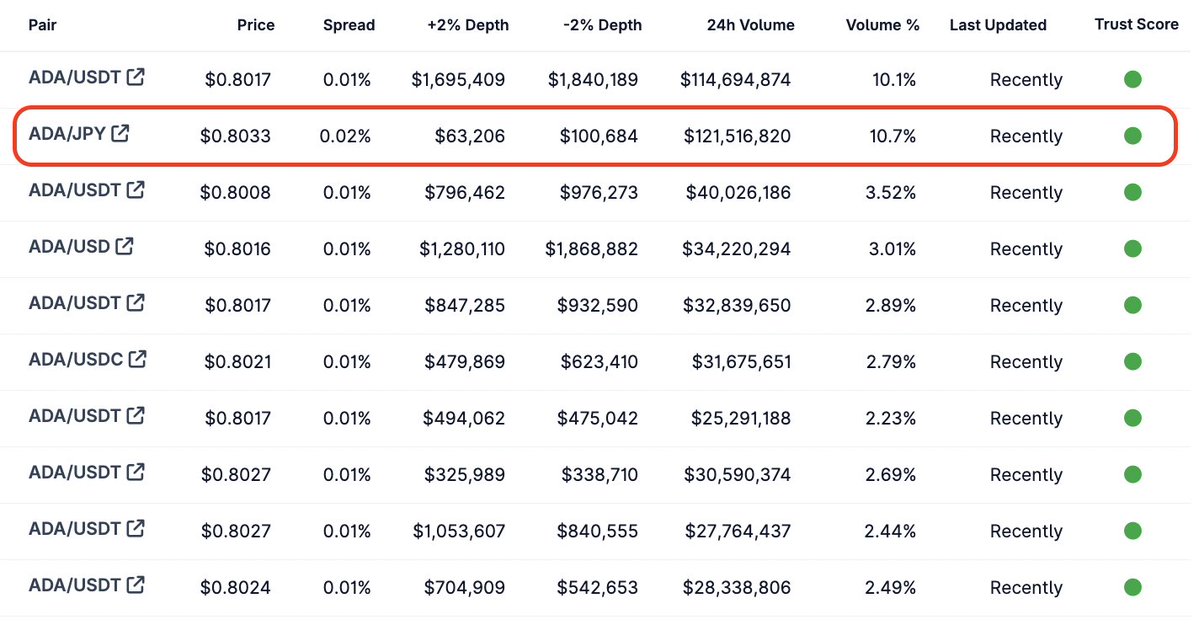
This pair, long overshadowed by ADA/USDT, rose sharply to become the second highest globally among ADA pairs in 24-hour volume. Trading activity for the ADA/JPY pair reached $121.5 million, accounting for 10.7% of all ADA trading and surpassing even ADA/USDT, which posted $114.6 million in volume at 10.1% share.

Image

Trading Volume Shifts Toward Yen

However, data shows the pair has lower liquidity when compared to the USDT pairs. This means there is $63,206 worth of demand (bids) and $100,684 worth of supply (asks) within a 2% price band around the current ADA/JPY price.

In contrast, ADA/USDT pairs reported deeper order books, with the top most exceeding $1.6 million on either side. These differences in liquidity suggest that while interest from Japanese markets is high, trading conditions remain thinner and potentially more volatile.

Price discrepancies also emerged during the period. ADA traded slightly higher against the yen, with the ADA/JPY rate at $0.8033, compared to the ADA/USDT range of $0.8017 to $0.8027.

Spreads for the yen pair also widened slightly to 0.02%, while USDT pairs maintained a tighter 0.01% spread. Despite the higher volume, these indicators pointed to more fragile market depth in the yen-based pair.

Historical Ties and Recent Developments in Japan

The latest trading activity follows a broader trend of reengagement between Cardano and Japan. Cardano’s founder, Charles Hoskinson, visited a prominent Japanese lawmaker earlier this year, amid discussions of regulatory changes in the country. 

These included proposals to lower crypto taxes and revise digital asset classifications. The visit came as Japan worked to improve its crypto environment, potentially influencing investor confidence.

Japan’s connection to Cardano dates back to its origins. According to history, Cardano was conceptualized in Osaka in 2015, and its initial token sale from 2015 to 2017 drew over 90% participation from Japanese investors. Cardano even hosted a launch event in Tokyo, reinforcing its early ties to the region.

Crypto Analyst Warns XRP Holders to Learn a Useful Lesson from Mt Gox

Citing the Mt. Gox collapse, a crypto commentator has urged XRP holders to take control of their assets instead of leaving them on centralized exchanges. 

This warning came from Alpha Lions Academy founder Edoardo Farina, whose recent commentary sought to remind investors how risky it can be to trust third parties with their crypto assets.

Mt Gox Downfall Sends a Warning to XRP Holders

Farina pointed to Mt. Gox’s downfall in 2014 as a lesson in what can go wrong when users don’t hold their own crypto. At the time of the crash, around 850,000 Bitcoins disappeared, most of them belonging to customers. 

While the exchange claimed technical issues, Farina suggested that what happened was likely an inside job that left customers with nothing but a fraction of what they were owed.

Instead of getting their BTC back, most users received repayments in U.S. dollars based on Bitcoin’s 2014 price of about $400 per coin. This was a bitter pill to swallow, especially since Bitcoin’s value later shot up past $20,000 and eventually over $60,000. 

According to Farina, those who had kept their crypto on Mt. Gox missed out on that growth, while the exchange’s trustees held on to billions worth of Bitcoin.

Farina’s main point was that keeping assets on exchanges means giving up control. His commentary essentially implies that XRP holders today risk repeating the same mistake if they don’t move their coins into self-custody wallets. 

A Massive Drop in Returns

While Farina’s message holds weight, some of his claims were slightly off. For instance, not all Mt. Gox creditors received payments in cash. Some did receive Bitcoin and Bitcoin Cash during the eventual repayment process, which began in late 2023 and continued through 2024. 

These repayments were part of a civil rehabilitation plan, and by July 2024, the trustees had returned about 142,000 BTC and other assets to creditors. Still, the overall recovery was only partial. 

Reports suggest that users got back roughly 15% of their original Bitcoin holdings. For context, an investor who lost 100 BTC might have received just 15 BTC in return.

Though the amount was small, Bitcoin’s price had climbed to around $63,000 by that point, so the recovered coins were still worth a significant sum. However, many creditors, especially those who were repaid in fiat, lost out big, since their compensation reflected Bitcoin’s much lower value back in 2014.

XRP Investors Should Prioritize Self Custody

Farina’s warning also comes on the heels of other major exchange failures, including the collapse of FTX in 2022, which led to losses totaling around $8 billion. In addition, customers lost about $190 million in the scandal involving QuadrigaCX, a Canadian exchange.

Notably, these events show how centralized platforms carry real risks, and XRP holders need to take steps to protect themselves. It is better to leverage tools like Xaman (formerly Xumm) for software storage, or better yet, hardware wallets like Ledger that store private keys offline.

Expert Says This Is the Most Silent Bitcoin All-Time High Seen

0

Quinten François noted that the recent Bitcoin ATH lacked usual hype, highlighting low retail buzz as altcoins remain stagnant.

Bitcoin recently reached a new all-time high, climbing past $111,000 amid a steady 18.2% increase over the past 30 days. This upward momentum, which pushed the price from approximately $102,000, reflects strong performance across the week.

However, despite this price surge, market watchers have noted a sharp contrast in public sentiment compared to previous bull runs. Notably, analysts and industry voices are observing a striking lack of retail excitement, even as Bitcoin surpasses its historical price ceiling.

Muted Retail Sentiment Despite Price Breakout

Over the past week, industry figures have highlighted the subdued reaction surrounding this milestone. Quinten François, Co-founder and Chief Brand Officer of WeRate, drew attention to the lack of celebration typically associated with Bitcoin’s all-time highs.

Confirming this sentiment, a crypto analyst known as Crypto Kid observed the absence of market euphoria. François responded by pointing to the stagnant altcoin market as a possible factor. 

Another market participant further emphasized that the lack of altcoin activity may be reducing overall market enthusiasm, stating that altcoins often generate the excitement associated with crypto rallies.

Google Trends Remain Low Despite Price Pump

This decline in visible hype has been supported by search engine trends. As Bitcoin approached its new peak, Matthew Sigel, Head of Digital Assets Research at VanEck, noted significantly lower Google search interest compared to previous highs. 

According to Google Trends data analyzed by Sigel, U.S. searches for “Bitcoin” stood at a relative value of 30. This is far below the 75 recorded during the late 2024 peak, when Bitcoin hit $108,268. This gap suggests that public curiosity has not matched the current price performance.

Institutional Involvement Emerges as a Key Driver

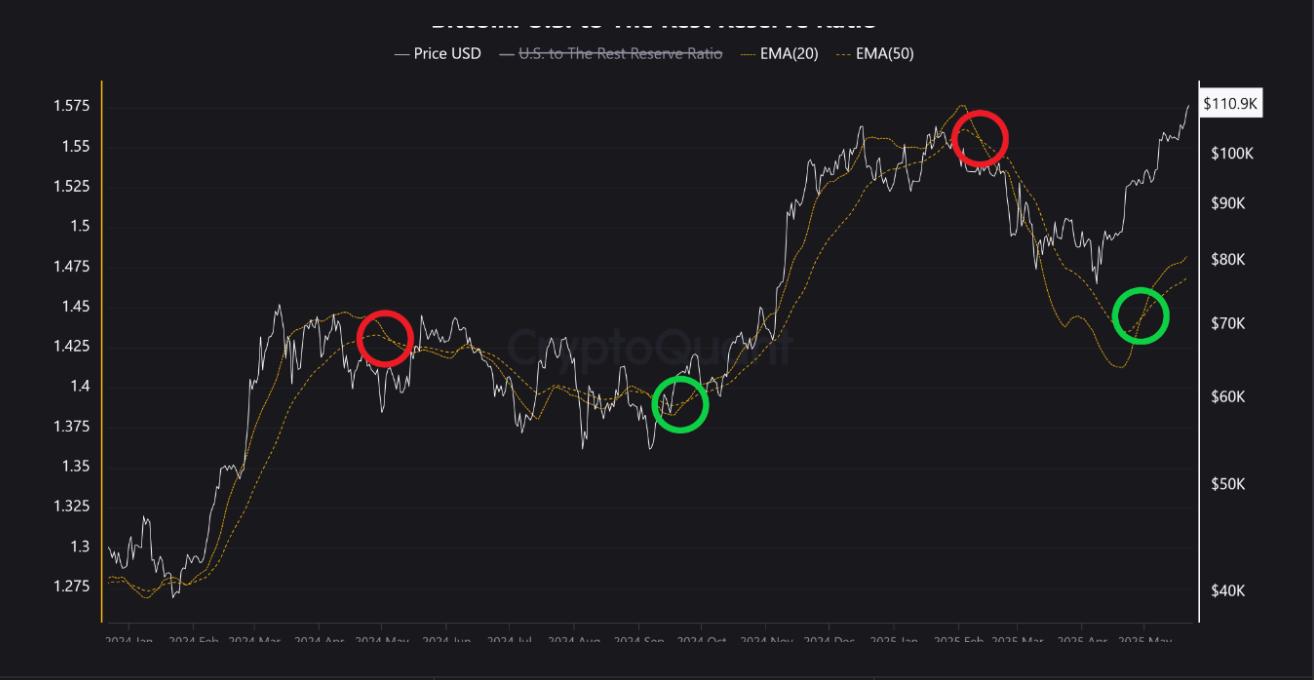
Meanwhile, data from CryptoQuant has indicated that U.S.-based entities, including exchanges, banks, and funds, are playing a growing role in Bitcoin’s ongoing rally. A notable increase in U.S. holdings has coincided with a technical “golden cross” formation. 

Screenshot 2025 05 23T103319557

Last year, a similar trend in institutional accumulation led to significant price gains. The current pattern suggests that institutions may now be the primary force behind Bitcoin’s movement, in contrast to previous cycles driven largely by retail investors.

This institutional involvement may help explain why the market response has remained quiet. Without significant retail participation, the typical signs of excitement, such as rising search interest and widespread social media discussions, have not materialized. Instead, the rally appears to reflect more strategic accumulation by professional investors.

Is The Market Bullish or Not?

Ultimately, without significant retail participation, the typical signs of excitement, such as rising search interest and widespread social media discussions, have not materialized.

However, such conditions often signal untapped upside potential, as broader retail engagement could further amplify price movement when it eventually returns.

Wormhole Integrates $36B Dogecoin to Solana: Details

0

Leading cross-chain interoperability network Wormhole has developed the first trustless bridge linking Dogecoin to the Solana ecosystem.

Wormhole announced the giant stride in a blog post on Thursday. The integration would allow a symbiotic relationship between Solana and Dogecoin users, bridging two of the largest crypto ecosystems.

Dogecoin Goes Multichain

Wormhole powered this innovation using its Native Token Transfers (NTT) framework and zero-knowledge proofs, developed by Psy and RISC Zero. The next-generation bridging technology validates Dogecoin’s proof-of-work consensus on Solana, allowing for cross-chain interoperability without third-party interference.

Notably, the bridging technology captures and directly validates each Dogecoin block header on Solana. This ensures users can perform DOGE transactions on the Solana network without intermediaries.

The trustless bridge uses QDOGE for its interoperability function. For perspective, the protocol converts a DOGE transaction to QDOGE and mints its equivalent on Solana for usage. When converting back, the bridge burns the QDOGE tokens and releases DOGE to the user’s Dogecoin address.

Notably, this technology ensures that Dogecoin users can access the Solana network’s DeFi, gaming, and NFT while bringing $36 billion worth of liquidity and the meme coin’s enormous community to Solana. Users would also directly utilize DOGE on Solana’s dApps without relying on wrapped tokens or third parties.

Remarkably, this is not Wormhole’s first multichain bridging on the Solana ecosystem. The protocol claims that it steered capital inflow worth $11.5 billion to Solana, more than any cross-chain interoperability service provider.

Enhanced Dogecoin Utility

The integration further adds a utility layer for Dogecoin, the largest meme coin by market cap. With its joke-themed origin, DOGE has little use case and relies mostly on hype and community support.

However, the narrative is gradually changing. In addition to its newfound utility in macro-payments, DOGE’s integration into Solana’s robust ecosystem would drive its utility in decentralized finance. This means that Dogecoin could be used for lending and payment services on gaming platforms and marketplaces on Solana.

Prominent asset manager 21Shares recently emphasized Dogecoin’s transition beyond its meme coin origin. It noted that growing institutional adoption and advancing technology have ensured the meme coin’s kick at mainstream adoption.

Meanwhile, the Solana integration had no significant impact on Dogecoin’s price at the time of writing. Nonetheless, the meme coin remains bullish, with recent analysis projecting an imminent upward price action to $0.31.

Here’s the Shiba Inu Price Prediction If Bitcoin Reaches $700,000

0

Leading chatbots such as Grok and ChatGPT predict Shiba Inu price in a scenario where Bitcoin skyrockets to an ambitious target of $700,000. 

Bitcoin has continued to turn heads in the crypto market following its remarkable rally that saw it register a new all-time high of $111,970 yesterday. This comes after its price soared by 6.59% in the past week and 18.64% over the past 30 days. 

Bitcoin to Hit $700K 

Bitcoin’s recent surge triggered a wave of optimistic predictions for the asset among crypto experts, with some predicting a rise to the $700,000 mark. 

Recall that BlackRock CEO Larry Fink first issued the bullish target in January during an interview with Bloomberg at the World Economic Forum (WEF). He projected that Bitcoin’s surge to the $700,000 mark would be driven by increased institutional interest in the asset. 

The BlackRock CEO envisioned a scenario in which sovereign wealth funds allocate 2% to 5% of their assets to Bitcoin, potentially driving the price to $700,000. For context, Bitcoin is currently changing hands at $110,754. Therefore, hitting the $700,000 target demands an upsurge of 532.03%. 

Potential Impact on SHIB’s Price 

Bitcoin’s potential surge to the $700,000 mark is expected to positively impact the price of altcoins like Shiba Inu (SHIB). 

With a 76% 30-day correlation to Bitcoin, according to IntoTheBlock data, Shiba Inu’s price typically rises and falls in tandem with BTC.

Essentially, an increase in Bitcoin’s price usually translates to an upsurge in SHIB’s value and vice versa due to Shiba Inu’s correlation with BTC. In most cases, SHIB amplifies this trend, as a slight increase in Bitcoin’s price leads to a greater price surge for Shiba Inu. 

This is reflected in the daily performances of Bitcoin and Shiba Inu. While Bitcoin’s price is up 1.03% in the past 24 hours, Shiba Inu’s price has spiked by 3.08% in the same timeframe. 

Shiba Inu Price If Bitcoin Hits $700K 

With Bitcoin projected to hit $700,000, multiple entities, including OpenAI’s ChatGPT and X’s chatbot Grok, forecasted how much SHIB could be worth if the BTC prediction materializes. 

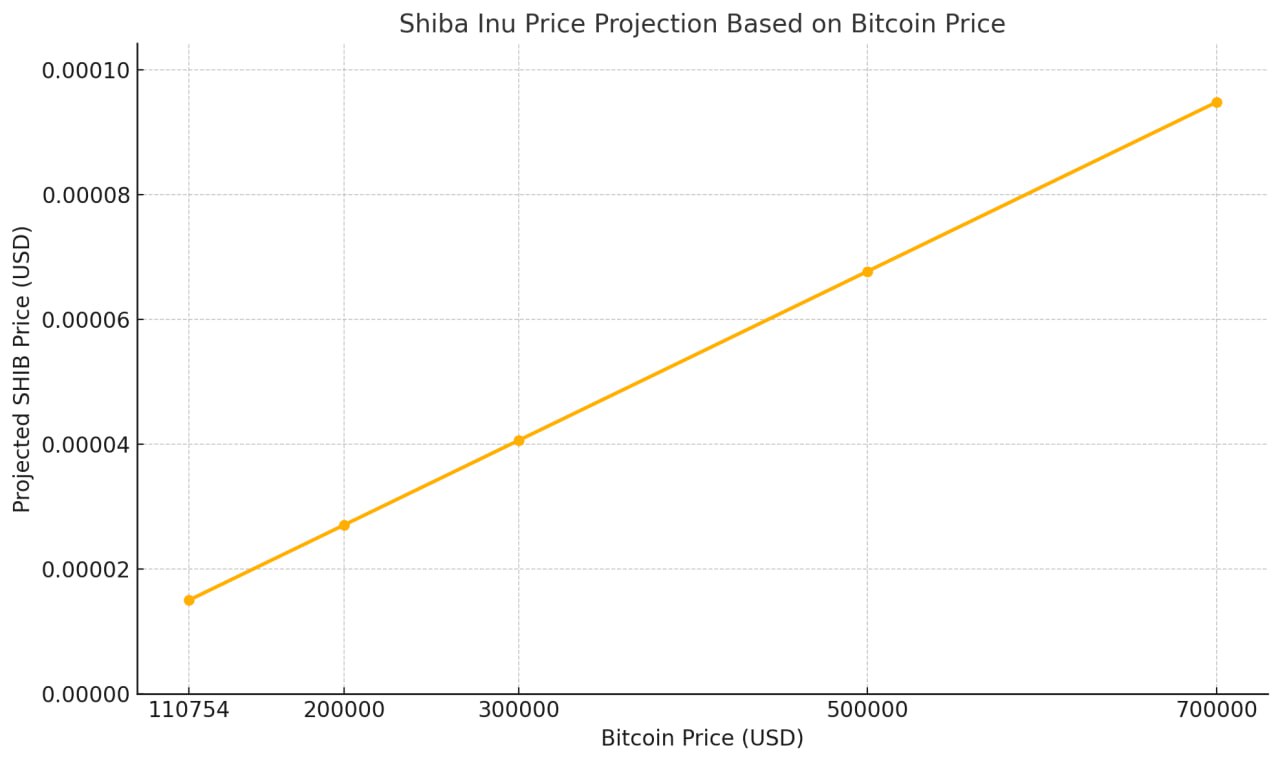
Notably, Shiba Inu is currently trading at $0.00001503, with its market cap at $8.85 billion. According to ChatGPT, if Bitcoin hits the $700,000 target and Shiba Inu maintains its current market cap ratio, the price of the doggy-themed token could rise to $0.000095.

This estimate assumes that Shiba Inu also grows proportionally, matching Bitcoin’s 532% move to the $700,000 target. 

ChatGPT prediction for Shiba Inu if Bitcoin hits $700000

Clinching the $0.000095 mark would mark a new all-time high for Shiba Inu, surpassing the previous record of $0.00008845 by 7.4%. 

Grok Prediction 

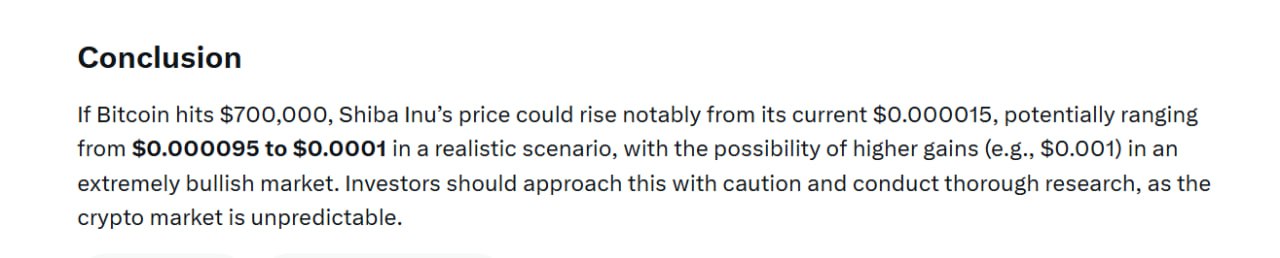
Notably, Grok also shared a similar view, forecasting that Shiba Inu’s price would climb to $0.000095 if it mirrors Bitcoin’s 532% surge. However, it suggested that Shiba Inu could surpass the $0.000095 target as SHIB is more volatile than Bitcoin. 

Given Shiba Inu’s highly volatile nature, Grok suggested that it could outperform or underperform Bitcoin’s gains under certain market conditions. 

Therefore, the chatbot set a target of $0.000095 to $0.0001 for Shiba Inu if Bitcoin clinches the $700,000 target. Interestingly, Grok forecasted that Shiba Inu might aim for ambitious targets like $0.001 under an extremely bullish market. 

Besides Shiba Inu’s strong correlation with Bitcoin, Grok suggested that certain factors like ongoing Shibarium developments could support the token’s surge to around $0.001, representing an increase of 6,553% from the current price. 

Meanwhile, Grok urged investors to exercise caution while investing in cryptos and not rely on its prediction as investment advice. 

Grok prediction for Shiba Inu if BTC hits $700K

Here’s How XRP Price Could Pump by 1,233% from Here

Market analyst CrediBull Crypto has spotlighted XRP as one of the most technically bullish altcoins in the market right now.

According to his latest chart analysis on X, the asset displays an impulsive structure based on its recent lows that is unmatched by any other altcoin.

Specifically, he stated that while he’s optimistic about the upside potential of his other holdings in the coming months, no other altcoin currently shows a lower timeframe impulsive structure “as clean as” XRP’s has been from its lows.

In parallel, CrediBull emphasized that the recent sideways action in XRP’s price shouldn’t concern investors. He explained that the coin consolidating tightly around the $2 mark is a bullish signal, not a bearish one.

He stressed that such price behavior often sets the stage for significant upward momentum. According to the analyst, the longer XRP remains in this compressed range, the more momentum it builds for its next leg higher, an outcome consistent with bullish setups in previous market cycles.

For instance, XRP broke out and surged 6X last year after several years of consolidation. Now, the coin has remained relatively passive for the past four months, even as Bitcoin continues to reach new highs. As a result, XRP analysts believe a powerful move is brewing.

Elliott Wave Theory Supporting XRP’s Massive Upside

In his analysis, CrediBull applies Elliott Wave Theory to forecast XRP’s potential movement, drawing comparisons to Bitcoin’s past performance.

The accompanying chart shows that XRP has completed its Wave (ii) correction and is now in for Wave (iii), which projects an aggressive price advance. Specifically, the chart suggests that XRP could surge from its current level to around $16 before undergoing a major Wave (iv) correction.

Upon a successful retest, further waves could potentially take XRP’s price as high as $32.

XRP Could Mirror Bitcoin’s Breakout from $25K to $74K

To support this forecast, CrediBull draws a parallel to Bitcoin’s historic Wave 3 rally, where BTC jumped from $25,000 to $74,000.

The comparison shows that XRP’s current consolidation phase and wave structure on the daily timeframe mirror Bitcoin’s setup on the weekly timeframe just before its breakout. 

Image
XRP and Bitcoin chart by CrediBull

Notably, Bitcoin’s Wave 3 saw it rise from around $25K in late 2023 to $73,750 by March 2024. This was followed by a corrective Wave 4 phase, during which the price revisited lows around $49,000. A continuation occurred later in 2024, which saw Bitcoin surpass $100,000 in December.

CrediBull uses this wave pattern to suggest a similar breakout may be imminent for XRP. If history repeats, XRP could be on the verge of a parabolic surge similar to the one that propelled Bitcoin to record-breaking highs.

XRP is currently trading at $2.42. Reaching $32, as CrediBull’s chart projects, would require a growth of approximately 1,233%.

Here’s Why Token Velocity Could Be a Possible Reason XRP Price Now Lags

Amid the slower growth XRP price has observed this month, a community analyst has called attention to token velocity as a possible reason.

While Bitcoin and Ethereum continue to post strong gains this month, XRP struggles to keep up. For instance, Bitcoin has jumped 17.59% in recent weeks, now trading above $110,000. Interestingly, Ethereum has done even better, rising nearly 50% and closing in on the $2,700 mark. 

In contrast, XRP has only seen an 11% increase over the same period and remains stuck near the lower end of the $2 range. While the 11% gain remains bullish, investors are growing impatient, especially after its November 2024 to January 2025 surge reignited hopes. 

XRP Has a High Token Velocity 

Notably, the analyst behind the popular “All Things XRP” account on X believes he knows why. Specifically, he recently pointed to XRP’s “token velocity” as a major reason the token hasn’t seen the same price surge. According to him, most XRP holders don’t understand what token velocity is.

For context, token velocity measures how quickly a cryptocurrency moves from one holder to another. It is calculated by dividing the total transaction volume by the circulating supply. 

Essentially, a high velocity means market participants constantly trade the token, while a low velocity shows that more investors are holding it. 

The analyst explained that when a token changes hands frequently, it puts more sell pressure on the market, which can push the price down. However, when people hold a token instead, supply tightens and prices rise, following the basic supply and demand law.

XRP’s Design for Payments Contributes to Higher Velocity

In XRP’s case, its design encourages high velocity. The original XRPL architects built XRP for speed and efficiency in payments. Notably, banks and financial institutions that use Ripple Payments typically buy XRP, use it for a transaction, and sell it right away. 

This keeps XRP moving quickly through the system, unlike Bitcoin, which investors mostly hold long-term, or Ethereum, which sees moderate movement due to DeFi and staking use cases.

The analyst noted that XRP behaves more like a stablecoin than a traditional crypto asset in this regard. Importantly, high transaction volume combined with periodic token releases from escrow adds to the supply and contributes to the high velocity. 

While this makes XRP ideal for fast, low-cost transfers, it also works against its price growth, and many XRP investors may not realize these simple mechanics. Interestingly, Ripple has also confirmed that its payment solution uses XRP in a way that does not impact its price significantly due to quick movements.

Ways to Improve XRP Tokens Velocity

Meanwhile, to improve XRP’s long-term price outlook, “All Things XRP” suggested a few possible solutions. One of them is introducing staking incentives to reward users for holding rather than trading the token. Note that Ripple is looking to introduce native staking to the XRPL. 

Nonetheless, he pointed to real-world asset tokenization as the most promising path forward. Tokenized assets like real estate, commodities, and private equity could use XRP in a way that locks it up rather than moves it around. That would reduce velocity, increase scarcity, and push prices higher over time.

The analyst also dismissed the idea that XRP will “moon” simply because of its use in payments. He argued that while XRP excels as a transactional tool, payments alone won’t deliver major price gains. Instead, he sees tokenization as the real driver of future value.

Top Trader Bets $60M on Ethereum With 25x Leverage Amid Market Rally

0

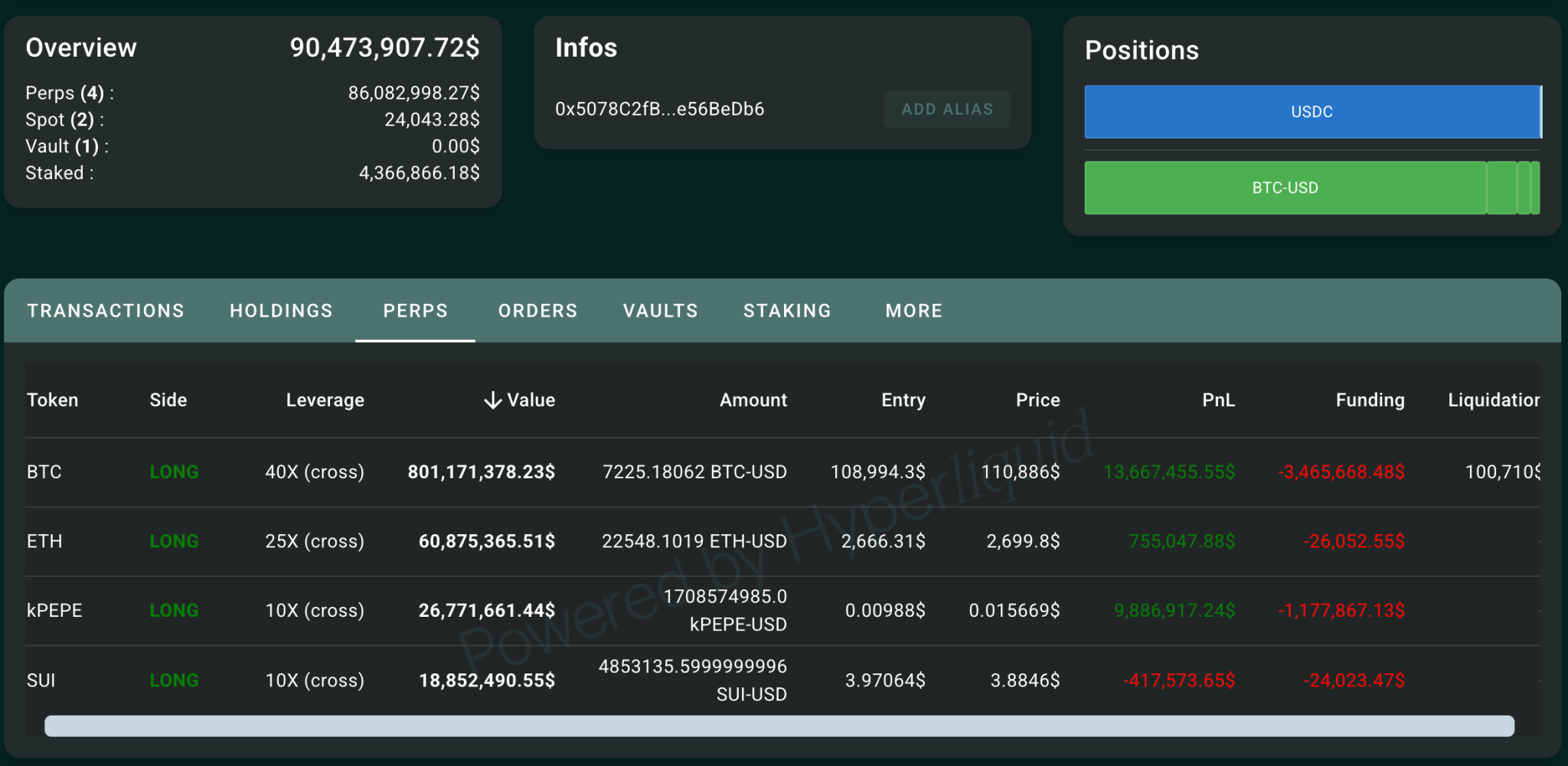
High-risk trader James Wynn recently made a bold bet on Ethereum, opening a 25x leveraged long position valued at $60.4 million with an entry price of $2,666.31.

As ETH trades near $2,699, the position is currently up by approximately $755,000. Over the past week, Ethereum has posted a sustained upward trend, rising from below $2,370 to over $2,700 between May 16 and May 23. As of today, ETH has crossed $2,700, reflecting renewed bullish sentiment across the market.

However, much of this movement is driven by aggressive trading activity, with leveraged positions increasingly influencing price action.

Wynn Bets Big on Ethereum

James Wynn, one of the most active traders in recent sessions, opened a leveraged long position totaling 22,548 ETH. Valued at $60.4 million, the trade was initiated at $2,666.31.

Screenshot 2025 05 23T082328748

With Ethereum trading around $2,699.80, the unrealized gains currently stand near $755,047.88. While the price increase may appear modest, the use of high leverage has amplified returns. Meanwhile, the funding cost for this position remains modest at $26,052.55, indicating favorable market conditions and a relatively short holding duration.

Meanwhile, this Ethereum position is part of Wynn’s broader high-leverage portfolio. Notably, he also holds a 40x leveraged long position in Bitcoin, with a notional value exceeding $801 million. That trade has yielded more than $13.6 million in profit, though it has accrued $3.46 million in funding fees.

Multiple High-Leverage Trades

In addition to Bitcoin and Ethereum, Wynn has a $26.77 million long position in the memecoin kPEPE, leveraged at 10x. This position remains active. However, not all of Wynn’s trades are in the green.

A 10x leveraged long on SUI is currently in the red, with an entry price of $3.97064. It stands as the sole underperformer in his otherwise profitable portfolio, despite broader market optimism.

These positions coincide with growing pressure on short sellers across the crypto market. Liquidation data over multiple time frames reveals a consistent pattern of squeezing shorts as prices climb.

Short Liquidations Dominate as Ethereum Rises

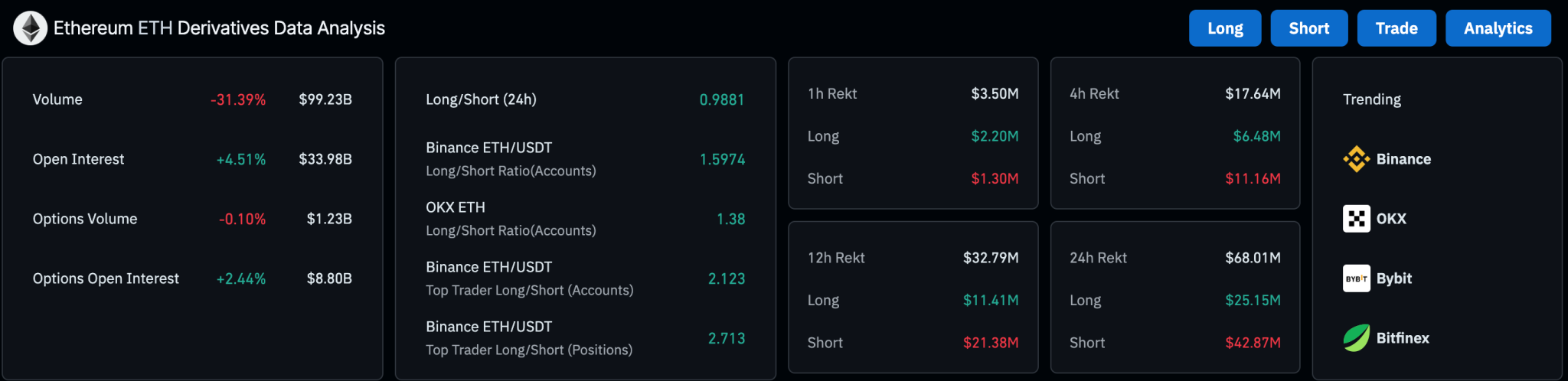
Data from the past 24 hours confirms a dominant trend in short liquidations for Ethereum. Out of a total $68.01 million liquidated, $42.87 million originated from shorts, almost double that of longs at $25.15 million.

This same imbalance extends to shorter windows: $21.38 million in short liquidations over 12 hours versus $11.41 million in long positions. 

Screenshot 2025 05 23T084244956

Within 4 hours, $11.16 million in shorts were cleared, compared to $6.48 million in longs. Even the 1-hour frame echoed this trend.

Essentially, the surge in Ethereum’s price and similar market moves continue to place over-leveraged short positions at risk.

At the same time, despite a 31.39% drop in overall trading volume, now down to $99.23 billion, market interest remains elevated. Open interest rose by 4.51%, reaching $33.98 billion.

JP Morgan Chase, Citibank, Bank of America, and Wells Fargo To Pursue Joint Stablecoin Venture

0

Banking giants in the United States have set their sights on the expanding stablecoin market through a joint venture.

A Wall Street Journal report on Thursday, citing people familiar with the matter, disclosed this new development. The proposed business will see major US banks compete with digital asset firms to gain relevance in the stablecoin market.

Banks Exploring Joint Stablecoin Issuance

The people familiar with the matter specifically mentioned that top US banks like JP Morgan Chase, Citibank, Bank of America, and Wells Fargo were part of the joint stablecoin issuance initiative. Other commercial banks involved in the enterprise include Early Warning Services—Zelle’s payment system operator—and the Clearing House.

Meanwhile, the possible bank consortium is still in its early stage and remains highly speculative. The report highlighted that the giant financial institutions are hinging the venture on a clear, stablecoin regulatory framework and their clientele’s demand for the real-world asset-backed cryptocurrency.

Notably, the former concern could be over soon, as the GENIUS Act recently progressed to the final senatorial approval stage. With a 66-32 vote on Monday, bipartisan support brought the stablecoin bill one step closer to passing.

Stablecoin Near Mainstream Adoption

Interestingly, the proposed venture reflects a warmer disposition among legal financial institutions toward the crypto industry. This further unveils the asset’s growing utility beyond the corridors of the digital asset industry.

Stablecoins are pegged 1:1 with fiat currencies, and their digital features and functionality are suitable for swift and low-cost transactions. These top US banks are exploring the possibilities of enhancing their slow and pricey cross-border transactions with technological innovation.

Meanwhile, demand for stablecoins is rising as major institutions continue to adopt the asset. Fintechs like Ripple and PayPal have created their own stablecoins to enhance their payment businesses. The World Liberty Financial, Donald Trump’s family business, also recently launched its native stablecoin.

Nations are also exploring the fiat-pegged cryptocurrency, with the United States in the mix. On Wednesday, the White House’s AI and crypto czar, David Sacks, noted that stablecoins will unlock trillions of dollars for the US Treasury.

Furthermore, the proposed venture emphasizes the growing mingling of digital and traditional financial systems. While crypto firms like Coinbase and Circle are pursuing bank charters, major banks like JPMorgan and Standard Chartered are exploring ways to increase exposure to blockchain technology.