Home Blog Page 731

Binance’s CZ Says the Risk Isn’t Just in Crypto Investing — It’s Also in Staying on the Sidelines

0

While stressing the need for risk management, Binance co-founder CZ has introduced a new narrative stressing the upsides of dabbling with Bitcoin and crypto.

Changpeng Zhao, the co-founder and former CEO of Binance, is bringing a new narrative aboard. While some institutions and market participants find the volatility associated with the crypto sector off-putting, Zhao, popularly known as CZ, thinks it is detrimental not to gain exposure regardless.

CZ Preaches Exposure Regardless

In a Monday tweet, CZ acknowledged that although it is risky to invest in cryptocurrencies, not owning Bitcoin could also be a riskier endeavor. Interestingly, this narrative talks up the theory that with significant risk comes great reward.

The crypto sector has observed bad and good days alike. Some have seen Bitcoin and crypto’s fast-paced price actions as a loophole for investors looking for a mild and conservative means for wealth sustenance and growth.

Further, the industry had just fully recovered from trust-diminishing events following the fallout from Terra, Three Arrows Capital (3AC), and, most recently, FTX. These events had image-tarnishing effects on the industry while stressing the need for clear regulation.

Nonetheless, the sector has grown past that stage, surviving the attacks and mending the trust of many. Also, the market has rallied extensively from the lows to current prices, extensively rewarding those who bought on the downside and held on.

Amid the recovery, which has seen Bitcoin transcend its previous prices, CZ has emphasized that not holding Bitcoin is riskier. Considering the asset’s future trajectory and the benefits of having even a small portion, not considering investing would be a generational fiscal misjudgment.

Meanwhile, while the tweet advocated embracing cryptocurrencies regardless of the narrative, it also acknowledged the hazards associated with the sector. Hence, due diligence and personal research play a major role in staying safe in the industry, as with many other financial markets.

Learn to Manage Risk: CZ

Meanwhile, CZ highlighted a few steps to manage risks while investing in crypto. In a follow-up tweet today, he mentioned three questions one should ask when dabbling in the digital asset business to ensure effective risk management.

First, he emphasized the “risk what you can afford to lose” theory. An important question every prospective crypto investor should ask is what the worst-case scenario would be. Notably, investors should always ask themselves if they are capable of surviving should their investments go to zero.

Secondly, he emphasized another defining question on risk management: how many times can one try while incurring consecutive losses?

Finally, he stressed the importance of learning what you are investing in. CZ noted that it is best to ask oneself if one actually understands what one is doing, as a little knowledge-seeking could change the narrative.

Bitcoin Would Have Proliferated Before Being Deemed Safe

Moreover, Michael Saylor, the executive manager of Strategy (formerly MicroStrategy), recently echoed a similar disposition on the crypto market’s risk.

Saylor, who shares the sentiment that volatility reflects Bitcoin’s utility, insisted that Bitcoin and the crypto market would have reached insane levels before financial advisors start to say it is less risky to invest in or own it.

Specifically, he noted that Bitcoin would hit $1 million before some legal financial institutions deem exposure ok and $10 million before they acknowledge that buying the premier asset is a good idea.

Interestingly, this narrative further stressed the current skepticism around the risks involved with crypto and how it has stood tall regardless. Nonetheless, this paradigm is starting to change as large institutions are beginning to come around.

For context, the $4 trillion asset manager JP Morgan’s CEO Jamie Dimon disclosed yesterday that the company will now allow clients to be exposed to Bitcoin.

Analyst Says Bitcoin Still Keeping it Simple as It Maintains Ascending Channel Above Super Trend Support

0

Analyst IncomeSharks suggests Bitcoin is “keeping it simple,” climbing within a clear ascending channel as bullish momentum holds steady.

Bitcoin has recorded a steady upward trend over the past week, marked by sharp fluctuations but underpinned by sustained bullish momentum. Despite these swings, the general trajectory since May 17 remains positive. 

The current price action shows a sustained yet volatile uptrend, attracting closer analysis from technical and on-chain perspectives.

Technical Indicators Support Ongoing Bullish Momentum

One of the parties involved on May 19 was the analytic account IncomeSharks, which shared a daily chart showing a sustained climb within a clearly defined ascending channel. Since mid-April, the price action has consistently made higher highs and higher lows, showing continued support for the bullish trend. 

Image

Notably, the SuperTrend indicator has played a major role in tracking this progression. Displayed as a green line beneath the price, it sat at $96,240 at the time of IncomeSharks’ post.

The proximity to this SuperTrend value signals a key support level. The market’s reaction in the next 24 to 48 hours could determine whether the current uptrend continues or faces a temporary pullback. 

The same indicator issued a buy signal on April 21, when Bitcoin traded near $96,000. This still acts as a crucial support. It also signaled the beginning of the current upward phase. Before that, in early April, the SuperTrend had flashed a sell signal, which coincided with a brief consolidation period and modest decline.

Meanwhile, the ascending channel has remained intact throughout this period, reflecting a consistent structure. Price movements have respected the boundaries of the channel, offering further confirmation of the ongoing strength in the trend.

The chart implies that Bitcoin is likely to continue climbing, provided it stays within the ascending channel and holds above the SuperTrend support. The visual projection aims for potential upside toward $112,000 to $120,000, assuming the current structure remains valid.

Resilience Without Signs of Overheating

Elsewhere, a CryptoQuant analyst dubbed Avocado has highlighted a key shift in Bitcoin’s recent price recovery. Previous rallies to new all-time highs were marked by a rapid spike in Binance market buy volumes and funding rates. 

These spikes triggered periods of overheating, followed by sharp corrections. According to Avocado’s assessment, this pattern occurred twice during the current cycle and is visible in historical chart boxes labeled 1 and 2.

However, the ongoing rebound diverges from this pattern. Box 3 on the chart shows that funding rates remain low and Binance market buy volumes are trending downward, not upward. 

Image

This development marks a change from prior surges. It suggests that the market is rebounding without the kind of aggressive buying behavior that previously led to overbought conditions and subsequent corrections.

Since 2023, market buy volume has trended steadily upward, despite short-term dips. This ongoing accumulation points to sustained demand.

While some may see the drop in sharp buying activity as a lack of momentum, Avocado interprets the data as indicative of a less leveraged and more structurally sound rally. Sentiment has improved following the rebound, but funding rates and volume patterns imply that traders remain cautious.

This change in behavior from prior rallies may reduce the likelihood of sudden reversals. The absence of overheated conditions supports the view that the market is not currently overextended. 

Bitcoin-Gold Relationship Signals a Potential Continuation

Another analyst has tracked a recurring cyclical relationship between Bitcoin and gold spanning from mid-2024 to May 2025. A comparative chart highlights four distinct phases, during which gold rallies first, followed by Bitcoin. These phases—marked as “Gold Leads” and “Bitcoin Catches Up”—repeat throughout the observed period.

Currently, Bitcoin appears to be in another catch-up phase, trailing gold’s latest move. Historical behavior shows that when this cycle occurs, Bitcoin typically follows with a more aggressive rally. The chart uses shaded zones to illustrate the alternating leadership between the two assets, underscoring the consistency of this pattern.

As of May 2025, both assets continue to climb. This alignment suggests the existing cycle remains intact. The comparative price action hints that Bitcoin may still have room to close the gap with gold, surging to levels above $140,000.

At press time, Bitcoin trades at $105,106, reflecting a 1.9% gain over the past 24 hours, a 2.4% increase over seven days, and an 11.3% rise in the last 14 days.

America’s Oldest Law School Says XRP Holders Have Bought a Slice of Ripple’s Future Cash Flow

A recent legal analysis from William & Mary Law School, the oldest existing law school in the United States, suggests XRP buyers procured a slice of Ripple’s future cash flow.

The report, authored by University of Texas law professor James C. Spindler and published in May 2025, asserts that XRP buyers essentially acquired an economic interest in Ripple’s future revenue streams. However, it also suggests a legal gray area that complicates the situation.

SMQKE, an independent crypto researcher, first brought the academic report to public attention in a post on X, triggering discussions within the XRP community.

XRP Holders Have Bought a Slice of Ripple’s Future Cash Flow

The report argues that XRP, while not conferring legal ownership or entitlements like dividends or voting rights, still functions like a vehicle for sharing in Ripple’s future business success. 

It suggests that investors are seen as betting on Ripple’s long-term profitability, specifically, revenue from its blockchain-based transaction settlement system, when they purchase XRP. The report argued that XRP’s value hinges on the success of Ripple’s infrastructure.

Ripple and XRP Commentary on William and Mary Law Review

Despite this, the report also calls attention to an important nuance. It claimed XRP doesn’t provide formal investor protections typically associated with securities, such as enforceable rights or disclosures under SEC regulations. 

This creates a paradox. While the economic relationship resembles an investment in Ripple, the legal structure avoids traditional oversight. 

XRP’s Utility Differentiates It from Normal Bonds

Meanwhile, Ripple has long maintained that XRP is a functional token used to facilitate cross-border payments, not an investment contract. Interestingly, the report acknowledged the strength of this argument.

The paper credits Ripple for constructing a system where XRP serves an actual use case, fueling transactions within its payment ecosystem, rather than merely existing as a speculative asset. 

It points out that XRP is essential to the system’s operation, with users required to utilize the token to process transactions on the XRPL, and as an optional bridge asset in Ripple Payments. This utility-focused design supports Ripple’s claim that the token is fundamentally different from a stock or bond.

The legal scholar also highlights the broader implications if Ripple’s approach becomes widely adopted. According to the report, companies might tokenize segments of future cash flows and distribute them through crypto markets, potentially bypassing regulatory scrutiny. 

Still, the report concedes that Ripple is one of the few crypto firms with a real, revenue-generating business, which lends credibility to its model.

Ripple and SEC Already Looking to End the Age-old Lawsuit

The report surfaces as Ripple and the SEC have recently agreed to abandon their appeals in the ongoing legal dispute. Both parties are now seeking court approval to finalize a settlement, indicating a possible end to one of the most high-profile crypto enforcement battles in recent years.

Ripple’s partial legal victory in 2023, which found that certain XRP sales did not violate securities laws, bolstered its standing in the crypto industry. 

The report from William & Mary suggests that while the company may have skirted traditional frameworks, its operational transparency and real-world use case put it in a different category from purely speculative ventures.

Singapore Dollar-pegged Stablecoin Launches on XRP Ledger, Backed by DBS and Standard Chartered

0

Leading digital payment provider StraitsX has introduced its Singapore dollar-pegged stablecoin (XSGD) on the XRP Ledger, following a partnership with Ripple. 

Ripple announced the development yesterday, with The Crypto Basic also confirming the move in an X post. 

The move aligns with the company’s efforts to cater to users’ demands for multi-chain stablecoins capable of facilitating cross-border settlements. This demand has soared recently following expectations that economic activity in Asia could skyrocket massively in the coming years. 

The press release estimates that cross-border commerce in Asia could hit $4 trillion by 2030, five years from now. Based on this projection, payment stablecoins like XSGD are expected to experience increased demand and eventually lay the foundation for the next phase of payment innovation in the region. 

Strategic Partnership between Ripple and StraitsX

Meanwhile, StraitsX disclosed that the launch was part of a broader strategic partnership with Ripple. The rollout is expected to occur in phases, beginning with XSGD’s integration into the XRPL.

This launch will give retail users, developers, and institutions open and permissionless access to a regulated Singapore dollar stablecoin like XSGD. Users can leverage XSGD for cross-border transactions, programmable financial flows, and on-chain settlements. 

Notably, StraitsX is expected to activate the second phase of the launch next month, in June 2025. By then, the payment provider will make XSGD available for institutional use. 

This planned launch will enable merchant settlements, programmable payouts, and compliance-ready integrations across various financial flows. The rationale behind these deployments is to bridge businesses’ regulatory and operational needs with the speed and flexibility of digital assets. 

XSGD Availability 

StraitsX, which is licensed by the Monetary Authority of Singapore (MAS), has been issuing XSGD since 2020. At the moment, XSGD is available on multiple blockchains, such as Ethereum, Polygon, Arbitrum, Avalanche, Zilliqa, and Hedera. With StraitsX debuting XSGD on XRPL, the stablecoin is now available on seven blockchains. 

Notably, StraitsX claims that each XSGD is fully backed 1:1 by cash reserves held at two major financial institutions–Standard Chartered and DBS Bank. 

It boasts a total supply of 83.61 million tokens, with 13.62 million currently circulating. At press time, its market cap was down 3.23% over the past 24 hours to $10.51 million. 

Ripple Exec Reacts

Commenting on the development, Ripple’s APAC Managing Director Fiona Murray stated that the launch of XSGD on XRPL underscores the importance of digital assets like stablecoins in global payments. 

Fiona expressed excitement about Ripple’s partnership with StraitsX, noting that it is pivotal, particularly as ‘several institutions and developers seek to build financial applications on-chain.’ 

In the meantime, the XRP Ledger is gradually providing the necessary infrastructure for top stablecoins following the debut of XSGD.

Last year, Ripple launched its dollar-pegged Ripple USD (RLUSD) stablecoin on the blockchain. In addition, the company partnered with Société Générale’s digital asset subsidiary, SocGen Forge, to introduce a Euro-backed stablecoin on XRPL. 

Here’s How XRP and Ethereum Battled for the Second Spot Over the Years

XRP and Ethereum had been in a battle for the second spot for years until the former entered a bearish phase following the SEC’s lawsuit.

With Bitcoin (BTC) securing its spot as the largest crypto asset by market cap, Ethereum (ETH) has also maintained the second spot for years. However, this dominance for first and second positions was not always the case.

Notably, while BTC has always remained the largest asset, the position of the second-largest cryptocurrency was once a constant battle between XRP and Ethereum, with both assets occasionally retaking and relinquishing this position for years. 

For context, before the launch of XRP and Ethereum, Litecoin secured the second spot among the largest crypto assets until October 2014, when XRP surpassed it to hold this position.

XRP and Ethereum’s Battle for Second Spot Before the SEC Lawsuit

XRP maintained this spot, with Litecoin unable to catch up, until Ethereum outranked it in February 2016. CoinMarketCap’s historical snapshot confirms that Ethereum soared to a market cap of $358.3 million in late February 2016, while XRP had a valuation of $276 million. 

Throughout 2016, Ethereum held the second spot, eventually closing the year with a valuation of over $600 million, over $400 million higher than XRP’s $200 million valuation. 

However, things changed in December 2017 on the back of XRP’s meteoric run. By December 31, 2017, XRP boasted a market cap of $89.12 billion, holding the second spot, while Ethereum, which had a market cap of $73.17 billion, was relegated to third.

XRP Overtakes Ethereum CoinMarketCap
XRP Overtakes Ethereum | CoinMarketCap

Nonetheless, as XRP witnessed a massive correction, Ethereum retook the second spot. In 2018 alone, the two assets continuously reclaimed and lost this position, with XRP closing the year as the victor with a valuation of $15.07 billion, dwarfing Ethereum’s $14.56 billion.

Aftermath of the SEC Lawsuit

This battle slipped into 2019 and 2020, but Ethereum mostly maintained the second spot. However, following the SEC’s lawsuit against Ripple in December 2020, XRP collapsed further, even relegating the third spot and slipping to as low as seventh in February 2021. 

In recent years, specifically in 2023 and 2024, XRP also struggled to even make it to the top 5. Even in October 2024, XRP languished in the seventh spot, with a market cap of $29.3 billion, ten times less than Ethereum’s market cap of $301.7 billion at the time.

XRP’s breakthrough materialized in November 2024 following the U.S. elections. By Dec. 8, 2024, the asset had recovered the third spot with a market cap of $148.98 billion. However, this was still $334 billion below Ethereum’s market cap of $482 billion.

Interestingly, due to its greater resilience amid the market-wide bearish pressure that began in February 2025, XRP is now closer to overtaking Ethereum than it has been in years. Currently, XRP’s market cap of $138 billion is $169 billion away from Ethereum’s valuation of $307 billion.

For context, XRP only needs to rally to a price of $5.24 to overtake Ethereum in market cap. This would require a 122% increase from the current price of $2.36. With the SEC lawsuit now heading toward a definitive settlement, most believe XRP could eventually retake the second spot if it maintains its growth momentum.

Analyst Identifies Dogecoin Trend Break Opportunity Following Inverse Head and Shoulder Breakout, Targeting $0.43

0

Bitcoinsensus has identified a Dogecoin uptrend opportunity on a key descending trendline after breaking an inverse head and shoulder neckline resistance.

Dogecoin (DOGE) has experienced volatility over the past week, recording a local high near $0.24 on May 14, 2025. However, after dipping to just above $0.21 by May 17, the memecoin regained momentum to trade at $0.227. 

Amid these price fluctuations, analysts have turned their focus to key bullish formations that could shape Dogecoin’s next move. Chart analyses from Bitcoinsensus outline distinct bullish patterns that, if confirmed, could result in a significant upward move.

Inverse Head and Shoulders Pattern 

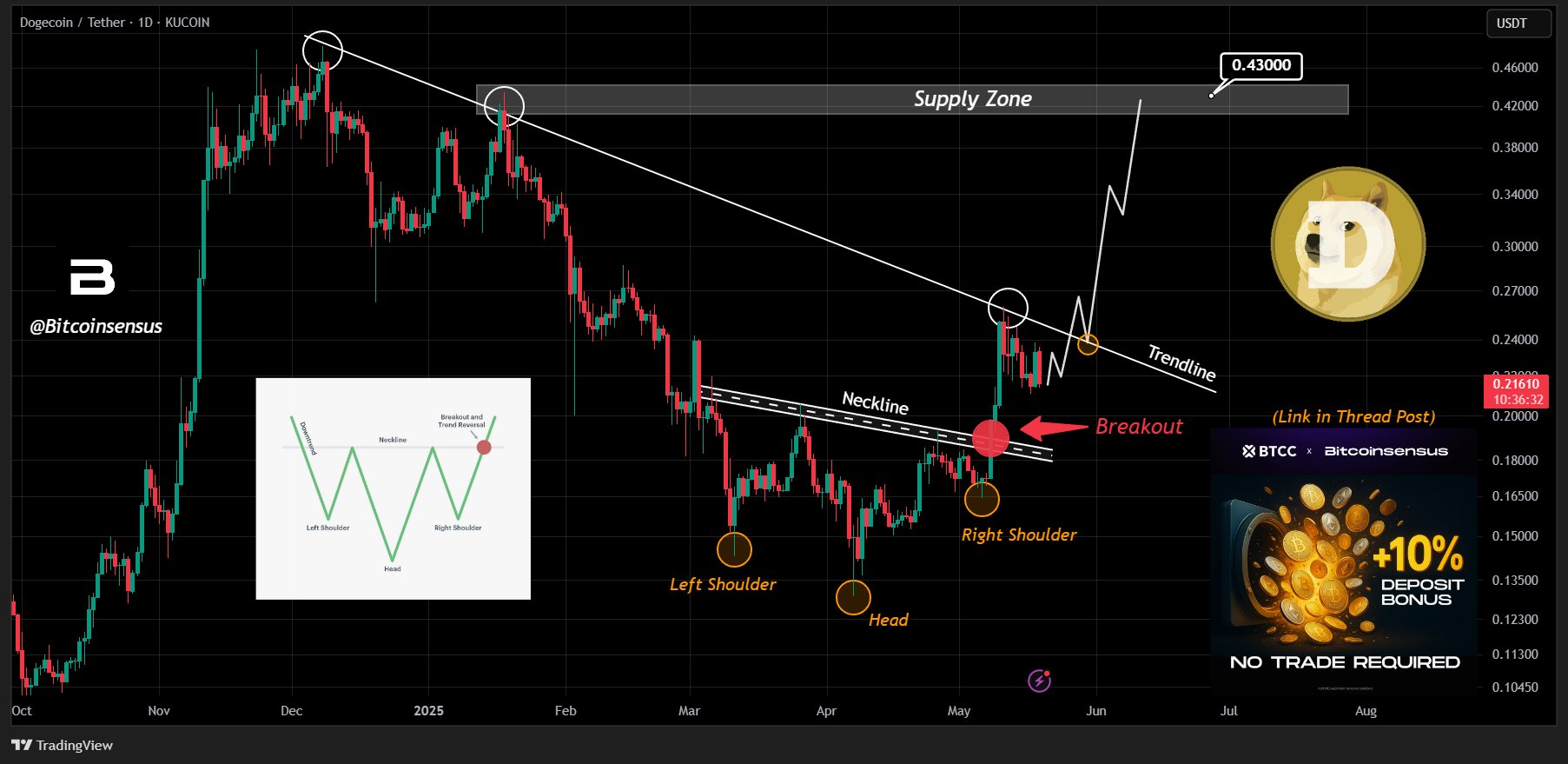
The analysis identifies an Inverse Head and Shoulders pattern forming on Dogecoin’s daily chart. This classic bullish reversal structure typically signals the end of a downtrend.

The pattern began forming in early March 2025, with the left shoulder appearing near the $0.15 level during a reversal from a prior downtrend. The head developed in April with a deeper price drop, while the right shoulder emerged in late April as prices rebounded above $0.165.

Image

The neckline of this pattern, which slopes slightly downward, served as a key resistance zone. The Bitcoinsensus chart showed that DOGE broke through this neckline, marking a potential transition into a new bullish phase. 

However, the market watcher also noted that Dogecoin remains constrained under a long-term descending trendline. This trendline, active since late 2024, has repeatedly capped price rallies.

For instance, the memecoin faced a rejection at $0.46 in December 2024, which aligned with this trendline. Further, another rejection emerged at $0.42 in January 2025, also aligning with the trendline. Following the January pullback, DOGE collapsed to the $0.135 range.

Currently, Dogecoin is testing this significant trendline once more. Bitcoinsensus stated that a breakout, retest, and confirmation above this level could validate the bullish reversal pattern.

A successful breakout could push DOGE toward the next major supply zone, located between $0.42 and $0.43. This would represent an 89.43% increase from the current trading level of $0.227.

Potential Continuation of Uptrend

Meanwhile, complementing the Inverse Head and Shoulders setup, a second technical pattern has emerged on the charts. Trader Jake Wujastyk identified a developing bull flag pattern, which generally forms during consolidation phases following a sharp price rally. 

This setup consists of two parallel downward-sloping trendlines representing the flag, and a preceding sharp move higher that forms the flagpole.

In this case, the flagpole formed during a strong rally that brought prices close to $0.25. Since then, the price has been consolidating between approximately $0.251 and $0.201, maintaining a controlled pullback within the flag.

Per the chart, this consolidation indicates that DOGE is cooling off while preserving its bullish market structure.

The key signal for this pattern would be a breakout above the flag’s upper boundary. Such a move, especially if accompanied by a spike in trading volume, could suggest a continuation of the previous uptrend. 

On-Chain Activity Surges, Supporting Technical Outlook

In addition to chart-based signals, on-chain data has recently shown strong alignment with the bullish technical outlook.

A report from IntoTheBlock highlights a sharp increase in Dogecoin’s Daily Active Addresses (DAA), which includes New Addresses (NA), Active Addresses (AA), and Zero Balance Addresses (ZBA). 

Dogecoin Daily Active Addresses

These three metrics recorded significant jumps over the past seven days, with New Addresses rising by 102.40%, Active Addresses up 111.32%, and Zero Balance Addresses increasing by 155.32%.

Historically, such surges in user engagement have correlated with price rallies in the DOGE market. The increased activity indicates broader user participation and may suggest strengthening demand as Dogecoin tests crucial technical levels.

DOJ Launches Probe Into Coinbase Breach Tied to Insider Bribery Scheme

0

The United States Department of Justice has initiated a criminal investigation into a recent cybersecurity breach at Coinbase Global Inc.

The inquiry, led by the DOJ’s criminal division in Washington, aims to uncover the events that enabled a group of actors to access user data through insider collusion. Coinbase disclosed that the breach stemmed from unauthorized access facilitated by the bribery of offshore customer service personnel. 

The company stated the attack targeted its support operations in India, where certain employees and contractors allegedly accepted bribes to leak sensitive client information.

Criminal Actors Exploited Insider Access 

Following an internal investigation, Coinbase confirmed that criminals persuaded support agents overseas to extract confidential user details. The breach, which the company labeled highly targeted, compromised fewer than 1% of the platform’s monthly transacting users. 

Data exposed included personal identifiers such as full names, phone numbers, residential addresses, and banking details. However, Coinbase emphasized that login credentials, private cryptographic keys, and access to user wallets remained intact.

The situation escalated when the attackers demanded $20 million from Coinbase in exchange for withholding the stolen data from public exposure. Rather than complying, the company launched a full-scale investigation, declined the extortion attempt, and introduced a $20 million bounty to capture the perpetrators. 

Insider Misconduct Detected Prior to the Breach

In the months before the incident, Coinbase reportedly identified irregular activity among offshore support agents. According to a corporate filing submitted last week, the firm had observed instances of non-U.S.-based customer service staff accessing internal systems and collecting client information without authorization. Following the discovery, Coinbase dismissed the implicated individuals from their positions.

Meanwhile, the platform notified regulators and international law enforcement agencies about the breach. Paul Grewal, Coinbase’s chief legal officer, stated that the firm proactively brought the matter to the attention of U.S. authorities and confirmed that it is not a subject of the investigation. 

The firm’s cooperation with law enforcement efforts aimed at identifying and prosecuting the involved parties.

Estimated Financial Impact and Global Regulatory Response

Coinbase estimated the cost of mitigating the breach could reach up to $400 million. The financial toll reflects both the scale of the breach and the measures required to safeguard the platform from future insider threats.

Simultaneously, data regulators in the United Kingdom and Ireland acknowledged receiving reports from Coinbase about the breach. Both agencies stated they are currently assessing the situation.

Here’s How Ripple Could Become One of the Largest Holders of US Treasuries

As U.S. regulations for stablecoins inch closer, Ripple may be positioning itself to become one of the world’s largest holders of U.S. Treasuries.

This transformation hinges on two major factors: Ripple’s own stablecoin ambitions and its reported bid to acquire Circle, the issuer of USDC. 

Ripple’s Stablecoin Move

Ripple entered the stablecoin market in late 2024 with the introduction of RLUSD, a U.S. dollar-pegged digital asset. RLUSD is supported by U.S. government treasuries, USD deposits, and cash equivalents. Leading stablecoin issuers like Tether and Circle also follow this model.

As of today, RLUSD’s market cap has expanded to over $321 million, placing it among the top 15 stablecoins just six months after launch.

Meanwhile, Ripple’s ambitions in the stablecoin market do not stop at RLUSD. According to Fortune, the company made a $4 to $5 billion offer to acquire Circle, the firm behind the second-largest stablecoin by market cap.

Although the bid was rejected, the discussions suggest that Ripple is seriously considering expanding its stablecoin footprint. This could dramatically increase its need for U.S. government debt as collateral.

Notably, Circle filed for an IPO in April, targeting a $5 billion valuation. However, ongoing acquisition talks with both Coinbase and Ripple suggest a potential change of course.

Coinbase currently has revenue-sharing and governance agreements with Circle around USDC, and many viewed it as the more natural acquirer. Still, Ripple’s deep war chest, including over $13 billion worth of XRP and access to another $86 billion in escrow, makes it a formidable suitor.

State of Stablecoin Regulation

Circle, Coinbase, and Ripple are all navigating a shifting regulatory landscape. Particularly, the GENIUS Act aims to establish a clear framework for issuing stablecoins in the United States.

Notably, the U.S. Senate advanced the GENIUS Act in a 66–32 procedural vote, with 16 Democratic senators crossing the aisle to support the bill. The legislation now heads to the Senate floor for debate and possible amendments, with a final vote expected soon.

Congressional Prediction for Stablecoin Issuers as Treasury Giants

In an interview on Monday with CNBC, Senator Bill Hagerty stated he expects stablecoin issuers to become the largest holders of U.S. Treasuries in the world by 2030, citing data from Citibank.

Indeed, Treasuries are central to stablecoin reserves due to their safety and liquidity, similar to money market funds.

Major issuers like Tether and Circle currently hold about $150 billion in U.S. government debt, a small share of the $28 trillion market. Standard Chartered predicts the stablecoin market could reach $2 trillion by 2028.

In perspective, this could add as much as $1 trillion in demand for Treasury bills. Citi suggests that stablecoin issuers could eventually surpass any single foreign nation in terms of Treasury holdings.

Ripple’s Path to Becoming a Treasury Giant

Tether, which already holds approximately $120 billion, could become the largest holder if it complies with new regulatory requirements.

Meanwhile, Ripple, if it successfully grows RLUSD and acquires USDC, would hold tens or even hundreds of billions of dollars in U.S. government debt to meet reserve standards and maintain user trust.

As global demand for digital dollars expands, so will the need to park assets in the safest, most liquid financial instruments available.

Cardano Founder Says “Audit Time” as Big Accounting Firms Involved in $600M ADA Audit Process

0

Cardano founder Charles Hoskinson has embraced the concept of a broader audit on Input Output Global to settle escalating claims of $600M ADA theft.

The Crypto Basic recently reported a heated community debate involving Hoskinson and a section of acclaimed ADA enthusiasts over an alleged 318 million ADA ($600 million at the time) diversion. The accusation drew a response from the Cardano founder and other prominent members of both the ecosystem and IOG.

With Hoskinson teasing an audit to clear these misappropriation claims, the proposal has gained momentum. It is “audit time,” the Cardano founder tweeted on May 20, sharing a post with further details on the process.

Big Accounting Firms Involved in the Audit Process

Meanwhile, Hoskinson’s tweet, which contained a quote from Bane in the popular “The Dark Knight Rises” film, quoted a post from a notable IOG employee. Specifically, he shares a tweet from Joel Telpner, the chief legal officer of IOG, providing a major update on the audit process.

Telpner mentioned that they have engaged prominent law and accounting firms to scrutinize the IOG’s books in an attempt to clear the air. Notably, law firm McDermott Will & Emery and accounting and auditing firm BDO International, which are household names in their fields, will take on the task.

Furthermore, the duo will engage a crypto analytics firm to document findings and draft a comprehensive report properly. This would enhance the transparency of the process and avert future claims of irregularity.

Nonetheless, the CLO stresses that although the audit process will resume immediately, it is unclear when the involved firms will submit a report on their findings. Notably, the statement came in response to the ADA community’s growing demands for a timeline and the audit’s scope.

Prominent Cardano Ecosystem Leaders React

Meanwhile, the days-long argument has drawn reactions from key Cardano ecosystem players, who have backed Hoskinson. One notable response came from EMURGO, Cardano’s commercial arm.

In a long thread on May 19, EMURGO’s official X account shed some light on the ADA redemption scandal ravaging the Cardano community. First, it confirmed that there were unclaimed ADA tokens from the 2017 ICO conducted by IOG.

However, the firm made substantial efforts to reach out to participants with unredeemed ADA vouchers through a thorough seven-year process. Some included a door-to-door search for users with unclaimed ADA in Japan, where most initial voucher holders resided, to facilitate the redemption process. Meanwhile, the effort proved partially effective, as some ICO participants were still not found.

Remarkably, the July 2020 Shelley hard fork possessed a crucial impediment to the ADA redemption process. For the uninitiated, the upgrade saw Cardano move from a federated model to a more decentralized network system, a process that would render the unclaimed ADA tokens unspendable.

To that effect, IOG moved the unredeemed ADAs to continue the claiming process without affecting Cardano’s upgrade roadmap. EMURGO stressed that this move, which is the backbone of the escalating claims, was in the best interest of the Cardano ecosystem.

Hoskinson to Dim X Presence After Audit

For context, Hoskinson noted that these attacks were quite personal, causing him to reevaluate things, including his social media presence. He concluded that he would hand over his X account to a social media team after the audit and change the format of his AMAs and X Space podcasts.

Meanwhile, he would still attend events and relate with the community as he used to. The founder noted this process was necessary for his healing journey.

Notably, this is not the first time Hoskinson has threatened such measures after a heated community feud. He stated he would go “off the grid” after the WALDE meme coin fallout with the community.

XRP Holders Targeted as Ripple Officially Warns of Rising XRP Scams

0

As market interest in XRP surges, the Ripple team has renewed its warnings over a growing wave of crypto-related scams. 

The company issued an alert on X, pointing to an increase in fraudulent schemes targeting XRP holders, especially those tied to fake airdrops and impersonation tactics. According to Ripple, these scams have persisted and are now adapting quickly, using sophisticated tactics to exploit unsuspecting users during market highs.


Rise in Fake Giveaways and Executive Impersonation

One of the most common scams flagged involves fake giveaways. These posts typically promise users double returns if they send a specific amount of XRP. The messaging often mimics Ripple’s CEO, Brad Garlinghouse, and other executives, employing deepfake technology to create convincing yet entirely fabricated promotional content.

In parallel, scammers are cloning profiles of Ripple executives using verified X accounts and accurate logos. These impersonators often send direct messages or tag users in posts claiming urgent XRP developments or exclusive airdrops.

Ripple has advised users to always verify account authenticity through official channels rather than relying on post interactions or direct messages. The firm stated that these scams have become more dangerous due to their increasing use of AI-generated content, such as deepfake videos and manipulated interviews involving Ripple executives.

Malicious Wallets, Phishing Traps, and the Treasury Hoax

Beyond fake giveaways and impersonations, scammers have created malicious wallets and exchanges designed to steal funds. These platforms often masquerade as legitimate XRP wallets but serve as drainers. Ripple recommended that users stick to recognized wallet providers such as Ledger, Trust Wallet, Xaman, Atomic, and GateHub. 

In addition, phishing scams remain a prevalent threat. Fraudsters send emails or direct messages that appear to be from Ripple support, using clean branding and accurate language. These messages typically include links asking users to verify their wallets or claim bonuses. However, clicking such links often leads to data breaches or wallet drains. 

Another dangerous trend identified was the “Fake U.S. Treasury Wallet” hoax. This scam gained traction in 2024 and falsely claimed that the U.S. Treasury was holding XRP in a government wallet.

The narrative was amplified by verified influencers on X, leading over 10,000 individuals to fall victim. Ripple reiterated that sensational claims should always be cross-checked with credible media sources before action.

How to Stay Safe as XRP Holder

Beyond Ripple, other influential voices in the XRP community are also flagging the threats and thus advising how to stay safe. An account on X, All Things XRP, has warned holders to stay alert, especially during price surges when scams often spike.

They caution users against FOMO-driven traps like “limited-time offers” or “pre-SEC decision rewards,” which are common scam tactics. To stay protected, XRP holders should use non-custodial or hardware wallets such as Ledger or Xaman. Moreover, they must avoid sharing private keys or seed phrases and only access official Ripple and XRPL websites.

The account also reminds users about the XRP reserve requirement, currently just 1 XRP. Any service demanding more, such as 10 XRP for wallet activation, is likely a scam.

Security Incident at Leading U.S. Crypto Exchange

Only hours ago, the U.S. Department of Justice launched an investigation into a recent security breach at Coinbase Global Inc., the country’s largest cryptocurrency exchange.

Federal investigators, including personnel from the Justice Department’s criminal division in Washington, are now examining how the incident occurred. 

Coinbase revealed that the breach involved threat actors who bribed support staff and contractors based in India to gain unauthorized access to sensitive customer data. The company disclosed the breach in a recent regulatory filing, noting that the attackers later demanded a $20 million ransom.