Home Blog Page 736

Selling XRP at $2.40 in 2025 Could Mean Missing $10K by 2027: Crypto Founder

Edoardo Farina, founder of Alpha Lions Academy, is doubling down on his warning against selling XRP too early.

In a recent tweet, Farina claimed that offloading XRP prematurely could go down in history as one of the greatest financial missteps investors ever made. He envisioned a 2027 scenario in which an investor, referred to as Joe Smith, regrets taking profits from XRP when it traded at $2.40.

Specifically, this hypothetical Joe Smith would be lamenting that he had sold his 500 XRP, purchased at $0.70 in 2024, for $2.40 in 2025. By 2027, those same 500 XRP could be worth $10,000. Instead, he sold them for just $1,200.

According to Farina’s scenario, had Joe been patient during XRP’s consolidation around $2.40, he could have benefited from the asset’s eventual price increase to $20 per coin.

Essentially, Farina suggests that XRP could still appreciate eightfold or surge by 733%, rewarding those who remain steadfast through periods of consolidation and price retracement.

Be Patient with XRP’s Price Action, Don’t Sell

This statement comes at a time when frustration is mounting among XRP holders. Specifically, the coin’s price action remains underwhelming despite bullish developments. At press time, XRP is down 2% to $2.37. Considering it traded at $2.65 earlier this week, it has lost 11% of its value in just a few days.

During the recent surge, many hoped it would push XRP back to the $3 range, a level it hasn’t reached in over three months.

Interestingly, this period has seen major developments. Ripple announced significant acquisitions to expand the utility of the XRP Ledger. The SEC also dropped its lawsuit against Ripple and approved a reduced settlement fine.

Furthermore, several major asset managers, including Franklin Templeton, a $1.5 trillion firm, have filed to launch an XRP spot ETF.

Despite these positive announcements, XRP’s price has remained largely stagnant. For many holders, this is frustrating as they hope XRP will resume its late 2024 rally and break its all-time high. As of now, XRP is trading 38% below its seven-year-old all-time high of $3.84.

Given the tendency of some investors to exit underperforming assets in favor of better-performing ones, industry voices like Farina are cautioning that, in hindsight, such decisions could turn out to be major investment mistakes.

Selling XRP Is Like Throwing Away a Winning Lottery Ticket

This isn’t the first time Farina has used futuristic scenarios to warn investors against selling their XRP holdings. Previously, he tweeted that liquidating one’s XRP portfolio is akin to throwing away a winning lottery ticket at the redemption office simply because the queue is too long.

This analogy reflects his strong belief in XRP’s future value and a call for patience amid current price stagnation. Other industry commentators have echoed this sentiment. They warned that by 2030, investors might even regret not buying enough XRP when they had the chance.

Expert Predicts How High XRP May Go if Ethereum Reaches $10K

0

Pseudonymous crypto expert, the Modern Investor, sets an ambitious price target for XRP in the event that Ethereum rallies to $10,000 this year. 

The recent lackluster performance across the crypto market has made many market participants believe that this season’s bull market has ended. However, some analysts, like ‘Modern Investor,’ still think the bull market is far from over. 

Ethereum to Hit $10K This Year 

In a recent X post, Modern Investor referenced a prediction from another prominent crypto expert, VirtualBacon, who predicted that the price of Ethereum would hit an ambitious target of $10,000 this cycle. 

Notably, Modern Investor echoed the same sentiment, forecasting that Ethereum would clinch the $15,000 target this year. The expert suggested that Ethereum’s potential surge to the $10,000 mark would positively impact the prices of other major cryptocurrencies, including XRP. 

XRP Price if ETH Hits $10K 

Modern Investor contends that if Ethereum climbs to $10,000, XRP could follow suit and rally toward a $20 price target before the end of the year. 


At the time of writing, XRP was trading at $2.37, having incurred a 24-hour decline of 2.11%. However, XRP’s price has soared 0.89% and 13.2% in the past week and month. It has also registered an increase of 359% over the past year and 14.2% since the beginning of 2025. 

At the current price, XRP boasts a market capitalization of $139.06 billion, positioning it as the fourth biggest cryptocurrency in the world. To hit the $20 target, XRP would need to rally 743.88% from its current level of $2.37. 

If XRP eventually clinches this target, its market cap would skyrocket to a whopping $1.17 trillion, assuming its circulating supply remains relatively stable at 58.62 billion tokens. 

Several early investors stand to benefit from this remarkable price surge should it materialize. To demonstrate its impact on investors’ XRP holdings, a portfolio of 50,000 XRP currently worth $118,500 would be valued at $1 million if the price hits the $20 mark. 

XRP to $20 Prediction 

For many investors, the $20 target is not a new prediction for XRP. This target has gained popularity within the XRP community as many experts have weighed in on when XRP would finally achieve the milestone. 

Pseudonymous market watcher and economist ‘XRP Shark’ forecasted that XRP could surge into the $20–$33 range by late 2025 or early 2026. The expert issued this bullish prediction last year when XRP’s price tanked to $0.39. 

Meanwhile, crypto analysts at Changelly’s trading platform believe it could take a few more years for XRP to clinch the $20 milestone. These experts set a timeline of April 2030–exactly five years from now–for XRP to hit the $20 target. 

On the other hand, popular prediction platform Telegaon expects XRP to trade around the $20 mark by 2028, three years from today. 

Top Investment Manager Says This Is a Once-in-a-Lifetime Opportunity to Buy Bitcoin, as BTC Could Reach $10M

0

A top investment manager has insisted that, considering the projected Bitcoin trajectory and the asset’s inherent qualities, it is a bargain at current prices.

Bitcoin, the pioneering cryptocurrency, has reclaimed $100,000 after months of sideways trend, yet is far off possible long-term targets. According to Lawrence Lepard, a sound money advocate and founder of Equity Management Associates (EVM), this remains a once in a lifetime opportunity to acquire the flagship crypto asset.

Bitcoin: A Perfect Investment

In a viral video making the rounds today, Lepard noted that the difference between two individuals in the future would be their exposure to Bitcoin. One would regret not buying the soundest money in the universe, and the other would receive accolades for sacrificing to buy a whole Bitcoin.

He noted that being a whole coiner in a few years would be massive, concurring with an assertion from top pundit Lark Davis, who said it would be “absurd” to hold 1 BTC in a few years. The Bitcoin advocate also stressed that 0.1 BTC would be an enormous deal soon, citing the premier asset’s upsurge potential.

Furthermore, Lepard emphasized that Bitcoin is still in its early days, and those who buy now, despite its six-figure valuation, will still be part of the long-term 10x to 1,000x move.

The investment manager stated, “I don’t think you have missed the boat; it (Bitcoin) can come out of the blue.” He added, ‘The thing that is so wild about this asset is the way that it can really move fast.’

Bitcoin’s Path to $10M

Meanwhile, Lepard noted that Bitcoin could easily reach $10 million per coin; hence, his insistence that it is still early to buy. While he did not provide a basis for this assertion in the video, he had earlier highlighted inflation and bad government monetary policy as menaces that would encourage the adoption of hard money like Bitcoin.

Interestingly, a rally to $10 million per coin, which he identified as a long-term plan, would see Bitcoin’s valuation grow to a $210 trillion asset. While this looks lofty at this time, maximalists share the sentiment that $100,000 also looked impeccable at one time in Bitcoin’s history.

For the current cycle, the EVM managing partner noted that Bitcoin would reach $200,000 or $300,000. Notably, there are several other predictions around the lower and midpoint of his price expectation. For perspective, Standard Chartered predicted a surge to $200,000 by year-end, while Sina’s quantile model targets $285,000.

In the meantime, Bitcoin trades at $103,484, 93% away from $200,000 and 190% off the $300,000.

‘Very Soon, Nothing Will be Holding XRP Back,’ Pundit Insists Judgment Day is Coming 

A prominent XRP community commentator says soon, XRP will have nothing holding it back, suggesting the judgment day to reveal all the truth is coming.

The latest commentary comes amid what many perceive as persistent pressure suppressing XRP’s price growth. Notably, this sentiment dominated the XRP community last year, particularly as XRP remained stuck around the $0.5 price range.

Several pundits insisted that the asset had been a victim of price suppression. Still, following XRP’s meteoric price rally above $2 as the year approached an end, mentions of this suppression subsided. However, as XRP again faces bearish pressure at the $2 level, these discussions have resurfaced.

“Very Soon, Nothing Will be Holding XRP Back”

The commentator behind the “All Things XRP” community-driven account recently called attention to this sentiment but suggested that soon, every factor contributing to the XRP price suppression would diminish.

According to him, very soon, nothing will hold XRP back from attaining its full potential. He predicted a decisive end to the ongoing Ripple vs. SEC lawsuit, further claiming there would be no more distractions.

For context, Judge Analisa Torres recently blocked a joint request from the U.S. SEC and Ripple to settle the pending lawsuit with favorable terms for Ripple, including a reduced fine and vacation of the permanent injunction. Judge Torres insisted that the filing was procedurally wrong.

Now, both parties would need to refile the motion using the right procedure, and while the case is already close to a decisive end, these processes have kept it alive. “All Things XRP” believes the XRP community will soon see the conclusion.

He suggests that when the case ends and the distractions are over, the only thing that could drive XRP’s price action would be the utility that most commentators have continuously discussed. Importantly, part of this utility involves XRP’s role in the future of payments and tokenization.

“Judgment Day is Coming”

Several community pundits have insisted that XRP could be central to the tokenization market, poised to reach a valuation of over $18 trillion by 2033. Others believe XRP has the potential to capture a portion of SWIFT’s daily transactions in terms of cross-border settlements. Both camps believe these positions could lead to massive price gains for XRP.

Nonetheless, critics have suggested these are merely wishful thinking. In his latest comments, “All Things XRP” noted that a “judgment day is coming,” which would essentially prove whether the ambitious projections for XRP were correct or not.

For context, analysts have predicted that when these events occur, XRP could soar to price targets of $50, $100, or even $1,000. However, even if these projections materialize, All Things XRP remains uncertain if the resulting XRP price growth would come from a sudden explosive push or a slow but gradual uptick.

Analyst Explains How XRP Can Do 50X Surge to $123 From Here

An analyst has reignited bullish expectations for XRP, pointing to a historical fractal pattern that could catapult the asset to more than 50 times its current price.

The analysis suggests XRP could reach as high as $123, a level not seen in any previous cycle.

Hints from XRP Historical Fractal

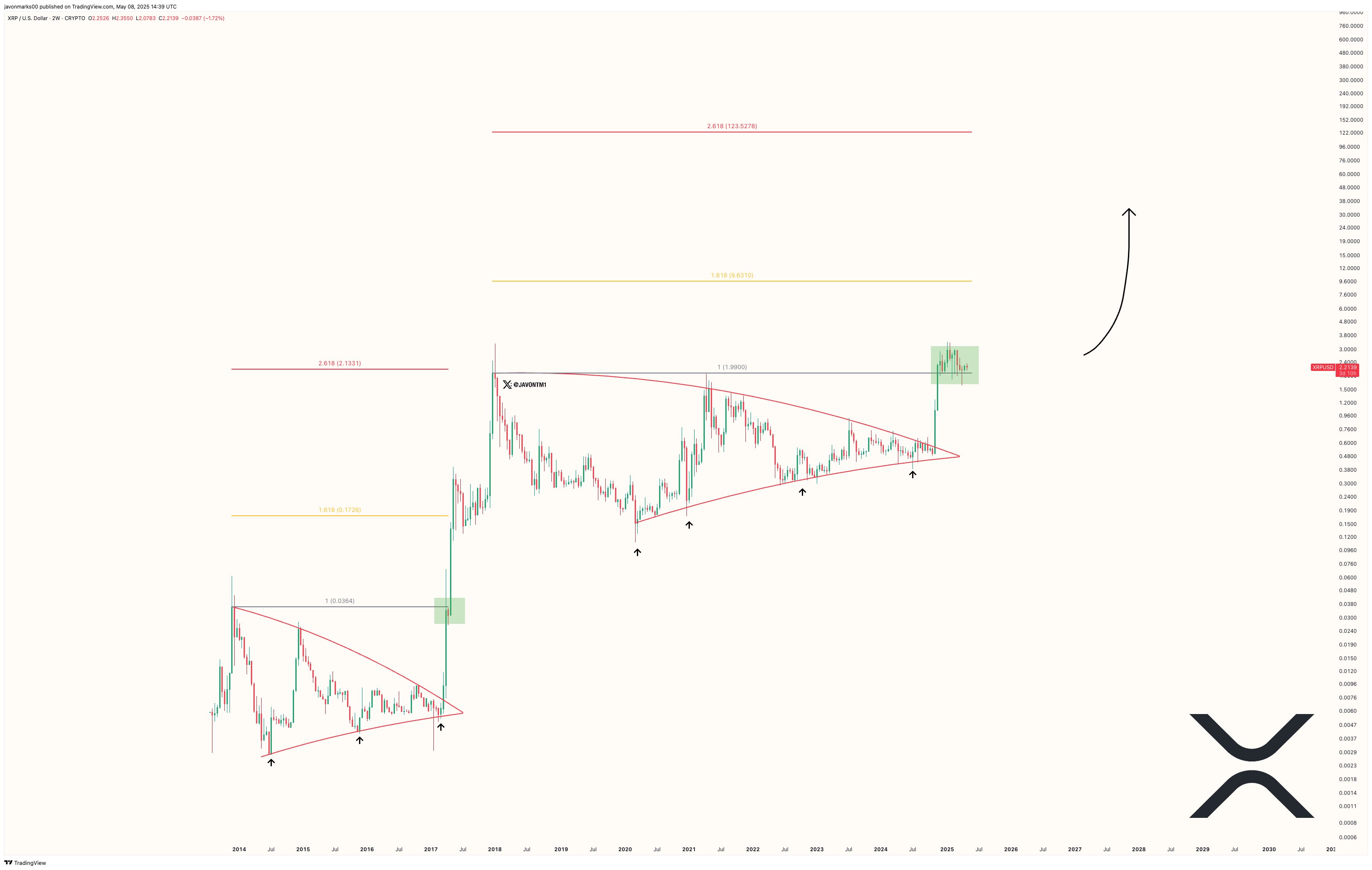
In his commentary on XRP’s performance, analyst Javon Marks shared a chart comparing XRP’s recent breakout to a similar technical pattern from 2017. At that time, XRP broke out of a pennant formation that spanned about two years.

XRP rallied from consolidation lows, where it traded with two leading zeros, to above the 2.618 Fibonacci extension, translating to a peak above $2.10.

During this climb, XRP formed local tops at the $0.0364 price mark (the 1.00 Fibonacci level), consolidated briefly, and broke out to the 1.618 Fibonacci level, equivalent to $0.1726. It then consolidated for several weeks before completing the bull run. Ultimately, XRP surpassed the 2.618 Fibonacci level and reached highs above $3.

Image
XRP chart by Javon Marks

Meanwhile, XRP entered a more prolonged consolidation phase that lasted over seven years. Marks’ chart confirmed that XRP has now completed the breakout from the multi-year pennant pattern, which formed in 2018.

This breakout has already pushed XRP into the $2+ range, slightly above the 1.00 Fibonacci level. Interestingly, the pattern XRP is forming now mirrors the early stages of the 2017 price explosion.

In particular, XRP has slipped into a ranging phase following the initial momentum from its breakout, cooling off the frenzy. Marks believes the second phase of a full-scale bull run is about to take shape. 

According to his chart, the next target before another period of consolidation is the 1.618 Fibonacci extension, equivalent to a price of $9.63.

Why $123 Is on the Radar

By applying the same Fibonacci logic to the current structure, Marks forecasts that XRP could again climb to the 2.618 Fibonacci extension, which this time sits around $123, after surpassing the 1.618 level. According to his estimation, this would represent a more than 50X increase from current price levels.

If such a move were to materialize, it would not only mark XRP’s highest valuation in history but would also place it among the top contenders in market capitalization, rivaling Bitcoin and Ethereum.

Specifically, at a $123 price, XRP’s market cap based on the current circulating supply of 58.55 billion tokens would be approximately $7.2 trillion. This is larger than the current combined market caps of Bitcoin and Ethereum, as well as the overall crypto market.

Caution Amid the Hype

While the technical setup is compelling, other analysts have cautioned that history doesn’t always repeat itself. In particular, some members of the XRP community believe the 2017 fractal is no longer relevant for future projections.

Critics of the $123 price target argue that such an audacious valuation, and the implied $7 trillion market cap, represent an overestimation of XRP’s potential in the current cycle. As a result, they advise holders to take profits strategically rather than waiting for these extreme price levels to materialize.

Why XRP Could Be the Next Bitcoin, Researcher Highlights Evidence from 8 Documents

A well-known researcher and XRP community figure has presented what he believes is evidence that XRP may be the next Bitcoin.

For context, in a recent interview, media figure Dave Portnoy shared that he’s invested in XRP. Interestingly, he admitted his decision was not from deep research but rather from the fear of missing out. Portnoy explained that if XRP turns out to be the next Bitcoin, experiencing a massive surge in value, he does not want to miss out.

Following this, SMQKE, a researcher, brought together information from eight different documents that discussed why XRP could genuinely follow in Bitcoin’s footsteps. These documents, collected from various credible sources over the years, point to XRP’s features and growing relevance in global finance.

XRP Uses a Different, More Efficient Transaction Approach

One report from December 2022, titled First Demonstration Experiment for Energy Trading System EDISON-X using XRP Ledger, shares how the XRP Ledger (XRPL) uses a different approach than Bitcoin or Ethereum to process transactions. 

Specifically, the XRPL relies on a system called the Federated Byzantine Agreement, which allows it to process transactions in just 3 to 4 seconds, at a very low cost, under a penny, and with high scalability. 

This makes it ideal for quick and inexpensive payments, but also opens the door to other uses like NFTs and DeFi. The report also noted that the XRP Ledger became carbon neutral in 2020, an important point as more industries aim to reduce their environmental impact.

Meanwhile, another mention came from Dcfintechweek, where industry experts highlighted the importance of cryptocurrencies that serve a purpose. Interestingly, the report named XRP as one of the digital assets that is helping drive real progress in finance.

Further, SMQKE also pointed to a document from Morgan Stanley. It recognized that XRP’s process of confirming transactions is far more energy-efficient than Bitcoin’s. Also, while Bitcoin takes around 10 minutes to process a block, XRP gets the job done in just 3 to 5 seconds. 

Although the report mentioned that XRP relies on a more centralized process than Bitcoin, it also made clear that XRP’s system shares some features with traditional banking. This may be an advantage in terms of adoption and regulation.

In addition, a report from Trade Finance Global mentioned that Ripple emerged to improve cross-border payments. The report described XRP as something like “Bitcoin for banks,” noting that several large financial institutions are already testing or using Ripple’s technology in their operations.

Reports from Nocash, ADB, and Waterford

Meanwhile, a document from nocash.ro discussed ISO 20022, a global standard for financial messaging. It explained that this standard could help level the playing field between traditional currencies and digital ones. 

XRP, being one of the few assets ready for ISO 20022, is on track to work alongside central bank digital currencies. According to the document, this is something Bitcoin and many other cryptocurrencies do not have, giving XRP a potential edge.

Further, a report from the Asian Development Bank (ADB) highlighted XRP’s unique place in global finance. It explained that while many assets like Bitcoin and Ethereum are often treated as being outside the system, XRP and Ripple are more frequently recognized as part of formal payment networks. 

SMQKE also presented a 2018 letter sent to the U.S. Federal Reserve by Brenden Sheehan, a concerned banking customer. He recommended the Fed partner with Ripple to modernize outdated U.S. payment systems. 

He praised Ripple’s speed, safety, and reliability, and warned that if the U.S. did not adopt this kind of innovation, it could fall behind other countries already exploring faster, tech-driven financial systems.

Finally, a report from the Waterford Institute of Technology concluded that Ripple boasts improvements over both SWIFT and the Bitcoin network. It suggested that banks could embrace Ripple’s system to upgrade the current payment experience for users and businesses alike.

Essentially, all eight documents presented by SMQKE point to the idea that XRP has the potential to be more than just another cryptocurrency. As a result, SMQKE believes the asset could very well be the next Bitcoin.

FTX to Disburse Over $5 Billion in Second Creditor Payout

0

FTX has confirmed it will initiate its second round of creditor distributions on May 30, 2025, in line with its Chapter 11 Plan of Reorganization. 

According to a recent press release, the upcoming distribution will exceed $5 billion and be allocated to claimants across several designated creditor classes. 

FTX Recovery Trust stated that eligible participants must have completed all pre-distribution steps to receive funds through their selected service providers. This event marks the first wave of non-convenience class payouts under the approved reorganization structure.

Once a leading name in the U.S. cryptocurrency exchange market, FTX collapsed following a rapid liquidity crisis. The company filed for bankruptcy in November 2022 after users rushed to withdraw funds amid revelations of financial misconduct. 

Reports indicated that founder Sam Bankman-Fried had diverted approximately $8 billion in customer assets to Alameda Research, an FTX trading firm.

Distribution Amounts by Creditor Class

Notably, according to details outlined in the Plan, each allowed claim class will receive specific percentage allocations based on a priority waterfall. The largest group is Class 5A Dotcom Customer Entitlement Claims. Specifically, this set will get a 72% distribution. Meanwhile, Class 5B U.S. Claims comes next and will get a 54% payout.

Other classes, like the Digital Asset Loan and General Unsecured Claims, will receive 61% of their approved claim amounts.

Separately, the Convenience Claims grouped under Class 7 will get a 120% distribution. This payment framework follows the structured guidelines detailed in FTX’s bankruptcy resolution and reflects distribution percentages proportional to each class’s claim value.

Timing and Distribution Logistics

FTX specified that distributions will be processed through either Bitgo or Kraken, depending on each creditor’s selection. Those who meet the requirements can expect to receive their payments within one to three business days following the May 30 start date.

Distribution Service Providers will deliver funds directly to users’ accounts, following prior agreements made during the onboarding process.

Importantly, customers who completed onboarding with a provider have formally waived the option to receive direct cash payments from FTX. Instead, they have authorized distributions to be transferred through their chosen provider. This method aligns with the operational plan and ensures streamlined payouts.

FTX Sues Two Firms Over Token Transfer Failures

This news came only weeks after the FTX initiated legal action against two crypto-related firms for allegedly failing to deliver digital assets as previously agreed. 

According to filings, the entities named in the lawsuit are NFT Stars Limited and Kurosemi Inc., accused of non-compliance with contractual obligations to transfer specific tokens to the now-defunct exchange.

14 US States Hold $632M in MicroStrategy Stock as Public Funds Increase Bitcoin Exposure

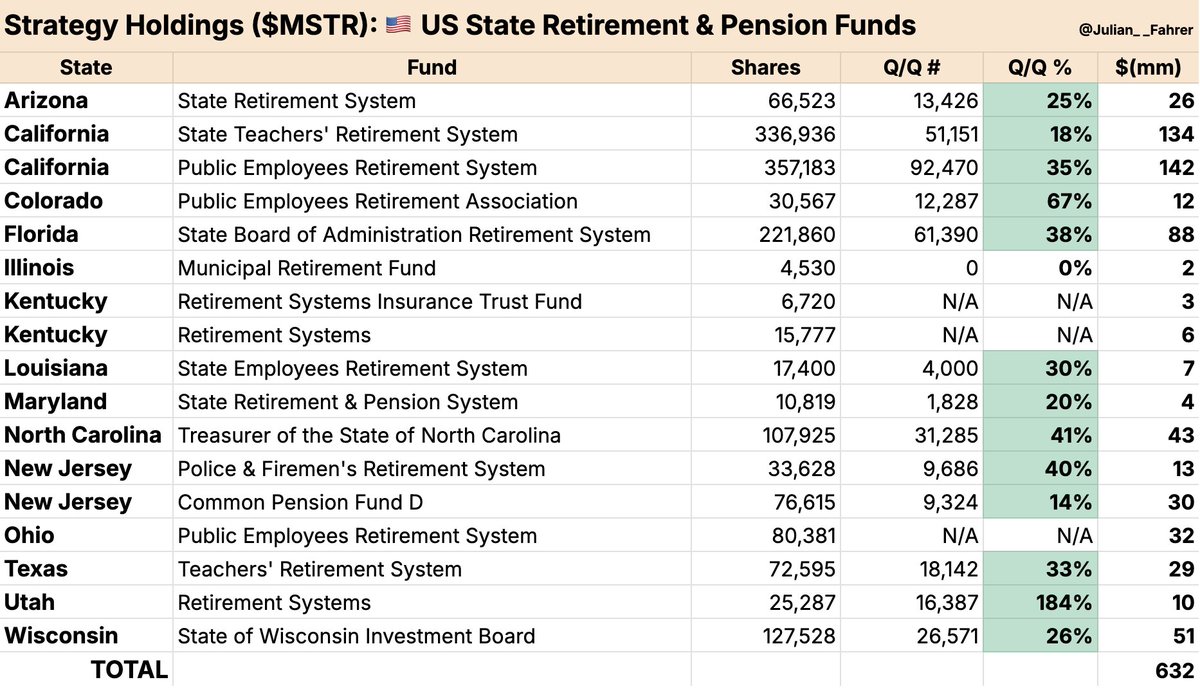
At least 14 U.S. state public retirement and pension funds now collectively hold $632 million in MicroStrategy (MSTR) stock, a company best known for its large Bitcoin treasury.

The data, compiled by Julian Fahrer, founder of Bitcoin Laws, highlights a strong quarterly increase of $302 million, underscoring the expanding role of Bitcoin-linked equities in government portfolios.

MicroStrategy as a Gateway to Bitcoin

MicroStrategy (now rebranded as “Strategy”) has become widely recognized as a proxy for Bitcoin exposure due to its long-term strategy of acquiring and holding BTC on its balance sheet. For public funds seeking indirect exposure to Bitcoin without holding the asset directly, MSTR has emerged as a preferred vehicle.

In Q1 2025, the combined investment from these 14 states reflects a growing appetite for Bitcoin-aligned equities. On average, the state funds increased their position size in MSTR by 44% compared to the previous quarter.

California, Florida, and Wisconsin Lead the Pack

California led the group with the largest total holdings. The State Teachers’ Retirement System and the Public Employees Retirement System held a combined 694,119 shares, worth over $276 million.

Florida followed with 221,860 shares worth approximately $88 million, while Wisconsin held 127,528 shares, totaling $51 million in exposure. Other notable holdings include:

  • North Carolina: 107,925 shares ($43 million)
  • Ohio: 80,381 shares ($32 million)
  • Texas: 72,595 shares ($29 million)

Fastest Growing Positions

Meanwhile, Utah’s Retirement Systems reported the most aggressive quarterly increase, with holdings surging 184% to 25,287 shares. Colorado also showed notable growth with a 67% jump in shares, followed by Florida (38%), Texas (33%), and Louisiana (30%).

Other states that reported an increase in their exposure include Arizona, Maryland, and New Jersey. The overall trend confirms broader acceptance of Bitcoin-aligned investment strategies.`

Image
Spreadsheet showing U.S. state exposure to Bitcoin MSTR by Julian Fahrer

Interestingly, some of these states are pursuing legislation to permit the investment of state funds directly in Bitcoin and strategic BTC reserves. Notably, data from Bitcoin Laws shows that 47 crypto-related bills have been introduced across 26 U.S. states, with 37 currently active.

Some, like New Hampshire, have achieved success. Governor Kelly Ayotte signed into law earlier this month a bill permitting up to 5% of the state treasury to be invested in Bitcoin. However, in states like Florida, similar initiatives have failed.

Others, like Arizona, are seeing partial success, with support for unclaimed asset applications but rejection of state treasury investment in Bitcoin.

Bitcoin Exposure by Proxy Becoming Mainstream

Despite the cautious approach still prevalent among many states, this influx of state-managed public funds into MSTR signals a new level of Bitcoin adoption among institutional and government-managed entities.

While direct crypto ownership by these entities remains rare, the strategic use of Bitcoin-aligned equities offers a regulatory-compliant and familiar method for gaining exposure.

Here’s What the Shiba Inu Team Has Done for the SHIB Ecosystem

0

A recent piece has highlighted the incredible role the Shiba Inu team has played in sustaining the SHIB ecosystem and keeping Ryoshi’s legacy.

Ryoshi created Shiba Inu in August 2020 as a decentralized ERC-20 token without presales, VC funding, or massive developer allocation. Five years later, the token has become central to a growing ecosystem despite a change at the helm.

For perspective, the pseudonymous creator disappeared in May 2022, leaving the Shiba Inu ecosystem in the hands of the current leaders piloted by Shytoshi Kusama. Since then, the team has led the ShibaArmy to a greater cause than owning a meme coin.

In a recent tweet, the Shiba Inu ecosystem marketer, Lucie, highlighted some milestones the team has helped the ecosystem achieve in their three-year tenure.

Adoption and Expansion

The Shiba Inu ecosystem team has kept Ryoshi’s dream alive despite his absence and has piloted the expansion of the ecosystem to a crypto powerhouse, according to Lucie. 

It started with the development of the ShibaSwap, a decentralized marketplace launched in 2021 where users can trade Shiba Inu and other ecosystem tokens. Furthermore, its introduction of staking, on-chain governance participation, and liquidity farming has made a difference.

In 2023, the Shiba Inu team launched the Shibarium network, an Ethereum layer 2 blockchain, which allowed users to transact cheaply and swiftly. Further, the ecosystem developers debuted an auto-SHIB burn mechanism, which uses a portion of the transaction fees on the blockchain to buy and incinerate Shiba Inu.

Soon enough, Shiba Inu became a household name in the space, drawing interest from tier-1 exchanges, including Binance, Coinbase, Kraken, and Crypto.com. Currently, SHIB is listed on over 100 major exchanges globally.

Maturity to Compete Squarely in An Evolving Space

Kusama has often stressed the team’s focus on utility, which transcends its meme coin origin. While newer and better features are on the horizon, the Shiba Inu ecosystem has achieved an impressive feat in real-world utility and adoption, spurred by the team.

For perspective, the meme coin became a means of payment for global brands and retail outlets. Some of the prominent entities that accept SHIB payment include Newegg, AMC Theatres, Gucci, Travala.com, NowPayments, and Flexa.

The team also brought gaming and NFTs to the Shiba Inu ecosystem. The development of the popular Shiba Eternity, whose Web3 version is currently in closed beta, the Lap Dogs, and Agent Shiboshi, among others, drew gamers to the network. They also introduced in-game NFT collectibles, which could be bought and sold in the marketplace.

Other Shiba Inu team innovations include the Shib: The Metaverse and the Shib OS. The team has also launched campaigns and charitable donations to give back to society.

Interestingly, Lucie stressed that these innovations have kept Shiba Inu in the spotlight and upheld decentralization, a core vision of its creator, Ryoshi.

Researcher Explains How XRP Could Surge to $5–$15 in Short Term and $20–$75 in Long Term

Crypto researcher Rob Cunningham recently outlined bold projections for XRP, suggesting that recent developments could propel the token’s price well into double digits.

Cunningham believes XRP could reach $5 to $15 in the short term and climb to $20 to $30 or higher over the long term. Supporting these claims are real-world utility, institutional demand, and regulatory progress.

Notably, the chief factor influencing his forecast is the potential supply pressure that Hidden Road’s use of the XRP Ledger could exert on the token’s availability.

Hidden Road Could Lock Up Billions in XRP Liquidity

In April, Ripple acquired the global multi-asset prime brokerage Hidden Road for $1.25 billion. The firm handles $10 billion in daily trading volume, which, according to XRP community commentators, could significantly boost demand for the coin.

Cunningham suggests that if just 30% of Hidden Road’s daily transactions were settled on the XRP Ledger, about $3 billion per day or $1.5 trillion annually, substantial XRP liquidity would be required.

He estimates this could lock up around 2.7 billion XRP, or 5% of the circulating supply, thereby reducing available tokens and creating upward price pressure. According to his forecast, this dynamic alone may push XRP’s price to $5–$15 in the near term. In the long run, he sees $20–$30 or more as a realistic target.

ETFs and CME Futures Set to Attract Global Institutional Demand

Cunningham further strengthened his forecast by highlighting the expanding institutional access to XRP. He pointed to 11 XRP ETF applications currently filed with the U.S. SEC, as well as the upcoming launch of CME Group’s XRP futures on May 19, 2025.

Already, products like the Teucrium 2x Long Daily XRP ETF reached $35 million in AUM just days after launch. This is evidence of strong early demand, according to Cunningham. With CME futures offering regulated access, hedge funds, asset managers, and banks can gain exposure to XRP in a compliant environment.

For now, the key milestone to watch is the SEC’s decision on Grayscale’s spot XRP ETF due by May 22.

ISO 20022 Standard “Positions” XRP for Cross-Border Payments Boom

Cunningham also touched on XRP’s speculative compliance with the ISO 20022 standard, which he claims gives it a strategic edge in global finance. Notably, Ripple itself is compliant with ISO 20022, though XRP proponents often link the standard to the token.

Analysts highlighted that this messaging standard will power 80% of high-value global transactions by 2025. Cunningham argued that XRP’s interoperability with ISO 20022 could make it a preferred solution for real-time cross-border settlement.

He cited over $434 billion processed daily through ISO 20022-compliant systems, asserting that XRP is in a position to benefit from this, particularly in international remittances.

FedNow and Real-Time Payments “Could Support XRP’s Broader Utility”

While XRP isn’t directly integrated into FedNow, the broader U.S. trend toward real-time payments supports the value proposition of fast, low-cost settlement systems. In this space, XRP has long positioned itself as a leader.

Cunningham suggests that this shift in infrastructure could ultimately benefit assets like XRP, especially if they are embraced by financial institutions seeking to modernize their payment processes.

$30–$75 Still in Play

By tying together real utility, upcoming financial products, and growing adoption momentum, Cunningham believes XRP is ready for explosive price movement.

“If XRP isn’t between $30 and $75 by the end of 2025, I’d be in utter disbelief,” he said.