Home Blog Page 74

Shiba Inu Surpasses 1.6M Holders as Investors Accumulate 51B SHIB From Exchanges

0

Shiba Inu surpasses 1.6 million holders but drops out of the top 30 cryptos as price slips; on-chain data and technical signals still show bullish momentum. 

Shiba Inu initially entered July on a bullish note, recovering part of its recent losses and briefly reclaiming a spot among the world’s top 30 cryptocurrencies by market cap. As market sentiment improved, the meme coin climbed to the 29th position.

However, the rally quickly lost momentum. SHIB subsequently fell from around $0.0000045 to around $0.0000043, causing the token to surrender its top-30 status.

At press time, SHIB trades at $0.000004399 with a market cap of $2.59 billion, making it the 31st-largest cryptocurrency by market cap. The token currently trails Near Protocol and Cronos, which occupy the 30th and 29th positions with market valuations of $2.59 billion and $2.74 billion, respectively. 

Shiba Inu Drops Out of Top 30

Shiba Inu Holder Count Surpasses 1.6 Million

Although SHIB temporarily lost ground in the market rankings, the network achieved a significant milestone in user adoption.

According to data from Etherscan, the number of on-chain Shiba Inu holders has surpassed 1.6 million for the first time. Moreover, SHIB has maintained steady growth since the beginning of July, adding more than 1,700 new wallet addresses during the month.

As of press time, a total of 1,600,003 addresses hold SHIB tokens. The steady rise in holder count suggests that investors continue to view recent price weakness as a buying opportunity rather than a reason to exit their positions. 

Shiba Inu Crosses 1.6M On chain Holders
Shiba Inu Crosses 1.6M On-chain Holders 

Exchange Data Points to Continued Accumulation

Exchange flow data further reinforces the bullish sentiment among investors. Over the past 24 hours, investors withdrew approximately 445.1 billion SHIB tokens from exchanges while depositing only 393.72 billion tokens. Consequently, the token recorded a negative exchange netflow of 51.38 billion SHIB, indicating that more tokens left exchanges than entered them.

Typically, investors transfer assets to private wallets when they intend to hold them for the long term rather than sell them immediately. As a result, analysts often interpret negative exchange netflows as a sign of accumulation.

Meanwhile, exchange reserves remain substantial at 86.97 trillion SHIB. Even so, the recent wave of withdrawals stands out because it follows a significant inflow event that previously sent roughly 665 billion tokens to exchanges. 

Shiba Inu Exchange Flowss
Shiba Inu Exchange Flows

July Has Historically Favored SHIB

Historically, July has delivered mixed but generally positive returns for Shiba Inu. The token suffered a sharp 28.5% decline in July 2021, marking its worst July performance to date. However, sentiment improved considerably over the following years, with SHIB posting gains of 13.4% in July 2022 and 11.8% in July 2023.

Although SHIB closed July 2024 with a 7.47% loss, the token reversed course the following year, finishing the month with an 8.92% gain. Despite giving up part of its early-month gains, SHIB remains up 4.74% so far this July.

Overall, the token has generated an average July return of 0.47% and a median return of 6.82%, underscoring the month’s tendency to support bullish price action. 

Shiba Inu Monthly Return
Shiba Inu Monthly Returns 

Analysts Spot a Mini Golden Cross That Could Fuel a 9% Surge

Beyond the encouraging on-chain metrics, technical indicators have also begun flashing bullish signals. Most notably, analysts identified a “Mini Golden Cross” on the four-hour chart after the 23-period moving average crossed above the 50-period moving average near $0.000004346. 
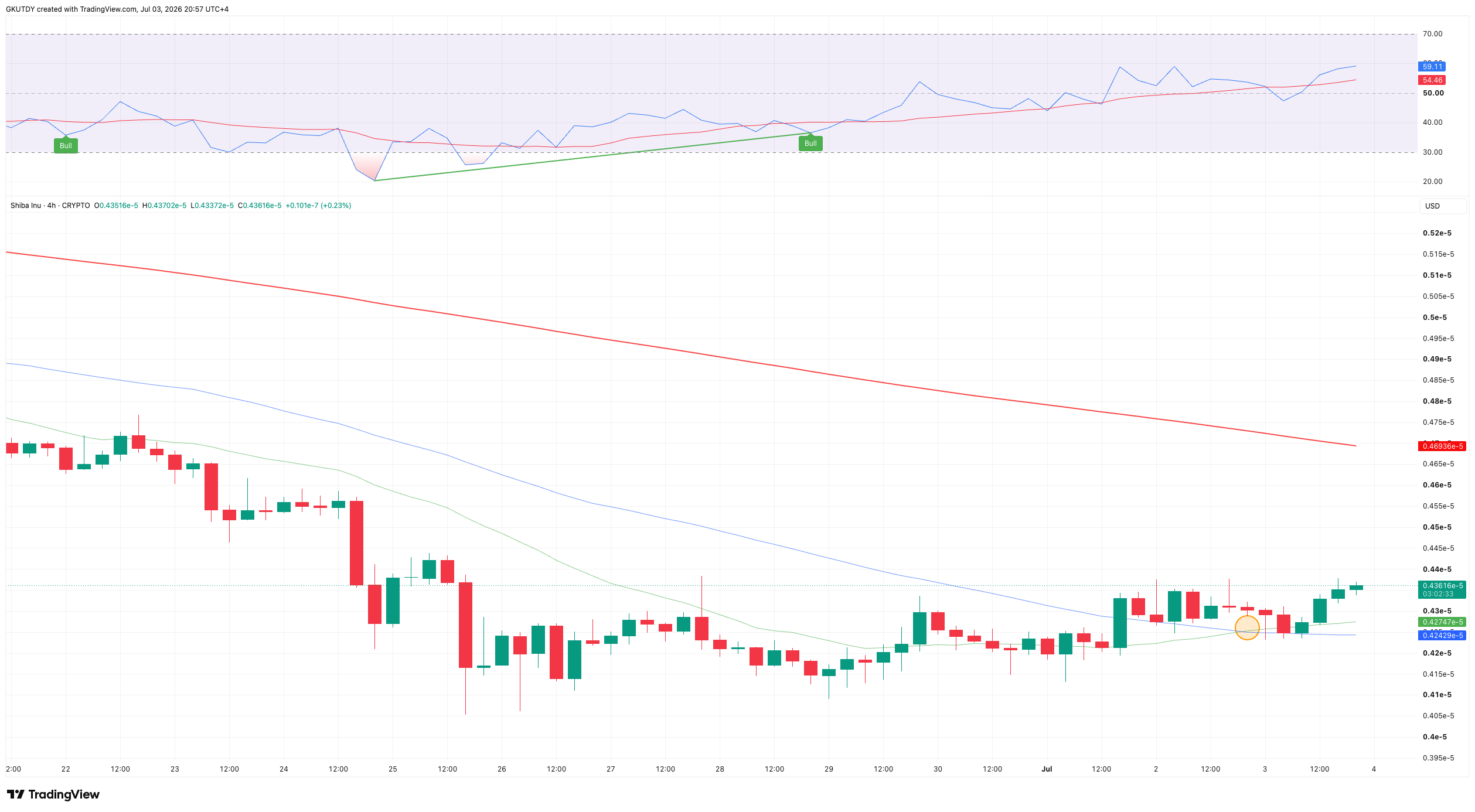
This crossover signals that buying pressure may be starting to outweigh recent selling activity, potentially marking the beginning of a short-term trend reversal. As the Mini Golden Cross takes shape, analysts have started projecting further upside for SHIB.

Specifically, they expect the token to target the $0.00000470 to $0.00000480 range, which represents a potential gain of roughly 9% from current levels.

Nevertheless, bulls may encounter a major obstacle before reaching those targets. The 200-period moving average remains above the current price and could act as a strong resistance level if buying momentum weakens.

For now, Shiba Inu’s growing holder base, persistent exchange outflows, and improving technical structure indicate that investor confidence remains intact despite the token’s recent exit from the cryptocurrency top 30 rankings. 
XRP Nears Key Gaussian Retest as Analyst Says Decade-Long Pattern Is Reappearing

XRP could be approaching a key long-term technical level, according to analyst ChartNerd. 

The analyst believes the token is following a pattern that has repeated across multiple market cycles over the past decade.

While historical trends do not guarantee future results, ChartNerd said XRP’s recent decline could be setting up another major long-term buying opportunity.

XRP Approaches Gaussian Channel Support

ChartNerd highlighted XRP’s 3-month Gaussian Channel, noting that the asset is once again nearing the channel’s upper regression band after months of declines.

According to the analyst, XRP has retested this dynamic support in every previous market cycle before moving into a strong rally.

The chart points to similar Gaussian retests in 2017, 2020, and 2023. ChartNerd believes 2026 could now be following the same pattern.

The upper regression band currently sits around $0.86. However, that level is expected to gradually rise as the channel evolves.

The analyst also noted that XRP has not always reversed exactly at the band. In previous cycles, the price briefly fell below that level before recovering and entering a sustained uptrend.

Image

Bearish Momentum May Keep Pressure on XRP

Despite the potentially bullish long-term setup, ChartNerd warned that XRP’s correction may not be over.

The analyst said Heikin-Ashi candles continue to print large bearish bodies with no upper wicks. This pattern typically signals sustained selling pressure.

ChartNerd expects XRP to see a short-term relief rally. However, the broader downtrend may continue before the market forms a lasting bottom.

The combination of bearish momentum and the approaching Gaussian support creates what the analyst described as a notable technical confluence.

Notably, XRP has seen an over 3% gain over the past day, trading at $1.13. This has improved the weekly performance as XRP now boasts a 7% gain.

XRP chart CMC
XRP chart CMC

XRP Down More Than 72% From Recent High

ChartNerd also highlighted the scale of XRP’s decline. The cryptocurrency has dropped more than 72% over the past 11 to 12 months. Indeed, since XRP hit $3.65 in July 2025, it has fallen to $1.0098 in June 2026.

Rather than viewing the sell-off as a reason for panic, the analyst argued that similar corrections have historically preceded some of XRP’s strongest rallies. For instance, XRP’s price dipped 96% after its 2018 peak.

Amid hopes of recovery, ChartNerd said the current market is closer to a “generational entry,” suggesting the downside is now lower for those buying now.

Even so, the analyst stressed that no technical indicator can predict future price movements with certainty. Essentially, historical patterns are not guarantees. 

XRP Quietly Developing Double Bottom: Here’s the Neckline to Determine a Reversal

XRP may currently be forming a double bottom, but a bullish reversal would depend on a breach of the neckline.

XRP has stayed under pressure for most of 2026, with prices moving mostly downward. However, recent price action between early June and early July suggests that the selling pressure may be easing. 

During this period, XRP formed what looks like a developing double bottom pattern. However, this pattern is not yet complete, and the neckline at $1.29 will likely decide whether XRP can turn higher or continue its decline.

XRP Sees Two Bottoms

The structure began when XRP dropped below the $1.28 to $1.30 support range in late May. This breakdown led to the first bottom at $1.05 in early June. At that time, selling pressure was strong, with volume reaching 281.77 million XRP on June 5 and 141.36 million XRP on June 6.

After this drop, XRP recovered and climbed to $1.29 by June 15, forming the neckline. However, the recovery did not last. Sellers pushed the price lower again, leading to a second bottom at $1.0092 on June 26.

This second low slightly moved below the first, which can sometimes signal a bear trap. In such cases, sellers push the price below support, but fail to keep it there. 

Volume data supports this idea. Although trading volume reached 145 million XRP on June 26, it was still lower than the heavy selling seen on June 5 and June 6. This drop in volume while price moves lower often suggests that selling pressure is weakening.

Volume Shows Partial Recovery

At the start of July, XRP began to recover. On July 1, the price broke out of a range between $1.02 and $1.07. Since then, XRP has recorded three straight days of gains, reaching $1.1385.

Trading activity also increased during this move. Volume rose to 87.97 million XRP on the breakout day, up from 66 million XRP the day before. In the days that followed, volume stayed above 84 million XRP.

XRP Forming Double Bottom

However, this is still much lower than the levels seen during the sharp sell-off in early June. Current volume is only about 30% of what was recorded on June 5, which means the recovery still lacks strong confirmation.

On the other hand, broader market data shows some support. XRP spot ETFs have seen consecutive weeks of inflows, adding up to about $1.47 billion. Meanwhile, exchange outflows have increased by about 200%, rising from 40.7 million XRP on June 22 to around 123 million XRP. 

This suggests that investors are moving their holdings off exchanges, which reduces available supply. However, this has not yet shown clearly in price momentum.

The Neckline Remains the Key Level

The most important level to watch right now is between $1.28 and $1.29, where the neckline sits. XRP needs to close above this range and hold it to confirm the double bottom pattern. Without this move, the setup remains incomplete.

If XRP breaks above this level, the next target stands near $1.57. This comes from adding the pattern depth of $0.28 to the neckline. This target is also close to the previous high of $1.5496 on May 14, which acted as strong resistance before the earlier drop.

Before reaching the neckline, XRP faces several resistance levels. The 44-day moving average at $1.17 represents the first barrier, and the price is currently looking to test this area. Above that is the 0.382 Fibonacci level near $1.18.

Data on holder positions adds to these resistance zones. Around 22.8 million XRP is concentrated between $1.18 and $1.19, while another 27.4 million XRP sits between $1.21 and $1.22. These levels could attract selling as investors try to exit at break-even.

Even with this developing pattern, XRP is still in a larger downtrend that started after its 2025 peak above $3.50. This means the current setup is still a possible reversal within a bearish trend.

Australian Lawmaker, White House Official Report XRP Holdings in Financial Filings

XRP has appeared in two separate political financial disclosures from Australia and the United States.

Specifically, Australian federal lawmaker MP Sally Sitou and White House official Ian Kelley both reported holdings of the digital asset in their official filings. The disclosures have attracted attention in the crypto community. Interestingly, one filing lists XRP as the only cryptocurrency owned by the official.

Australian MP Lists XRP as Only Crypto Holding

Australian Labor MP Sally Sitou disclosed ownership of XRP in the Australian Parliament’s Register of Members’ Interests. The filing describes the asset as “Crypto currency (Ripple)” held through Australian exchange CoinSpot.

The disclosure shows XRP as Sitou’s only cryptocurrency investment. The filing does not list Bitcoin, Ethereum, or any other digital assets.

Australian Labor MP Sally Sitou's XRP disclosure
Australian Labor MP Sally Sitou’s XRP disclosure

Sitou also reported investments in physical gold through ABC Bullion and a large portfolio of traditional stocks and exchange-traded funds. Her Australian holdings include companies such as:

  • Telstra
  • Cochlear
  • Commonwealth Bank
  • BHP
  • Fortescue
  • AGL

She also disclosed several Vanguard ETFs covering Australian, international, Asian, and high-growth markets. The filing further lists U.S. stocks, including AMD, Meta Platforms, Qualcomm, Costco Wholesale, General Electric, GE Vernova, and Aecom.

White House Official Reports XRP in Coinbase Wallet

Separately, Ian Kelley, White House War Room Director and Special Assistant to the President, disclosed XRP holdings in a public financial filing submitted after his January 2025 appointment.

The filing reports XRP held in a Coinbase wallet with an estimated value of $1,001 to $15,000. Unlike Sitou’s disclosure, Kelley reported a diversified crypto portfolio. In addition to XRP, he listed holdings in:

  • Bitcoin
  • Ethereum
  • Solana
  • Chainlink
  • Cardano
Ian Kelley's crypto holdings with XRP
Ian Kelley’s crypto holdings with XRP

Each asset falls within the same $1,001 to $15,000 disclosure range. The filing also includes traditional financial assets, such as cash holdings, retirement accounts invested in mutual funds, and prior employment income from the Republican National Committee and Donald J. Trump for President 2024.

These disclosures add to a growing number of public financial filings that include XRP alongside traditional investment assets.

Neither filing reveals the exact amount of XRP owned. However, they show that public officials in both Australia and the United States hold the token, either as a standalone crypto investment or as part of a digital asset portfolio.

Cardano Founder Says Ripple Is Still Here After Years of Criticism, Praises Its Relentless Execution of Major Deals

0

Cardano founder Charles Hoskinson has acknowledged Ripple’s ability to consistently execute its strategy despite enduring years of criticism from across the cryptocurrency industry.

Speaking on The Breakdown podcast with host David Gokhshtein, Hoskinson noted that Ripple has remained focused on expanding its business regardless of public opinion or industry backlash.

According to Hoskinson, Ripple’s greatest strength lies in its ability to continually launch products and secure major partnerships. 

Ripple Continues to Deliver Products and Partnerships

He pointed to the December 2024 launch of RLUSD, Ripple’s dollar-backed stablecoin, as evidence of the company’s continued expansion into new markets.

In addition, Hoskinson highlighted Ripple’s reported $1.25 billion acquisition of Hidden Road, which was subsequently rebranded as Ripple Prime. In his view, the deal is another example of Ripple’s determination to pursue large-scale institutional opportunities.

Beyond individual deals, Hoskinson emphasized that Ripple has successfully onboarded hundreds of banking partners over the years, significantly strengthening its position within the global financial system. Most of these institutions rely on Ripple’s payment infrastructure, particularly Ripple Payments, to facilitate cross-border transactions and settlements.

More recently, Ripple CEO Brad Garlinghouse told CNBC that the company now processes approximately $16 trillion in annual payments and clearing activity across its businesses.

Results Matter More Than Popularity

While acknowledging that industry participants may disagree with some of Ripple’s decisions, Hoskinson argued that it is difficult to ignore the company’s track record of product launches, partnerships, and business expansion over more than a decade.

In his view, longevity in the cryptocurrency industry rarely happens by accident. Instead, surviving multiple market cycles, regulatory battles, and shifts in investor sentiment requires disciplined execution rather than short-term hype.

Therefore, he stressed that Ripple’s continued relevance after more than twelve years demonstrates the importance of consistently building products and delivering measurable results.

This is not the first time Hoskinson has publicly acknowledged Ripple’s achievements, despite occasionally disagreeing with Garlinghouse and segments of the XRP community. Previously, he celebrated Ripple’s legal victory against the U.S. SEC, praised the XRP community, and described the XRPL Unique Node List (UNL) as a “well-reasoned” system. 

The Same Philosophy Applies to Cardano

Meanwhile, Hoskinson stressed that crypto projects must continue building regardless of growing criticism, summarizing his philosophy with a simple message: “you gotta build.”

The statement reinforces the idea that long-term relevance comes from creating products, attracting users and partners, and consistently delivering on promises. Ironically, Cardano itself is currently facing increasing scrutiny over the performance of its native asset, ADA, governance disagreements, developer departures, and the shutdown of a few ecosystem projects.

Nevertheless, Hoskinson, along with Input Output Global and other founding organizations, continues to pursue initiatives aimed at improving Cardano’s competitiveness.

Shortly after unveiling the testnet for Leios, Hoskinson revealed that Cardano is preparing for the largest upgrade in the network’s history. According to him, the transformation will revolve around RealFi initiatives, the Midnight privacy ecosystem, and expanding opportunities in Bitcoin DeFi.

25-Year-Old Entrepreneur Mohammad Alvee Builds Success With And Launches AlveeFX Trading Education Platform

At a time when unemployment continues to challenge millions of young people around the world, one young entrepreneur is proving that age is no barrier to success.

Meet Mohammad Alvee, a 25-year-old self-made entrepreneur who chose to create opportunities instead of waiting for a job. While many people of his age are still searching for employment or completing their university education, Mohammad Alvee has already established himself as a multi-millionaire entrepreneur through his international e-commerce business.

As the Founder and Owner of Alvee Express, he has built a successful cross-border e-commerce company serving customers across multiple countries. Through hard work, innovation, and strategic business planning, he has transformed his vision into a globally successful enterprise.

But his journey did not stop there.

Recognizing the growing interest in financial education and trading, he founded AlveeFX, an online trading institute dedicated to helping aspiring traders develop professional skills and gain practical knowledge of the financial markets. The institute provides structured education and expert guidance to help individuals build successful careers in trading.

To learn more about AlveeFX, visit: website.

AlveeFX also has an official Telegram community, which has become highly popular among traders: Telegram.

Today, Mohammad Alvee continues to inspire thousands of young entrepreneurs. He has demonstrated that success comes through hard work, consistency, and the courage to think beyond conventional career paths.

His journey reminds us that with determination, a positive mindset, and a commitment to continuous learning, age can never be a barrier to achieving extraordinary success.

This is not just the story of one entrepreneur, it is the story of a new generation creating opportunities, driving innovation, and shaping the future.

AlveeTrade – Free forex signals, mentorship, and community. Join our Telegram channel now. Telegram Alvee FX

Disclaimer: This Press release article is provided by the Client. The Client is solely responsible for this page’s content, quality, accuracy, products, advertising, or other materials. Readers should conduct their own research before taking any actions related to the material available on this page. The Crypto Basic is not responsible for the accuracy of info and any damage or loss caused or alleged to be caused by the use of or reliance on any content, goods, or services mentioned in this press release article.

Please note that The Crypto Basic does not endorse or support any content or product on this page. We strongly advise readers to conduct their own research before acting on any information presented here and assume full responsibility for their decisions. This article should not be considered investment advice.

Every Year XRP Saw Declines in Q1 and Q2, A Recovery Ensued in Q3

0

Market data confirms that each year XRP recorded consistent declines in Q1 and Q2, a recovery ensued during the third quarter of the year.

XRP has not escaped the ongoing downtrend that began in October 2025, down 40.17% this year alone despite the recent rebound effort in July. However, market data points to an encouraging pattern that could provide some relief in the short term.

Notably, XRP has often alternated between gains and losses in the first and second quarters of each year since it started trading in the public market in 2013. However, in rare cases where it saw consistent losses in Q1 and Q2 within a particular year, the market always delivered gains during the third quarter.

XRP Quarterly Performance in 2014

This pattern has played out three times since 2013. The first instance was in 2014 after XRP saw a strong pullback following the impressive gains recorded the previous year. Specifically, XRP first collapsed nearly 68% in Q1 2014 and then by another 57% in the second quarter of that year.

Notably, during this period, XRP saw consistent losses across multiple consecutive months, including -24.9% in January 2014, -33.62% in February 2014, -35.73% in March 2014, -38.95% in April 2014, -22.53% in May 2014, and then -8.61% in June 2014. 

However, a recovery campaign ensued in July 2014, as the market introduced a relief bounce amid the downtrend. Specifically, XRP gained 36.73% in July 2014, rising from $0.00379 to $0.00519. Despite seeing mild losses in August and September 2014, Q3 closed with a 22.9% upsurge.

XRP Quarterly Performances in 2018 and 2022

The other two times this pattern played out were during the bear markets of 2018 and 2022. After reaching the $3.31 peak in January 2018, XRP recorded its most devastating crash in recorded history over a 3-month period, leading to a massive 77.7% loss in Q1 2018.

The downtrend persisted into the next quarter. Despite an impressive 67% recovery in April 2018, the declines in subsequent months brought Q2 2018 performance to -9.1% for XRP.

While the downtrend slipped into the start of the third quarter, XRP saw a 73.6% increase in September 2018, and this was enough to offset the losses from July and August, leading to a 24.4% rebound in Q3 2018.

XRP Quarterly Performances

For the 2022 bear market, XRP first saw a mild 2.14% loss in Q1 despite gains in February and March. However, the Terra implosion resulted in steeper declines in Q2, with XRP dropping 59.4% during that quarter. Interestingly, Q3 introduced a 44.5% recovery while the bear market remained intact.

XRP Already Following the Pattern

This year, XRP has already recorded losses in the first and second quarters, with a 27.1% decline in Q1 and a 22.4% drop in Q2. This follows a 35.4% crash during Q4 2025, as the bear market drags on.

Interestingly, the asset already seems to be following the recorded pattern, as it embarks on an early recovery push in July 2026, which has put Q3 at a gain of 6.05% as of the time of reporting.

Market data suggests that XRP has seen an average gain of 17.3% in Q3 since it started trading in 2013. While Q3 has not delivered the highest average gain, this quarter appears to have seen the most consistent recoveries in history, with only three instances seeing declines in 13 years.

If XRP maintains the pattern and records at least the average 17.3% gain for this quarter, it could close the quarter with a recovery above the $1.20 level. While this may provide a glimmer of hope, there is no guarantee that Q4 will extend the rebound push.

CAKE Long-Term Structure Breakout Targets 630% Rally to $10

0

The long-term target for CAKE is $10, as it continues to hold the lower support of a long-term price structure on higher timeframes.

CAKE, the native token of PancakeSwap, is currently trading near a long-standing support zone that has repeatedly acted as a floor over the past two years. Meanwhile, the 1-week chart shows this is part of a larger compression within a broader symmetrical triangle with bullish implications upon breakout.

CAKE Holds Multi-Year Triangle Support

The recent price structure indicates that CAKE may be building a base after an extended decline. On the weekly chart, CAKE trades close to the lower boundary of a symmetrical triangle that has formed since late 2023.

Since the structure started forming in October 2023, the token has recorded a series of lower highs and higher lows. Additionally, the structure has continued to compress slowly, building momentum for a subsequent breakout.

Currently, CAKE trades near the lower support of this symmetrical triangle. The recent downtrend took the coin to a low of $1.12 in early June before rebounding to its current price of $1.37.

CAKE Symmetrical Triangle

While the possibility of one final decline toward the psychological $1 level remains, such a move could mark a potential final support sweep. This scenario could most likely happen if the broader cryptocurrency market, especially Bitcoin, drops to lower prices.

Meanwhile, holding this $1.12 support paves the way for a rebound to higher prices. The natural target is the upper resistance trendline, where prices have repeatedly faced rejection, currently near $3.40.

CAKE Breakout Targets $10

In an optimistic scenario where CAKE eventually breaks above the triangle’s descending resistance line, the target is a strong upsurge to multi-year highs.

The first upside target sits between $3.90 and $4.50, a region that aligns with previous resistance while prices trended within the structure. Notably, this 184% to 228% growth from the current market price could serve as the first take-profit area. 

Should bullish momentum continue beyond that level, the next major rally target is between $9 and $10, a 557% to 630% pump from here. This would take the CAKE token to price levels last seen in April 2022.

Meanwhile, between these two major targets are micro-resistance regions. Specifically, levels at $5.45 and $8.50 are areas of interest, where CAKE might face mild opposition.

In the meantime, CAKE continues to face declining futures and spot demand despite its 2% in the past 24 hours. During this period, Coinglass futures flows show that traders are closing more derivative contracts than opening, with inflows at $2.48 million and outflows at $2.82 million.

CAKE Futures Flow/Coinglass

Spot buyers are also increasingly moving more CAKE to exchanges than they are withdrawing to self-custody wallets. Coinglass’s spot inflows stand at $853,640 and outflows at $701,170, suggesting increased selling pressure.

XRP Faces Crucial Breakout Test, Analyst Maps Path Toward $7.50

XRP entered July 2026 below its 50-month Simple Moving Average (SMA), a development that analyst EGRAG believes could shape the rest of this market cycle.

He said the $1.65 price level remains XRP’s key macro resistance. A decisive breakout above it could mark the start of the asset’s next major expansion phase. Notably, XRP is trading at $1.07, up 3.71% over the past day.

XRP Starts July Below the 50-Month SMA

EGRAG noted that XRP opened July trading below its 50-month SMA. Historically, this has often preceded one final correction before a major rally.

Based on previous market cycles, XRP typically formed its final bottom around the 88-month SMA before beginning its strongest advances. If history repeats, the asset could revisit that level before its next macro breakout.

However, EGRAG said this cycle could unfold differently. If buyers quickly reclaim the 50-month SMA, XRP may avoid a deeper pullback altogether.

EGRAG Outlines Three Possible Scenarios

To assess XRP’s outlook, EGRAG assigned probabilities to three possible outcomes. The analyst sees a 55% chance that XRP will retest or briefly wick below the 88-month SMA before beginning its next expansion.

He also assigns a 30% probability that XRP quickly reclaims the 50-month SMA. In that scenario, the asset would skip a return to the 88-month SMA and break from its historical pattern.

The least likely outcome carries a 15% probability. In this case, XRP’s price would lose support around the 88-month SMA and require more time to build a new bullish structure.

Despite these different possibilities, EGRAG said one resistance level remains the most important.

$1.65 Is the Key Level to Watch

EGRAG identified $1.65 as XRP’s defining macro resistance.

According to his chart, XRP remains in what he calls “macro compression” until that level is decisively broken. Trading below the 50-month SMA continues to warrant caution. A successful reclaim of the moving average, however, would signal renewed strength.

The chart also suggests that a confirmed breakout above $1.65 could open the door to much higher long-term price targets.

Image

Breakout Could Trigger Move to $7.50 and Beyond

If XRP breaks above $1.65, EGRAG believes it could begin a macro expansion similar to previous market cycles.

His first major upside target is $7.50, representing the initial expansion phase. Beyond that, the analyst continues to project a long-term measured-move target of $42 based on historical cycle analysis.

Although he acknowledged that history may not repeat exactly, EGRAG said his highest-probability scenario is still a final test of the 88-month SMA before XRP begins its next major rally.

At the same time, he noted that a quick reclaim of the 50-month SMA would suggest this cycle is developing differently from previous ones. For now, EGRAG maintains that $1.65 is the decisive level to watch. 

Cardano Founder Slams Big Pey Over Midnight Criticism, Says “You Have No Clue About Adoption”

0

Cardano founder Charles Hoskinson has pushed back against criticism surrounding Midnight City, rejecting claims that the initiative does not contribute to ecosystem user adoption. 

His response followed remarks from prominent Cardano content creator Big Pey, who questioned the project’s commercial relevance and value proposition.

Big Pey Questions Midnight City’s Impact on Adoption

In a recent post on X, Big Pey pointed to Midnight City as an example of wasteful spending within the Cardano ecosystem. According to him, the Cardano team invested millions of dollars into a project that would not directly attract new users or drive adoption.

He characterized the strategy as the “Cardano Way,” suggesting that the ecosystem often allocates significant resources to initiatives that fail to generate immediate commercial returns.

Hoskinson Loses Respect for Big Pey Over Recent Criticism 

Hoskinson quickly dismissed the criticism, arguing that it reflected a fundamental misunderstanding of product development and consumer behavior.

The Cardano founder stated that he had “lost all respect” for Big Pey as an entrepreneur, adding that the criticism ignored how successful consumer products and adoption strategies work.

According to Hoskinson, Big Pey has no clue how consumer experiences evolve or how ecosystems onboard mainstream users.

Furthermore, Hoskinson predicted that Midnight City would eventually become one of the most important applications within the broader Midnight Network ecosystem. He challenged the critic to revisit the discussion in the future, stating:

“Save this tweet and come back in a year to apologize.” 

Midnight City Initiative 

For context, Midnight City serves as an interactive and always-on showcase for the Midnight Network, the privacy-focused partner chain associated with Cardano.

The platform aims to make advanced privacy technologies easier to understand by transforming complex blockchain mechanics into a retro-futuristic, living 2D city. Midnight City operates through autonomous AI agents that continuously interact within the digital environment.

These agents generate large volumes of realistic activity, including transactions, economic behavior, and network interactions that closely resemble how consumers and businesses may eventually use blockchain applications in everyday scenarios.

Notably, Hoskinson views Midnight City as a foundational infrastructure designed to support future consumer adoption and enterprise onboarding. From his perspective, creating compelling user experiences and realistic environments represents a necessary step toward bringing mainstream users into blockchain ecosystems.

Midnight Continues to Gain Institutional Interest

While Hoskinson believes Midnight City could eventually attract more users to both Midnight and Cardano, the underlying Midnight blockchain has already begun securing notable partnerships.

Since launch, the network has attracted organizations including Monument Bank, Google, and AlphaTON Capital.

Moreover, Hoskinson recently revealed that discussions are underway with several major investment banks across the United States and Europe regarding potential integrations.

According to the Cardano founder, 2026 will serve as a beta year for Midnight as the team focuses on strengthening infrastructure and preparing the ecosystem for broader public adoption.