Home Blog Page 757

Here’s How Much Shiba Inu You Need to Become a Millionaire at $0.0001 and $0.001

0

Investors seeking to become millionaires through investment in Shiba Inu must hold a substantial amount of SHIB if the price hits $0.0001 or $0.001. 

Many people pursue becoming millionaires in U.S. dollars for financial freedom. Achieving this status allows individuals to cater to their needs without worrying about money.

While some inherit their wealth, others achieve this goal through self-effort by following specific strategies. These include investing early in assets with high growth potential.

People often commit portions of their income to investment vehicles like real estate and stocks. However, due to the slow pace at which these assets generate returns, many consider cryptocurrencies like Shiba Inu a viable means of reaching millionaire status.

This mindset is fueled by Shiba Inu’s historical performance, particularly during the 2020/2021 market cycles, when many investors became overnight millionaires.

Investors Still Optimistic Despite Shiba Inu’s Underperformance 

While many expect Shiba Inu to replicate its 2021 performance in this cycle and reach jaw-dropping targets like $0.0001 or $0.001, others are skeptical due to SHIB’s recent price action.

For context, Shiba Inu, which surged to a multi-month high of $0.00003329 on December 8, 2024, is currently down 61.76% from that level, trading at $0.00001273.

Since its December peak, Shiba Inu has struggled to stage a major rebound. For weeks, its price has hovered between $0.000011 and $0.000013. However, investors remain optimistic about its prospects.

Some hope that if the price rises to targets like $0.0001 or $0.001, it will propel them to millionaire status.

Shiba Inu Road to $0.0001 and $0.001 

Reaching the $0.0001 and $0.001 targets would mean Shiba Inu eliminates one or two zeros from its current price.

Recall that Shiba Inu came close to hitting the $0.0001 target in October 2021, when it reached an all-time high of $0.00008845. However, the coin has since dropped significantly from its ATH, down 85.6% at its current price.

To reach the $0.0001 target, Shiba Inu would need to rise 685.54% from its current price of $0.00001273. Similarly, the $0.001 target would require a surge of 7,755%.

The $0.0001 and $0.001 targets would translate to market valuations of $58.92 billion and $589.25 billion, respectively.

Predictions for SHIB to Reach $0.0001 and $0.001 

Interestingly, several analysts, like Eunice Wong, believe that the $0.0001 target is within reach for Shiba Inu, with the expert speculating that SHIB could clinch the target this year. 

Similarly, a Forbes report indicated that Shiba Inu would rise to the $0.0001 target during this cycle. However, Changelly projects that the $0.0001 target would not materialize until September 2029, four years from now. 

Furthermore, Changelly also predicts that Shiba Inu could reach the $0.001 milestone between 2035 and 2039. However, TradingView analyst Krao forecasted that the $0.001 price target would materialize sooner than Changelly’s timeline. The analyst expects SHIB to hit the ambitious target this year. 

How Much Shiba Inu Is Required to Become a Millionaire at $0.0001 or $0.001

Amid these projections, to become a Shiba Inu millionaire at $0.0001, an investor must hold at least 10 billion Shiba Inu tokens. At the current price of $0.00001273, investors can procure these 10 billion SHIB tokens for $127,300. 

However, those seeking to become millionaires if SHIB clinches the ambitious $0.001 milestone would require fewer tokens. Becoming a millionaire at $0.001 through SHIB investment demands a holding of 1 billion tokens. At the current price, these 1 billion Shiba Inu tokens cost $12,730. 

Despite how enticing this analysis might seem, it should not be taken as investment advice. Investors must conduct due diligence to assess whether investing in Shiba Inu is appropriate.

Could XRP-Backed Government Bonds Become a Reality? A Bold Proposal by Black Swan Capitalist

Vandell Aljarrah, co-founder of Black Swan Capitalist, recently triggered a dicussion on X by proposing the bold idea of XRP-backed government bonds.

Instead of issuing traditional Treasury bonds, Aljarrah suggests that the U.S. government could issue debt instruments denominated in XRP. Investors would purchase XRP from the Treasury, earn a fixed yield, such as 2% annually, paid in either USD or XRP, and redeem the asset at maturity, just like traditional bonds.

In theory, such a system could modernize sovereign debt markets by leveraging blockchain technology, increasing transparency, and enhancing efficiency. However, it also faces significant challenges before becoming a feasible reality.

Challenges to XRP-Backed Government Bonds

The concept of tokenized government debt is not entirely outlandish, especially as global finance experiments with digital assets. However, several major hurdles stand in the way. The chief drawback is the volatility of crypto assets.

Unlike the U.S. dollar or other fiat-backed securities, cryptocurrencies like XRP remain volatile. Its value fluctuations must significantly reduce to serve as a stable debt instrument, possibly requiring mechanisms similar to those of stablecoins.

Another factor is regulatory barriers. Until now, the U.S. SEC has been notoriously cautious about cryptocurrencies. Still, despite its evolving stance on crypto under new leadership, issuing XRP-backed bonds may require new financial regulations and a clear classification of XRP as an acceptable reserve asset.

Notably, efforts are underway to clarify crypto regulation. Even so, the current U.S. administration, as well as several states, only recognize Bitcoin as a qualified reserve asset.

Some states, like New Hampshire, have already passed laws to allocate treasury investments in crypto assets with a $500 billion cap and above. Indeed, Bitcoin is the only asset that meets this requirement.

Another challenge to XRP-backed government bonds is the financial system itself. Aljarrah himself acknowledges that something would have to “fundamentally collapse” in the traditional bond market for governments to consider such a radical alternative seriously. A global debt crisis or a breakdown in confidence in traditional Treasury bonds could prompt the exploration of alternative instruments.

Despite these challenges, the broader concept of blockchain-based sovereign debt is already gaining traction. Countries like El Salvador have explored tokenized bonds, and tokenizing real-world assets (RWAs) is becoming a major trend in crypto finance.

While XRP-backed U.S. government bonds remain speculative, Bitcoin is already seeing serious bond proposals at the institutional level. 

Bitcoin in Government Bonds

At the recent Bitcoin For America event, Andrew Hohns, CEO of Newmarket Capital, proposed that the U.S. government issue $2 trillion in bonds, allocating 10% to Bitcoin.

According to Hohns, issuing these bonds at a 1% interest rate, significantly lower than the current 4.5% yield on U.S. Treasuries, could save the government $70 billion annually, or $700 billion over a decade. The plan aims to introduce Bitcoin exposure while reducing the overall cost of debt.

Interestingly, VanEck executive Matthew Sigel has made a similar Bitcoin proposition to help the government refinance $14 trillion in debt.

Bitcoin Reclaims $97K Amid US-China Trade Talks: Is $100K Next?

Bitcoin has reclaimed the $97K mark as US-China trade talks revive investor sentiment. Will BTC hit $100K next?

The crypto market has momentarily bounced back, with the US and China ready to renegotiate trade deals in Switzerland this weekend. This boosted Bitcoin’s price to momentarily reclaim the $97,000 mark.

Currently, Bitcoin is trading at $96,585, recording a near 3% increase over the past 24 hours. Will this short-term recovery in Bitcoin help it reclaim the $100,000 mark?

Bitcoin Price Analysis

In the 4-hour price chart, the BTC price trend shows a bounce back with a double-bottom reversal from $93,766. With a solid baseline formed, the reversal in BTC price marks a positive turnaround.

Bitcoin Price Chart
Bitcoin Price Chart

However, the bullish recovery fails to surpass the previous swing high. With a higher price rejection and a 24-hour high formed at $97,711, the BTC price is now back near $96,500.

Nevertheless, the short-term recovery has led to a bullish crossover in the MACD and signal lines. With a positive crossover, the momentum indicator signals a heightened possibility of BTC challenging the overhead trend line.

Furthermore, the BTC price surge has reclaimed the 50-EMA line, challenging the 23.60% trend-based Fibonacci level near $97,237. Following the recent triangle breakout in mid-April, the currently formed expanding channel holds the BTC price trapped.

If the uptrend continues to challenge the overhead trend line near the 38.20% Fibonacci level at $99,384, a breakout rally is possible. The Fibonacci level sets the extended price target near $102,854 and $105,325.

On the flip side, the 50-EMA line at $94,962 remains a crucial dynamic support.

US Spot Bitcoin ETFs Witness $84M Outflow

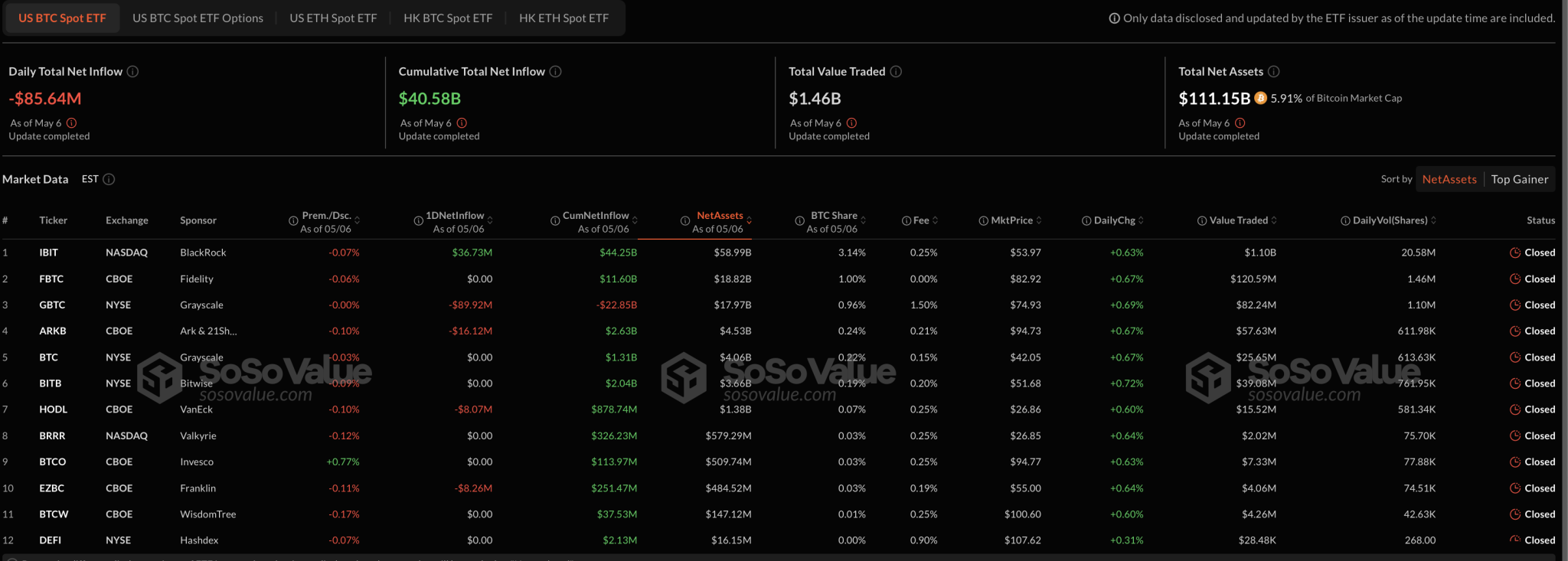
Despite the short-term relief witnessed in the U.S. and crypto markets, institutional support for Bitcoin lags. On May 6, the total daily net outflow from U.S. spot Bitcoin ETFs stood at $85.64 million.

Bitcoin ETFs
Bitcoin ETFs

Notably, BlackRock remains the only ETF with positive flow on Tuesday, with an inflow of $36.73 million. Grayscale led the outflows with $89.92 million, followed by ARK and 21Shares with $16.12 million.

Franklin and VanEck ETFs recorded outflows of $8.26 million and $8.07 million, respectively. As of May 6, the total net assets held by U.S. Bitcoin spot ETFs are $111.15 billion.

MetaPlanet Adds 555 BTC

Despite the outflows in Bitcoin ETFs, MetaPlanet, a Japanese investment firm, has announced the acquisition of additional Bitcoin.

The company purchased 555 BTC, increasing its total Bitcoin holdings to 5,555 BTC with an average cost of $90,236 per BTC.

Bitcoin Open Interest Surge Sparks Long Position Spike

As Bitcoin’s price surges, the derivatives market has seen a spike in bullish sentiment. According to Coinglass, the BTC open interest has surged by 2%, reaching $63.75 billion.

Furthermore, the Bitcoin funding rate remains positive at 0.0013%. As Bitcoin OI and the funding rate increase, long positions are gradually growing.

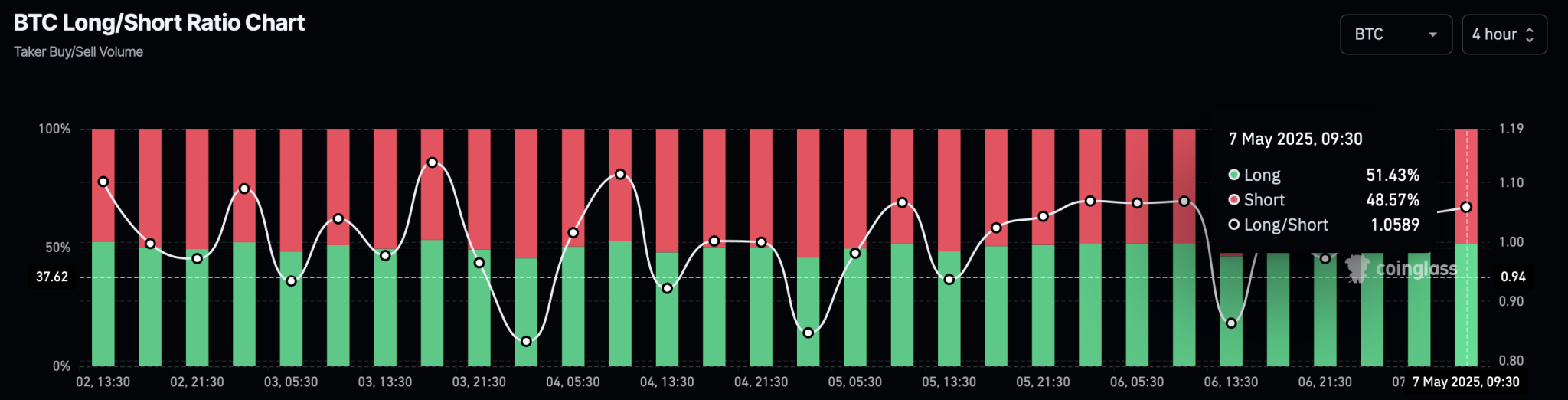
Bitcoin Long/Short Ratio Chart

According to the Bitcoin Long-to-Short Ratio chart, long positions over the past four hours now account for 51.43%. This makes the derivatives field marginally bullish, with a long-to-short ratio of 1.0589.

Santiment Identifies Signs of a Bitcoin Breakout as Large Wallets Accumulate While Retail Sells

0

Santiment reports large Bitcoin wallets are steadily accumulating as small holders sell, signaling potential for a breakout ahead.

Notably, Bitcoin surged above $97,000 on May 7, marking a significant price breakout following a period of tight consolidation. 

Interestingly, amid the renewed momentum, broader market behavior indicates that the underlying support may be driven more by accumulation patterns than by immediate speculative interest.

Whales Accumulate as Small Holders Reduce Exposure

Throughout recent volatility, data from Santiment reveals that wallets holding between 10 and 10,000 BTC—known to correlate closely with market trends—have increased their balances. Specifically, over the past six weeks, these wallets have added 81,338 BTC, a growth of 0.61% in holdings. 

Meanwhile, wallets holding less than 0.1 BTC have reduced their balances by 290 BTC, representing a 0.60% decline. Notably, this divergence aligns with previous patterns where large wallets accumulate during downturns as small holders engage in selloffs.

The behavior of small wallets has remained consistently reactive. These holders tend to sell during dips or periods of sideways movement, while larger entities sustained gradual acquisition.

Santiment indicates that this dynamic, where retail activity contrasts with strategic accumulation, is a strong long-term signal of price bidding time before another breakout. This accumulation pattern persisted even as Bitcoin experienced local pullbacks.

Long-Term Holding Still Strengthening

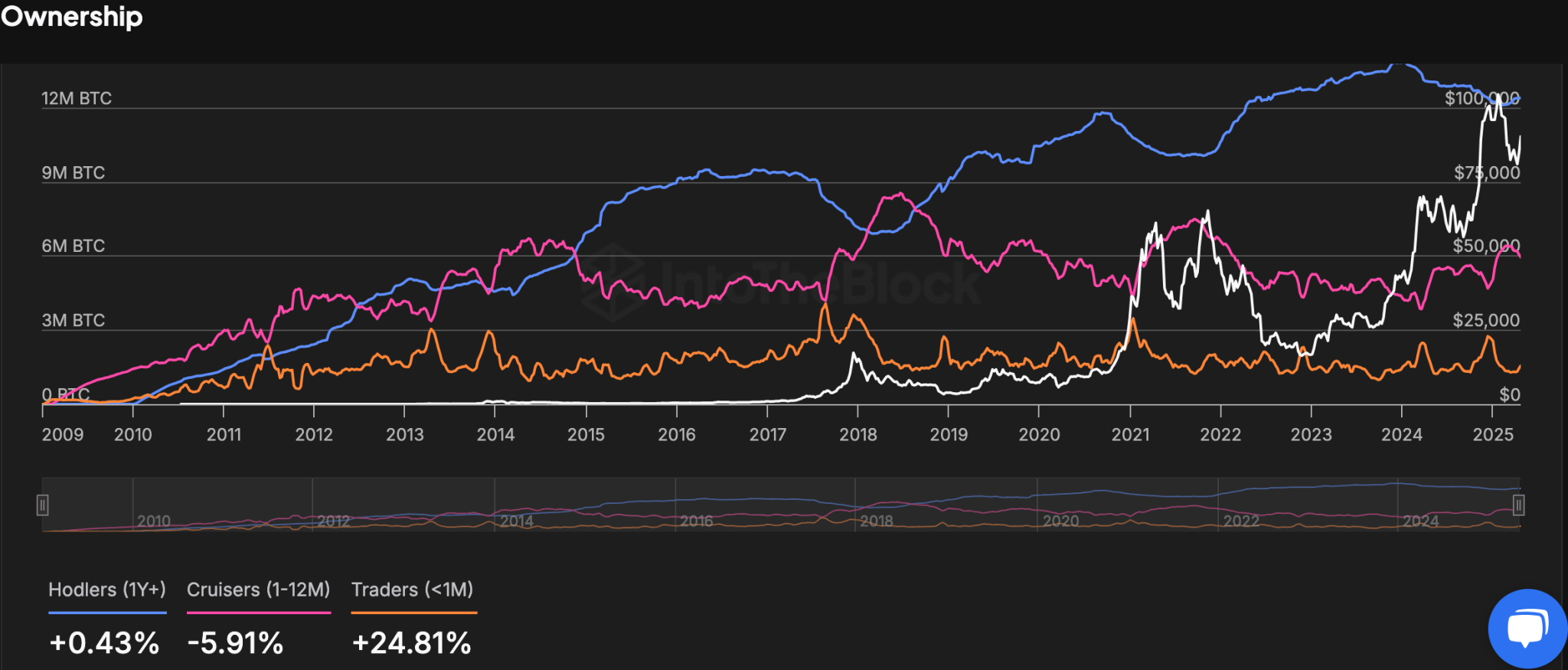
Additional on-chain analysis from IntoTheBlock supports this view. Ownership metrics show a rise of 0.43% among long-term holders—wallets holding Bitcoin for over a year—signaling sustained conviction. 

Bitcoin Balance by Time Held | IntoTheBlock

However, the mid-term holder segment, or “cruisers” holding assets between one to twelve months, has decreased by 5.91%. At the same time, traders—wallets holding within 30 days—have surged by 24.81%, indicating rising speculative interest amid the recent price surge.

Exchange Flows and Bitcoin’s Next Move 

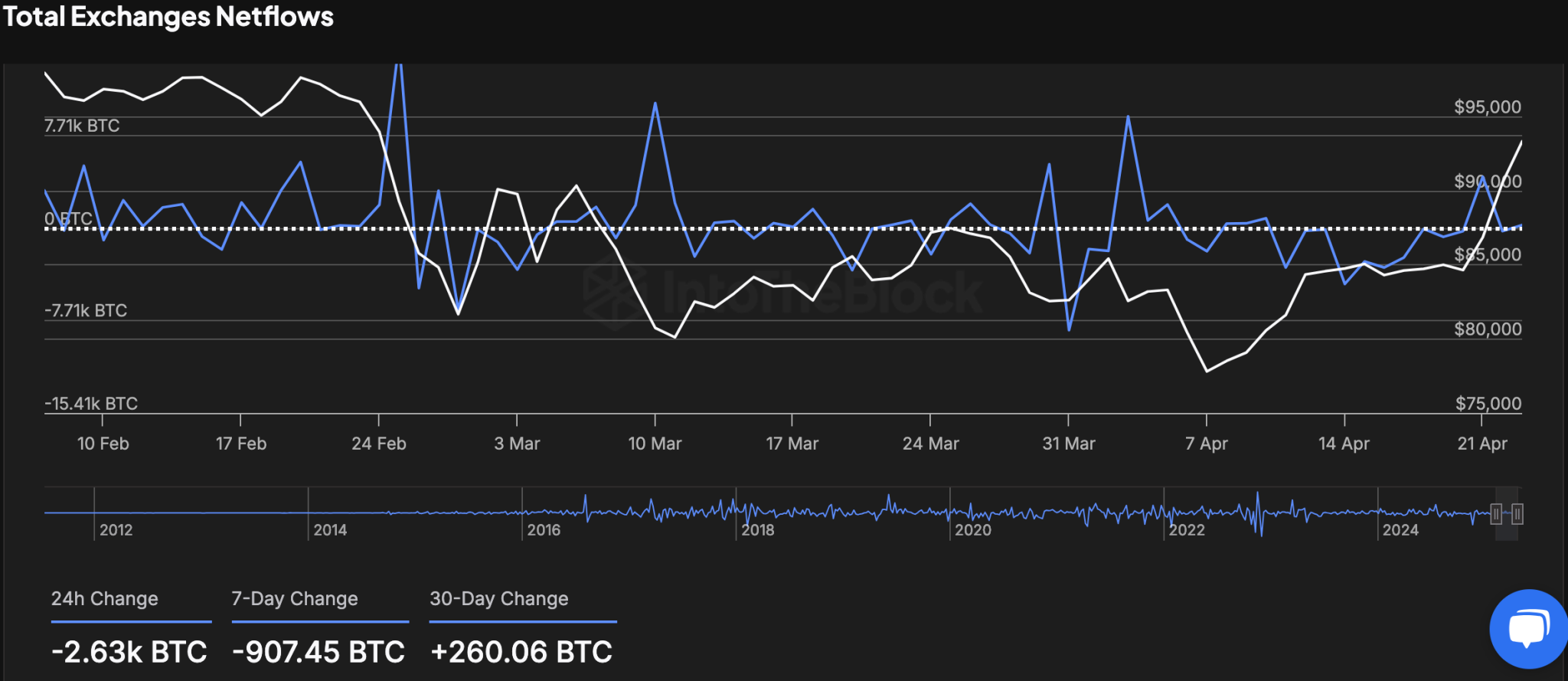
Moreover, netflows across centralized exchanges provide further context. IntoTheBlock’s exchange data shows a 24-hour outflow of 2.63K BTC, paired with a 7-day outflow of 907.45 BTC. 

Bitcoin Total Exchanges Netflows | IntoTheBlock

These figures suggest sustained movement of BTC off exchanges, often interpreted as a signal of reduced sell pressure. Over 30 days, however, exchanges saw an inflow of 260.06 BTC.

In the technical space, one market analyst on X, called King of the Charts, notes that Bitcoin is currently completing wave (v) of Minor Wave 1 under the Elliott Wave framework. The pattern projects a near-term pullback after this wave concludes, with a potential retest of the $88,500 level. 

This would mark the backtest of a previously confirmed double bottom structure before advancing further. The same analyst forecasts that Minor Wave 3 could push Bitcoin toward $150K to $175K by fall.

Michael Saylor Insists Bitcoin Will Hit $280T Market Cap

0

Strategy Chairman Michael Saylor has insisted that Bitcoin would become a global powerhouse asset, predicting an ambitious surge in valuation.

Saylor has dropped another Bitcoin bombshell. Interestingly, each of his statements in a public setting always emphasizes the bullish trajectory of the pioneering cryptocurrency.

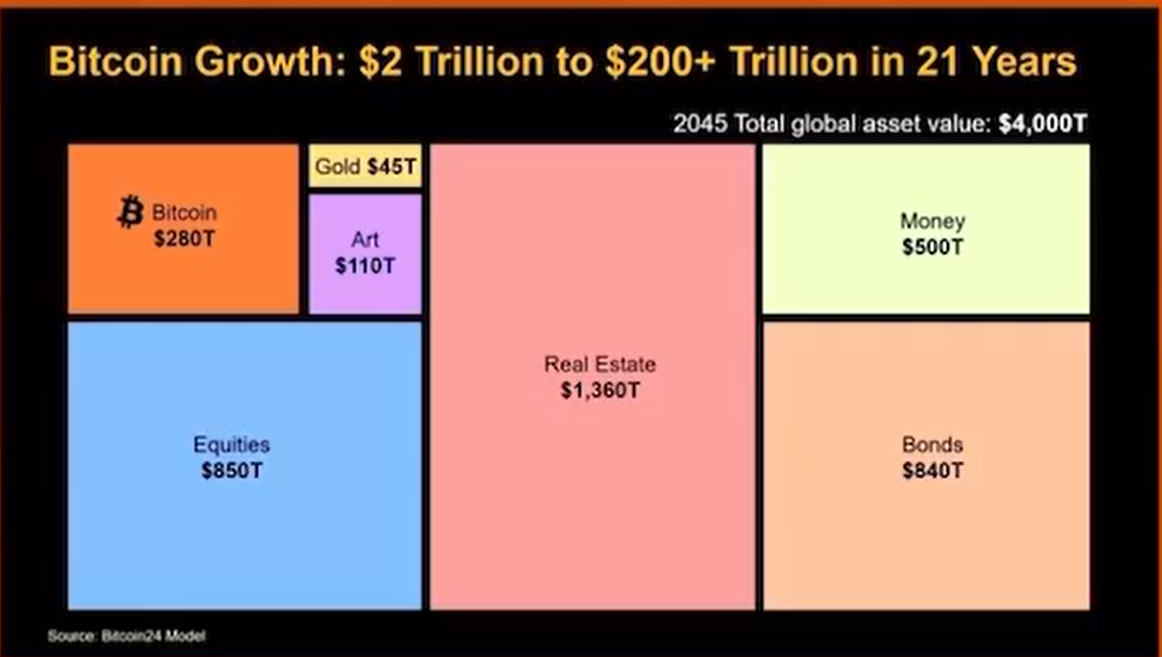
Yesterday, he reiterated Bitcoin’s bright future outlook, predicting its growth to become a global powerhouse. Furthermore, he insisted that the asset’s valuation would hit $280 trillion one day.

Saylor Says Bitcoin to $280T

Speaking at Strategy’s Bitcoin for Corporations conference yesterday, Saylor stressed that what most financial advisors term “smart investments” have failed to outperform the S&P 500’s 10% performance in the past ten years. Some of them include hedge funds, pension funds, and endowments.

Meanwhile, the S&P 500, while profitable, has seen its performance trounced by Bitcoin, an asset some once scorned for its volatility. Saylor shared that the pioneering cryptocurrency has an annualized ten-year performance of 79% and has grown to become one of the best-performing assets in the last decade.

Furthermore, Saylor reiterated that Bitcoin would grow from a $2 trillion to a $280 trillion asset in the next 20 years. He emphasized that while its valuation would still not match the bonds and equity market, it would become more noticeable.

Bitcoin Cap Trajectory per Michael Saylor

His projection also identifies that Bitcoin would be worth over five times the value of gold by 2045. Interestingly, several Bitcoin maximalists have aligned with this long-standing projection, citing a divergence from gold to “digital gold” as the financial scene evolves.

Bitcoin’s Price at $280T Market Cap

Currently at $96,627, Bitcoin’s market cap stands at $1.92 trillion. At $280 trillion, the premier asset’s valuation would have grown a staggering 14,483%.

Meanwhile, at the current circulating supply of 19.8 million, a $280 trillion market cap would culminate in a price of $14.14 million per coin. However, at a maximum cap of 21 million, Bitcoin would trade at $13.33 million.

Interestingly, this aligns with Saylor’s parallel prediction that Bitcoin would hit $13 million by 2045, with widespread adoption as a catalyst.

Strategy and AI

Notably, Saylor also revealed Strategy’s embrace of artificial intelligence (AI), an emerging sector gaining traction in the global market. He shared that the business intelligence firm leverages the powerful digital tool in making deep research and financial decisions.

Furthermore, the executive chairman noted that Strategy’s convertible preferred stock products, Strike and Strife, emerged with the help of AI. For the uninitiated, Strategy launched the Perpetual Strike Preferred Stock (STRK) and the Perpetual Strife Preferred Stock (STRF) earlier in the year as a means of raising capital through stock offerings to buy Bitcoin.

Saylor disclosed that Strategy built the Nasdaq-listed products solely with artificial intelligence, stressing it was the first AI-generated securities product in the industry. Meanwhile, he noted that more productive inventions like that would come into existence, and they all will use Bitcoin as digital capital.

Upbit Sees $500M in Net XRP Sell Volume, Suggesting Bearish Disposition Among Korean Traders

Korean traders might have turned bearish on XRP, as leading exchange Upbit witnesses half a billion dollars in net XRP sell volume within a month.

This is according to data presented by Dom, a well-known analyst and order book expert, following an assessment of the XRP pair against the Korean Won (XRP/KRW) on Upbit, South Korea’s largest crypto exchange by 24-hour trade volume.

Notably, his latest disclosure builds on a persistent bearish trend across the Korean market in recent times, as traders take to selling off their XRP holdings amid the ongoing bearish pressure. For context, XRP has witnessed turbulence since February, with its recent price action bordering on extensive consolidation.

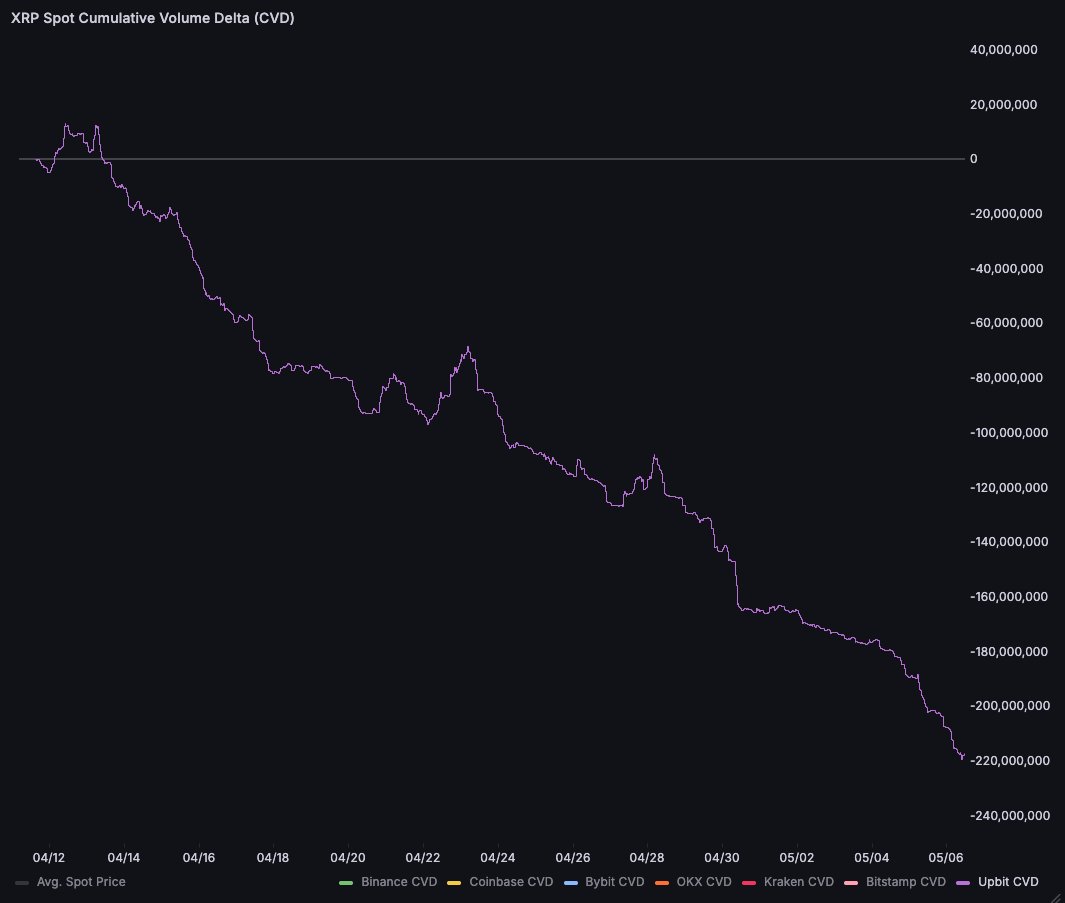
XRP Sees 220M Net Sell Volume on Korea Exchange Upbit

According to Dom, the XRP/KRW pair has observed a net sell volume of 220 million XRP since April 11, as selloffs in Korea continue. Importantly, at the current price of $2.14, this 220 million XRP volume translates to over $470 million, nearly half a billion dollars.

The market analyst cited data from the XRP Spot Cumulative Volume Delta (CVD) metric. For the uninitiated, this metric tracks the overall difference between market buy and sell orders on the spot exchange. Notably, an upward trend indicates more active buying, while a downward trend suggests stronger selling activity.

Data from Dom’s chart shows that since April 11, the CVD has trended downward consistently. The metric had a value of 0 as of April 11 but dropped below -100 million XRP in late April before rebounding slightly. However, this downtrend slipped into May, with the latest value being -220 million XRP, reflecting the 220 million tokens in net sell volume. 

XRP Upbit CVD Dom
XRP Upbit CVD | Dom

According to Dom, the latest reality suggests that Korean traders might have flipped bearish on XRP. The Crypto Basic called attention to this discouraging trend last month. It bears mentioning that XRP’s price direction has been largely dictated by Korean investor behavior. 

For instance, after the SEC lawsuit victory in July 2023, Korean traders contributed largely to XRP’s surge to $0.93 with massive buy volumes. Consequently, a change in investor behavior on Korea’s largest exchanges could help with any rebound attempt from XRP. 

Global XRP Sell Volume 

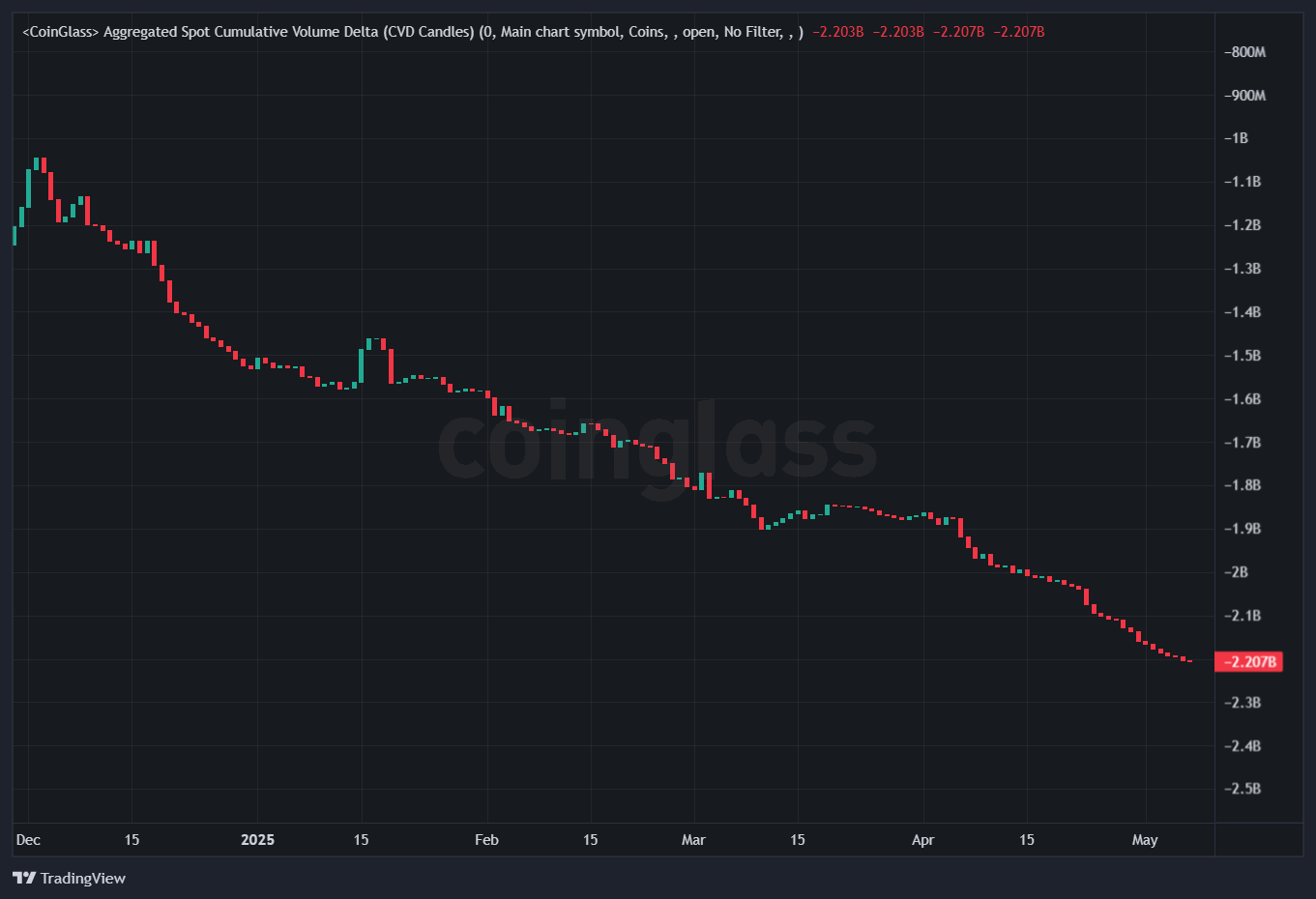
Meanwhile, data from Coinglass shows that the XRP selloffs have not only come from the Korean market. Data shows a more massive global sell volume on Binance. Specifically, the Binance XRP CVD stood at -1.876 billion XRP as of April 6. 

XRP Binance CVD
XRP Binance CVD | Coinglass

However, this has dropped to -2.207 billion XRP at press time, representing a net sell volume of 330 million XRP over the past month. Currently, XRP changes hands at $2.13, having slipped below the pivotal $2.2 support level. The bulls are currently awaiting a broader market recovery to attempt a rebound.

First US State Bitcoin Strategic Reserve Goes Live in New Hampshire, Allocating 5% of Treasury to BTC

0

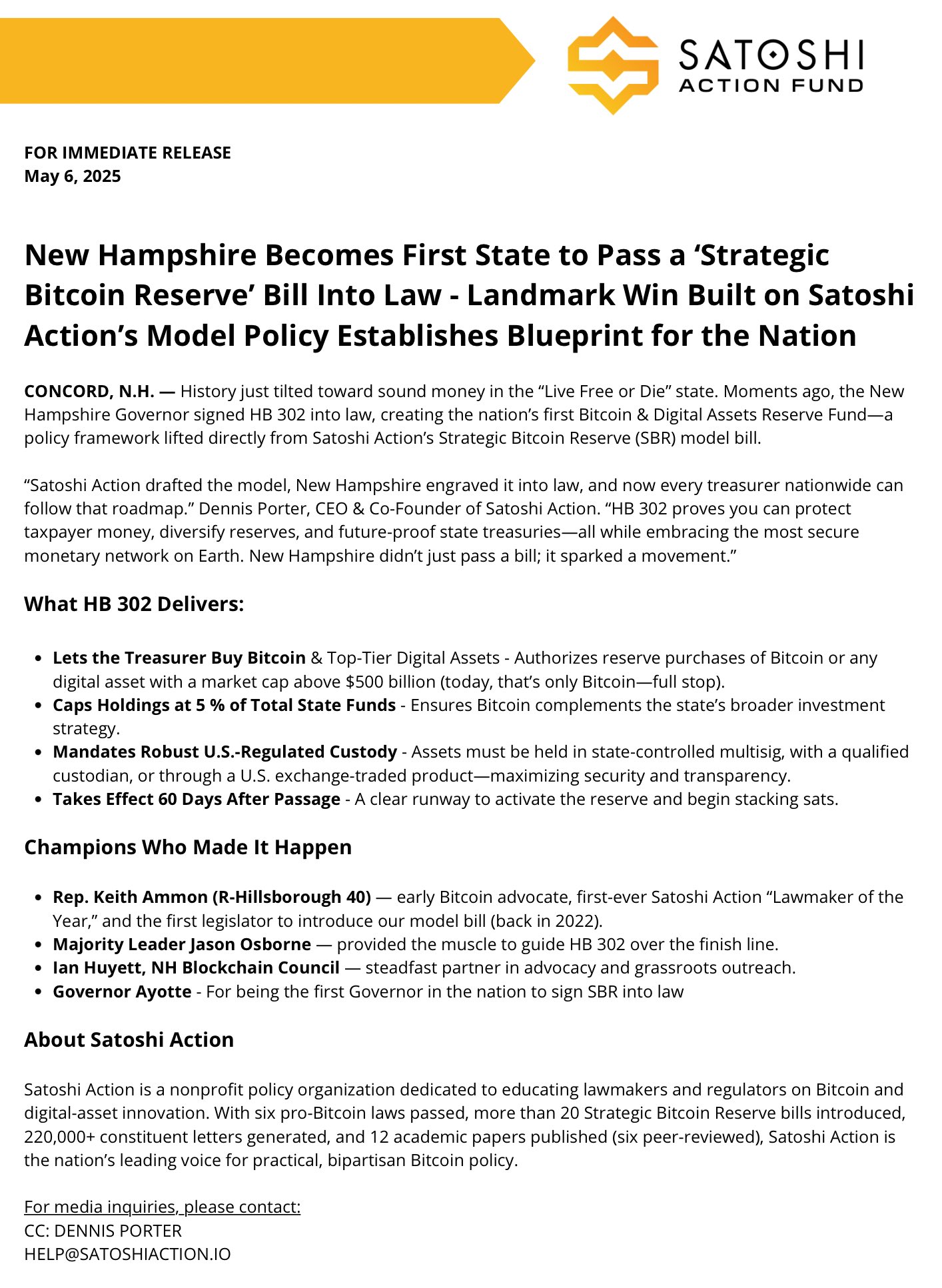
New Hampshire has become the first U.S. state to authorize a government-held Bitcoin and digital asset reserve. 

Governor Kelly Ayotte has officially signed House Bill 302 (HB 302) into law, creating a digital reserve fund. This new law allows the state to hold a limited portion of its treasury in Bitcoin or similarly large-cap digital assets. 

This measure comes as part of a broader movement among several U.S. states exploring cryptocurrency-based fiscal diversification. Notably, the bill takes effect in 60 days, establishing a timeline for state implementation and operational readiness.

Image

Policy Framework Limits Risk

The new law permits the New Hampshire State Treasurer to acquire Bitcoin or other digital assets, provided their market capitalization exceeds $500 billion. As of now, Bitcoin remains the only qualifying asset under this criterion. 

However, the legislation includes a cap—holdings cannot exceed 5% of the state’s total reserves. This provision ensures a controlled approach, allowing diversification without significantly altering the state’s overall fiscal position.

To address asset security, HB 302 mandates custody through U.S.-regulated structures. These include state-controlled multisignature wallets, qualified custodians, or exchange-traded products registered in the U.S.

This requirement emphasizes transparency and protection for taxpayer funds while aligning with existing regulatory standards. Moreover, the framework, originally proposed by Satoshi Action, aims to balance innovation with fiscal discipline.

Legislative Support 

The bill in New Hampshire found support across several influential figures. Representative Keith Ammon, a longstanding cryptocurrency advocate, first introduced the Satoshi Action model bill in 2022.

Majority Leader Jason Osborne played a critical role in moving the bill through the legislature. The New Hampshire Blockchain Council, led by Ian Hueyett, also contributed to sustained advocacy and outreach that supported the legislative process.

New Hampshire’s passage of the bill marks a departure from outcomes seen in other states. Arizona, for instance, advanced similar legislation to the governor’s desk, but the proposal was vetoed.

Florida, meanwhile, chose to withdraw its related effort entirely. In contrast, North Carolina remains actively pursuing a comparable initiative, backed by a key state legislator.

Expert Says Adoption Could Drive XRP to Its Biggest Breakout Ever

0

Edo Farina, the founder of Alpha Lions Academy, predicts an imminent moonshot for XRP, driven by the mass adoption of XRP. 

In a recent post on X, Farina prepared the minds of XRP proponents for what he called an ‘XRP Adoption Candle.’ The accompanying image portrays this as a long green candlestick on XRP’s mascot skyrocketing into the sky. 

Farina speculated that this major adoption would propel XRP to its “biggest breakout ever.” Farina believes the imminent price breakout will dwarf XRP’s prior rallies.  

His commentary suggests that Farina expects XRP’s next major rally to be driven by fundamentals and utility rather than speculation. Although he did not specify any particular factors that would drive this adoption, his message echoes a prevailing sentiment within the XRP community.

Potential Factors That Could Drive XRP Adoption  

In recent times, there has been growing interest in XRP among retail and institutional investors. This trend gained traction amid speculation that the SEC would drop its case against Ripple. 

Amid this, leading asset managers like Bitwise and Canary Capital pursued the launch of spot XRP exchange-traded funds (ETFs) in the United States. These products will expose both retail and institutional investors to XRP performance, potentially driving the adoption of the underlying asset. 

Although the SEC has yet to approve any spot XRP ETF for launch, investors are optimistic that at least one of these funds will come to market this year. 

US Interest in XRP 

Meanwhile, another factor driving interest in XRP is President Donald Trump’s teaser of XRP’s inclusion in the U.S. crypto reserve. In a Truth Social post, Trump disclosed that the digital asset reserve would include five coins, like Bitcoin, Ethereum, XRP, Solana, and Cardano. 

In parallel, Trump ordered the Department of Treasury and Commerce to proceed with the crypto reserve initiative using coins obtained through civil and criminal forfeitures.

Consequently, many speculated that other nations might follow the U.S. approach and adopt XRP as a reserve asset. They anticipate this potential move enhancing XRP’s credibility and attracting institutional and retail investors to the coin. 

Latest Stats Show Strong Institutional Interest in XRP 

Meanwhile, fresh data from the XRP Market Report by Ripple shows that institutional demand in XRP investment products soared in Q1 2025. In particular, ETPs tied to XRP recorded inflows of $37.7 million in the first quarter, outperforming Bitcoin and Ethereum peers. 

This investment brought XRP ETPs’ YTD inflows to $214 million, just $1 million away from matching Ethereum’s global fund inflows. While XRP gradually sees strong adoption, it remains unclear when Farina’s predicted ‘big breakout’ could happen. 

In the meantime, XRP is trading at $2.13, down 36% from its January 20 peak of $3.34. Nonetheless, several analysts are confident that XRP will embark on a major recovery this year. 

For instance, top Bitcoin proponent Davinci Jeremie predicted that XRP could reach an audacious price of $24 in 2025, potentially driven by the enormous support the coin receives from U.S. government officials. 

Researcher Says Worst Place to be Right Now is with No XRP

Amid the current XRP adoption rate, a market researcher has suggested that the worst place for anyone to be is without an XRP investment.

The recent comment comes as community figures continue to encourage an accumulation culture among investors during the ongoing market uncertainty. For context, XRP has relinquished the much-contested $2.2 price level following four consecutive intraday declines from May 2 to 5.

XRP Wallets Hit New Milestone

Despite a mild recovery on May 6, the altcoin remains below the pivotal $2.2 level, repeatedly switching between resistance and support. As tensions rise, some investors have seized the opportunity to amass more tokens. 

Specifically, addresses holding at least 10,000 XRP tokens recently spiked to a new all-time high above 300,000. The Crypto Basic confirmed this bullish development, citing on-chain data provided by Glassnode. The data indicated that this tier has continued to increase throughout the year despite the ongoing market uncertainty.

Interestingly, Chad Steingraber, a software engineer and XRP community figure, also called attention to this spike in addresses holding 10,000 XRP and above. According to his disclosure, the number of XRP whales is increasing, and this gradual uptick could also translate to an increase in XRP price.

Researcher Believes Not Holding XRP is a Bad Decision

Notably, Rob Cunningham, a writer and researcher, built on this narration. He noted that he carried out an AI analysis of Steingraber’s claims and found that even with the increase in addresses holding at least 10,000 XRP, their number is still very small compared to the general adult population.

According to Cunningham, of the 300,000 wallets, he estimated that a third might belong to the same investors. As a result, he calculated that the actual number of individuals who own these 300,000 wallets might be 200,000 in reality. This is a reasonable estimate, considering that some investors hold multiple XRP wallets for several purposes.

Now, his AI analysis suggested that the 200,000 estimated figure only makes up 0.0032% of the adult population with at least 10,000 XRP. Cunningham believes this is still very low. Notably, this reflects the sentiment that despite existing for over a decade, the XRP market is still in its early adoption phase.

Community commentators like Cunningham believe this presents an attractive opportunity for investors to commit to XRP now that it is early. According to Cunningham, the worst situation for any individual to be in right now is to live without an XRP wallet or without holding XRP.

This sentiment comes from the optimism surrounding XRP’s potential, as several analysts expect it to claim higher price levels in the foreseeable future. For instance, market watcher Cryptominder suggested last month that XRP could hit $50 by 2030, a 2,247% increase from the current price of $2.14. Interestingly, others are also eyeing the $100 price mark as a potential target. 

Morgan Stanley: Bitcoin Now Large Enough to Be a US Reserve Asset

0

Morgan Stanley has stated that Bitcoin now possesses sufficient market capitalization to be considered a U.S. government reserve asset. 

However, the financial institution cautioned that Bitcoin’s volatility remains significantly higher than that of other traditional reserve currencies. 

Notably, Bitcoin’s market capitalization stands at $1.87 trillion. Morgan Stanley estimated that a $370 billion allocation to Bitcoin would mirror its global market capitalization weight. The report also suggested that a U.S. reserve holding between 12% and 17% of the total Bitcoin supply would be consistent with how other reserve currencies are proportioned.

The findings arrive as the Trump administration advances plans for a Strategic Bitcoin Reserve. In March, an executive order directed the formation of a federal entity to custody Bitcoin assets, drawing comparisons to Fort Knox. 

Bitcoin advocate Troy Cross noted that although current volatility may disqualify Bitcoin from formal reserve status, its declining trend suggests potential. He added that once Bitcoin stabilizes below volatility thresholds, its adoption as a reserve could accelerate sharply.

Bitcoin Strategic Reserve Bill Faces Opposition

Despite support from crypto advocates, the proposed reserve plan has faced resistance from some financial leaders. In a public debate, Kevin O’Leary dismissed the initiative, asserting that the Strategic Bitcoin Reserve Bill would not pass in Congress. 

He criticized the bill’s champion, Michael Saylor, alleging that his company’s Bitcoin accumulation strategy is motivated by self-interest. O’Leary argued that Saylor’s firm raises capital through share and debt sales to fund Bitcoin purchases, creating a valuation model he claims lacks long-term sustainability.

Meanwhile, proponents like Anthony Scaramucci argue that the Bitcoin reserve measure would position the U.S. at the forefront of digital asset integration and help address the U.S. national debt.

UK and Switzerland Reject National Bitcoin Reserves

International response to Bitcoin reserve proposals has also remained cautious. The United Kingdom has ruled out holding Bitcoin as a reserve asset. Economic Secretary to the Treasury Emma Reynolds confirmed the decision during her remarks at the FT Digital Asset Summit. She emphasized that the UK would instead focus on regulation and the use of blockchain in public finance systems.

Meanwhile, the Swiss National Bank (SNB) has echoed similar concerns. At the institution’s General Assembly, SNB President Martin Schlegel stated that cryptocurrency market liquidity and volatility continue to present risks for long-term value preservation.

He noted that even seemingly stable digital markets can quickly lose liquidity during crises, disqualifying them from consideration as reserve-grade assets.