Home Blog Page 76

XRP Whale Withdrawals Hit 26% on Coinbase as 228M XRP Leaves Binance and Upbit

Large XRP holders are making up the share of withdrawals from major cryptocurrency exchanges. 

New CryptoQuant data shows whale outflows have surged on Coinbase, while XRP reserves on Binance and Upbit have dropped to multi-month lows.

The on-chain data shows large amounts of XRP are leaving exchanges. However, it does not reveal where those tokens are going, meaning it cannot confirm accumulation or signal an imminent price rally.

Coinbase Whale Withdrawals More Than Double

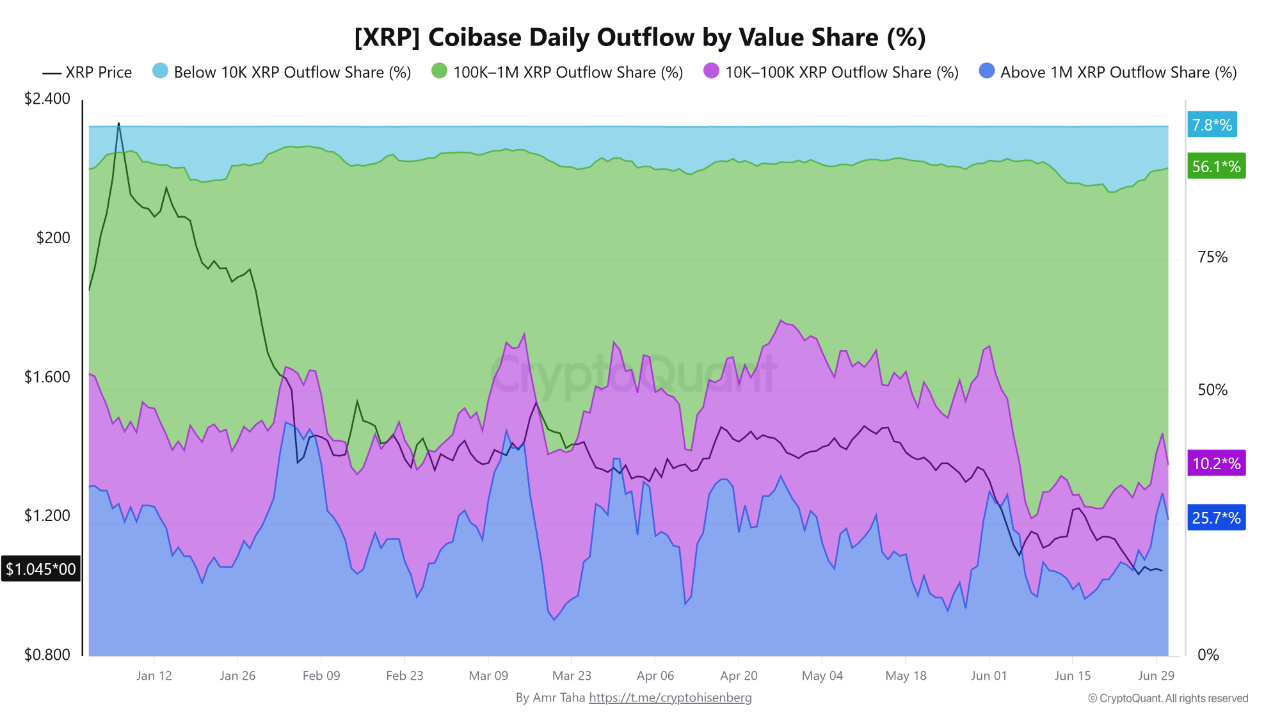
According to CryptoQuant analyst Amr Taha, whale-sized XRP withdrawals from Coinbase have increased notably over the past two weeks.

On June 16, transfers of more than 1 million XRP accounted for about 10% of Coinbase’s total XRP outflow value. By July 1, that share had climbed to 25.7%.

Essentially, in just over two weeks, the share of whale withdrawals more than doubled. The data suggests large holders are playing a much bigger role in XRP leaving the U.S.-based exchange.
Binance Still Led by Large XRP Transfers

Meanwhile, Binance showed a different pattern. During the same period, transfers of more than 1 million XRP consistently accounted for nearly half of the exchange’s total XRP outflow value. By July 1, whale withdrawals made up 49.6% of all XRP outflows.
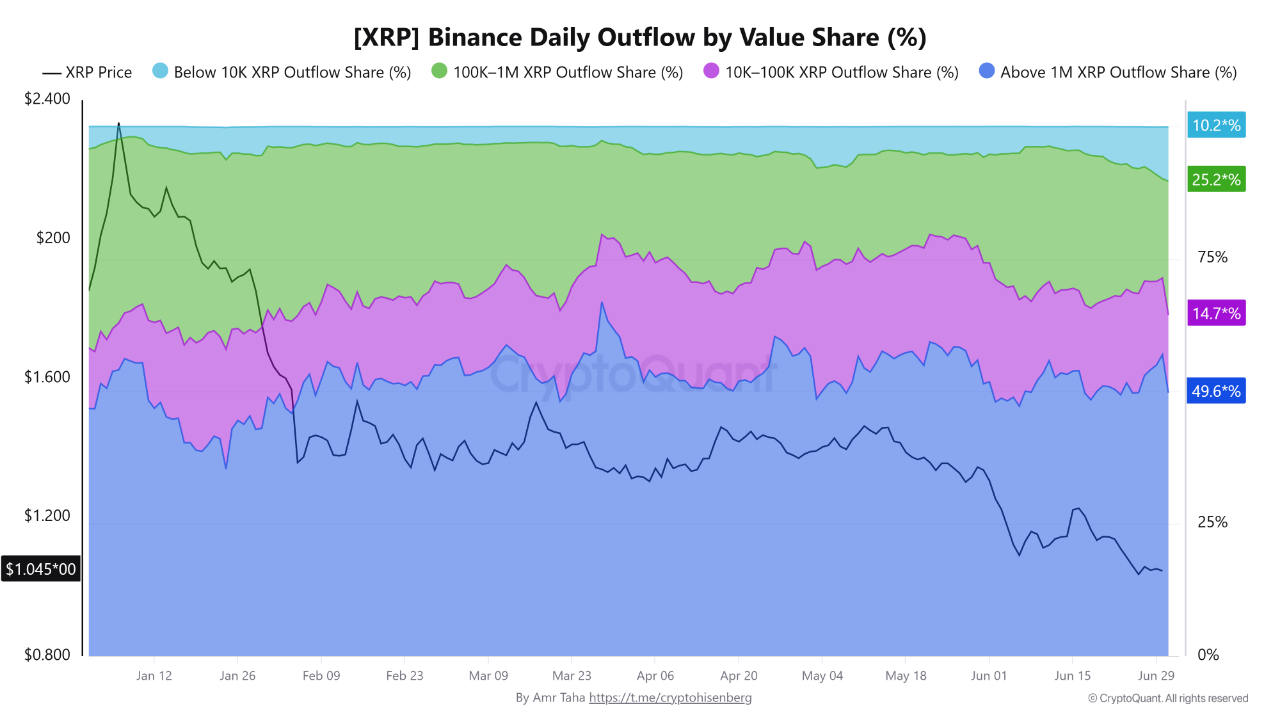
The comparison suggests Coinbase is moving closer to Binance in terms of whale withdrawals. However, Binance has been dominated by large transfers for much longer.

The data does not show where the withdrawn XRP is ultimately sent. Still, it highlights that larger holders now account for a greater share of exchange withdrawals.

Binance and Upbit Reserves Hit Multi-Month Lows

In a separate analysis, Taha said XRP reserves on Binance and Upbit have declined significantly in recent weeks.

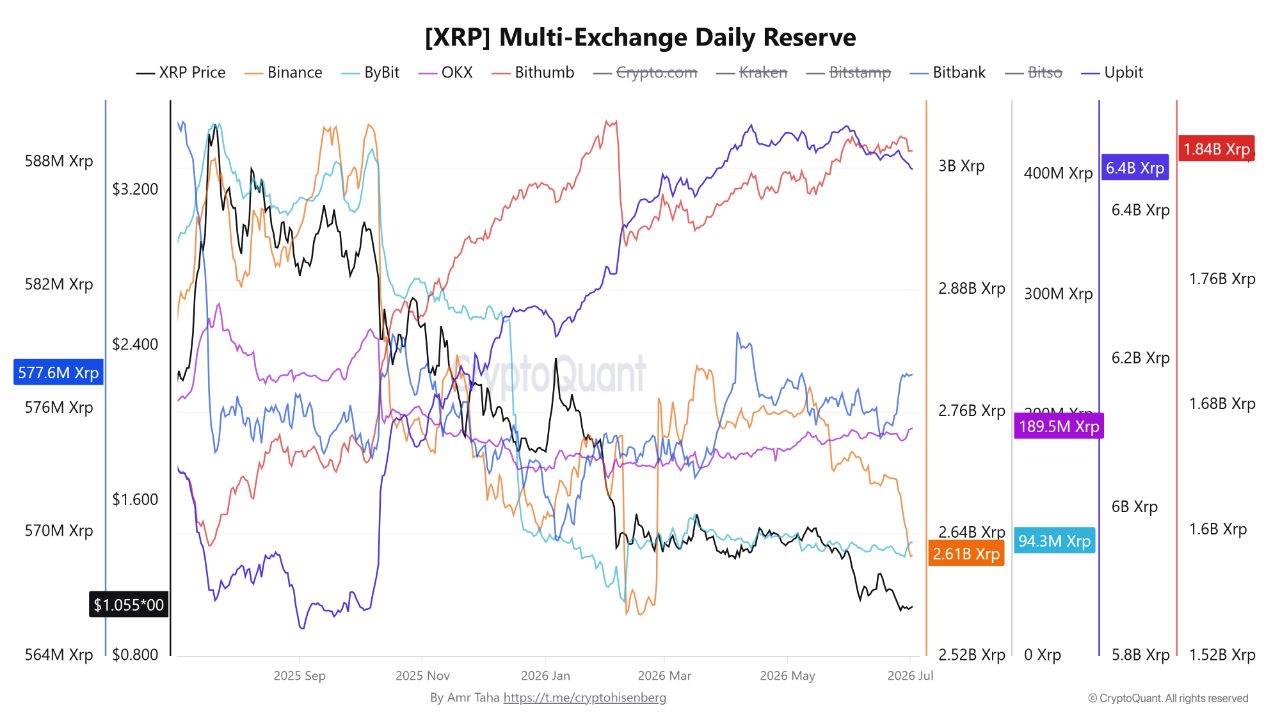
Binance’s XRP balance fell from about 2.78 billion XRP on May 12 to 2.61 billion XRP on July 2. That represents a decline of roughly 170 million XRP, or more than 6%. It is also Binance’s lowest XRP reserve since March 2026.

Upbit also recorded lower reserves. Its XRP balance dropped from about 6.515 billion XRP on May 30 to 6.457 billion XRP on July 2, a decline of roughly 58 million XRP. That is the exchange’s lowest reserve level since April 2026.

Combined, Binance and Upbit have seen about 228 million XRP removed from their tracked reserves during the recent drawdown.
Lower Reserves Are Not Necessarily Bullish

On the other hand,  South Korean exchange Bithumb maintained relatively stable XRP reserves at around 1.84 billion XRP. This suggests the withdrawals are concentrated on certain trading platforms and not an overall market trend.

Taha said lower exchange balances can have several explanations. Tokens may be moving to private wallets, transferred between exchanges, or simply reducing the amount of XRP immediately available for trading.

He also cautioned against treating lower reserves as clear evidence of accumulation or a guaranteed bullish signal. Whether the withdrawals support XRP’s price will depend on continued demand.

Hoskinson Says Largest Upgrade in Cardano History Is Imminent, Confirms ADA Fundamentals Remain Strong

0

Despite broader market uncertainty, Cardano founder Charles Hoskinson has emphasized that the network’s underlying fundamentals remain strong.

He made this known in a recent update to Cardano enthusiasts. According to Hoskinson, network reliability remains one of the most important indicators of blockchain health, and Cardano continues to excel in that area. 

He stressed that the network has never been hacked, while block production continues uninterrupted and at a consistent pace. In his view, these operational metrics demonstrate that Cardano’s core infrastructure remains dependable regardless of short-term market sentiment or price fluctuations. 

Cardano Prepares for Its Largest Upgrade Yet

Meanwhile, Hoskinson revealed that Cardano is approaching the largest upgrade in its history. He suggested that the network is entering a major new phase characterized by significant technological advancements and scalability improvements.

The upcoming upgrade is expected to strengthen Cardano’s infrastructure and further expand its capabilities as the ecosystem matures. Interestingly, he highlighted the ongoing progress surrounding Cardano’s RealFi. This project aims to bridge decentralized finance (DeFi) with the real-world economy by putting idle on-chain liquidity to work in lending and credit markets.

According to Hoskinson, RealFi is now transitioning from concept to implementation. Notably, he disclosed that the RealFi testnet is scheduled to launch on July 6, with a mainnet deployment expected shortly afterward.

The milestone represents a significant step toward Cardano’s long-standing mission of bringing financial services to unbanked populations while connecting blockchain liquidity with real-world economic activity.

Bitcoin DeFi and Midnight Gain Momentum on Cardano

In addition, Hoskinson pointed to the growing momentum behind Bitcoin decentralized finance on Cardano through the Pogun initiative.

He believes Bitcoin DeFi could unlock access to a substantially larger pool of liquidity and users by enabling BTC holders to participate in decentralized financial services within the Cardano ecosystem without leaving the Bitcoin economy entirely.

Another initiative receiving considerable attention is Midnight, Cardano’s privacy-focused partner chain, according to Hoskinson.

Hoskinson described 2026 as the “beta year” for Midnight, explaining that the primary objective has been to prepare the network for broader public adoption. He added that development is progressing at an impressive pace and argued that Midnight’s rollout validates Cardano’s partner-chain model.

According to Hoskinson, the project’s progress demonstrates that specialized chains can operate alongside Cardano while benefiting from its broader ecosystem and security model.

Hoskinson Pushes Back Against “Cardano Is Dead” Narrative

Hoskinson’s comments come amid growing criticism that Cardano is losing relevance following recent price underperformance and governance tensions.

For context, ADA continues to trade below the $0.20 psychological level and remains the 15th-largest cryptocurrency by market capitalization on CoinMarketCap. Its weak price performance, combined with ongoing governance tensions and the departure of key entities from Cardano, has fueled claims that the project is dead. However, Charles Hoskinson has rejected this narrative.

He argued that Cardano would continue to survive and evolve even without his involvement. Furthermore, he maintained that market sentiment does not determine a project’s long-term future and that a token’s trajectory can change rapidly.

Strong Fundamentals Continue to Drive the Ecosystem Forward

Ultimately, Hoskinson reiterated that Cardano’s long-term fundamentals remain intact. He pointed to continued progress across key initiatives, including Midnight, RealFi, and Bitcoin DeFi, as evidence that the ecosystem continues to expand despite temporary setbacks and negative sentiment.

For Hoskinson, these developments reinforce the argument that Cardano’s value lies not in short-term price performance but in the steady growth of its technology and real-world utility.

XRP Just Printed Its Lowest Monthly RSI Ever: Here’s What History Says Could Come Next

XRP recently posted the lowest monthly Relative Strength Index (RSI) reading in its entire history amid the steep June 2026 price crash. 

Specifically, in June 2026, XRP’s monthly RSI closed at 40.59 after the price dropped by 21.97% during the month. This decline marked XRP’s biggest monthly loss since February 2025 and showed how strong the recent downward pressure has been.

The RSI level of 40.59 is especially important because it marks XRP’s steepest ever monthly reading, even lower than what XRP recorded during major bearish periods, including the COVID crash in March 2020 and the Terra ecosystem collapse in May 2022. 

Interestingly, XRP has managed to stay above the pivotal $1 price level despite the deeply oversold RSI. Notably, the price closed June at $1.03. So far in July 2026, XRP has seen a slight bounce to $1.05, but the RSI remains weak at 40.97 at press time. This suggests that while the price has stabilized a bit, momentum is still low.

When XRP RSI Floor Came Before Upward Rallies

Historical data shows that when XRP’s monthly RSI falls to such low levels, it often indicates that the market is close to the cycle bottom or a rebound may be imminent.

For instance, in October 2024, XRP dropped by 16.74%, which pushed the Relative Strength Index down from 52.57 in the previous month to 48.27.

Soon after, the market turned upward in November 2024, triggered by strong bullish sentiment following Donald Trump’s election victory. XRP eventually climbed from $0.50 at the October close to a high of $3.4 by January 2025.

Another example comes from February 2017, when XRP declined by 12.28%, bringing the RSI down to 47.18. Although the cycle bottom had already formed at $0.0030 in January 2017, the drop in RSI still came just before a strong rally. 

Starting in March 2017, XRP pushed higher and eventually reached $3.31 in January 2018. During this period, the price increased by more than 59,000%.

When XRP RSI Floor Marked Cycle Bottoms

In other cases, the steep RSI drop marked the cycle low. For instance, in June 2022, XRP fell by 21.01% during a wider market downturn caused by the Terra collapse in May 2022. 

During that period, the RSI dropped to 43.91, which was its lowest level at the time. Interestingly, this RSI floor also coincided with XRP’s bottom of $0.28 in that same month. 

Although a full recovery took nearly two years, the price never went below $0.28 after June 2022, with the market recording several short-term rallies before the stronger move in November 2024.

XRP Monthly RSI
XRP Monthly RSI

In addition, XRP showed similar behavior during the COVID crash in March 2020. Notably, the price fell by 24.06% that month, coinciding with an RSI drop to 43.75. 

Just like in June 2022, the RSI drop in March 2020 occurred alongside XRP’s cycle low of $0.1140 during that downturn. In the months that followed, the market gradually improved, leading to a peak of $1.96 by April 2021.

XRP Now Deeply Oversold

Now, with the RSI at 40.59 in June 2026, XRP is again in a zone that has often appeared near major turning points. The recent June 2026 low of $1.0079 could mark the bottom of the current downtrend, or the RSI floor could mean that a recovery may begin soon.

Another momentum indicator confirms XRP’s oversold position. Notably, the Commodity Channel Index (CCI) dropped to -134.61 in June 2026, its lowest level since the COVID crash in March 2020, about six years ago. 

What stands out is that XRP has reached these levels while still holding above $1. If past patterns play out again, this could set the stage for a recovery. Such a move could even push XRP toward a new all-time high.

That said, the broader market still looks weak, and this could delay any recovery. While history suggests that very low RSI levels often come before a rebound, it is still unclear when the move might begin.

XRP Lending Infrastructure Could Unlock New Borrowing Strategy, Analyst Says

XRP analyst James Dula says new lending infrastructure on the XRP Ledger could eventually let holders borrow against their XRP without selling it. 

He also believes they could earn yield on unused XRP to help offset borrowing costs.

In a post on X, Dula linked several recent developments. These include Coinbase’s XRP-backed loans, government-backed crypto mortgage structures, and proposed XRP Ledger lending features. He argued that together they could create a new financial model for long-term XRP holders.

Borrow Against XRP Without Selling

According to Dula, XRP holders can already use their tokens as collateral for crypto-backed loans through Coinbase, which added XRP as eligible collateral earlier this year.

He used a hypothetical example. An investor holding 10,000 XRP worth about $1 million, assuming an XRP price of $100, could pledge 2,500 XRP valued at around $250,000. With a loan-to-value ratio of roughly 49%, the investor could borrow about $120,000 in USDC without selling their XRP.

Dula said the transaction would be treated as a loan rather than a sale. That means it would not trigger a taxable capital gains event while allowing the investor to keep exposure to potential future XRP price gains.

Crypto-Backed Mortgages Show Where the Market Is Heading

Dula also pointed to a recent milestone involving Better Home & Finance and Coinbase. The companies completed the first Fannie Mae-backed mortgage in the United States using Bitcoin as collateral.

He said the structure combines a traditional mortgage with a separate crypto-backed loan for the down payment. Unlike many crypto-backed loans, the pledged Bitcoin is not automatically liquidated if its price falls, as long as the borrower continues making mortgage payments.

Although XRP is not supported under that program, Dula said it shows how crypto-backed financing could evolve. He believes similar structures could eventually be expanded to include XRP.

Proposed XRPL Lending Features Could Add Yield

Looking ahead, Dula said proposed XRP Ledger lending features, including XLS-66d, could further expand XRP’s utility.

In his scenario, XRP that is not used as collateral could be deposited into a Single Asset Vault. There, it would earn yield by supplying liquidity to institutional borrowers.

Assuming annual yields of 4% to 7%, Dula estimated that 7,500 XRP valued at $100 each could generate between $30,000 and $52,000 a year.

He compared that with a hypothetical borrowing cost of about 3.2% annually on the pledged XRP. That would result in interest expenses of roughly $3,800 per year.

According to Dula, the yield earned from the unpledged XRP could exceed the cost of servicing the loan. That could allow holders to borrow against their XRP, keep their long-term position, and cover financing costs through lending income.

Dula concluded that collateralized lending, institutional liquidity pools, and yield-generating vaults represent infrastructure that is gradually being built for digital assets. However, he acknowledged that some XRP-specific features, including XLS-66d, are still proposals and are not yet available.

Next XRP Downside Target After Major 50MA Rejection

0

XRP remains under pressure after failing to reclaim a major resistance level at the 50-day simple moving average last month month.

Notably, this failure suggests further price weakness in a broader downtrend that has now lasted for nearly a year. Although buyers attempted to regain momentum with that XRP retest in June, the rejection from the key trend indicator suggests that bears still control the short-term direction.

Unless XRP can reclaim the SMA 50, technical indicators continue to point toward the possibility of another move lower.

XRP in a 1-Year Descending Channel

On the 1-day chart, XRP is trading inside a descending channel that has remained intact since its cycle high at $3.66 in July 2025. Throughout this period, each recovery has produced a lower high before the coin resumed its decline.

The latest rebound followed the same pattern. XRP briefly pushed toward the 50-day moving average on June 15. It reached a high of $1.30 that day, falling short of the resistance trendline at $1.32. Essentially, XRP failed to break above the moving average, reinforcing the broader bearish structure.

XRP 1D Chart Analysis

Following the rejection, XRP has dropped 18% to its current price at $1.06 and is now finding support at the 0.618 Fibonacci retracement trendline. Nonetheless, the asset remains beneath key resistance levels, meaning downward pressure continues to outweigh buying momentum.

Historical Pattern Points to One More Dip

A close look at the chart shows symmetry between previous declines. The two earlier bearish legs inside the channel ended after pullbacks of about 50.3% and 53.4%, both producing new lower lows before a temporary recovery followed. The first pullback saw XRP drop to $1.81 in November 2025, and the second one took the coin to $1.12 on February 6.

Notably, the current decline has not yet reached a comparable rate. If the existing pattern continues to mirror the earlier moves and XRP fails to reclaim the 50 SMA, there could still be room for another leg lower before finding stronger long-term support.

The downside target is at least a 50.33% correction from the March lower high of $1.60. This aligns with the 100-period MA, a long-term trend indicator that acted as a major support zone during XRP’s previous market cycle. XRP established a bottom around the indicator in June 2022, then bounced from it in November 2024 to much higher prices.

Currently, the 100 MA lies at $0.815, representing a 23% drop from the current market price. It also aligns with the lower band of the descending channel.

For now, XRP continues to hold the $1 support, bouncing from $1.02 on Wednesday to the current price. Trading volume remains subdued, and open interest is up slightly to $2.31 billion in the past 24 hours, suggesting a cautious approach among market users.

XRP Closes Below 200WMA for First Time Since 2024 Rally: Is This the Best Buying Opportunity?

XRP has now closed below the 200-week moving average for the first time since the 2024 rally, confirming the overall bearish market trend. 

This move comes during the ongoing downtrend that started in Q4 2025 and has now lasted for ten months. Despite the decline, past trends suggest that a drop below this major moving average after an uptrend can indicate that a possible bottom may be forming.

However, it does not necessarily mean prices will recover right away. In most cases, this phase represents a change toward stabilization, not an immediate rebound.

XRP Closes Below 200WMA

Specifically, in the first week of June, XRP closed at $1.155, while the 200-week moving average stood at $1.189, confirming the breakdown. 

This marked the first time XRP traded below this level and the first weekly close under it since the first week of November 2024, just before the Donald Trump-led market rally.

The 200WMA represents the average price over about four years of weekly closes, and this makes it an important long-term benchmark. When prices stay below it, it shows that most medium- and long-term holders are now holding at a loss.

Since the breakdown, XRP has now spent three weeks below the 200WMA and is heading into a fourth week. At the time of writing, XRP trades at $1.0584, while the moving average has climbed to $1.20.

The 200WMA has also flipped from dynamic support to resistance. This means that if price moves back toward it, sellers are more likely to step in, which could limit any short-term recovery attempts.

How XRP Behaved in 2022

A similar breakdown occurred during the Terra ecosystem collapse in May 2022, when XRP closed below the 200WMA in the second week of May 2022 for the first time in over a year. 

After that, XRP remained below the moving average for five weeks before reaching a cycle low of $0.28 in June 2022.

Although this level marked the bottom, recovery did not happen quickly. Specifically, XRP did not begin a clear uptrend until November 2024, more than two years later. 

During that time, the price oscillated above and below the 200WMA multiple times before finally breaking above it during the November 2024 rally, which confirmed a stronger trend.

XRP’s 2019 Case

Before that, XRP showed a similar pattern in August 2019, when it closed below the 200WMA after an uptrend. It then stayed below the moving average for five weeks and reached a low of $0.22 in September 2019, which seemed like a bottom at the time.

However, the recovery that followed this floor price failed, and XRP dropped below the moving average again, eventually falling further to $0.11 in March 2020, about seven months after the initial breakdown. 

XRP Closes Below 200WMA

Nonetheless, most analysts see this as an exception because it was caused by the COVID-19 market crash, an unexpected global Black Swan event.

Meanwhile, after reaching the $0.11 bottom in March 2020, XRP eventually staged a recovery effort. The price later moved back above the 200WMA in January 2021, which led to a strong rally that pushed the asset up to $1.96 by April 2021.

Is This a Buying Opportunity?

If no major external shock occurs, XRP could follow the 2022 pattern, where it formed a bottom within a few weeks after falling below the 200WMA. 

However, history shows that reaching a bottom does not mean a new bull run will begin immediately. In the 2022 cycle, XRP still spent nearly two years moving around the 200WMA, struggling to stay above it before finally breaking out.

For now, even if XRP finds a bottom soon, the market may only see short-term relief rallies instead of a strong recovery. A longer period of sideways movement could come before any clear uptrend begins.

Hoskinson Responds to Criticism Over OUSD Stablecoin Exclusion, Says DRep Can’t Reject Cardano Commercialization and Complain About It

0

Charles Hoskinson has pushed back against criticism surrounding Cardano’s absence from the Open USD (OUSD) stablecoin consortium.

During a recent exchange on X, Hoskinson argued that ecosystem participants cannot criticize Cardano’s lack of involvement in major commercial initiatives while simultaneously voting against proposals specifically designed to create those opportunities.

Hoskinson’s remarks came in response to criticism from prominent Cardano DRep YODA. The DRep questioned why major Cardano-related organizations, including EMURGO, Cardano Foundation, and Input Output Global (IOG), were absent from the newly formed Open USD Consortium.

Notably, the consortium includes more than 140 institutional partners, among them Ripple, Mastercard, OKX, MoonPay, and Visa.

Hoskinson Calls for Governance Accountability

In response, Hoskinson stressed that governance participants must accept responsibility for the consequences of their voting decisions. According to him, the development teams invested hundreds of hours designing proposals intended to accelerate Cardano’s commercialization efforts. However, once those proposals entered the governance process, DReps voted them down.

“We put hundreds of hours, carefully proposing direct routes to commercialize Cardano. We brought it to a vote. You voted against it,” the Carano founder noted. 

Hoskinson added that he does not care about the reasons behind those decisions because DReps ultimately own the outcome of their votes.

“I don’t care about your reasons. You own the vote,” he remarked. 

Commercial Partnerships Require More Than Membership: Hoskinson 

Meanwhile, Hoskinson argued that joining initiatives such as the Open USD Consortium is relatively straightforward. The more difficult challenge, he said, involves deploying capital and building the financial infrastructure necessary to support those partnerships.

As part of that effort, he pointed to his proposal for a managed sovereign wealth fund capable of providing liquidity, minting stablecoins, and financing ecosystem growth initiatives. Hoskinson also highlighted several projects that he believes form the commercial backbone of the Cardano ecosystem, including RealFi, Midnight, Blockfrost, and Pogan.

According to him, these initiatives provide the infrastructure upon which larger commercial integrations can be built. 

Governance Tensions Continue Across the Ecosystem

The latest dispute further highlights the governance tensions that have dominated much of the year within the Cardano ecosystem.

The disagreements contributed to the cancellation of several IOG funding proposals, including research and development funding for Blockfrost and the Cardano Summit 2026.

Amid the ongoing debate, Hoskinson recently advocated for governance reforms. His proposals include moving Cardano governance discussions to a moderated Discord server, becoming a DRep himself to participate directly in voting and improve accountability, and revising the ecosystem’s constitution. 

Ripple Backs Open USD Launch, Says Multichain Payments Will Drive RLUSD and XRP Growth

Ripple has reaffirmed its commitment to multichain payments and institutional blockchain infrastructure by joining Open USD as a day-one integration partner.

Ripple President Monica Long said the future of payments will be built on interoperable blockchain networks rather than isolated ecosystems. She said Ripple’s focus is to strengthen the XRP Ledger (XRPL) as a leading blockchain for institutional payments while expanding the global use of RLUSD and XRP.

“The future of payments will be multichain, interoperable, and built on institutional-grade blockchain infrastructure,” Long said. She added that Ripple wants XRPL to become a natural home for the next generation of regulated stablecoins.

Ripple Doubles Down on Interoperability

Responding to the Open USD launch, Ripple said stablecoins are reshaping global value transfers. It added that interoperability is essential for institutional-scale adoption.

The company said that joining Open USD as a launch integration partner supports its strategy to build open, multichain infrastructure. The goal is to connect institutions across the digital asset ecosystem.

Ripple has also continued to position RLUSD as a regulated stablecoin that complements XRP and XRPL rather than competing with them. The company says both assets play key roles in institutional payment solutions.

Open USD Focuses on Open Governance

The announcement came from Open Standard, which introduced Open USD as a new stablecoin for global money movement.

The project is based on three core principles:

  • Free and unlimited minting and redemption.
  • Reserve earnings shared with partners after management fees.
  • Collaborative governance through an independent organization led by participating partners.

According to Open Standard, this model addresses common concerns with existing stablecoins. These include high issuance costs, limited access to reserve revenue, and dependence on a single issuer’s roadmap.

Open Standard CEO Zach Abrams said Open USD gives businesses an open, low-cost, high-throughput stablecoin. He said the project supports internet-scale payments while aligning with partners’ long-term interests.

More Than 140 Companies Join

Open Standard said more than 140 organizations have joined the initiative ahead of its planned launch later this year.

The participants include companies from traditional finance, payments, technology, and crypto. Among them are Visa, Stripe, Mastercard, BlackRock, BNY, Shopify, Google, Coinbase, Fireblocks, Solana, Ripple, Crypto.com, Gemini, Polygon, Stellar, Aptos Labs, MoneyGram, Western Union, and several global banks.

Executives from participating companies described Open USD as an important step toward shared, regulated payment infrastructure. They said open governance and interoperability could help speed up mainstream stablecoin adoption.

The consortium expects Open USD to launch later this year. It aims to build an open payment network for institutional and cross-border financial activity on a global scale.

Cardano Breaking Out Against Bitcoin Amid 4% Increase

0

Cardano appears to be breaking out against Bitcoin, as its price has considerably outperformed the apex cryptocurrency in the past few days.

Cardano (ADA) is having a good start to July, bouncing 4% already today to reclaim $0.150. This is a positive sign considering the altcoin dumped 38% in June, its worst monthly performance since November 2018.

The uptick comes after days of consolidation at a key support level around $0.140. This rebound against the USD pair and its recent performance against Bitcoin is beginning to look like the start of a sustained move to higher prices.

ADA/BTC Chart Turns Bullish

The daily ADA/BTC chart shows a clear disparity between the two assets’ price trends in the past few days. While Bitcoin has trended lower, Cardano has gained strength and moved in the opposite direction.

Over the past three days, ADA has gained against Bitcoin. After a mild 0.41% increase on Monday, the ADA/BTC pair rose by 1.65% on Tuesday and an impressive 3.66% so far today. This price trend is reflected in the 4% Cardano rise and nearly 1% Bitcoin drop in the past 24 hours.

ADA/BTC Breaking Out

Typically, Bitcoin controls the mood of the broader crypto market. Its drop or increase has a ripple effect on altcoins, forcing them to follow its trend in most cases.

As such, the Cardano breakout against BTC is significant. It suggests that ADA could continue to gain strength regardless of Bitcoin’s trend. This could see the altcoin target higher prices if momentum sustains, even if the broader market is bearishly biased.

Resistance Levels Ahead

However, the ADA/BTC pair has clear resistance levels ahead. Currently at 0.00000255, it trades exactly at the 20-day exponential moving average (EMA). This dynamic supply zone forced the pair lower in early June, following the rejection at 0.00000325.

How ADA/BTC reacts around this EMA would determine its next direction. A sustained trend above this level would confirm the breakout, while a rejection would form another lower high and kickstart another leg down.

Higher EMAs like the 50-day, 100-day, and 200-day are at 0.00000279, 0.00000310, and 0.00000369, respectively. They are also areas of interest if the upward momentum endures.

Cardano Volume Spikes 60% as Momentum Returns

Following the rally to reclaim $0.150, trading activity has increased 60% over the past 24 hours to $471.3 million, signaling growing market participation.

Open interest has also improved 1.43% to $371 million, showing emerging derivative interest. The slight uptick in OI shows that the recent increase is not derivative-driven but rather the momentum from dip-buying among spot traders.

Cardano Derivative Data/Coinglass

Coinglass’s Cardano spot flows activity confirms this. Over the past 24 hours, exchange outflows have surpassed inflows, with the former at $29.13 million and the latter at $28.55 million.

XRP Commodity Channel Index Hits Most Oversold Level Since the 2020 COVID Crash

The monthly XRP Commodity Channel Index (CCI) has dropped to its lowest level in six years, closing way below the -100 baseline in June.

The decline came amid a weak close in June, when the indicator stood at -134.61 following a nearly 22% drop in XRP’s price for the month. This made June the asset’s worst monthly performance since February 2025.

XRP Commodity Channel Index Hits 6-Year Low

While XRP has opened July with a small rebound, rising 0.61% to trade at $1.04487, the CCI has collapsed further this new month, currently sitting at -137.30. 

For context, when the CCI falls below -100, it usually points to oversold conditions. At -137.30, XRP now sits far below its 20-period average, suggesting that the current level of selling may not last for long.

The last time XRP’s CCI reached a similar level was in March 2020, during the COVID-19 market crash, when the price dropped below $0.20. During this period, the Commodity Channel Index crashed to -140.67, marking XRP’s bottom for that downturn.

After the crash, XRP’s price recovered considerably and climbed to around $1.96 within the following year. While it is important to consider this historical context, it does not necessarily mean the same kind of recovery will happen again.

How the Current Decline Compares to 2020

The 1-month chart shows a similarity between the CCI low in March 2020 and the one recorded in June 2026, as both sit at nearly the same depth below the oversold level. 

However, the reasons behind the two drops are different. In 2020, the market fell quickly due to an external shock and then recovered just as fast. This time, XRP has been moving down gradually since Q4 2025 within a falling channel.

The CCI also shows a secondary signal line at -3.69, as the main CCI remains at -137.30. The gap between these two lines creates room for a possible crossover, which traders often see as an early sign of recovery. 

However, for now, no crossover has happened, so the oversold reading alone does not confirm a reversal. The price still needs to show clear signs of strength before any change in direction could emerge.

XRP Monthly CCI
XRP Monthly CCI

XRP Ichimoku Cloud Confirms Bearish Trend

Meanwhile, the monthly Ichimoku Cloud confirms the extent of the ongoing bearish trend, as all four main components remain above XRP’s current price of $1.04487. 

Specifically, the Tenkan-sen stands at $1.79398, while the Kijun-sen sits higher at $2.02423, placing it about 94% above the current price. Since the Tenkan-sen is below the Kijun-sen, the chart confirms a bearish crossover, showing that short-term movement still follows the broader downtrend.

Further, Senkou Span A is at $1.90910, and Senkou Span B is at $1.97650, forming a bearish cloud where Span B stays above Span A. This presents a strong resistance zone between $1.90910 and $2.02423, meaning XRP must push through a tight range of about $0.12 before the structure can turn neutral.

The only slightly positive signal comes from the Chikou Span, which compares the current price of $1.04487 with past price action from May 2024, when XRP traded below $1.00. The position gives a mild bullish signal but has little weight since the rest of the indicators remain clearly bearish.

XRP Falling Channel and Key Price Levels

Also, XRP has moved within a falling channel since October 2025, forming a downward pattern across nine monthly candles. The upper boundary of this channel now sits between $1.40 and $1.60, while the lower boundary points to a range between $0.85 and $0.90. This lower area lines up with a key support level at $0.87493.

At the moment, XRP trades at $1.04487, just $0.04487 above the important $1.00 level. If the price closes below $1.00 on the monthly chart, it would break a key level that supported the early stages of the 2024 rally. 

If this happens, the next support comes in at $0.87493, followed by $0.66158, a level last seen in early 2023 and about 37% below the current price.

On the upside, XRP faces multiple resistance levels. It must first move past $1.20, then break above the channel’s upper boundary between $1.40 and $1.60. 

After that, it would need to clear the Tenkan-sen at $1.79398, the cloud between $1.90910 and $1.97650, and finally the Kijun-sen at $2.02423. Only a strong move above all these levels would shift the overall trend from bearish to neutral.